




Abstract

At the age of 37, novelist, poet and human rights activist
The story is a vignette from the war with a dash of magic realism and a twist. A little girl hides in a cupboard as a soldier roams around her room. Her readers would have assumed that the girl was Ukrainian and the soldier Russian, but there is a twist.
I was still waiting for the blog when Amelina was killed by a Russian missile strike on a restaurant in Kramatorsk on 27 June, although with characteristic tenacity she held on to life until 1 July. There was also a missile strike on Kremenchuk on the same day, presumably to “celebrate” the anniversary of Russia’s missile strike on the Amstor shopping centre in the same city, which killed at least 20 people. Another poet who features in Stanzas for Ukraine, Alisa Havrylchenko, lives near the city, and I wrote several emails to her. My relief when she replied confirming that she had not been near the site of the explosion was short-lived. I found out later that Amelina had been injured and I hoped to the end that she would recover.
At the time, Amelina was working on a non-fiction project, Looking at Women Looking at War: War and Justice Diary. An award-winning prose author, whose work includes the novels Dom’s Dream Kingdom and Fall Syndrome, she also founded the New York Literature Festival, which took place in a village called New York in the Bakhmut area.
Amelina is one of several Ukrainian poets to have died during the war. Many of the poets in the Stanzas for Ukraine series have narrowly avoided Russian missile and drone strikes, or are in the armed forces. One poet carried a note in her pocket in the early days of the war to allow her to be identified if Russian saboteurs should murder her. Russia’s aim is to eradicate the notion of a distinct Ukrainian national culture, and the damage inflicted on the country’s literature and arts is central to a war that Moscow is using as an instrument of cultural erasure.
Amelina was very aware that the war was a continuation of last century’s genocide in Ukraine, which caused millions of deaths through famine, along with targeted killings, including those of prominent authors. This is why the murder of the writer Volodymyr Vakulenko, who was killed when his village, Izium in Kharkiv Oblast, was occupied by Russian soldiers in 2022, was so significant for her.
The award-winning Ukrainian novelist Victoria Amelina, who was killed in the summer of 2023 by a Russian missile strike while she was eating in a restaurant
CREDIT: Osabadash/Wikimedia

From 2022 onwards, Amelina collaborated with Ukrainian NGOs, including Truth Hounds and the Centre for Civil Liberties, to document war crimes and advocate for accountability for the international crimes committed in Ukraine. In an essay for PEN Ukraine, she summarised her situation and that of her fellow poets and artists facing yet another round of culling by Russia:
“Before the full-scale invasion, when the threat was already in the air, I kept thinking about Ukraine’s Executed Renaissance. In the 1930s, the Soviet-Russian regime murdered the majority of Ukrainian writers and intellectuals. The few that survived were scared and unfree. And this, of course, wasn’t the first time the Ukrainian elite had been erased or forced to assimilate to Russian imperial culture.
“The purges and centuries of unimaginable pressure are why you don’t often hear about great Ukrainian literature, theatre and art. When you look at the map of Europe, you see Dante here and Shakespeare [there], but only a vast gap where Ukrainian culture should have been to make Europe whole and safe.
“Now there is a real threat that Russians will successfully execute another generation of Ukrainian culture - this time by missiles and bombs.”
There are, indeed, Ukrainian equivalents of Dante and Shakespeare, and returning them to the world’s cultural heritage is part of overcoming, in so far as is possible, Russia’s historic genocide. However, Ukrainian literature remains marginalised and its creators were murdered and destroyed in their hundreds. As Amelina also noted in her essay, the Russians destroyed the second manuscript of Mykola Khvylovy’s short story The Woodsnipes and every copy of the magazine where it appeared. It is not an isolated incident: many manuscripts by Ukrainian authors were destroyed and many of them never wrote the books they might have written because
they were repressed or murdered.
Time will tell if we care enough to stop the erasure of Ukrainian culture and another expansion of Russia that wipes a whole people off the map to make lands completely Russian, as is the case in places such as Adygea and Buryatia. The mentality that led to the severing of human heads in the Caucasus of the 19th century has survived intact through repeated genocides: Vladimir Putin says that Russia has no borders and Alexander Pushkin spoke of the war with Poland as a “war of extermination”. His words resemble those that have been spoken of Ukraine by many contemporary Russian authors, but the question for us is where we set a boundary on the role of Russian literature and the cultural erasure many of its canonical texts normalise, and on the country’s physical expansion. Surely the death of yet another great Ukrainian author will finally compel us to realise that Ukrainians are fighting a war that is our war also and they are shielding Europe from an unsated imperialism. That would be a fitting tribute to Victoria Amelina.
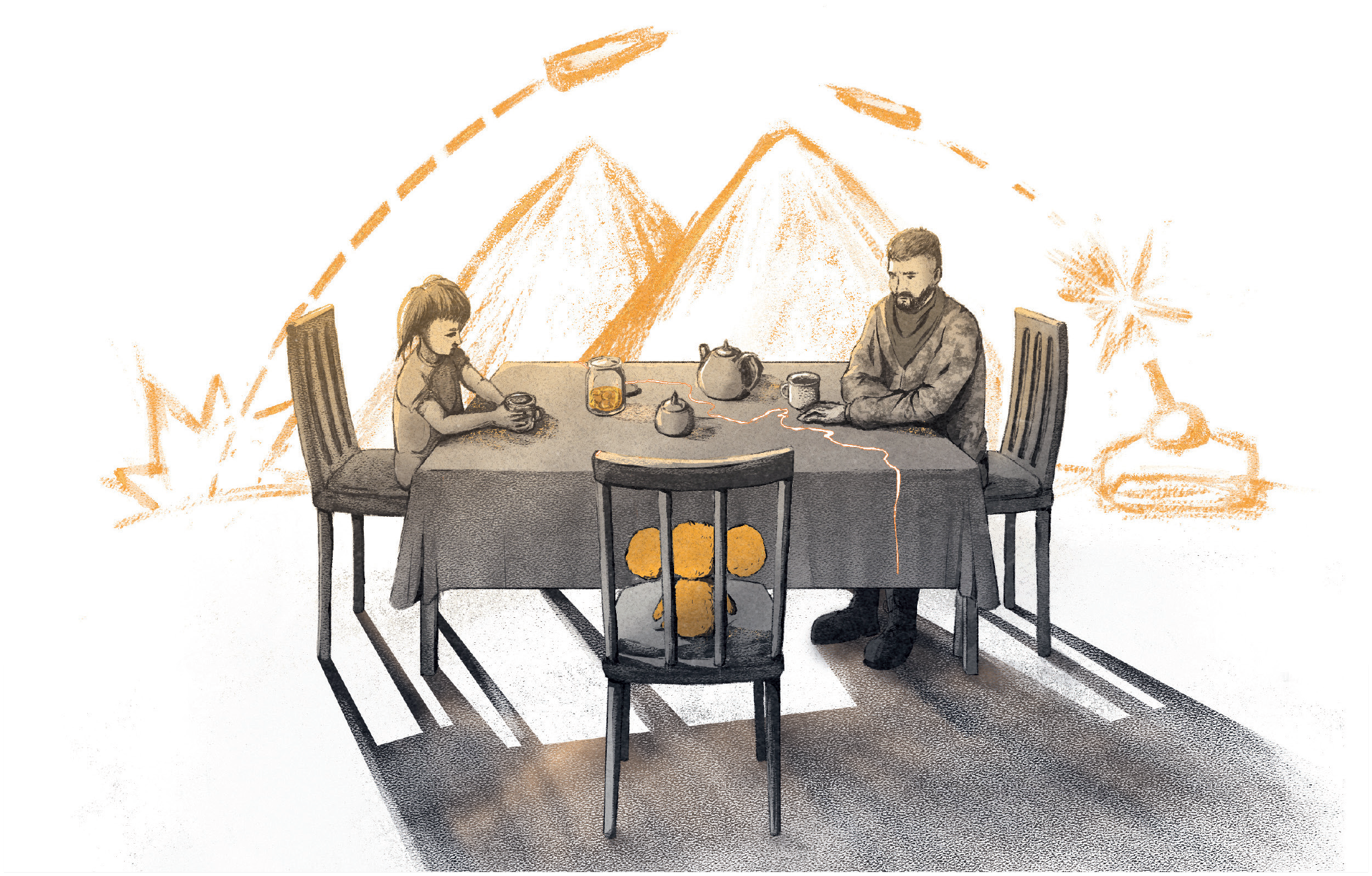
How has this happened? You woke up at dawn, put a party dress on, unearthed your favourite toy, the one with the big ears, which your grandma confiscated for disobedience, took out a rotund jar of apricot jam, brilliant amber like the beads also found in the drawer, along with your father’s photo. Your father had to have tea with you and Vukhatyi, Big Ears, eating jam with a big spoon, that only you would eat now, but your dad would watch as if he was happy for you. What to do now? You rummage in the closet and that aperture, slender and bright, shows everything, as was only seen before on TV, that is terrifying: everything that grandmother, old war movies and blokes from the televisions warned you about.
You heard how the floorboard creaked. Creaked quietly, and quietly and odiously just once. But memory suddenly dumped everything on you. Everything that you remembered even though it had not happened to you: all that you had seen on the television, that those blokes had seen with their own eyes, everything that Grandma had heard on the market and from the neighbours. And how you crawled into the closet and banged your knee, which now hurts in the darkness and probably, oh such rotten rotten luck, will stain your clothes red (and fly from Grandma), how you hid behind an old fur coat, which you were afraid of because it was from some scary fanged beast. The girl had forgotten the creature’s name.
And now she breathes heavily, and the fur of this nameless creature hides her from the war, as people now use blankets to hide from the shelling. And the war is here now, in the room. With the features of a fascist occupier, with the arm patches of evil on its dirty uniform. And how much Nadia hates now! And how much it now transpires that you can hate. You are able to hate and want to hate. The tears come and the damp makes that coat smell of the scary creature. And such sorrow for herself she has, this little one guilty of nothing and so pretty in a party dress.
* * *
The Commander was utterly destroyed, in burned clothes, but somehow intact. He fell through the entrance into the house that, from a distance, resembled his grandmother Nastya’s home. However, his grandmother remained back there, further to the North, merging into the earth that she loved so much after she died twenty years ago. That soil, strewn with pine needles, had pleasantly prickled her grandson’s heels, but this soil here burns under his feet. The house is similar to Grandmother’s house but also foreign, the soil is like his native soil but unforested, broken with slag-heaps which like pyramids draw their dead to themselves. The pillows in the house are, as they should be, stacked and covered with a translucent snow-white mesh, the television opposite the oven is a cathode-ray tube one, the Electrode brand. There are red carpets on the wooden floor as in a mausoleum. There is no icon in the corner. He thought about that and came round. One. Two, three… he forgot how many there were. The first, the second one… The first was Kolya, a lad with an invisible moustache, he kept growing it, but his efforts were pointless. His bristles, light as his skin, remained imperceptible when he fell on his back. And then they all understood (or was it only he, the Commander, who understood it all?): the enemy had seen them. Don’t go out. Don’t slither away. Do not become part of yet another necessary marvel that would be created for them with the times of this ungodly war. The first, the second, that was Sasha, whose call sign was…
“Lord!”
The Commander who had remained whole fell and crawled on his knees across those boards fashioned from distant pines, to that corner where the Madonna and child would hang in another house.
* * *
Through that slit, thin as the line of last light before the darkness, wiping with her sleeve tears, snot, hairs of that beast with its name forgotten, like entrails, that girl whose grandmother went to collect her pitiful pennies pension and never returned saw a horrific thing. Someone blackened with death was wandering around her room. A brute. He peered, listened, sniffed, although he resembled a dog, a werewolf. It was a miracle that he did not hear the girl’s rasped breath, while he turned his huge bestial head silently and ran his dirty hands along the white walls. Then he stiffened suddenly and grimaced, as if a tooth ached; perhaps even a brute was afraid of the huge spider in the corner of the room. He fell to his knees, sobbed and howled as a wolf howls at the moon, at the spider webs on the ceiling. He stayed on his knees for a long time, as if he too were punishing himself where Nadia would be forced by her grandmother to kneel on dried peas for the slightest transgression.
But then - had he even heard her? - he looked at the closet. As if he saw Nadia and her jam through that gap. He stiffened and looked with his stupid eyes and Nadia understood completely now; this was the end. Then the brute rushed, covering the distance between them in a second, she closed her eyes and screamed, thought that she was screaming, and the silence rang in her ears and the blows thudded dully like a giant heart pounding in a place of utter silence. The closet shuddered because the pine boards on which the tiny victim lay ran through the whole room.
Bang! Bang! The killer delivered the blows raising his hand high and mumbling bestially. As if he wanted to kill all that lived in the whole world. And not just the little doll with the big ears and soft belly that he was smacking.
The killer stopped. He looked around as if seeing the room for the first time. He wept. Wept long and bitterly rubbing the black grime from his face with his sleeve. Then he began rummaging through Grandmother’s closets. There was a clink as a transparent bottle was sat on the table. Nadia thought he would kill her, only drink his fill and kill her, that happened a lot in their village even without the war.
CREDIT: (all images) Maksym Filipenko

But that moment passed. The brute drank and roared and calmed and became human. Finally he laid down on his side next to the maimed animal toy as if to meet the gaze of those plastic eyes and just fell asleep. He slept for a long time. Darkness was falling and the gap through which she viewed the room disappeared into the murk, taking the war with it. The girl lay down on her grandmother’s cardigans, wrapped herself in them and, exhausted, fell asleep. She dreamed of lovely cartoons whose colours slowly faded until they became black and white, similar to Soviet cinema where undefeated people filmed in black and white perish one after another. And the sun was fading all this time and then out of nowhere it reappeared in the same place as yesterday, opposite that narrow gap between the doors of the closet.
During the day the brute drank and wept. Wept and drank. He switched on the TV, people spoke the truth. The girl knew this because the brute knocked the TV off its stand. The unprotected screen cracked and Nadia, even if she lived, would not see her big-eared friend again, even in a cartoon. And moreover the brute had eaten all the jam. Except for the last jar which remained in the palms of her hands. Tightly screwed shut.

And more than jam, even, she wanted something to drink and finally to emerge from the smelly sticky rags. Sweat coursed down her cheeks and Nadia smeared her fingers through it, licking her own sweat salty palms as if they were ice cream. And the sun slid its beam on the floor as if it too wanted to lick the deep wounds of her toy Cheburashka.
The killer squinted. He had neither drunk nor wept today. Maybe the bottle he drank yesterday was the last. And in a moment Nadia stopped being afraid, perhaps her thirst became greater than her fear. She wanted to cry but the tears would not come and then she too howled like a werewolf, albeit a small mouse-sized one.
* * *
“Who are you? Where are you from?”
The last light struck Nadia’s face as she whispered “I am Nadia” and then added, for some reason, “from Novorossiia”.
But of course that was not exactly what he wanted to ask, he only wanted to know where she had come from before she was in the wardrobe and Nadia wanted to die as a hero and not even a heroine. Like those brave blokes would have done on the TV. Nadia knew what she was going to do, and it was all about that big-eared doll with the white hole in its toy belly.
So the girl didn’t flee, she was ready to lay her head with its two completely messed up pigtails on the chopping block. The brute stroked her dishevelled parting for a long while. He said something that was recognisable as language and raised a mug of water to his lips. Then, anxious that he had eaten all the foodstuffs in the house he began rifling through numerous drawers.
“I still have a jar of jam. Over there in the closet.”
* * *
He pulled the table up to the window, brushing the crumbs from it with his sleeve, found the last of the teabags, finally washed the remaining grime from hands blackened with death and washed his face.
They drank tea in silence. The brute did not eat anything. He just watched how the girl ravenously scooped up the jam in a large spoon as if he were happy for her. She suddenly pushed the jar away as if she did not want to eat at the same table as him and didn’t even want any more jam.
He was silent waiting for her to respond for a while, perhaps by screams, hysterics, running away. But the girl asked quietly: “Why do you hate Earie so much?”
Something cracked in the Commander as the TV screen had cracked earlier, breaking him in half.
“I really love him very much.”
“Why did you then…?” the girl asks looking into his eyes.
This is how it will be at the Last Judgment. Just like this, the Commander thinks. Adults will be judged by children: why did you kill my Cheburashka?
The Commander was silent for a moment. How can he explain it? The past, that is yours. You are that past. You can never explain yourself. Your memories, of childhood with the flavour of barberry candies, a cartoon where a Cheburashka learns to march in formation, following behind the pioneers, the pioneers such as you. A childhood steeped with belief. They say that a generation had to pass. The Commander really longed to have passed already. But someone had given the girl, Nadia, a virus. Along with that little creature with the big ears…
“I love him and everything that brings us all… “ He counted them again, the first was Kolya, the second Sasha, the third… it was possible to return to the past.
He says something more about the USSR, the way Soviet people were brought up, and the old propaganda of that belief and that war. The girl looks at him as if she were not breathing, as if she also had plastic eyes. She will probably not understand, say or ask anything. She only knows of the Soviet Union from that lamp monstrosity, whose fragments he had thrown out of the garden. But you cannot throw yourself out of the garden.
“All this because of Cheburashka?” the girl asks.
The enamelled mug clinks on the table and the sound of a train comes from somewhere else. They look into each other’s eyes, an adult from the USSR who believes that he lives in Ukraine and a girl from Ukraine who believes that she lives in Novorossiia.
“Because,” it was hard for him to say, “not because of Cheburashka. It’s all because of me. Generally everything is because of me.”
* * *
They didn’t talk about Cheburashka any more. The man began sorting things in the house while grumbling: “What kind of a grandmother do you have, she hasn’t even hung up the net curtain.” Then he waved his hand and they drank tea, by the bare window with a view over the field and those paternal slag-heaps. They patched up the Cheburashka’s cotton belly and sewed the ears back on but its smile had become a little crooked. The Commander was a poor hand at sewing and Nadia was too little to sew properly. Then he said, quietly and uncertainly, that after the war he would buy a new television for them. And he thought how naming a child Nadia, or Hope, was the same as not naming them at all because all children embody some hope.
But then he will probably also name his daughter Nadia sooner or later.
“I will soon be leaving.”
“Where will you go?”
“An officer who has been surrounded must get back to his own side.”
It was as if he was repeating something learned from a textbook. But he stopped himself.
“However, I can’t get back to our side here. And if it is not possible to make it back to your own side, it is necessary simply to… ”
“To what?”
“To continue fighting.”
“But if you go I will be alone.”
The Commander is silent, turning his case to the bare window which lacks a net curtain.
“Maybe you could just not go anywhere?”
* * *
They sat and drank tea by the window: the still relatively young Commander without a platoon, the bright girl from a non-existent country, and that strange creature with its scars, the nameless one. Because if it is the case that you do not know your own name, they would give you the most absurd one from all the possible names… is that really better than the total absence of a name?
They both watched as the sun sank behind the slag-heaps and sipped tea from enamel mugs with chipped rims and talked about some vacant topic. The Commander smiled. Shells flew above the little building that resembled his grandmother Nastya’s house. Noiselessly as birds, not impacting anyone. So the Commander, the girl and the Cheburashka are already able to believe that things had to be this way. And would always be so.
Perhaps, the Commander thought, the shells would pass him and Nadia by because they are, quite simply, no longer in this world.
The girl wonders if, perhaps, they should never have been here.
Perhaps, the Cheburashka thinks, it will occur to these two one day to put yet another, third mug on the table, but the doll, like the people, is silent. Most importantly the troops had stopped shooting around them for now and maybe it was better that everyone thought the Cheburashka was dead.
Somewhere, in the real world, the sun rises at last.