




Abstract

A theatre company based in the Jenin refugee camp operates under the most testing circumstances and since the Israel-Gaza escalation their fight for freedom of all kinds has never been more vital.
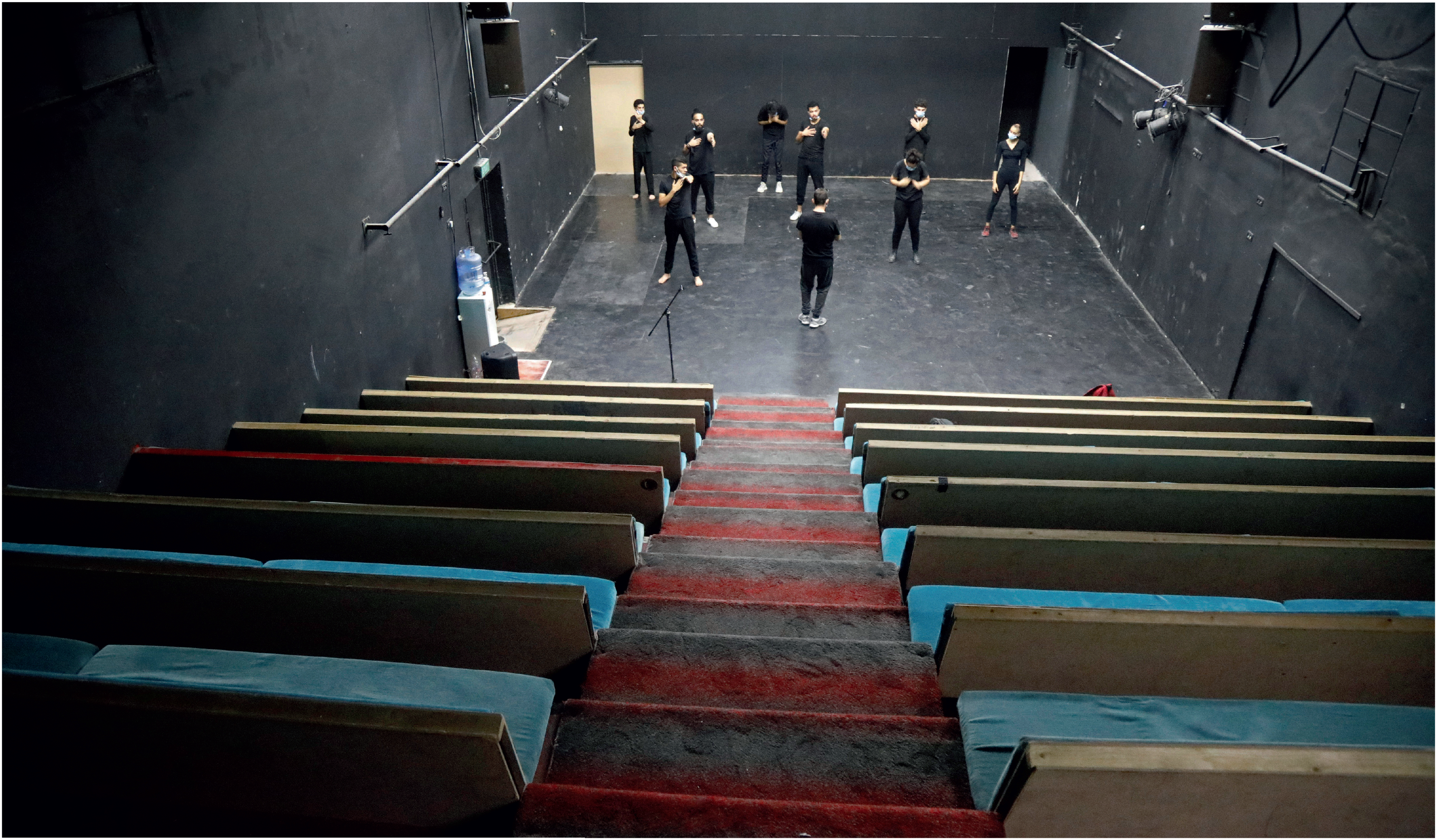
PICTURED: A rehearsal at the Freedom Theatre in Jenin, in the West Bank, July 2020
CREDIT: Raneen Sawafta/Reuters
As the full extent of what had happened became clear, the head of the acting school Yasmin Sameer thought, “Ok, maybe we are in a war.” She went back to be with her family in Jerusalem. Sameer was right. The Hamas attack on Israel, the retaliatory air strikes on Gaza and subsequent ground invasion by the Israeli army were the latest events in a long 75 year history of occupation and resistance, and there would be a knock-on effect on the West Bank.
While the eyes of the world were further south, the West Bank was locked down, roads closed and movement restricted. Incursions by Israeli forces were launched into cities. Rehearsals, and indeed the tour which should have started a few weeks later, never came.
“It was way too much to think about anything else,” Sameer remembers about the following weeks, when theatre staff and students were separated. They struggled to communicate. After a few weeks, Sameer made the decision to start running Zoom classes for her students.
“Some days we had to stop because of an invasion of a certain city,” Sameer told Index. “It is hard to make art in the midst of all of this. Especially theatre. Theatre is such a physical thing that you really miss a lot when you do it in another way. And when you are in the middle of the trauma […] it’s hard for you to articulate what you’re feeling.”
The Freedom Theatre prides itself on its courageous output, with a mission of cultural resistance. In February 2024, the theatre was nominated for a Nobel Peace Prize.
Sameer said: “We believe that if you want to be free, you need your society also to be free. To tackle more sensitive stuff, to talk about it more freely: women’s rights to decide, freedom of speech to say what you believe freely without having to worry about it. And we are also a conservative community, so we have also these challenges.”
Sameer explains that they believe in resisting every kind of oppression: “That’s why we talk a lot about feminism, that’s why we talk about freedom of speech, that’s why we talk about the freedom of Palestine, which is the main thing.”
After weeks of online classes following the outbreak of war, Sameer and her students felt they needed to be back in the theatre. “When they invade… we will stop,” they decided.
It wasn’t long before that happened. Sameer was at her home in Jerusalem on 13 December 2023 when Jenin was raided by Israeli forces.
“They were in the theatre, destroying and sabotaging things,” Sameer said. “Jenin and the refugee camp is often invaded and often there is destruction, but that particular day was really, really hard.”
A message came in from a colleague: Mustafa Sheta, the theatre’s general manager, had been arrested from his apartment in Jenin City. Only an hour or so later, Sameer remembers, artistic director Ahmed Tobasi was also arrested, followed shortly by Freedom Theatre graduate and acting trainer Jamal Abu Joas.
Arts and human rights organisations around the world, including Index, Pen International and London’s Royal Court Theatre, called for their release. Tobasi and Abu Joas were released later in the week, but Sheta has reportedly been sentenced to six months in administrative detention, imprisoned without charge. Sameer said they have no contact with him.
After the raid, some students from Jenin went to assess the damage and clean up what they could. The checkpoint was closed, which meant Sameer couldn’t get across to Jenin. “It was a complete mess,” Sameer said. Props and computers were destroyed. At the entrance, the poster for their latest feminist theatre production had been graffitied with a Star of David, as had the white screen in the cinema room.
“It was a very heavy day, to put it lightly,” Sameer said. “We started to think what we can do? We quickly realised that our students also need to speak out.”
The theatre students, aged between 19 and 25, have been impacted greatly by the arrests. Sameer went back and forth with associate artistic director Zoe Lafferty, and they struck on the idea of starting a series of written testimony. The project is called Youth Against Invasion. Sameer and Lafferty asked the students to write a short piece of text each, then they worked collaboratively on edits. “It’s part of how to narrate your own story in your own words.”
The stories do not shy away from how the young actors have been impacted by occupation, war and the raid on Jenin. Some of the reading is uncomfortable. For the Freedom Theatre it is part of their cultural resistance: the pieces have been published on social media and read at protests. Two of the pieces are printed below. In the long term, they might become artefacts that reflect the mood and experiences of young artists in Palestine who are so often denied a voice.
Jenin is a place often considered the capital of Palestinian resistance and militancy, and the company is no stranger to conflict. The theatre was officially formed in 2006 by Palestinian-Israeli actor Juliano Mer-Khamis, Swedish activist Jonatan Stanczak and former al Aqsa Martyrs’ Brigades leader Zakaria Zubeidi. The story starts slightly before however, when Mer-Khamis’ Israeli mother, the human rights activist Arna Mer-Khamis formed The Stone Theatre in 1987 with a vision to work with Palestinians to end the Israeli occupation — a vision the Freedom Theatre has upheld. The Stone Theatre was bulldozed in 2002 by Israeli forces. Juliano Mer-Khamis’ documentary Arna’s Children tells his mother’s story.
Famously, Mer-Khamis told the world: “The third intifada will be a cultural one”. In 2011, he was shot dead outside the theatre. The killer was never identified.
As for Zubeidi, he has been held in an Israeli prison since 2019.
“Sometimes we have limitations of course,” Sameer began, but when asked for an example of limitations on the company’s freedom she paused. “Now you’re asking and I’m thinking, ‘We talked about that. we talked about everything basically.’ But the thing is, you can’t go to the next level of talking about it.”
One limitation might be nudity on stage, but Sameer said that’s not something they want to do anyway. Instead, they’ll find a different way of performing a scene that doesn’t put anyone in danger.
I recall what Ahmad Tobasi said, quoting Juliano Mer-Khamis, “The theatre is my AK47”.
With all this internal struggle and feelings of revenge, a sense of strength emerges, the strength of the theatre.
Suddenly, an armed Israeli force storms right next to my house, arresting a group of young men and women, my neighbours.
As I look out the window, a mix of emotions floods over me. Looking at my family, I feel fear. Looking at the soldiers, I feel strength and the will to resist. A Zionist commander calls to me, issuing a threat, “You’re causing a lot of trouble. Watch out for yourself.”
Meanwhile, amidst the gunfire, the local news network composed of mothers reports: “The Freedom Theatre has been raided, its property completely destroyed.”
I remember one of the plays that required an actor to portray an Israeli soldier… Now, the real soldier is in the theatre, and the actor, Jamal Abu Joas, is imprisoned.
The occupying forces are trying to suppress all cultural and historical landmarks in Jenin, raiding theatres and demolishing our important landmarks.
I call upon the entire world to take to the streets, wear Palestinian attire, and sing Palestinian songs.
I call on you, to express our culture worldwide.
“As a place that’s in the middle of Jenin refugee camp, we are part of the community, we are part of whatever is happening in the country, and we respect it,” she said, adding that they try to foster respect for ideas.
Outside their work at the theatre, varying degrees of censorship are felt acutely by the theatre’s staff and actors when speaking about the ongoing war.
“For each one of us coming from a different area, there’s different limitations,” Sameer explained. “For instance, me from Jerusalem, I have a different limitation in the freedom of speech and what I can say, and what is censored and what is not censored, than someone coming from Jenin, [or] than a Palestinian living in the Netherlands or wherever.”
Sameer added that censorship comes from the Israeli government, as well as places including the USA and EU.
“It is harder for us because we are living immediately under the occupation, because you could lose your job if you talk, because you support what they call terrorism,” she said, describing how any cultural resistance can be called terrorism because it is “expressing and exposing the amount of oppression, injustice and brutality”.
She told Index she has friends who were arrested for liking social media posts and others who have been beaten after checkpoint soldiers looked through their Instagram feeds. One, she said, was beaten by Israeli soldiers for not having Instagram on their phone at all, with the assumption they must have deleted the app to hide something.
Even before 7 October, running a theatre school in the West Bank was completely different from anywhere else. The simple act of travelling to class, through a checkpoint, starts with the thought: “Maybe I won’t arrive”. And unlike communities not under occupation, the topics they tackle at the Freedom Theatre are always about resistance. Sameer recalls her own time rehearsing a play at the Freedom Theatre several years ago.
“Every night there was an invasion. I remember some days I did not sleep for five minutes,” she said. The next morning, they would rehearse, before pausing to grieve, then coming back together to sit and vent. Rehearsals would continue. “Is that normal? I’m completely sure that’s not normal. Does that happen elsewhere?”
It was an exhausting way to live and work, but she said: “That gives you the whole energy of continuing. That’s why we do this. And that’s why we shouldn’t stop. Because they want us to stop.”
Destruction surrounds the theatre now, which makes accessing it difficult. But the stage is filled with activity and students occupy the space.
“We still go there, we still do classes there, we still meet there,” Sameer said. “Because we think it’s important to stay, and to be there. And to continue no matter what happens.”
In light of the war, as a Palestinian with Israeli citizenship, I cannot do anything. Anyone calling for its end is accused of supporting terrorism. If I post on social media, I will be arrested. If I march in protest, I will be arrested. If I go to pray, I will be assaulted or arrested…
So I have become just a viewer, watching the news and images of the annihilation of my people. As the lives of children, women and the elderly are taken, I have become ashamed and disgraced as a human being - feelings that come before being a Palestinian.
The Israeli occupation has annihilated an entire people. Not only shedding blood, but wiping out thought, laughter, safety and freedom. I cannot express my overwhelming anger, and the only reaction I am allowed is silence. As I watch the desecration and violation of holy places, I remain silent to the point I feel ashamed before God our Creator.
As a Muslim from 48, I have become afraid of publishing Qur’anic verses calling for love and humanity and praying for our innocent martyrs. Even if I go to Al-Aqsa Mosque, there is a checkpoint with occupation forces at the gates.
When I decided to become an actor I was interested in history, culture, politics… But inside 48, I do not feel patriotism or belonging to Palestine. How can I express myself when our freedom has so many limits? When I cannot use my Arabic language first?
So I choose The Freedom Theatre in Jenin Refugee Camp, and to live the life of a Palestinian who directly faces the violence of the occupation forces. An oppression that is not hidden. Where we are not divided. A pure real Palestinian feeling.
Because of The Freedom Theatre, I saw the apartheid wall for the first time and experienced the checkpoints… I saw the life and alleyways of Jenin Camp… The tired walls riddled with bullets. I saw with my naked eyes everything the Israeli army does with all brutality and barbarism. And it increased my belonging.
The repeated aggression on The Freedom Theatre aims to disrupt art and entertainment… To erase our culture and take away a safe space for our skills and dreams. I always feel anxious and afraid. But despite this, we will continue to nurture ourselves so that we can flourish in the gardens.
Our civilisation.
Oh world, do not extinguish the sunlight from our flowers… let them grow and grow.
This piece, alongside the one on p.107, were written by students with Freedom Theatre and Artists on the Frontline, republished here with permission