




Abstract

While it might seem contrary to concentrate on the arts when your country is facing economic collapse, there are skirmishes on its borders and the political class is locked in stalemate, Kassem Istanbouli, the leader and founder of the Tiro Association for Arts (TAA), believes it is a “public duty”.
“The main thing is that art is for everyone, meaning that theatre and cinema are for the people,” Istanbouli, a former director and actor, told Index. “We want people to get used to theatre and cinema, and to know them well.”
The NGO operates across cities, villages and towns all over Lebanon. The transformed cinema halls allow locals not only to enjoy film and theatre but also engage in workshops and community events that foster a sense of collective identity.
The events include music, arts and crafts, contemporary dance, photography lessons and hakawati (the ancient Arab tradition of storytelling).
Since 2014, under Istanbouli’s guidance, the TAA has evolved from a cultural initiative into an essential resource for Lebanon’s underserved communities.
“One of our key goals is to decentralise culture from Beirut, spreading it to places that are typically underserved... It’s not easy to do this in Lebanon,” he said.
Culture amid war
In southern Lebanon, the ongoing war in Gaza has exacerbated the already dire economic and humanitarian situation, with daily exchanges of fire between Hezbollah and the Israeli military.
Many residents, especially those in farming communities, have suffered enormous losses amid the fighting, leading to a massive displacement as more than 90,000 families have been forced from their homes - many of them losing their sources of income.
In Tyre and Nabatieh, where scores of displaced people have recently relocated, the TAA has sparked a small but significant cultural revival and offered children a creative outlet.
In this context, Istanbouli believes “theatre and cinema are an act of endurance, an act of will, and a way to honour the people and their resilience”.
“We do what we do for those who have lost their homes through no fault of their own, and for the children who’ve done no wrong,” he said. “The war has destroyed their livelihoods. It is our obligation to do this very small thing to help them.”
In Tyre, the revival is significant. Before being closed for 30 years, the city’s cinemas were gathering places for leftists and artists such as the Palestinian poet Mahmoud Darwish and the Lebanese composer Marcel Khalife.
Movies were brought to the city by sea from Greece and Palestine, and they were screened to packed audiences who came not just for entertainment but for a sense of intellectual exchange.
Kassem Istanbouli, the leader and founder of the Tiro Association for Arts, believes theatre and cinema are acts of endurance
CREDIT: AP Photo/Bilal Hussein via Alamy
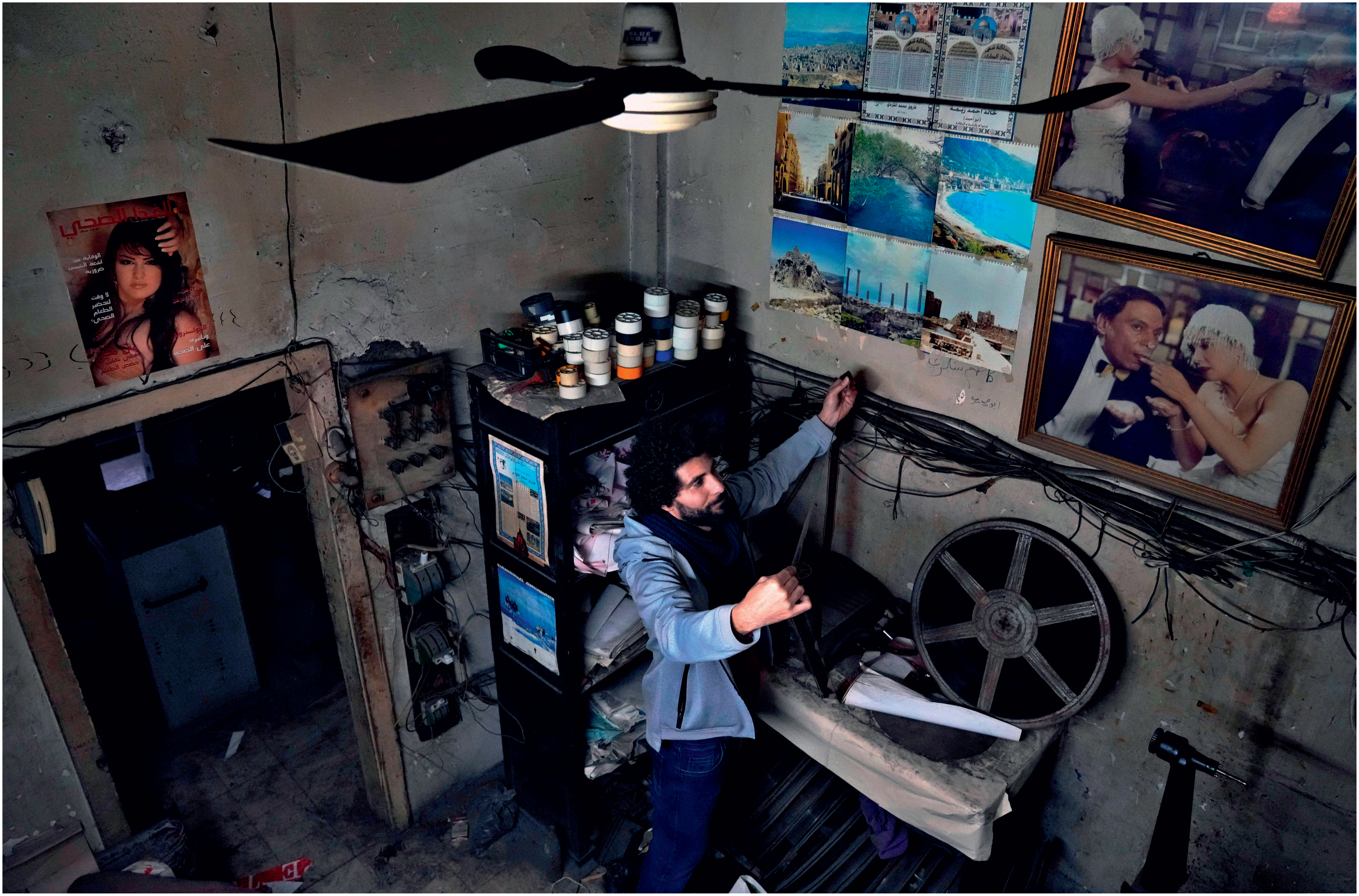
By reopening these spaces to the public free of charge, the association is both resurrecting this cultural heritage and creating new avenues for dialogue and free expression.
’Peace arts bus’
As part of its outreach, the TAA also operates a “peace arts bus” that serves displaced Lebanese people, as well as Syrian and Palestinian refugees. The initiative transports children from schools to theatres and enables them to take part in handicrafts and painting, fostering integration into the broader Lebanese community. The bus, decorated with images of Lebanese artists, sets off from Tyre and travels around villages in southern districts to perform free mobile shows and has brought joy and a semblance of normality to children whose lives have been disrupted by displacement and war, Istanbouli said.
The association works with people with disabilities and special needs and has screened films for the deaf and the blind. It offers a programme for women and girls promoting “social-economic empowerment and recovery”.
“We really enjoy the theatre; it helps us forget the war,” says Batoul, one woman who takes part.
Expanding reach
Years before launching the TAA, 37-year-old Istanbouli, who studied theatre at the Lebanese University, founded the Istanbouli Theatre alongside colleagues and friends with the vision of bringing street theatre “directly to the people”.
The project later evolved into the Tiro Association, named after the Spanish word for Tyre. Today, the TAA operates four cinemas across Lebanon in Tyre, Nabatieh, Tripoli and Beirut, with plans to renovate another.
Initially, the nonprofit was heavily reliant on membership, donations and the contributions of volunteers without any formal employees. As it gained recognition and won awards, it attracted a broader support base. Cultural institutions and donor organisations became partners including Unifil and Unesco.
Today, the group - which has more than 300 members - thrives with the help of volunteers, particularly the youth who believe in the project which, according to Istanbouli, wouldn’t exist without them.
Istanbouli said that the association had not experienced censorship, despite it being an ongoing issue in Lebanon. To remain apolitical, it has avoided accepting donations from politicians.
“Being free and independent is something we have maintained since the beginning of our initiative,” the TAA says in its brochure.
A beggar sits at the entrance of the abandoned Empire Cinema in Tripoli, Lebanon. It has since been restored by Kassem Istanbouli as a theatre
CREDIT: AP Photo/Bilal Hussein via Alamy

It has further broadened its scope by co-operating with global cultural centres and associations from countries including Brazil, India and Spain. A recent initiative, the Sudanese Film Week, drew attention to the migrant worker community.
Overcoming challenges
In some ways, it is setbacks which have spurred the TAA into action. Amid and after a 2019 uprising spurred by the economic crisis, its volunteers, undeterred by the lack of electricity, took their activities into public spaces.
“We performed plays where we were telling people to not accept the status quo, to not accept what we see today, to not accept inflation, to tell them we have a role to play,” Istanbouli explained. “The theatre was inciting them to think, ‘We shouldn’t accept this’.
“We were saying art is against oppression, against corruption. It was cinema against the state.
“Theatre and cinema today play an even more important role in times of crisis - it’s not only during good times that they’re important. Theatre and cinema seek to provoke, to raise awareness, to shift societal views, to bring people together, to reflect what we live today. If we’re living in a crisis, they will reflect the crisis; if we live in a war, they will heal the wounds of people. No matter what we’re enduring, we want to reflect these realities in cinema, in theatre and in music.”
As an artist, Istanbouli says his greatest ambition has been realised through the TAA. He has been able to foster cultural continuity and to leverage the arts to engage and unify communities across his country, centring on his hometown of Tyre.
“We are walking our own path. It is a path that resembles us and that resembles the people,” he said. “Any city that’s without a theatre or a cinema is a dead city. A city that has theatre and cinema in it has people within it who want to live, and who have something profound to offer society.”