




Abstract

The emphasis on sexual activities and the sexual parts of a person shows the act’s aim is to police sexuality and its representation, with attention to sartorial and artistic acts that are considered erotic or whose intention is perceived as erotic arousal. It is not surprising therefore that the act’s victims so far are mostly women who were considered indecently dressed or too erotic for the public eye. Indeed, shortly after the act became law in 2014, two women - Jane Nabukenya and Prossy Nassuna - were detained for three hours each by Catherine Baguma, the Bukomansimbi District Grade One Magistrate, who found them in contempt of court for dressing indecently. In the same year, Jemimah Kansiime, also known as Panadol wa Basajja (men’s painkiller), was charged under the act for promoting pornography in her song Nkulinze (Luganda for: I am Waiting for You). Its video shows her fondling her breasts as she dances erotically in anticipation of her lover whom she invites for a shower. She denied the charges, but the producer of the song, March Didi Muchwa Mugisha, who was co-charged with her, pleaded guilty.
In July 2019, one of Uganda’s top musicians, Winnie Nakanwagi alias Winnie Nwagi, was reported by Ugandan media to have apologised to the Pornography Control Committee for a show she had held at St Mary’s College, Kisubi, a boys-only school in Entebbe, Uganda. Uganda Radio Network reported her apology as reading thus, in part: “I, Nakanwagi Winnie aka Winnie Nwagi of Swangz Avenue, do hereby acknowledge that my representation through indecent and erotic dancing during the music show held on 13 July 2019 at St. Mary’s Kisubi was pornographic and contravened the provisions of the Anti-Pornography Act, 2014.”
The act came into force in 2014, when Ugandan President, General Yoweri Kaguta Museveni, signed it into law. Shortly after, five organisations (led by the Centre for Domestic Violence Prevention) and four individuals petitioned the Uganda Constitutional Court to declare it null and void because several of its sections contravene the provisions of the 1995 Constitution of Uganda. Indeed, on 13 August 2021, the petition succeeded in part as the panel of judges, led by Justice Frederick Engonda-Ntende, declared five sections null and void for being inconsistent with the constitution.
The petitioners argued that the definition of pornography as provided in section two of the act was bound to lead to infringement on citizens’ rights as it was too sweeping and imprecise. In the words of Justice Engola Ntende, it “is too general and unacceptable as it may capture a range of conduct that is too wide and not intended to be subject to the offence”. The court also found the powers granted to the Pornography Control Committee and the courts were unconstitutional. As Justice Ntende put it bluntly, “the activities of the Pornography Control Committee and the courts in relation to sections 12 and 15 of the Anti-Pornography Act equally [do] not pass constitutional muster.”
Given that the entire act depended on the definition of pornography and the functions of the committee and of the courts of law, it goes without saying that what is left is just a shell. However, Charles Dalton Opwonya, who represents the Uganda Law Society on the committee, does not agree with this view. He argues that the judgement did not affect the committee’s work. In fact, the day Index talked to him in May 2024, he was in the northern Uganda City of Gulu where he had been participating in the committee’s work of sensitising the community about the Anti-Pornography Act. When Index asked him if the committee was not in contempt of the Constitutional Court that had declared its work unconstitutional, he argued that this was not the case as the court had not taken away the committee’s power to teach the nation about the evil effects of pornography. When Index told him it appeared that the committee was concerned more with morality than legality, he argued that British common law, on which Uganda’s penal code is based, is grounded in the Bible’s Ten Commandments.
Ugandan musician turned politician Bobi Wine addresses a crowd in Hoima, Uganda
CREDIT: Sally Hayden/SOPA Images/ZUMA Wire via Alamy
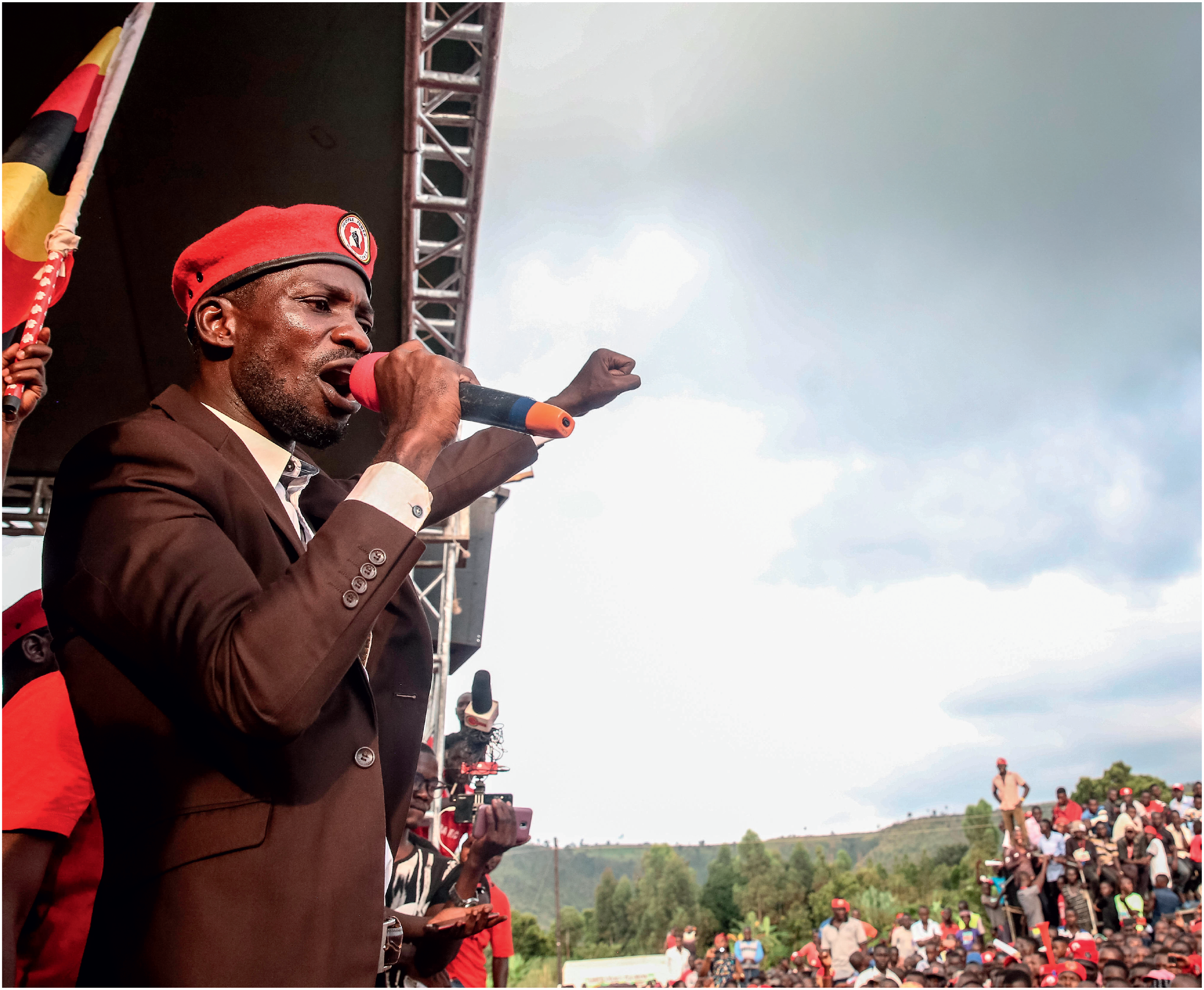
While defending public morality and decency are the main aims of the act, according to Oponya, there is fear that the act could be weaponised to stifle dissent as with the Computer Misuse Act (2011). At least two writers - Stella Nyanzi and Kakwenza Rukirabashaija - were arraigned in courts of law under this act (the Computer Misuse Act) for allegedly offending and cyber-harassing President Museveni. Nyanzi even got convicted for the latter offence although a higher court exonerated her after she had served more than a year of her sentence. Given the increasing role that artists are playing in Ugandan politics, there is the possibility that the government could use the act against the opposition - the leader of the biggest opposition party, the National Unity Platform, is Robert Ssentamu Kyagulanyi, also known as the singer and actor Bobi Wine.
It is significant that in Index’s interview with Opwonya, he kept mistaking the Anti-Pornography Act with the Computer Misuse Act (2011) and the Anti-Homosexuality Act (2023). This underlines the fact that these acts are similar in intention - to unleash a legal regime meant to benefit the ruling party. To appreciate this point, we need to look at what happened in 2006, when President Museveni tried to use the courts to frustrate retired Colonel Kizza Besigye Kifefe’s candidacy in the presidential elections by bringing a rape case against him. It turned out that Kifefe had never met the woman the prosecution alleged he had raped. In his ruling in this case, the presiding judge of the High Court, Justice John Bosco Katutsi, could not help but lambast the state for abusing the courts for political gain. In their article entitled Personalisation of Power Under the Museveni Regime in Uganda, Gerald Bareebe and Kristof Titeca cite part of Justice Katusi’s judgment: “The evidence before this court is inadequate to even prove a debt, impotent to deprive of a civil right, ridiculous for convicting of the pettiest offence - scandalous if brought forward to support a charge of any grave character - monstrous if to ruin the honour of a man who offered himself as a candidate for the highest office of this country.”
Further still, the fear that Museveni could weaponise the Anti-Pornography Act lies in the fact that its enforcement largely depends on the relevant minister, in this case the Minister of State for Ethics and Integrity, who is appointed by the President of the Republic of Uganda. It follows that the minister can use the act to go after people who are considered enemies (read: critics) of the sitting president, as has been the case with the Computer Misuse Act (2011).
Uganda finds itself in a tricky situation where advocates for freedom of speech, like Jemimah Kansiime’s lawyer, Isaac Ssemakadde, believe that the Anti-Pornography Act is unworkable. The members of the Pornography Control Committee, on the other hand, believe that since the Constitutional Court did not declare the entire act null and void, they still have a role to play in fighting pornography. It is this unclear situation which is the ghostly existence of the act. True, Jemimah Kansiime is not in prison because the act under which she was charged is moribund, but she is not free either since the state prosecutors have not withdrawn her case. At any time, the skeleton that still walks and breathes called the Anti-Pornography Act could pull her into the cold cells of prison until her lawyer manages to get her out.