




Abstract

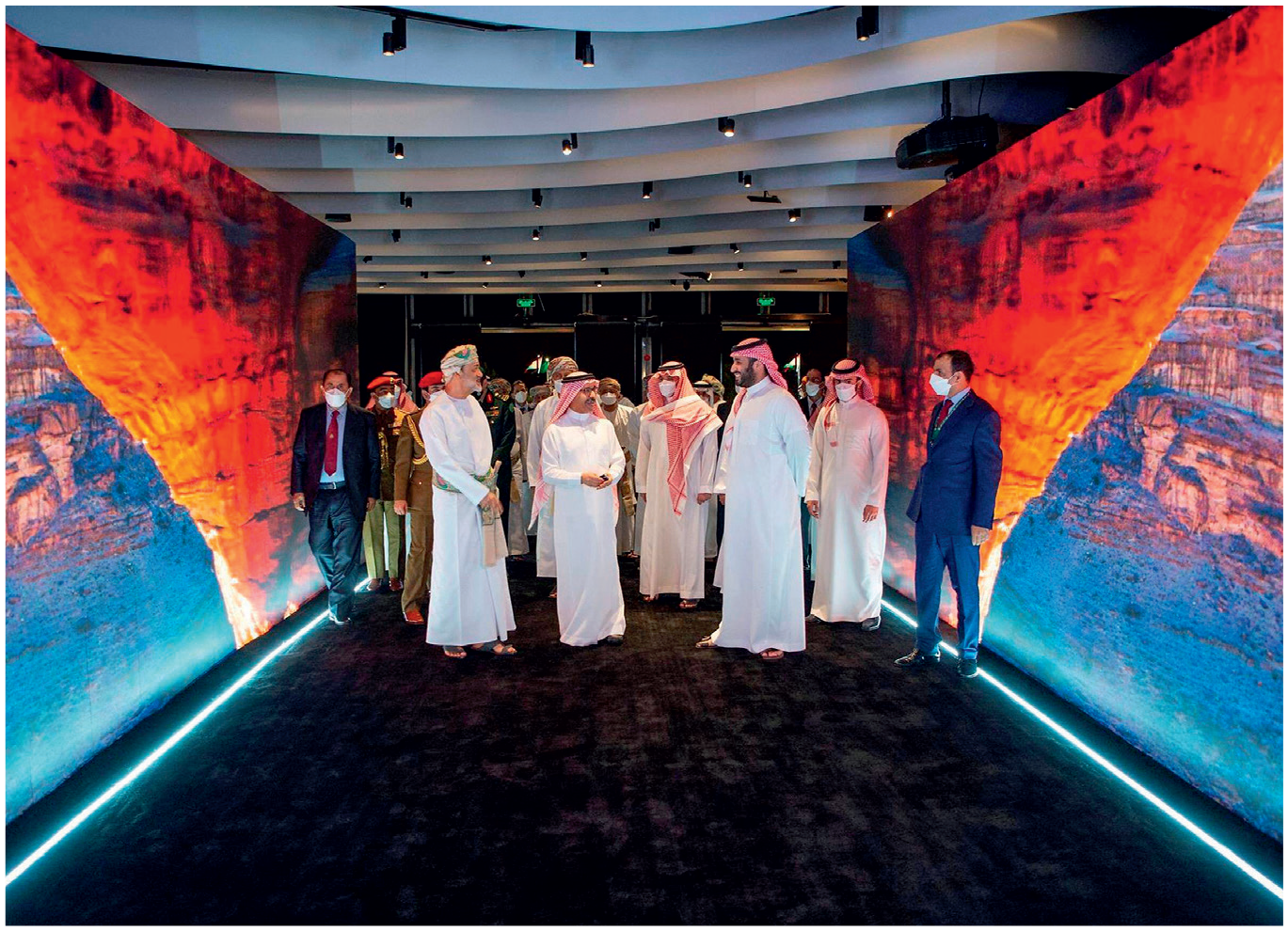
Saudi Crown Prince Mohammed bin Salman tours the Neom Centre for Knowledge Enrichment
CREDIT: Abaca Press / Alamy
It was the first Saudi feature film to be shot entirely in Saudi Arabia, the first feature-length film made by a female Saudi director, and the first film Saudi Arabia submitted for an Academy Award consideration.
Alas, there was no Oscar. But the film had a lasting cultural impact.
Sarah Taibah was in her early 20s, studying for a master’s degree in fine art in San Francisco when she first watched it at the cinema.
“I cried,” the 35-year-old artist, actor, writer and filmmaker explained from her home in Jeddah.
Taibah had good reason to be emotional. Cinema was then still banned in the conservative kingdom. The ban begun during the 1980s, when conservative Islamists introduced it. The first film to be shown in public after it was lifted in 2018 was American superhero tale Black Panther.
The first Saudi film to be screened in public was Rollem (2019), which Taibah starred in.
At that stage, Saudis were making films on YouTube, she said. “We were the number one content makers for YouTube for many years and we made many films here before there was cinema.”
Taibah is a celebrity in Saudi Arabia and has appeared on the covers of Marie Claire Arabia and Vogue Arabia. Her rise to fame coincided with the success of dark comedy Jameel Jeddan (2022), broadcast on Shahid, the world’s leading Arabic streaming platform, facilitated by Saudi state broadcaster MBC.
The show set another cultural historical precedent - Taibah, its creator, became the first Saudi woman to write and star in her own TV show.
She is part of a new generation of Saudi filmmakers. Modern, suave and cosmopolitan, most earned their cultural credentials in the West.
There are limited freedoms in Saudi Arabia today, said Taibah - “especially when it comes to topics like sex”.
But subtlety can work to a filmmaker’s advantage, she said. “There are many ways to show intimacy on screen which allow space to imagine and respect the audience.”
Riyadh-based director Khalid Fahad agrees.
“People in Saudia Arabia don’t like to see sexual scenes [in movies], so when we talk about [censorship] it’s not about rules and regulations, or about the government, but about respecting the culture and the audience,” he said.
His films, including Valley Road (2022) and From the Ashes (2024), are currently available on Netflix. Fahad, who studied film in Canada, the UK and the USA, said the cinema ban in Saudi Arabia was often misunderstood.
“The ban was specific: watching film in public places,” he said. “It was not a ban on watching movies at home. There were shops in Saudi Arabia where you could rent DVDs and markets where you could buy them.”
Fahad claimed the Saudi authorities implemented the ban because there were not many films being made at the time and they were concerned that showing international movies in a communal public space that did not relate to Saudi culture or heritage “might change people’s religious beliefs”.
Today, the film industry in Saudi Arabia is booming, with accumulative box office revenues (mostly from Hollywood blockbusters) hitting almost $1billion since cinemas reopened.
Those figures are from an article published in March in British film magazine Screen Daily. It’s a sponsored feature piece, paid for by the Saudi Film Commission.
Set up in 2020 and affiliated with the Saudi Ministry of Culture, the commission is ambitious.
It believes the country will eventually have the capacity to compete with the Egyptian film industry, Bollywood and European cinema.
“This will take time,” said Fahad.
The country has only a small number of feature films made by Saudi directors but he said it was the top ranking country in the Middle East for cinema ticket sales.
And he mentioned the recent success of Norah, directed by Saudi filmmaker Tawfik Alzaidi which received a Special Mention from the jury at this year’s Cannes Film Festival.
“The Saudi Film Commission has been very supportive of Norah and contributed a lot of the budget for promoting the film at this year’s Cannes Film Festival,” said a spokesperson for TwentyOne Entertainment, a film acquisition and distribution company based in Riyadh.
It’s no secret that the commission has deep pockets and is more than willing to flash the cash for cultural projects.
At the moment it’s offering international filmmakers lucrative incentives to shoot films there - but getting US and British filmmakers to speak on the record about working in Saudi Arabia proves difficult.
One filmmaker, currently working on a film that was shot in Saudi Arabia did agree to an interview with Index. But they were not granted the approved authority needed from the Saudi Ministry of Culture, which also happens to be the main funder.
Mohamed Ghazala, an assistant professor of animation and the chair of the Cinematic Arts School at Effat University in Jeddah, said the ministry was now “looking at cinema as another economic resource as Saudi Arabia moves to diversify its income away from industries other than oil”.
He also spoke about the delicate issue of censorship.
“Saudi film makers know they live in a conservative society, so they have their own self-censorship,” he said. “They don’t focus on the authorities but on how Saudi society will perceive their films.”
WHEN MAHMOUD AL-MASSAD was offered $40,000 from the Red Sea International Film Festival fund to finish his new documentary, Cinema Kawakeb, he was overjoyed. He needed money for post-production and sources of funding for documentaries in Jordan are limited.
But then he was sent the contract.
“To my surprise ... it said I am not allowed to criticise Saudi Arabia in any format on social media or publicly,” he told Index.
“What is so silly [is that it said] I can’t do this until 2030”
Al-Massad asked fellow filmmakers and discovered this was normal practice.
He joked: “Maybe on 1 January 2030 I will publish all my cursing on social media [saved up] for the past six years!”
He rejected the money on principle.
“You have to be really honest with yourself as a journalist or filmmaker. You can’t do something about humanity when someone has already bought your freedom and dignity,” he said.
Saudi Arabia is doling out hundreds of millions of US dollars, and many filmmakers have swallowed their consciences to take it.
Most of the legal dealings are carried out in secret, but Saudi Arabia’s censorship emerged into the open at last year’s Red Sea festival.
It was held in the first week of December, only months after the start of the Israel-Hamas war.
Other film festivals in the region had been cancelled and organisers scaled back events in solidarity with the Palestinians. But Saudi Arabia’s Ministry of Culture was having none of it, went ahead with the film festival and refused to stop other activities which were part of its planned five months of parties and celebrations aimed at making Riyadh “the Middle East’s new centre of entertainment, sports, live events and incredible cultural and dining experiences”.
Palestinian and other filmmakers hoped they could raise the Palestinian cause at the festival but found themselves gagged. Middle East Eye reported festival-goers were banned from wearing the Keffiyeh (the Palestinian scarf) and al-Massad told Index even people wearing tiny Palestinian flag pins were prevented from going into screenings.
The event was star-studded, with many Hollywood legends attending - including Gwyneth Paltrow, Johnny Depp, Halle Berry and Andrew Garfield.
The jury was chaired by celebrated Hollywood director Baz Luhrmann with actors and directors from around the world.
Although nothing political could be said about Palestine, Palestinian films were awarded prizes and funding.
Al-Massad told Index some Palestinian filmmakers were so angry that they couldn’t raise the Gazan cause they returned the Saudi money - but couldn’t talk about it publicly because of the contracts they had signed. Others kept their funding and have been feted this spring in Cannes.
Not everything about Saudi Arabia’s involvement in film is bad, al-Massad told Index.
He is very supportive of young Saudi filmmakers and describes holding a film workshop in Jeddah before the controversy – “one of the best” he has ever done.
“Two short films from the workshop have been screened on Netflix - something I’m proud of,” he said. “Saudis are amazing people and [there is] such a variety of people in Jeddah. It was fascinating.”
Al-Massad has joint Dutch/Jordanian citizenship and is no stranger to censorship in his country of birth. His feature film Blessed Benefit, from 2016, cannot be shown in Jordan, even though it was one of the first Arab films to be screened on Netflix, where it is still available.
The Jordanian government objected to scenes where public officials and police officers were bribed, even though it is now commonplace because of the high cost of living and low wages.
He is amazed that in the USA he has received money from the Sundance Festival “to make a film to criticise [US] policy and politics”, but added: “It’s wonderful!”
He is continuing to work on his new documentary, Cinema Kawakeb, about an old deserted cinema in Amman bearing witness to the city.
“Now,” he said, “I want to work on a good film, I want the least money possible, and I want to be happy. This is the most important thing.”
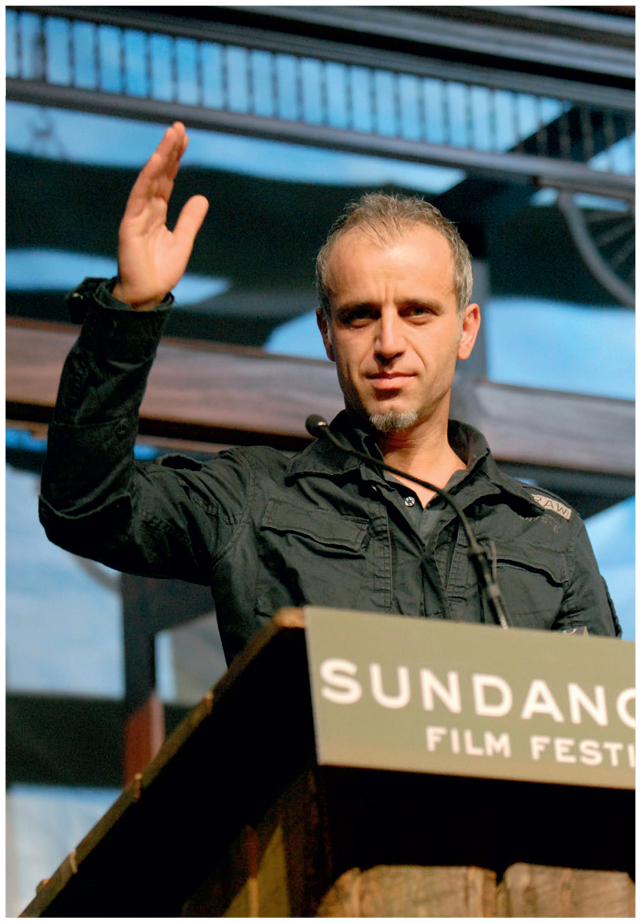
Cinematographer Mahmoud al-Massad at the Sundance Film Festival
CREDIT: UPI Photo /Alexis C. Glenn / Alamy
The Saudi film scholar, author and director said all international film makers and companies going to work in the country “welcomed, but with an appreciation of the local culture and community rules and ethics, set by the Ministry of Culture”.
This is something Netflix understands. “There is compromise between what Netflix wants for [its audience] and what the Saudi [authorities] are willing to accept,” Ghazala said.
In January 2019, several Western media outlets reported that Netflix withdrew an episode of the comedy show Patriot Act with Hasan Minhaj, after Saudi officials complained.
The episode of the news-comedy programme in question raised the issue of Jamal Khashoggi. The dissident Saudi journalist, who wrote for The Washington Post and was critical of Saudi Crown Prince Mohammed bin Salman, was murdered in the Saudi consulate in Istanbul in 2018. US intelligence agencies have since claimed the Crown Prince approved the assassination.
In February, Vanity Fair ran an article exploring Hollywood actor Johnny Depp’s close cultural and financial ties with Saudi Arabia.
In the same month, The Hollywood Reporter published an article about how The Red Sea Film Foundation (a non-profit organisation created to support the film industry in Saudi Arabia) has approved financial backing to Modi, an upcoming biopic - mostly shot in Budapest - about the life of Italian artist Amedeo Modigliani, starring Al Pacino and directed and produced by Depp.
Bissan Fakih, Amnesty International’s campaigner for Saudi Arabia, said getting famous actors to speak in a positive manner about the country was a way for it to project an image to the world that human rights had improved.
“Amnesty has not come across any cases of individuals in Saudi Arabia who are being detained for making films or documentaries,” she said. “But there is a zero-tolerance policy for criticism inside Saudi Arabia right now, which is the worst that we as an organisation have ever documented for freedom of expression.”
Fakih said there might be some situations where the Saudi authorities would allow filmmakers a little more freedom but added: “It would be very difficult to produce a film or a documentary without the agreement of the Saudi authorities.
IT IS NOW more than a century since Hollywood’s emergence as the centre of worldwide film production. Studios were attracted to Los Angeles by the sun, the low cost of land and easy access to a variety of locations. It was also easier for studios in LA to avoid the gaze of Thomas Edison’s Motion Picture Patents Company on the other side of the USA in New Jersey.
Now Saudi Arabia is trying to do the same - and some of the reasons why early producers went west are now attracting them eastwards.
Saudi has sun in spades: Jeddah is one of the hottest places in the world.
It also has land - plenty of it - which can easily be repurposed without worrying about the objections of those who have lived on it for generations, as is the case of the half-trillion-dollar Neom project for a new urban area in Tabuk which has displaced the Huwaiti tribe (Index vol 52,3 p12).
Money, though, is the big attraction and Saudi has plenty of it, which it is using to extend its soft power globally.
Oil money has gushed into sport by the gallon in the last few years, particularly in football and golf, and now it is the movie industry’s turn.
At the Cannes Film Festival in 2022, the country announced details of a film tax incentive scheme that would allow productions to claw back 40% of their in-country spend in cash.
Tax schemes such as this can work well, and other countries have already proven this. Fiji offers producers incentives of 47%, Poland 50%, rising to 70% for “difficult films”.
The controversial Neom project is at the heart of the country’s burgeoning movie sector and there are two production facilities based nearby - Media Village and Bajdah Desert Studios.
Media Village currently has two 2,500 square metre sound stages as well as workshops, production offices and make-up and green rooms. Two more stages are already under construction on the same site. Bajdah Desert Studios has two 3,000 square metre soundstages and four more are planned.
The Neom site also has accommodation for cast and crew and five-star hotel rooms for the on-screen talent.
Dunki, directed by Rajkumar Hirani and starring Shah Rukh Khan, is the first Bollywood film to shoot at the facilities in Neom. It will not be the last.
Neom is also central to plans for MBC Studios, the production arm of Middle East broadcaster MBC Group, which recently moved its HQ to Riyadh.
At the 2023 Red Sea International Film Festival, the studio’s then managing director - former US TV executive Christina Wayne - said the company was “making a push to shoot a large part of our slate in Saudi Arabia”.
However, she lasted only just over a year in the role. In March 2024, the Hollywood news service Deadline reported that she resigned because “she is unable to move to Saudi Arabia full-time”.
MBC Studios is behind the movie Hwjn, directed by Yasir Alyasiri, and the $120 million-budget Anthony Mackie movie Desert Warrior, shot at Neom.
Jeremy Bolt, a producer on the film, gives a testimonial on the Neom website, saying: “At Neom, we are not reliant on CGI because it’s a real oasis, surrounded by the most phenomenal mountain desert landscape I’ve ever seen.”
Saudi Arabia provided the backdrop for the Gerard Butler action flick Kandahar, by director Ric Roman Waugh, which in 2021 became the biggest Hollywood feature to shoot entirely in the country.
A year after announcing tax breaks, the Saudi Ministry of Culture returned to Cannes to announce the launch of two separate film sector funds worth a total of $180 million. The money was intended to both develop the movie industry inside the country and, more importantly, attract productions to go there.
At the time, it was announced the schemes were aimed at productions which feature the kingdom’s “culture, history and people along with showcasing the kingdom’s diverse selection of landscapes”.
The $100 million Saudi Film Fund, launched in February, is intended “to spur investment in this industry” and is a collaboration between the Cultural Development Fund, MEFIC Capital, which will manage the fund, and ROAA Media Ventures.
ROAA will be the technical partner and will seek “to facilitate collaboration with leading international studios and create content that highlights Saudi culture and values”.
Tellingly, the chairman of ROAA is Redha Alhaidar, former president of the General Commission of Audiovisual Media, the Saudi media regulator.
The Saudis’ other film incentive fund is the Red Sea Fund, which has granted $15 million in support to more than 250 films.
The fund is also aimed at projects from directors of African nationality as well as those of Arab nationality or origin.
The 2023 movies Omen, written and directed by Belgian-Congolese director Baloji, and Goodbye Julia, directed by Sudanese director Mohamed Kordofani, have both received investment from the fund.
As detailed elsewhere in this issue, countries with deep pockets recognise the power of movies to extend influence around the world. After all, Hollywood has been doing it for years.
“There is also self-censorship, because individuals in Saudi Arabia know if they are critical of the authorities they are likely to face harsh sentences.”
The cinema market in Saudi Arabia is expected to reach $1.70 billion by 2030. It seems, for now at least, that actors and filmmakers from across the world are willing to look the other way at ongoing human rights abuses. Money talks. And profit will dominate most of that global conversation.”
Footnotes