




Abstract

Poet
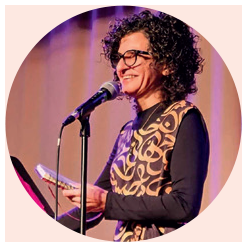
Bänoo Zan speaks at Shab-e She’r, the poetry night she founded in Canada in 2012
But in dictatorships and totalitarian regimes, there is state censorship in the name of national security or cultural and religious identity. And, of course, almost everything worth saying is targeted by the censors. Even writings that are not censored lose their significance in the absence of counter arguments and diverse viewpoints. Censorship in such countries is maintained by force, threats, intimidation, jail sentences, assassinations and other coercive methods.
I was born and raised in such a place: Iran. I studied and taught English literature at Iranian universities, and in 2010 I emigrated to Canada and started to explore the English language literary scene. I joined workshops and attended readings, book launches and open mics.
I published a book in Iran and here in Canada, and I published two more, sat on juries and editorial panels, ran workshops and published more than 300 poems, essays, and translations in magazines around the globe.
In 2012, I founded Shab-e She’r (Poetry Night), a monthly poetry reading and open mic series based on values of diversity and freedom of speech. These reflections of my experience of Western censorship are based on my encounters with poets, writers, members of literary juries, editors, publishers and organisers in the Canadian and immigrant literary scenes, as well as my observation of patterns of acceptance and rejection of my own writing by English language literary magazines and book publishers based in the USA, the UK, Canada and Europe.
The book I published in Iran was submitted to the state censor in the Ministry of Culture and Islamic Guidance. In Western democracies, censorship is usually in the form of peer and self-censorship. This is maintained in the name of freedom of speech or diversity. It stems from the fear of being dominated by minorities, the fear of backlash by hardliners, or the fear of being unkind to minorities. It operates mainly through manuscript rejections by publishers and editors, retraction of articles, loss of opportunities and disinvitations.
Poets and writers who leave their repressive homelands for the West may at first think that they have escaped censorship. Those who continue to write in their mother tongues may never know otherwise. In Canada, many immigrant and refugee writers keep writing in their native language. And since the censorship office in the Islamic Republic of Iran does not have jurisdiction in Canada, Iranian writers in exile can “freely” express themselves in Persian. The problem, however, is that since they are writing in a language unknown to most Canadians, the mainstream Canadian reading and writing community cannot access their writing.
Exiled writers are separated from their linguistic community. For instance, the majority of Persian language publishers and readers are in Iran, Tajikistan and Afghanistan. Separation from the speakers of the language makes it difficult for the writer to keep in touch with changing nuances in language and culture. Loss of readership and community limit the writers’ impact as well. Living in ethnic neighborhoods in the West may partially solve the issue, but it disconnects exiled writers from the mainstream arts and culture scene of their adopted countries.
As a result, writers in exile are censored out of their native and host literary scenes: censorship through marginalisation. It is only when immigrants write in the official languages of their adopted countries that they begin to perceive limitations on freedom of speech.
The censorship controversies that get into the news mark a later stage in the process. For censorship to be newsworthy, the author must already be published or have secured a high-profile speaking gig. But censorship starts much earlier than that. Because of the competitive nature of publishing and the lack of forgiveness towards those deemed ideologically erratic, self-censorship is the practice of many writers. This habit is detrimental to their intellectual clarity and honesty, turning writing into a negotiation with the powers of untruth.
If a writer manages to overcome self-censorship and produce a text that is original and authentic, the next stage is to secure a publishing deal. This is the most daunting stage. In democracies, writers’ peers are their most formidable censors. And what these peers are influenced by matters a lot.
CREDIT: (portrait) Bänoo Zan via Facebook; (illustration) Gary Waters / Ikon Images

The literary scene is split roughly into two camps. One camp supports freedom of speech. The progressives in this camp believe in global solidarity among social justice causes. They support political writers who raise awareness about human rights abuses in their home countries. Many literary circles in this camp were formed by those who experienced the 1960s and 1970s and are leftists or liberals in the older sense of the words. They are anti-dictatorial as much as they are anti-colonial. They believe in universal values that connect diverse struggles for social justice around the world. This camp may not be as ethnically diverse, but it believes that freedom of speech allows individuals to combat inequality.
This camp no longer sets the tone of debate on the left, nor does it control the narrative in the mainstream literary scene. It is sidelined by a newer left that is more interested in issues of identity. One other factor that detracts from the influence that this camp can have is the emergence of online platforms and publications that are controlled by the younger generation who mostly subscribe to the values of the newer left.
Others who belong to the free speech camp have other agendas and lean to the political right. They betray an antagonistic attitude towards specific countries, regions and religions. They welcome self-critical minority writers, but not minority writers critical of the West. Joining the right-wing camp may at times feel like betraying your roots. Hence, some immigrants, refugees and people of colour may not feel they belong.
At the opposite end of the spectrum, there is a camp that promotes diversity - a laudable cause. But the way it proposes to achieve this end is through limiting speech. In its efforts to achieve equity and inclusivity, it resorts to tactics such as refusal to publish, deplatforming, retracting writing from (online) magazines, and pressuring organisations and employers to fire or disinvite writers, thinkers and activists. Its goal is to delegitimise certain ideas by marginalising them. It is the newer left: more anti-colonial than anti-dictatorial. In fact, it is curiously silent about dictators who hold their own populations hostage in the name of religion, nationality or identity.
This camp is indifferent to human rights abuses beyond Western borders. International issues are dismissed until they become Western issues, such as the current Israel-Palestine conflict. What is happening in Sudan, Afghanistan or other regions is irrelevant to this camp. It denounces as racist those who disagree with the terms and definitions it holds sacrosanct. This camp is mainly interested in positive and uplifting stories that glorify religions, countries, cultures and ethnicities from the global south. This is the group that has the most power and influence and today controls the narrative in the publishing world.
It should be noted that in the current artistic and political climate, even publishers who say they believe in freedom of expression will not publish work that may bring the ire of diversity advocates and Islamists upon their head. When they do, they quickly remove the controversial piece. The same fate awaits speaking gigs and featured readings.
Many writers are critical of their own - especially refugee and immigrant writers who have left their homelands because of political, social, cultural and artistic suppression. Although the newer left may validate some components of these writers’ identity, it coerces them into silence and conformity and discourages them from adopting a self-critical outlook. As a result, the newer left in the publishing industry here in Canada ends up promoting mainly North American writers born and raised in Canada or assimilated into the Canadian culture. Immigrant and refugee writers who have experienced life under dictatorships and corrupt regimes find that they do not quite belong to this camp.
Minoritised writers, therefore, find themselves in a dilemma: one camp wants them to criticise only their own culture while the other demands that they only praise it. Very few literary outlets encourage writers to be truth-tellers.
Many immigrant or refugee writers don’t find it worth their while to write in a foreign language only to play into the hands of those who reduce them to propagandists for or against their culture.
In Toronto, there are innumerable reading series and poetry events but, as far as I know, Shab-e She’r is the only regular poetry event founded and run by an immigrant. Hence, it falls into neither camp. I tell the audiences that the answer to a poem is another poem - not a call to silence the offending voice. Diverse means diverse from you, whoever you are and however you identify.
Adrienne Rich famously rejected the National Medal of the Arts in 1997 to protest inequality in the USA under president Bill Clinton, saying: “Art - in my own case the art of poetry - means nothing if it simply decorates the dinner table of power which holds it hostage.”
Freedom and art are inseparable. As the writing community, we need to examine the powers that hold us hostage.