




Abstract

Bolivian President Luis Arce raises a defiant clenched fist in La Paz after an attempted coup
CREDIT: AP Photo/Juan Karita/Alamy
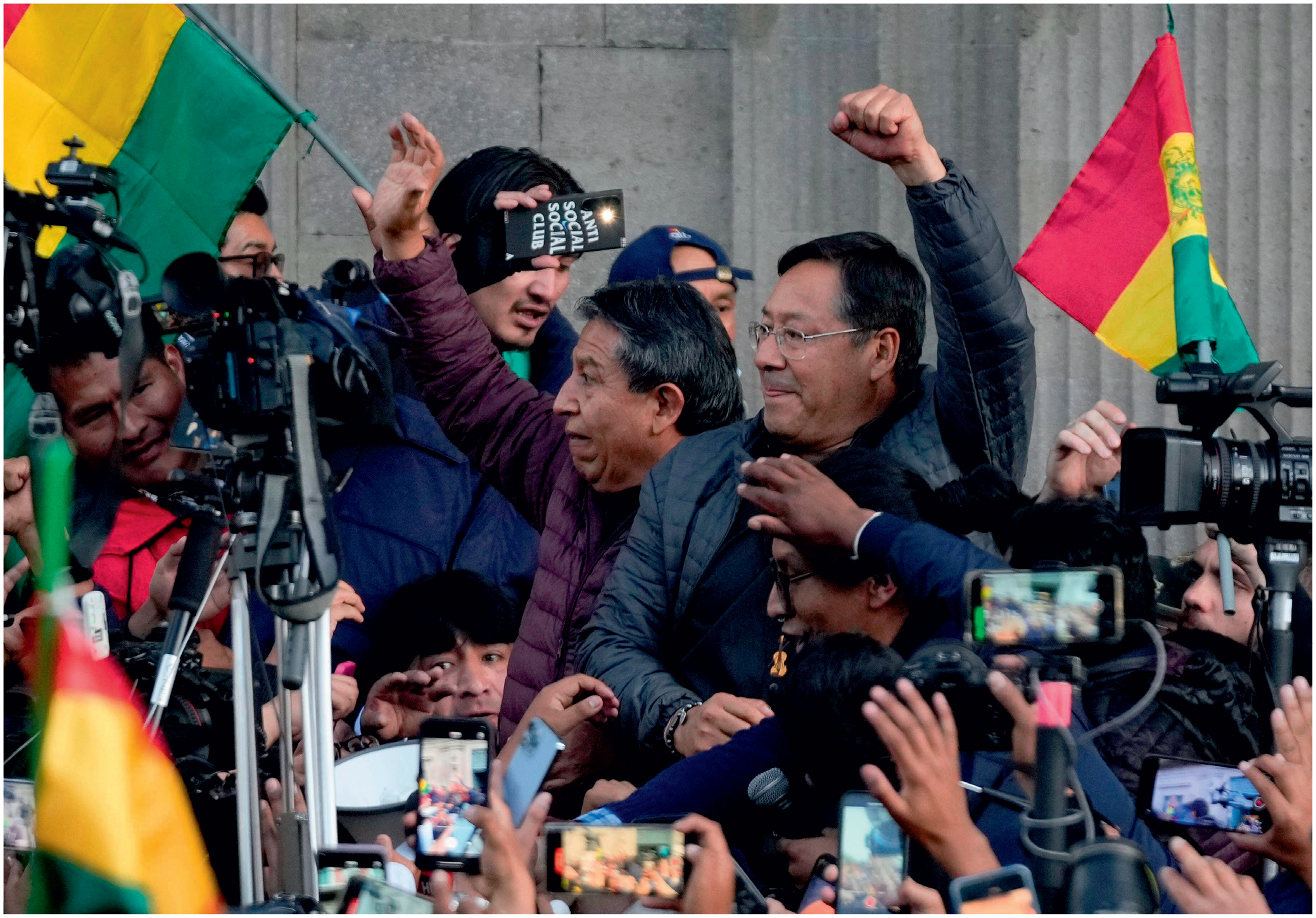
President Luis Arce stormed downstairs to face off with disgraced general Juan Jose Zuniga and ordered him to stand down, before abruptly swearing in a new military high command who ordered the troops to fall back. They complied. An attempted military coup had, it seemed, been put down in time for tea.
Outside, Zuniga was arrested - but not before declaring to the watching press that he had been ordered to stage the uprising by the president who wanted to boost his popularity.
The episode paints a dismaying picture of democratic fragility ahead of the presidential elections in August 2025 - and an adverse scenario for journalists, NGOs and other critical voices navigating polarisation, stigmatisation and physical violence.
Journalists covering the crisis were tear-gassed and manhandled by the security forces and insulted by pro-government protesters as they tried to work. Three weeks later, they received an invitation from the Ministry of Government to attend a working breakfast. Reporters were quick to denounce it as a government attempt to lean on them to glean information that supported the official narrative.
When it comes to rights and freedoms, economic, party-political and institutional factors all pose threats to press freedom, freedom of expression and the right to freedom of assembly.
The 26 June attack was particularly disturbing because it carried echoes of the crisis that forced former president Evo Morales from office in November 2019.
After controversial electoral fraud accusations against Morales sparked a wave of lethal protests, the police mutinied, and the army “suggested” Morales step down - in what many decried as a coup. Bolivia was ruled for a year by the caretaker government of former far-right senator Jeanine Áñez before Arce was elected.
Some 37 people were killed during the crisis, and there were attacks on the press all over the country, with journalists suffering physical attacks and having their offices and equipment destroyed and burned. The security forces as well as protesters and partisan shock groups were behind the violence.
The Inter-American Commission on Human Rights declared in a report on the state of human rights in the country that “never before had it been so difficult to exercise journalism in Bolivia”, and recommended that a non-state organisation be established to offer legal and psychological support to at-risk journalists. Almost five years later, this has not happened.
Landlocked and sparsely populated, Bolivia has long been one of the poorest and least-developed countries in South America. However, for the past two decades, it has enjoyed a cycle of economic prosperity, as high prices for its gas exports bolstered state coffers.
The left-wing government of Morales and his Movement Towards Socialism (MAS) party ploughed the proceeds into social programmes that helped cut poverty and tackle inequality.
Now, the model is becoming unsustainable. The country’s gas reserves are running out - a large discovery in July notwithstanding - and the government has been unable to coax a profit from the country’s enormous lithium deposits.
Now, Bolivia’s international reserves are running on empty, making it increasingly onerous to pay for imports and subsidies on items such as fuel.
At the time of writing, the boliviano is trading at more than 10 to the dollar in parallel exchange markets while at home it has been pegged by the government at just seven to the dollar for more than a decade.
Miguel Miranda, co-ordinator of the human rights incidence team at the Bolivian NGO CEDIB, which seeks to archive history and build knowledge for the future, told Index that cuts were inevitable. “It will hit the popular classes the hardest,” he said. “So how are they [the government] going to contain that? Because people will hit the streets. [They will respond] with measures that restrict rights.”
Miranda also fears the government will try to ward off possible protests by passing decrees that could be used to restrict them.
But protests are not the only prospective casualty in such a scenario. Strapped for cash, the government has turned heavily towards harmful extractive industries - and environmentalists sounding the alarm have had a chilly reception.
In May 2023, the senate passed a law allowing the government to trade gold bought from local mining cooperatives. Yet, indigenous people and park rangers have accused gold miners of illegally pushing into national parks, polluting rivers and violently crushing resistance. Indigenous communities and environmental groups have also raised concerns over projects such as the Chepete and Bala megadams, which would allow Bolivia to export power, but which would flood large tracts of biodiverse protected areas.
Many young, grassroots environmental organisations enjoy such social legitimacy that governments baulk at the political cost of moving against them, Miranda argued. Although some of the region’s most repressive regimes - such as the government in Nicaragua run by Daniel Ortega - have done so anyway, Arce has not displayed this kind of authoritarianism.
“They’re a stone in the government’s shoe, because they have a strong moral value,” Miranda said.
Arce’s challenges as election season looms are not only economic. Barely had he got his feet under the table as president when cracks started to emerge between him and his erstwhile mentor, Morales. Today, their MAS party is experiencing a full-blown feud so bitter that a party conference decided to expel Arce and his vice-president David Choquehuanca in October 2023.
The split is affecting journalists. On 10 July, a reporter from the pro-Morales station Radio Kawsachun Coca was in La Paz to cover a multi-party meeting convened by the electoral authorities. She was attacked by Arce supporters who set off firecrackers, pushed her, threw stones and other objects at her and chanted: “Out! Out! Out!”
In a joint statement, Bolivia’s National Association of Journalists and the La Paz Journalists’ Association condemned the attack, noting that it was not the first time the political divide had sparked violence against journalists.
“This lamentable incident adds to a series of grave violations of freedom of expression and of the press, which are encouraged by stigmatising discourse that incites violence against journalists,” they warned. “Once again, this leaves evident the negligence of the authorities, who are called on to guarantee the safety of journalists and press workers as they carry out their jobs.”
Journalists from the Federation of Press Workers protest against further press regulation
CREDIT: AP Photo/Juan Karita/Alamy
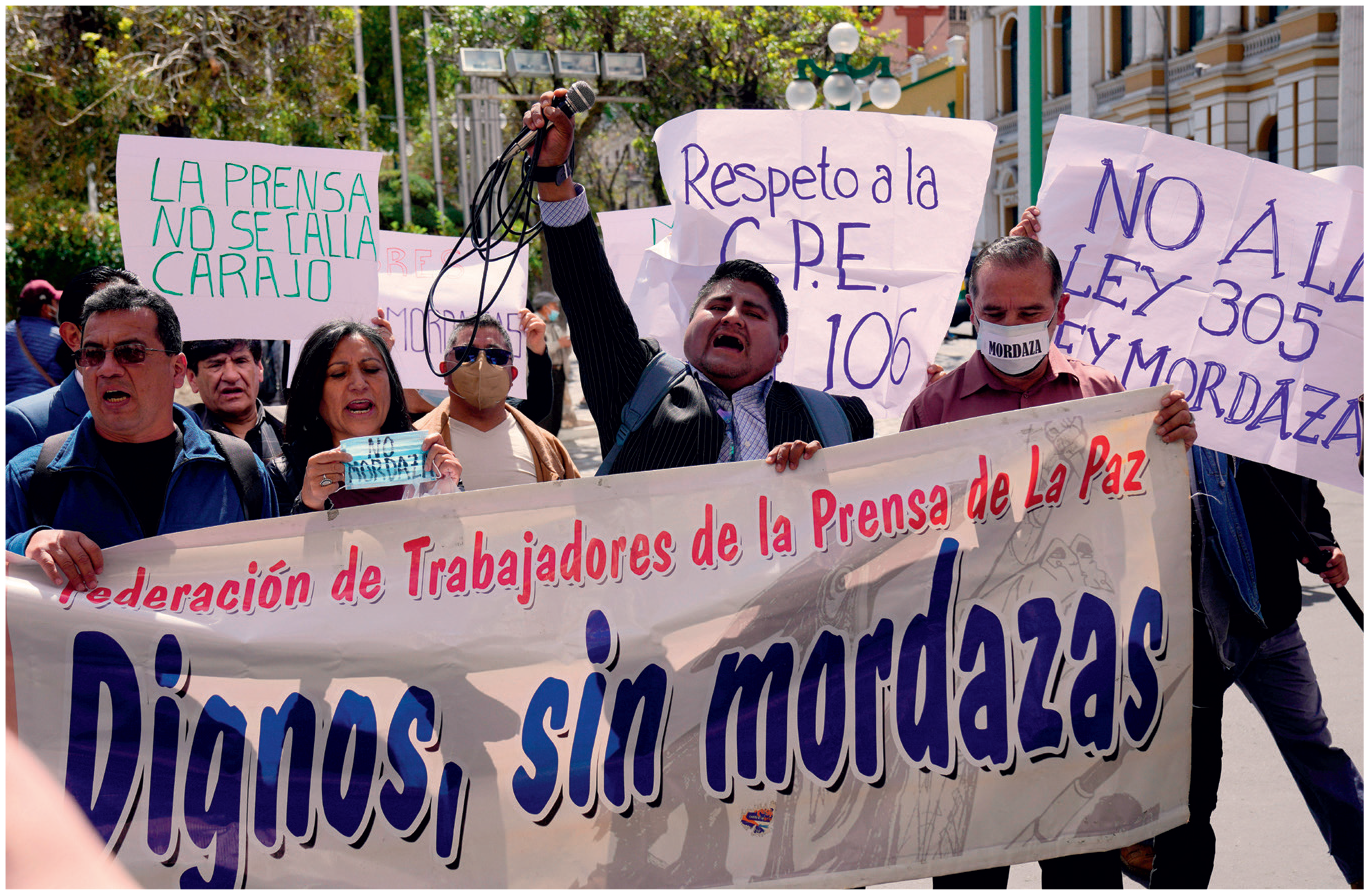
While in government, Morales frequently accused critical media outlets of lying, and Reporters Without Borders has warned that there is a “trivialisation of stigmatisation” of journalists. The country slid by seven places to 124/180 in the organisation’s 2024 World Press Freedom Index.
Unitas, a non-profit that monitors rights and freedoms in Bolivia, identified 143 cases of press freedom violations during 2023. Of these, 30 were physical, sexual or psychological attacks against journalists, while 28 involved threats or intimidation. All too often, these attacks go unpunished.
In one of the most egregious incidents of recent years, six journalists reporting on a land occupation in Guarayos, in the eastern Santa Cruz department, were met by men with guns, who shot their vehicles’ wheels, kidnapped them and destroyed some of their equipment.
Bolivian police played the attack down, describing it as an “altercation”. Nobody has been prosecuted for the attack and Zulema Alanes, president of the National Association of Journalists of Bolivia, warns that upcoming judicial deadlines mean it could soon end in impunity.
Claudia Teran, co-ordinator of Unitas’s rights defenders programme, pointed out that while attacks were often perpetrated by private individuals or shock groups, who may or may not have ties to the government, the government did little to protect the journalists affected. “When journalists report this kind of attack, the state’s mechanisms of investigation and punishment are very weak,” she said.
Even for routine coverage of street protests, insults and aggression against journalists have become commonplace, according to Alanes. Women are particular targets for sexual harassment and degrading insults. “They say, ‘Why don’t you go back to the kitchen?’“ Alanes said. “We’re in a situation of violence and persistent violation of press freedom and of direct physical violence against journalists, with impunity and without reparations or justice.”
The government also uses state advertising spending as a mechanism to discipline media outlets. In June 2023, government-critical newspaper Pagina Siete announced its closure. In a letter to readers, president of the board Raul Garafulic Lehm blamed a perfect storm, accusing the government of withholding state advertising and harassing the paper with audits and fines, while going easy on more sympathetic outlets. One of the major challenges likely to face journalists going into the elections is a scenario of extreme polarisation, Zulema Alanes of the National Association of Journalists said. It and other civil society organisations have formulated recommendations to guarantee that citizens can inform themselves. One of these involves organising obligatory debates for presidential candidates. They have also recommended that Bolivia’s electoral authorities ally with fact-checking organisations Chequea Bolivia and Bolivia Verifica to combat the spread of misinformation and fake news.
Claudia Teran, of Unitas, and Alanes both called for Bolivia to implement a law on access to information. “Access to public information should be the rule, not the exception, and refusal should be justified,” Teran said.
For Miranda, Bolivia doesn’t just need policies. It needs a paradigm shift.
“We need a society that really enjoys the right to freedom of information,” he said. “We need to move towards critical dissidence, towards a vigorous critical citizenship that permits structural change.”