




Abstract

UK Journalist
An article in the Guardian, Beware the Spinal Trap, written by scientist and author Dr Simon Singh, took aim at chiropractors, particularly those who promoted the therapy as a way of treating virtually any ailment or illness, not just the back problems. Singh had explored the claims of chiropractors in his book Trick or Treatment, co-authored with Edzard Ernst, an expert in the study of complementary and alternative medicine.
In the article, Singh wrote: “The British Chiropractic Association [BCA] claims that their members can help treat children with colic, sleeping and feeding problems, frequent ear infections, asthma and prolonged crying, even though there is not a jot of evidence. This organisation is the respectable face of the chiropractic profession and yet it happily promotes bogus treatments.”
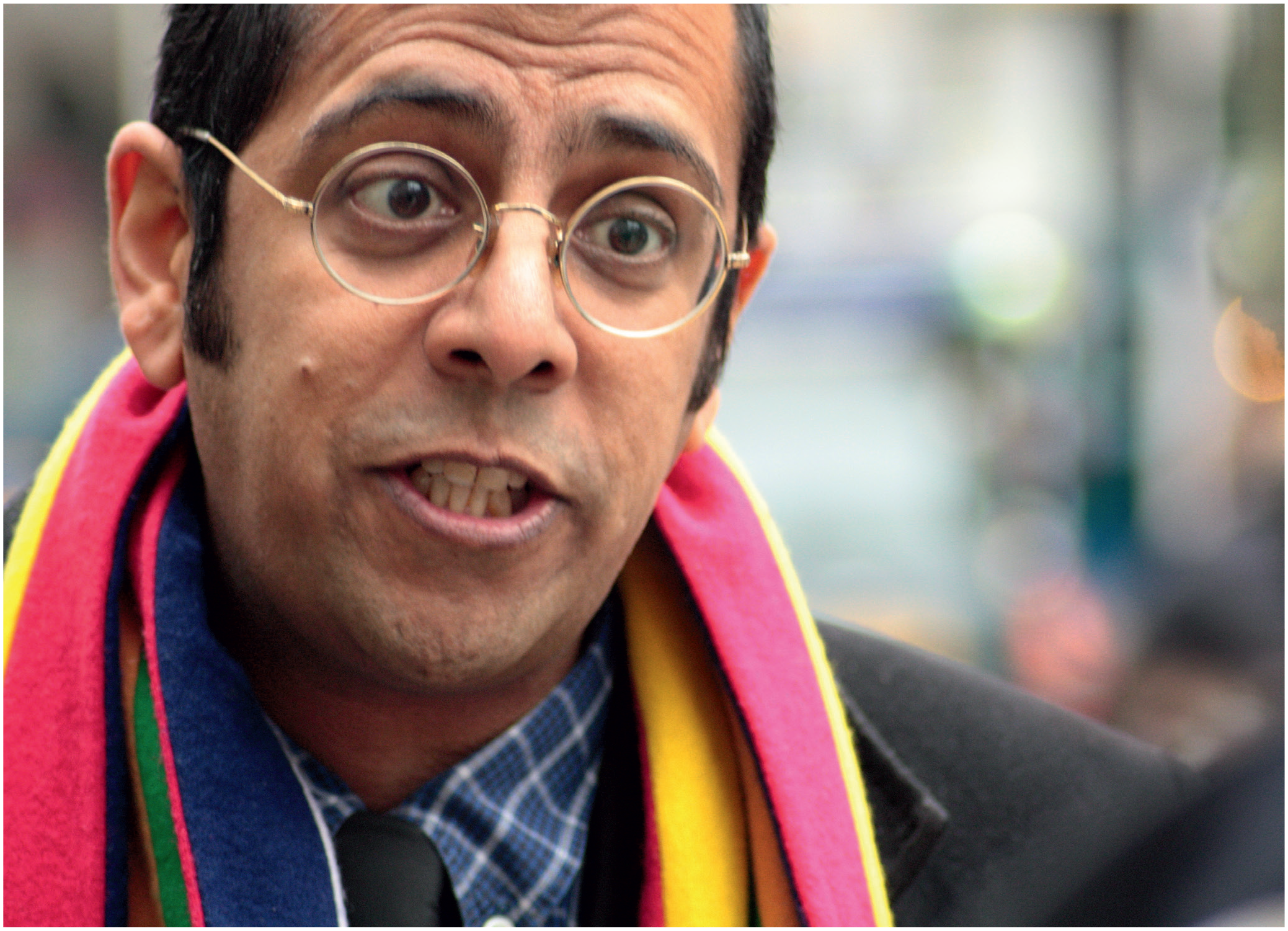
Simon Singh at the Royal Courts of Justice after winning his appeal against the British Chiropractic Association
CREDIT: Robert Sharp / English PEN
The BCA strongly objected to the article and sued the author.
Speaking to Index, Singh said: “The article was written by me, read and checked by a medical expert, and checked again by the Guardian comment editor and the Guardian legal desk... and we all thought it was a fair and reasonable article.”
Unfortunately for Singh, the court case came at a time when scientists and journalists who write about science were coming under attack from organisations eager to polish their reputations, and companies wanting to protect their investments, particularly when it came to drug research.
Tracey Brown, director of campaigning organisation Sense about Science, said that in the 1990s and early noughties there was a growing feeling of openness and transparency among scientists globally. “Access to evidence was open and you had initiatives, for example, to make the body of scientific literature available to people in countries where libraries didn’t have the money for subscriptions.”
But as the new millennium progressed that optimism died and companies and organisations started to use the UK’s libel laws to silence critics.
As Brown explained: “People were being dragged to the London courts or threatened with being dragged to the London courts and silenced that way. To the shock of many in the human rights movement, it was affecting scientists and groups of patients who wanted to debate which treatment worked. It was affecting medical whistleblowers. It wasn’t just the oligarchs and their big businesses that were using that technique. The law was being used to effectively to silence scientific discussion.
“Journals were so fearful that it began to affect things like their decision to retract papers and their decision to publish responses to papers. Things were being pulled for no good scientific reason.”
It was into this world that Singh’s article appeared. In a preliminary hearing in 2009, Justice Eady ruled that the use of the phrase “bogus treatments” was a statement of fact rather than an opinion, which Singh denied. As a result, he faced ruin. Costs in the case amounted to more than £200,000 and he had been unable to work while defending the case, resulting in two years of lost earnings.
Despite this, Singh took the expensive decision to take the decision to the Court of Appeal. A year later, it ruled that Singh’s remarks were fair comment. After Singh’s successful appeal, the BCA withdrew its action.
Singh’s case and the libel laws
Following the ruling, Index along with Science about Science and English PEN joined forces to launch the Libel Reform Campaign. It attracted tens of thousands of supporters, including Stephen Fry and David King, former chief scientific adviser to the UK government.
This resulted in the 2013 Defamation Act which made sweeping changes to the law including the granting of privilege to scientific journals for articles and statements which had been peer-reviewed; a requirement that plaintiffs must demonstrate they had suffered serious harm following publication; and a stronger defence of fair comment.
Singh would have been extremely unlikely to have been taken to court for his article under such a law.
Singh told Index: “I am quite happy with how events unfolded, from the failure of the British Chiropractic Association’s case against me to the reform of the libel laws, so I would certainly write the same article again, assuming it would lead to the same sequence of events.”
But while Singh was ultimately successful he still rues the “chilling effect of libel”.
“For every article that provoked a libel action, there were hundreds of others that were written in an overly cautious manner, skirting around the real issues, just in case a single contentious word could lead to a multi-million pound libel bill,” he said.
Overall, Sense about Science’s Tracey Brown believes the success of the Libel Reform Campaign was positive too and says there were other spin-offs from the campaign.
Dr Simon Singh lost two years of earnings and faced costs of more than £200,000.
CREDIT: Robert Sharp / English PENsurname#

“What we learned from the Libel Reform Campaign, we put to direct use in the huge international campaign for Alltrials [the initiative to ensure all clinical trials are reported], which was very successful in highlighting the fact that fewer than half of the trials on the drugs people use were ever published. And guess what? Generally speaking, it was the half that companies didn’t want you to know about that were not.”
She highlights the case of a drug whose efficacy has been effectively enhanced because trials where the drug failed to perform are hushed up. “The integrity of the research base and the basis for deciding what works in future medicines was really questionable,” she said.
“If you have a drug to tackle stroke risk and someone comes along with a compound that is better, you don’t see it’s better because you’re comparing it with something that’s too optimistic in the first place. There may well have been things that haven’t been developed and haven’t been brought to market because they’re being compared to over-optimistic interpretations of the drugs we’ve already got.”
Science being silenced
While the reform of the libel laws helped science get a fair hearing, it has still not ended the attempts to silence science in the UK.
A study by the University and College Union in 2017 found that more than 35% of academics have undertaken self-censorship (refrained from publishing, teaching or doing research on a particular topic), for fear of negative repercussions; the figure was 19% in the EU.
Covid, with its waves of scientific claims and counter-claims, was a particular low point argued Brown.
Scientists Chelsea Polis (left) and Nancy Olivieri (right) pick up the 2023 Maddox Prizes from Sense about Science director Tracey Brown (centre).
CREDIT: Sense about Science

“During the pandemic, we saw cases where companies were threatening researchers and the universities lawyers were encouraging those researchers to simply withdraw their comments and promise never to repeat them,” she said.
The annual Maddox prize, run by Sense about Science in conjunction the scientific journal Nature exists because of attempts to silence scientists round the world. The prize recognises courageous individuals who stand up and speak out for science and evidence-based policy, advancing public discussion about difficult topics despite challenge or hostility. Prize-winners have often called out the intimidation of researchers and the organisations which have failed to protect them.
“It’s really important for society that researchers can be confident to talk about their findings, especially when they are not what we expect or raise difficult questions. When decisions are made without all the evidence, we all lose out,” says Dr David Schley, Sense about Science’s deputy director.
In 2023 the prize went to Nancy Olivieri, now a senior scientist at Toronto General Hospital in Canada. In 1998, Olivieri blew the whistle over the drug deferiprone, used to remove excess iron from the body in patients with thalassaemia major, which was being trialled at the hospital in where she was then working. Olivieri suspected the drug was causing serious adverse events, which the drug manufacturer and trial funder Apotex denied. When Olivieri said she intended to inform participants of her concerns, Apotex terminated the trials and invoked a confidentiality agreement in the research contract and threatened legal action if she made the findings public. Undeterred, Olivieri shared her results at a scientific meeting and submitted them for publication. She was sacked.
In 2009 the FDA declined Apotex’s request for approval of deferiprone as first-line therapy. In 2011, the FDA issued approval for deferiprone as “last resort” therapy, to be prescribed only after first-line therapies had failed, cautioning that no controlled trials of deferiprone had demonstrated direct treatment benefit.
“Hostility was certainly a feature of my story: the harassment, the bullying, the multiple firings by academic institutions enabled by a pharmaceutical company over two decades,” said Olivieri when she picked up the award.
The role of social media
Social media has also placed scientists in the firing line.
“What worries me enormously is the idea that we can write an algorithm for science,” Brown told Index. “What 20 years in this interface between science and society has taught me is that there are no shortcuts. During the pandemic, you had the British Medical Journal and the Cochrane collaboration being unable to publish because the algorithm had been determined that the title of papers fell foul of what was considered good science.
“It misunderstands science; science is about the new; algorithms are based on the past. So inevitably any algorithm will not account for new discoveries.”
Academic institutions have also become really dependent on their social media profiles as they try to attract high-fee-paying students from around the world.
“They are really touchy about any kind of bad online publicity,” said Brown. What that means is that they really don’t have the backs of people who work for them and they often overreact.”
Singh argues that social media isn’t the only culprit.
“There is a ton of scientific misinformation on social networks, but there is also far too much dodgy material in the mainstream media,” he said.
“A sensationalist scaremongering article will always appeal to readers, and a phone-in based on pseudoscience will too often find a home on local radio.”
A decade and a half on from the BCA case, Singh has moved on. Since the libel case, he has not written any new books, a shame given his titles on Fermat’s Last Theorem and the Big Bang were hugely successful popular science titles.
His focus is now on a charity called Good Thinking, set up to “encourage curiosity and promote rational thinking”.
Singh says, “We are pro-science and pro-evidence, which means we are anti-woo and anti-quack. In short, we like scepticism, but not cynicism. We like nerds and geeks, but we hate bogus things without a jot of evidence.”