




Abstract

LEFT: Yekaterina Duntsova enters Russia’s Central Election Committee in 2023 to submit her documents as a presidential candidate for the upcoming presidential election
CREDIT: Alexander Zemlianichenko/Associated Press/Alamy

“MY CHOICE IS made: I’m staying here with the people who need someone to represent their voice,” Lev Shlosberg from the Yabloko opposition party told independent media outlet Zhivoy Gvozd on 3 October 2024. This was the day after security forces armed with sledgehammers raided his home in the city of Pskov, as well as that of his 95-year-old father.
Two weeks later, the local Yabloko office was targeted as well. Shlosberg is now facing criminal charges for allegedly failing to disclose his status as a foreign agent, the label he was given for speaking out against the war in Ukraine. People blacklisted as foreign agents by the Kremlin are subject to restrictions on their public activities and have many “duties”, such as providing reports for the authorities on what they are doing.
Shlosberg is not the only Yabloko member to be prosecuted: five of its members have had criminal charges brought against them for criticising the invasion. And one of them, Mikhail Afanasyev, has already been sentenced to five and a half years in prison for “spreading false information” about the Russian military.
One independent politician, who spoke with Index from Russia and requested anonymity, said war was not the only topic it is unsafe to raise. Talking about any important social or political issue can lead to punishment.
One area which concerns her is the backlash against women’s rights. She is concerned that the state is using blatant propaganda to persuade the public, namely school children, that “a woman’s sole purpose in life is to reproduce… because the government needs [new] people”.
A new bill, which was signed into law in November, has banned “propaganda” about childfree lifestyles and could lead to the persecution of politicians who raise awareness about threats to women’s reproductive rights.
“As a politician, I am aware that [when I speak out for women’s rights] I have to control myself more [than before the invasion],” she said, explaining there is other draconian legislation which can be used to punish people “if [the authorities] feel like it”.
Gender-based violence is also on the rise, she told Index, a result of the government failing to help veterans from the war in Ukraine adapt to civilian life.
Yulia Galyamina is another opposition politician who has not fled Russia. At the beginning of the war, she was sentenced to a month in prison for calling on people to protest against President Vladimir Putin’s aggression. In her last word to the court, she said: “I am a Russian patriot and I believe that sooner or later, our country will become a land of humanity.”
Shortly thereafter, Galyamina was deemed to be a foreign agent - and so was the women-led movement for nonviolent action, Myagkaya Sila (Soft Power), of which she is a founding member.
Galyamina believes that politics start with grassroots movements. “Unity of the people, in any form, is political action”, she wrote on Telegram in October 2024, arguing that “it is precisely why independent initiatives receive such a violent reaction from the security forces: they see these as a threat to their power”.
She was referring to the recent persecution of doctors whose homes were raided by police. They had been supporting their imprisoned colleagues, and had signed an open letter demanding an investigation into the suspicious death of opposition leader Alexei Navalny in prison. Several were detained.
The authorities do not even tolerate initiatives providing humanitarian aid to people in regions near the border with Ukraine, who have been forced from their homes because of the fighting. One such movement, Sograzhdane (Fellow Citizens), was declared a foreign agent. In the city of Yekaterinburg, in west-central Russia, four volunteers, including a minor, were arrested for helping the homeless and charged for taking part in an unauthorised meeting.
Despite the Kremlin’s iron grip, people are still capable of mass political mobilisation in support of alternative presidential candidates, even though, since the invasion of Ukraine, the oppression of the Kremlin’s opponents, and especially politicians, has been unprecedented.
Dozens of politicians have had to flee the country to avoid being imprisoned. In April 2022, municipal deputy Alexei Gorinov was sentenced to seven years in jail for speaking up about Ukrainian children killed in Putin’s war.
Yet at the end of 2023, Yekaterina Duntsova, a little-known journalist from the city of Rzhev, declared her intention to run for president in the national election in March 2024. She said she stood for “peaceful politics” and “democratic values”. A month later, she had amassed more than 300,000 supporters on her Telegram channel, but was disqualified from running due to what the authorities claimed were errors in her documentation.
Duntsova urged her followers to support another prominent pro-peace candidate, Boris Nadezhdin, whose last name is significant: nadezhda is Russian for “hope”. People travelled from remote areas in order to give signatures of support at campaign offices in cities all over Russia, so that he could register as a candidate. Many stood in line in freezing cold temperatures. Nadezhdin delivered 105,000 signatures to the Election Committee - which was more than the required minimum. He too was barred from the presidential elections, for alleged “invalid” signatures.
These efforts were not in vain. People who oppose Putin’s politics realised from these actions that they were far from alone and there were others around the country who supported peaceful democratic politics. Dmitriy Kisiev, a politician who created Shtab Kandidatov (Candidates’ Headquarters), the team which stood behind Nadezhdin’s campaign, spoke to Index from Moscow. He stressed that his team “managed to find a way for the people to interact with each other, and with Nadezhdin, in a context [of repression] where it seemed that there was no such opportunity”.
“I think that getting the public involved in politics in such dark times is a great achievement,” he said, and highlighted that today in Russia “people are often afraid to even say the very word ‘politics’”.
People are often afraid to even say the very word ‘politics’
As for Duntsova, when she wasn’t allowed to run for the presidency, she created a party called Rassvet (Dawn), which submitted documents for registration at the beginning of November 2024. By the end of the month, their application had been rejected. She told Index that “independent political activity today is without doubt restricted, as well as the possibilities of people who consider themselves as part of opposition”.
She and her team “are very cautious” now, and ensure their activities “have nothing to do with real political action, which could be perceived as some sort of protest”.
Instead, they are involved in social activities, supporting political prisoners, organising neighbourhood cleanups and holding discussions and debates - “anything that allows the people to grow into active and thinking citizens”.
Despite these seemingly small actions, Duntsova and her party are increasingly under pressure. Rassvet meetings have been targeted by police on more than one occasion. And in October, one of its members, Alexander Germizin, was reportedly detained under extremism charges for comments made on social media.
BELOW: Yulia Galyamina was detained after holding a one-person protest during the Covid-19 lockdown in 2020
CREDIT: Pavel Golovkin/Associated Press/Alamy
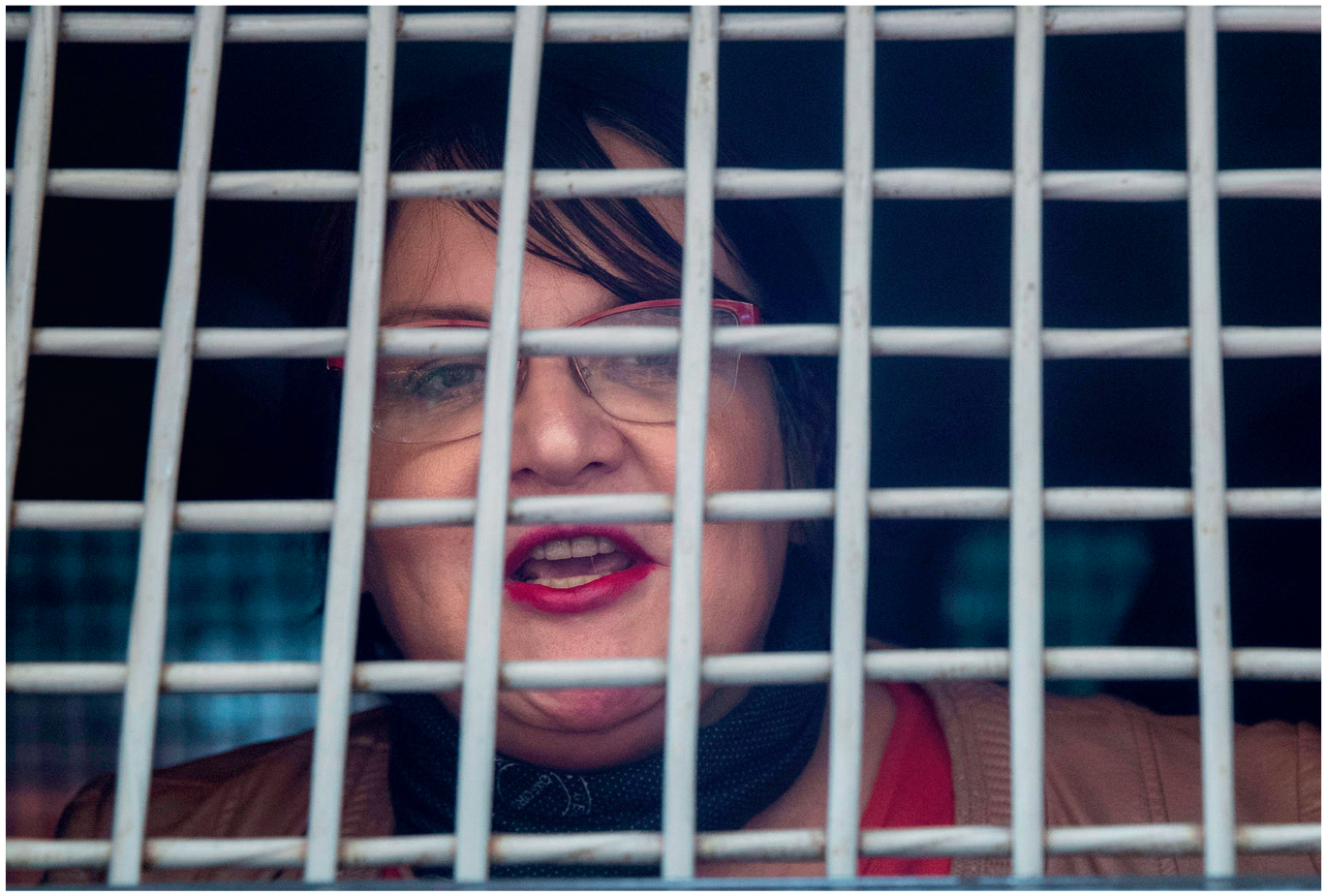
She is “constantly waiting” for the authorities to put an end to her activity, or “for something even worse” to happen
Another of Duntsova’s supporters, Vasiliy Gorelikov, who also worked as a volunteer for Boris Nadezhdin, now faces criminal charges for alleged “extremism on the internet”. During the raid on Gorelikov’s home, police confiscated letters to political prisoners. Many of Nadezhdin’s other volunteers were arrested, in particular those who attempted to do exit polls work during the rigged elections.
Duntsova told Index that she is “well aware of the risks” of staying in Russia, adding that “being labelled as a foreign agent is the least [frightening] thing that could have happened" to her. She recognised that she is "constantly waiting” for the authorities to put an end to her activity, or “for something even worse” to happen.
Nevertheless, she said: “I’m not going anywhere, because my home is here. So, [me and my team] just keep on living and carry on with our work. Whatever will be, will be.”
On 29 October 2024, a few weeks after she spoke with Index, Duntsova was fined 30,000 rubles (just over $300) for, absurdly, “not denouncing herself” as a foreign agent.
Asked by Index whether he fears persecution, Kisiev said that he was “very surprised” that his home was not targeted. He had already been arrested in the past and his home raided for taking part in street protests.
“Maybe [the police] will come [to my home again], but I try not to think about things that I cannot control,” he said. “We have learned to overcome our fear.”
On the bright side for Kisiev, he believes the public puts more trust in Russian politicians who are persecuted by the authorities.
“Because if someone risks their life and freedom to make [other people’s] lives better, it means that they are genuinely devoted to their cause - and must be supported,” he explained.
Despite the pressure, Kisiev hopes that one day a citizens’ movement for a democratic Russia could be built, “so that the energy and the people, who came together during [Nadezhdin’s campaign] could be mobilised to create a positive legal force”.
Shlosberg from the Yabloko party remains hopeful, too. In the interview with Zhivoy Gvozd, he said that he stands with “the millions, not just thousands, of people, who need different politics, different treatment, different laws and a different government”.
He added: “There is a light at the end of the tunnel - let’s just say it is rather far away.” ✘
Footnotes