




Abstract

SOMALIA IS ONE of the most dangerous countries in which to be a journalist. Reporters don’t just face the risk of being caught up in the violence they cover - they are sometimes the targets of that violence or find themselves stuck in the middle of competing armed groups, where keeping one side happy risks angering another.
This is the situation Mohamed Ibrahim Osman Bulbul, a freelance journalist and advocate for media freedom in Somalia, found himself in after a recent government directive regarding Islamist group Al-Shabaab.
“[The directive] stipulated how Al-Shabaab should be named in the media,” Bulbul told Index. “We should no longer refer to them as ‘Al-Shabaab’ but instead as ‘terrorists’.”
For Somali journalists, adopting this terminology poses serious dangers, especially as there is no one to guarantee their security. These risks force many journalists to focus on international issues rather than critical local stories as they feel they lack the freedom to report honestly on domestic matters.
They also face arbitrary arrest and detention - something Bulbul has experienced. In August 2023, he reported on a case of corruption involving high-ranking police officials. Shortly afterwards, he was arrested.
“In broad daylight, unknown individuals kidnapped me while I was at university,” he said. “They [showed] no warrant and didn’t explain the reason for my arrest until seven days later.”
After being held in an underground cell, Bulbul was transferred to another prison, where he remained for 56 days.
It wasn’t the first time his reporting had attracted revenge. In 2019, he reported on Al-Shabaab halting the construction of Mogadishu Stadium over demands for payment. He said the story drew threats not only from Al-Shabaab but also from the government and businesspeople involved in the project. Due to escalating threats, he left the country for a year.
The situation is no better in the towns outside Mogadishu, where there is sometimes even less freedom. In Kismayo, several hundred kilometres south of the capital, there has been no independent media for 13 years. Journalists cannot report on anything that the local government does not approve of, and they also face threats from Al-Shabaab if the group objects to any stories.
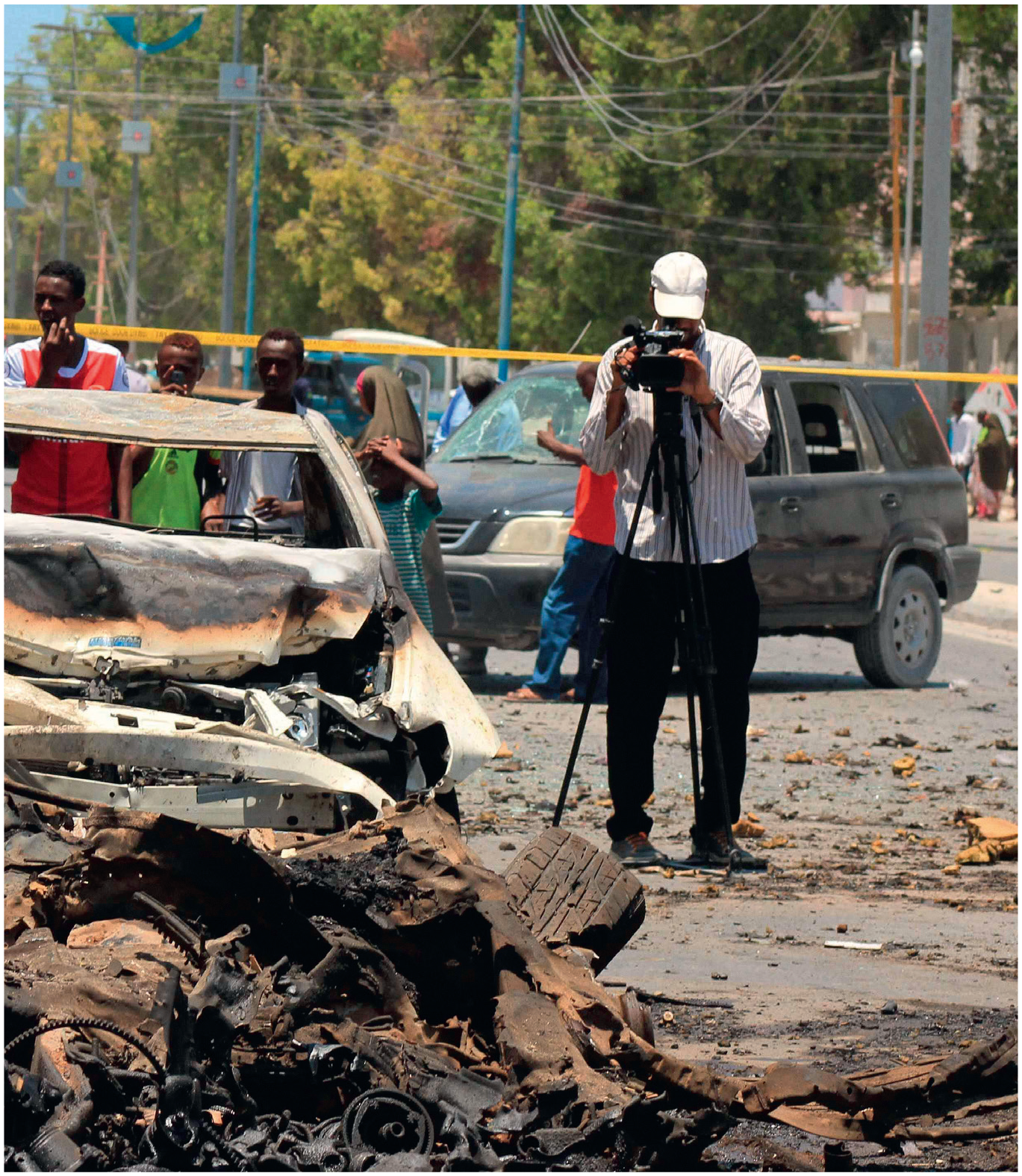
LEFT: A video journalist works at the site of an explosion in Mogadishu in 2017. Danger and threats of violence are an occupational hazard for journalists in Somalia
CREDIT: Imago / Alamy
Sometimes the competition to report first
Two months ago, Abdimajiid Abbas Adan, a 30-year-old journalist working in Kismayo, was contacted directly by Al-Shabaab after he covered an attack on a local military base. Before that, he had questioned budget allocations released by the Ministry of Finance in the state of Jubaland and was threatened by the government.
“During the election campaigns [in] October 2024, I reported on one candidate which led to my arrest,” he told Index. “After three days, I was deported from my own city, with a one-way ticket to Mogadishu and no explanation given. I have three children and a family in Kismayo, but I don’t know when I’ll be able to return. My future feels uncertain.”
One of Somalia’s few women journalists, Maryan Abdiqani has a long list of daily harassments and obstacles that stand in the way of her reporting.
“Reporting on sensitive topics like clan conflicts, terrorist attacks and corruption exposes journalists to threats from all sides, and sometimes the competition to report first can add further risk, as speed can compromise both safety and accuracy,” she said.
And she believes that economic interests are leading to oppression.
“I went to report on fishermen protesting [against] the takeover of their fish market by outside parties. My cameraman and I arrived, filmed the news and captured the story,” she said.
“But the police intervened, took us to the station and told us we couldn’t publish. We were detained for three hours and they deleted all the footage we had recorded.”
As well as threats of violence and arrest, journalists face an uphill struggle to navigate bureaucratic hurdles, limited transparency, restrictions on movement and a lack of formal channels through which they can request information. Public offices and private organisations operate under a culture of secrecy, making the collection of reliable data exceedingly difficult.
Hassan Istiila is a freelance journalist based in Mogadishu who knows these hurdles all too well.
“One of the main challenges we face as local journalists in Somalia is gaining access to information,” he said. “For instance, obtaining information from the government and the private sector is extremely difficult.”
He said there were many reasons for this, the most significant being the security concerns which limit journalists’ ability to move freely and prohibit their ability to gather information.
“Additionally, the political situation in Somalia is unstable and sensitive, especially regarding interactions between the federal government and the federal member states. On top of that, private companies have become increasingly reluctant to share information,” he said.
Istiila also decries a lack of unity among media associations, seeing this as a major issue. As a result, local journalists often distrust one another and struggle to collaborate. Without a united front they lose their collective influence and cannot advocate effectively for better access to information.
This lack of access has serious consequences. When journalists cannot obtain reliable information, it inevitably leads to the spread of misinformation and unverified news. This erodes public trust in the media and undermines accountability, damaging democratic governance and allowing corruption to thrive.
Farah Omar Nur, secretary general of the Federation of Somali Journalists (FESOJ), regularly hears these issues raised by fellow media workers.
“Journalists often struggle to obtain accurate information, which sometimes forces them to include their personal opinions in their reports,” he said. “Government entities, along with public and private organisations, are unwilling to share information freely. They release details selectively - based on their own interests - which makes it nearly impossible for journalists to gather the facts they need. This lack of transparency seriously undermines the fact-checking process and the public’s right to receive truthful information.”
The FESOJ’s latest Press Freedom Report, covering the period from May 2023 to May 2024, documented 28 instances of abuse against journalists, with three deaths. One of those was the result of long-term injuries that a journalist sustained several years ago, when they were the victim of a car bombing.
The FESOJ also reports that 20 journalists were detained during that year while one was tortured and another kidnapped.
“Under these circumstances, journalists are understandably afraid to cover sensitive topics,” said Nur. “And when journalists do attempt to report on these issues they frequently face harassment from the police. Although there is a media law signed by former president Mohamed Abdullahi Farmaajo, it has not been actively enforced to protect journalists.”
It’s not surprising that many journalists are intimidated into silence or, if they do manage to report on controversial issues, are locked up or beaten into silence.
It doesn’t look as though this will change anytime soon and Somalia is likely to remain one of the most dangerous places to carry out this most important of jobs. ✘
Footnotes