




Abstract
Donald Trump’s re-election is indicative of a broader global trend towards a new age of veiled authoritarianism, writes
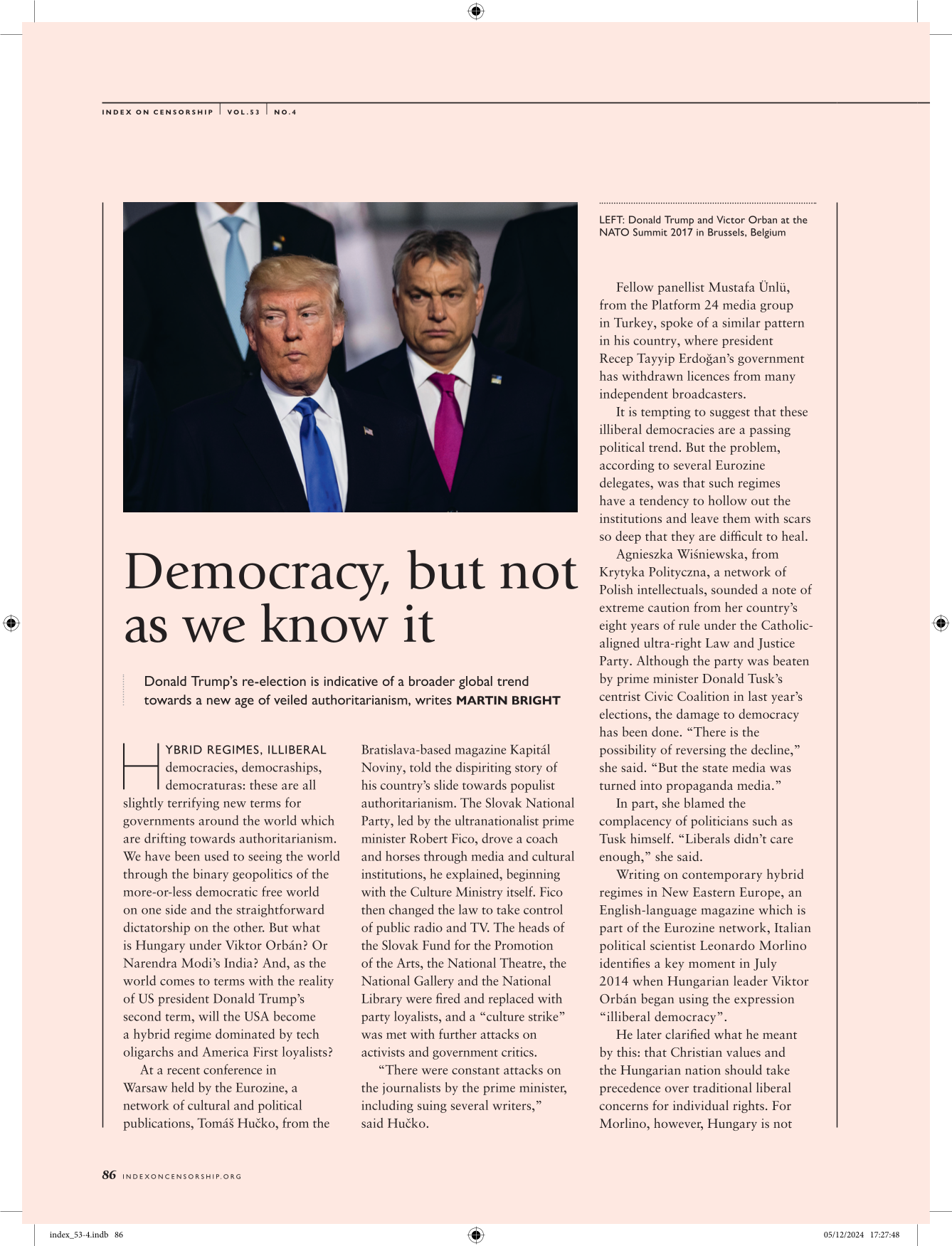
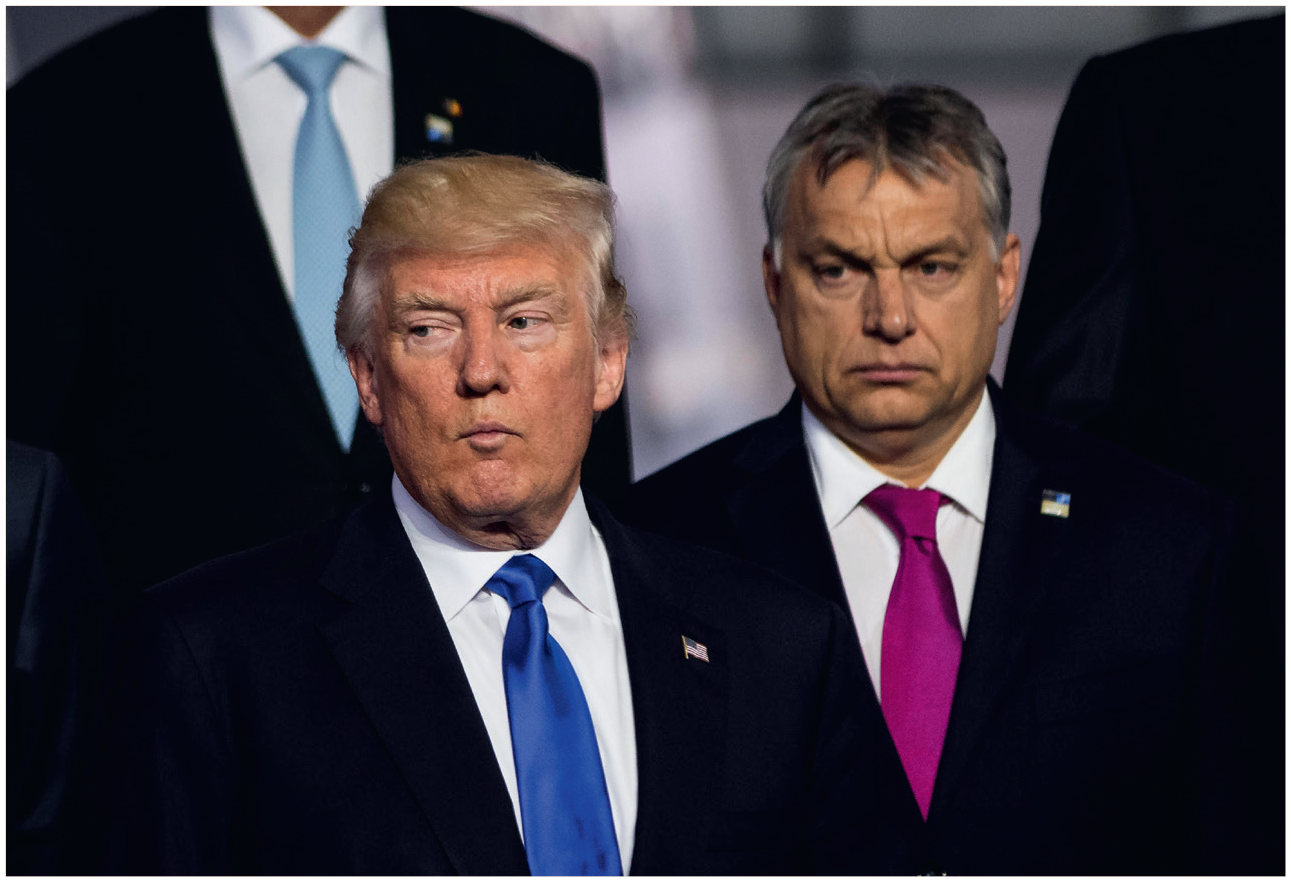
LEFT: Donald Trump and Victor Orban at the NATO Summit 2017 in Brussels, Belgium
HYBRID REGIMES, ILLIBERAL democracies, democraships, democraturas: these are all slightly terrifying new terms for governments around the world which are drifting towards authoritarianism. We have been used to seeing the world through the binary geopolitics of the more-or-less democratic free world on one side and the straightforward dictatorship on the other. But what is Hungary under Viktor Orbán? Or Narendra Modi’s India? And, as the world comes to terms with the reality of US president Donald Trump’s second term, will the USA become a hybrid regime dominated by tech oligarchs and America First loyalists?
At a recent conference in Warsaw held by the Eurozine, a network of cultural and political publications, Tomáš Hučko, from the Bratislava-based magazine Kapital Noviny, told the dispiriting story of his country’s slide towards populist authoritarianism. The Slovak National Party, led by the ultranationalist prime minister Robert Fico, drove a coach and horses through media and cultural institutions, he explained, beginning with the Culture Ministry itself. Fico then changed the law to take control of public radio and TV. The heads of the Slovak Fund for the Promotion of the Arts, the National Theatre, the National Gallery and the National Library were fired and replaced with party loyalists, and a “culture strike” was met with further attacks on activists and government critics.
“There were constant attacks on the journalists by the prime minister, including suing several writers,” said Hučko.
Fellow panellist Mustafa Unlu, from the Platform 24 media group in Turkey, spoke of a similar pattern in his country, where president Recep Tayyip Erdogan’s government has withdrawn licences from many independent broadcasters.
It is tempting to suggest that these illiberal democracies are a passing political trend. But the problem, according to several Eurozine delegates, was that such regimes have a tendency to hollow out the institutions and leave them with scars so deep that they are difficult to heal.
Agnieszka Wisniewska, from Krytyka Polityczna, a network of Polish intellectuals, sounded a note of extreme caution from her country’s eight years of rule under the Catholic-aligned ultra-right Law and Justice Party. Although the party was beaten by prime minister Donald Tusk’s centrist Civic Coalition in last year’s elections, the damage to democracy has been done. “There is the possibility of reversing the decline,” she said. “But the state media was turned into propaganda media.”
In part, she blamed the complacency of politicians such as Tusk himself. “Liberals didn’t care enough,” she said.
Writing on contemporary hybrid regimes in New Eastern Europe, an English-language magazine which is part of the Eurozine network, Italian political scientist Leonardo Morlino identifies a key moment in July 2014 when Hungarian leader Viktor Orban began using the expression “illiberal democracy”.
He later clarified what he meant by this: that Christian values and the Hungarian nation should take precedence over traditional liberal concerns for individual rights. For Morlino, however, Hungary is not the only model of a hybrid regime. He provides a list of countries in Latin America (Bolivia, Colombia, the Dominican Republic, Ecuador, Guatemala, Haiti, Honduras, Mexico and Paraguay) with “active, territorially widespread criminal organisations, high levels of corruption and the inadequate development of effective public institutions” where democracy is seriously weakened. Meanwhile, in eastern and central Europe he recognises that Russian influence has created the conditions for hybrid regimes in Armenia, Georgia, Moldova and even Ukraine.
The term “democratura” comes from the French “democrature” and combines the concepts of democracy and dictatorship. In English this is sometimes translated as “Potemkin democracy”, which in turn comes from the phrase “Potemkin village”, meaning an impressive facade used to hide an undesirable reality. This is named after Catherine the Great’s lover Grigory Potemkin, who built fake show villages along the route taken by the Russian Empress as she travelled across the country.
It is tempting to suggest Trump is about to usher in an American Democratura, but none of these concepts map neatly onto the likely political context post-2025. The USA cannot be easily compared to the fragile democracies of the former Soviet Union, nor is it equivalent to the corrupt hybrid regimes of Latin America. It is true that Trump’s former adviser Steve Bannon liked to talk about “illiberal democracy”, but more as a provocation than a programme for government.
And yet there is an anti-democratic tone to the language used by Trump’s supporters. In the BBC Radio 4 series on US conspiratorial ideology, The Coming Storm, reporter Gabriel Gatehouse noticed the increasing prevalence of the right-wing proposition that the USA is a “constitutional republic”, not a democracy.
This line of thinking can be traced back to American ultra-individualist thinker Dan Smoot, whose influential 1966 broadcast on the subject can be found on YouTube. Smoot was an FBI agent and a fierce anti-communist who believed a liberal elite was running the USA, as he explained in his 1962 book The Invisible Government, which “exposed” the allegedly socialist Council on Foreign Relations.
Such rhetoric is familiar from the recent election campaign, which saw Trump attacking Kamala Harris as a secret socialist and pledging to take revenge on the “deep state”.
There are worrying signs that Republicans under Trump will be working from an authoritarian playbook, and this could have a chilling effect on the media. Last month, the Republican-controlled US House passed a bill that, if signed into law, would give the government powers to target and punish non-profits it deems to support “terrorism”. Critics argue such a law could be abused by Trump to unfairly target his political opponents. Similar laws have already been passed in Modi’s India and Putin’s Russia.
Trump has consistently attacked critical media as purveyors of “fake news”. He has suggested that NBC News should be investigated for treason and that ABC News and CBS News should have their broadcast licences taken away. He has also said he would bring the independent regulator, the Federal Communications Commission, under direct presidential control. In one of his more bizarre statements, he said he wouldn’t mind an assassin shooting through the “fake news” while making an attempt on his life.
Whether a Trump administration emboldened by the scale of the Republican victory will seriously embark on a project to dismantle American democracy is yet to be seen. The signs that the president has authoritarian proclivities are clear and he has made his intentions towards the mainstream media explicit.
Hybrid democracy may not quite be the correct terminology here. We may need a whole new lexicon to describe what is about to happen. ✘ There are worrying signs that Republicans under Trump will be working from an authoritarian playbook
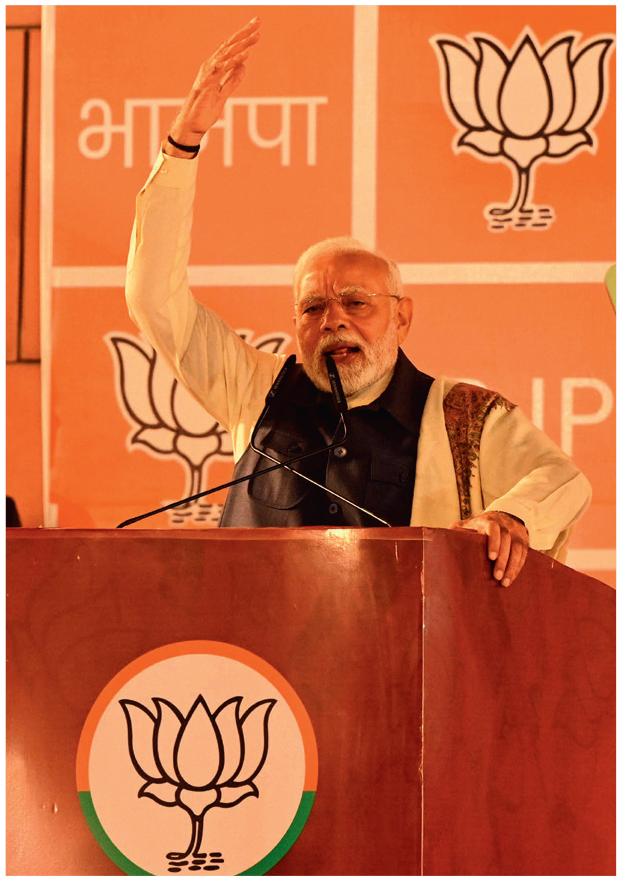
ABOVE: Narendra Modi, Prime Minister of India, celebrating his party’s victory in the Maharashtra Assembly elections and in several bypolls at BJP headquarters in November 2024
CREDIT: (Trump) Julien Mattia / ZUMA Wire / Alamy; (Modi) Sipa US / Alamy
Footnotes