




Abstract

ABOVE: Palestinians inspect the site of an Israeli strike on tents of displaced people in Deir Al-Balah, the central Gaza Strip in November 2024
CREDIT: Imago / Omar Ashtawy / Alamy
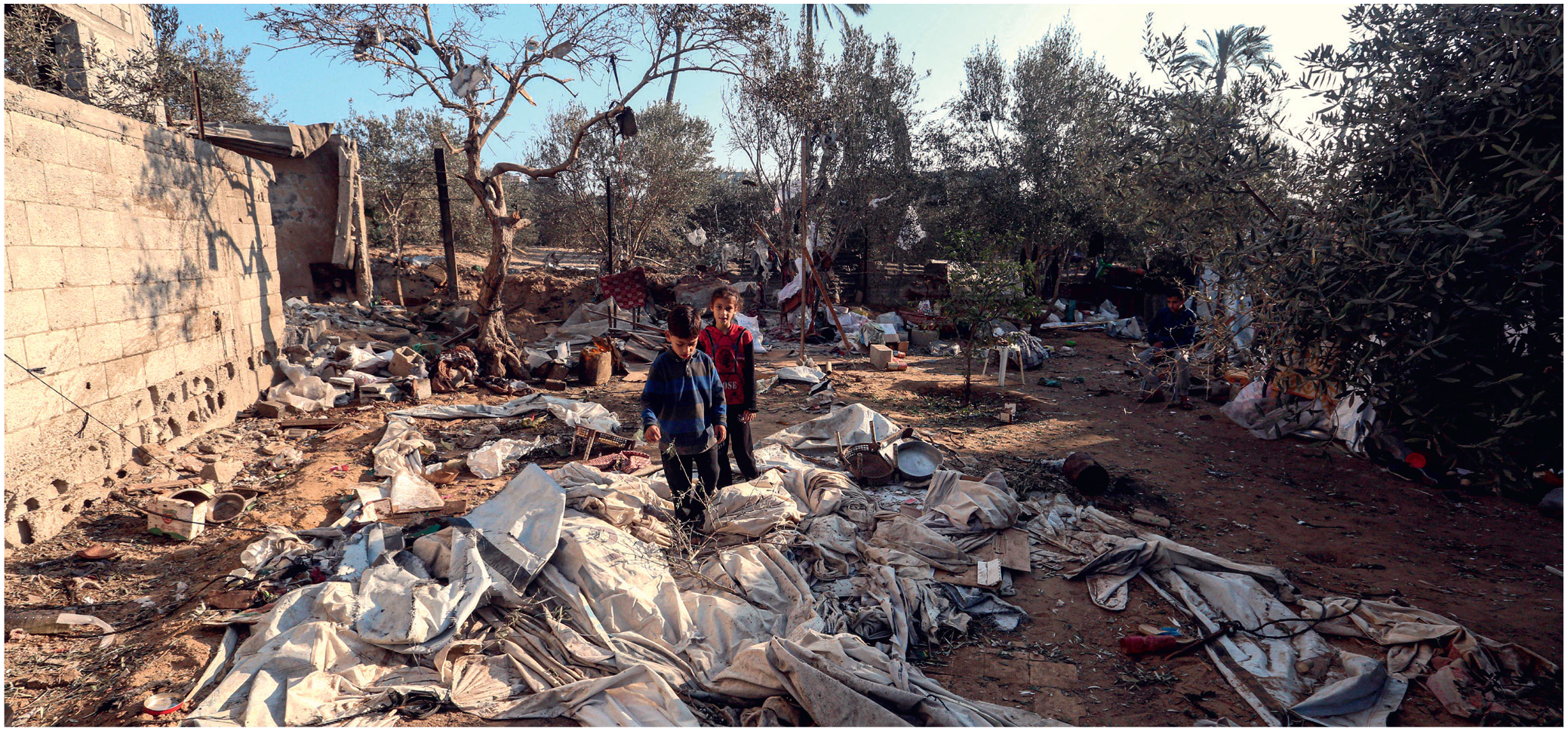
IT’S BEEN MORE than a year since Hamas’s brutal incursion into Israel on 7 October, when the militant group killed 1,200 people and took more than 250 people hostage. It was the deadliest day for Jewish people since the Holocaust. In response, Israel launched a devastating war on Gaza that has caused, and continues to cause, immense suffering and destruction. Benjamin Netanyahu’s government has killed nearly 44,000 Palestinians, including at least 14,000 children.
There has also been an assault on free speech and the press. According to the Committee to Protect Journalists (CPJ), this has been the most lethal conflict for journalists since 1992, claiming the lives of at least 137 media workers (overwhelmingly Palestinian), at least five of whom were directly targeted by Israeli forces.
The war has since expanded to Lebanon, where Israel has gone on the offensive against Hezbollah and more than 3,200 people have been killed. Meanwhile there have been back-and-forth missile attacks with Iran. Serious concerns remain worldwide that the situation could escalate into a full-blown regional war. A recent ceasefire deal agreed between Hezbollah and Israel offers a small glimmer of hope that an end to the fighting could be in sight -though when, we do not know.
Amidst the human devastation, displacement and death, social media has proven itself to be at once a tool for fearless reportage and propaganda, for free speech and silencing. When international news crews were banned from entering conflict zones, brave on-the-ground Palestinian reporters risked their lives to share videos and testimonies online to show the world the truth. Yet social media has also been a cataclysmic playground for vitriol.
Exactly one year on from 7 October 2023, London-based Israeli journalist Dimi Reider reflected on the suffering of both Palestinians and Israelis in this short piece of prose reprinted below. He originally wrote it for Elon Musk’s platform X, which has been rife with hatred targeted at both Jewish and Muslim communities, Israelis and Palestinians, often by those with no connection to the conflict.
He reflects on the binary, “us-versus-them” culture that has propagated online in self-righteous, tit-for-tat echo chambers, whilst those in Gaza, Israel and Lebanon, and their loved ones elsewhere, are forever scarred by the horrific brutality of the past year.
One endless day, and what comes after
I THOUGHT I’D be writing a big analytical piece on the anniversary of 7 October. Where we’ve been, where we’re going. What I got wrong, who got what right. And maybe I’ll write some of this yet.
But in truth, it doesn’t feel like the day for it. Not only because I don’t want to add to the cloud of analysis on a day so many people, from every side, are coming up here to share their own personal pain. But mainly because it doesn’t feel like an anniversary. Anniversaries imply revisiting an event defined in time: a death, a marriage, a birth, the establishment of a state, the publication of a book, the inauguration of something, the ceremonial end of something else.
None of this applies: 7 October never ended, and not just because Israeli TV seems to eternally return to the stories of that one day at the expense of so many other stories. 7 October never ended because it became 8 October and 10 October and 12 October, and then we killed Refaat, who loathed the Israeli state but taught Hebrew poetry to his students in Gaza; and Vivian’s body was found and “missing” was augmented to “dead” over and over again, and children were blasted apart, so many children, and we may or may not have torched that first hospital but we’ve flattened so many more since, and so many hearts broke, and broke again, and broke again, or cracked, or hardened, or simply stopped. And we killed hostages, and they killed hostages, and in the midst of it all, one hostage, an older woman, on her way home, stopped before one of her captors, and bid him farewell, and the world saw his hand come off the trigger of his assault rifle to reach out and shake hers.
And then we went right back to it, and it got worse, and worse again, and we graduated from disproportionate violence to genocidal almost seamlessly because most genocides snowball from tiny decisions and from impunity, not from a flowchart in a letterhead notepaper in a villa by a lake; and every red line any of us ever imagined turned out just that - imaginary: because it turns out that yes, people who’ve been through horrible things, or feel like they’ve been through horrible things will do horrible things, and film themselves doing it, and make stupid jokes about doing it, and then do them again, all the while feeling like they’re the victims; and no one should be surprised because no one is, in fact, under an obligation to become a better or more forgiving person because of their trauma.
And meanwhile, folks on, say, Twitter, will piss all over the graves of yours or somebody else’s loved ones, excuse or shrug off every atrocity, and then imagine atrocities not yet committed and loudly luxuriate in wishing those on people they never met, their fists pounding their keyboards, their teeth chattering even if their jaws are clenched or stretched in a rictus grin - because alongside the rage everyone is afraid, or afraid of being afraid, or afraid of seeing each other or seeing each other in each other; and behind the clatter of the keys, there is a thin, almost constant, almost silent scream: WHY CAN’T YOU SEE ME and HOW DARE YOU NOT SEE ME and HOW DARE ANYONE SEE YOU WHEN THEY SHOULD SEE ME, or, somewhat more sanely, can’t they please, please, see me, for a change. See us.
People who’ve been through horrible things, or feel like they’ve been through horrible things, will do horrible things, and film themselves doing it
And it’s still going on, expanding, corroding every bit of the land, and now it’s in Lebanon and in Syria and in Yemen and perhaps even soon in Iran, and it’s poisoning even distant democracies, and the same politicians are still making the same excuses - yes, the same politicians; because incredibly, or all too credibly, not one person directly responsible has lost their job (except by assassination, which really isn’t good enough.) It’s 7 Oct v. 366, and Sinwar is still here, and Biden’s still here, and, God help us, even Netanyahu’s still here, now and for the foreseeable.
And so are we.
And it is this, quite simply, which gives me - not so much hope, which can make for a dangerous medicine, but rather the plain knowledge of perseverance. We are still here, Palestinians and Israelis, clenching our homeland or stretching to it from great distance. Still here.
(I don’t for a minute take this for granted; I was fairly sure, for example, that all surviving Gazans would be pushed out to Egypt within the first quarter; this hasn’t happened yet, and I’m almost sure that it won’t; among the great cruelty, a small, bitter mercy.)
We are still here, and among the great rending there are countless stitches that hold - tying us to the land and to each other: in part thanks to people managing to stay human, in part thanks to very hard, unglamorous small-scale mediation work, we have not yet become Rwanda.
And there are new stitches being made every day. New dialogue groups open and instantly get oversubscribed. New projects, single-identity and cross-community, are being thought up, organised, put into play. New ideas, sidestepping or venturing far, far beyond a reheated Oslo process; new alliances, new ideas, new vocabularies, new modes of being together and being apart, new ways of thinking about each other even for those who aren’t talking to each other yet. The Palestinian liberation movement is rejuvenating and rebuilding. Israelis you would never expect to be taking on the toughest challenges and questions, or to give radically new answers, are doing just that.
And we killed hostages, and they killed hostages, and in the midst of it all, one hostage stopped before one of her captors and bid him farewell
There’s a lot going on. Anaemic? Bit dull? Bit flat? Not as evocative as the horrors I listed earlier? Perhaps. We are generally not wired towards things like community work, mediation, deconfliction; you don’t need adrenaline pumping and heart racing and every nerve in your body engaged to draw lines on a flip chart or sit in a room for the 30th time trying to catch the subtlest change in tone or in language that hints at a possible opening to change. But this, too, is the work that needs doing and it is being done, on scales more grand and more granular than many of us might imagine.
So yes. It’s 7 October, the 366th of this war. Year 95, if that’s how you count, of the conflict. Year 76 of the Nakba and of the Jewish state. And the work goes on. Because even if we aren’t there yet, there is an “after” to the now. And we’re still here, and there is much good work worth doing - some now, some being prepared for later, some being written for much, much later on.
What more can one say. Condolences to those grieving in ways I can’t even conceive of. ✘
Footnotes