




Abstract
Health inequalities are silencing marginalised communities, writes
MODERN MEDICINE IS a wonderful thing. Before Edward Jenner’s development of the smallpox vaccination in 1796, infectious diseases and viruses killed millions. The introduction of anaesthetic gases during surgical procedures in 1846 eliminated the excruciating pain of surgery. And before Alexander Fleming’s discovery of penicillin in 1928, people died unnecessarily from cuts and grazes.
But the benefits of modern medicine are not felt equally around the world. In this issue, we explore the forgotten patients in global healthcare settings – the marginalised groups who fall through the cracks or are actively shut out of healthcare provision, then ignored or silenced when they raise concerns.
On compiling this issue, it was obvious that the treatment of women is a huge area of worry across continents.
In the UK, Martin Bright investigates the state of whistleblowing in the National Health Service. Inadequate protections and actively malicious practices by management are preventing staff and patients from speaking out about dangerous care, particularly in maternity services.
Exiled Afghan journalist Zahra Joya investigates the dire state of women’s healthcare in Afghanistan, which is now virtually non-existent under the Taliban. In Somalia, Hinda Abdi Mohamoud explores how those who speak up about the horrendous practice of female genital mutilation (FGM) are punished.
We also look at inequality where gender and ethnic discrimination collide. Katie Dancey-Downs investigates the abhorrent treatment of Roma women in Slovakia and the Czech Republic – particularly the secrecy shrouding their historical subjection to forced sterilisation. Mackenzie Argent speaks to UK-based anti-racism campaigner and medical doctor Annabel Sowemimo about the insidious self-silencing of Black women in health settings for fear of being labelled as “aggressive” or “attention-seeking”.
In the fog of war, one repercussion little spoken about is psychological impact. I explore the mental health issues facing children in Gaza, many of whom are left literally speechless as trauma has caused them to lose the ability to verbally communicate.
No health-themed issue would be complete without a look at the unfettered rise of health misinformation online. Mark Honigsbaum examines what it means when this rhetoric is repeated by those in positions of power, focusing on the USA’s new health secretary Robert F Kennedy Jr. Meanwhile, Ella Pawlik tells the stories of those who had legitimate adverse reactions to Covid vaccines, analysing how they have been shut out of the conversation on vaccine safety.
Outside the special report we explore the rise of corruption in Greece and delve into how digital activism is being used as a tool of resistance in Myanmar. In our culture section, we feature a short story by Ariel Dorfman and anti-colonial poetry by Diane Fahey.
Just like free speech, healthcare is an indisputable human right. But for many around the globe, both these rights are being removed in conjunction with each other. Through telling their stories, this edition aims to shine a light on these injustices and – we hope – empower more people to speak up for the right to health for themselves and others.
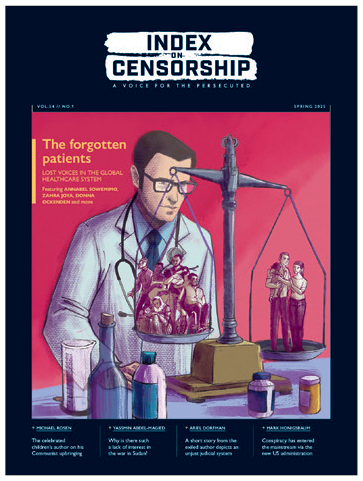
The scales are tipped against minorities
SYRIAN-DUTCH VISUAL ARTIST Diala Brisly was brought up in Damascus.
Initially, she created art for her own enjoyment but eventually sent some of her 2D animation work to Syria’s Spacetoon children’s TV channel.
Brisly’s work focuses on themes of justice, psychology and wellbeing.
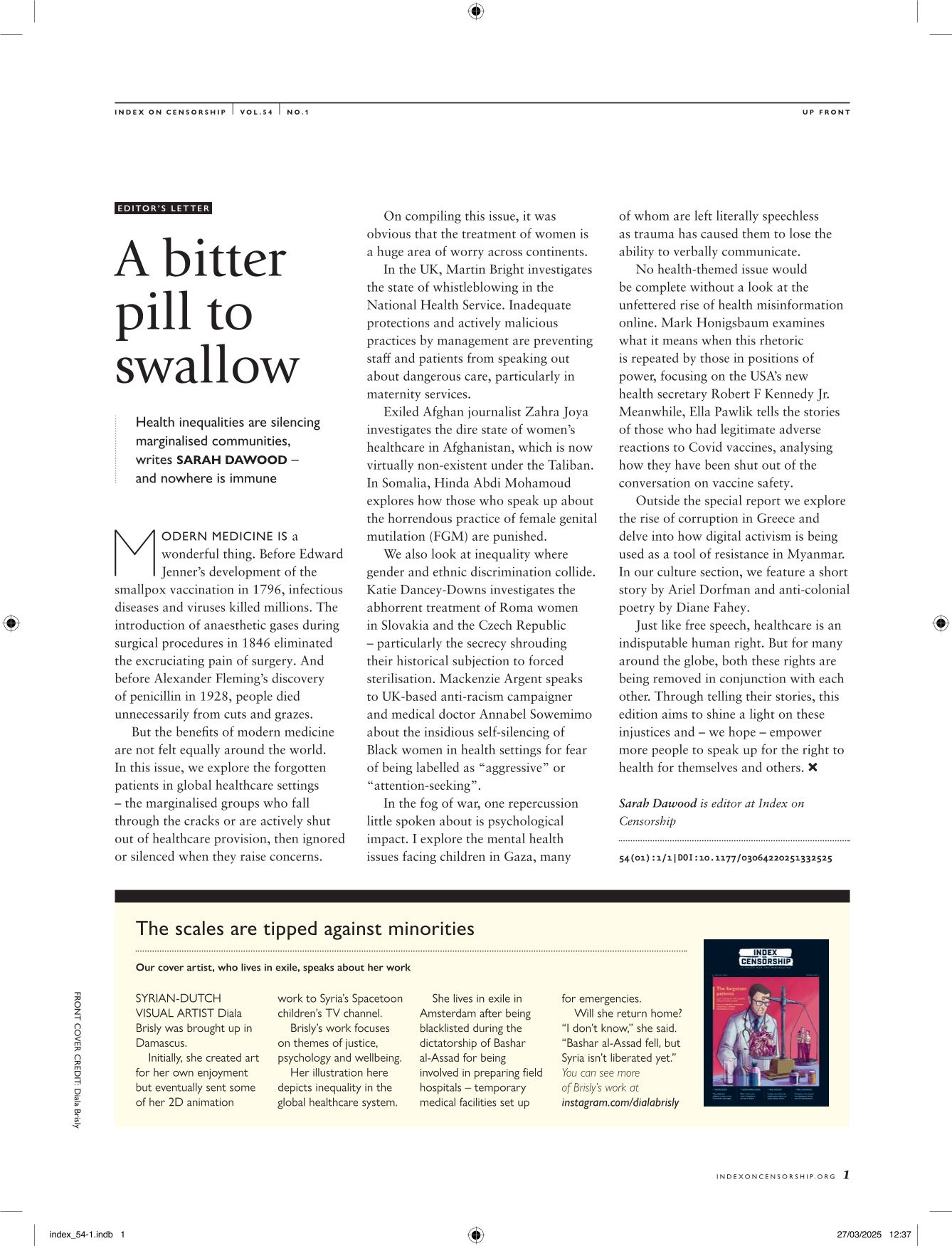
Her illustration here depicts inequality in the global healthcare system.
She lives in exile in Amsterdam after being blacklisted during the dictatorship of Bashar al-Assad for being involved in preparing field hospitals – temporary medical facilities set up for emergencies.
Will she return home? “I don’t know,” she said. “Bashar al-Assad fell, but Syria isn’t liberated yet.” You can see more of Brisly’s work at instagram.com/dialabrisly
FRONT COVER CREDIT: Diala Brisly
Footnotes