




Abstract

A young queer artist in Siberia tells
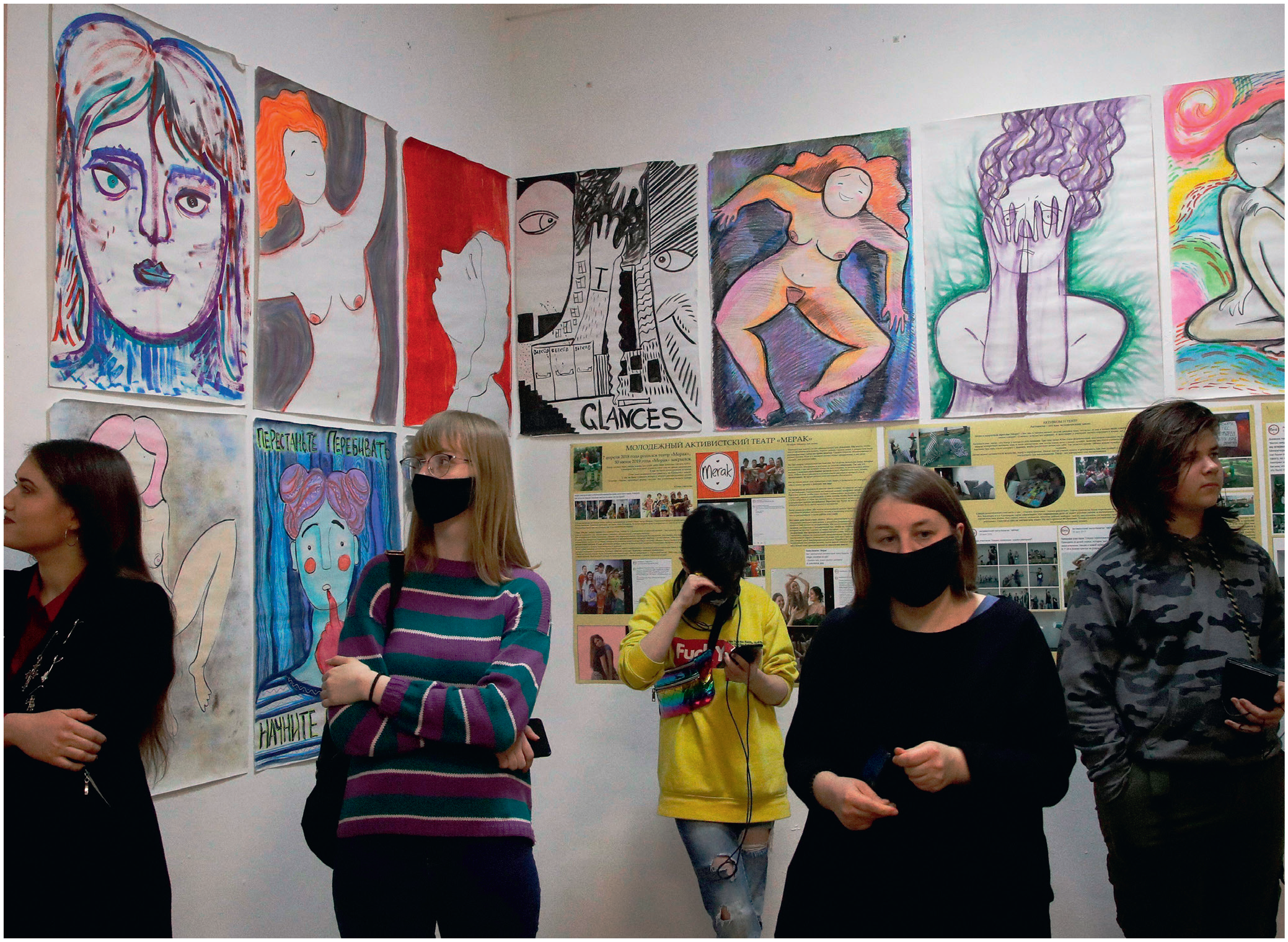
LGBTQ+ art has been under siege in Russia – this art exhibit by Index Freedom of Expression Award winner Yulia Tsvetkova in St Petersburg in 2021 could no longer be displayed in the country, and Tsvetkova herself was forced into exile in 2023
CREDIT: AP Photo / Dmitri Lovetsky
“I’M ASHAMED TO say this: I’m scared to go outside,” said Misha (not his real name), a 25-year-old queer visual artist and photographer, speaking to me over the phone from Siberia.
“It was tough when the war [in Ukraine] began, I felt terrible about it,” he said. When Russian President Vladimir Putin announced a military call-up in September 2022, Misha left his homeland for Norway, to take up an artist residency.
But, he explained, he felt lost there. Back home, he had photographed Siberia and its Indigenous people and didn’t see how as an artist in exile he could contribute to Norwegian society. Ultimately, he didn’t find work and was left with no choice but to return to Russia. He was hoping that going back to his native land would allow him to find meaning in life again and to carry on with his art.
But from the moment he crossed the Russian border, he became aware of a “colossal change” in the atmosphere. He said “a fear appeared” within him. First and foremost, he was afraid to be persecuted for being gay. In November 2023, just weeks before he returned home, the Supreme Court of Russia labelled “the international LGBT movement” extremist. Since then, places where queer people gather around the country, particularly nightclubs, have been targeted at least 30 times. During some of the raids, the police humiliated and beat men, and collected their personal data.
At least 13 LGBTQ+ extremism criminal cases have now been opened over the past year. In one egregious case last December, Andrei Kotov, who had been allegedly running a travel agency for LGBTQ+ people, died in pretrial detention. Kotov was beaten up, subjected to electric shocks and placed in solitary confinement. He was facing up to eight years in prison if convicted, and his lawyer said he will be tried posthumously. The authorities reported that he had killed himself.
The police have also begun pursuing people just for displaying the rainbow flag which has now been deemed “an extremist symbol”. In one case, in the city of Nizhny Novgorod, Anastasia Ershova spent five days in jail for wearing rainbow-coloured earrings.
Another piece of anti-LGBTQ+ legislation passed in 2022 outlawed “gay propaganda”. In the city of Ufa, prosecutors used this law to fine a 16-year-old schoolboy for wearing lipstick in a video published on social media. And in Siberia, following a complaint about “LGBT propaganda”, a theatre was forced to cancel a children’s play, because the role of a princess was played by a man. In July 2023 President Putin added to restrictions on queer and trans people by signing legislation which banned people from medically changing their gender.
As a result of these laws, and the intensifying homophobic and transphobic rhetoric of the government, queer people now face growing threats to their safety. According to a report by LGBTQ+ rights groups Vykhod and Sfera Foundation, 43.5% of LGBTQ+ respondents experienced violence or harassment in 2023, compared to 30% the year before.
Misha told me that when he arrived back in Siberia, the first thing he wanted to do was take off the bright green hat which he wore, to avoid being perceived as queer.
“But I decided that [keeping my hat on] would be my small act of resistance,” he said.
But since he has returned, his voice has become deeper, and his manners more stereotypically masculine.
“Nonetheless, I try to assert my [queer] identity the way I can – at the very least, keep my hat on!” he said.
He said that he felt especially exposed in the small city where his parents live because he couldn’t “get lost [in the crowd]” there and he didn’t feel physically strong enough to defend himself if he were attacked on the street.
He didn’t feel this way before the war, when, according to him, LGBTQ+ people were in a “grey zone” where their existence was neither prohibited nor authorised.
“What about now?” I asked. To which he answered: “Now we are in the red zone”.
“[Today] I have to hide my [sexual] identity, avoid showing my feminine side and refrain from voicing how I feel about this situation.”
He recalled the day a friend, who is gay, took him in his arms in the street and held him, “more than the socially acceptable one-and-a-half seconds”.
Misha remembered: “A police car drove by with the headlights on, and so I said [to my friend], ‘[Stop], I don’t want [the officers to ask us] questions’.” He didn’t want to risk it all for a hug.
He recently came out to his mother and father and, as he predicted, felt rejected by them. He stressed that for his parents, his sexual identity “is simply about sexual preference, or even some deviation from the norm”.
This perspective, he added, mirrored the government’s narrative.
He said that he hadn’t come out on social media because “it could be interpreted as [LGBTQ+] extremism or propaganda” by the authorities.
Misha said he was living in a state of constant fear which has prevented him from feeling inspired to pursue his work; however, he doesn’t need to censor his art, as it does not centre around LGBTQ+ politics.
Alongside his fear of punishment for being gay is a fear of conscription.
“When I first arrived here, I was afraid that security forces would knock on my door to take me [to the army office],” Misha recalled.
He decided to stay at a friend’s apartment in a modern building, where there were security cameras and a concierge, which he said the police were not able to target as easily. This made him feel safer, albeit not entirely secure.
Since the military draft was announced, civilians have been sent to Ukraine to fight. Police pluck men from the streets, the subway, universities and even bars and dance venues. In November 2024, security forces handed draft notices to men during a raid of a queer nightclub in Moscow.
Misha is scared that one day the authorities will use a centralised database to draft young men like him, who have not yet been called up. A law authorising the implementation of such a system was signed in April 2023.
With this threat looming, he said: “I have to find a way to leave here as soon as I can.”
Footnotes