




Abstract
The tech entrepreneur is now at the heart of the Trump administration.
PEOPLE WAKING UP in Britain on 11 April 1992 were told by The Sun newspaper that it was “The Sun wot won it” after John Major’s slim victory in a general election that was expected to go the other way.
Now, a third of a century further on, it is relevant to ask whether it was X wot won it for Donald Trump in the recent US presidential election.
X’s owner Elon Musk was certainly on-message in the run-up to the election and he now appears to have been justly rewarded for his support with a wide-ranging role as an adviser and head of the Department of Government Efficiency.
With this in mind, Index decided to analyse what Musk was posting about in the run-up to the election. Musk has always been a power user of X (and previously Twitter), so it was always going to be an interesting analysis.
The analysis covers a year of posts to X between 27 January 2024 and 26 January 2025, a period that spans nine months before the election to just after Trump’s inauguration. We chose this period to see both cause and effect.
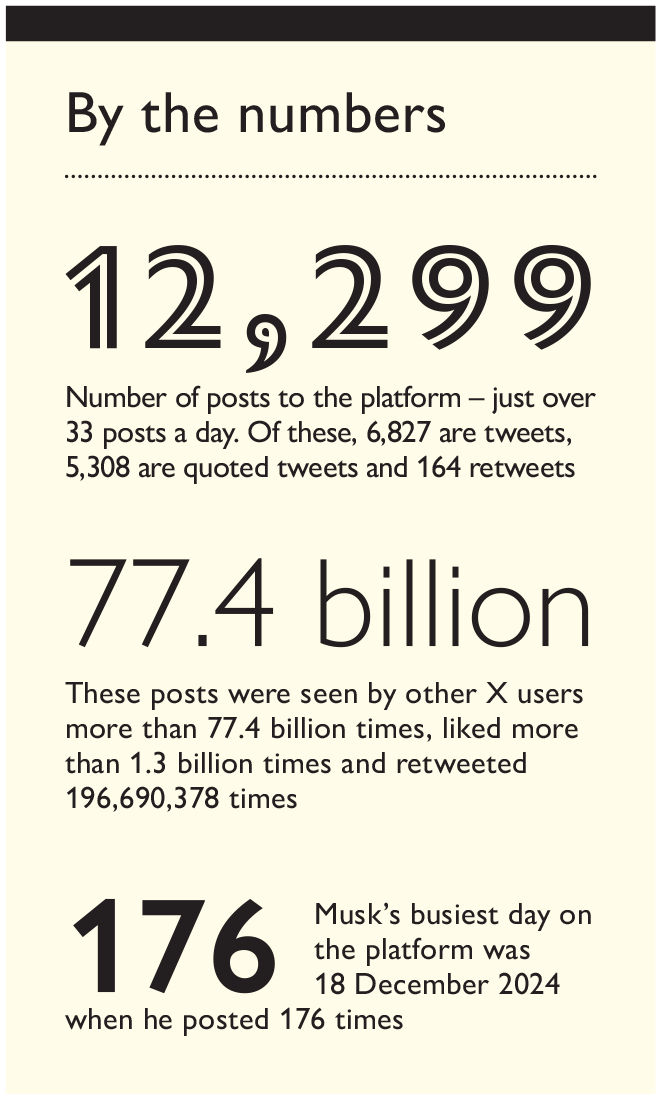
In that year, Musk made an incredible 12,299 posts to the platform – just over 33 posts a day. Of these, 6,827 are tweets, 5,308 are quoted tweets and 164 retweets.
These posts were seen by other X users more than 77.4 billion times, liked more than 1.3 billion times and retweeted 196,690,378 times, a global influence possibly only matched by the Pope and Lionel Messi.
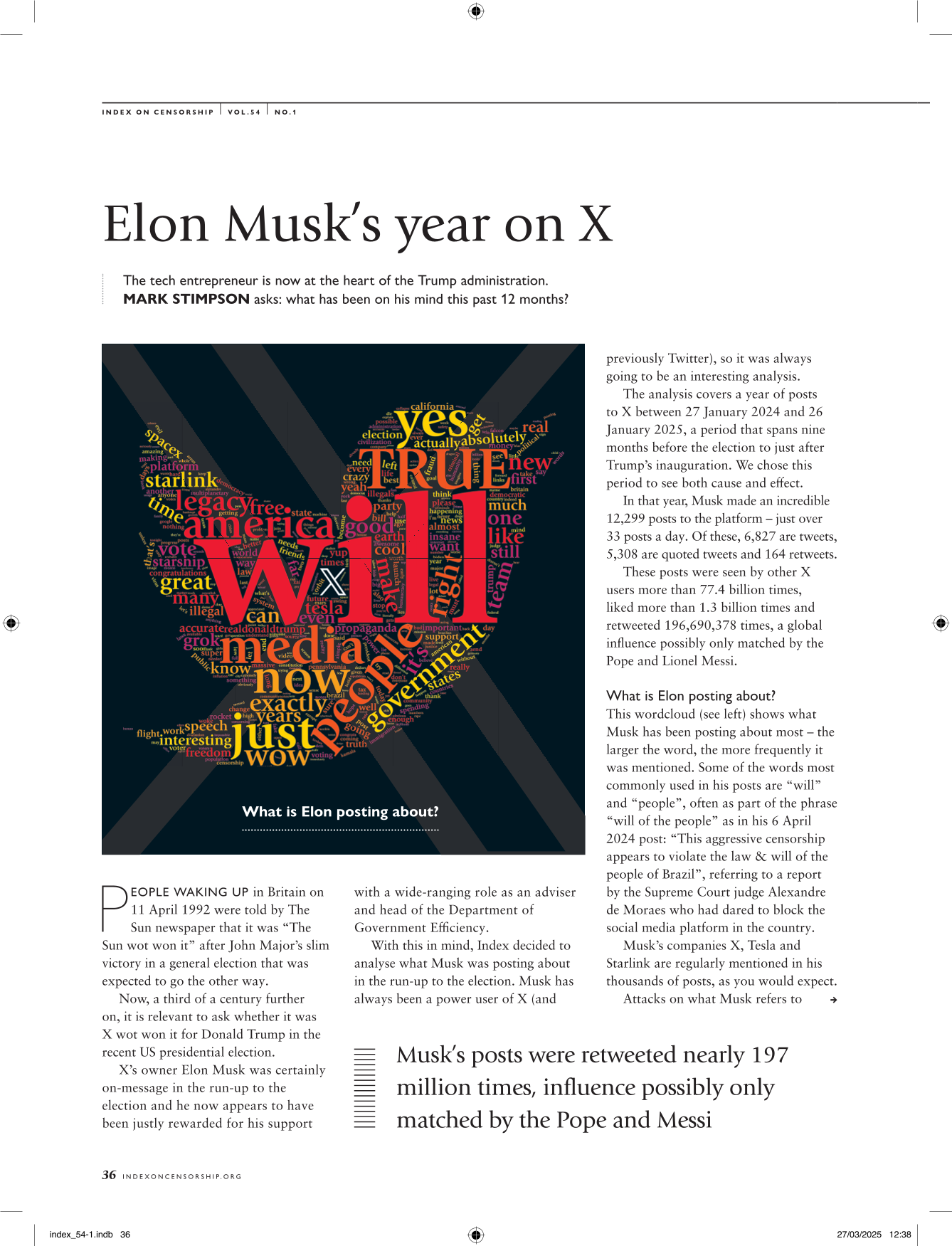
What is Elon posting about?
This wordcloud (see left) shows what Musk has been posting about most – the larger the word, the more frequently it was mentioned. Some of the words most commonly used in his posts are “will” and “people”, often as part of the phrase “will of the people” as in his 6 April 2024 post: “This aggressive censorship appears to violate the law & will of the people of Brazil”, referring to a report by the Supreme Court judge Alexandre de Moraes who had dared to block the social media platform in the country.
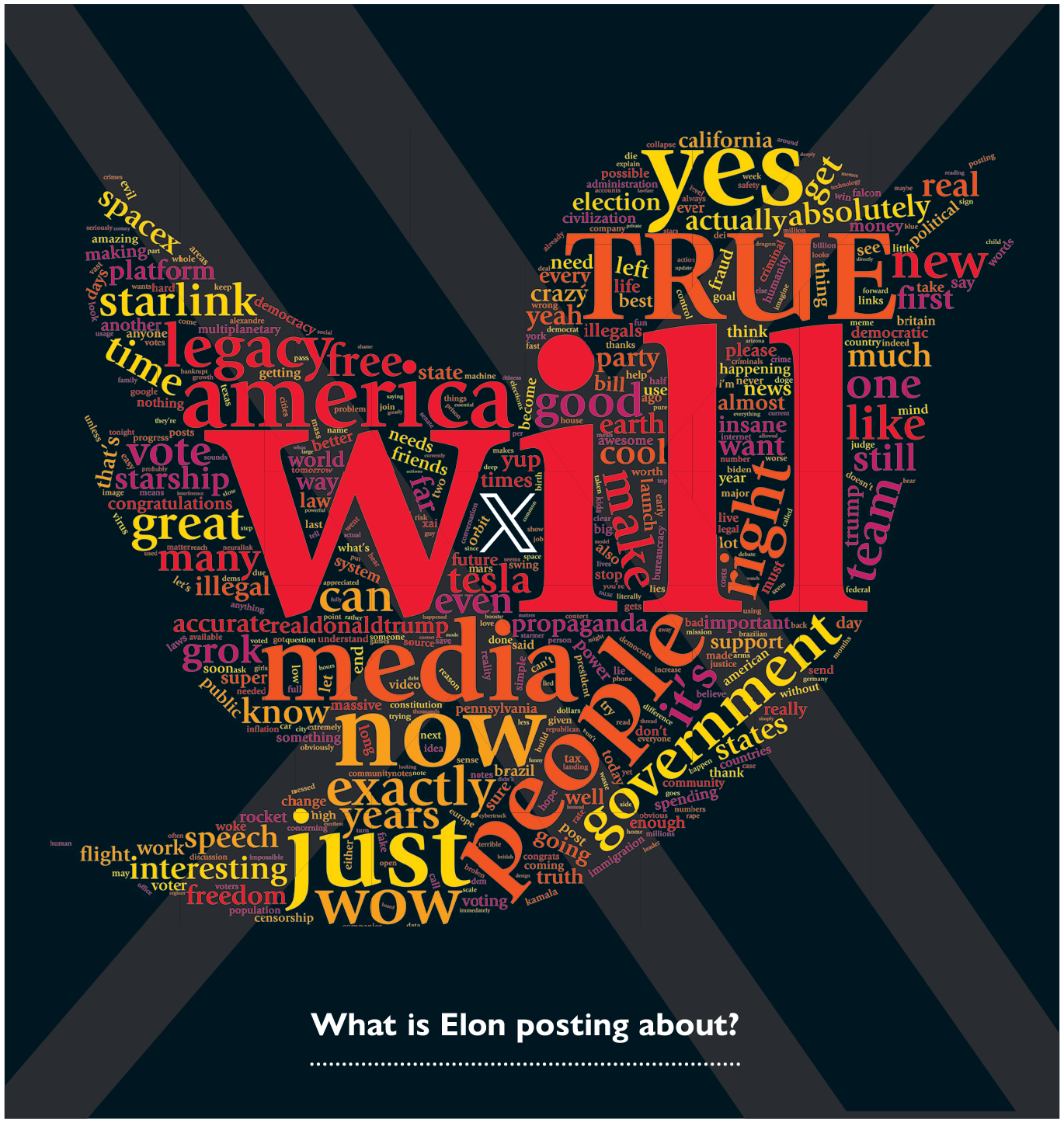
Musk’s companies X, Tesla and Starlink are regularly mentioned in his thousands of posts, as you would expect.
Attacks on what Musk refers to as the “legacy media” are a common theme throughout the year, with the phrase appearing in 224 posts. These include “An attack by the legacy media in Germany is exactly what I expected and wanted to happen. It will only help the @AfD win” on 10 January 2025. Or “Legacy media is written by the FAR LEFT. Only 3% of journalists are Republican! It is borderline illegal in newsrooms to be a Republican journalist” on 22 December 2024.
Musk has made it abundantly clear what the alternative to the legacy media should be – users of X. His frequently repeated mantra “You are the media now” appeared in 40 posts during the year.
The phrase “free speech” crops up in his posts 40 times during the year, including on 13 March 2024 where he declared “Free speech is the bedrock of democracy” and on 6 September when he said “Kamala wants to destroy your right to free speech under The Constitution”. This post was in response to US Daily Mail reporter Charlie Spiering posting on X that Harris had previously said she would use the Department of Justice (DOJ) to “hold social media platforms responsible” for “misinformation”.
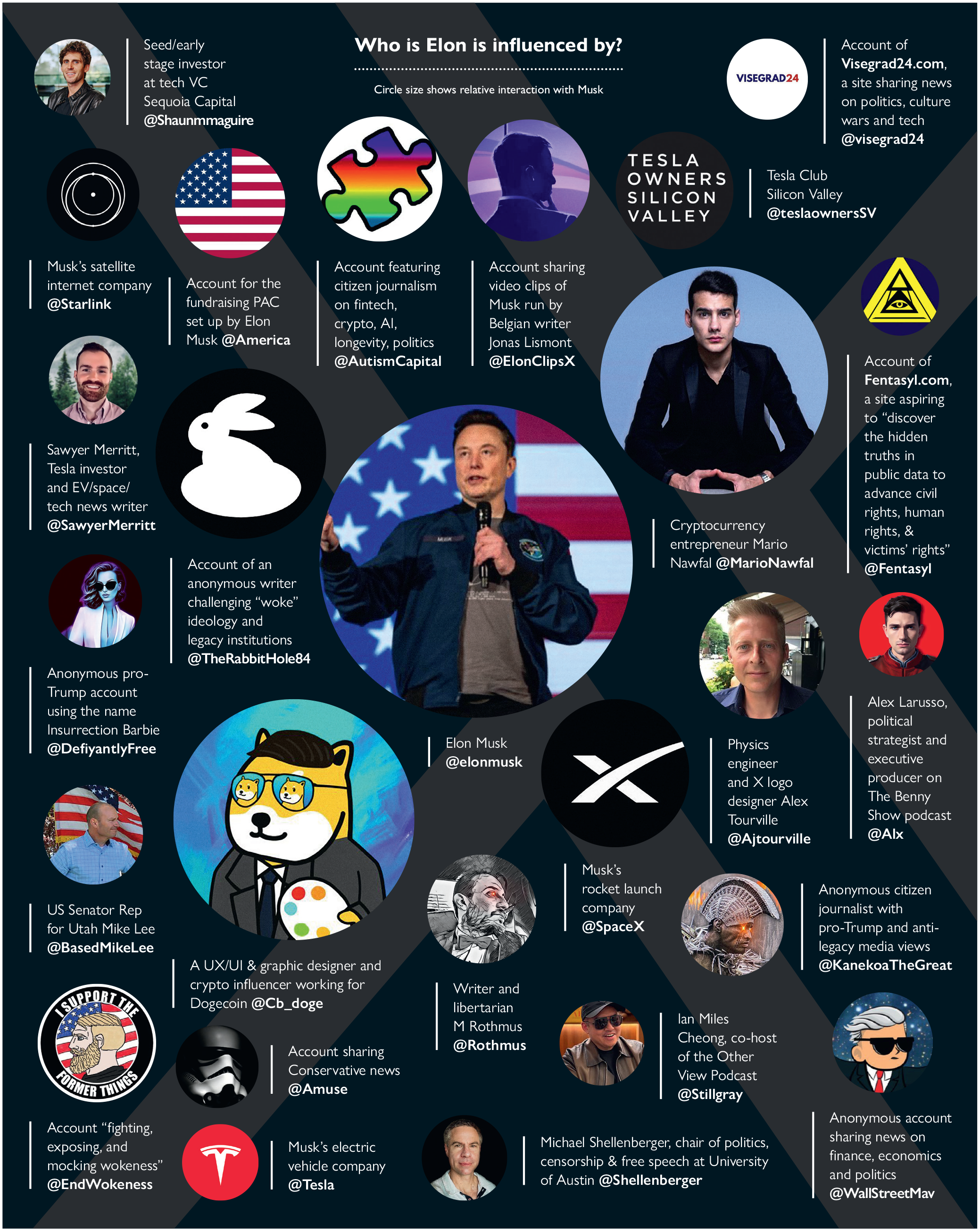
Who is Elon influenced by?
It is interesting to look at the individuals and accounts that Musk quoted and retweeted during the course of the year. These include:
■ GB News (
■ Nigel Farage (
■ Tommy Robinson (
the media now.”
When is Elon posting?
This chart shows when Musk is active on X. The x-axis shows the number of days since the series began, so starting at 26 January 2024 on the left and ending at 25 January 2025 on the right. The y-axis shows the time of day that the post was made (based on the Central Standard Time zone, as Musk is based predominantly in Austin, Texas). This scatter plot shows two things – you can see that Musk is less active between 3am and 9am CST, suggesting that this is when he sleeps. It also shows that he massively ramped up his activity on the platform from around the middle of August 2024, around a month after the official nomination of Donald Trump and J D Vance as the Republican candidates in the presidential election. In the first half of the year, Musk posted on the platform 2,381 times. In the second half of the year, this ramped up to 9,918 times. The day on which Musk posted most often was 18 December 2024, when he posted 176 times. It was the day that a deal was reached on US government spending after president-elect Trump threw his weight behind plans to avoid a government shutdown.
What have we learned?
This analysis is revealing, showing that Musk’s focus has been on a limited range of topics – his companies naturally, but also the sort of thinking that has now been confirmed as central to the second Trump presidency. It also reveals the sorts of people that appear to shape Musk’s thinking and there are few surprises – crypto fanboys and alt-right conspiracy theorists are front and centre.

Did Musk influence the outcome of the election? His million-dollar prize draws, where he gave away millions to voters in swing states, turned heads and will have converted some to the cause.
Media platforms always like to exaggerate their importance, as in the case of The Sun in 1992.
In November, experts at the Center for Countering Digital Hate issued a report which found that X and Musk’s posts played “a central role in enabling the spread of false information about the critical battleground states”. On a recent Wired podcast, journalist Tim Marchman said: “The thing that Musk brings above all else is this overwhelming attention vortex. He is constant, he’s ubiquitous, he is non-stop, he is pushing 1,000 things at any one time, and he commands attention as the richest man in the world.”
This analysis corroborates that.
Footnotes