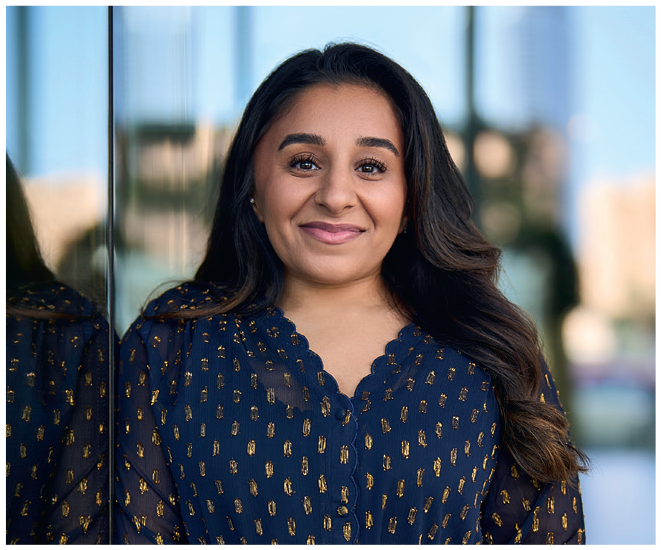
Award-winning disability inclusion specialist SHANI DHANDA has dedicated her career to combatting social inequality
“It’s frustrating that other people’s assumptions about me impact my life outcomes,” says Shani Dhanda
CREDIT: Sebastian Böttcher
SHANI DHANDA SET up the Asian Woman Festival, the Asian Disability Network and the UK’s Diversability Card, a discount card for disabled people. In 2020, she was
included on the BBC’s 100 Women list.
She speaks to Index about her journey into activism and her view of the new Trumpian world order.
INDEX What made you embrace activism?
DHANDA As a South Asian disabled woman from a working-class background, I’ve had to deal with a kind of exclusion that’s shaped pretty much everything about my life. There’s this constant feeling of being over excluded or underestimated, not just because of my health condition [a bone condition called osteogenesis imperfecta], but because of where I’m from and who I am. These overlapping parts of my identity shape how others view me, often limiting my potential before they even give me a shot. It’s frustrating that other people’s assumptions about me impact my life outcomes. That’s what pushed me to become an activist.
INDEX How have attitudes to disability changed in Britain since you were a child?
DHANDA Some improvements have been made, but many places remain inaccessible; transport is still not accessible and buildings often lack ramps or lifts. However, it’s the negative attitudes towards disabled people that remain the most stubborn barrier. When it comes to employment, ableism is still a huge issue. Disabled people are twice as likely to be unemployed and cuts to social care continue to hit us the hardest.
INDEX How can marginalised groups get their voices heard?
DHANDA By being clear about what they’re trying to achieve – whether that’s better access to healthcare, more representation or real change in policy. Organising through community-led advocacy, using social media to amplify their messages, and partnering with allies in healthcare and policy can make a huge difference.
INDEX How do you feel about the executive orders on diversity, equity and inclusion (DEI) Donald Trump made on entering office?
DHANDA For me, it was a reminder that the fight for real change isn’t always straightforward and it felt like it would set back our progress. But it also made me feel more determined. It pushed people to speak up and take action, proving that we’re not backing down from fighting for fairness and inclusion no matter how much resistance there is.
INDEX Others now seem to feel empowered to persecute women, people of colour and disabled people. Will people still speak out?
DHANDA I don’t always feel supported in those moments. As a broadcaster I regularly get trolled. First, they’ll target my disability, then my race, ethnicity and nationality and, if they get to it, maybe my gender. It’s like there’s this constant pressure to stay quiet because speaking up often feels like it just brings more hate. But, despite that, I keep pushing; the more we speak the more we stand a chance of changing things.
INDEX If you were jailed for your activism, which book would you take with you?
DHANDA But What Will People Say? Navigating Mental Health, Identity, Love and Family Between Cultures by Sahaj Kaur Kohli.
INDEX Which piece of art has inspired or moved you most?
DHANDA The Revolution Will Not Be Televised, by Gil Scott-Heron.
INDEX Which news headline would you be happiest to read?
DHANDA “Intersectional inclusion legalised globally: A new era of equity for all”.
Footnotes
Shani Dhandais an inclusion accessibility specialist and broadcaster. Follow her at @ShaniDhanda