



Abstract
Social learning theory is one of the most prominent general theories of crime. Yet recent research has called into question its applicability to all offenders. Specifically, the influence of antisocial peers has been found to exert a stronger effect among those individuals evincing higher levels of criminal propensity (deemed social amplification), whereas other components of the theory have either not been shown to interact with criminal propensity or not been tested. This study examines several social learning theory components to determine whether its influence is dependent on an individual’s level of self-control. Results suggest little support for the social amplification hypothesis as the components of social learning theory were found to operate similarly across individuals regardless one’s level of self-control. Implications for criminological theory are discussed.
Social learning theory is a popular criminological theory, and has received extensive support (Akers, 1998). As a general theory of crime, the elements of the theory—differential association, differential reinforcement, procriminal definitions, and imitation—are not only purported to explain a wide variety of offending and deviant behaviors but also are applicable to all individuals. That is, social learning theory is germane to explaining the offending of any given individual.
Recent developments, however, have called the generality of social learning theory into question. Specifically, the influence of antisocial peers has been found to exert a stronger effect among those individuals evincing higher levels of criminal propensity (Ousey & Wilcox, 2007; Wright, Caspi, Moffitt, & Silva, 2001). However, other components of the theory have either not been shown to interact with criminal propensity or not been tested. The state of the empirical research, therefore, is inconclusive in regards to whether social learning theory is a general theory of crime that is relevant to all types of offenders.
The current study advances our understanding about the applicability of social learning theory across individuals with varying levels of criminal propensity. More specifically, we assess whether differential association, differential reinforcement, and procriminal definitions are moderated by self-control. To the extent that these elements operate similarly across levels of self-control, social learning theory can be viewed as a general theory of crime. If, however, one or more of these elements interacts with self-control, it would suggest that social learning theory should be integrated with other theoretical perspectives. To assess these issues, the current analysis uses an adolescent sample (n = 1,674) drawn from middle and high schools.
Background
For some time, there has been an ongoing debate within criminology surrounding the breadth of what a theory should explain. On one hand, general theories of crime and criminality suggest that a variable (e.g., self-control) or set of variables (e.g., procriminal definitions, differential reinforcement) can explain the universe of criminal and deviant actions. Furthermore, such theories are purportedly applicable to all offenders, meaning that the criminal (and deviant) actions perpetrated by any given individual can be explained by the same factors. On the other hand, advocates of specific theories of crime argue that crime and criminality are too heterogeneous, and no one factor can reasonably explain this divergent class of behaviors (or offenders). Instead, specific theories of crime and criminality focus on how crime and criminals differ, and what factors are most applicable to each. For instance, homicide and loitering have little in common other than the fact that they are prohibited by law. Violent, recidivistic felons, likewise, bear little resemblance to the delinquent whose criminal history is short-lived and circumscribed to the period of adolescence. Because of this heterogeneity, specific theories of crime focus on more homogenous crimes and types of criminals in an effort to provide a more succinct, and arguably valid, explanation.
An example of a general theory is social learning theory (SLT), as articulated by Akers. SLT is a general theory in that it purportedly can explain the universe of crimes, from aggravated battery to substance use. That is, factors that influence aggravated battery are also the same ones that effect substance use. In both instances, having procriminal definitions increases the likelihood of the crime occurring. A person who believes that violence and assault are acceptable means of getting what one wants is more likely to use violence. Similarly, a person who believes substance use is a suitable way to escape their perceived problems, or is an enjoyable experience, is more likely to engage in this behavior. Thus, despite the heterotypic differences in these two behaviors, they can both be explained by the same general factors.
Beyond procriminal definitions, SLT contains several other elements. One of the most important is differential peer association. Drawn from the work of Sutherland, this component of SLT indicates that an individual who is exposed to peers who are involved in antisocial behavior and/or who define antisocial behavior positively is more likely to engage in similar behaviors. Differential reinforcement is another element of SLT, which refers to the extent to which an individual is reinforced (or not) for involvement in antisocial behavior. Thus, the more rewards one is exposed to, the greater likelihood he or she will participate in antisocial behaviors. Finally, imitation is another facet of SLT and indicates that the mere witnessing of antisocial behaviors increases the likelihood an individual will behave similarly. Imitation likely plays a greater role in the initiation of a given behavior, and may be more important earlier in the life course. Similar to the discussion above on procriminal definitions, these factors can be used in the explanation of a wide variety of criminal and deviant behaviors. Furthermore, all four elements denoted in SLT are ostensibly applicable to all individuals.
In terms of empirical support, the literature has consistently supported each element of SLT. For instance, the criminogenic influence of antisocial peer relationships is one of the most robust findings in the criminological literature (Warr, 2002). Furthermore, several studies have found procriminal definitions, and to a lesser degree, differential reinforcement and imitation related to criminal and deviant behaviors (Pratt et al., 2010).
Despite the compelling theoretical nature of SLT, and the accompanying impressive support, there are some initial indications that call into question its generality. Specifically, there is burgeoning evidence that the influence of antisocial peers on antisocial behavior may operate differently depending on one’s level of criminal propensity. Wright et al. (2001) found that the effect of peers on antisocial behavior was stronger among those with lower self-control. Similarly, Ousey and Wilcox (2007) found that peers were a more potent correlate of delinquency for those with elevated levels of criminal propensity. Thus, there are two studies that indicate the peer effect may be more important among those with greater criminal propensity; stated alternatively, those with less criminal propensity are less influenced by antisocial peers. Notably, however, Ousey and Wilcox failed to find that the effect of procriminal definitions on delinquency was moderated by criminal propensity. Although preliminary, the findings suggest that the generality of SLT may not be accurate.
Wright et al. (2001) have offered an explanation of the differential effect of peers on antisocial behavior. Within their life-course interdependence model, these researchers suggest two complementary processes that can explain why many criminological factors may exert different influences on antisocial behavior depending on the type of offender. First, the social protection hypothesis indicates that protective factors (e.g., strong, prosocial bonds) offer greater protection among those with the greatest propensity to offend. The basis for this is that those higher in criminal propensity have more to gain from protective influences. Conversely, those with lower levels of criminal propensity benefit less from protective factors because such individuals are already much less likely to offend. The second process they offer is the social amplification hypothesis, which states that criminogenic factors exert a greater influence among those with elevated levels of criminal propensity. The rationale for this process is that those with greater criminal propensity are more easily swayed into antisocial action, and thus more susceptible to criminogenic influences. Thus, criminogenic influences (e.g., antisocial peers) have a more pronounced effect on those with higher criminal propensity. Wright and colleagues found considerable support for the life-course interdependence model; both prosocial and antisocial ties were more important among those lower in self-control.
The findings noted above appear to offer some support for the life-course interdependence model. That is, the effect of antisocial peers on antisocial behavior is stronger among those with elevated levels of criminal propensity. Nonetheless, there remain several unanswered questions. First, the differential effect of peers across levels of criminal propensity has been noted in only two studies. This novel finding requires additional empirical support. Second, it is unclear if other elements of SLT are also moderated by criminal propensity. As mentioned above, Ousey and Wilcox (2007) found that procriminal definitions did not significantly interact with criminal propensity, thereby suggesting that this component of SLT is invariant across different types of offenders. We are aware of no empirical analysis that has assessed whether differential reinforcement is moderated by criminal propensity. Given that antisocial peers is the only component of SLT shown to operate differently across propensity, it may not be accurate to call into question the generality of SLT but rather only one element of the theory.
We expect each component of SLT, as well as self-control, to exert significant main effects on antisocial behavior. Beyond these main effects, however, less definitive hypotheses are offered. Although SLT has garnered extensive empirical support, previous literature has rarely tested whether the components of this theory vary by criminal propensity. Similarly, the life-course interdependence model has not been subjected to much empirical analysis. Given this state, strong a priori hypotheses appear to be immature. On one hand, SLT is a general theory of crime, and if correct in this regard, none of the components of this theory should vary as a function of self-control. The life-course interdependence model, on the other hand, is a specific theory of crime and advances that differential processes are needed to explain offending based on the offender’s level of criminal propensity. Based on the very limited empirical evidence, we hypothesize that peers will significantly interact with self-control. Conversely, there is no empirical support suggesting procriminal definitions or differential reinforcement vary in this manner, and we therefore hypothesize that these factors will operate similarly across levels of self-control. If these hypotheses are confirmed, the weight of the evidence will favor SLT over the social amplification process articulated in the life-course interdependence model.
Method
Participants
The analyses were based on information collected from students in Largo, Florida, in 1998. This cross-sectional study was designed to examine crime and delinquency among middle and high school students. Participation was voluntary and conditional on passive parental consent. The total sample size was 1,674 students, with 621 from high school (37.3%) and 1,043 from middle school (67.7%). The sample was evenly split between males (49.9%) and females. The age distribution of Largo students was slightly positively skewed, reflecting the majority of students that were in middle school. The mean age was 13.8 years, whereas the range was 11 to 19. Seventy-four percent of respondents were White, 11.2% Black, 3.9% Hispanic, 3.1% Asian, and 3.8% other.
Measures
Antisocial behavior
The dependent variable—antisocial behavior—was a 17-item scale (α = .84) that asked participants to self-report whether they had ever engaged in any of the specific antisocial actions listed. The mean number of different acts committed was 5.35, with a standard deviation of 3.62 (see Table 1). Although there was a modest, positive skew (skew = 0.74, SE = 0.06), the scale was not transformed because an analysis of the residuals (of the predicted and observed values for each regression model) suggested the transformed scale departed from normality much more so than the untransformed scale. 1
Descriptives and Pearson’s Zero-Order Correlations
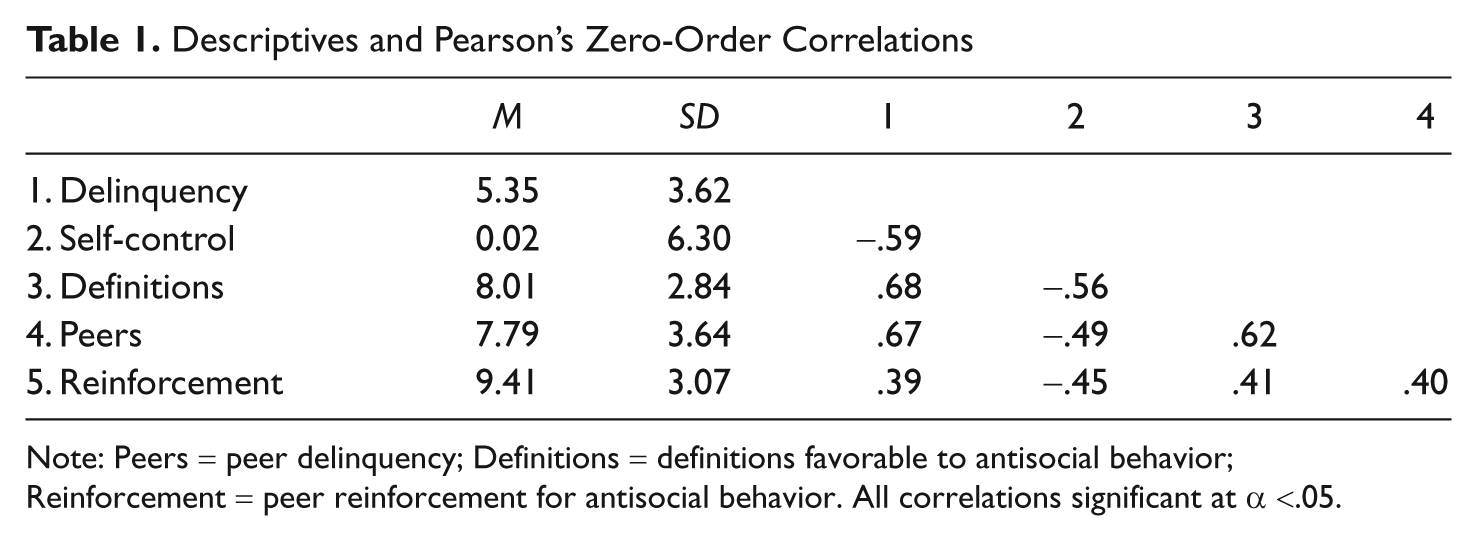
Note: Peers = peer delinquency; Definitions = definitions favorable to antisocial behavior; Reinforcement = peer reinforcement for antisocial behavior. All correlations significant at α <.05.
The operationalization of this variable was based on several factors. First, a broad measure was chosen that incorporated a wide variety of antisocial behaviors. Similar to other studies, there are both minor (e.g., truancy) and serious (e.g., attacked someone with a weapon) antisocial behaviors included in this scale. Also, the antisocial behavior scale is a variety scale. Psychometric analyses indicate that variety scales evince superior internal consistency, stability across time, and convergent validity compared to frequency scales (Bendixen, Endresen, & Olweus, 2003).
Social learning theory
Three components derived from the social learning perspective were examined: definitions, peer associations, and reinforcements. Definitions are attitudes one takes toward a behavior that he or she identifies as positive, neutral, or negative (Akers, Krohn, Lanza-Kaduce, & Radosevich, 1979). Definitions were operationalized as one’s positive evaluation toward four types of delinquency. 2 Responses ranged from 1 (strongly disagree) to 4 (strongly agree), with higher values indicative of procriminal definitions. The four items (α = .75) were summed and had a mean of 8.01 (SD = 2.84).
The second component of social learning theory assessed in this analysis was peer associations. This was measured by asking what proportion of the participant’s friends committed any of four types of delinquency with responses ranging from 1 (none of them) to 5 (all of them). The four items (α = .80) were summed and had a mean of 7.79 (SD = 3.64). Higher values are indicative of more deviant associations.
Lastly, differential reinforcements refer to the balance of rewards and punishments that strengthen or reduce behavior. Reinforcements were measured by asking if friends respected the participant getting away with any of four types of delinquency, with responses ranging from 1 (definitely would not) to 4 (definitely would). Higher scores indicated stronger reinforcement of delinquency. Four items were summed (α = .78) and had a mean of 9.41 (SD = 3.07).
Self-control
Gottfredson and Hirschi (1990) asserted that low self-control is the only consequential predictor of criminal and analogous behavior. Those low in self-control are described as “impulsive, insensitive, physical, risk-taking, short-sighted, and nonverbal” (Gottfredson & Hirschi, 1990, p. 90). Previous studies have revealed that the elements of physical activities and simple tasks are not particularly important (Arneklev, Grasmick, & Bursik, 1999; Arneklev, Grasmick, Tittle, & Bursik, 1993). Therefore, the current analysis focused on the remaining four elements: impulsivity, risk seeking, self-centeredness, and temper. To capture these dimensions, 11 items that incorporate both behavioral and attitudinal indicators of self-control were selected. Because these items were based on different metrics, each item was standardized prior to summing them (α = .80). The mean of this scale was .02 with a standard deviation of 6.30. Responses were coded such that a lower score was indicative of lower self-control.
Procedure
In middle schools, the survey was administered to all social studies classes. Two researchers were present during data collection. One researcher read the survey questions aloud, while the other assisted students as needed. The survey administration required approximately 50 min to complete. The response rate for the middle school sample was 81%. In high school, the survey was administered to a random sample of third period classes. One researcher stayed in the room to give instructions and answer questions while students completed the survey. All surveys were completed in approximately 25 min. The response rate for the high school sample was 79%. Participation was voluntary and conditional on passive parental consent.
Analytic Plan
A baseline model includes self-control, definitions, peers, reinforcement, and demographic controls. The second, third, and fourth models include cross-product terms for the interaction of low self-control and each of the three components of SLT separately. To reduce multicollinearity, all constituent terms were standardized before the interaction terms were created. Following the recommendations of Aiken and West (1991), interactions are probed by examining the effects of definitions, peers, and reinforcement on antisocial behavior at low (−1 SD) and high (+1 SD) levels of self-control. This allows for an examination of the magnitude and significance of the effects of each of the constructs among those low and high in criminal propensity. The models were assessed for influential outliers, and in no instance was there evidence of this.
Results
As shown in Table 1, self-control and each of the elements of SLT included in this study demonstrated a significant relationship with the variety of self-reported antisocial behaviors in the expected direction. To test how robust these bivariate relationships were, multivariate analyses were performed to examine the independent effects of the various constructs within each theory, as well as their interactions with self-control, while including appropriate controls (e.g., sex, race, and age). 3
The results of the regression models examining self-control, the SLT constructs, and their interaction are presented in Table 2. In the first model, antisocial behavior was regressed on the social learning variables and self-control to estimate their main effects, controlling for age, sex, and race. Overall, the first model was statistically significant (F = 308.83, p < .001) and able to explain 60% of the variance in the variety of antisocial behaviors committed. 4 Definitions and peers (β = .30, β = .35, respectively) each had significant positive relationships with antisocial behavior, although the effect of reinforcement was not significant. Thus, individuals who expressed definitions favorable to antisocial behavior and had more antisocial peers were more likely to engage in antisocial behavior. Self-control had a significant negative effect on antisocial behavior (β = −.24), meaning the greater one’s self-control, the less likely one was to engage in antisocial behavior.
OLS Regression Results for Social Learning Variables, Self-Control, and Interactions (N = 1,421)
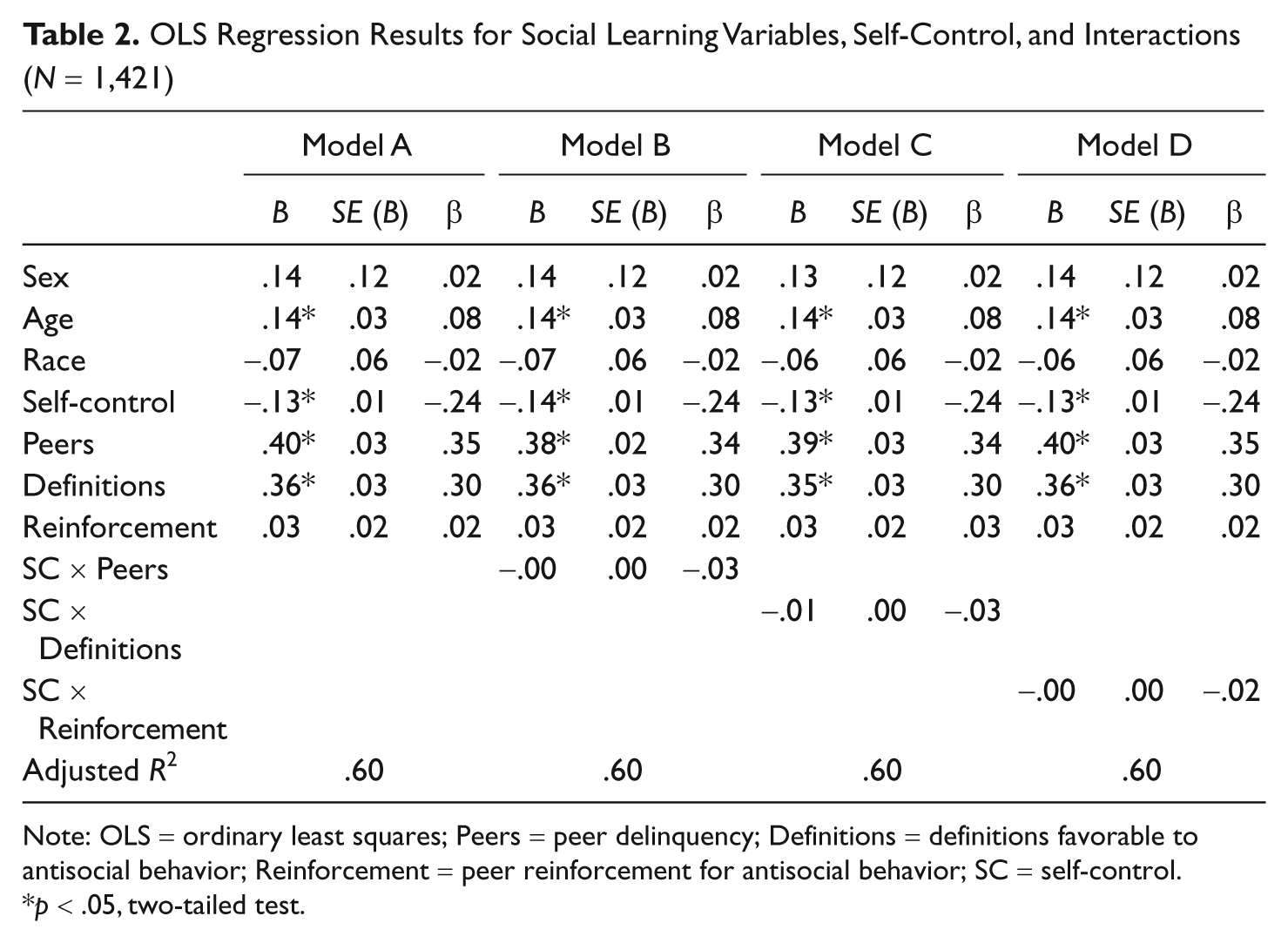
Note: OLS = ordinary least squares; Peers = peer delinquency; Definitions = definitions favorable to antisocial behavior; Reinforcement = peer reinforcement for antisocial behavior; SC = self-control.
p < .05, two-tailed test.
The next three models in Table 2 included the interactions between each of the three social learning theory constructs and self-control. As seen in the table, none of the interactions were significant, indicating that the effects of social learning theory constructs were not moderated by self-control. In addition to the interaction terms, we also estimated the effects of each component of social learning theory at low (−1 SD) and high (+1 SD) levels of self-control. The effects of peers (β = .36, p < .05), definitions (β = .32, p < .05), and reinforcement (β = .04, p > .05) were stronger at lower levels of self-control compared to higher levels (peers, β = .31, p < .05; definitions, β = .27, p < .05; reinforcement, β = .01, p > .05). However, the differences between the slopes at low and high levels of self-control were not significantly different from one another.
These results indicate that self-control and each of the social learning components are independently related to antisocial behavior and thus account for unique variance. Furthermore, there was no evidence that the components of SLT were moderated by self-control.
Discussion
As a general theory of crime, SLT has fared well in the empirical literature. Yet some evidence has emerged in recent years calling into question the generality of this theory. The current study provides additional insight into this question, and the findings indicate that SLT, and the individual components of the theory, operate similarly across individuals of varying criminal propensity. Therefore, these findings offer more support for SLT as a general theory of crime than to the social amplification process noted in the life-course interdependence model.
As expected, peers and definitions were strong correlates of antisocial behavior. However, reinforcements failed to demonstrate a significant multivariate effect. This latter finding was somewhat surprising, especially given that a moderate bivariate relation with delinquency was observed (r = .39). However, reinforcements was moderately correlated with both definitions (r = .41) and peers (r = .40). Although collinearity diagnostics did not indicate any problems, it is possible that too little unique variance remained. Nonetheless, on the whole, SLT fared well in the current analysis as it has in the past. Self-control also demonstrated a significant effect, supplementing a vast literature with similar findings (Pratt & Cullen, 2000).
Beyond the main effects of these constructs, several moderating effects were explored. Unlike previous work (Ousey & Wilcox, 2007; Wright et al., 2001), the current study failed to find that the effect of peers was moderated by self-control. It is unclear why the results of the current study diverged from previous research. One speculation is that it may be due to the imprecision with which peer delinquency is typically measured. As Ousey and Wilcox note, asking participants to estimate the delinquency perpetrated by their peers may overestimate its effect, which also increases the chance of observing a significant interaction. One recent study appears to offer some support for this notion. McGloin and O’Neill Shermer (2009) assessed actual peer self-reported delinquency, as opposed to perceptions of peer delinquency, and failed to find a significant interaction between self-control and antisocial peers. Our data do not allow for an analysis of self-reported peer delinquency. Furthermore, because perceived peer delinquency was the measure used in the current analysis, it is unclear why our results should differ from those of others. More empirical attention needs to be focused on this issue to not only provide a more valid estimate of the effect of peers but also better understand whether criminal propensity moderates this effect.
In terms of assessing SLT more broadly, and whether its components interact with criminal propensity, additional elements of the theory were used in the current analysis. We failed to find that reinforcements interacted with self-control. We are aware of no other study that has explored this specific interaction effect. We also assessed whether the effect of definitions was moderated by self-control, but again failed to find any effect (see also Ousey & Wilcox, 2007).
Although we make no claim to have assessed the veracity of the life-course interdependence model in its entirety, we did examine one of the key processes highlighted in this perspective. Specifically, we explored the social amplification hypothesis, which indicates that antisocial ties exert a more pronounced influence among those with higher levels of criminal propensity. Extending this notion a bit further, this perspective appears to indicate that criminogenic influences are more influential in increasing antisocial behavior among those with higher criminal propensity, because such individuals are more readily swayed into antisocial action. The current findings fail to offer much support for this. Nonetheless, there are several other studies that offer support for some aspects of this model, especially the social protection hypothesis (De Li, 2004; Jones, Cauffman, & Piquero, 2007; Wooten, Frick, Shelton, & Silverthorn, 1997). Thus, the life-course model deserves more empirical attention.
Of course, there are some limitations that are important to consider. First, the data in this study were cross-sectional. Because only one snapshot in time has been examined, it cannot be concluded that the findings are a result of developmental processes or that these relationships change as a process of development. Although much research attests to this, it is not the focus here. In addition, the results may not be generalizable to adolescents outside of Largo, Florida. Lastly, not all criminological constructs were examined in this study. Although this is the most exhaustive list of SLT constructs tested in any one study, there are certainly other constructs (e.g., opportunity) that can be assessed to potentially reveal other person–environment interactions.
Despite these limitations, this study has provided a useful test of the extent and nature of person–environment interactions that influence antisocial behavior. Ultimately, the findings and insights gleaned from this study require replication. In so doing, researchers might explore whether theories that assume a hedonistic, self-centered, and rational basis of human nature are influenced by criminal propensity differently than those theories that assume one must be pushed, or lured, into antisocial behavior. To the extent that future replications confirm this, a cumulative control model might deserve to be articulated.
Footnotes
The author(s) declared no conflicts of interests with respect to the authorship and/or publication of this article.
The author(s) received no financial support for the research and/or authorship of this article.