




Abstract
Hirschi’s reconceptualized control theory suggests that social bonds serve as the primary inhibitors to delinquency and that personality-based self-control (PBSC) is not relevant. He also indicates that the number of inhibitors, multiplied by their salience, influences the perceived costs of delinquency. These claims have not been widely tested. Using a large, school-based sample of adolescents, the authors test Hirschi’s reconceptualization and find that certain inhibitors (e.g., parental monitoring) are more important than others (e.g., maternal attachment). There are also unique types of costs (e.g., parental costs, peer costs) with differential impacts. Salience exerts a main effect, but there was little evidence to suggest it interacts with costs. Finally, PBSC has the strongest effect. These findings not only offer support for some of Hirschi’s claims but also provide directions to better formulate a more comprehensive and empirically supported control theory.
Introduction
Gottfredson and Hirschi’s (1990) general theory of crime is one of the most cited theories in criminology (Cohn & Farrington, 1999; R. A. Wright, 2000), and evidence has been largely favorable to the theory (Piquero, 2008; Pratt & Cullen, 2000). In the original specification of the general theory, self-control was defined as the tendency to refrain from antisocial behavior due to recognition of the long-term costs associated with such behavior. Moreover, individuals with low self-control were described as “impulsive, insensitive, physical (as opposed to mental), risk taking, short-sighted, and nonverbal” (Gottfredson & Hirschi, 1990, p. 90). Despite the accumulated support for the original version of the general theory of crime, Hirschi (2004) recently argued for a modified approach to conceptualizing and testing self-control, specifically, and the general theory, more broadly.
There are two primary changes that Hirschi (2004) had offered to the general theory. The first is to no longer rely on the elements of low self-control that were originally listed (e.g., impulsiveness). Instead, he recommended the use of inhibitors, which he defines as the “factors that one takes into account in deciding whether to commit a criminal act” (p. 545). The specific inhibitors he suggested that are most important can be gleaned from earlier accounts of social control theory (Hirschi, 1969). For instance, mother attachment and monitoring, as well as school commitment, are specifically listed as inhibitors in the 2004 revision. In large part, inhibitors are very similar to the elements of the social bond noted decades ago (Hirschi, 1969).
The second notable modification focused on broadening the notion of costs. Instead of suggesting that only long-term costs of antisocial behavior are relevant (as was noted in the original specification of the general theory of crime; Gottfredson & Hirschi, 1990), Hirschi (2004) suggested that all costs—whether long-term or contemporaneous—should be considered. In this regard, he does not explicitly indicate what is meant by the term costs, though one might assume that any subjectively negative outcome (e.g., disapproval of parents) could be conceived of as a cost to the individual.
With these modifications, Hirschi claimed to have demonstrated the relationship between social controls/bonds and self-control by indicating that more inhibitors (i.e., bonds) lead to an evaluation of more costs, which compels the individual to restrain themselves from delinquency (i.e., exhibit self-control). Thus, Hirschi concluded that social and self-control were one in the same. Hirschi was also more explicit in noting that cognitive appraisals (i.e., perceived costs) should mediate the link between inhibitors and delinquency, although as noted previously he did not provide any specific recommendations on how to assess costs. 1
A small literature has examined some of Hirschi’s recent recommendations and revisions to the general theory of crime. Using data from the Richmond (California) Youth Project and Fayetteville, Arkansas, Hirschi (2004) constructed a nine-item Dichotomized Inhibitor Scale reflective of the bonds related to attachment (parental and school) and commitment (school). Findings in support of his reconceptualization of self-control indicated that an increase of inhibitors (i.e., bonds) was negatively related to delinquency.
Piquero and Bouffard (2007) provided a more detailed examination of Hirschi’s reconceptualization by creating a scale that examined the cognitive mechanism (cost times salience) that enters an individual’s decision-making process. Although Hirschi indicated that social bonds were the key inhibitors, Piquero and Bouffard referred to the costs (times salience) as inhibitors. Using a sample of young adults, they presented two hypothetical offending situations that included drunk driving and sexual coercion (only men were assessed on the latter). After reading the scenarios, participants were asked to indicate their likelihood (0%-100%) of driving home, and men were asked to note their likelihood of attempting to get a woman drunk to have sex with her. To operationalize Hirschi’s reconceptualized self-control, participants listed up to seven “bad things” that might occur if they engaged in the offending from each scenario. By using this method, they were able to measure the number of consequences an individual attends to before committing an act. To capture the dimension of salience, participants were also asked how important (0%-100%) each of the items were. They multiplied the number of costs listed by the average salience across them. In addition to the redefined self-control measure, participants also completed the 24-item Grasmick, Tittle, Bursik, and Arneklev (1993) Attitudinal Self-Control Scale and an 8-item Social Bonding Scale that measured their level of attachment, belief in the law, and religious commitment. The first analysis conducted by Piquero and Bouffard found that the Grasmick et al. scale, but not the bonding scale, was significantly related to intentions to offend. However, after including costs (times salience), the Grasmick et al. scale was rendered nonsignificant. This set of findings offered some support for Hirschi’s reconceptualization.
Higgins, Wolfe, and Marcum (2008) assessed the roles of social bonds, the Grasmick et al. (1993) scale, and costs (times salience, as assessed by Piquero and Bouffard) in understanding digital piracy. Using 358 surveys collected from college students, their results provided mixed support for the new conceptualization. When all three measures were included in the model, they found that individuals with lower scores on the Grasmick et al. scale (which equated with higher self-control), stronger bonds, and more inhibitions (greater cost times salience) were less likely to illegally download music. In addition, and contrary to Piquero and Bouffard, they found that the cost times salience variable and social bonds did not reduce the effect of the Grasmick et al. scale. These findings suggest that each of these inhibiting factors independently and significantly influence an individual’s decision on whether to engage in digital piracy, and that costs (times salience) is not a mediating variable.
In an effort to capture Hirschi’s notion of inhibitors, both of the previous studies operationalized this construct as the perceived costs multiplied by the average salience. Another interpretation was provided by Jones, Lynam, and Piquero (2011), who argued that the key inhibitors were the bonds, and the costs were the mechanism through which the inhibitors acted. In addition, they included two variants of impulsivity—lack of premeditation and thrill and adventure seeking—to test Hirschi’s claim that personality traits consistent with the notion of self-control were unimportant. Results showed that both personality traits and inhibitors (i.e., familial bonds) exerted significant, independent influences on various forms of substance use. They also noted that inhibitors were not mediated by perceived costs; instead, when there was evidence of mediation, having more inhibitors decreased the perceived rewards of substance use.
Too few empirical analyses exist to reach a strong conclusion regarding Hirschi’s modifications to the general theory, and several questions remain to be investigated. These concerns surround two major components of the modified version of self-control. The first deals with inhibitors, which Hirschi (2004) suggested should be measured dichotomously: “I . . . did not know how [the inhibitors] would behave when dichotomized and combined” (p. 546), suggesting that inhibitors measured in this way are substantively different than simply measuring bonds as continuous variables that can be summed to create a scale. With the exceptions of Hirschi 2004 and Jones et al. (2011), no studies have assessed inhibitors in this fashion, and none have compared it with the more traditional way of conceptualizing social bonds. Thus, what is needed is a direct comparison of these two operationalizations.
Beyond the issue of dichotomized inhibitors, it remains unclear whether inhibitors are best represented as one construct or whether there are unique dimensions. That is, should inhibitors based on social bonds be examined as one scale or might different elements (e.g., parental vs. school bonds) demonstrate different relationships? And what role, if any, does the notion of personality-based self-control (PBSC) play vis-à-vis social bonds? PBSC is a distinct type of inhibitor and one that has received support (Cauffman, Steinberg, & Piquero, 2005; Grasmick et al., 1993; Jones, Cauffman, & Piquero, 2007; Tittle, Ward, & Grasmick, 2003).
The second component of the modified theory requiring further illumination is the conceptualization and measurement of costs. In the revised theory, it is not clear whether these costs should be conceived of as general or specific. For instance, the deterrence and rational choice literatures suggest a key cost is perceived certainty (Nagin, 1998; Piquero, Paternoster, Pogarsky, & Loughran, 2011). A more specific variant of cost would be parental disapproval. It is unknown whether general or specific costs demonstrate similar or unique relationships to delinquency and whether either offers a better mechanism linking inhibitors and delinquency. Another concern related to costs is the role of salience. Previous efforts have assessed the effect of costs multiplied by salience on intentions to offend (Higgins et al., 2008; Piquero & Bouffard, 2007). A different approach would assess the main effects of costs and salience as well as their interaction. This would provide a more stringent test of Hirschi’s suggested operationalization. Finally, the main and interactive effects of costs and salience can be assessed as a potential mediator of the inhibitors and delinquency relationship.
These issues are addressed in the current study among a sample of middle and high school youth in Florida. Based on the theory and limited empirical evidence, the following hypotheses will be empirically tested:
Hypothesis 1: As inhibitors, measured dichotomously or continuously, are based on the same items, they will exert similar effects on delinquency.
Hypothesis 2: Although social bonds are anticipated to be positively related to one another, unique types of inhibitors should emerge. We assess mother attachment, father attachment, mother monitoring, father monitoring, and school bonds. We expect mother and father attachment to represent one manifestation of inhibitors, mother and father monitoring another, and school bonds a third type of inhibitor.
Hypothesis 3: The different forms of inhibitors will be related but demonstrate unique relationships to delinquency. Inhibitors based on social bonds will be distinct from PBSC and both will be related to delinquency.
Hypothesis 4: Both general and specific costs will be identified and each will be uniquely related to delinquency. For general costs, the certainty of punishment will be used, whereas for specific costs parental and peer disapproval are examined.
Hypothesis 5: Salience will have a significant, independent effect on delinquency.
Hypothesis 6: The interaction between each cost and salience will be related to delinquency.
Hypothesis 7: Consistent with previous research, the main and interactive effects of costs and salience will not mediate the relationship between inhibitors and delinquency.
Method
Sample
The data for this study are based on middle and high school students from a large city suburb in Florida. A questionnaire was designed that used Likert-type scales to gather an array of information from the youth. Involvement was voluntary and required passive consent from the student’s parents. In the high school (Grades 9-12), the survey was administered to 30 randomly selected classes during the third period. Of the 796 eligible students in the 30 random classes, 625 surveys were usable, resulting in a response rate of 79%. In the middle school sample (Grades 6-8), the survey was administered during the 45 social studies classes among the three grades. Of the 1,266 middle school students enrolled, 1,050 surveys were usable, producing a response rate of 83%.
The total sample size from both samples was 1,675 youth, with 37.3% from the high school (n = 625) and 62.7% from the middle school (n = 1,050). 2 Youth ages ranged from 11 to 19 years (M = 13.79, SD = 1.96), and there were slightly more males (n = 835, 50.2%). The majority of the students were White (77.2%), followed by Black (11.6%), Hispanic (4.1%), Asian (3.2%), and Other (3.9%).
Measures
Delinquency
Participants were asked to self-report whether they had ever engaged in each of 17 specific delinquent acts that covered a wide range (e.g., truancy, petty theft, aggravated assault; see appendix). Individual items were dichotomized and then summed to form a variety scale. The scale (α = .84) had a mean of 5.35 (SD = 3.62), and there was some evidence of nonnormality (skew = 0.74, SE = .06). An analysis of the residuals indicated that the untransformed scale was less problematic than a transformed scale, and therefore, no modifications were made. The delinquency scale is best characterized as a variety scale, which is superior to a frequency scale in terms of internal consistency, stability across time, and convergent validity (Bendixen, Endresen, & Olweus, 2003).
Descriptive Statistics of Key Study Variables
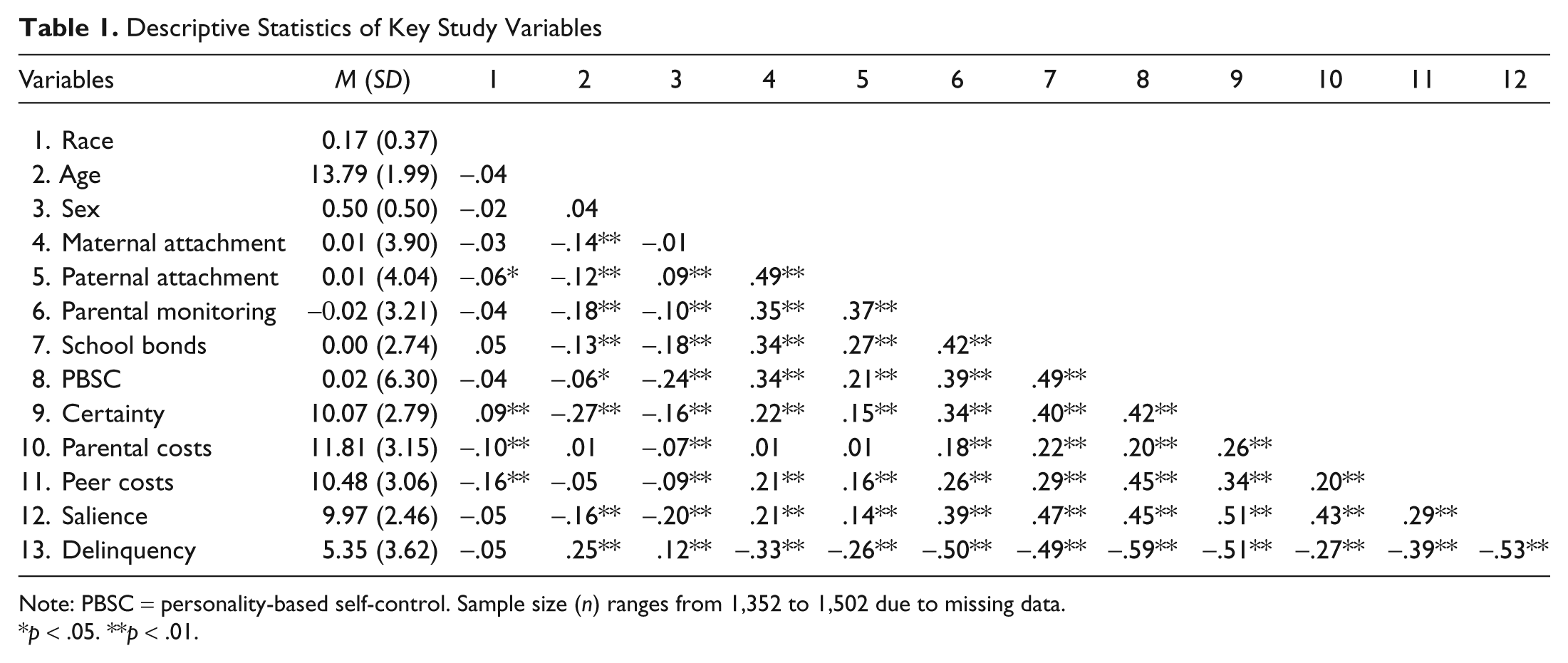
Note: PBSC = personality-based self-control. Sample size (n) ranges from 1,352 to 1,502 due to missing data.
p < .05. **p < .01.
Inhibitors
Hirschi describes inhibitors as the set of factors that an individual considers when deciding to engage in delinquency. His own conceptualization of this construct included items tapping into school attachment and commitment, and mother attachment and monitoring. The current analysis used a larger set of inhibitors tapping into mother attachment (five items), father attachment (five items), parental monitoring (four items), and school bonds (four items; attachment and commitment). Different conceptualizations of inhibitors were created to address specific hypotheses. Each of the inhibitors was dichotomized and summed; responses were scored as “1” if the respondent indicated the presence of the inhibitor. The second operationalization was based on a sum of these items measured continuously, with higher values indicative of greater bonding. Comparing these two different operationalizations addresses the first hypothesis. To test Hypothesis 2 regarding the factor structure, the continuous measurement of the items was used.
Self-control
Individuals who are low in self-control are “impulsive, insensitive, physical, risk-taking, short-sighted, and nonverbal” (Gottfredson & Hirschi, 1990, p. 90) and tend to neglect the long-term consequences of their actions (Hirschi & Gottfredson, 2001). Previous studies have shown that physical activities and simple tasks are less important for assessing self-control, and no items included in the current measures tapped into those elements (Arneklev, Grasmick, & Bursik, 1999; Arneklev, Grasmick, Tittle, & Bursik, 1993). The remaining four elements—impulsivity, risk seeking, self-centeredness, and temper—were assessed with 11 items. Some items were behavioral (e.g., choosing to confront vs. avoid a classmate who is spreading rumors), whereas others were attitudinal (e.g., preferring to take risks for the fun of it; see appendix). The items were on different metrics and were standardized prior to summation. The scale had a mean of 0.02 (SD = 6.30), with higher scores indicative of higher self-control.
Costs
Hirschi indicates that both short- and long-range costs should be considered as the mechanism by which self-control operates. Furthermore, he suggests that the salience of those costs should also be gauged. Beyond these broad statements, Hirschi does not provide much assistance in terms of measuring costs. He does note, however, that an individual will likely consider two issues before engaging in delinquency: “Do I care what X thinks of me? Will X know what I have done?” (Hirschi 2004, p. 545). The “X” in this case refers to others the individual perceives as important. To assess this first question, two costs—parental and peer costs—are included. Both are measured by asking participants whether the participant believes that her or his parents or peers will lose respect for them if they engaged in delinquency. Parents and peers were chosen because the opinions of both are likely among the most important for many individuals. To assess the latter question, a measure of certainty is included, which assesses the participant’s perceived likelihood of getting caught for engaging in delinquency.
Hirschi is more ambiguous about how to measure salience. Piquero and Bouffard (2007) assessed salience by asking respondents to indicate how important each costs was on a scale from 0 to 100. In the present study, salience was measured by the extent to which individuals perceive being caught by the police would represent a problem for them (see appendix). We recognize that this overlaps with the notion of severity represented in the deterrence and rational choice literatures but represents our best effort to capture Hirschi’s notion of salience in the current data. Clearly, this will be an important consideration in future research.
One interpretation of Hirschi’s reconceptualization is that costs should interact with salience. That is, the influence of costs should be more strongly related to delinquency as the salience of the costs increases. Previous research has examined a single measure of costs multiplied by salience and found it to be significantly related to intentions to offend (Higgins et al., 2008; Piquero & Bouffard, 2007). In this study, the main and interactive effects are explored to provide additional insights into this process.
Control variables
Controls are included for sex, race, and age. Sex (0 = female and 1 = male) and race (0 = White and 1 = non-White) are binary indicators, whereas age is measured continuously.
Table 1 presents descriptive statistics and interitem correlations for the key study variables.
Analytic Plan
Four types of analyses were performed. First, descriptive statistics of the independent, dependent, and control variables were computed. Percentages were presented for dichotomized variables, and means and standard deviations were used for ordinal and interval variables. Next, bivariate correlations were performed to (a) examine the interitem correlations between each measure and (b) how each of the key study variables was related to delinquency. Third, a series of ordinary least squares (OLS) regressions was estimated to test the effects of the key study variables on delinquency while controlling for age, race, and sex. Measures used in the interaction analyses were mean centered. Variation inflation factors were examined to ensure that collinearity was not an issue.
Finally, we used multiple mediation models using a SPSS macro provided by Preacher and Hayes (2008) to test for mediation. According to Preacher and Hayes, multiple mediation models have several advantages over single multiple mediation models. First, it is possible to determine which specific mediators mediate the effect between the predictor and outcome variables. Second, there is a higher likelihood of reducing the parameter bias due to omitted variables. Third, the magnitudes of the specific indirect effects associated with multiple mediators can be determined in multiple mediation models.
Results
To test Hypothesis 1, we explored whether dichotomizing and combining inhibitors (bonds) demonstrated a unique relationship to delinquency compared with more traditional, continuous measures of social bonds. Bivariate analyses indicated that the Dichotomized Inhibitor Scale is more weakly related to delinquency than a continuous measure of social bonds (r = −.42 and r = −.46, respectively). This supports the first hypothesis but hints that a continuous measure may be better.
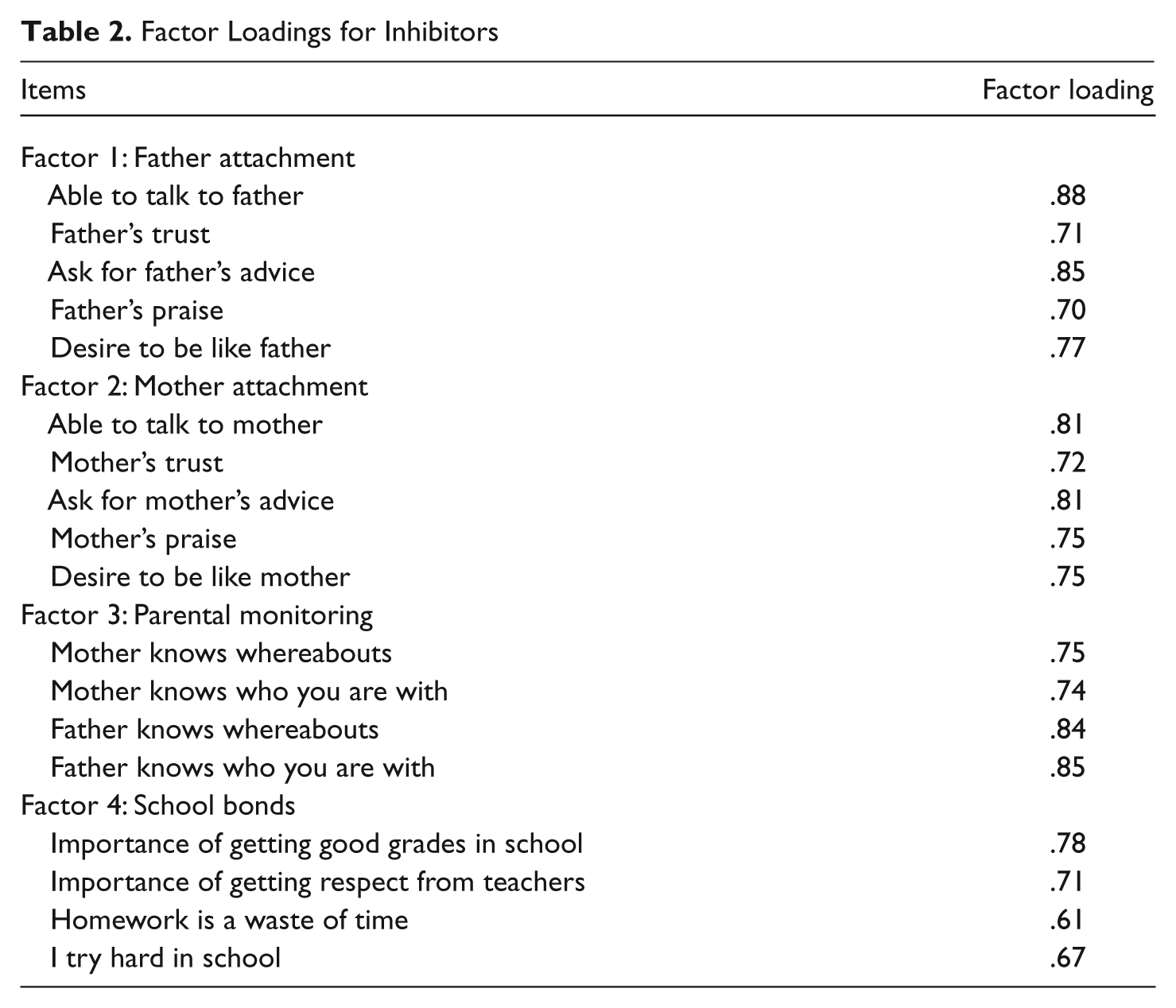
With reference to Hypothesis 2, an exploratory factor analysis was performed (with Promax rotation). The results indicated four distinct factors: maternal attachment, paternal attachment, parental monitoring/supervision, and school bonds (see Table 2). In addition, we were also interested in whether different inhibitors evinced unique relationships with delinquency. To test the unique effects of each inhibitor with delinquency, we used OLS regression (Table 3, Model 1). Maternal attachment (b = −.09, SE = .02), parental monitoring/supervision (b = −.36, SE = .03), and school bonds (b = −.41, SE = .03) were all negatively and significantly related to delinquency, indicating that individuals who had more maternal, parental monitoring/supervision, and school bonds were less likely to be delinquent. However, paternal attachment was not significantly related to delinquency. These findings indicate that the most appropriate means of assessing the influence of inhibitors is to assess specific types. The results also suggest that the traditional manner of assessing social bonds is superior to the newer conceptualization offered by Hirschi. As such, all remaining analyses will be based on specific types of inhibitors (i.e., maternal attachment, paternal attachment, parental monitoring, and school bonds) measured on a continuous scale.
Factor Loadings for Inhibitors
OLS Regression Models With Key Study Variables
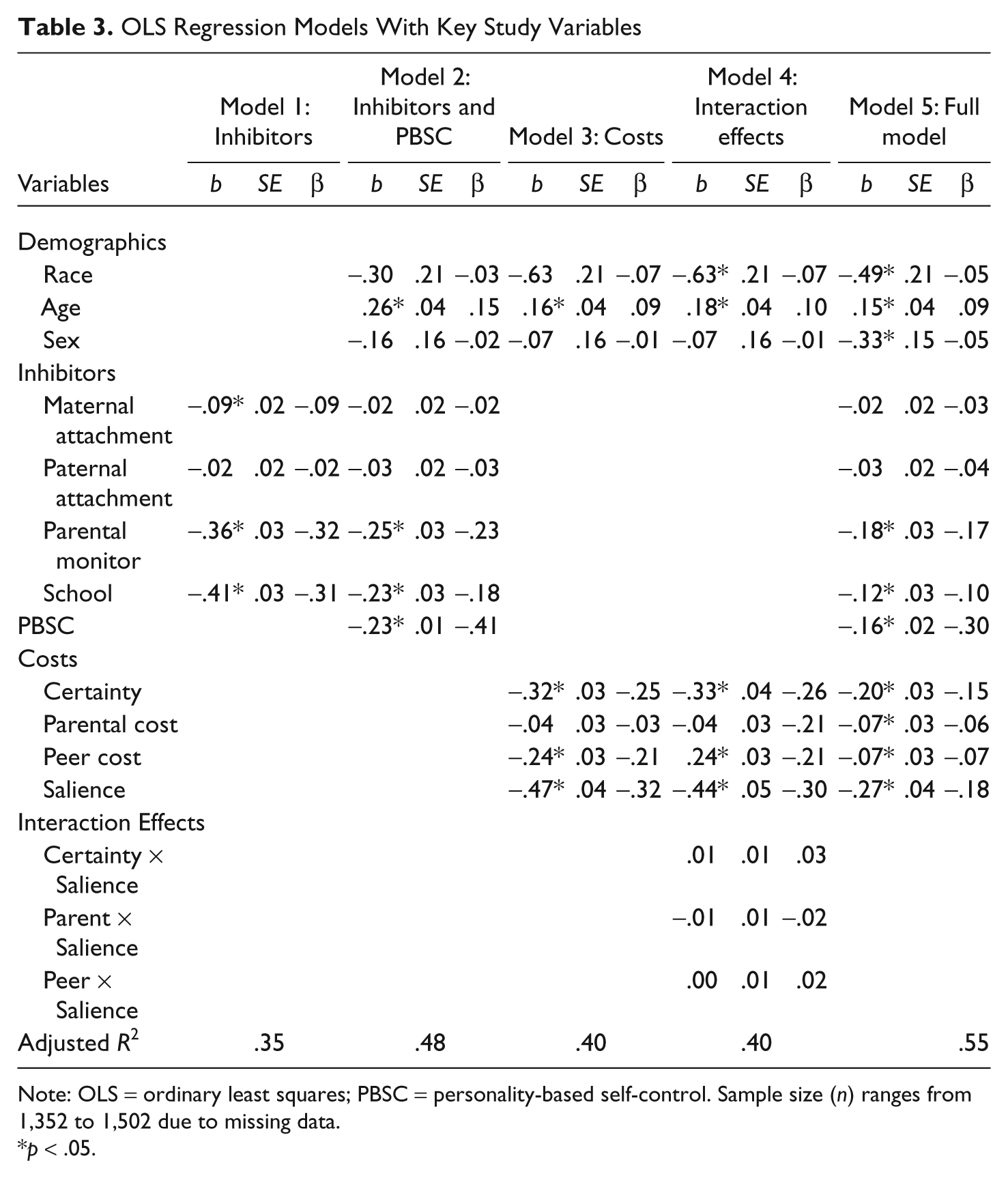
Note: OLS = ordinary least squares; PBSC = personality-based self-control. Sample size (n) ranges from 1,352 to 1,502 due to missing data.
p < .05.
Inhibitors
The next set of analyses addressed Hypothesis 3 and examined the influence of inhibitors, with a specific focus on whether their effects are independent of PBSC. At the bivariate level, PBSC was significantly related with each of the inhibitors (rs range from .21-.49; see Table 1). OLS regression was also used to examine whether each inhibitor exerted an effect on delinquency, net of PBSC. The results indicate that parental monitoring/supervision inhibitors (b = −.25, SE = .28), school inhibitors (b = −.23, SE = .33), and PBSC (b = −.23, SE = .14) were negatively and significantly related to delinquency, demonstrating that inhibitors and PBSC are unique constructs. In addition, the standardized coefficients illustrated that PBSC (β = −.41) had stronger effects on delinquency than parental monitoring/supervision and school inhibitors (β = −.23 and −.18, respectively). When each inhibitor and PBSC were included in the same model (Table 3, Model 2), paternal attachment remained nonsignificant and maternal attachment became nonsignificant, indicating that the most influential inhibitors, net of PBSC, were parental monitoring/supervision and school bonds.
Costs
To examine Hypothesis 4, the next set of analyses explored costs, with a focus on their factor structure and relationship to delinquency. A total of 16 items were entered into an exploratory factor analysis, yielding four distinct factors that accounted for 66.91% of the variance. More specifically, the costs could be conceptualized as general (the likelihood of getting caught) and specific (losing respect of parents and peers). These findings suggest that costs are multidimensional. Items representing salience loaded on a separate factor, suggesting this construct should be considered distinct from costs.
Following these findings, we examined the second component of Hypothesis 6 by using OLS regression to test whether the different types of costs were related to delinquency, while controlling for salience, sex, race, and age. Model 3 (Table 3) illustrates that some costs were uniquely related: Certainty of being caught (b = −.32, SE = .03, β = −.25) and peer costs (b = −.24, SE = .03, β = −.21) were negatively and significantly related to delinquency. However, parental costs were nonsignificant in the model. In addition, salience demonstrated a significant, independent effect on delinquency (b = −.47, SE = .04, β = −.32), consistent with Hypothesis 5. These findings suggest that there are specific types of costs that are more influential than others, and those costs, as well as salience, exert main effects on delinquency.
Hirschi suggests that costs are moderated by salience, such that costs will exert stronger effects when that cost holds relative importance for the individual. Interaction terms were created to test this hypothesis. Model 3 (Table 1) reveals that none of the interaction terms was significantly related to delinquency, regardless of whether they were examined individually (not shown in table) or as a group. These findings are not consistent with Hypothesis 6. Next, in Model 5 (Table 3), demographics, inhibitors, costs, salience, and PBSC were included. This model continued to show that PBSC (b = −.16, SE = .02, β = −.30), parental monitoring/supervision (b = −.18, SE = .03, β = −.17), school bonds (b = −.12, SE = .03, β = −.09), certainty of being caught (b = −.20, SE = .03, β = −.15), peer costs (b = −.07, SE = .03, β = −.07), and salience (b = −.27, SE = .04, β = −.18) were negatively and significantly related to delinquency. Contrasted with Model 3, when examining all the measures simultaneously, parental costs became negatively and significantly related to delinquency (b = −.07, SE = .03, β = −.06), indicating a suppressor effect but similar to Model 2, maternal attachment and paternal attachment remained nonsignificant.
Mediation Models
Our next set of analyses focused on Hypothesis 7 and explored whether costs (and salience) mediate the relationships between inhibitors and delinquency. We also explored whether PBSC was mediated by any of the costs (or salience). The results indicated that effects of parental monitoring and school bonds were significantly mediated by the costs (t = −5.01 and −7.05 at p < .05, respectively). More specifically, the effect of parental monitoring was mediated by perceived certainty (t = −2.90), parental costs (t = −1.98), and salience (t = −3.99), whereas school bonds were mediated by perceived certainty (t = −4.18), parental costs (t = −2.19), peer costs (t = −1.76), and salience (t = −4.40). However, neither maternal attachment nor paternal attachment was significantly mediated by any of the costs. The effect of PBSC on delinquency was significantly mediated by the costs (t = −7.63). Specifically, the effect of PBSC was mediated by perceived certainty (t = −5.33), parental costs (t = −2.22), peer costs (t = −2.51), and salience (t = −4.51). In contrast to Higgins et al. (2008) and Jones et al. (2011), these results provide some evidence that inhibitors (parental monitoring and school bonds) are mediated by costs and salience—perhaps owing to the age range of the sample (younger than in prior studies).
Discussion
This study assessed the measurement and operationalization of Hirschi’s (2004) reconceptualization of the general theory. Specifically, we examined the different conceptualizations and measurements of inhibitors, whether Hirschi’s notion of costs yielded different constructs, how they interacted with salience, and whether they mediated the relationship between inhibitors and delinquency. Based on the findings, some components of Hirschi’s new conceptualization were supported, whereas others were not.
Our first set of hypotheses (1-3) examined inhibitors. Our results demonstrated that the dichotomous measure of inhibitors is more weakly related to delinquency than a continuous measure of bonds. Although the traditional bonds construct was somewhat stronger, the differences in the effect sizes were quite modest. Perhaps the slightly stronger effect found in the traditional bonds measure was due to this scale having more variation than the new conceptualization of inhibitors, which was based on dichotomous items. Our findings suggest that there is no strong justification for modifying the items from their more traditional manner. Although Hirschi implied that dichotomizing bonds represented an improvement, our findings indicated that the new operationalization was more weakly related to delinquency and combined specific bonds that demonstrate unique relationships. To the extent that future research reveals the same, measuring them in a manner consistent with the original social bonding theory seems a more defensible strategy.
Next, the results indicated that inhibitors were distinct from PBSC, and when included in the same model, parental monitoring, school bonds, and PBSC were significantly related to delinquency. However, when inhibitors and PBSC were included in the same model, the effect sizes of inhibitors were reduced. The effect of parental monitoring was reduced by 31%, whereas the effect of school bonds was reduced by 44%. In addition, maternal attachment became nonsignificant. This suggests that inhibitors and PBSC have shared variance, even though they had independent effects, and that PBSC occupies an important role in relating to delinquency—perhaps more so than Hirschi had anticipated.
These findings offer both convergence and divergence from previous efforts exploring Hirschi’s reconceptualization. Similar to previous research, the current study found that social bonds and PBSC accounted for unique variance in delinquency (Longshore, Chang, Hsieh, & Messina, 2004; B. R. E. Wright, Caspi, Moffitt, & Silva, 1999). Contrary to prior literature (Higgins et al., 2008; Piquero & Bouffard, 2007), PBSC had stronger effects on delinquency than the new conceptualization of bonds. However, our study conceptualized inhibitors differently than previous efforts. Although we used bonds to replicate Hirschi’s new construct (which he labeled as inhibitors), other studies operationalized inhibitors as the perceived costs (multiplied by their salience). Based on our findings, and more consistent with those of previous studies, the standardized coefficients for certainty and salience were larger than the standardized coefficient for PBSC. However, those other studies did include a measure of social bonds (although not labeled as inhibitors), and in both instances, bonds exerted weaker effects than PBSC. In that regard, our results are in accord with earlier efforts.
Our last set of hypotheses (4-7) examined costs, salience, and their interactive effects (costs times salience), and whether costs and salience mediated the relationship between inhibitors and delinquency. Our results indicated that there are unique costs, and salience should be examined separately from such costs. The fact that different types of costs loaded on different factors argues against the notion of examining costs unidimensionally. This conclusion is bolstered by the fact that different costs exerted unique effects on delinquency. Certainty of being caught, peer costs, and salience were significantly related to delinquency. Losing the respect of parents (if one were to be caught engaging in delinquency) was not significantly related to delinquency. This finding is inconsistent with Hirschi’s suggestion that parental costs are particularly important.
It is also important to note that salience exerted a significant effect on delinquency, net of costs. However, none of the interaction terms representing costs times salience were significantly related to delinquency, whether they were examined individually or as a group. Other studies have found that a Cost × Salience interaction was related to intentions to offend (Higgins et al., 2008; Piquero & Bouffard, 2007). Yet, those studies did not explore the main effects of costs and salience, rendering any comparison premature. What can be gleaned from this and previous studies is that, in addition to individual characteristics, there are rational decision-making factors that are important in understanding the decision to engage in delinquency (Piquero et al., 2011; Piquero & Tibbetts, 1996).
These cognitive factors (i.e., costs) are also important in that they demonstrate the mechanism by which external and internal inhibitors exert their influence. Specifically, external (parental monitoring and school bonds) and internal (PBSC) inhibitors were mediated by the certainty and salience of getting caught as well as losing the respect of one’s parents. Also, the effect of school bonds and PBSC was mediated by peer costs. These findings offer some divergence from previous research that failed to find inhibitors operated through costs (Higgins et al., 2008; Jones et al., 2011). Nonetheless, our findings support control theories generally in that a cognitive evaluation of the costs is the mechanism by which inhibitors (whether they be social bonds or PBSC) operate. These findings are substantively important in that they go beyond demonstrating a relationship between social bonds and PBSC and delinquency. Instead, they offer an explanation of why and how these inhibiting forces lead to less delinquency. Future research should bear this in mind not just with control theories but all criminological theories. By explaining the mechanisms, greater theoretical clarity and more fruitful intervention programs can be achieved (Agnew, 1993).
This study is not without limitations. First, our measure of PBSC was consistent with, but not identical to, more widely used measures such as the Grasmick et al. (1993) self-control scale. It is unclear whether similar results would be obtained if such measures were used. In addition, each element of the social bond was not assessed. In his reanalysis, Hirschi (2004) focused on maternal attachment and monitoring as well as commitment to school. As one of the goals of the present study was to replicate his scale accurately, these elements were examined (along with paternal attachment). It might be that a more comprehensive assessment, including additional elements of the social bonds would reveal other important relationships. Also, we were unable to capture a full range of costs, and as such, there may be additional costs (e.g., losing the respect of one’s teachers) that are important to consider.
There are issues with the generalizability of the results. The sample used in the analyses represents only middle and high school youth from specific schools in Florida. Consequently, it remains unknown whether similar results would be found elsewhere. Moreover, the cross-sectional nature of our data prohibits causal connection, and as such, findings should be cautiously interpreted.
Despite these limitations, this study has addressed a relatively new theoretical perspective and addressed some of the key questions stemming from it. The results provided support for some aspects of Hirschi’s (2004) reconceptualization of the general theory, whereas other components fared less well. Future research is likely to yield other insights based on questions not posed in the current study. Yet, we hope that the intriguing findings revealed here invigorate and inform this theoretical debate.
Footnotes
Appendix
Key Measurement Items
|
Take risk for fun of it Like to test self by doing something risky Act on spur of the moment without thinking Do what is pleasurable now at cost I don’t feel bad for others with problems If things upset people, it’s their problem I lose my temper easily When I am mad people better stay away More likely to confront or avoid classmate More likely to tease or be friends with someone More likely to hit or talk when mad |
|
Maternal Attachment
Paternal Attachment
Able to talk to father Father’s trust Ask for father’s advice Father’s praise Desire to be like father School Bonds Parental Monitoring |
|
Parental Costs
Would your parents lose respect if you skipped school Would your parents lose respect if you stole Would your parents lose respect if you hit someone with the idea of hurting them Would your parents lose respect if you used marijuana
Peer Costs
Would your friends respect if you got away with skipping school Would your friends respect if you got away with stealing Would your friends respect if you got away with hitting someone with the idea of hurting them Would your friends respect if you got away with using marijuana
Certainty
Do you think you would get caught by the police if you skipped school Do you think you would get caught by the police if you stole Do you think you would get caught by the police if you hit someone with the idea of hurting them Do you think you would get caught by the police if you used marijuana
Salience
If caught for skipping school, how big of a problem If caught for stealing, how big of a problem If caught for hitting, how big of a problem If caught for using marijuana, how big of a problem |
|
Damaged or destroyed another’s property on purpose Stole an item worth 50 dollars or less (stole backpack under 50 dollars and stole other things under 50 dollars were combined) Lying (lied to parent, to teacher, and to get something were all combined) Skipped class without an excuse Stayed out longer than allowed Run away from home Stole anything over 50 dollars Used a weapon or force to get money or things Hit someone to hurt them Attacked someone with a weapon Carried a weapon for protection Burglarized (tried or gone into a house to steal something and tried or gone into a building to steal something were combined) Tried or stolen a car or motorcycle Used tobacco products Used alcohol Used marijuana Used other illegal drugs |

Indicates items that overlap with Hirschi’s (2004) inhibitor scale.
Declaration of Conflicting Interests
The author(s) declared no potential conflicts of interest with respect to the research, authorship, and/or publication of this article.
Funding
The author(s) received no financial support for the research, authorship, and/or publication of this article.