



Abstract
Prior research has shown that various situational factors and behaviors can affect one’s perception of whether a rape has occurred. Moreover, some hold false beliefs about rape. This can also affect one’s perception of ambiguous situations. This study included the administration of a survey to 584 college students; the survey examined the prevalence of rape myths and responses to vignettes of potential rape scenarios. It was found that although the majority of this sample did not support rape myths, male students were significantly more likely than female students to support rape myths. Furthermore, approximately 20% of students did support one subscale of the rape myth scale: He didn’t mean to [commit rape]. The results also revealed an interaction effect between the observer’s sex and the victim’s sex, suggesting a complex gender relationship.
Introduction
Individual perceptions of what constitutes rape can have a substantial impact on society. What is considered “criminal” is defined by members of society (Gottfredson & Hirschi, 1990) and often changes depending on societal norms, advocacy group efforts, and media portrayal of harm caused by various actions. More specifically, what constitutes rape often goes beyond the behavior of the offender, and includes a host of other factors. For example, researchers have reported that the following factors can affect one’s perception of whether a rape has occurred: the sex of the victim, the relationship between the victim and offender (Bell, Kuriloff, & Lottes, 1994), the presence of alcohol (Richardson & Campbell, 1982), and the behavior of the victim prior, during, and after the sexual encounter (L’Armand & Pepitone, 1982; Wyer, Bodenhausen, & Gorman, 1985). In addition to situational factors, one’s personal beliefs also affect whether one perceives a given situation as rape (Burt, 1980).
In 2009, there were 8,097 reported cases of rape (Department of Justice, 2011). It has been well documented that rape on college campuses, especially among women, is a major public health concern (McMahon, 2010; Tatum & Foubert, 2009). A large portion of college women, 35 out of every 1,000 women, will experience a completed or an attempted rape during their college careers (Karjane, Fisher, & Cullen, 2005). Other sources indicate similar numbers: One out of every 20 college women will be subjected to rape or to attempted rape (Mohler-Kuo, Dowdall, Koss, & Wechsler, 2004).
The focus of this study includes an examination of the prevalence of rape myths among a college sample, with emphasis on the effects of various situational contexts and the sex of the observer and the victim. This research will fill a gap in the existing research by providing insight into various situational contexts of rape and interaction effects of the victim’s sex and the observer’s sex; such information will be helpful to those who are likely to encounter a rape victim, which includes rape victim advocates, law enforcement, and even potential jury members of a rape case.
Rape Myths
In a process of identifying beliefs that perpetuate rape, sociologists in the 1970s developed the concept “rape myths” (Brownmiller, 1975; Schwendinger & Schwendinger, 1974). This concept is based on sex role socialization and just world hypothesis in that it assumes men have been socialized to be aggressive and somehow victims engage in behavior or place themselves in situations that promulgate rape. More specifically, this set of beliefs involves blaming the victim and absolving the offender of any responsibility through minimization (e.g., It’s not really his fault) or justification (e.g., She should not have accepted an invitation into his house). Burt (1980) defined rape myths as false beliefs regarding rape victims, rapists, and the rape incident.
Definition and Development of Rape Myths
The concept of rape myths was developed to explain a set of beliefs that serves as a foundation for sexual aggression toward women (Brownmiller, 1975; Burt, 1980). Burt (1980) initially proposed a definition of rape myths as “prejudicial, stereotyped, or false beliefs about rape, rape victims, and rapists” (p. 217). Later, Lonsway and Fitzgerald (1994) proposed another definition of rape myths: “attitudes and beliefs that are generally false, but are widely and persistently held, and that serve to deny and justify male sexual aggression against women” (p. 134). Inherent in these myths are adversarial sexual beliefs, acceptance of interpersonal violence, and gendered stereotypes. They also support blaming the victim, absolving the perpetrator, and rationalizing sexual violence (Burt, 1980; Edwards, Turchik, Dardis, Reynolds, & Gidycz, 2011; Payne, Lonsway, & Fitzgerald, 1999). Examples of rape myths include the following: She asked for it; it was not really rape; he did not mean to; she wanted it [the rape]; she lied [about the rape]; and rape is a trivial event (Payne et al., 1999).
Rape myths are identified as beliefs that many have toward rape, yet where data do not substantiate the belief (Lonsway & Fitzgerald, 1994). An example of this is the claim that women often lie about rape. A few isolated media reports of women falsely claiming instances of rape led people to believe such instances are common (Lonsway & Fitzgerald, 1994), yet data from the FBI’s Uniform Crime Reports show the number of such instances are extremely low (less than 10%). 1
Background: Theoretical Foundation of Rape Myths
The theoretical foundation that led to the development of rape myths also provides additional insight. Feminists and sociologists proposed the concept of rape myths in the 1970s. Feminist theory emphasizes biological differences between men and women as well as disparities in their socialization during childhood (Adler, 1975). Feminist theory also purports that society has established a patriarchal society, where men hold high status and have more power than women (Brownmiller, 1975). Several of the identified rape myths are based on these feminist assumptions. For example, the myth “If a woman is willing to ‘make out’ with a guy, then it’s no big deal if he goes a little further and has sex with her” is based on a woman’s lack of authority and power over her own body.
From a sociological perspective, Burt (1980) purported behaviors that are acceptable by society and based on one’s sex provide a foundation for sexual interactions and are learned through a developmental process. Men learn to be aggressors and women take on a more passive role. An example of a rape myth that imbues this concept is “Although most women wouldn’t admit it, they generally like being physically forced to have sex.” This sociological perspective, therefore, suggests rape is an expression of a traditional interaction in an extreme form, rather than a psychological aberration, especially in the case of acquaintance rape (Bridges, 1991).
Another sociological concept that serves as a foundation for rape myths is “belief in a just world,” which purports the world is just and fair with good people having good experiences and bad people having bad experiences (Gilmartin-Zena, 1987); thus, a victim of a tragic event somehow deserves the misfortune (Lerner, 1980). The just world concept has been applied by researchers to explore the level of blame placed on the victim in rape scenarios (see generally, Kleinke & Meyer, 1990; Pollard, 1992). Based on this concept, it is acknowledged that attribution of rape responsibility varies widely depending on a variety of conditions. In general, this concept supports the notion that the victim did something that justifies or at least minimizes the rape. An example of this is as follows: “A woman who is raped while she is drunk is at least somewhat responsible.”
Rape Myth Research
Research shows that approximately 25% to 35% of respondents support rape myths (Lonsway & Fitzgerald, 1994). Recently, a meta-analysis examined the prevalence of rape myth acceptance; the study was based on 37 previous studies that relied on either the Rape Myth Acceptance Scale (Burt, 1980) or the Illinois Rape Myth Acceptance Scale (Lonsway & Fitzgerald, 1995). Men were significantly more likely than women to support rape myths (Suarez & Gadalla, 2010). This is consistent with previous findings (e.g., Chapleau, Oswald, & Russell, 2008; Newcombe, Eynde, Hafner, & Jolly, 2008; Whatley, 2005). This research also found a strong positive association between support for rape myth attitudes and sexual aggression (along with other hostile attitudes and aggressive behaviors toward women; Suarez & Gadalla, 2010).
Rape Perceptions Research
Researchers have previously reported that the following factors affect one’s perception of whether a rape has occurred: the sex of the victim (Groth & Burgess, 1980), the sex of the third-party observer (Lonsway & Fitzgerald, 1995), and the relationship between the victim and offender (married vs. nonmarried, stranger vs. acquaintance, and having a previous consensual experience; Bell et al., 1994). Furthermore, the victim’s appearance and behavior (before, during, and after the rape) also affect perception. This includes drinking alcohol (Kanin, 1984) and whether physical violence was used by the offender as evidenced by physical scratches, bruises, and so on (Ong & Ward, 1999). Unlike other criminal offenses, people develop a “rape framework” that involves placing blame on the victim when mitigating factors are present (Deitz, Littman, & Bentley, 1984).
Male Victim
When the victim is male, for example, cognitive barriers exist to accepting that a rape has occurred. It is (wrongly) assumed that (a) men are too strong to become a rape victim (Groth & Burgess, 1980), (b) men always want sex, and (c) if a man didn’t want sex, he could not achieve an erection (Sarrel & Masters, 1982). Albeit not a common event, documentation of male victimizations of rape and sexual coercion does exist. For example, a survey of households in Los Angeles, California, that included 1,480 interviews of men revealed 7.2% had at least one incident of forced or pressured sexual incident as an adult (Sorenson, Stein, Siegel, Golding, & Burnam, 1987). Moreover, about 3% of the 1,480 men indicated the incident involved sexual intercourse. Male college students also report a relatively high rate of coercive sexual incidents. For example, in a review of previous campus surveys, 12% to 16% of college men indicated they had been pressured or forced to have sex with a dating partner. Physical force was rarely reported, however. Only between 1% and 7% of the victims reported the use of physical force.
Male and Female Perception of Rape
Research has also found that in addition to male participants accepting rape myths at a higher rate than female participants (Lonsway & Fitzgerald, 1994, 1995), male participants also have different perceptions of what constitutes rape (Deitz et al., 1984; Szymanski, Devlin, Chrisler, & Vyse, 1993; Tetreault & Barnett, 1987). Furthermore, men who are more supportive of rape myths also have attitudes that can lead to rape behavior (i.e., rape is justifiable when a woman initiated the date, paid for the date, and/or went to the man’s apartment; Muehlenhard, Friedman, & Thomas, 1985). In addition, the relationship between one’s sex and judgments of responsibility (for the victim and the offender) in date-rape scenarios are mediated by rape myth acceptance (Hammond, Berry, & Rodriguez, 2011). Thus, the relationship between one’s sex and other variables offers additional insight into perceptions of rape.
Relationship Between Victim and Offender
Situations that involve a victim and offender who knew each other are substantially less likely to be perceived as rape (Bell et al., 1994; Check & Malamuth, 1983; Koss, Dinero, Seibel, & Cox, 1988; Quackenbush, 1989; Warshaw, 1988). For example, in Quackenbush’s (1989) study, male college students placed more responsibility on the rape victim in a vignette depicting an acquaintance rape scenario compared with one depicting a stranger rape scenario.
Whether a woman was married at the time of the rape also affects one’s perception. In general, less blame is placed on the victim when she is married (compared with when she is not married). More specifically, the punishment recommendation of the offender who victimized a married woman was more than that of a divorced woman (Jones & Aronson, 1973; Kanekar & Kolsawalla, 1977).
Victim Behavior: Alcohol Use, Prior Sexual Activity, Resistance Level, and Appearance
Typically, when a victim consumes alcohol prior to a rape incident, it is less likely to be perceived as rape. Researchers have documented that when a woman has been drinking, she is perceived as sexually promiscuous (Kanin, 1984; Martin & Hummer, 1989). For example, in a survey asking 213 college students their reaction to different rape vignettes, female victims were significantly more likely to be blamed for the incident when she was described as drinking (compared with when she was not consuming alcohol; Sims, Noel, & Maisto, 2007). These results corroborated the findings of other studies (Corcoran & Thomas, 1991; Norris & Cubbins, 1992).
The sexual history of the victim is another factor affecting an individual’s perception of whether a rape has occurred. For example, in a study involving 650 college students who read (created) newspaper reports of rape, the sexual histories of the reported victim significantly affected individual perceptions of the situation (L’Armand & Pepitone, 1982). In general, when the victim’s sexual history was described as “extensive” (compared with “limited” or no information provided at all), the rape was reported as less serious, causing less damage, and the participant suggested fewer years (on average) of a sentence for the offender. Similarly, Cohn, Dupuis, and Brown (2009) found when the victim (portrayed in a video) had a bad reputation, she was held more responsible than victims who had a good reputation.
Individual perception of whether a sexual encounter meets the criteria of rape is also affected by the victim’s level of resistance (Ong & Ward, 1999). When the victim resists during an attack, and the attacker is not punished, observers are most likely to report the situation as unjust (Wyer et al., 1985). Similarly, in McCaul, Veltum, Boyechko, and Crawford’s (1990) survey of 93 college students, significantly less blame was placed on the victims who resisted compared with those who did not resist.
Research has shown that the way the woman was dressed (“somberly” or “seductively”) affects a third-party observer’s perception. Even when the research was focused only on marital rape victims, those who dressed seductively were rated as more responsible for the rape than those who dressed somberly (Whatley, 2005). This research corroborates earlier research. For example, Edmonds and Cahoon (1986) conducted a study that involved showing a sample of college students pictures of women wearing “sexy” and “nonsexy” clothing. The observers in this study also ranked those in sexy clothing as significantly more likely than those in nonsexy clothing to provoke an attack and be responsible for the attack (in rape and robbery scenarios).
Current Study
Although previous literature has identified that what constitutes rape is highly affected by various situational factors and individual beliefs, additional inquiry of these factors and how they relate to rape perception is warranted. Much of the existing research is based on relatively limited samples (Payne et al., 1999). Although focus on a college sample makes sense, many of the samples relied solely on psychology majors 2 (Pollard, 1992) and even those are based on small numbers. Thus, a more cross-sectional sample of varying majors and demographics is needed.
More research is needed that closely examines the relationship between the third-party observers’ sex and the victims’ sex—as the current research simply notes that male observers are less likely than female observers to perceive an ambiguous situation as rape (Lonsway & Fitzgerald, 1994). Given that prior research consistently notes the sex of the observer is a critical variable and that rape myths are predictive of sexual aggression, this study examines these variables in a more critical manner.
The study, therefore, examines the prevalence of rape myths among a group of college students, with specific attention to male/female differences. It also identifies different situational factors (e.g., prior relationship between victim and offender, alcohol consumption, consent, and use of force) that may affect rape perception. Thus, student-generated scenarios are relied on, which are based on an inductive approach to generate scenarios that students are potentially more likely to encounter than standard scenarios that have been generated by previous research. Of primary interest to this research is the examination of the effect of the victim’s sex, the observer’s sex, and any interaction between the two. This research will specifically add to the literature by going beyond male/female perceptions of rape and will include the gender of the victim to determine interaction effects.
Method
Survey Instrument
A survey was developed that included the 19-item Illinois Rape Myth Acceptance Scale (Payne et al., 1999). The questions are grouped into the following subscales: (a) She asked for it, (b) it wasn’t really rape, (c) he didn’t mean to, (d) she wanted it, (e) she lied, (f) rape is a trivial event, and (g) rape is a deviant event (Payne et al., 1999). The scale yields a Cronbach’s alpha of .88, which indicates the constructs are highly related (Lonsway & Fitzgerald, 1994).
The authors of this article developed the 13 rape scenarios based on a deductive and inductive approach. Deductively, prior literature was examined to assess factors that may affect individual perceptions of what constitutes rape. This included the following themes: the relationship between the victim and offender, lack of consent (via intoxication and/or under the influence of drugs), victim with a promiscuous reputation, age of consent, victim giving mixed signals/ambiguous consent, use of force, and victim as virgin (see appendix for the scenarios).
Inductively, a convenience sample of 10 students were interviewed via a semistructured questionnaire for the purpose of establishing realistic situations of rape they or their acquaintances were aware of; the questionnaire asked students whether they knew of anyone who had been the victim of rape and the circumstances involving the situation. From this approach, it was found that most of the students were aware of at least one incident of rape and that the factors (themes identified from previous literature) do not occur singularly. For example, one student described a scenario that involved intoxication and lack of consent. Given that multiple factors were present in the scenarios, combined factors in one scenario are included. For each of the rape scenarios, the subjects were asked whether they considered the scenario to be rape; the responses included a scale that ranged from 1 to 5, where 1 was “definitely rape” and 5 was “definitely not rape.”
Two versions of the survey were created; the only factor that differed in the two versions (Version A and B) was the sex of the victim in the rape scenarios. In Version A, the victim was always female and in Version B the victim was always male. All other details (i.e., sex of aggressor and situational characteristics) remained identical. In each pool of subjects, the surveys were stacked where every other survey was Version A. All other sections of the survey were identical, which included the Illinois Rape Myth Acceptance Scale and demographic/background questions.
Administration of the Survey
A sample of college students at Texas State University, San Marcos, was relied upon. The researchers, in an attempt to gain a wide range of students, obtained a copy of all classes in the fall of 2008. For the purpose of disturbing the least number of classes, yet obtaining the largest number of student participants, classes that had more than 100 students enrolled were selected, entered into a database, and a random sample of 10 classes were chosen. The instructors for those 10 classes were identified (which included nine professors; one professor was listed as the instructor for two of the selected classes). The professors were contacted via email and asked for approximately 45 min of their classroom time for the purpose of administering the survey. Most students completed the survey in 30 min, but others took up to 45 min. The purpose of the study was described in the email. Four of the professors agreed and surveys were administered in those classes, which included biology, chemistry (for nonscience majors), and two political science courses. All of these classes were introductory classes that students typically take during their first 2 years of college.
Students who refused to take the survey were also tracked by keeping a copy all blank consent sheets for each class. The researchers did not provide the students with any incentive to participate in the study. The survey was administered at the beginning of class for two of the classes and at the end for the other two classes.
Participants
Surveys were administered to 619 students, and 34 refused to participate; thus, a total of 585 surveys were collected. One of the surveys had substantial missing data and, therefore, was not included. The final sample size was 584. Of the 584 students, the majority of the students, 78%, were freshmen (n = 175; 30%) or sophomore (n = 274; 48%). The remaining 22% indicated they were juniors (n = 93; 16%), seniors (n = 34; 6%), or graduate students (n = 1; <1%; missing = 7). About 62% of the students were female (n = 359); 38% were male (n = 218; missing = 8). The majority of the students identified themselves as Caucasian (n = 398; 70%); however, there were a number of minorities. About 21% (n = 121) identified themselves as Hispanic, and 7% (n = 37) identified themselves as African American. An additional 2% (n = 12) identified themselves as Asian/Pacific Islander and one (< 1%) identified him/herself as Native American. However, 15 students did not specify their race/ethnicity. 3
The students listed 57 different majors in addition to “undecided.” The highest percentage of students (n = 91; 16%) indicated they were undecided about their major. The other most frequently listed majors included business (n = 55; 9%), education (n = 40; 7%), mass communication (n = 32; 6%), and psychology (n = 30; 5%). The remaining 73% (n = 276) included 53 different majors. Data were missing, however, for 60 students. 4
Analytical Strategy
To assess the prevalence of belief in rape myths, descriptive statistics were utilized. This included frequencies, means, and standard deviations for each of the 17 Illinois Rape Myth Acceptance items. Those who agreed or strongly agreed were collapsed into one category to identify those who are accepting of rape myths. To compare male/female differences, t tests were utilized; ANOVA was utilized to compare African American/Hispanic/Caucasian differences.
To identify different situational factors (e.g., prior relationship between victim and offender, alcohol consumption, consent, and use of force) that affect rape perceptions, the 13 rape scenarios created by the authors of this article were examined. Approximately half of the sample received scenarios with female victims and the other half received scenarios with male victims. Frequencies and averages were utilized separately for the two groups (male victims and female victims). Using t tests, comparisons were made between the two groups.
To examine the effect that the participants’ sex and the victims’ sex have on perception of rape for various situations, a multivariate factorial ANOVA was utilized. The perception of each scenario became the dependent variables, and the independent variables were the victim’s sex and sex of the person taking the survey (scenario × victim’s sex × participant’s sex). This type of analysis examines not only whether the victim’s sex affects individual perceptions but also whether participant’s sex has an effect and whether there is an interaction effect between the victim’s sex and the participant’s sex.
Several items had a low level of missing data. For the descriptive reports, the missing data are noted and for t tests and ANOVA, a mean replacement was used; this allowed us to retain as much of the sample size as possible.
Results
Prevalence of Rape Myths Among a Sample of College Students
Overall, the majority of students do not agree with the rape myth items (see Table 1). There were only four items in which more than 20% agreed or strongly agreed with the item: (a) Rape accusations are often used as a way of getting back at men; (b) Men don’t usually intend to force sex on a woman, but sometimes they get too sexually carried away; (c) A woman who dresses in skimpy clothes should not be surprised if a man tries to force her to have sex; and (d) Rape happens when a man’s sex drive gets out of control.
Summary of Illinois Rape Myth Acceptance Scale Results.

Note: 1 = strongly disagree; 2 = disagree; 3 = neutral; 4 = agree; 5 = strongly disagree.
Male participants, however, were significantly more likely than female participants (p ≤ .001) to agree with almost each item on the Illinois Rape Myth Acceptance Scale with the exception of two items: (a) Rape happens when a man’s sex drive gets out of control (t test = −.742; p > .05) and (b) Most rapes and sexual assaults are committed by strangers (t test = −1.39, p > 05). Thus, on these items, there appears to be very little discrimination between male and female college students on these items.
Perceptions of Rape Scenarios
Twelve rape scenarios were created to assess which factors affected one’s perception of rape. The most likely situation perceived as rape was a scenario that involved stranger rape, physical force, a clear lack of consent, and a female victim (see Table 2; higher numbers indicate that it was more likely to be perceived as rape).
Responses to Rape Scenarios.
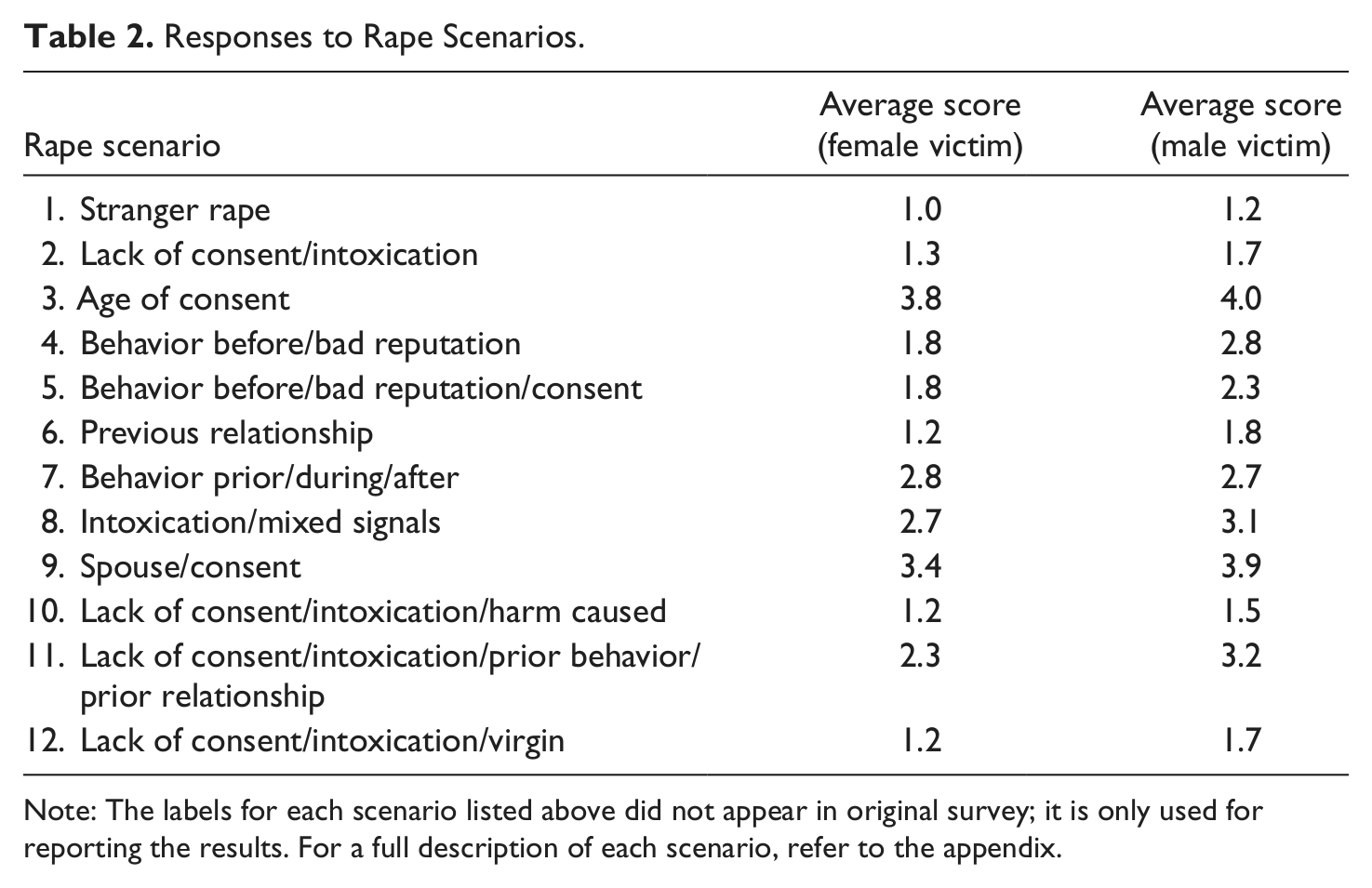
Note: The labels for each scenario listed above did not appear in original survey; it is only used for reporting the results. For a full description of each scenario, refer to the appendix.
Effect of Participants’ Sex and Victim’s Sex
To assess the effect that the participants’ sex and the victim’s sex had on the perception of various rape scenarios, a multivariate factorial ANOVA was utilized (for results, see notes in Table 3). Here, the dependent variable was the perception of the rape scenarios and the independent variables included the sex of the person taking the survey and the sex of the victim portrayed in the survey. The participant’s sex (person taking the survey) was significantly related (p < .05) to whether he or she perceived the described situation as rape in all but two of the scenarios. The participant’s sex was not significantly affected for a scenario describing consensual sex between a 16- and 19-year-old (Scenario 3) and a scenario describing very mixed signals from the victim (Scenario 7). For the remaining scenarios, male participants were less likely than female participants to perceive the described situation as rape (see Table 3).
Participants’ Responses to Rape Scenarios.
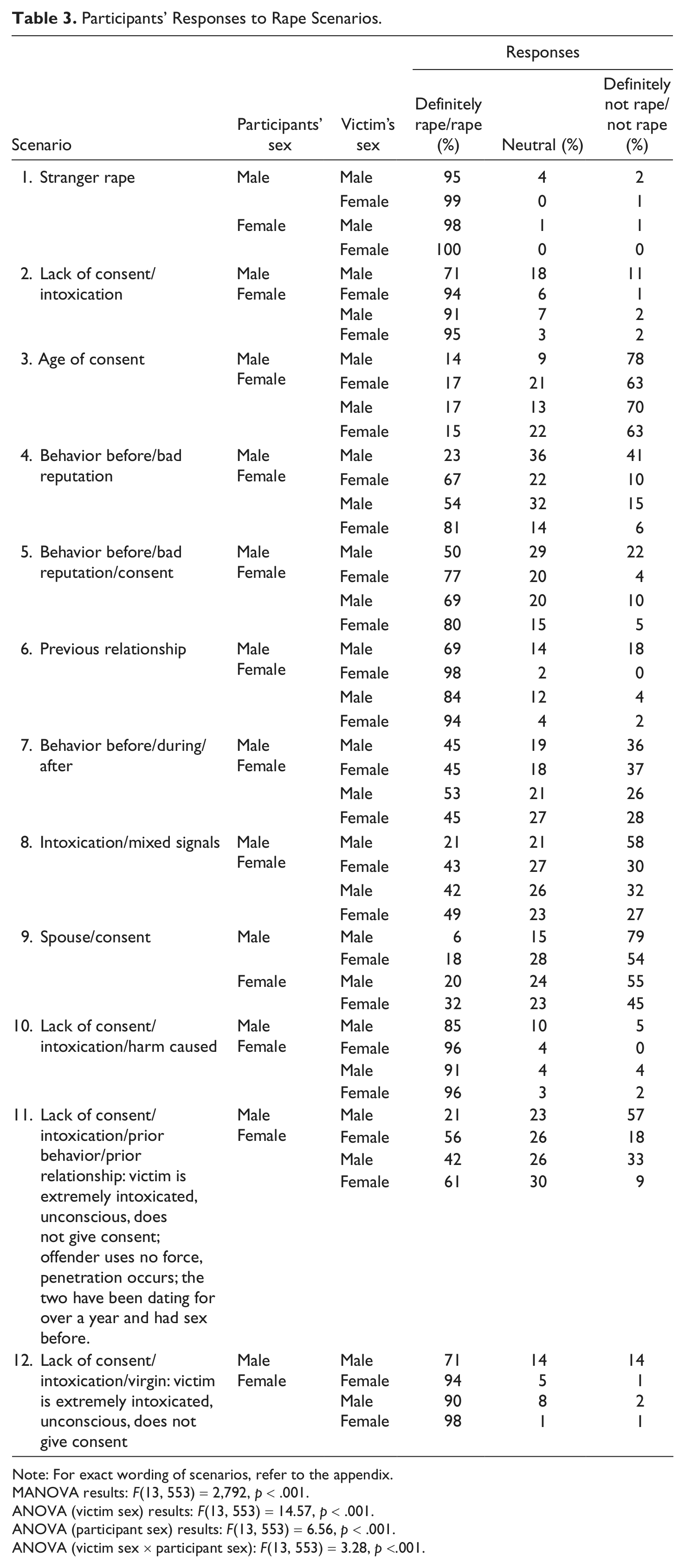
Note: For exact wording of scenarios, refer to the appendix.
MANOVA results: F(13, 553) = 2,792, p < .001.
ANOVA (victim sex) results: F(13, 553) = 14.57, p < .001.
ANOVA (participant sex) results: F(13, 553) = 6.56, p < .001.
ANOVA (victim sex × participant sex): F(13, 553) = 3.28, p <.001.
In addition, the victim’s sex significantly (p < .05) affected the subjects’ perception in every scenario except Scenario 7, which described very mixed signals from the victim. In most of the scenarios, the participants were significantly more likely to perceive the vignette as rape when the victim was female compared with male.
One of the advantages of relying upon a factorial ANOVA is that it will detect interaction effects in addition to main effects. For example, thus far, it is known that the participant’s sex and the victim’s sex affects individual perceptions of rape (in most described scenarios), yet it may be possible that perception is affected by a combination of the participant’s sex and victim’s sex. For example, in some scenarios, it may be that male subjects are more (or less) likely to perceive a given situation as rape, but only when the victim is male (or female).
For seven of the scenarios, a significant interaction effect was found between the participants’ sex and the victims’ sex. The most common pattern was found in six of the scenarios (Scenarios 2, 4, 5, 8, 11, and 12), and among those scenarios, the most common pattern that was perceived as a rape occurred when a female participant was reading about a female victim. The second most likely group to perceive these scenarios as rape included male participants reading about female victims; this was followed by female participants reading about a male victim and male participants reading about a male victim, respectively. These included the following scenarios: (Scenario 2) intoxicated victim who is unconscious, no consent given; offender uses no force, yet penetration occurs; (Scenario 4) victim has bad reputation, flirts at party, and no consent given; (Scenario 5) victim has a bad reputation, flirts at a party, takes clothes off, but says “no,” penetration occurs after some force occurs; (Scenario 8) both drank a lot of alcohol, mixed signals are given, penetration occurs; (Scenario 11) intoxicated victim who is unconscious, no consent given; offender uses no force, penetration occurs; the two have been dating for over a year and had sex before; and (Scenario 12) intoxicated victim who is unconscious, no consent given; offender uses no force, penetration occurs; the victim is a virgin.
The other significant interaction (between victim sex and participant sex) identified included the scenario that described a rape between two people who had a previous relationship (Scenario 6). With this scenario, male participants reading about a female were most likely to perceive this situation as rape (followed by females reading about a female victim, females reading about a male victim, and males reading about a male victim).
Discussion and Conclusion
The results of this research corroborate previous research in many ways; first, it shows the largest percentage of college students do not support rape myths. In addition, it shows that male college students are more likely than female college students to support rape myths. Lonsway and Fitzgerald (1994) reported that sex (male/female) was the most critical factor in predicting support for rape support myths; more specifically, men were more supportive than women of rape myths. Moreover, men are generally less likely than women to perceive ambiguous situations as rape. Stranger rape was most likely to be perceived as a rape by the students, which corroborates previous research (Bell et al., 1994).
This research also builds on the existing literature by providing additional information about factors that affect perceptions of rape that could affect those who are likely to encounter rape victims. The rape myths that were most likely to be supported involved men not being able to control their sexual urges (men don’t usually intend to force sex on a woman, but sometimes they get too sexually carried away; and rape happens when a man’s sex drive gets out of control). There are many implications for such findings. For example, it has been noted that potential jury members for rape cases should be screened to determine whether they hold false beliefs regarding rape (Hammond et al., 2011); the finding from this research specifically suggests for those who do support rape myths, they are likely to support myths surrounding biological control. Thus, particular caution should occur in cases that involve a situation where biological control is in question (i.e., both agreed to have sex initially, yet she changes her mind shortly before intercourse).
At the onset of this research project, the goal was to go beyond the finding that simply stated men are more likely to support rape myths and examine any confounding effects that occur with the victim’s gender and the sex of the observer. With regard to implication, the “observer” could be anyone from a friend of a rape victim, someone providing services to a rape victim, a potential juror, or law enforcement personnel. This research found that when the victim is male, the rape scenario is less believable. The believability diminishes even more when the observer is male compared with female. Thus, when men do work in professions where they are likely to encounter rape victims, additional education and training may be necessary. Such training, for example, should include scenarios involving male victims of rape.
For most scenarios, a female observer of a female rape victim was most likely to perceive the situation as rape. The least likely scenario to be perceived as rape was a male reading about a male victim. Some situations, however, changed this dynamic, for example, when the aggressor and the victim had a previous relationship. Here, a male observer reading about a female victim was the most likely to perceive the situation as rape. Again, in terms of jury selection for cases that involve an (alleged) offender and victim who had a previous relationship, male jurors may be more prone to believe the incident was rape.
Although this study had several methodological improvements over previous efforts (i.e., larger sample that was more representative of the population from which it was drawn, included a larger proportion of Hispanic students, included studies with a variety of majors, and relied upon a validated instrument), it still had several limitations, which yields itself to suggestions for future research in this area. The study included a sample of students from only one university; future research should include students from multiple regions and multiple universities. In addition to the Illinois Rape Myth Scale, vignettes were created to examine several concepts and those vignettes may not have fully tested the concept being measures; additional analysis and tests are needed to test the validity of these vignettes.
This research, therefore, shows that students, overall, generally do not support rape myths. When rape myths are supported, they most likely involve the biological control of the male aggressor. Male observers are less likely than female observers to support rape myths. The interaction of the victim’s sex and the observer’s sex, along with the context of the rape, can affect one’s perception. These findings, therefore, warrant further inquiry.
Footnotes
Appendix
Declaration of Conflicting Interests
The authors declared no potential conflicts of interest with respect to the research, authorship, and/or publication of this article.
Funding
The authors received no financial support for the research, authorship, and/or publication of this article.