



Abstract
Violence against sex workers is considered a global phenomenon. Despite this, very little is known about the patterns and nature of this form of violence. This article is concerned with violence against Chinese female sex workers in Hong Kong. Based on a systematic analysis of 75 police case files, it was found that violent attacks on sex workers display clear temporal and spatial patterns, and that perpetrators share certain characteristics. The article concludes that violence against female sex workers in the Chinese context is largely opportunity driven and goes on to argue that situational measures offer the greatest potential for preventive gains. Barriers to effective implementation such as the inappropriate or unfavourable responses of the government, the police, community leaders, and local residents toward commercial sexual activity are also discussed.
Introduction
Violence against sex workers has become a worldwide issue, drawing the attention of researchers in numerous countries, including India (Karandikar & Próspero, 2010; Suresh, Furr, & Srikrishnan, 2009), Britain (Barnard, 2009; Sanders, 2004), China (Choi & Holroyd, 2007), Serbia (Simić & Rhodes, 2009), Nigeria (Izugbara, 2005), United States (Lutnick & Cohan, 2009), and South Africa (Wechsberg, Luseno, & Lam, 2005). It has been estimated that female street sex workers are 60 to 100 times more likely to be murdered than are other women (Salfati, James, & Ferguson, 2008).
Comparatively, available literature on Hong Kong’s sex workers has been limited. Whereas some studies were concerned with the Mainland Chinese sex workers’ experiences with the Hong Kong’s criminal justice responses (Laidler, Petersen, & Emerton, 2007), the historical review of sex industries (Lethbridge, 1978) and the connection between the Hong Kong’s sex workers and local triads (Chu, 2000), and the prevalence of violence against sex workers (Action for Reach Out, 2007), very little has been done on analyzing patterns of violence against sex workers and its prevention strategies. This is an exploratory study with the aim to gain a better understanding of violence against sex workers in Hong Kong and determine strategies for prevention. Chinese sex workers in this article refer to ethnical Chinese doing sex work in Hong Kong; both local people and Mainlanders are included.
The article is structured as follows. First, research on violence against sex workers is briefly reviewed. Next, the study site (Hong Kong), data set, and analytical strategy are described. This is followed by a critique of current violence-prevention strategies. Finally, the article concludes with a discussion of the study’s limitations and implications of the findings for preventing violence against sex workers in Hong Kong.
The prevalence of violence against sex workers has been evident in past research. For instance, a study conducted in New York found that two out of three sex workers reported physical and sexual abuse by either a partner or a customer in their lifetime (EI-Bassel, Witte, Wada, Gilbert, & Wallace, 2001). Hong Kong is no exception. In a survey study of 113 female sex workers in Hong Kong, 40.7% of respondents had encountered the customers’ attempt of removal of condom, 25.7% had been confronted by nonnegotiated sex acts, 18.6% had experienced refusal of payment from customers, 14.2% had been robbed, and 13.3% had suffered from verbal threats and blackmail by someone (Action for Reach Out, 2007).
Violence against sex workers takes various forms, ranging from verbal harassment to physical and sexual assault, assault with a weapon, strangling, abduction or kidnapping, and attempted sexual assault (Shannon et al., 2010). It also includes robbery and murder (Ratinthorn, Meleis, & Sindhu, 2009). Simić and Rhodes (2009) suggested that the everyday violence confronting street sex workers can be physical, emotional, or social. Comack and Seshia’s (2010) categories of violence, including verbal, physical, sexual, and economic violence, seem comprehensive and applicable to the Hong Kong situation.
Violence against sex workers can be client related or partner related (Wechsberg et al., 2005). In addition to clients and partners, pimps and police officers may inflict abuse on sex workers (Dalla & Kennedy, 2003). In a study conducted in Cambodia, it was found that more than half of the sample of sex workers reported being abused by the police (Jenkins, 2006). Sanders (2004) found that community protestors can also be perpetrators of violence against sex workers.
Violence can be related to the working venue of sex workers. In a study undertaken in three cities in the United Kingdom, 81% of street sex workers and 48% of those who worked indoors had experienced violence at the hands of clients (Church, Henderson, Barnard, & Hart, 2001). Similarly, in the survey by Action for Reach Out, street sex workers in Hong Kong generally reported more incidents of violence, compared with those who worked in indoor venues, such as salons, nightclubs, and one-woman brothels. The working venues for street sex workers—deserted location, alleyway, backstreet, or a vehicle belonging to the client—are comparatively risky (Salfati et al., 2008). A lack of guardianship in the workplace combining with the power relationship between sex workers and their customers create a high-risk working environment for sex workers in Hong Kong.
Without a doubt, violence is loathed and feared by victims. Recent research has emphasized the harm that sex workers suffer as a result of violence. In a worldwide research project, sex workers’ mental health problems were found to relate primarily to various forms of violence (Rossler et al., 2010). In addition, violence has been found to be a strong predictor of the depression of sex workers in India (Suresh et al., 2009). Under the threat of violence, sex workers in Mainland China were forced to have sex with customers without the use of condoms (Choi & Holroyd, 2007).
Previous literature has highlighted measures that can be taken to tackle this particular type of violence. These measures can be taken by government regulation, by mutual support within a community (social measures), or by removing risk on victims through changing the immediate environment (situational measures). In some countries, the government takes an active role in protecting sex workers from victimization. For example, the creation of managed street sex work zones has helped to reduce violence against and insecurity in sex workers in Germany (Kerschl, 2004) and the Netherlands (Van Doorninck & Campbell, 2006). Sex industries in these countries are mostly decriminalized or legalized.
In addition, one believes that crime control is fundamentally social—relying heavily on the collective responses of different parties in the community. A successful community project in the United Kingdom used a multiple-agency working approach to tackle client violence against female sex workers (Penfold, Hunter, Campbell, & Barham, 2004).
Many sex workers are, in fact, not passive in the face of violence and recognise their vulnerability to victimization. Some routinely adopt situational crime prevention (SCP) measures to ensure their own safety. SCP “seeks to alter the situational determinants of crime so as to make crime less likely to happen” (Clarke, 2008, p. 178). For example, two studies conducted in the United Kingdom between 2000 and 2002 using qualitative fieldwork found that sex workers try to reduce their risk for being attacked by managing the environment (e.g., through the use of closed-circuit televisions [CCTVs]), using individual protection mechanisms (i.e., application of personal skills to deal with a perpetrator), and using collective control (e.g., the flow of customers is controlled by a manager or receptionist in premises shared by several sex workers; Sanders & Campbell, 2007). In these two studies, qualitative data from interviews with sex workers confirmed that they felt safe in their workplaces with the application of these three techniques. These techniques can be categorized into some of the 25 SCP techniques by Cornish and Clarke (2003): “strengthening formal surveillance,” “reducing frustrations and stress,” and “use of place manager,” respectively. In Germany, with the enactment of the 2002 Prostitution Act, sex workers can work without criminalization within a specific area, where they are under the formal surveillance of the police (Sander & Campbell, 2009). This resulted in a huge reduction in violence against sex workers (Kerschl, 2004). Similarly, in the regulated zone in Utrecht, the Netherlands, sex workers can solicit clients under the protection of the police (formal surveillance techniques). Since this policy was implemented, there have been no records of the murder of sex workers in this area (Sander & Campbell, 2009). Nevertheless, Sander and Campbell (2009) also noted that safety can no longer continue to be assured because of the influx of global immigrants into the sex industry in this country. This is probably because immigrant sex workers remain underground and thus out of sight of the police. It is worth exploring in this article whether the aforementioned measures in the United Kingdom, Germany, and the Netherlands can be applied in Hong Kong, where the sex industry is neither illegal nor government regulated.
Setting for This Research
Hong Kong is a Chinese coastal city that was under the colonial rule of the British government for almost 100 years until 1997. Hong Kong society has been influenced by Eastern and Western cultures. In spite of this cultural diversity, Hong Kong citizens’ attitude toward sex workers tends to be conservative, intolerant, and hostile—very similar to Chinese attitude. In fact, the Hong Kong population was about 7 million in 2009, and 95% were of Chinese descent (Hong Kong Government, 2010). A study conducted based on a sample of Chinese citizens found that prostitution was generally perceived as unjustified by Chinese citizens, especially by those who valued the importance of family (Cao & Stack, 2010). Purchasing sex is viewed by Chinese people as being unfaithful to their partner.
The sex trade in Hong Kong takes place in various forms and venues, such as “love hotels” that are used by street sex workers, nightclubs, one-woman brothels, and saunas and massage parlours. In recent years, some teenage girls were found to engage in a type of commercial intimate relationship called “compensated dating” (with or without sex) as a freelance job. Some visitors from Mainland China and other places, such as Thailand and the Philippines, were arrested for their involvement in the sex industry. Without a formal registration system, it is not possible to make an accurate estimation of the number of sex workers in Hong Kong. A rough account by a local newspaper said that 200,000 sex workers were in business in Hong Kong in the year 2000, with more than 80% working in one-woman brothels (Action for Reach Out, 2007).
Currently, the sex trade in Hong Kong is not considered illegal unless a person is found to be keeping a vice establishment, soliciting for an immoral purpose in public places, letting premises for use as a vice establishment, or living on earnings of the prostitution of others (Crime Ordinance, Cap 200). If anyone holding a visitor’s visa is found to be working in Hong Kong (including sex work), she or he will be accused of breaching the conditions of her or his stay (Crime Ordinance, Cap 200). Obviously, although the sex industry in Hong Kong is decriminalized, the Hong Kong government adopts tight control over sex workers as well as those who facilitate the sex industry. To crack down on the illegal activities defined by the aforementioned criminal codes, and to respond to the complaints from residents and local community leaders, the Hong Kong police use a tough and high-profile approach to deal with sex workers. Sex work was legalized and regulated in Hong Kong from 1878 to 1932, and sex workers were required to register for licenses, pay taxes, and have regular health examinations. Sex work became an underground activity in 1932, when the Hong Kong government issued a ban on it (Yang, 2006). In line with the economic prosperity of the 1980s and 1990s, the sex industry in Hong Kong was able to continue operating by relying on the protection of triad societies in Hong Kong. Since the 1990s, the influx of young women from Mainland China provided a cheap labour force for the sex industry in Hong Kong. Because of these unique social situations, the sex industry in Hong Kong is still flourishing, despite facing tight control from the police and resistance from the general public in the society.
In recent years, violence against sex workers has become a hot topic in Hong Kong, especially after the extensive reporting by the mass media of the serial murders of three sex workers in March 2008 (Ming Pao Daily News, 2008). These intimidating crimes aroused sex workers’ concern. The sex workers subsequently organized demonstrations to assert their right to protection (Wen Wei Po, 2008). A communication platform was promptly set up between the police and several organizations fighting for the basic human rights of sex workers in Hong Kong. This platform was an attempt to generate solutions to the problem of violence against sex workers.
However, investigations of violence against sex workers in Hong Kong remain very limited. And “one of the biggest questions remains whether violence against prostitutes is one of opportunity and availability or because they are prostitutes” (Salfati et al., 2008, p. 514). To understand whether this criminal act is opportunity driven, we need to know about the nature and pattern of this kind of violence and the characteristics of perpetrators. Regrettably, available data in Hong Kong are scarce. Consequently, the evidence base that can usefully inform the development of crime prevention measures to contend with this problem is limited. To address this gap in the literature, this article is intended to contextualize our understanding of the nature of violence against sex workers and to discuss some possible ways and barriers to implementing effective crime prevention methods in a Chinese society: Hong Kong.
Method
Police case records were made available for the 24-month period (June 2008 to June 2010). In an attempt to create a clearer picture of the characteristics of perpetrators and the pattern of violence against sex workers in Hong Kong, data were coded and analyzed. Each record contains information about the crime event (i.e., date, time, and place), perpetrators’ description (gender, age, language, and appearance), as well as the offending techniques. Since 2008, each social service agency assisting sex workers has been provided a full set of recorded cases of violence against sex workers from the police so as to inform sex workers in the community about the risk of victimization. With the permission of one such agency, the researcher was also able to access 80 case files and conduct an analysis of these data. Five cases were eliminated due to missing data and irrelevancy. Consequently, 75 cases remained, involving 75 victims and 75 known perpetrators. All the victims were females. Based on the concepts generated from previous literature and from preliminary scanning of the 75 cases, the researcher uncovered the following themes:
Pattern of violence (month, day, and time of the violent incidents) Characteristics of perpetrators (sex, estimated age, ethnicity) Use of weapon Nature of violence (economic, physical, verbal, and sexual violence)
A research staff following the researcher’s instruction conducted the coding of the scripts of the 75 cases with the assistance of NVivo. In addition to simple numerical count of the aforementioned themes, the research staff also categorized the corresponding incident scripts into four different “tree nodes” based on the nature of violence. More than one type of violence could be involved in one single incident. Finally, the researcher (who is also the author of this article) confirmed and analyzed the data and generated her conclusions about the feasibility of applying SCP in dealing with violence against sex workers in Hong Kong. One should bear in mind that data drawn from police records should be used with caution. The present analysis, for instance, does not cover unreported incidents such as the violence perpetrated against sex workers by police officers, pimps, family members, and friends. More than 90% of the reported cases happened indoors, mostly in one-woman brothels. Police statistics do not contain unreported cases involving sex workers on the street who are reluctant to report their victimization to the police due to the risk of being charged for “soliciting others in a public place” (Crime Ordinance, Cap 200, Sect. 147).
Despite this, the analysis of police records can shed some light on the workplace violence encountered by sex workers in Hong Kong. What is identified in this analysis is that violence against sex workers displays clear chronological, temporal, and spatial patterns. The perpetrators of such crimes, according to the data analyzed here, also exhibit distinctive characteristics. Therefore, violence against sex workers is not random and is likely to be predictable and preventable.
Findings
Pattern of Violence
In analyzing 75 incidents that occurred over the 24-month period from June 2008 through June 2010, one can identify the high and low seasons for crimes against sex workers in spite of some deviation in the data. Within the reported period, 40 criminal cases were reported in the months of March, June, July, and December, which accounted for more than 53% of the total reported cases. In the months of February, August, September, and October, crimes against sex workers were few—the data reflect just 10 cases (see Table 1). Clearly, February was not a popular month for offenders; one may speculate that this is because most sex workers from Mainland China returned to their homeland for Chinese New Year, leaving few targets in the community. More targets became available when sex workers returned from their holidays in March, possibly working harder after a period without income. Similarly, sex workers might put in longer hours in December and January so as to save money before the Chinese New Year. For the same reason, offenders become more motivated in these 2 months.
Pattern of Violent Incidents Against Sex Workers.
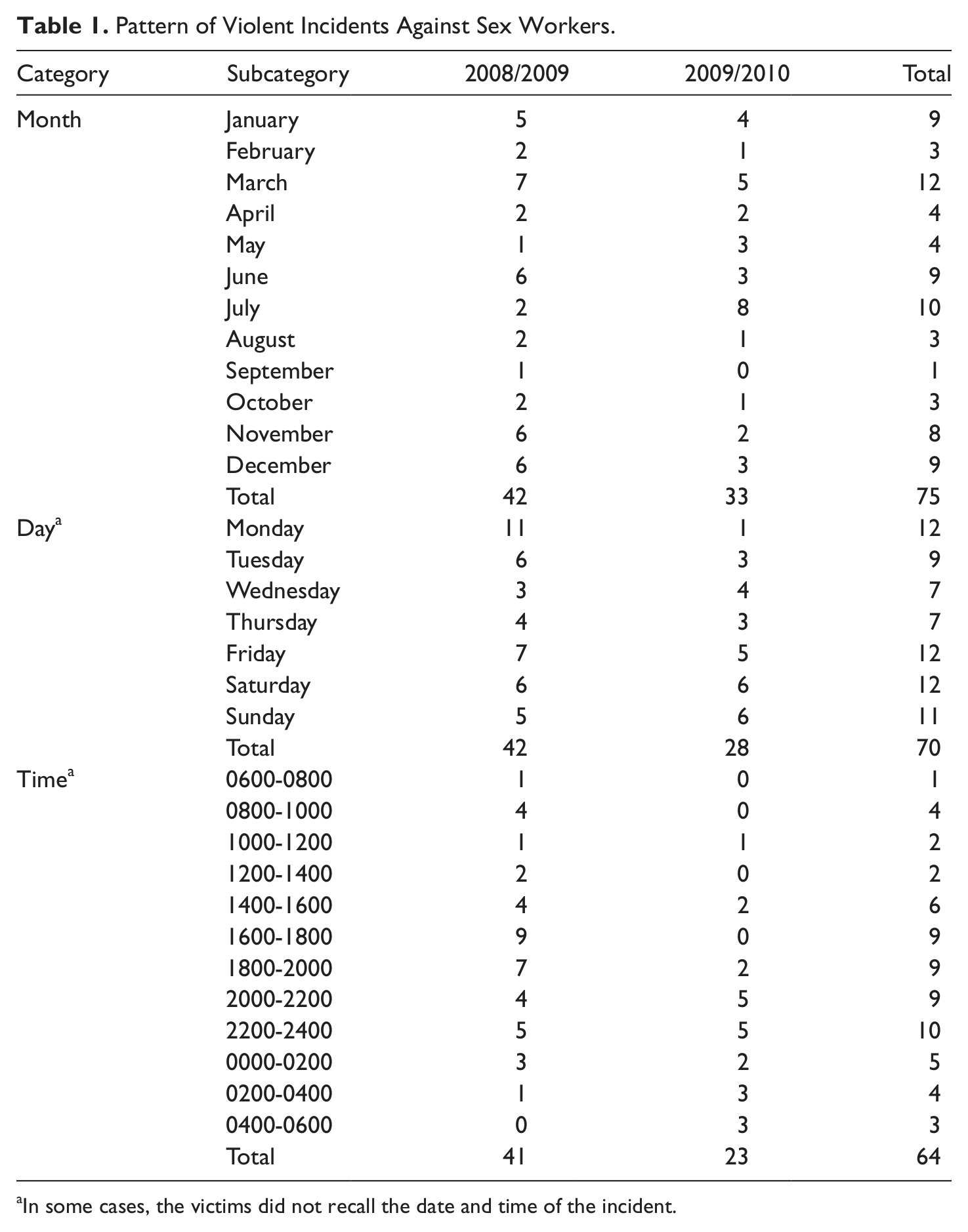
In some cases, the victims did not recall the date and time of the incident.
Data in Table 1 also indicate that crimes against sex workers were more frequent on Friday, Saturday, and Sunday, as well as from late afternoon (4:00 p.m.) to midnight (12:00 a.m.). This pattern is consistent with the “business hours” of commercial sex in Hong Kong where more attractive targets are available.
More than 30% of the reported cases happened in two urban areas of Hong Kong: Sham Shui Po and Tsuen Wan. In these two hot spots, old buildings from the 1950s, which usually lack security facilities and management, appear to be attractive to offenders. Paradoxically, premises with cheap rent and good accessibility are perceived as desirable for commercial sex operations.
Characteristics of Perpetrators
A total of 75 known perpetrators were involved in 75 crime incidents in a 24-month period in the data investigated (see Table 2). More than 1 perpetrator was involved in some cases, whereas no perpetrator was recorded in other cases. Offenders and suspects were overwhelmingly Chinese males, except in one case involving a female offender. A small number of the perpetrators were Mandarin speaking; these were most likely visitors from the Mainland. Thus, it is believed that perpetrators of this type of crime in Hong Kong are mostly local people. Data showed that more than 61% of the cases were committed by customers. More than 44% of these crimes were committed by younger adults (aged 21-30), whereas the older adult group (aged 31-60) accounted for about 30% of incidents. People aged 20 and below and those aged above 61 were less likely to be offenders in cases of violence against sex workers, each making up less than 10% of cases.
Crime Techniques and Characteristics of Perpetrators.

Interviewees might report more than one type of violence in a single event.
There were cases involving more than one perpetrator, whereas in some murder cases, the number of perpetrators was unknown.
It was commonly found that offenders took cash and cell phones from victims when the victims were in the shower after sex. Offenders also threatened victims with weapons after sex. It is worth noting that some offenders pretended to be police officers to persuade victims to let them enter their premises. However, in most cases, this ruse did not work, and the perpetrators had to use violence to get their victims under their control.
Nature of Violence
The use of violence was found to be prevalent in the reported crimes against sex workers. Among the 75 criminal incidents, 93% involved violence. According to the latest victimization survey conducted in Hong Kong, the victimization rate of violent crimes was 10.5 per 1,000 people, accounting for 18% of all victimization cases reported by the survey interviewees in 2005 (Census and Statistics Department, 2007). Police statistics indicated a similar profile; that is, 18% of the total crimes reported to the police were violent crimes (Hong Kong Police, 2009). Clearly, sex workers in Hong Kong display a higher risk of being the victim of violence when compared with the general population. Weapons were involved in 37% of the cases (see Table 2). Perpetrators typically used knives because they are easily concealable. Without a doubt, sex workers function in unfavourable or even dangerous environments. They are exposed to various forms of violence, including economic, physical, verbal, and sexual violence. Even worse, they may encounter more than one form of violence during a single incident.
Economic violence
Economic violence in the forms of robbery, theft, snatching, and refusal to pay for services was found to be the most common type of violence among the reported cases. In all, 64% of respondents reported that they had experienced economic violence (see Table 2). The offenders in cases of economic violence were opportunists who took cash and cell phones from victims when they were showering. The following are examples of this type of crime:
The suspect visited the victim at her place for services. Victim invited him in. She left him in the room alone while she was in the shower. After the services, the suspect left. The victim then found that her handbag from her drawer was gone, including her cash and proof of identity. (Case 20090302) The suspect visited the victim at the above address and paid immediately. The victim immediately went to the bathroom to shower, but the suspect stayed in the room alone. The suspect left alone after the service. The victim later realized that the cash in her handbag was missing. (Case 20100116) This victim is working in a one-woman brothel. Suspect pretended to be a customer for the service she provided. After it was done, the suspect took out a knife and pointed it at the victim. The suspect snatched $200, a purse, a cell phone and an octopus card (a card used for electronic payments). Afterward, he brought the victim to the ATM machine to withdraw cash. While they were walking to the building’s concourse, the victim shouted for help, after which the suspect absconded with the money. (Case 20080624)
In most of the cases, economic violence was accompanied with physical violence.
The victim provides sexual service at the above address. At the above date and time, the suspect visited the address above requesting service. After entering the flat, the suspect took out a 3-inch spring knife to threaten the suspect and stated that he was a robber. The victim handed over $1000 in cash to the suspect, who attempted to leave. The victim attempted to stop the suspect from leaving, but during the struggle, the victim was cut in the abdomen. The suspect escaped, and the victim immediately called the police. (Case 20100730)
Physical violence
Physical violence involved the use of physical force with the intention of bringing harm, injury, or even death to another person or object. More than 43% of the reported cases involved physical violence (see Table 2). Common examples of this type of violence include punching, slapping, hitting, choking, burning, and using weapons. In some cases, violence was used by the customer in a verbal conflict with the sex worker.
At the above date, time and place, the suspect visited the victim. Afterwards, the suspect and the victim disputed the price of the service. The suspect suddenly assaulted the victim’s shoulder and legs, and left immediately. Before he left, the suspect threatened the victim, stating that she was not to call the authorities again or she would be assaulted again. The victim called the police out of fright. (Case 20100113)
On some occasions, sex workers suffered from intimidation by gangsters. In fact, sex workers are regarded as a source of income by the triad gangs in Hong Kong.
The victim provides services of a sexual nature at the above mentioned address. At the above date, time and place, Suspects 1 to 3 visited the victim and knocked on her door, requesting service. As the victim was working, she refused to open the door. Suspect 3 repeatedly kicked the door and caused damage to the lock, springing the front gate open. The victim opened the door to check and saw that Suspects 1 to 3 had fled the scene. She therefore called the police. (Case 20100310)
Verbal violence
Compared with economic and physical violence, verbal violence was perceived as less threatening. Only 21% of the reported cases involved verbal violence (see Table 2). Victims were less likely to report cases to the police unless they found themselves in great danger.
The victim has published her personal address and cell phone number on the Internet as a personal introduction of herself. On December 4 at 4:36 pm, the victim received a phone call from an unknown suspect. At that time, the suspect intimidated her, stating that he would kill her, and then he hung up. Another day, on December 7 at 7:10 pm, the same suspect called the victim again. It was also an unknown phone call. The victim was told to be careful that night. For safety and security reasons, the victim reported this case to the police. (Case 20081204) A man stated after entering the flat that he was a policeman. The sex worker requested to see some form of identification but was responded to with harsh language. The sex worker immediately opened the door in an attempt to chase the man away, but the man refused and shut the door by force. The sex worker refused to believe that the man was a police officer and requested that he call another colleague to the scene. The man refused and warned the sex worker that she needed to improve her attitude. (Case 20091202)
Sexual violence
Sexual violence against sex workers was rarely reported; only 5% of the cases could be categorized as this type of violence (see Table 2). The cases below illustrate how sex workers suffered from indecent assault by customers or strangers.
The arrested suspect had been to the brothel four times. Every time, he did the same thing. He pressed the doorbell, waited till the victim opened the door, then rushed into the apartment and indecently assaulted the victim. On May 22, 2009, this suspect went to the victim again and kept pressing the doorbell; then the victim called the police. The police arrested him after that. (Case 20090305) The wanted suspect rang at the door, claimed that he was a police officer and asked the victim to open the door so that he could do a regular check-up of licenses. The victim let him in and requested to see his identity, but the suspect did not show her. At the same time, the suspect started touching the victim’s body on the breast and waist without permission. The victim charged the suspect for this contact, and the suspect refused to pay. The victim tried to stop him from striking her body, but she failed. The suspect snatched her cell phone and punched her with both hands. The victim cried out for help during the fight. The suspect bit her hand, leaving marks on her right palm, and also hurt her right forearm. (Case 20081114)
It is clear from the above cases that sex workers in Hong Kong have been confronted with various forms of violence. Furthermore, these cases of violence have a specific profile in terms of date, time, and place. This kind of violence is entirely purposive (i.e., economic gain) relying on opportunities offered by the environment, such as availability of targets and negligence of victims.
Discussion
Possible SCP Measures
Because of the predictable nature of violence against sex workers in Hong Kong, SCP measures (Clarke, 1980; Cornish & Clarke, 2003) and the enhancement of capable guardians (Cohen & Felson, 1979) can be considered to prevent it.
Reduce provocation
The case analysis shows that most of the perpetrators were customers who spent some time with the sex worker (the target) before becoming violent. Therefore, using skills that “reduce frustration and stress,” such as using humour, speaking in a gentle voice, and showing care and concern, during the transaction may help sex workers reduce the customers’ anger and frustration. In addition to these communication skills, keeping alert of the customers’ emotional stage is of great importance.
Increase the risks
Violence of this kind is predictable and occurs in specific places, dates, and times. Periodic profiling of violence cases can generate valuable references for the police to prevent crime by strengthening formal surveillance in certain hot spots (old premises in particular districts), peak seasons (March, June, July, and December), and specific times of day (from late afternoon to midnight). It seems possible to deploy more police power and therefore have higher visibility. In addition, the installation of panic buttons in one-woman brothels is another measure being considered by some organizations offering assistance to sex workers in Hong Kong. Sex workers can seek immediate help from these organizations by pressing the button when facing crises, including violence. In addition, some sex workers have installed CCTVs at the entrance of their brothels (use of place management) to deter potential offenders and to screen out high-risk customers.
Reduce the reward
In cases of economic violence, the perpetrators mostly stole cash and cell phones from victims when they were showering. Under such circumstance, the technique of “removing the target” can work, such as keeping only a small amount of cash and not leaving cell phones unattended in the workplace. In addition, sex workers should consider concealing their credit cards and jewellery.
Cautions for Implementation
The social conditions (i.e., residents’ response, policing strategy, and government attitude to sex workers) of Hong Kong are by no means identical to Germany and the Netherlands. Precaution shall be paid to those anticipated barriers to implementing situation crime prevention measures.
Protection versus control
Although commercial sex in Hong Kong is not illegal, the punitive agenda of the Hong Kong government has put sex workers under tight controls. Females working in one-woman brothels are often under tight control from the police. Sex workers are charged if two of them have a commercial sex operation in the same premises. This substantially eliminates the possibility of mutual support among sex workers, especially at times of risk. In addition, according to the Crime Ordinance, a person shall be guilty of a crime if she or he knowingly lives wholly or in part on the earnings of prostitution of another person (Crime Ordinance, Cap 200, Sect. 137). Under such restrictions, sex workers find it difficult to locate security services on their own. What they can rely on is the use of CCTV. However, the usefulness of CCTV is minimal unless it is monitored by security staff at all times.
Guardian versus enemy
Sex workers seldom seek help from the police, even in the face of crime. In addition to the problem of trust toward police officers, administrative control over visitors is a significant issue. According to prison statistics, a great number of women were arrested by the police for breaching the “condition of stay” when they were found to be involved in the sex trade. Mainland immigration violators made up around 60% of sentenced women in prison in 2004 (Lee, 2007). To avoid being arrested for breaching the condition of stay, sex workers who hold visitor visas are less likely to report their victimization to the police. Local sex workers also reported having troublesome encounters with the police. Complaints by sex workers about police “strip searches,” “battering the arrested,” and “abuse of power to enjoy free sex service” are not unusual in Hong Kong (Ziteng, 2009). Negative experiences of encounters are probably the main barrier for sex workers in seeking protection from the police.
Natural surveillance versus invisible residents
In Hong Kong, members of the public are generally not willing to have contact with neighbours who provide commercial sex. Community leaders have urged the police to clean up prostitution activity so as to create a “safe” and “decent” living environment. In line with the intolerant attitude of community members, the Hong Kong government has devoted much effort to restraining the expansion of the commercial sex industry via legislative measures. According to the Crime Ordinance, the owner, tenant, agent, occupier, or person in charge of any premises or vessel shall be guilty if she or he knowingly lets, permits or suffers the whole or part of the premises to be kept as a vice establishment, or to be used for the purpose of habitual prostitution (Cap 200, Sects. 143, 144, and 145). In the face of unfavourable community situations, sex workers maintain a low profile and have very limited contact with others in the community. Under such situations, natural surveillance by neighbours can hardly take place on the sex workers’ premises. Understandably, this may provide opportunities for offenders to initiate attacks on sex workers.
Access control versus making it accessible
Premises with lower rent tend not to be well equipped with crime prevention measures and capable security staff. Monitoring of the building entrance is always far from adequate. Residents, customers of sex services, strangers, and even offenders can easily go in and out of the building without screening or checking. The security guards at the main entrance often adopt a less intrusive manner when dealing with visitors who appear to be the customers of sex workers. This not only provides convenience to customers but also opportunity to offenders.
Conclusion
The aim of this study was to contextualize our understanding of the nature of violence against female sex workers in Hong Kong and to discuss the possible barriers to its prevention. The findings have theoretical and practical implications. Theoretically, the findings suggest that violence against sex workers is clearly patterned and largely opportunity driven. The case analysis indicates that most perpetrators attacking sex workers are motivated by economic gain, and they commit their crimes in specific places (urban areas with old buildings), dates (from Fridays to Sundays), and times (from late afternoon to midnight). Their use of violence appears purposeful and involves the coercion of sex workers. Therefore, it is reasonable to assume that crimes against sex workers can be reduced if effective crime prevention measures such as reducing frustration and stress, use of place management (panic button), removal of target (cash and cell phone), and strengthening formal surveillance by the police in those hot spots and peak season/time are established. Nevertheless, this study has shown that social context, policing practice, and community dynamics have placed some constraints on SCP measures, such as controlling access to facilities and natural surveillance. In addition, unlike previous studies that focused on the risks for street sex workers, the present study is intended to remind readers of the risks associated with indoor sex trading venues in Hong Kong. Government regulation and the police practices actually increase the risk of this situation.
Practically, the current study concludes that certain social conditions could be better prepared in line with the establishment of SCP measures such as “assisting natural surveillance,” 1 “controlling access to facilities,” 2 and “strengthening formal surveillance” 3 (Clarke & Eck, 2005).
First, a cohesive and caring community is fundamental to assisting natural surveillance. Understandably, people only pay attention to the neighbours whom they care and concern. Although we are a long way from achieving the process of “social inclusion” for sex workers (O’Neill, Campbell, Hubbard, Pitcher, & Scoular, 2008) in a Chinese society, it is a great idea to educate the public to treat sex workers with basic human dignity. For instance, in recent years, Ziteng, an organization promoting the human rights of sex workers in Hong Kong, attempted to teach customers to get service from sex workers in a respectful manner. Ziteng also released information online to increase the general citizen’s understanding of the circumstances and rights of sex workers.
Second, it is true that offering sex workers legal protection is imperative (Kurtz et al., 2004). The policing strategy and operational procedure for handling the victimization of sex workers need to be reviewed and revised so as to achieve the purpose of strengthening formal surveillance. In Hong Kong, the Independent Police Complaints Council 4 (IPCC) could contribute more to monitoring and making recommendations on policing practice as necessary. However, a legislative amendment permitting sex workers in Hong Kong to hire security staff of their own is worth considering.
Third, the measures of controlling access to facilities can only be possible under good premise management. The owner corporation 5 of each premise is assigned the legal responsibility by the government to take good care of the property management of their own building on behalf of other residents. Each corporation shall require the security staff to hold tight access control to the building. Relevant and adequate training to the staff, and installation and maintenance of crime prevention devices such as alarms and cameras are necessary.
Finally, the empowerment of sex workers is fundamental. They are entitled to receive some help in defending themselves from possible risks (e.g., by getting information about the implementation of SCP techniques and by training in self-defence). In India, some sex workers practice karate to prepare themselves to deal with workplace violence (The Gaea Times, 2009). In Argentina, sex workers have formed their own union and members of the union demand better work conditions, including health, safety, contractual rights, and decriminalization of sex work (World Health Organization [WHO], 2005).
This study itself is not perfect in terms of its research design and sample. It is recognised that the police report data in this study do contain bias and limitations. For future study, a method combining survey and in-depth interview with sex workers may yield more comprehensive data. A comparison on the risk of indoor versus outdoor sex work is also worth doing.
Footnotes
Acknowledgements
The author is very thankful to Action for Reach Out for allowing her to get access to the recorded cases of violence against sex workers in Hong Kong, to Aiden Sidebottom from the Jill Dando Institute of Security and Crime Science, UCL for his inspiriting suggestions for writing this topic, and to the anonymous reviewers for their valuable comments on the early version of this manuscript.
Declaration of Conflicting Interests
The author declared no potential conflicts of interest with respect to the research, authorship, and/or publication of this article.
Funding
The author received no financial support for the research, authorship, and/or publication of this article.