



Abstract
This article is concerned with the macro-level propositions of Nisbett and Cohen’s culture of honor thesis. The results suggest that the culture of honor proxy has a strong positive influence on homicide across nations. In fact, culture of honor exhibited larger effect sizes than all of the important social-structural controls. These results suggest that consideration of cultural processes is important for understanding macro-level variation in violence.
Introduction
In recent decades, renewed interest in cross-national criminological inquiry has substantively contributed to criminological knowledge. This research has been particularly effective at identifying the key structural predictors of violence across nations. Less is known, however, about the important cultural predictors of violence. This fact is quite lamentable when considering that a complete understanding of the relationship between social organization and violence cannot be attained unless social-structural and cultural processes are taken into account (Messner & Rosenfeld, 2007). There are two principal reasons for the lack of attention given to cultural explanations of violence at the cross-national level. First, existing theory on the topic is underdeveloped. Most of the existing theory on culture and violence focuses on how subcultural values among certain subgroups within nations explain group- or region-level variation in violence. For example, a sizable body of empirical research has tried to account for higher levels of violent crime rates in the southern United States during the 20th century. As noted by Pratt and Cullen (2005), explanations for elevated violence in the South have ranged from a historical tradition of chivalry, to heightened notions of defensiveness, to the exaggerated willingness to resort to violence to protect the honor of a good woman. An additional example involves the work of Elijah Anderson (1999), who proposes that a code of the street that regulates interpersonal behavior operates in socially disadvantaged African American neighborhoods and accounts for elevated levels of violence. Less effort has been given to explaining how cultural or subcultural processes account for societal variation in violence. Although some have called for greater consideration of such processes (Adler, 1983; Neopolitan, 2001), most contemporary explanations of crime simply fail to do so (for exceptions, see Braithwaite, 1989; Messner & Rosenfeld, 2007). Second, it has been difficult to operationalize the important predictors of cultural processes at the cross-national level. Much of the existing macro-level research on cultural processes and crime has used region or nation-level dummies to take cultural processes into account, but questions have been raised concerning whether this approach is scientifically defensible (Kornhauser, 1978; Pratt & Cullen, 2005; Pridemore, 2002c).
Despite the lack of attention given to cultural explanations of cross-national violence, there is reason to believe that further development of such explanations would be fruitful. The few existing cross-national studies that have incorporated cultural processes have been received positively in the criminological literature. For example, institutional anomie theory (Messner & Rosenfeld, 2007), a theoretical perspective that incorporates social structure and culture, has generated substantial interest in the field. In addition, Braithwaite’s (1989) reintegrative shaming theory continues to garner attention from criminological researchers (Schaible & Hughes, 2011). The knowledge generated from research on the above-mentioned theoretical perspectives suggests that criminologists should continue to explore the effects of cultural processes on violence.
One potential avenue for further exploration involves testing the macro-level propositions of Nisbett and Cohen’s (1996) culture of honor thesis. Although researchers have examined the individual-level components of this theory, the macro-level propositions virtually have been ignored. In brief, Nisbett and Cohen argue that in societies where a culture of honor prevails, a cultural milieu emerges that increases levels of violence. As discussed in the following, this cultural milieu has implications for those who adhere to the culture of honor and those who do not, and is believed to influence levels of violence. The study aims to add to our understanding of how cultural processes influence cross-national variation in violence by testing the macro-level propositions of Nisbett and Cohen’s thesis.
Brief Overview of Subcultural Research in Criminology
Cultural and subcultural explanations of violence are not new. In fact, social scientists have been citing culture as a source of violence since at least the 19th century (Corzine, Huff-Corzine, & Whitt, 1999; Guerry, 1833; Pridemore, 2002; Redfield, 1880). Early American criminologists also had an interest in understanding the role that culture played in shaping delinquent behavior (Sellin, 1938; Shaw & McKay, 1969; Sutherland, 1937). For example, Shaw and McKay (1969) argue that socially disorganized neighborhoods help produce and sustain unconventional traditions and values that were transmitted through successive generations of juvenile delinquents. The foundation for contemporary approaches to the criminological study of culture, however, was established by Wolfgang and Ferracuti (1967) who argue that differences in values, norms, and expectations of behavior can explain group-level variation in violence. From this perspective, some groups have higher levels of violence than others because individuals from high violence groups were (a) more likely to value honor, (b) less likely to value life, (c) more likely to view violence as an appropriate response during altercations, (d) and more likely to believe that responding to altercations with violence will be rewarded, and failing to do so will lead to some type of social punishment (Vold, Bernard, & Snipes, 1998). Wolfgang and Ferracuti attribute the emergence of a subculture of violence to social and historical factors; they also maintained that once values conducive to violence were established, they were transmitted generationally, even if the social and historical factors that led to the emergence of the violent subculture had been removed. In essence, although Wolfgang and Ferracuti acknowledge that structural forces shaped the development of culture, they viewed cultural processes as operating independently to influence levels of violent crime.
Since the work of Wolfgang and Ferracuti (1967), a considerable body of research has emerged that has examined the relationship between subcultural values and variation in crime among certain subgroups within the general population. Although this research has contributed to the body of criminological knowledge, it also has faced considerable scrutiny and criticism. For example, Kornhauser (1978) notes that many cultural and subcultural explanations of violence are tautological, lack a clear definition of culture, fail to clearly define the mechanisms through which culture operates to influence crime, have not clearly delineated the manner that values operate to influence behavior, and do not take into account the role of social structure in influencing the formation and maintenance of cultural values and in shaping how cultural values affect behavior. These criticisms are further supported by the fact that subcultural and cultural explanations of violence have received some of the weakest support in the criminological literature (Pratt & Cullen, 2005).
The theoretical criticisms against cultural explanations of violence, when considered in light of the unimpressive empirical performance, have led to two responses among criminologists. The first is that there is now sufficient evidence to support the abandonment of cultural and subcultural explanations of violence. From this perspective, it now seems prudent for criminologists to direct their efforts to more fruitful research endeavors. An alternative perspective—and the one endorsed here—is that scholars should address the theoretical and empirical challenges lodged against cultural explanations before abandoning them. The primary advantage to embracing the latter approach is that it provides the opportunity to develop a more complete understanding of the relationship between social organization and violence. Indeed, a small number of contemporary criminologists have called for greater attention to cultural processes. These calls have been made in response to the realization that structural forces alone cannot account for variation in violence (Corzine et al., 1999; Matsueda, Piliavin, Gartner, & Polakowski, 1992; Pridemore, 2002). What has yet to emerge in response to these calls, however, is a body of research that incorporates more sophisticated theoretical explanations of the relationship between culture and violence, as well as scientifically defensible measures of culture. One potential avenue for development involves testing the macro-level propositions of Nisbett and Cohen’s (1996) culture of honor thesis.
Theoretical Framework
Nisbett and Cohen (1996) propose a culture of honor theory to explain White, southern male violence. According to Nisbett and Cohen, higher levels of southern violence stem from the economic environment of the early settlers’ country of origin. Settlers of the northern United States consisted primarily of Dutch, Germans, Puritans, or Quakers. Importantly, these early northern settlers were from farming communities where cooperation with neighbors was emphasized, and the need to have a reputation for strength was unimportant. Early southern settlers, on the other hand, were Scottish and Irish descendents of Celtic Herdsman. Nisbett and Cohen argue that this distinction is important because the precarious economic environment of herdsman require them to project a determined willingness to protect their honor and property at all costs. Under such circumstances, herdsmen adopt a stance of extreme vigilance whenever they face an affront that calls into question their ability to protect their honor and property. Nisbett and Cohen suggest that early Scotch Irish settlers imported these characteristics to their new American homeland.
The geographic makeup of Appalachia, with its low population density, mountains, and wide-open spaces, likely reinforced the cultural tendencies of Scotch Irish immigrants. Inefficient farming practices, and the impotent reach of American law enforcement in frontier areas, encouraged southern settlers to have a strong attachment to their land and to rely on self when protecting their investments. As a result, a retributive justice system emerged where lex talionis was the law of the land and every man was the sheriff of his property. According to Nisbett and Cohen (1996), herding remained the basis of the southern economy for many decades, and by the time subsequent changes in the economy began to influence southern culture the culture of honor was well established.
The defining element of the culture of honor is the willingness of individuals to use violence to protect their reputation of strength and honor. Cultures of honor are said to be most likely to emerge where the individual is at risk from his countrymen, and where the state is incapable of punishing theft of property. When such conditions prevail, individuals living in areas where the culture of honor dominates will be more likely to view the use of violence as a legitimate tool for the protection of self, family, and home, as well as for the socialization of children. In addition, adherents to the culture of honor are more likely to support owning a gun for protection, and are more willing to use a gun in response to perceived aggression. Nisbett and Cohen suggest that these processes lead to violence in the following way:
In a culture where honor is so important, arguments lead to affronts that demand retribution. The availability of guns increases the chances that the retribution may be deadly. In addition, the knowledge that the other person may be armed and may begin acting violently may lead to preemptive first strikes. Once conflicts escalate, a man may be more apt to take a first strike as a matter of self-protection before he himself gets shot. At a cultural level, the occurrence of hundreds of these violent self-fulfilling prophecies creates a milieu where the threat of violence keeps individuals vigilant in their own defense. (p. 38)
The notions of honor and strength highlighted in the culture of honor are explicitly linked to masculinity. As such, the culture of honor particularly influences the behavior of men. Nevertheless, Nisbett and Cohen (1996) also suggest that women are active participants in the culture of honor. They note that women in traditional Mediterranean cultures routinely carry out certain types of homicide and that female Celtic forbears of the Scotch Irish were regarded as ferocious fighters by the Romans. Nisbett and Cohen also find that southern women are much more likely to kill, endorse violence for an affront, oppose gun control, and support spanking than their northern counterparts. Taken together, this suggests that men and women are active participants in the culture of honor and that societies characterized by the culture of honor should have elevated rates of violence for men and women alike.
Importantly, Nisbett and Cohen (1996) propose that the influence of the culture of honor extends well beyond regulating individual behavior. The values espoused by the culture of honor are said to operate at the collective level to influence rates of crime. As noted previously, Nisbett and Cohen argue that the culture of honor operates at the macro level to influence crime by creating a social milieu that keeps individuals vigilant in their own defense. Nisbett and Cohen do not fully explicate these processes but seem to imply that the culture of honor increases levels of violence by decreasing levels of informal social control and increasing levels of strain felt by members of the population. In societies with high levels of adherence to the culture of honor, high levels of fear, mistrust, and uncertainty make it difficult for members of society to come together for purposive collective action. The result is a society unable to realize effective informal social controls. Furthermore, the constant stance of vigilance required by adherents to the culture of honor increases the likelihood that members of the population will come into contact with angry and frustrated individuals and be presented with other negative and aversive stimuli.
The diminished informal social control and increased levels of strain create an environment where there are few constraints to responding to culturally induced strains with violence. In addition, because the culture of honor dictates that one must use violence to protect their reputation or be viewed with contempt, members of society may come to believe that the only appropriate way to respond to an affront is with violence. When viewed in this manner, adherence to the culture of honor is not simply a set of values toward which action is directed, but a toolkit of symbols, stories, rituals, and worldviews that configure strategies of action that people draw from to solve certain problems (Swidler, 1986). By viewing culture in this way, the analysis provides a useful mechanism to link culture with action, while avoiding the potential pitfalls associated with making values the central causal element of culture (Swidler, 1986). Culture is expected to influence variation in levels of violence in two ways (Corzine et al., 1999). First, culture establishes how people within society interpret and respond to certain events and provocations (Swidler, 1986; Unnithan, Huff-Corzine, Corzine, & Whitt, 1994). In essence, it is culture that influences how an actor interprets a situation and whether he determines that the use of physical violence is appropriate. Second, cultural processes may influence knowledge of weapons—including how to identify and use them (Corzine et al., 1999; Kopel, 1992).
Extending the Culture of Honor Thesis to Account for Predatory and Instrumental Violence
Nisbett and Cohen (1996) focus primarily on argument- or honor-related homicides, but recent work by Lee (2011) provides a framework for understanding how the culture of honor can operate to influence predatory and instrumental violence. Lee argues that in settings characterized by isolation from the law, poverty, and the breakdown of mainstream institutions that socialize people to navigate the challenges that they might encounter; the strategies of action contained in the average cultural toolkit will be limited. As such, the strategies of action that are normally used to solve interpersonal disputes will be drawn upon to navigate through other situations, thereby increasing levels of predatory violence. Lee refers to this process as contextual transference. Lee’s conceptualization of contextual transference accounts for why predatory violence is also high in some places where the culture of honor is thought to operate (i.e., inner-city Black neighborhoods). This concept is also important for understanding why the culture of honor likely influences instrumental and expressive rates of violence at the macro level. Lee contends that poverty and isolation from the law are two necessary conditions for contextual transference to occur. This conceptualization fits nicely with Nisbett and Cohen’s argument that economic precariousness and weak informal control are necessary conditions for the emergence of the culture of honor. Although Nisbett and Cohen say little about institutional breakdown in their articulation of the theory, it seems plausible that societies characterized by economic precariousness and weak informal control might also be characterized by weak institutions or institutions that do not fully equip societal members with the strategies of action necessary to navigate the challenges they are likely to face. Under such circumstances, these societies should be expected to have higher rates of honor-related, predatory, and instrumental homicide.
Research on the Culture of Honor Thesis
Research on the culture of honor thesis has reported inconsistent results. Some of the strongest evidence was presented by Nisbett and associates (Cohen, 1996, 1998; Cohen, Bowdle, Nisbett, & Schwarz, 1996; Cohen & Nisbett, 1994; Cohen & Vandello, 1998; Nisbett & Cohen, 1996). For example, Nisbett and Cohen (1996) find that homicides involving threats to property or integrity were more common in the South; southerners are more approving than northerners of violence for protection of self, family, and possessions, in response to an insult, and for socializing children; southerners who are insulted respond with a range of physiological, cognitive, and behavioral reactions that are different from noninsulted southerners and all northerners; southerners are more likely to believe that the failure to respond to an insult will cause others to hold them in contempt; and southern laws, institutions, and social policies require many people to participate in a meaning system that is consistent with the culture of honor (Cohen, 1998; see also Nisbett & Cohen, 1996). What was most remarkable about Nisbett and Cohen’s research is that it used multiple methods and data sources to test and find support for the culture of honor theory. These findings led Nisbett and Cohen to conclude that southerners are more approving of violence when it is used for self-control or social control. Importantly, Nisbett and Cohen found no evidence for the proposition that southerners were more supportive of general violence or violence in the abstract. The findings led Nisbett and Cohen to conclude that various public representations—such as laws, institutions, and social policies—are expressive of values justifying violence under those circumstances where an individual’s honor is placed at risk as a result of a threat or affront to their person or property.
A recent study by Baller, Zevenbergen, and Messner (2009) provides further support for the ecological foundations of the culture of honor theory. This study examined whether the size of the Scottish Irish population, the amount of herding activity, and the amount agricultural activity in the Old South circa 1850 can account for contemporary rates of White male argument-related homicides. The results suggest that White male argument-related homicide was significantly influenced by an interaction between a proxy of the presence of Scottish Irish communities and the amount of herding activity. Baller et al. also find that argument-related homicide was lower in southern counties with high agricultural activity.
Other research, however, has not been nearly as supportive. Some have argued that Nisbett and Cohen’s (1996) findings are plagued with methodological problems, and when these problems are controlled, results emerge that are inconsistent with the core propositions of the theory (Chu, Rivera, & Loftin, 2000; Felson & Pare, 2010; Loftin & Mcdowall, 2003; Rivera, Chu, & Loftin, 2002). For example, Chu et al. (2000) argue that previous results suggesting a relationship between White male homicide rates and environmental regions are artifacts of skewed distributions, unreliable estimates of homicide rates, and the failure to control for the distribution of White poverty levels. Even research somewhat supportive of the culture of honor theory has reported inconsistent results and marginally significant findings. For instance, Hayes and Lee (2005) find that southern rural White males were only more approving of the use of violence than northerners in some situations related to defending honor, family, and property. Importantly, Hayes and Lee also find that about half the time, southerners and northerners reported similar attitudes in response to situations involving defending honor, family, and property. Despite the inconsistent findings, it may not yet be time to throw the culture of honor theory in the criminological dustbin. Some of the inconsistent findings reported in previous studies probably reflect the challenges associated with measuring culture of honor. Thus, more work must be done to adequately operationalize such indicators before firm conclusions can be reached (Pridemore, 2002). In addition, no study to date has examined whether the macro-level processes proposed by Nisbett and Cohen hold in other social settings. Thus, even if the culture of honor theory no longer accounts for violence among White male southerners, it may still be useful for accounting for violence in other settings.
The Current Study
The current study is concerned with testing the macro-level propositions of Nisbett and Cohen’s (1996) theory. Nisbett and Cohen suggest that cultural processes are linked to violence in several ways. First, they state that defending honor or respect is central to understanding crime among some populations. Second, they argue that the emphasis on defending one’s honor emerges in response to precarious economic situations, and the inability to depend on the state for protection. Third, Nisbett and Cohen argue that in honor cultures a type of cultural milieu prevails that increases the likelihood that citizens will arm themselves and that individuals will take bold and sometimes preemptive steps to defend their personal honor. Fourth, a recent essay by Lee (2011) argues that in settings where the culture of honor is likely to emerge the strategies of action contained in the average cultural toolkit will be limited, thereby also increasing predatory and instrumental levels of violence. These propositions provide a useful framework for understanding how cultural and subcultural processes operate to influence violence at the macro level.
One question that emerges about the culture of honor theory is whether it can be applied to non-White, nonsouthern men. A close reading of Nisbett and Cohen (1996) suggests that the answer to this question is yes. Nisbett and Cohen clearly state that the processes they outline are not unique to any specific group. Regarding this issue, they state that
Cultures of honor should not be limited to herding economies. Such cultures should be found wherever the possibility exists that scarcity will be produced by predatory actions of others, especially when the state is unwilling or unable to provide the protection from such predation. (p. 89)
These statements establish that the culture of honor theory can be generalized to other social settings.
What is less clear, however, is the most appropriate level of explanation to test the macro-level propositions of the theory. Would it be more appropriate to test Nisbett and Cohen’s arguments across specific groups in society, across small or medium sized macro-level aggregates such as communities or cities, or on large macro-level aggregates such as nations? At first glance, it would seem that the group level would be most appropriate, but applying the theory in this manner raises some important issues. Individuals within a society belong to multiple groups, and it would be difficult to determine which groups transfer deviant values to societal members (Messner & Rosenfeld, 2007). Furthermore, accounting for group differences across nations would require extensive explanation of the functional interrelationships between groups. In addition, even if such extensions were made, beyond-group explanations would still be warranted. Macro-level variation in violence may not fully be explained by differences between groups within certain aggregates. More specifically, because Nisbett and Cohen suggest that the culture of honor creates a social milieu conducive to violence; even members of society who do not fully adhere to it are affected by its presence and must respond accordingly.
Applying the hypothesis to a large macro-level unit such as a nation may not only help to avoid some of the challenges associated with testing it at the group level but also raise some important issues. The primary question that emerges is whether the culture of honor is a subcultural characteristic of members of certain groups within society, or whether the adherence to the culture of honor by some members of society shapes the context of the overall societal culture. The application of the theory to southern White males seems to give support to the first option, but statements made by Nisbett and Cohen in other parts of their work seem to lend support to the latter. For example, Nisbett and Cohen argue that crime is higher in the South because southerners are descendents of Celtic Herdsman, thereby suggesting that herding societies in general are characterized by the culture of honor and higher levels of violence. Furthermore, they state that cultures of honor will emerge wherever scarcity is produced by predatory actions of others and when the state is unwilling or unable to provide protection from such predation. These statements seem to imply that when certain structural conditions emerge, the culture of honor may become more than just a subcultural characteristic of certain oppositional group members. There is also the possibility that both processes could be working simultaneously to influence macro-level variation in crime. That is, increasing the number of oppositional group members who adhere to the culture of honor may eventually influence the overall societal culture.
In spite of the challenges associated with testing this perspective at the cross-national level, doing so offers some distinct practical and theoretical advantages. On a practical level, it is currently the best option available. Currently no data are available for group characteristics and rates of violence across nations. Theoretically, this approach is important for establishing the generality of cultural theories of violence and examining the utility of macrosociological approaches to explaining violence (Messner, 2003). Importantly, it is not the argument of the author that a group-level examination of the culture of honor theory is unworthy of exploration. Rather, it is argued here that, under the circumstances, a cross-national examination is the best available. This study is a preliminary attempt to examine the macro-level propositions established by Nisbett and Cohen (1996). Based on the previous discussion, this study examines the hypothesis that rates of homicide will be higher in nations with higher levels of adherence to the culture of honor.
Method
Nations were selected for analysis if data were available for the culture of honor indicator, the homicide measure, and other important controls. Sample selection for cross-national criminological research traditionally has been driven by data constraints, as reliable measures of social and structural characteristics of nations have been limited to Western industrialized nations. 1 In recent years, however, data from a larger subset of nations have become available, thereby making it possible to examine the predictors of crime in many non-Western nations, as well as in nations with emerging economies (Pridemore, 2002a, 2002b; Stamatel, 2009). Data for the 51 nations examined in this study come primarily from Western Developed nations, but also include nations in Asia, Latin America, Eastern Europe, the Middle East, and Sub-Saharan Africa. Thus, although the sample is not randomly drawn, it includes a diverse set of nations from different cultural settings. While not perfect, the data examined here seem adequate for an initial examination of the relationship between the variables of interest. A complete list of the nations examined in this study can be seen in the appendix.
Dependent Variable
The dependent variable examined in this study is the international homicide index. This violence indicator was selected for three reasons. First, the theoretical perspective reviewed earlier explicitly links cultural processes to violent crime. Second, at the cross-national level, homicide data are more reliable than data for other offenses (Lafree, 1999; Neopolitan, 1997). Crime definitions are often inconsistent across nations and reporting practices vary by nation (Interpol, 2003; Neopolitan, 1994). Both of these issues make comparability difficult across nations. It is generally agreed upon, however, that homicide is the most similarly classified crime across nations (Neopolitan, 1997). Third, homicide data were available for a larger group of nations than other crime offenses. Alternative data sources such as the International Crime Victimization Survey (ICVS) were only available for a smaller subset of nations.
The international homicide index (Marshall & Block, 2004) was created by ranking nations from lowest to highest based on the 2001 to 2005 World Health Organization (WHO) average homicide rate and the 2003 to 2005 average UN homicide rate, creating a standardized ranking for both measures, 2 and averaging the two standardized rankings. INTERPOL data were not included in this index because the data are no longer publicly available. Most cross-national criminological research uses either INTERPOL, WHO, or UN data, but use of the international homicide index has two primary advantages: improved reliability and fewer missing values (Marshall & Block, 2004).
Independent Variable
One of the challenges associated with cross-national criminological research is finding appropriate measures of key macro-level constructs. Because precise indicators of these key macro-level constructs often are not readily available, many researchers turn to the use of proxies. Most macro-level examinations of culture and violence have employed some type of dummy variable to measure cultural processes. The problems with such an approach, however, are well noted (Pratt & Cullen, 2005; Pridemore, 2002). Although no data exist that directly measure cross-national variation in cultures of honor, data are available for the two factors that Nisbett and Cohen (1996) contend are most important for the formation of the culture of honor: economic precariousness that causes citizens to project a determined stance of vigilance to protect their wealth and honor, and the inability or unwillingness of the state to provide protection from the predation of others.
Economic precariousness that causes citizens to project a determined stance of vigilance to protect their wealth and honor was measured using three World Values Survey (WVS) indicators. 3 The first is the percentage of respondents in each nation who reported that they were dissatisfied with the financial situation of their household. The second is the percentage of respondents in each nation who reported having to spend their savings and borrow money from others within the last year. The third is an indicator of the percentage of respondents who say that you cannot be too careful because most people cannot be trusted. This indicator was included to tap into the extent that respondents believed they were required to project a determined stance of vigilance to protect their wealth and honor.
The inability or unwillingness of the state to provide protection from the predation of others was measured using one WVS indicator and indicators from the Worldwide Governance Indicators Project (WGI) (see the World Bank Group, 2011). 4 The WVS indicator is the proportion of respondents in each nation who reported having no confidence in the police. The indicators taken from the WGI are political stability, absence of violence, and rule of law. Political stability and absence of violence measures perceptions of the likelihood that the government will be destabilized or overthrown by unconstitutional or violent means, including politically motivated violence and terrorism. Rule of law measures perceptions of the extent to which agents have confidence in and abide by the rules of society, and in particular the quality of contract enforcement, property rights, the police, and the courts, as well as the likelihood of crime and violence. 5
The culture of honor proxy was created using a factor-created index of these six measures. A confirmatory factor analysis revealed that these measures load on a single factor with an Eigenvalue of 3.09. The factor loadings ranged from .59 to .81. In addition, the Cronbach’s alpha for the scale was .81. This variable was coded so that culture of honor is expected to be positively associated with homicide.
Control Variables
The control variables included in the analyses performed in this study were selected in consideration of several factors. The first was to isolate the effects of culture of honor on homicide. The second was to ensure that these measures mirrored the control variables typically included in recent cross-national analyses of homicide. Additional factors included choosing control variables in consideration of limited availability of degrees of freedom and problems associated with multicollinearity, which are common in cross-national criminological research. The following control variables were included in these analyses: economic inequality, modernity, sex ratio, and ethnic heterogeneity.
Data for economic inequality were taken from the World Development Indicators website (World Bank, 2011). Economic inequality was operationalized using the Gini index for the year 2000. The Gini index measures the extent that the distribution of income among individuals or households within a society deviates from a perfectly equal distribution (World Bank, 2011). The measure ranges from 0 to 100, with higher values indicating higher levels of economic inequality. Although this measure of economic inequality is widely used in cross-national criminological research, it does have some limitations. As noted by Messner (1989), Gini coefficient does not account for the structuring of inequality in terms of ascribed cultural characteristics. In addition, Pratt and Godsey (2002) note that the Gini index tends to be highly correlated with other important cross-national predictors of homicide, which can lead to unreliable statistical analyses. Despite these limitations, the use of the Gini index as a control is warranted here for two reasons. First, previous research has found the Gini index to predict crime across nations (Messner, Raffalovich, & Sutton, 2010; Pratt & Cullen, 2005). Second, the Gini index is not highly correlated with the other controls included in the analysis, which lends greater confidence in the reliability of the results. Modernity is a factor-score index consisting of measures of urbanization, GDP/capita, and population between the ages of 15 and 34 during the year 2000. Data for the GDP/capita and urbanization indicators were taken from the World Development Indicators website and the data for the population 15 to 34 measures were taken from the Demographic Yearbook (United Nations Statistics Division, 2010). These three measures load on the same factor with an Eigenvalue of 1.49. Sex ratio was operationalized as the ratio of men per 100 women in society for the year 2000. Sex ratio has been found to be an important predictor of violence within and between nations (Pratt & Cullen, 2005). The ethnic heterogeneity index was created by summing the squared fractions of the proportion of the population in each group and subtracting that number from 1. The equation for the ethnic heterogeneity index is: 1 − Σpi2, where pi is the fraction of the population in each group. This index represents the chance expectation that two randomly chosen persons in the population do not belong to the same group. Data for this indicator were taken from Alesina, Devleeschauwer, Easterly, Kurlat, and Wacziarg (2003).
Results
Bivariate Analysis
Table 1 reports descriptive statistics and bivariate correlations for the variables analyzed in this study. Similar to what has been found in previous research, homicide is associated with three of the four control variables included in these analyses. More specifically, homicide is positively associated with economic inequality and ethnic heterogeneity, and negatively associated with sex ratio. These correlations point to the importance of including these controls in the multivariate analyses reported in the following. Homicide is also significantly associated with the culture of honor proxy. In fact, no other indicator has a stronger association with homicide. If this finding holds in the multivariate analysis, it would suggest that cultural predictors may be as important as social-structural predictors for explaining cross-national variation in homicide.
Means, Standard Deviations, and Correlations.

p < .05. **p < .01.
The culture of honor proxy also is correlated with several of the control variables. Notably, the culture of honor proxy has a negative association with modernity. This suggests that the culture of honor is more likely to be present in lesser developed nations. This should not be surprising in light of the fact that lesser developed nations are more likely to be characterized by scarcity of resources and the absence of a strong government that can provide adequate protections for citizens. The culture of honor proxy is also positively associated with economic inequality and ethnic heterogeneity. This suggests that the culture of honor is more likely to emerge in nations with higher levels of economic inequality and ethnic heterogeneity. It is not exactly clear why culture of honor would be associated with either of these variables. Perhaps elevated levels of economic inequality and ethnic heterogeneity weaken the state and increase the economic precariousness experienced by citizens.
Taken together, the results from Table 1 beg the question of what effect culture of honor has on homicide when controlling for important structural predictors. This question is addressed in the following analysis.
Multivariate Analysis 6
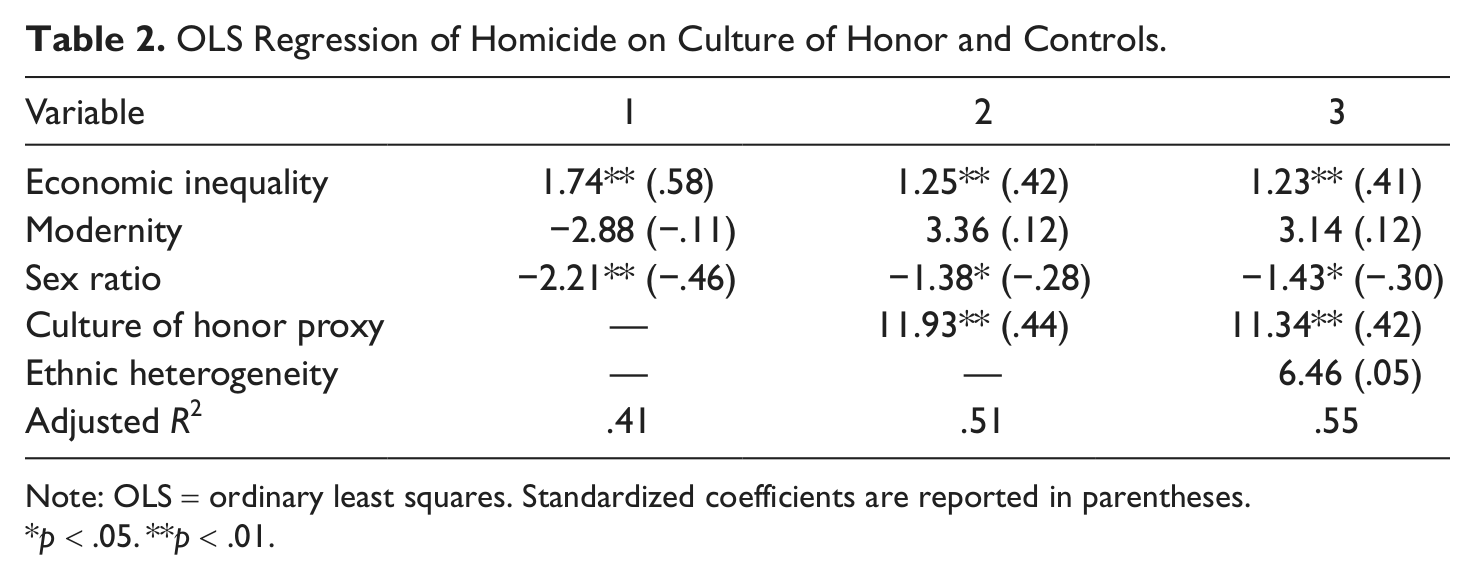
Table 2 reports the results of models examining the effects of culture of honor on homicide. Model 1 examines the baseline model that includes the control variables but excludes the culture of honor proxy. Consistent with previous research, economic inequality and sex ratio significantly influence homicide. The significant effect of economic inequality lends credence to the relative deprivation hypothesis and points to the importance of accounting for economic conditions when attempting to explain cross-national variation in homicide. Economic inequality has the largest standardized effect size in the model. For every 1 standard deviation increase in economic inequality, homicide rates increase by 0.58 standard deviations. Due to the limits of the above-mentioned Gini coefficient, however, it is not possible to determine whether the significant effect of economic inequality is the result of members of specific groups in society being subjected to greater levels of economic discrimination. The significant effect of sex ratio lends support to Guttentag and Secord’s (1983) contention that sex ratios have important implications for societal variation in violence. The model is relatively robust: 41% of the variation in homicide is explained by the variables included.
OLS Regression of Homicide on Culture of Honor and Controls.
Note: OLS = ordinary least squares. Standardized coefficients are reported in parentheses.
p < .05. **p < .01.
The culture of honor proxy is introduced in Model 2 of Table 2. This model shows that culture of honor is a robust predictor of homicide. In fact, the culture of honor proxy has the largest effect of all the variables included in the model. For every standard deviation increase in culture of honor, homicide index levels increase by 0.44 standard deviations. This finding lends further support to the notion that considering social-structural and social-cultural factors is important for understanding how social organization influences cross-national variation in homicide. Economic inequality and sex ratio continue to influence homicide after the culture of honor proxy is introduced into the model, but a proportion of the effect of economic inequality on homicide is mediated by culture of honor. This is likely due to the fact that a greater proportion of citizens are likely to face economic precariousness in nations with high levels of economic inequality. It may also suggest that cultural processes play an important role in determining the manner that important social-structural factors influence violence. The model is relatively robust: 51% of the variance in homicide is explained by the variables included.
In Model 3 of Table 2, ethnic heterogeneity is introduced as a control. Including this control was necessary to ensure that the results presented in Model 2 were not being driven by the competing value systems of the different ethnic groups living in the nations examined here. Introducing ethnic heterogeneity into the model had virtually no impact. Ethnic heterogeneity did not significantly influence homicide and none of the findings reported in Model 2 were changed substantively. This finding is interesting because previous research has found ethnic heterogeneity to be an important predictor of homicide at the cross-national level (Altheimer, 2007, 2008). The implications of these results are discussed in the following sections.
Discussion
The objective of this study was to test Nisbett and Cohen (1996) culture of honor theory at the macro level. Toward that end, this study examined the hypothesis that rates of homicide will be higher in nations with high levels of adherence to the culture of honor. This hypothesis received strong support in the analysis. These results suggest that in nations where the culture of honor predominates, a cultural milieu prevails whereby violence is considered an appropriate response to affronts to ones person or property. The presence of this cultural milieu reduces levels of social control and increases criminal motivation, thereby increasing rates of homicide. The fact that the culture of honor proxy influenced rates of total homicide lends support to Lee’s (2011) contention that in settings characterized by isolation from the law, poverty, and the breakdown of mainstream institutions that socialize people to navigate the challenges that they might encounter; the strategies of action contained in the average cultural toolkit will be limited, thereby leading to increases in predatory and instrumental levels of violence. These findings support Corzine et al.’s (1999) contention that cultural processes should influence levels of violence, and points to the important role that culture plays in influencing cross-national variation in homicide. The culture of honor proxy was the largest predictor of homicide. In fact, it exhibited larger effects on homicide than traditional structural predictors such as economic inequality and sex ratio. This finding is in line with recent research suggesting that cultural processes may be the most important predictors of violence at the cross-national level (Nivette, 2011).
Taken together, the results from this study lend support to recent calls for greater consideration of the role of culture in explaining macro-level variation in crime (Corzine et al., 1999; Pridemore, 2002). Although scholars have acknowledged the problems associated with ignoring the role of culture, attention given to cultural explanations of violence currently lags behind that given to social-structural explanations. This disparity is partially explained by the fact that measures of structural predictors of violence are more accessible than indicators of culture. Fortunately, cultural predictors of macro-level processes are becoming more accessible. It should also be acknowledged, however, that the dominance of social-structural explanations may also be influenced by lingering ideological bias against cultural explanations of behavior (Nisbett & Cohen, 1996). Despite any reservations some may hold about cultural explanations of violence, it can be argued that exploration of cultural processes presents the most promising path for the further development of dynamic macro-level theory that can effectively explain variation in rates of homicide and other violence.
There are several avenues through which researchers can further explore the dynamic between culture and violence at the macro level. First, more attention needs to be devoted to understanding the mechanisms through which culture of honor operates to influence rates of homicide. In this study, it was argued that culture of honor influenced homicide by increasing criminal motivations and lowering social controls. Although this explanation seems plausible, others do as well. For instance, the culture of honor may shape patterns of behavior in ways that influence criminal opportunities, thereby leading to higher rates of violence. Second, more consideration should be given to the structural and historical factors that lead to the development of the culture of honor. Although Nisbett and Cohen (1996) suggest that a culture of honor is most likely to emerge when societal or group members face a precarious economic situation and when governmental officials are unable to establish law and order, these issues were not directly addressed here. Research that addresses these issues would contribute considerably to knowledge of how cultural processes come to influence rates of violence. One potential avenue for such research would be to examine the impact that herding has on the economic precariousness of citizens in weak nation-states. As noted by Baller et al. (2009), there is no reason to expect the effects of herding to be limited to the southern United States. Third, Nisbett and Cohen (1997) clearly state that the culture of honor theory should account for assaults and other forms of violence besides homicide. Examining such propositions at the macro level will help determine the scope of cultural explanations of violence. Fourth, research must consider whether the culture of honor interacts with key social-structural predictors to influence homicide. Past research exploring interactions of important macro-level predictors has shown promise (Altheimer, 2008; Pratt & Godsey, 2003; Savolainen, 2000). Although not tested here, it seems plausible that culture of honor would interact with important structural predictors to influence rates of homicide. It also seems fruitful to expand the perspective proposed previously to account for individual- or group-level differences within nations. Although multilevel models are increasing in popularity, little is known about how large-scale cultural forces shape individual behavior across nations. Furthermore, no contemporary theoretical explanation adequately accounts for the fact that similarly situated groups respond to criminogenic environments with varying rates of crime (Tonry, 1997). One likely reason that knowledge on this issue has not advanced is because scholars have not adequately considered the role that culture plays in shaping how group members interpret their social predicament. Finally, these results point to the need for further development of cultural explanations of all types. This will allow more empirical evaluation of what cultural explanation best accounts for variation in crime.
These results also suggest that recent research that found subcultural and cultural perspectives to be among the worst performing criminological theories (Pratt & Cullen, 2005) may be more of an indictment of the way culture has been operationalized, rather than an accurate reflection of the utility of cultural explanations of violence. Criminologists must continue to push the envelope when considering creative ways to develop and test scientifically defensible proxies of culture. Although this is a difficult task, availability of quality cross-national data has improved over the years and all indications are that it will continue to improve. Although existing macro-level indicators show promise, the search for the optimal macro-level measures of culture is in its infancy. Development of accurate measures of cultural processes will be necessary to adequately determine the extent that cultural processes influence rates of homicide. This study utilized a proxy of the factors theorized to lead to the emergence of the culture of honor. Although this proxy is an improvement over the dummy variables used in previous macro-level research on culture processes and violence, future research should look to develop more direct measures. Nisbett and Cohen assert that economic precariousness and the inability of the state to provide protection lead to the emergence of the culture of honor, but this claim has not been substantiated empirically. It is also plausible that the stated antecedents of the culture of honor lead to other social conditions that are conducive to crime but not specified in the theory. Thus, more definitive claims about the relationship between culture of honor and homicide will have to wait until more precise measures of culture of honor can be operationalized.
The results also have implications for social policy. Although it should be acknowledged that cultural change is often a slow process, it is also important to recognize the role that public policy can play in fomenting social change. Messner and Rosenfeld (2007) suggest that one way to weaken the criminogenic qualities of a corrosive culture would be to strengthen the social structure by developing policy that supports important social institutions. Based on this logic, it follows that the most effective way to respond to a culture of honor would be to address those structural conditions that made it possible for it to emerge. Thus, countries characterized by the culture of honor must pass public policy that relieves the economic hardships faced by citizens and strengthens the rule of law in these nations. Of course, passing such policy may be challenging in developing nations with limited resources.
Footnotes
Appendix
Declaration of Conflicting Interests
The author declared no potential conflicts of interest with respect to the research, authorship, and/or publication of this article.
Funding
The author received no financial support for the research, authorship, and/or publication of this article.