



Abstract
This article explores the concept of “intermittency” and uses qualitative life history narratives with male offenders from The Stockholm Life Course Project to distinguish between two qualitatively different forms of intermittent offending. Findings suggest that one form of intermittency can be characterized by “breaks” and “pauses” in offending, where the offender for a period of time “holds up” but without attempting to commit to any long-term change in trajectory. The second form can best be understood as incomplete or aborted attempts at desistance, where attempts to change are present but not realized. Perceived or experienced failure to enter conventional roles and engage in conventional practices is highly relevant to understand these attempts. The intermittent zigzag patterns of offending observed in quantitative studies of criminal careers can thus actually entail qualitatively different life course processes of continuity and change. Implications for policy and future research are highlighted.
In Glaser’s study of prison and parole systems, he puts forth the well-known argument that “almost all criminals follow a zig-zag path” (Glaser, 1964, p. 85), such that most individual criminal careers are characterized by movements back and forth between periods of offending and nonoffending. Even the more serious offenders are not “persistently criminal” (Piquero, 2004, p. 105). Rather, they are “casually, intermittently, and transiently” engaging in crime (Matza, 1964, p. 28). In the desistance literature, this has become a troubling issue: as a criminal career often includes stops and starts, desistance becomes difficult to study. Instead, some researchers (e.g., Tunnel, 1992) have turned to the concept of “temporary desistance,” others to a distinction between “primary” and “secondary” desistance (Maruna & Farrall, 2003), whereas some have begun to explore the concept of “intermittency,” the latter of which is of interest in this article. Intermittency has been described as “a temporary abstinence from criminal activity during a particular period of time only to be followed by a resumption of criminal activity after a particular period of time” (Piquero, 2004, p. 108). 1 In this sense, the criminological concept of intermittency is similar to the cessation/relapse processes identified in research on drug use (see Hser, Longshore, & Anglin, 2007; Hubbard, Flynn, Craddock, & Fletcher, 2001), but considerably less studied.
A handful of quantitative studies have included work on intermittency, all expressing the importance of exploring the concept and phenomenon further to gain a greater understanding of criminal careers (Barnett, Blumstein, & Farrington, 1989; Land, McCall, & Nagin, 1996; Nagin & Land, 1993; Piquero, Farrington, & Blumstein, 2007). Also, recent trends in life course criminology argue that closer attention needs to be paid to the lived experiences of offenders (Gadd & Farrall, 2004; Ulmer & Spencer, 1999), especially when it comes to serious offenders (Laub & Sampson, 2001). Qualitative studies focusing on processes of intermittency in criminal careers are thus much needed, for they can study it with depth, context, and attention to the “contingencies that facilitate or constrain movement from one stage to another” (Ulmer & Spencer, 1999, p. 106).
The main aim of this article is thus to develop a qualitative understanding of intermittency among offenders with criminal careers characterized by serious and frequent criminal offending not limited to adolescence. This will be done by analyzing life history narratives collected through interviews with male offenders (the Clientele men, born in Stockholm, Sweden, 1943-1951) within the frame of The Stockholm Life Course Project, a longitudinal study of criminal offending across the life course. Contrary to the majority of both quantitative and qualitative studies on criminal careers, this study has the advantage of (a) thick descriptions of the offenders’ life histories and (b) being able to cover a large part of the life course and follow the men well into their 1960s.
Two specific arguments will be advanced. First, it is useful to distinguish between two qualitatively different forms of intermittency. The intermittent zigzag patterns of offending observed in quantitative studies of criminal careers can actually entail qualitatively different life course processes; one characterized by continuity and the other by change. Second, to understand how and why offenders’ attempts to change are not realized, greater attention needs to be paid to how they perceive and experience the conventional roles and conventional practices associated with “going straight” and following the normative model of the life course. The next section highlights the literature on intermittency, the life course, and human agency. This is followed by a description of the Stockholm Life Course Project and then a review of the study’s findings. The article concludes with a summary and discussion.
Intermittent Offending and the Life Course
When not imprisoned, hospitalized or in any other way incapable 2 of offending, even “persistent offenders do many things other than think about or commit offenses . . . for much of the time, most offenders engage in everyday practices and routines that are similar to those of everyone else” (Shapland & Bottoms, 2011, p. 257). In that sense, any offender who commits more than one crime can be characterized as intermittent and perhaps rightly so. Like termination of offending, intermittency takes place all the time, depending on how the period of time between offenses is operationalized. “Drifts” or “lulls” in offending are likely to occur due to the nature of the social world, full as it is with its complexity, coincidences, and contingencies.
However, more distinct changes in offending are usually brought about by processes of change in other areas of life. Relationship and family formation, engaging in employment, and the disintegration of peer groups are all life course processes that tend to support desistance (Giordano, Cernkovich, & Rudolph, 2002; Laub & Sampson, 2003; Warr, 1998). Examining month-to-month variation in offending in a sample of convicted felons, Horney, Osgood, and Marshall (1995) found that changes in social controls turn offenders away from crime, even for shorter periods of time. In a sample of California parolees, Piquero, Brame, Mazerolle, and Haapanen (2002) found similar patterns studying year-to-year changes in social controls, such as marriage, and offending (see also McGloin, Sullivan, Piquero, & Pratt, 2007).
Considering that the majority of even highly persistent offenders eventually desist from crime (Laub & Sampson, 2003), it is likely that periods of nonoffending in an individual’s criminal career become more durable as time goes by. As offenders age, the time gaps between offenses increase, suggesting an emerging desistance process (Raskin, 1987). In a similar vein, findings in recidivism studies have repeatedly shown that the longer an individual’s period of nonoffending, the less likely it is that recidivism will occur (Blumstein & Nakamura, 2009; Zamble & Quinsey, 1997). Intermittency is thus closely tied to desistance, because the latter is likely to emerge from the later phases of an intermittent offending pattern and especially so among more serious and frequent offenders (Maruna & Farrall, 2003).
The Importance of Human Agency
For Laub and Sampson (2003), changes in within-individual offending over time emerge through changes in social control, routine activities, and human agency. These changes come about as offenders encounter potential turning points, such as a stable job and/or the formation of a “good” relationship, and respond to them in specific ways, which then bring about changes in social control and routine activities. These in turn bring about changes in offending.
Two of the most powerful predictors of desistance from crime are relationship formation and stable employment (see Bersani, Laub, & Nieuwbeerta, 2009; Blokland & Nieuwbeerta, 2005; Laub, Nagin, & Sampson, 1998; Sampson, Laub, & Wimer, 2006; Savolainen, 2009; Skardhamar & Lyngstad, 2009; Uggen, 2000; Uggen & Wakefield, 2008).
More than most other social institutions, the formation of a “good” relationship and/or a stable employment have the potential to make the individual (a) “knife off” the past from the present, (b) invest in new relationships that foster social support and growth, (c) be under direct and/or indirect supervision and control, (d) engage in routine activities centered more around conventional life, and/or (e) perform an identity transformation (Sampson & Laub, 2005). Crucial here is how individuals respond to these potential “hooks for change” that is, the importance of human agency for being able to sustain a state of nonoffending. Similarly, for Shover (1996), the two “classes of contingencies” which strongly influence the later phases of a criminal career are the development of conventional social bonds, and the “strengthened resolve and determination” to refrain from crime completely (p. 124).
It is reasonable to assume that sooner or later in the desistance process, human agency becomes important for an offender to refrain from future criminal offending, but exactly how and when it does so differs between offenders. What individuals want, desire, and wish for changes at various stages of their lives, and does so in interaction with the social environment. As LeBel, Burnett, Maruna, and Bushway (2008) argued, “cognitive and external influences . . . operate through a dynamic, interactive process” (p. 153). There is thus a dialectic relation between a social institution like employment or relationship formation and the individual’s position in relation to it. This concept of human agency is not only a thoroughly social one but also entails a need for consistency and reinforcement over time: a stable job or a lasting “good” relationship is more likely to bring about a human agency committed to maintaining a state of nonoffending (Laub & Sampson, 2003), as the offender moves through the life course and its associated transitions.
These transitions between different social roles are “aspects of a normative model of the life course which is sanctioned by formal and informal networks of social control” and should occur in a certain order at “age-appropriate” times (Elder, 1975, p. 174). Just as offenders tend to age out of crime, they tend to conform by “growing into” the normative model of the life course. The rebellious delinquent who reaches adulthood or midlife starts to “settle down,” form a family, work, and live a life more centered around conventional practices.
However, as Maruna (2001) has argued, to develop a will to desist and to actually desist can be two very different things. Individuals who in one way or another “find the constraints of these conventional roles unacceptable are the same individuals who tend to show high rates of offending” (Siennick & Osgood, 2008, p. 163). Conventional roles tend to represent the social and institutional order (Berger & Luckman, 1966) and the activity of “deviance” often “creates difficulties by failing to mesh with expectations in other areas of life” (Becker, 1963, p. 35). The development of a human agency committed to change might thus be associated with experiences of what can be called “role strain,” as the offender encounters various difficulties in conforming to the conventional life often associated with desistance (Marks, 1977; for a psychological perspective on similar notions of “coping” and “relapse” in recidivism processes, see Zamble & Quinsey, 1997).
Narratives of Offending
One way to explore the processes described above is to focus on how individuals describe, interpret, and explain the events that occur in their lives. This practice, of paying close attention to how people talk, has a long sociological and criminological history (Maruna, 2004; Mills, 1940; Scott & Lyman, 1968; Sykes & Matza, 1957; Youngs & Canter, 2012). This article follows in that tradition by exploring life history narratives.
Narrative usually takes the form of a written or an oral text and has been conceptualized as “a temporally ordered statement concerning events experienced by and/or actions of one or more protagonists” (Presser, 2009, p. 178). Narratives constitute forms of reality and is a “vehicle for self-understanding” and, as such, “an instigator to action” (Presser, 2009, p. 191). The “explanatory styles” (Maruna, 2004) that emerge in offenders’ narratives thus mirror how they view themselves and their place in social contexts, and are also thought to influence social action. For example, the “condemnation scripts” noticed by Maruna (2001, chap. 4) in the persisting offenders’ narratives, include notions of being “doomed to deviance” and “victims of circumstance,” which in turn can bring about continued persistence in crime. This will be an important part of the analysis that follows, as the two forms of intermittency outlined below can be distinguished by different explanatory styles at the narrative level.
The Stockholm Life Course Project
This study is part of the Stockholm Life Course Project, a longitudinal, largely retrospective study on life courses and crime (see Carlsson, 2012). The main purpose of the project is to explore and understand the life course processes surrounding onset, persistence, desistance, and intermittency of offending. In the qualitative part of the project, life history interviews are being conducted with a sample of offenders here called the Clientele men.
The Clientele men consist of 287 men born in Stockholm between 1943 and 1951. When they were between 11 and 15 years old, they participated in a large study commissioned by the Swedish Parliament, the purpose of which was to study the causes of delinquency. The study was called The 1956 Clientele Study of Juvenile Delinquents. The boys were divided into two groups, a crime group (n = 192) and a matched control group (n = 95). 3 The crime group was drawn through a random sample of boys who were (a) at least 11 years old and (b) registered for a nontrivial offense by the Police Department in Stockholm for the first time. The matched control group was drawn from the Swedish population records. In the 1980s, a follow-up was conducted (Sarnecki, 1985), and the crime group was then divided into two groups, D1 (n = 131) and D2 (n = 61). In the D1 group, every boy was known by the police to have committed at least one crime prior to age 15. In the D2 group, the boys were known by the police to have committed two or more crimes prior to age 15. During the 1980s follow-up, 199 of the Clientele men were interviewed, and of these, 157 are still alive as of this writing. The present article is based on interviews conducted with individuals in the D2 group.
The original D2 group—those with two or more registered offenses prior to age 15—consisted of 61 individuals. In the 1980s follow-up, 54 were still alive, and of those, 36 were interviewed. In the 2010/2011 follow-up, 26 of those 36 men were still alive, but even after extensive searches, we were unable to locate 7 of the men. Letters were sent out to all remaining 19 men, and 15 of them were interviewed (the others declined, or were in such bad health that they could not be interviewed). The 15 persons interviewed in 2010/2011 thus constitute a subset of the 36 D2 individuals interviewed in the 1980s.
The Life History Interviews
The circumstances surrounding the interviews varied, as some were conducted in the individual’s home, others at his or her workplace, at Stockholm University, or cafés and restaurants. In several cases, two interviewers were present, whereas in eight cases the interviews were conducted by a single researcher (the author). The interviews were retrospective and unstructured with an interview guide covering a range of topics including living arrangements, education and school experiences, employment history, health, social relations, experiences of crime, drug use, victimization, and the criminal justice system. We kept our questions as open as possible, also allowing the interview participant to develop themes that we had not asked about. We did this by asking, for example, “What experiences would you say have been important for you, considering the way your life is today?” or “You said that you quit crime when you met your wife, can you elaborate on that?” Also, rather than systematically leading them on we tried to summarize and feed back to them what they had just said, encouraging them to elaborate on it or adjust it if they wanted to. This not only helped us judge whether we had understood them adequately or not but also helped us establish trust: it showed that we were attentive and interested in their life histories.
The lengths of the interviews range from roughly 45 min to more than 4 hr. The interviews were tape-recorded, transcribed preserving the original language of the interview participants, and analyzed using QSR NVivo 9.
Analysis
The analysis was made in several steps. First, every transcription was read through, and the interviews that did not include accounts of offending in adulthood were excluded (2 interviews). Second, in the remaining 13 interviews, all extracts that involved an aspect of intermittency (a direct or indirect account of “ceasing,” “restarting,” “picking up” offending, “failing to quit,” “being unable to go straight,” etc., and/or the event(s) the interview participants described as the reason for such changes in offending) were coded under the same node in NVivo (“intermittency”). 4
This amounted to roughly 100 extracts from a total of 13 interviews, which were then closely studied for common themes, patterns, and structures. Two social institutions—employment (25 extracts) and relationship formation (34 extracts)—stood out. They were both common and seemed to be attributed importance for the interview participants’ continued (non)offending, and initially the narratives were focused around those (in NVivo, they were categorized as separate subnodes under the intermittency node). Third, considering that continuity and change in offending within individual life courses are inherently temporal processes, the dimension of time was taken into account. In NVivo, this was done by “tagging” the interview extracts with the approximate age the interview participant was referring to in the given extract (or when this was not possible, the part of the life course, such as childhood, adolescence, young adulthood, midadulthood, etc.). Finally, this structuring of the data allowed for a close reading of the narratives (although fragmented) in “chronological” order.
The main theme that stood out was the development of two “forms” or “phases” of intermittency, which can be said to consist of two distinct “explanatory styles” (Maruna, 2004): one characterized by sporadic “breaks” and phases of “holding up” (28 extracts) and the other by the development of a “will to desist” but, because of various obstacles, an inability to “follow through” and maintain this change in behavior (31 extracts).
This structuring of the data meant that (a) an individual could be included in both the “employment” and “relationship formation” nodes and (b) a given narrative could manifest both forms of intermittency (i.e., include both notions of “holding up” and the “will to desist”), but almost exclusively at different phases of the life course.
Considering that this “fragmented” way of analyzing coherent, rich life history narratives may make the extracts devoid of meaning, every extract was then reanalyzed by going back to the raw transcript and interpreting it in its context. As part of the interpretive process, or “circle,” the meaning of an extract could be deepened by interpreting it in relation to the narrative as a whole (Denzin, 2002).
Because not all 13 individuals could be included in the “Results” section due to space limitations, the presentation of the findings had to be based on a selection of cases. The seven cases included below were selected on the criteria that they (a) together constitute a good illustration of the overall life history narratives of the interviewed D2 offenders and (b) could provide illustrative, thick descriptions with depth and context to their offending.
Results
Initially it should be noted that the Clientele men share many demographic characteristics (see Table 1). They were born in lower class families and neighborhoods in Stockholm during the 1940s and early 1950s, had an onset of delinquency between ages 11 and 15 that developed into criminal offending in adolescence, and continued into adulthood. At the time of the interview, all but two interview participants had a low socioeconomic status. Three men were single, one was married, and three were in a relationship. None of the men had yet reached the formal retirement age (65 years), and two were working part-time, one was unemployed, and four were on disability pension. None of the men thus worked full-time. The total number of registered offenses varied among the men (between 22 and 97). All men had served at least one prison sentence, whereas four men had served more than five.
Demographics of the Interview Participants at the Time of Interview (Only Those Seven Included in the Results Section).9
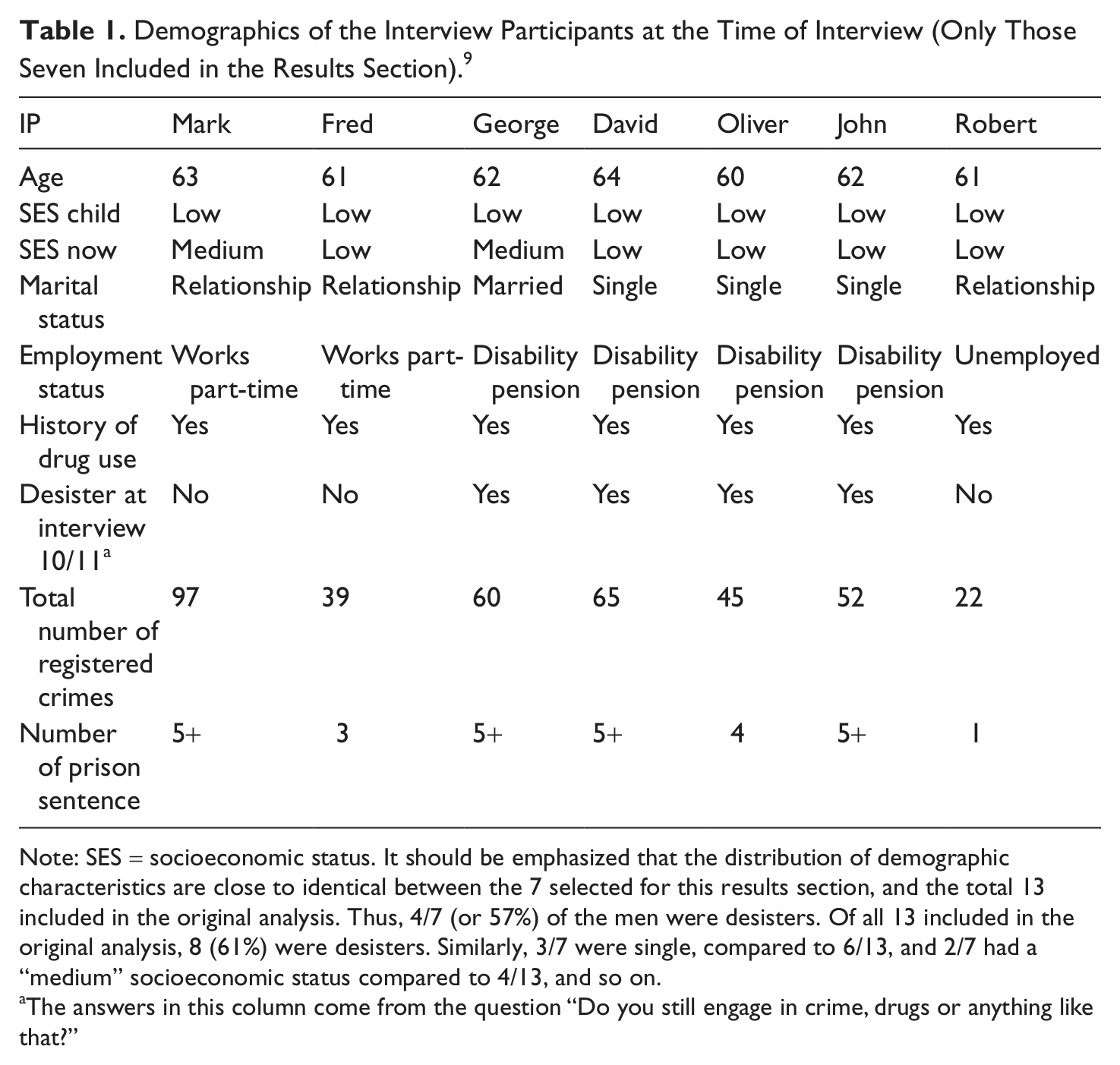
Note: SES = socioeconomic status. It should be emphasized that the distribution of demographic characteristics are close to identical between the 7 selected for this results section, and the total 13 included in the original analysis. Thus, 4/7 (or 57%) of the men were desisters. Of all 13 included in the original analysis, 8 (61%) were desisters. Similarly, 3/7 were single, compared to 6/13, and 2/7 had a “medium” socioeconomic status compared to 4/13, and so on.
The answers in this column come from the question “Do you still engage in crime, drugs or anything like that?”
Although drug use seldom was what made them start offending in their youth, it tended to become an integral part of their offending as it developed, but it was always combined with other offending. The interview participants will sometimes refer to their presence on the “drug-scene” or “crime-scene,” but the reader should have in mind that when they talk about one, the other is almost always present as well. 5 It must be understood in relation to the context specificity of illegal drug use in Sweden, with its welfare system and repressive drug policy (Lenke & Olsson, 2002). The Clientele men grew up in Stockholm during the 1960s, paralleling a strong increase in both supply and demand of drugs, and the establishment of illegal drug use as a social problem.
In the below sections, two forms of intermittency are distinguished in the life history narratives. These are qualitatively different life course processes, which cannot be explored with the help of quantitative data. Findings are centered around two common social institutions associated with desistance from crime, employment, and relationship formation. These two stand out as important, not only empirically in the present study but also according to the existing research field (Bersani et al., 2009; Laub et al., 1998; Savolainen, 2009; Uggen & Wakefield, 2008).
Narratives of “Holding Up”: Intermittency as Continuity
One form of intermittency is where the offender for a significant period of time “holds up,” takes a “time-out,” experiences a temporary “burnout,” or takes a “break.” These episodes seldom occur as abrupt as the word break suggests but are rather gradual processes of temporarily decreasing (and ceasing) offending. Consider the life history of Mark, 6 who is 63 years old, and grew up with his mother and stepfather in Stockholm. He describes his childhood as “happy,” even though his stepfather “worked too much and drank too much” and his mother was “a very nervous, stressed out person, could easily give me a slap in the face, but . . . all kids got that from their parents where I grew up.” He did his military service but after that, at the age of 18, he got thrown out of his home “because of my long hair, I refused to cut my hair . . . up until then, I had stayed away from the street, away from alcohol, drugs, and crime.” 7 Now Mark took to the street, where he “lived for many years.” Through the years, he served repeated prison sentences and drug use developed as an integral part of his criminal career. He has a total of 97 registered crimes, among them 37 drug-related, 10 property offenses, 6 frauds, and 1 violent crime.
Were there times [back then] when you thought that you wanted to quit?
No but I wanted to hold up. When I got out of prison, I didn’t want to go right out on the same track again, but that was for many reasons. I wanted a time-out, you know, and do some work, make some legit money, and then go back [here, Mark is referring both to “going back to prison,” and to what can be called “a criminal life”]. I didn’t want to go straight from prison, because I had seen people getting out, being out for a couple of weeks, doing parties and burglaries and drugs, and then come back, getting an even harsher punishment [because of the Swedish parole system]. I wanted to get out for a while, be fresh and in good health. But then the drugs and that life started to suck me in again, because that’s who I was.
He went through several such phases of “holding up” and, as can be seen in this extract, these phases were not attempts at achieving any substantial change in life. The theme of the narrative can be understood as one of continuity, including the “time-outs,” drifts, and lulls within it. It is explained by Mark as being a part of his identity (“that’s who I was”). Any change in lifestyle or routine was not initiated by Mark for him to desist; rather, if any such change occurred, it was simply a consequence (often unintended) of his “pause” in offending.
Similar accounts can be found in the case of Fred. Fred is 61 years old at the time of the interview and has a lengthy and versatile history of offending: in total, he has 39 registered crimes, among them 11 thefts, 7 drug-related offenses, 4 violent crimes, and 2 frauds. He grew up with his mother (Fred has never met his father), who “brought home a lot of drunks, who tried to tell me how to behave.” Around the age of fifteen, he started stealing cars and doing burglaries, and his criminal offending continued into adulthood. Getting a job and forming a relationship did not cease his offending, but it contributed to making it sporadic. Here he is describing an episode from his life during the 1970s when he was living with his girlfriend and how he reacted when they argued.
So when things got too rough at our place [when they argued], I got a room at my friend’s place. So I got out, bought a quarter of booze and did some lines, went into town and did all kinds of stupid things [fought, stole]. Then I went to my friend, slept and got up and worked the next day.
So you managed to keep your job during that time?
Oh yeah, I managed anything, no matter how fucked up I was. Really scary, if you think about it. There was only one time, no two, when something came out of it [a warning at work], but the job made that kind of life possible . . . I never really quit . . . then, but I still worked, I even drove a bus, I had all kinds of jobs. Then I held up, sometimes. I worked at a bank until they had to let me go. Later, I sometimes worked nights at a gas station, sold stuff [drugs] to people there.
“I never thought about quitting or anything like that,” Fred continues. Here too, there is the explicit absence of any will to change. On the contrary, he “managed anything, no matter how fucked up” he was, which is a statement entailing a notion of continuity. The reason behind this possibility of persistence in offending is the “kinds of jobs” he had: on a very concrete level, Fred could combine his drug use and offending with working nights at a gas station, being a factory worker or driving a bus. This “moonlighting” in crime (Steffensmeier & Ulmer, 2005) occurred regularly, and the only change in offending Fred describes is during the time he worked at a bank. The social control and structured routine activities inherent in that kind of job made him “hold up, sometimes.” However, the jobs were often “temporary,” and Fred was not attempting to sustain his states of nonoffending for any lengthy periods of time. His intermittent offending—the zigzag pattern identified in much quantitative criminal career research—corresponds to short-term changes in other areas of his life when Fred “held up, sometimes” but “never really quit” or even “thought about quitting.”
An additional extract, this one from the interview with George, illustrates the temporal dimension of this form of intermittency. It tends to be present in the earlier rather than later phases of the criminal career, typically when the men describe themselves as “young” and “still in the game.” George has a total of 60 registered crimes, among them 41 for theft, 5 for fraud, 2 for violence, and 2 for drug-related offenses. He spent most of his childhood in a foster home, started his criminal career in the early 1960s with drug use and theft, and describes himself as “a good thief”:
I began early, I began . . . then I held up for a while, during the 1980s, was married and started to study, went to vocational school and became a carpenter.
Right.
Then I got divorced, opened my business again [started to reoffend], so I did another stretch there. I wasn’t satisfied the way I lived, so I moved between different worlds, in a way. But I never tried to, you know, to stop, not back in those days. I was still young, in a way, still in the game. Those phases just kind of happened.
We see George “holding up for a while” during the 1980s when he got married, started to study and became a carpenter. However, he describes a parallel process here, where he was “moving between worlds . . . still in the game.” He “wasn’t satisfied the way I lived,” “still young” and those episodes of nonoffending “just kind of happened.” Similar notions were found in the other narratives (which will be discussed in greater detail below):
I took some breaks when I needed them, when I had money or a girl or felt burned out, but soon I started to roll the dice [do crimes and drugs] again . . . I had no reason to stop, didn’t want to stop, time was going fast, things were rolling and I was having fun. (John) I pushed “pause” a couple of times when I was young [in his twenties and thirties], took a couple of months off, did some regular work working construction or as a janitor, you know, but I mean, they were just phases. (Oliver) Quitting? I never quit, not back then. Well, I mean, when you were in prison you held up, of course, and maybe I did that a couple of times when I was out too, like, there was one time I had a girlfriend and I held up for a while, until we started to do stuff [crimes] together, but you know . . . nothing more. I was soon going at it again. (Robert)
The men find themselves in phases of the life course where ending a criminal career is not (yet) considered desirable (see Katz, 1988, for the very real “seductions of crime”). Temporary changes in the social control and routine activities—such as finding temporary work or being in a relationship—in the men’s lives can bring about changes in offending for a period of time and thus constitute a form of intermittency, but the changes in offending can also, at the narrative level, be understood as a form of continuity. More or less temporary “breaks” are followed by periods of offending.
These phases of their criminal careers are, in the words of Matza, episodes of “postponing commitment, evading decision” (Matza, 1964, p. 28). Laub and Sampson (2003) expressed a similar notion when they note that, in summarizing their findings about persistent offenders, the Glueck men had “a distorted sense of autonomy without any commitment” made to other people or institutions (p. 194). Sometimes weeks, months, even a year can go by without any offending (as in the case of Fred when he worked at a bank, and in the case of George’s marriage and going to vocational school), but this time is described as a pause or a phase of holding up, never really an attempt at achieving a more lasting change. As David, another Clientele man whom I will return to below, puts it, “I did not want to quit or even attempt to quit [neither drugs nor crime] because I knew I wasn’t done with it yet. I knew I had more to do.”
This form of intermittency is not characterized by any changes in the areas of lifestyle, routines, or identity. Although the Clientele men do talk about “holding up” or “taking a time-out,” these narratives can also be characterized as narratives of “rumbling on,” “staying in the game,” “not being done yet”—narratives of continuity. It constitutes a natural part of offending for most offenders with a criminal career stretching into adulthood. This form of intermittency seems to occur relatively early in the men’s lives, typically prior to the age of 40. It is thus a form of intermittency that often precedes the second form, which is the subject of the next section.
“Trying to Desist”: Intermittency as Attempted Change
This section considers the second form of intermittency, best understood as incomplete, unsuccessful, or aborted attempts to desist from crime. The main difference here is the will to desist, and it is crucial because of what it entails. A will to desist is often accompanied by a change in values and desires, and attempts to change one’s lifestyle, routines, and everyday life. It is characterized by longer periods of nonoffending and less serious offenses. Although narrative extracts like “I held up for a couple of months” were common in the first form, extracts like “I tried to stop and managed to go straight for a year or two” are prominent here, and the two forms thus constitute distinct narrative differences. How the interview participants describe their reonset of offending after a period of nonoffending also differs from the previous section. There, they “got back in the game” or “picked it up again”; here, they “relapse” or “fail to stay away,” accounts similar to the recidivism processes identified in psychological studies of recidivism (Zamble & Quinsey, 1997) and drug use.
This section focuses particularly on how changes toward a state of desistance need to be understood as attempts to not only refrain from certain actions but also as attempts to move toward a state characterized by a more “conventional” life.
Expanding on the life history of David, he has a long and extensive criminal record. At the age of 16, he served a 6-year long prison sentence for murder and spent most of his young and adult life offending—committing fraud, thefts, selling drugs, and using drugs. He has 65 registered crimes, among them 21 frauds, 13 thefts, 5 violent crimes, and 4 drug-related offenses. In the beginning of the 1980s, at the age of 43, he met a woman and engaged in a lengthy relationship. This marks a change in his narrative: from a narrative of “rumbling on,” it becomes a narrative of struggle as the relationship exerted social control over him and he attempted to change.
If I’ve understood you correctly, when you were with her, you didn’t do drugs and crime as much?
I didn’t do it at all. Because she made demands, I was on heroin then, too. So she said, it’s either me or the drugs. I was madly in love, so I chose her. “If you quit, I’ll be there for you 100 percent,” she said. And I mean, I was lying at home in detox, and had a relapse, and when she found out about that, I started doing amphetamine instead. I did a month of that, and then she made me quit that, and when I turned to alcohol, she made demands there too. But it was harder to quit that.
It was harder to quit alcohol than amphetamine?
It was harder because I had to have something.
. . .
So you really tried this time, is that correct?
This time I really tried, yeah, it was the first time I really tried to quit.
Unlike earlier in his life, David was now consciously attempting to change, trying to “stay clean,” and making the move into conventional life. For a while it worked, as he did not do crimes “at all.” Importantly, the will to change was not initiated by David himself but emerged out of the social control of the relationship. It has been suggested that cognitive factors precede social factors (see LeBel et al., 2008, and see also the case of Oliver below), but David’s account shows that it is not necessarily so. Rather, as noted in the literature review above, the relationship between agency and elements such as social control should be thought of as dialectic, where both elements can inform one another.
In David’s case, however, the relationship formation took the form of a struggle, until it finally ended and David went back to a life characterized by offending and drug use. When asked about “other relationships,” David elaborates,
There were some relations then, on the drug scene, but I mean, they were doomed, even if both wanted it to work. If there’re drugs in the picture, the relationship will never work. Amphetamine has that sex drive thing too, so you destroy your sex life, in a way, so it’s, I don’t want any relationships. And also, I feel I enter some kind of trap. I feel un-free. Even if I wanted a relationship, you know, being a man and all, I know that it would never work. Because I’m that fucked up, I have no normal upbringing, my life hasn’t been normal.
The explanatory style of being “doomed by deviance,” and the (very real) obstacles associated with conforming to conventional life which Maruna (2001) found in the persisting offenders’ narratives, is very present here. Moreover, David perceives the institution of a relationship, and the position it would place him in, as a “trap” (a good example of what Siennick & Osgood [2008] meant when they talk about “conventional roles” being perceived as “unacceptable”).
However, “unacceptable” does not necessarily mean a rejection of the role but rather that the offender cannot live up to the normative expectations associated with it. Part of a “good” relationship is the sexual dimension, a part that is “destroyed” for David (without the drugs, he is incapable of having sex). Here we see the salience of gender, where the attempt to perform a desirable masculinity is compromised: “being a man and all,” David would want a relationship, but because of his history and what he perceives as his insufficient sexual capacity, it becomes impossible. As a gender management strategy, David does not “want any relationships.”
Fred describes a similar life course process:
That [his inability to maintain relationships] has followed me through life, basically, relationships and traditional family life . . . after a couple of years they make me feel claustrophobic. There have been many short ones. I mean, I can see that my years growing up have structured my life in a way that I can’t live like a regular person. I have been drawn to addictions and kicks the whole time, I have always gone back to that. But, as I tried to stop, I managed to be crime-free longer and longer.
Conventional life, its practices, Fred’s positioning in relation to it, and the importance of this positioning for understanding his persistence in drug use and offending, is evident. He has attempted to change but “traditional family life” tends to make him “feel claustrophobic.” His childhood and adolescence is attributed explanatory significance: it has “structured” his life in such a way that lasting convention and nonoffending (living like “a regular person”) is perceived as impossible. It is difficult to maintain the “law-abiding,” normatively expected position and it is continuously challenged by the move back into offending, because it remains an alternative and well-known path to go back to.
Importantly, as Fred attempted to stop, the time periods of nonoffending became longer. This notion, that they experience longer periods of nonoffending when consciously attempting to refrain from offending, is present in all the interview participants’ life histories. Thus, the intermittent offending pattern changes its character: “When you want to quit, you really try,” Oliver says. He has 45 registered crimes and among them, 22 drug related, 4 frauds, and 2 thefts. He is the only child of his family, with an alcoholic father and a mother who had a job as a social worker. Today, he lives alone and suffers from lung disease, which he says was brought on by his “lifestyle.” Oliver began smoking pot at an early age but soon turned to heroin and amphetamine, and made his money as a drug dealer for close to 30 years. When he was around the age of 40, he began to “wake up” and tried to change:
You resist temptations, you don’t answer the phone, you go looking for work . . . you try to keep yourself busy and the day only has 24 hours, you know. So it [offending] got much less intense, until it became something I only rarely did.
In the extract from Oliver’s narrative, it becomes clear how a will to desist can bring about changes in lifestyle and routine activities: Oliver tried to “resist temptations,” knife off the ties to his friends (he did not answer the phone), went looking for work, and “kept himself busy.” This change toward desistance made his offending “much less intense.”
Timing too is an important feature of life course transitions. In Hogan’s words, “a man [sic] who lives through the sequence of . . . transition events in a disorderly fashion more frequently is in discord with the social setting” (Hogan, 1978, p. 575). Its importance for intermittent offending becomes clear in Oliver’s narrative. When his change began to emerge, he felt he was “too old” to form a family.
I had a relatively normal life until I was sixteen, seventeen. Then I got onto the drug scene. And those were the years people spent forming a family, making a career, all that. And when I began to wake up I was around forty and, well, then it was too late.
It was too late?
Yeah, how the hell am I going to find a woman and form a family? I am pretty tired and torn, show me a woman who wants that. Somehow I have lived, while life has run away from me.
Because of his age, he perceived forming a family as impossible and relationship formation could thus not act as the “necessary distraction,” he said he would have needed to desist. Oliver attributes this exclusion to himself and his past—he is “pretty tired and torn”—and expresses the feeling of being out of timing: he has lived, yet life has “run away” from him.
The consequences of experiencing oneself as being “out of timing,” and its importance for understanding intermittency, become clear in the life history of John as well. John is 62 years old, and prior to this interview, he has just returned from the treatment clinic, where he goes three times a week to get his dose of methadone to handle his former heroin addiction. John was a drug dealer most of his life and has a total of 52 registered crimes, among them 24 drug-related offenses, 13 cases of fraud, 7 thefts, and 1 violent crime. He underwent treatment for his drug use in the 1980s. What precipitated John’s enrollment in treatment was the death of his fiancée. She died of an overdose, and it was John who had made her start using.
Now I had to do a serious attempt, you know. And I was there [in treatment] for a long time. Then I got an apartment, and . . . well, tried to live a nice and orderly life and I did for a while. But then a friend whom I liked a lot, he and I started using on weekends again. And that wasn’t good. Then it was up to full speed again.
At that time your attitude towards working had changed?
Oh yes, yes. After treatment, I had a different attitude towards it and also, I had gotten older . . . that was crucial . . . it made it easier to stay away . . . but then, when I started using during weekends again, it all began again.
What was it that changed your attitude towards working?
I think I had matured. I got no help from my parents to grow up to become a young man, you know, I became an irresponsible teenager. So I had to do it all on my own. But by then it was too late.
Can you expand on that?
Well, you know. Who the hell would want to hire a 62-year-old ex-addict? An ex-addict who can’t stay away? I know I wouldn’t.
Earlier in his life, John had a strong resistance toward working: “it took up my time, you know,” he says. “I did not like the idea of working.” By the time he had matured, and had a different attitude toward it, “it was too late” for him to enter the institution of employment and start to work: “Who the hell would want to hire a 62-year-old ex-addict who can’t stay away?” Furthermore, even though John’s narrative could be understood as an expression of continuity (he “began again” and “soon it was up to full speed”), there is a clear difference: he defines these reonsets of offending and drug use as relapses, as failures to “stay away.”
Accounts like these also mirror a dimension of stratification and express the theme of marginalization. If these men were to engage in employment, the jobs available to them would be of low status and perhaps perceived as unattractive: “Working nine to five on a factory floor, what kind of life is that? I would almost rather do drugs, then,” George says. They express the same underlying theme, where the interview participant positions himself in relation to the institution of employment, and the associated constraints and opportunities he perceives to come along with life’s conventional practices (see also Åkerström, 1985, chap. 9). Attempts to enter conventional roles are combined with difficulties, and this is eventually what makes it impossible for the interview participants to enter or remain engaged in them, even if they want to. For the Clientele men, these processes of intermittency remained present well into adulthood. An additional example, this one from Robert, illustrates this point. He grew up in a broken home with an absent father, and started to offend, eventually being sentenced to prison for having stolen a large amount of cigarettes and alcohol. It was not until then that he began to use drugs. For Robert, the formation and deterioration of relationships have been important:
If you think back, what would you say have been most important for you, considering the way your life is today? What experiences or people have—
The break-ups and divorces.
The break-ups and divorces.
Yes. That leaves you alone, see. Nobody wants to be alone. That’s the biggest thing. It makes you destructive and was partly what made me start using. It began with the first one. When I met her, everything became better. When she left, it all got worse. It’s always been like that, and life shouldn’t be like that.
During your life, did you want to change? I mean, did you attempt to quit [offending]?
As time went by, yes [laughs]. Of course.
Robert’s intermittent history of offending—including 12 registered thefts, 6 drug-related offenses, and 4 violent offenses—meshes well with the theory of age-graded informal social control (Laub & Sampson, 2003), where changes in the social control of the relationships are accompanied by changes in offending.
How did that [the will to change] make things different? If it made things different at all?
I tried to stay away from the bad stuff, you know, the bad buddies, the bad places . . . bad drugs. I tried to work, tried to . . . shape up. Tried to keep the relationships alive, but couldn’t. It’s difficult when you’ve lived the kind of life I have. You don’t really have anything, you know? None of the stuff people say makes life worth living. You don’t have it, and it feels impossible to get it.
Once again, the attempt to desist is present but never realized due to the obstacles associated with entering conventional life, and the self-ascribed burden of having lived the “kind of life” Robert has. And once again, we see an intermittent offending pattern emerge but not out of a sense of continuity but out of a very different narrative: a narrative of attempted change.
Even though the Clientele men are in their 60s, these narratives are still very much in the making. For example, Robert at the age of 61 stands without an income and, due to the harsher social insurance policies in Sweden, has started to regularly shoplift groceries and alcohol. Mark and Fred regularly use drugs illegally (morphine and marijuana, respectively), whereas David, Oliver, George, and John define themselves as still maintaining their state of desistance. As George puts it, even though he says he has not offended for over 10 years (see also Maruna, 2001),
When somebody asks if I’ve quit . . . if I’m drug-free, law-abiding, that’s, I don’t think so. I’ve never said I am and I don’t think I will.
Two Forms of Intermittency
To summarize, the distinct form of intermittency changes over time, as the individuals move along the life course. The first form tends to precede the second one in time and thus they constitute different phases of the criminal career. A “will to change” often emerges through a set of interconnected life course processes that include not only changes in social control and routine activities but also processes of aging and maturation. Intermittent offending patterns can thus entail qualitatively different underlying processes: to “hold up” is very different from “attempting to change,” to “restart” one’s offending is very different from “failing to stay away” or “relapsing.” The offender who holds up and “restarts” is an actor acting according to his or her intention and will (Matza, 1964), the offender who “fails to stay away” cannot, for one reason or another, overcome the obstacles associated with desistance and conventional life (see also Maruna, 2001, chap. 4). This second form of intermittency typically entails more distinct changes in lifestyle, desires and values, and is characterized by longer periods of nonoffending and less serious offenses.
Finally, two things need to be emphasized. First, although a will to change is the dividing line between the two forms of intermittency, this transformation of human agency tends to include significant changes in other areas of life as well. Human agency can inform changes in social control, routine activities, and lifestyle, just as changes in social control and routine activities can facilitate a cognitive transformation of will, that is, a change in human agency.
Second, this, of course, does not mean that distinct, lasting changes in offending must come from a will to change, but only that it seems rather uncommon that they do not. Many changes, including desistance from crime, can occur “by default” (Becker, 1960; Laub & Sampson, 2003) or simply due to the contingencies of life. The presence of a committed human agency, however, is likely to very much impel and facilitate such changes.
Discussion
This article sought to shed a qualitative light on intermittent offending through life history interviews with a sample of male offenders in Stockholm. The main argument has been that it might be useful to think of intermittency in two ways. One form of intermittency is where the offender for a significant period of time “holds up,” “takes a break,” or “pauses.” The second form of intermittency might best be understood as incomplete, unsuccessful, or aborted attempts to desist. Here, the will to make a lasting change in one’s life is present but not fully realized.
These two forms of intermittency and their dynamic need to be studied further, particularly in criminal careers where drug use is absent or only a marginal part of their offending. Although it is well known that careers in drug use and criminal offending are similar (they have both been included in discussions of “deviant careers,” see Becker, 1963, p. 25ff), and are in many ways contingent on similar factors and processes (Laub & Sampson, 2001), the specific importance of drug use must be explored further. What similarities and/or differences in the two forms of intermittency can be found in such criminal careers? Second, the Clientele men in the present study constitute a group with long criminal careers. What similarities and/or differences in intermittency can be found among offenders with shorter and/or less serious criminal careers? Furthermore, it is reasonable to assume both similarities and differences in criminal careers across genders and ethnicities (Lanctot, Cernkovich, & Giordano, 2007). Exploring intermittency along these lines should be considered a high priority for future research.
There are clear limitations to this study. Besides the obvious limitation of the sample—the study is based on Stockholm-born, lower-class males only—the study is also limited by a low number of cases. What one gains in depth, one loses in breadth, and although this study has had the advantage of exploring processes by deep, rich narratives, it is lacking in breadth, making inferences difficult. Similarly, because the men are in their 60s, it is difficult to answer whether and how these processes of intermittency manifest themselves in the lives and narratives of younger offenders.
Implications
In a sense, intermittent offending is the criminal career, because the great majority of offenders, if not all, tend to follow a zigzag path between onset and desistance. It therefore deserves much more attention than it has received so far. Theoretically, this article highlights the contingent nature of social life: life in general, and crime in particular, tends to be much more complex than many perspectives on criminal careers seem to recognize. The fluid nature of criminal offending over time, and the dialectic relationship between the individual offender and the surrounding social context, is inherent in the theory of Laub and Sampson (2003), but these notions tend to take a step back in favor of their stress on the importance of turning points. Perhaps, it is most explicitly dealt with in the interactionist approach to crime and criminal careers (Steffensmeier & Ulmer, 2005; Ulmer & Spencer, 1999), where the dialectic of choice and constraint is taken seriously. Biography and structure continuously intersect (Mills, 1959/2000), and it is here, in Mills’ famous formulation of the sociological imagination, that research and theory meets practice: To channel individuals away from crime, policies need to focus on individual biographies and the structural constraints within which these individual biographies unfold.
This study also illustrates the complex nature of offenders’ lives and their considerable behavioral continuity and change as well as their attitude towards convention and the social institutions of society. Any intervention needs to have in mind that the road toward desistance is often long and the “participants often unwilling” (Laub & Sampson, 2003, p. 292). Notwithstanding this obvious issue, and the clear limitations outlined above, the findings of this article indicate certain policy implications and two are of particular importance.
First, it is more difficult to make an offender begin a desistance process if he or she is merely “holding up” or “taking a break,” than if he or she is consciously attempting to “stay away.” Similarly, an offender who does attempt to enter a desistance process but experiences feelings of being “doomed” by his or her past, and thus structures his or her perceptions of the present according to this experience (i.e., “I can’t live like a normal person”; “Relationships make me feel un-free”; etc.), will have more trouble desisting from crime, thus increasing the risk for recidivism and continued intermittency. The cognitive transformation (Giordano et al., 2002) needed for such changes to occur supports the use of interventions like Cognitive Behavioral Therapy, which focuses on the cognitive restructuring of the offenders’ image of himself or herself, and his or her social environment. The relationship between cognitive processes—which include certain rationalizations, attitudes, and beliefs about oneself, others, and society—and persistent criminal offending has repeatedly been established, in adolescents and adults (Liau, Barriga, & Gibbs, 1998; Wilson, Bouffard, & Mackenzie, 2005). This is the essence of cognitive interventions and, as can be seen in the “Results” section above, many of the men’s narratives can be characterized by explanatory styles of being “doomed by deviance,” or rhetorical questions like “Who the hell would hire a 62-year-old ex-addict?” Changing such thought patterns is important.
Second, however, it is important to remember the remark made by Maruna, that
[t]he obstacles that interviewees say prevent them from making good are not delusions or figments of their imagination. Making an honest living is not easy for a poorly educated, poorly connected, working-class ex-convict with a massive criminal record, weak family ties, and no savings. (Maruna, 2001, p. 73)
This remark reverberates throughout the criminological literature, from recent studies of criminal background checks (Blumstein & Nakamura, 2009), via Lemert’s observation that “choice” tends to be a “compromise between what is sought and what can be sought” (Lemert, 1967, p. 52, italics added), back to the Chicago School and beyond. To characterize the men’s narratives of themselves as distortions or delusions would thus be a grave mistake. 8 Indeed, today, many employers actually would not hire a 62-year-old ex-addict.
Changing thought patterns can therefore never be enough. Although crucial, lasting behavioral change is a result of social and interactional processes (Shover, 1996). There is no point in “challenging criminal thinking” if, when released from prison or treatment, offenders will not be able to find legitimate opportunities for self-support (Maruna, 2012). Elder (1998), one of the pioneers in life course studies, has always been careful to point out that human agency cannot realize itself without the external resources or structural opportunities and possibilities to do so. Social control and structured routine activities—for example, in the form of attachment to the labor market or other parts of the institutional fabric of society—can facilitate the emergence of a human agency committed to change. This dialectic is the intersection of biography and structure in practice.
Just like reintegration, then, processes of exclusion take place in an interactional process between the individual and his or her environment. For example, the criminal background checks recently discussed by Blumstein and Nakamura (2009) regularly occur in Sweden as well, as employers have the right to run them (it should be noted that not all employers do). The tendency toward harsher and longer punishments seen in Sweden during the past decades and the tougher social policies regulating disability pensions and health insurances are both examples of policies which run the risk of making desistance from crime and the successful reintegration of offenders more difficult, even where a will to make a lasting change in one’s life is present. Changing trajectories of crime must come through policies that facilitate integration into the conventional social order, not through policies which foster isolation, exclusion, or punishment.
It is quite ironic that the more severe and heavy penalties tend to fall when many offenders are close to desisting (Shover, 1996). Within the criminal justice system, policy makers and practitioners could benefit from this deepened understanding of intermittent offending patterns, because an offender who expresses a will to desist in the later phase of a criminal career should reasonably have a low(er) risk of further recidivism. If the same offender also has been “crime-free” for a significant amount of time prior to this episode of recidivism, the risk of continued offending is even lower (Blumstein & Nakamura, 2009; Raskin, 1987; Zamble & Quinsey, 1997). In line with very recent developments within rehabilitation research, these factors could be considered “signals” of desistance (Maruna, 2012), signals which may be used in processes of offender reentry.
Footnotes
Acknowledgements
The author thanks Alex R. Piquero, Stephen Farrall, Felipe Estrada, Henrik Tham, and three anonymous reviewers for their helpful comments and suggestions on earlier drafts of this article.
Declaration of Conflicting Interests
The author(s) declared no potential conflicts of interest with respect to the research, authorship, and/or publication of this article.
Funding
The author(s) disclosed receipt of the following financial support for the research, authorship, and/or publication of this article: This study was funded by the Department of Criminology, Stockholm University.