



Abstract
Research on juvenile offenders has largely treated this population as a homogeneous group. However, recent findings suggest that this at-risk population may be considerably more heterogeneous than previously believed. This study compared mixture regression analyses with standard regression techniques in an effort to explain how known factors such as distress, trauma, and personality are associated with drug abuse among juvenile offenders. Researchers recruited 728 juvenile offenders from Missouri juvenile correctional facilities for participation in this study. Researchers investigated past-year substance use in relation to the following variables: demographic characteristics (gender, ethnicity, age, familial use of public assistance), antisocial behavior, and mental illness symptoms (psychopathic traits, psychiatric distress, and prior trauma). Results indicated that standard and mixed regression approaches identified significant variables related to past-year substance use among this population; however, the mixture regression methods provided greater specificity in results. Mixture regression analytic methods may help policy makers and practitioners better understand and intervene with the substance-related subgroups of juvenile offenders.
Although research on juvenile offenders’ use and abuse of drugs has yielded useful findings, similar to other at-risk populations, they are not a homogeneous group (Nieuwbeerta, Blokland, Piquero, & Sweeten, 2011). Regarding juvenile offenders as essentially the same has important and potentially dubious implications for juvenile justice policy, practice, and research. Not taking into account the apparent heterogeneity among juvenile offenders may be a limiting factor in research that could more adequately inform the effectiveness of system-wide policies and intervention protocols for youth in the juvenile justice system. As policy makers have increased mandates of the use of evidence-based practices (EBPs), it is important that researchers and practitioners work to address some of limitations in the existing evidence that is currently used to inform assessment and treatment. Research on the most efficacious practices for at-risk youth has highlighted that these interventions need to be more individualized to a client’s cultural needs to increase efficacy (Holleran-Steiker, 2008). For example, youth of a particular minority group may be influenced differently by factors (e.g., level of trauma exposure in the family or community) that are said to place an adolescent at risk for substance use. Although delinquency intervention researchers acknowledge the importance of culturally grounding treatments that recognize the heterogeneity of delinquent youth, research specifically informing these heterogeneous characteristics is limited.
New statistical technologies have become widely available in recent years, primarily within the family of finite mixture modeling, that facilitate the modeling of underlying or latent heterogeneity within a wide variety of samples, including criminological ones (e.g., Piquero, 2008). In this study, we use one such technique, mixture regression (sometimes referred to as latent class regression or mixed regression), and compare it with standard linear multiple regression to explore whether mixture regression results are more informative than those of standard linear regression. The benefit of this approach is to not only learn more about the different groups of youth but also to potentially match interventions for greater impact. Latent class regression goes beyond standard linear regression by specifying different equations for mixtures of different respondents (latent classes). Thus, latent class regression is more refined if meaningful latent subgroups are present in the data, because regression results are tailored to each latent subgroup identified. As such, a deeper analysis results with statistics that are closely tied to the different groups of juvenile offenders that exist. In this exploratory article, we examine whether mixture regression is more informative regarding factors associated with past-year drug use than standard multiple regression among a statewide sample of juvenile offenders. Specifically, we explore the extent to which mixture regression can account for heterogeneity among substance-using juvenile offenders. First, a brief review of findings on some of the major factors associated with substance use among juvenile offenders and their variability is described below.
Background
The term juvenile delinquents refers to a broad category of youth who engage in deviant behaviors, such as status offenses (e.g., running away, curfew violations, school truancy, and drinking alcohol) and/or criminal and violent acts (e.g., use/distribution of illegal substances, breaking and entering, burglary, and assault). When researchers investigate substance use among juvenile offenders, they frequently draw from a risk factor framework. They assert that when particular risk factors are present, an individual is at greater risk of subsequent negative outcomes (e.g., Greenwood, 2008). However, the risk factor framework has been criticized for being atheoretical (e.g., Luthar, Cicchetti, & Becker, 2000; Luthar & Zelazo, 2003) and lacks explanatory power. One theory that offers an explanation for how risk factors lead to increased negative consequences among juvenile delinquents is general strain theory (GST; Agnew, 1985). GST asserts that adolescents engage in illicit behavior (e.g., substance use) in effort to reduce emotional distress caused by strain. Examples of some types of strain are traumatic experiences, loss of a loved one, or peer rejection. How an individual responds to strain (e.g., whether an individual chooses to use substances) can be influenced by individual personality traits (Agnew, 2006). In addition, Agnew (2006) asserts that various factors, such as gender, socioeconomic status, or ethnicity, can make an individual more or less likely to respond to strain in a particular way. Additional research is needed to understand how strains, responses to strains, and other factors contribute to specific illicit behaviors. Specific strains and factors associated with strain among substance-using delinquents are briefly described below.
Substance Use
The use of illicit substances has been one of the most widely cited factors associated with juvenile delinquency (Hawkins, Catalano, & Miller, 1992; Jenson, 1997; Williams, Ayers, Abbott, Hawkins, & Catalano, 1999). Although approximately 10% of youth in the United States reported illicit drug use in the past year (Substance Abuse and Mental Health Services Administration [SAMHSA, 2010), delinquent youth are 3 times more likely to use a psychoactive drug than are youth in the general population (Office of Applied Studies, 2003), with prevalence rates of past-year drug use among juvenile offenders ranging from 38% to 85% (Chassin, 2008; McClelland, Teplin, & Abram, 2004). A recent national report examining the prevalence of drug use among juvenile delinquents revealed a substantial increase over the past 25 years (Office of Juvenile Justice and Delinquency Prevention [OJJDP], 2008). Adolescents in the juvenile justice system account for 39% of female and 55% of male admissions to substance abuse treatment nationally (SAMHSA, 2007). Therefore, exploring the relationship between factors that are associated with substance use among this population is important.
Mental Health
The prevalence of mental health conditions is also higher among substance-using juvenile offenders, which further complicates the problems these youth encounter. It is important to note that mental health problems have not specifically been identified as a risk factor for substance use among adolescents (see National Institute on Drug Abuse, 2003); however, mental health conditions are higher among this population and add further complication to understanding the interplay of factors that cause strain among substance-using juvenile offenders. Juvenile offenders who use substances are more likely to evidence histories of severe violence (Ford, Elhai, Connor, & Frueh, 2010), posttraumatic stress disorder (PTSD; Odgers, Burnette, Chauhan, Moretti, & Reppucci, 2005), depressive symptoms (Marmorstein, 2010), psychosis (Colins et al., 2009), anxiety, substance-use disorders, and attention deficit hyperactivity disorder (ADHD; Odgers et al., 2005). Many of these Axis I disorders (e.g., PTSD, psychosis, anxiety, and ADHD) add strain that make it more difficult for substance-using offenders to make positive choices.
A mental health construct that has been associated with substance-using adolescent offenders (Mailloux, Forth, & Kroner, 1997) and has been argued to be the single best predictor of future violence and recidivism (Harris, Rice, & Cormier, 1991; Salekin, Rogers, & Sewell, 1996; Serin & Amos, 1995) is psychopathy. No firm prevalence rate of psychopathy among juvenile offenders exists; however, some researchers have found that approximately 67% to 82% of adolescent offenders score relatively high on psychopathy measures (Murrie & Cornell, 2002). Although not currently in the Diagnostic and Statistical Manual for Mental Disorders (4th ed., text rev.; DSM-IV-TR; American Psychiatric Association, 2000), the new DSM-V is expected to consider callous–unemotional psychopathy traits as a subtype of conduct disorder (American Psychiatric Association, 2012). Various operationalizations of psychopathy exist (e.g., Cleckley, 1976; Hare, 1996; Lynam, 2002; McCord & McCord, 1964); however, most agree that psychopathic traits coalesce around fearlessness, callousness, an absence of emotion, self-centeredness and narcissistic traits, and impulsivity. Recent studies have also highlighted that psychopathic traits are not homogeneous and vary across ethnicities (see Sullivan & Kosson, 2006). In a study of adolescent psychopathy, researchers have found that psychopathic traits have been significantly related to violent offending (Forth, Hart, & Hare, 1990; Loper, Hoffschmidt, & Ash, 2001), higher violent recidivism (Brandt, Kennedy, Patrick, & Curtin, 1997), and higher levels of aggression (Stafford & Cornell, 2003). The assessment and understanding of psychopathic traits in adolescents is important, because recent research has suggested that those who have psychopathic traits may respond well to intensive treatment (Skeem, Polaschek, Patrick, & Lilienfeld, 2011).
Antisocial Behavior
Antisocial behavior has long been considered a risk factor for substance use (Hawkins et al., 1992) as well as subsequent adult criminal offending (e.g., Farrington, 1989). The relationship between antisocial behavior and substance use has long been established. For example, Windle (1990) conducted a 4-year longitudinal study among adolescents and found antisocial behavior to be a significant predictor of substance use in late adolescence. Furthermore, he found that there was a stronger relationship between antisocial behavior and substance use among non–African American males (Windle, 1990). In addition, in their longitudinal study with approximately 200 youth, Capaldi and Stoolmiller (1999) found that childhood antisocial behavior was also related to subsequent poor peer relationships, substance use, poor familial relationships, educational problems, unemployment, driver’s license suspensions, and early pregnancies in young adulthood, many of which are also risk factors for adult criminal offending.
Trauma
Researchers have estimated that approximately 10 million adolescents are exposed to violence each year (Straus, 1992). This number becomes of concern when one considers the negative ramifications associated with violence exposure. Not only does exposure to violence significantly predict substance use (Khoury, Tang, Bradley, Cubells, & Ressler, 2010), but recent research has highlighted consequences that emerge into adulthood. Eitle and Turner (2002) conducted a longitudinal study with just more than 1,000 middle school participants and found that among those who had exposure to violence in the community, a history of receiving traumatic news, direct victimizations in the community, and recent difficult life events predicted young adult criminal offending.
Heterogeneity Among Substance-Using Juvenile Offenders
Research has suggested that there is heterogeneity in factors among substance-using juvenile offenders. For example, serious and chronic offenders have been found to be more likely to use higher levels of substances and are more likely to qualify for a substance-use disorder diagnosis (Mulvey, Schubert, & Chassin, 2010). Potter and Jenson (2003) conducted a cluster analysis and found evidence of three clusters in a sample of detained adolescents and found a severe group characterized by higher rates of comorbid substance use and mental health symptoms.
An additional area of difference is with regard to race. For example, drug use among Caucasian juvenile offenders has increased 300%, compared with a 32% increase among African American juvenile offenders (OJJDP, 2008). Several recent studies confirm these results (Caldwell, Silver, & Strada, 2010; Felson, Deane, & Armstrong, 2008; Odgers et al., 2005; Vaughn, Wallace, Davis, Fernandes, & Howard, 2008; Vincent, Grisso, Terry, & Banks, 2008). For example, Caldwell and colleagues (2010) studied 438 adjudicated juvenile offenders from the Western region of the United States. Results indicated that Caucasian adolescents were more likely to use cocaine, methamphetamines, cigarettes, narcotics, and over-the-counter drugs than African American youth. In addition, Felson and colleagues (2008) found that African American juvenile offenders had fewer drug violations but were 3 times more likely than Caucasian youth to commit acts of armed violence. African American juvenile offenders are also more likely to be victims of violence and experience trauma compared with their Caucasian counterparts (Vaughn, Wallace, et al., 2008). Caucasian offenders, however, have been found to have higher rates of mental health service referrals (Odgers et al., 2005), suicidal ideation (Vincent et al., 2008), and depressive symptoms (Caldwell et al., 2010) than juvenile offenders coming from racial minority groups.
Although substance-use trends among adolescents have generally risen in recent years, considerable heterogeneity has been found among juvenile offenders with regard to substance use (e.g., Vaughn, Freedenthal, Jenson, & Howard, 2007), mental health conditions (Caldwell et al., 2010; Odgers et al., 2005; Vincent et al., 2008), and trauma (Vaughn, Wallace, et al., 2008). Researchers and practitioners desiring to most efficaciously intervene in substance-using delinquents’ risk for subsequent lifetime offending must operate from a more culturally grounded approach, recognizing that considerable differences do exist among delinquent youth. By more adequately understanding how specific strains are related to substance use among juvenile offenders, intervention researchers and practitioners can suggest more client-specific treatment approaches among this heterogeneous population.
To better understand these differences among juvenile offenders, new analytic methods may yield additional information above and beyond standard analytic techniques. Standard linear regression offers the researcher the ability to understand how a set of independent variables accounts for the variance in relation to the dependent variable among a sample. However, when a sample has considerable heterogeneity (such as a sample of juvenile offenders), the interpretation of the relationship between the independent variables and the dependent variable may not be as clear or accurate because of the differences that may exist within the sample. As Agnew (2006) suggested, juvenile delinquent populations are not homogeneous, and various factors (such as race and/or socioeconomic status) can contribute toward understanding how different levels of strain impact illicit behaviors such as substance use. Latent class or mixture regression statistically allows parameter estimates to be fitted to relatively discrete subgroups in an analytic sample, thus facilitating a more refined analysis. This allows researchers to explore how the identified independent variables in relation to a portion of the sample (thus, not treating the sample as homogeneous) are related to varying levels (revealed in the separate classes or models) of the dependent variable.
Research Questions
This study compared mixture regression analyses with standard regression techniques in an effort to further understand the heterogeneity of characteristics related to drug use among juvenile offenders. The authors hypothesize that specific strains (antisocial behavior, psychiatric distress, and prior trauma) will be associated with substance use among juvenile offenders. Furthermore, it is hypothesized that the sample is not homogeneous and mixture regression will yield information above and beyond standard linear regression. As aforementioned, previous research has illustrated that racial differences do exist among substance-using offenders. More specifically, it is expected that mixture regression will highlight racial differences in levels of strain associated with psychopathic traits, antisocial behavior, and prior trauma. Therefore, this exploratory study examined (a) how identified strains were associated with level of past-year drug use among juvenile offenders, (b) significant differences between latent classes, and (c) what information mixture regression could yield beyond traditional linear regression analyses.
Method
Sample
Study participants were drawn from 27 residential rehabilitation facilities of the Missouri Division of Youth Services (DYS). Facilities range in size from 8 to 102 beds, with an average of 27 beds per facility. DYS is the legal guardian of all residents who are committed to its care by the state’s 45 juvenile courts. The DYS population is representative of incarcerated youth nationally with regard to the average age and gender distribution of offenders, percentage of misdemeanor, felony, and status offenses, as well as the number of youth currently incarcerated in the state (based on rates per 100,000 adolescents; Sickmund, 2004; Snyder, 1998). All residents at each participating juvenile correctional facility were recruited for study participation. A total of 740 youth were eligible to participate in the study. In all, 10 youth were on furlough at the time of interviewing, and 2 youth were transferred to another facility while interviewers were at the facility, but before they could be interviewed. Of the 728 youth available to interview, all agreed to participate. However, four interviews were discontinued due to illness, and 1 youth chose not to continue his interview. Personal interviews were completed with all participants over a 3-month period. The 723 youth who completed the interview comprised 97.7% of all residents of DYS facilities at the time of data collection, 99.3% of all residents actually available for interviewing, and 55.0% of all youth committed to DYS annually. Thus, the present sample essentially represents the population of current DYS residents at the time interviewing was conducted.
Procedures
Interviews were conducted by a team of 15 interviewers; 7 core interviewers were graduate students and completed 530 (73.3%) interviews. All interviewers completed an intensive 1-day training session. The training comprised an overview of the study, the consent procedures and the questionnaire, and what to do if youth reported any suicidal thoughts or unusual distress during the interview. Principal investigator (PI)–observed practice interviews were conducted with the research assistants. This was executed until interviewers were comfortable and familiar with the procedures. Interviews lasted approximately 50 min for each participant. Beyond introductions and consent procedures, the interviews comprised administration of the measures. An interview editor was on-site at each facility to minimize interviewer omissions and errors. An interview editor is someone who receives each questionnaire from the interviewer and checks for any errors or omissions that may have occurred during the interview. DYS residents are under 24-hr-a-day supervision; thus, interviews were conducted in large rooms that provided private areas where confidential interviews could be conducted. This study was approved by DYS, the Washington University Institutional Review Board, and the federal Office of Human Research Protection. A Certificate of Confidentiality was also granted to the project by the National Institute on Drug Abuse. Youth received US$10.00 for their participation.
Measures
Dependent Variable
Past-year substance use
A polysubstance-use matrix was used to assess past-year substance use (scale range = 0-126, α = .88). Participants were first asked about their past-year use of 14 different categories of psychoactive substances. For each substance they reportedly used, they were asked to indicate how frequently they had used that substance in the past year. The past-year frequency of use measure ranged from 1 (used once) to 9 (used 2 to 3 times a day). Thus, the overall index of past-year substance abuse is a multiplicative function of number of psychoactive drugs used and the frequency with which they were each used.
Independent Variables
Psychopathic traits
Two measures of psychopathy were used in this study, the Antisocial Process Screening Device (APSD) and the Psychopathic Personality Inventory–Short Form (PPI-SF). The self-report version of the APSD (Frick & Hare, 2002) was used to assess psychopathic features in this sample. The 20 APSD items are scored on an ordinal scale asking youth to indicate how true each statement is of them (0 = not at all true, 1 = somewhat true, 2 = definitely true). Support for a three-feature model, consisting of impulsive, callous–unemotional, and narcissistic traits, respectively, has been adduced (Frick, Bodin, & Barry, 2000; Vitacco, Rogers, & Neumann, 2003). The total APSD reliability in the study sample was adequate (α = .83).
A modified 56-item PPI-SF (Vaughn, Howard, & DeLisi, 2008) was also used to gather information on psychopathic traits. The PPI-SF is based directly on the 187-item PPI (Lilienfeld & Andrews, 1996), which has shown good reliability and usefulness as a self-report measure assessing psychopathic personality. The PPI and PPI-SF are highly correlated (r = .90) and possess a Likert-type response format ranging from 1 = false, 2 = mostly false, 3 = mostly true, and 4 = true. Unlike the APSD, the PPI is considered a “pure” measure of psychopathy because it includes no items directly assessing antisocial or criminal behaviors and instead relies on personality constructs such as cold-heartedness, blame externalization, social potency, and Machiavellianism. Consequently, this measure avoids the tautology of using a measure of antisocial behavior to predict antisocial or criminal behavior.
Psychological distress
The Brief Symptom Inventory (BSI; Derogatis, 1993) was used to assess current (i.e., past-week) psychiatric distress. This instrument consists of 53 items with a Likert-type response format constituting nine subscales (e.g., Anxiety, Depression, etc.) and an overall Global Severity Index characterizing current overall psychiatric distress. Studies support the BSI as a reliable and valid measure of current psychiatric distress (Derogatis & Savitz, 2000; Kellett, Beail, Newman, & Frankish, 2003; Soar, Turner, & Parrott, 2006). Total BSI reliability in the present study was excellent (α = .96).
Antisocial behavior
Antisocial (also known as delinquent) behavior was assessed using the Self-Report of Delinquency (SRD) modeled after a similar measure used in the National Youth Survey (Elliot, Huizinga, & Ageton, 1985; Elliot, Huizinga, & Menard, 1989). The SRD organizes questions by property/nonviolent offenses and violent offenses, and asks respondents about the type and frequency of their offending in the year prior to the current treatment episode. This instrument has been widely used for approximately 20 years. Interitem reliability analyses on the SRD in the present sample indicate adequate reliability for the total SRD (α = .84), and Violent (α = .73) and Non-Violent (α = .81), delinquency subscales. Frequency of having been in a gang fight was assessed using an item with a response scale that ranged from 0 (never) to 9 (2 to 3 times daily). Similarly, weapon carrying was assessed with an item asking, “Have you carried a hidden weapon” with an identical response format.
Trauma
Prior experiences of trauma were assessed using the Massachusetts Youth Screening Inventory (i.e., MAYSI-2) Traumatic Experience subscale. This subscale consists of a series of five “yes or no” items. The total number of affirmative item responses was summed to provide an overall trauma scale score for each respondent. Studies using the MAYSI-2 with incarcerated youth samples have found it to be reliable (Grisso & Barnum, 2000; Grisso, Barnum, Fletcher, Cauffman, & Peuschold, 2001). Reliability analyses from the present study indicate adequate reliability for the Traumatic Experiences subscale (α = .77 for females and .68 for males).
Demographic Covariates
Demographic variables of age (continuous variable), gender (1 = male, 2 = female), race/ethnicity (1 = African American, 2 = Caucasian, 3 = Latino/Latina, and 4 = Multiracial/other), and family receipt of public assistance (0 = no, 1 = yes) were included.
Analytic Plan
The aim of the analysis was to examine variables related to past-year drug abuse using standard multiple linear regression in comparison with mixture regression. Mixture regression uses independent and covariate variables to estimate a model that assigns cases (i.e., persons) to each latent class, without the conventional regression assumptions of normality and homogeneity of variances along the regression line (Ding, 2006; Vermunt & Magidson, 2005). This technique allows for heterogeneity in the analytic sample by identifying underlying clusters of homogeneity with respect to the dependent and independent variables. Coefficients and variance parameters are free to vary and are specific to each latent class found. Standard regression assumes that the sample is homogeneous, and mixture regression allows the flexibility of key regression statistics, such as the regression coefficient and the amount of variance explained, to be specific to each major latent cluster found in the modeling procedure. As such, these key statistics are not “averaged” across the heterogeneous sample. The overall consequence is that regression results are more specific to each latent cluster identified, providing a better and informative model fit.
First, we performed a standard multiple regression analysis using previously described variables that have been found to be theoretically and empirically associated with drug abuse. Prior to interpreting the standard linear multivariate statistics, regression diagnostics were examined to identify potential multicollinearity problems across models. Examination of variance inflation factors (VIF) shows that no values exceeded four, which is a conservative cut point indicating multicollinearity (Fox, 1991). Inspection of tolerance values yielded findings consistent with the VIF values.
Next, the same variables included in the standard regression analysis were included in mixture (i.e., latent class) linear regression models. A series of models ranging from one to three classes was evaluated to identify distinct subtypes of respondents. The Bayesian information criterion (BIC) was used as the primary statistical value to select the best-fitting model. A lower BIC value suggests the model with a better fit and parsimony (Schwarz, 1978). Log likelihood values were also used to assess model fit. Higher values reflect better model fit. The theoretical interpretability of various class solutions was also considered to aid in selection of the final model. Analyses were conducted using SPSS 17.0 and Latent GOLD 4.5 software (Vermunt & Magidson, 2005).
Results
Two-Class Segment Identified
Using Latent GOLD software, we compared regression models containing one to three latent classes or groups, and comparative statistics indicated that the best-fitting solution was the two-class model. The BIC values were lower for the two-class model compared with the one-class (5,814.92 vs. 5,852.19) and three-class (5814.92 vs. 5880.51) models, which suggests, based on our dependent and independent variables, that in the data there were two discrete latent classes. Statistically, there are two relatively distinct latent subgroups in our juvenile offender sample. The final two-class solution was not only the best-fitting model but also conceptually clear and comprised a group characterized by lower past-year drug use (Class 1: n = 401, M =15.63, SD = 9.63) and a group characterized by higher past-year drug use (Class 2: n = 312, M = 43.61, SD = 17.25) that were relatively unique from one another based on our descriptive findings presented below.
Characteristics of Standard and Two-Class Mixture Samples
Descriptive characteristics of the study sample are presented in Table 1. Adolescents in the overall sample were primarily male (87.0%) and African American (32.9%) or Caucasian (55.3%). They were approximately 15 years of age, and slightly less than half (39.8%) of their parents received public assistance. However, substantial differences existed between the two latent classes. Youth in Class 2 had a significantly higher mean level of past-year drug use (t = 24.89, p < .001, d = 2.00), were significantly more likely to be Caucasian (χ2 = 162.93, p < .001) and female, and were significantly less likely to have come from a family receiving public assistance (χ2 = 25.82, p < .001) than Class 1 youth. Class 1 youth were significantly younger (t = −4.57, p < .001, d = 0.34) and displayed significantly fewer traits of impulsivity (t = −4.41, p < .001, d = 0.33), fearlessness (t = −4.05, p < .001, d = 0.30), and low emotionality (t = −3.76, p < .001, d = 0.28) than Class 2 youth, and more than half of the youth in Class 1 were African American (χ2 = 162.93, p < .001).
Descriptive Characteristics of Total Sample of Study Participants and Two Derived Latent Classes.

Note: MAYSI = Massachusetts Youth Screening Inventory; BSI = Brief Symptom Inventory; SRD = Self-Report of Delinquency; APSD = Antisocial Process Screening Device; PPI-SF = Psychopathic Personality Inventory–Short Form.
p < .05. **p < .01. ***p < .001.
Standard Multiple Regression
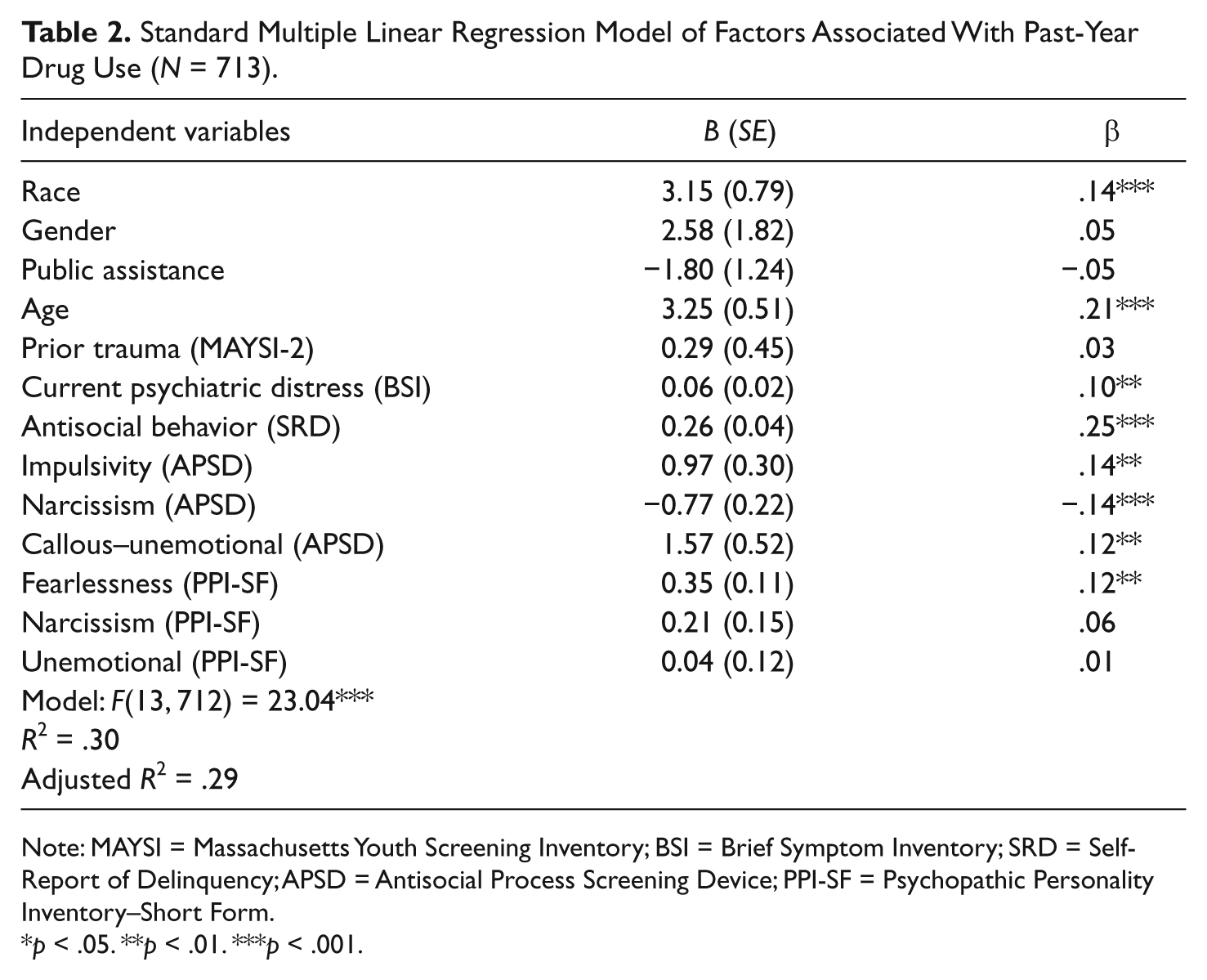
Results of the multiple linear regression model presented in Table 2 indicated a significant overall model, F(13, 712) = 23.04, df = 699, p < .0001, that accounted for 30% of the variance in past-year drug abuse. Caucasian ethnicity (β = .14, p < .001) and older age (β = .21, p < .001) were significantly associated with high levels of past-year drug use. Other independent variables significantly associated with past-year drug use in the model included APSD impulsivity (β = .14, p < .01), APSD callous–unemotionality (β = .12, p < .01), PPI fearlessness (β = .12, p < .01), BSI current psychiatric distress (β = .10, p < .01), and frequency of past-year antisocial behavior (β = .25, p < .001). APSD narcissism was significantly inversely related (β = −.14, p < .001) to levels of past-year drug use.
Standard Multiple Linear Regression Model of Factors Associated With Past-Year Drug Use (N = 713).
Note: MAYSI = Massachusetts Youth Screening Inventory; BSI = Brief Symptom Inventory; SRD = Self-Report of Delinquency; APSD = Antisocial Process Screening Device; PPI-SF = Psychopathic Personality Inventory–Short Form.
p < .05. **p < .01. ***p < .001.
Mixture Regression
Table 3 presents the linear regression results for the two latent classes identified and described previously. Both overall regression models were significant (p < .001); however, the percentage of explained variance differed substantially across the two latent classes. Variables in Class 1 accounted for 21% of the explained variance in past-year drug use, whereas variables in Class 2 accounted for 47% of the variance. Race (Caucasian in Class 2 and African American in Class 1) was a significantly inverse variable in both classes (p < .05), and age was positively associated (p < .01) with past-year drug abuse in both classes. In contrast to the standard linear regression in Table 2, prior trauma was a significant variable related to past-year drug abuse in Class 1 (β = .10, p = .054) and Class 2 (β = .11, p = .027) youth. Antisocial behavior and APSD callous–unemotionality were significant correlates of past-year drug abuse in both classes, which were the same findings as the standard linear regression model. With respect to the remaining independent variables, findings diverged for each latent class. Impulsivity (β = .18, p < .01), fearlessness (β = .13, p < .01), and current psychiatric distress (β = .24, p < .001) were significantly associated with past-year drug abuse in Class 2, who evidenced higher drug use during the past year. These variables were not significant among Class 1, which comprised lower past-year drug users.
Mixture Regression Results of Factors Associated With Past-Year Drug Use.

Note: MAYSI = Massachusetts Youth Screening Inventory; BSI = Brief Symptom Inventory; SRD = Self-Report of Delinquency; APSD = Antisocial Process Screening Device; PPI-SF = Psychopathic Personality Inventory–Short Form.
p < .05. **p < .01. ***p < .001.
Discussion
This study sought to understand factors associated with drug use among juvenile offenders by comparing standard regression with mixture regression approaches. The first research aim was to explore how identified strains were associated with past-year substance use among juvenile offenders. As hypothesized, the standard multiple regression model revealed that in this sample of juvenile offenders, frequency of past-year antisocial behavior, psychiatric distress, and psychopathic traits such as impulsivity, fearlessness, callous–unemotionality, and narcissistic features was significantly related to higher levels of past-year drug use. In addition, multiple regression revealed that race and age were significantly related to substance use. These results are similar to those of previous studies with reference to race (OJJDP, 2008), age (Mauricio et al., 2009), and presence of mental health conditions (Odgers et al., 2005) predicting greater substance use among juvenile offenders.
The second research aim was to explore the differences in the latent classes (lower substance-using Class 1 and higher substance-using Class 2). Results demonstrated that mixture regression models provided a more precise characterization of the heterogeneity among juvenile offenders in this sample. The primary differences found were with regard to level of substance use, ethnicity, age, receipt of public assistance, and psychopathic traits. Specifically, Class 1 had much lower levels of substance use, was primarily African American and significantly younger, had more youth from families receiving public assistance, and had fewer psychopathic traits. Conversely, Class 2 had much higher levels of substance use, was primarily Caucasian and older, and had more psychopathic traits.
Providing the strong rationale for how the latent classes were conceptually created, the strongest significant (p < .001) effect size (d = 2.00) was found in examining the difference in the level of substance use between the two classes. Thus, Class 1 was labeled lower substance-using class and Class 2 was labeled higher substance-using class. In addition, it was found that the higher substance-using Class 2 offenders were significantly more likely to be Caucasian and older than the higher substance-using Class 1 members. The younger Class 1 included almost all the African American participants in the sample. Recent studies examining substance use and heterogeneity among juvenile offenders have also found that Caucasian juvenile offenders exhibit much higher levels of substance use (Caldwell et al., 2010; Felson et al., 2008; Vaughn, Wallace, et al., 2008; Vincent et al., 2008).
Another significant difference between the two latent classes was the receipt of public assistance. The higher substance-using, primarily Caucasian, Class 2 received significantly less public assistance, whereas the lower substance-using Class 1 (containing the majority of the African American population in the sample) came from families that received significantly higher levels of public assistance. This finding indicates that the lower substance-using Class 1 juvenile offenders were more likely to come from families with lower levels of economic support. Previous delinquency scholars have espoused, in a similar fashion, that African American juvenile offenders frequently come from poverty-stricken environments (Piquero, Moffitt, & Lawton, 2005). It has also been found that African Americans are more likely than their Caucasian counterparts to come from neighborhoods with higher levels of crime and violence (Piquero et al., 2005). Despite this disadvantage, however, this study (along with other aforementioned studies: Caldwell et al., 2010; Felson et al., 2008; Vaughn, Wallace, et al., 2008; Vincent et al., 2008) highlights that African Americans use less illicit substances when compared with Caucasian offenders.
In addition, youth in the higher substance-using, primarily Caucasian, Class 2 had significantly higher levels of psychopathic traits. This finding suggests that Caucasian offenders who use higher levels of illicit substances may be more likely to display psychopathic traits. However, it is possible that these findings might be limited by inadequate measurement that lacks cultural sensitivity and poor validation in minority samples; the use of mixture regression highlights important differences that need further exploration.
The final research aim explored the extent to which mixture regression analysis could yield information beyond traditional linear regression analysis. As mentioned above in relation to the standard regression results, there were a number of variables that accounted for the variance in past-year drug use among juvenile offenders. However, once the two latent classes were identified, a more specific and explanatory model emerged, providing a more clear understanding of past-year drug use among juvenile offenders in this sample, particularly those with relatively higher drug use problems (Class 2). This model revealed that age, prior trauma, greater levels of antisocial behavior, and psychopathic traits were associated with higher past-year drug use among the primarily Caucasian Class 2 sample. Although the standard regression model yielded some of the similar results, the model had a smaller effect size, and some pertinent information was not revealed. For example, traumatic experiences were not found to be related to substance use in the standard multiple regression model. However, mixture regression analyses revealed that traumatic experiences were related to substance use in the higher substance-using Class 2 and the lower substance-using Class 1. It is possible that traumatic experiences might play a different role in the level of substance use among juvenile offenders. For example, traumatic experiences might lead Caucasian juvenile offenders to self-medicate with psychoactive substances. Even though recent research indicates that African American juvenile offenders are more likely to report greater levels of victimization and trauma (Vaughn, Wallace, et al., 2008), they may have different coping strategies other than seeking comfort in higher levels of substance use. It may be useful for future researchers to examine how trauma might be specifically related to various levels of substance use among offenders.
In addition, the mixture regression analysis assisted in underscoring the reality that it was primarily youth from the mostly Caucasian class whose mental health conditions (greater number of psychopathic traits and psychological distress) accounted for variance in higher drug use. Conversely, only one psychopathic trait (callous–unemotional) accounted for the variance in past-year drug abuse among the lower substance abusers in the largely African American Class 1. These results suggest that understanding drug use among juvenile offenders from the perspective various clusters of characteristics may be more useful than viewing these youth as a homogeneous group. In other words, supporting our hypothesis, mixture regression is more informative than standard linear regression.
Although results from standard multiple regression analyses offered insights into factors associated with drug use among juvenile offenders, mixture regression results possessed greater specificity and possible explanatory power. The findings of this investigation are consistent with other recent reports that have remarked about the value of using mixture regression to better fit analyses and account for underlying heterogeneity in a given sample (Kimber & Sandell, 2009; Levine, Rabinowitz, Case, & Ascher-Svanum, 2010; Wu et al., 2009). Importantly, this is one of the first studies of which we are aware to use mixture regression in a sample of juvenile offenders.
There are several limitations that warrant caution when interpreting the results of this study. Participants in this study resided in Missouri; thus, results may not generalize to all American youth. Second, causality cannot be determined due to the cross-sectional nature of the survey sample and because the temporal ordering of variables is not accounted for in regression analyses. There was also a heavy reliance on self-report data, and a social desirability bias may have influenced obtained results. Finally, there was a lack of environmental variables, such as family measures and neighborhood circumstances, which previous research has shown to have important effects on the use of drugs among juvenile offenders. The incorporation of these variables into regression models could have differentially effected the identification and characterization of latent classes.
As the problem of sustained and increasing drug use persists, it is important that researchers evaluate how the current knowledge base may be failing today’s at-risk youth. Many scholars agree that most treatments for at-risk youth are not culturally grounded, and more population-specific information is needed to design the most efficacious interventions (Holleran-Steiker, 2008). As the fields of social science continue to move toward an EBP framework, and policy makers continue to mandate the use of EBPs, it is important that delinquency researchers conduct research and illuminate the specific factors, such as demographic characteristics, antisocial behavior, or prior trauma, found in this heterogeneous population. Through the use of advanced analytic techniques such as mixture regression, researchers may be able to offer policy makers and practitioners more specific data with which to plan future treatment interventions.
Footnotes
Declaration of Conflicting Interests
The author(s) declared no potential conflicts of interest with respect to the research, authorship, and/or publication of this article.
Funding
The author(s) received no financial support for the research, authorship, and/or publication of this article.