



Abstract
Using a sample of 70 juvenile probationers (39 treatment and 31 controls), we evaluated the effectiveness of a rehabilitation program that combined cognitive-behavioral training and automated phone calls. The cognitive-behavioral training contained six 90-min sessions, one per week, and the phone calls occurred twice per day for the year following treatment. Recidivism was measured by whether they were rearrested and the total number of rearrests during the 1st year. To test the impact of the phone calls, those who received phone calls were divided into high and low groups depending on whether they answered more or less than half of their phone calls. Those who completed the class and answered at least half of their phone calls were less likely to have been arrested and had fewer total arrests.
In 2009, juveniles between the ages of 10 and 17 comprised 10.6% of the U.S. population but accounted for 14% of all arrests, 15% of all violent arrests, and almost 25% of all arrests for property crimes (Puzzanchera, Adams, & Kang, 2012). From 1985 to 2009, juvenile court cases in the United States increased 30%. In 2009, the juvenile courts processed 1.5 million cases and more than 31 million youth were under their supervision (Puzzanchera, Adams, & Hockenberry, 2012). Research indicates that childhood delinquency influences adult lives and that saving a high-risk juvenile from a life of crime could save society up to US$5 million per life span of each juvenile (Cohen & Piquero, 2009; Piquero, Farrington, Nagin, & Moffitt, 2010).
Many programs have been created to help juvenile probationers succeed, and in recent years, an increased emphasis has been placed on evaluating their effectiveness (Farrington & Welsh, 2007; Greenwood & Welsh, 2012; MacKenzie, 2002; Sherman, Farrington, Welsh, & MacKenzie, 2002). Although progress has been made in identifying effective programs, there is a need for additional research on program effectiveness and the mechanisms that explain why a program is effective (Bushway, Piquero, Broidy, Cauffman, & Mazerolle, 2001; Greenwood & Welsh, 2012; Lynch, 2006; Sherman et al., 2002; Visher, 2006).
Theoretical Foundations
This article is part of an ongoing evaluation of a cognitive-behavioral rehabilitation program which comprises six 90-min training sessions followed by automated phone calls for a year. In previously reported research of 70 juvenile participants, Burraston, Cherrington, and Bahr (2012) found that juveniles who participated in the program had 51% fewer arrests than comparable controls. However, it was not clear how the positive results were achieved. The purpose of this article is to examine two components of the program to estimate the extent to which each influences recidivism. We are particularly interested in assessing how well the phone-coach component reduces recidivism because it uses the technology of cell phones as a tool to provide follow-up.
Character Development Model
The theoretical foundation for the program comes from the Character Development Model (J. O. Cherrington & Cherrington, 2000), which is a theory explaining the internal processes leading to behavior change. This model explains the moral development process by examining the interactions among the following four key concepts: attitudes, behavioral intentions, behavior, and behavioral explanations. Behavioral intentions and behavioral explanations serve as intervening variables that explain the reciprocal impact of attitudes and behavior on each other. For example, attitudes influence behavior by first influencing behavioral intentions, while behavioral explanations mediate the effects of behavior on attitudes.
In the Character Development Model, the reasons why behavior influences attitudes and creates internalized values are explained by the mental thought processes associated with explaining one’s actions. People do not view themselves as capricious, random actors but as rational beings whose behavior is conscious and planned and whose actions are consistent with their attitudes. When behavior is inconsistent with attitudes, the easiest way to create harmony is to change one’s attitudes. Therefore, when a given action creates inconsistency between an attitude and behavior, the easiest way to reestablish harmony is to rationalize and justify the behavior (Ajzen & Fishbein, 1980; Crandall & Eshleman, 2003; Festinger, 1957; Veer & Shankar, 2011).
This rationalization process can be reversed, according to the Character Development Model, if people recognize that their behavior is improper and make a plan to change (Lowell, 2012; Stone, 2012). This reversal can be facilitated by external interventions that affect any of the four internal components. These external interventions can occur independently or in combination, and the strength of a treatment intervention would be expected to increase as the number of components increases.
Cognitive-Behavioral Training
There has been extensive research on the effectiveness of rehabilitation programs for adult and juvenile offenders. In a meta-analysis of 400 studies treating juvenile delinquents, Lipsey (1995) observed that the average recidivism rate was about 50% for the control group compared with 45% for the treatment group, a 10% improvement. Lipsey, Chapman, and Landenberger (2001) examined 14 experiments and found that recidivism of those in treatment was only 55% of the recidivism of controls. Finally, in a meta-analysis of cognitive-behavioral programs, Landenberger and Lipsey (2005) concluded that the most successful programs (a) focused on high-risk offenders, (b) had high quality implementation in terms of the length of the training and the number of treatment sessions per week, and (c) included training in anger control and interpersonal problem solving.
In their review of various meta-analyses, Lipsey and Cullen (2007) concluded that cognitive-behavioral programs tend to reduce recidivism although the results are rather modest. As they examined the different training programs, however, they concluded that “while the type of treatment clearly matters in relation to recidivism effects, it is not clear what it is about the different treatment types that accounts for those effects” (Lipsey & Cullen, 2007, p. 17).
The cognitive-behavioral training program evaluated in this research contains six 90-min training sessions. The concepts contained in the training were developed primarily by Bennett (1987) and are designed to help individuals examine their principles and beliefs more clearly, understand how their beliefs influence their behaviors, and make certain that the results of their behavior are aligned with their basic needs. This model assumes that human behavior is motivated by a desire to satisfy one of the following four basic needs: the need to live (survive), the need to love and be loved, the need to feel important, and the need to experience variety. It provides a value-neutral, nonjudgmental framework for examining one’s beliefs and adjusting one’s behaviors to achieve desired results.
Phone-Coach Monitoring
Prior research in the United States, England, and the Netherlands has demonstrated that telephone calls help some people overcome addictions to alcohol (Cacciola et al., 2008; Mundt, Moore, & Bean, 2006; Weitzel, Bernhardt, Usdan, Mays, & Glanz, 2007), tobacco (Gilbert & Sutton, 2006), and other drugs (Oudejans et al., 2009). Telephone calls have been highly effective in providing exercise counseling and promoting physical activity (Castro & Ling, 2002). Phone calls have also been used to treat people suffering from depression (Datto, Thompson, Horowitz, Disbot, & Oslin, 2003).
Most telephone technologies have utilized an interactive voice response that requires the participants to make daily calls and report their behavior by responding to a series of questions (Brown, Saunders, Bobula, Mundt, & Koch, 2007; Mundt et al., 2006). A branching format allows the answer to one question to determine what the content of following questions will be. Participants are asked to explain their failures and they are congratulated on their successes. They are required to initiate the phone calls and are paid to continue their participation. If they miss two successive days, a counselor calls to remind them.
The results of these studies are rather mixed; the participants generally provide accurate reports of their behaviors but the behavior of those who receive the phone calls is not much better than the controls. Furthermore, some participants have negative reactions to receiving daily phone calls; the calls are perceived as annoying and irritating.
In this research, the phone-coach program avoids the problem of requiring participants to initiate the phone calls by using an automated system to call all participants. Although the technology is rather sophisticated, the application of the phone-coach program is very simple. People participate in deciding how often they will be called and what they will be asked. Most participants receive two phone calls per day at preestablished times and their questions are tailored to their own personal situations. Their responses are recorded and compiled on a secure Internet site. The phone-coach system tracks progress and provides immediate feedback to the participant and, when authorized by the participant, to a parole officer or counselor. 1
Prerecorded messages of support by friends and mentors can be played to reinforce or encourage good behavior. Most participants relied on family members for their support. Each participant identified three support persons and gave them a sheet of instructions explaining how to leave the following two messages: one that congratulated them when they were succeeding in reaching their goals and one that encouraged them when they were struggling. As these were simple phone-mail messages, they could be changed at any time by the support persons.
The calls can be received on any phone but most participants use cell phones. As most people carry their cell phones, they can receive calls at any time or place. The phone-coach program is a creative application of technology and needs to be evaluated.
Research Questions
The treatment program contains the following two primary components designed to reduce recidivism: (a) the cognitive training class, which is an intervention affecting attitudes and behavioral explanations, and (b) automated phone calls, which is an intervention affecting behavioral intentions and behavior. In this study, we focus primarily on the effectiveness of the automated phone calls on reducing recidivism. We hypothesize that participants who answer more phone calls will have fewer arrests than those who fail to answer as many.
Research Methodology
Participants
The participants in this study came from a juvenile court in one county of a western state of the United States. A total of 76 juveniles were recruited to participate in this study: 33 controls plus 43 treatment participants who participated in one of five training groups. For the first two groups, moderate to low-risk participants were randomly assigned to one of the following three conditions: control, class-only, and class plus phone calls. The court assigned moderate to high-risk juveniles to the last three groups and allowed us to use court records to identify a matched control group of youth with the same age, gender, race, type of offense, and risk (low, medium, or high). Attrition was small—2 of the control and 4 of the treatment participants were lost from the study because they moved from the area, leaving a final sample of 70 juveniles. The 31 participants in the control condition received standard treatment for juveniles on probation, which included an individualized treatment plan plus classes to help them avoid drug use or succeed in school. The treatment and control participants were called every month to complete the monthly report card assessing their attitudes and behaviors.
Procedures
The 39 juveniles who received treatment all completed the cognitive-behavioral class. The six training sessions occurred every week and lasted about 90 min each. The content of these sessions was described in D. J. Cherrington, Bahr, Kawai, Bennett, and Burraston (2011) and focused on helping the youth to understand the natural consequences of their behavior and to discover whether their outcomes are satisfying their needs. In one of the sessions, the participants were asked to identify their long-term goals and what they needed to do to accomplish them.
Toward the end of the classes, all youth chose some goals and 28 were given cell phones, called twice daily, and asked how well they were accomplishing their goals. Personalized messages from significant others were created to congratulate them when they were making progress or to encourage them if they were struggling. The automated questions were updated periodically at the request of the participant; support people could also update their comments.
Eleven participants were not offered the phone-coach option after completing the class.
Measures
Outcome variables
This study used two outcome variables: (a) whether or not a participant was “rearrested” and (b) the “total number of rearrests” during the year following treatment. The juvenile court keeps a detailed record of each juvenile and the types and frequency of all offenses. Although arrests may not result in convictions, rearrests are a common measure of recidivism (Agnew & Brezina, 2012) and these data are obtained independently from court records. Total rearrests may be the better measure of recidivism as it is an indicator of seriousness—a juvenile who has been rearrested five times is a more serious offender than one who has been arrested only once.
Independent variables
The major purpose of this analysis is to examine whether involvement in the phone-coach component is associated with recidivism. The participants were categorized into four treatment groups: (a) The “Class-phone High” group completed the class, participated in the phone-coach program, and answered half or more of their calls; (b) the “Class-phone Low” group completed the class, agreed to participate in the phone-coach program, but answered less than half of their calls; (c) the “Class-only” group completed the class but did not receive phone calls; and (d) the control group did not participate in the treatment but received standard programming for juvenile probationers.
Control variables
Previous research has shown that age, gender, and criminal history are associated with recidivism (Agnew, 2005; Laub & Sampson, 2003; LeBel, Burnett, Maruna, & Bushway, 2008). Therefore, in the analyses we controlled for age, gender, number of prior felonies, and risk level. As shown in Table 1, the participants ranged in age from 13 to 18, 89% were male, the average number of previous felonies was 1.1, and the mean risk score was 1.87 on a 3-point scale. There were no significant differences between the treatment and control groups in age, gender, prior felonies, or risk level.
Description of Control Variables (N = 70).
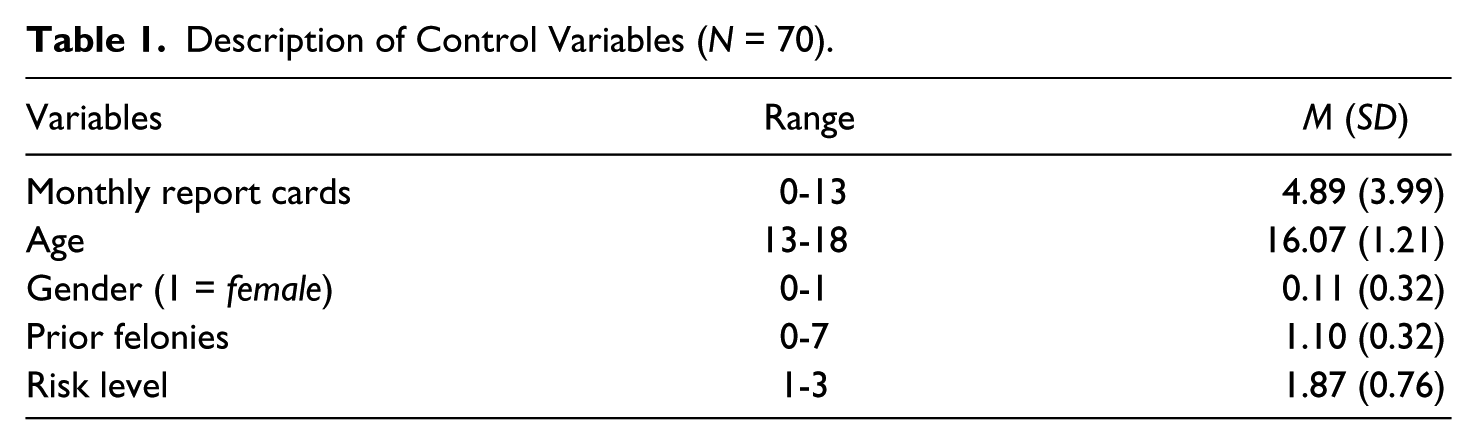
One of the major challenges of evaluation research is avoiding selection bias. A crucial question for our research is whether involvement in the phone-coach program helps participants avoid arrest or whether answering phone calls is just an indicator of a preexisting motivation to succeed. If it is the latter, those who answer more phone calls would be expected to have lower recidivism rates whether or not they answered the phone calls; answering the phone regularly would just indicate a high motivation to succeed and would not be evidence of a valid treatment effect. To control for selection bias, the completion of monthly report cards was used as an indicator of preexisting motivation; those highly motivated to succeed would likely have been available to answer monthly report cards regularly. If, after controlling for the number of monthly report cards, those in the phone-coach program have less recidivism than the control participants, this difference could be attributed to the phone-coach program rather than to preexisting motivation.
Results
Quantitative Results
Table 2 compares the four groups on percent rearrested and average number of total rearrests. Those who attended the class and answered more than half of their phone calls had the lowest percent rearrested (39%) and the fewest number of total arrests (.83). Participants who attended the class but did not have a phone also had a relatively low percent rearrested (55%) and a low average number of total arrests (.91). Those in the control condition had the highest percent rearrested (90%) and the greatest average number of total arrests (2.29), whereas those who attended the class but failed to answer their phone calls were only slightly better than the controls (80% and 2.00, respectively).
Percentage Rearrested and Mean Total Rearrests by Treatment Group.

Survival analysis was used to estimate the risk of rearrest during the year following the completion of the class, 2 while negative binomial regression was used to estimate the impact of the treatment groups on total rearrests. 3 The results of the two regression equations are shown in Table 3. As hypothesized, those who answered at least half of their daily calls were 79% less likely to be rearrested (1.00 − 0.21 = 0.79) and they had 57% fewer total rearrests than those in the control group (1.00 − 0.43 = 0.57).
Regressions of Rearrest and Total Rearrests by Treatment and Control Variables (N = 70).
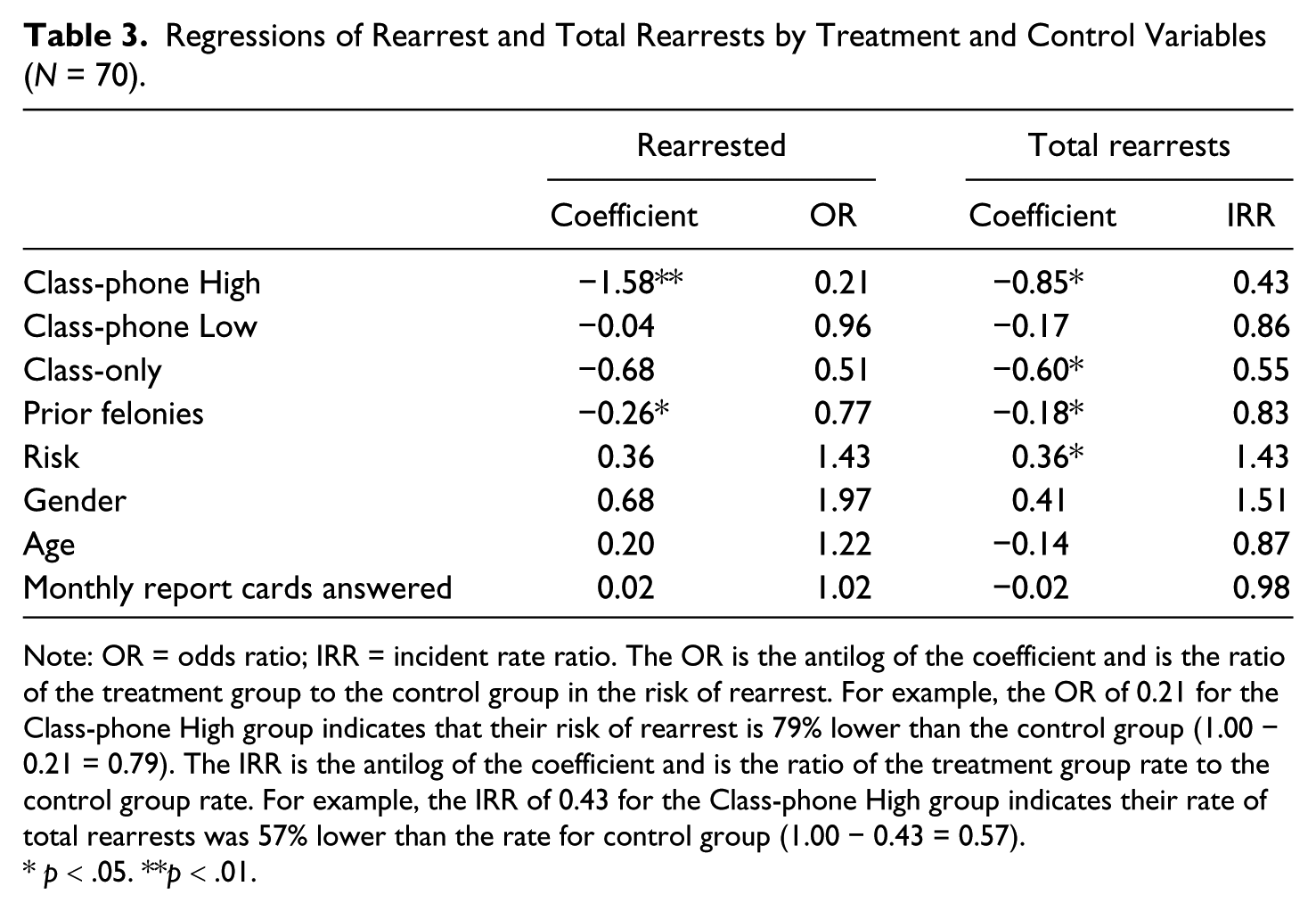
Note: OR = odds ratio; IRR = incident rate ratio. The OR is the antilog of the coefficient and is the ratio of the treatment group to the control group in the risk of rearrest. For example, the OR of 0.21 for the Class-phone High group indicates that their risk of rearrest is 79% lower than the control group (1.00 − 0.21 = 0.79). The IRR is the antilog of the coefficient and is the ratio of the treatment group rate to the control group rate. For example, the IRR of 0.43 for the Class-phone High group indicates their rate of total rearrests was 57% lower than the rate for control group (1.00 − 0.43 = 0.57).
p < .05. **p < .01.
Those who attended the class but did not receive phone calls had significantly fewer total rearrests than the control group (45%). They were also less likely to be rearrested (49%) although this difference was not statistically significant.
Those who took the class but answered fewer than half of their calls were not significantly different from the control group in the probability of being rearrested or in total rearrests. This finding suggests that involvement in the phone coach is not an effective treatment intervention unless the participants answer their phone calls.
Qualitative Results
The phone-coach program capitalizes on the use of a popular technology to facilitate change by directly influencing behavior and by creating behavioral intentions through a goal-setting program. The exit interviews at the end of a year suggest that the following factors contribute to the success of the phone-coach program.
Aftercare support
One participant said, “This was the best thing for me. It made me aware of my weaknesses and provided support based on my goals.” Previous research has demonstrated that aftercare may be critical in sustaining treatment effects (Inciardi, Martin, & Butzin, 2004; Kurlychek & Kempinen, 2006). The phone-coach program provides a low-cost method of aftercare by encouraging participants and providing support when they are most at risk. Contact and encouragement can be timed to come at the most vulnerable times to strengthen a participant’s resolve. The participant can choose not to answer the phone, but even if the call is refused, it is a reminder of previous decisions.
Manageable goals
One participant said, “It helped because it kept my plan in focus all the time. It kept reminding me of what I wanted to do.” When starting a change program, participants often set goals that are perceived as too large and hopeless. The phone-coach program helps participants break large goals into manageable parts and achievable time frames. Participants can design the calling schedule to fit the time frame that works best for them relative to their levels of personal control.
Support of significant others
A youth said, “It was good to be able to hear inspiring messages people left for me like my Mom when I was doing good; in some ways it helped me meet my goals.” The phone-coach program provides an opportunity for support people to leave voice messages of congratulations and encouragement without requiring them to know or have access to any of the details of the person’s goals. These messages provide positive recognition and can be recorded at any time and from any location and made available to the participants.
Accountability
One youth said, “It was a struggle in the beginning and when you would get the phone call you knew you had to answer yes or no to them so there was accountability for the actions that I was doing.” Another said, “When I first started messing up it would call and make me feel a little guilty.” With each phone call, the participants are asked whether they have stayed with the goal since the last phone call. If they have, they receive praise; and if they have not, they are asked to explain what they have done and why. These types of questions reinforce the concept of personal accountability.
Real-time data
Another youth said, It was a constant reminder—twice a day. They would call and if I’m in a position to go one way or the other, they’re calling and putting me in my place. It made me think, “I shouldn’t go that way.” It really really was effective.
Data collected days after an event are not as accurate as data collected at the moment of the event. Research on smoking cessation finds that people who are asked why they smoked during the week provide much more general answers compared with people who are asked the same question just after extinguishing a cigarette (Prochaska & DiClemente, 1983). The phone-coach program collects data in real time and makes the data available in real-time reports.
Discussion
Juvenile probationers who participated in the class and phone-coach program had less recidivism than comparable juveniles who did not receive the program. Those who were actively involved in the phone-coach component and answered more than half of their daily calls were less likely to be rearrested and had fewer total arrests than juveniles who answered fewer calls or were in the control groups. Those who participated in the cognitive class but did not receive phone calls had significantly fewer total rearrests than the control group. The class-only group also had a lower probability of being rearrested; however, this difference was not statistically significant due to the small sample size.
Good theories are needed to understand how the components of treatment programs affect their effectiveness (Cullen & Jonson, 2011; Lynch, 2006). A useful theory for explaining the effectiveness of the phone-coach program is Dalton’s (1973) theory of lasting change. Dalton claims that lasting change occurs when change interventions go from generalized goals to specific objectives, from former social ties to new relationships, from self-doubt to heightened self-esteem, and from external to internal motives for change.
Generalized goals → Specific objectives
The phone-coach program requires participants to move from general goals to specific objectives. General goals, such as wanting to be a better student or have better health, are not as powerful in creating change as specific objectives, such as completing daily homework assignments and avoiding the use of alcohol that day. Before they begin receiving calls, participants identified specific behavioral objectives that can be measured during each phone call.
The participants were required to identify a list of the activities and tasks that they could do on a daily basis to help them achieve their objectives. To stimulate their thinking, they were shown a list of potential activities that others had created. The participants were encouraged to identify at least a dozen activities, although some listed as many as 30. Each phone call asked how well they were achieving their specific objectives and the activities that accompany them. The calls helped keep them focused on what they wanted to accomplish.
Former social ties → New relationships
The phone-coach program helps participants develop new associations with people who support their efforts to change. They have to think about whom they admire and who would be willing to help them. The automated message delivery provides unprecedented access for these support people to deliver messages of praise and encouragement. These messages are frequently delivered at key times regardless of the participant’s location at that moment. Often, the messages are expressions of love and appreciation that the support people have wanted to give but have avoided saying in the past because it felt awkward.
Periodic calls asking participants about their progress also help them recognize the destructive impact of negative relationships. Friends who encourage them to do things that are contrary to their goals cause problems; in time, they tend to avoid these friends and seek more positive relationships. One participant reported, “It’s been a long time, but it reminded me to stay away from other people on drugs.”
Recorded messages extend the influence of support people. A probation officer described it this way, The phone coach gives us the ability to reach the kids at parties and in gang hang outs, places we cannot go. When we reach them, the phone coach lets people they care about give them messages encouraging them to change.
The messages inspire, motivate, and sustain people as they work on change.
Self-doubt → Self-esteem
An ideal way to boost the participants’ self-esteem is to help them experience success. Daily feedback about even small successes is uplifting. One participant said, “It’s difficult being out of jail; you have such low self-esteem. The phone calls are helpful because it’s like you’re learning to walk again. It kept reminding me that I was doing better.” While technology cannot build self-esteem, it serves as a reminder of positive goals and provides helpful feedback. When failure occurs, the technology encourages participants to keep going, and it puts the failure in context.
The phone-coach program identifies daily objectives and measures personal progress. When the participants are achieving their goals, each phone call provides another opportunity to experience success and a feeling of personal accomplishment. As participants progress, the messages build self-esteem and provide assurance that behavior change is possible.
External motives for change → Internal motive for change
The phone-coach program helps participants internalize a desire for change. During the final training session, they write the goals and activities they want to have programmed into their phone calls. They are encouraged to select goals that are personally meaningful and they are reminded that this program is strictly for their own benefit.
Most participants identify meaningful goals that they genuinely want to achieve, and over time, these goals become internalized as part of their basic value system. It is not unusual for some participants initially to identify goals that sound good but do not really mean anything to them. Nor is it unusual for some participants to report that they are doing better than they really are. After a short time, however, many participants realize that they are only fooling themselves and there is nothing to be gained from lying. At this point, they tend to create more meaningful goals and realistic activities that will help them achieve success. This process moves the motive for change from external sources of pressure to internal sources of personal commitment.
Participants who say that the program is an irritant or that the calls are annoying generally do not feel a genuine sense of ownership of their goals or they are not answering the questions truthfully. Experience indicates that when participants have meaningful goals and realistic action plans, they are emotionally invested in the program and use it to improve their lives.
Limitations
There are important limitations to this research. First, the sample was relatively small and from one location. The small sample limited the statistical power of the analysis. It is important to replicate these findings with larger samples and participants from other geographical areas. Second, it is possible that the results were due to some unmeasured variables, such as internal motivation to change. The monthly evaluations were used as a control for personal involvement and internal motivation, but this was a rather crude control and we did not measure internal motivation directly. There is a need for further evaluation of the program to examine other possible confounding variables.
There are also important limitations to using cell phones with juvenile delinquents. We discovered that the phones could be misused to arrange drug exchanges or to view pornography. Some parents and case managers were not willing to allow some youth to have access to a cell phone. Strict rules regarding the appropriate use of the cell phones had to be taught and those who violated the rules lost the privilege of having a phone.
Conclusion
Although previous researchers have found that cognitive-behavioral programs tend to reduce recidivism, we know relatively little about how or why they contribute to success. This study examines the impact of a program that combines cognitive training and a phone-coach system. The evidence indicates that the class and the phone coach helped delinquent youth avoid rearrest. The phone-coach system was particularly beneficial; those who answered more phone calls were much less likely to be rearrested than those who answered fewer calls.
The Character Development Model explains why the cognitive training and phone calls contribute to the success of the program. The combination of training and phone calls encourages participants to adopt more favorable attitudes, create more specific behavioral intentions, and more accurately explain the consequences of their actions. A vital aspect of the training is that it helps participants understand the natural consequences of their actions in an environment that respects their personal agency. The phone-coach program is an ideal behavioral intentions intervention, as it requires participants to understand goal setting, create meaningful goals, and regularly report on their goal accomplishment. Most importantly, the phone-coach program is a powerful behavioral intervention because it encourages participants to change their behavior and it measures their progress. Researchers need to explore further the usefulness of the phone-coach system in different settings and for different types of treatment. If future research confirms and extends these results, the phone-coach system would be a useful and cost-effective tool in the treatment of juvenile and adult offenders.
Footnotes
Declaration of Conflicting Interests
The author(s) declared no potential conflicts of interest with respect to the research, authorship, and/or publication of this article.
Funding
The author(s) received no financial support for the research, authorship, and/or publication of this article.