



Abstract
This article reports on qualitative research with Alan, a former resident of the therapeutic communities at Her Majesty’s Prison (HMP) Grendon, England, exploring narrative identity beyond therapy. The study emphasises the complexity inherent in the five identities on which Alan draws—the Achiever, the Liminal Man, the Lucky Man, the Puppet, and the Wise Man. We suggest that narrative identities are adapted and reconstructed as they are taken outside of the therapeutic community into a less supportive social environment. This process continues to present challenges for the ex-resident, who may struggle to reconcile the redemptive identities nurtured in therapy with condemnatory ones that have echoes of a criminal past, which may be reignited by personal and social circumstances.
Narrative Approaches in Social Science and Criminology
In recent years, social scientists have become increasingly interested in how people tell stories about their lives through oral, written, and/or visual means (Atkinson, 1997; Atkinson & Delamont, 2006; Riessman, 2008). As such, a significant body of literature has emerged around the concept of narrative. Social scientists concerned with narrative are essentially interested in the narration of stories: How do storytellers present stories about their lives and the lives of others? Why do they tell the stories in the way that they do? Narration has a purpose—to share a story with an audience—and indeed, the audience or audiences, actual or perceived, are shapers of narrative. As Riessman (2008) argues, “one can’t be a ‘self’ by oneself; rather identities are constructed in ‘shows’ that persuade” (p. 106). Given this, and furthermore, if the story is to have meaning to the audience, the narrator must draw upon a range of narratives to tell it in a way that will make sense to the audience. Narratives are essentially social—a set of recognisable formats drawn from the social and cultural context within which the story is told (Atkinson & Coffey, 2003). Individuals will differ in terms of which narratives are available to them—their archive or order of discourse (Foucault, 1972). Examples of narratives discussed in the general literature are the canonical narrative—relaying how life should be lived (Bruner, 2004); master narratives, for example, the brave and courageous John Wayne or the caring and concerned Florence Nightingale (Thorne & McLean, 2003); and subcultural or counter narratives used to make sense of experiences that lie outside of or in opposition to mainstream or dominant forms of understanding lives (Bamberg & Andrews, 2004). Therefore, the stories people tell are revealing not just in terms of what the story conveys about the narrator’s understanding of their lives but also in terms of what the story tells us about the culture in which the story is created and told (McAdams, 2006). Some narrative scholars posit that narrative and identity are inextricably interlinked: “In the end, we become the autobiographical narratives by which we ‘tell about’ our lives,” and given the social nature of the narratives upon which we draw, “we also become variants of the culture’s canonical forms” (Bruner, 2004, p. 694). As such, the term narrative identity is commonly used, which is understood as “an individual’s internalized, evolving and integrative story of the self” (McAdams, 2008, p. 242). The term “evolving” is crucial here; the self is multifaceted, fluid, and never completed. This is reflected in flexible narrative identities. Mead (1934) argues that the mind and the self were social products facilitated through language, or “vocal gestures.” As such, the centrality of interpretation of language in social interaction adds further weight to the argument for narrative studies: “The biological individual must be able to call out in himself the response his gesture calls out in the other, and then utilise this response of the other for control of his own further conduct” (Mead, 1934, p. xxi). The interpretation of language will be mediated by the cultural context within which there are frameworks guiding what constitutes “normal” or mainstream and what is “deviant” or runs counter to social acceptability.
Criminologists have engaged with narrative in several different ways. Studies have explored the narratives deployed by offenders during the course of their offending—prominent among the Chicago School studies of the 1930s (e.g., Shaw, 1930); in the aftermath of criminal episodes or careers—most notably within the desistance literature (e.g., Giordano, Cernkovich, & Rudolph, 2002; Laub & Sampson, 2003; Maruna, 2001), as well as Youngs and Canter’s (2012) work on narrative roles; and prior to offending—identified by Agnew (2006) and seen more recently in studies analysing the written narratives produced by offenders before committing their crimes (Presser, 2012; Sandberg, 2013). Presser (2009, 2010) provides a general conceptual framework for criminological approaches to narrative, each representative of differing ontological and epistemological traditions. Narrative as record is ontologically realist, seeking to identify the nature of past criminal experience, and, as such, is preoccupied with probing the validity of accounts. Narrative as interpretation also explores past criminality but actively seeks to elicit the subjective interpretations of the narrator, more concerned with identifying the meaning and significance of the events than the factual accuracy of the story. The final approach is narrative as constitutive, which sees narrative as central to shaping experiences, holding potential to explore the past, present, and future—here the narrator’s story is situated within the overarching discourses of their social reality.
Despite the potential of narrative as constitutive, Presser (2009) notes that it is the least utilised approach in criminology. However, a handful of scholars have drawn upon this approach, and it appears to have gained ground more recently, particularly in the work of Sandberg (2009, 2010, 2013), who joins Presser in further emphasising the flexible nature of narrative identities, drawing attention to the normality of contradiction and conflict in the stories people tell.
Perhaps the most influential constitutive study of recent years, however, is that of Maruna (2001), who explored the stories of individuals with histories of drug and property offending. Maruna stressed that narrative identity was key to understanding “desistance,” or leaving crime behind. Narrative enabled his existing participants to make sense of the journey from a criminal past to a legitimate present and onward to a crime-free future. Through a slow process of incremental change, participants adapted the stories they told about themselves. The condemnatory scripts from which they narrated past criminality were gradually disconfirmed as redemptive scripts began to emerge. Personal agency was a key feature of this process—just as desistance was a choice, so too had been the decision to offend in the first place, and accepting responsibility for previous criminal behaviour was central to their process of change. Agency had been rediscovered and was challenging previous structural explanations of offending. Maruna also highlighted the applied potential of narrative enquiry—the very fact that narrative identity is amenable to change suggests that it should be central in shaping policy and practice in and around the criminal justice system.
Ward and Marshall (2007) complement Maruna (2001) in arguing that a more adaptive narrative identity is a crucial component of rehabilitation—this involves the critiquing of the stories told about oneself, essentially remodelling them as pro-social. Indeed, Ward is a pioneer of an approach termed the Good Lives Model or GLM. The GLM posits that offenders and nonoffenders alike seek similar things from life (also known as “primary goods”); examples include knowledge, happiness, family and romantic relationships, and excellence in play and work (Ward, 2002). However, for individuals lacking access to pro-social means of achieving these goals, criminal activity may result and the narratives deployed by offenders are characterised by justification of such means or “neutralization” (Sykes & Matza, 1957). The GLM involves identifying legitimate means of achieving aims and goals, essentially adapting the story in which the offenders place themselves: “At the heart of the notion of a good life is the concept of narrative identity, essentially the view an offender has of himself or herself and what is of fundamental importance to him or her” (Ward & Marshall, 2007, p. 290). Essentially, the GLM challenges existing narrative identities and prompts critical reflection upon the narrative repertoire or order of discourse (Foucault, 1972) through which individuals make sense of their experiences and recount those experiences to others. Ward and Marshall highlight that narrative is not only useful for understanding why people engage in criminal activity in the first place but also in developing effective interventions to prevent future criminal activity. Scholars have long acknowledged the role of narrative in shaping future expectations as well as recounting past events (Bruner, 2004; McAdams, 2008), but the practice-based insights of Ward and colleagues (Ward, 2002; Ward, Mann, & Gannon, 2007; Ward & Marshall, 2007) have operationalised this through the GLM. One particular institution within which GLM and narrative are of significant importance is Her Majesty’s Prison (HMP) Grendon (Brookes, 2009, 2010b), which is explored in the following section.
HMP Grendon: Narratives in Transition
HMP Grendon differs from many other institutions within the English and Welsh prison estate in that it is the only prison to operate wholly as a therapeutic community. The prison can be described as a democratic therapeutic community (DTC), which contrasts with the concept-based hierarchical therapeutic communities (HTCs) seen in the United States. Both are heavily community-based and address psychological disturbance, but HTCs focus on individuals for whom drug abuse is the symptom, while DTCs focus on individuals for whom offending is the symptom—ultimately, HTCs deal with a narrower group of individuals (Lipton, 2010). HTCs are firmly stratified, with identifiable chains of command, whereas DTCs have a flatter structure and interactions between staff and residents are less formal. In HTCs, most staff are recovering addicts, while in DTCs they are professional psychologists and therapeutically trained correctional officers. Within the HTC, work is the organising principle, while in the DTC, jobs are still important but are just one among many building blocks of the therapeutic process.
Potential residents apply to go to HMP Grendon and must demonstrate a significant commitment to change (Ministry of Justice [MoJ], 2013; for a general introduction to the work of HMP Grendon, see Genders & Player, 1995). If successful, the applicants then spend an initial period of time in the induction unit, where their motivation and capacity for engaging in the therapeutic regime are observed. The staff then decide either to progress the applicant onto one of the main wings or to return them to their sending institution (Brookes, 2010a). If applicants still wish to continue, they must be serving sentences that will allow a stay of at least 24 months at Grendon (MoJ, 2013), a stay that for many will represent a period within their prison life rather than the final destination; having completed therapy at Grendon, most are then transferred to other establishments, with an average of only 6 men released from Grendon directly into the community each year (Brookes, 2012). The prison is home to up to 238 residents, the vast majority of whom are serving life sentences (Brookes, 2012). The main offences of HMP Grendon residents are violence against the person (62.4%), sexual offences (19.3%), robbery (13.3%), and other offences (5%; HM Chief Inspector of Prisons, 2011). Grendon residents present complex needs and psychological disturbance, some have engaged in self-harm and suicidal behaviours, and many have a significant history of institutional misconduct in other prisons (Newberry, 2009; Newton, 2010; Shine & Newton, 2000). However, Grendon represents, for these men, an opportunity to embark upon a process of change with the “supportive and affirmative social climate” of the DTC (Shuker, 2010, p. 463).
Rapoport’s (1960) four underlying principles of TCs—democratisation, permissiveness, communalism, and reality confrontation—are operationalised within HMP Grendon through several mechanisms. Every Tuesday, Wednesday, and Thursday, residents participate in small therapy groups (Brookes, 2010b). The small therapy groups, consisting of up to eight people, are the forums within which all elements of residents’ lives are considered and discussed, including childhood, family life, offences, victims, educational experiences, relationships, working life, and incidents or events that have occurred in the prison. While “permissiveness” (Rapoport, 1960) enables residents to behave “as normal” and tolerate each other’s perceived deviancy within the community, “reality confrontation” (Rapoport, 1960) comes to the fore in the small therapy groups, where all behaviours come under scrutiny. Residents reporting their experiences within the small therapy groups emphasise that the therapeutic process “is not an easy option” (Brookes, 2010a, p. 483), as “Don,” one of the participants in Stevens’s (2013) research, comments,
You’re talking about yourself day in, day out, really personal stuff and even though I know the end result is absolutely joy, at the present time, it’s hard and I feel like I’m being punished every day. I don’t sleep. I’m talking about things that I never thought I’d talk about and it’s daunting; it really is. How horrible it is when you’re lying in your pad knowing you’ve got to come down here next day and talk some more. Sometimes I just hate it and want to leave, but I know I’ll benefit in the end and so will everyone else, because I won’t be running around causing mayhem. (p. 73)
Progress made within the small therapy groups is communicated to other staff and residents through wing-community meetings at which additional issues affecting community life are discussed and voted upon, for example, the organisation and allocation of paid work. The twice-weekly community meetings are an example of “democratization” (Rapoport, 1960) at work in HMP Grendon—meetings are chaired by an elected resident and enable ongoing access to the decision-making process for all residents. Community meetings also provide a glimpse into the principle of “communalism” (Rapoport, 1960). All residents take on responsibilities relating to their physical environment and the events that happen within that environment. Every resident will undertake a series of “rep jobs,” which may include roles as diverse as entertainment coordinator, health and hygiene compliance officer, family day coordinator, or drugs strategy advisor (Stevens, 2013, p. 104).
Therefore, HMP Grendon is a living-learning situation (Kennard, 1998), within which “every aspect of prison life is an integral component within the therapeutic environment” (Brookes, 2010b, p. 103). Narrative is central to psychotherapeutic interventions in which life stories are elicited, interrogated, critiqued, and reformed (Adler, Skalina, & McAdams, 2008; Adshead, 2011; Lieblich, McAdams, & Josselson, 2004), and HMP Grendon is no exception—such an environment is a facilitator of narrative reconstruction, as Stevens (2013) notes,
. . . conventional “con” self-narratives, those hypermasculine, anti-authoritarian, crime-glorifying, risk-taking tales of criminal derring-do, sometimes intertwined with self-pitying justifications to the effect that “life made me do it . . . ” (p. 159)
The scrutiny applied by staff and fellow residents within the small group and community settings enables such narratives to be actively challenged and reframed, supporting each resident’s evolving model of a good life. This process involves the discovery, rediscovery, and trying-on of identities—which are created and maintained by alternative narratives and are not premised upon their master status as an offender or prisoner (Stevens, 2013). In the later stages of therapy, new identities and the narratives through which they are given meaning are tested, reflected upon, and approved by fellow residents (Genders & Player, 1995; Stevens, 2012; Wilson & McCabe, 2002). Interrogation of the narratives deployed in the telling of life stories during small group sessions is central to the therapeutic process. Peers and staff actively critique the narratives adopted, challenging those who are bereft of personal responsibility, as self-narratives “act to shape and guide future behaviour, as persons act in ways that agree with the stories or myths they have created about themselves” (Brookes, 2010b, p. 105). In her research with Grendon residents in the later stages of therapy, Stevens’s participants displayed a shift from their old offending selves to a “new me” (Stevens, 2012, p. 14), summarised below:
To hear these residents narrate the ways in which they had changed in the TC and describe their belief that these changes were “for real” was therefore powerfully affecting . . . Hopelessness had been replaced by hope, and low self-esteem by self-confidence and self-efficacy . . . they could construct their own self-fulfilling prophecy and embed it within the reconstructed narrative identity. (Stevens, 2013, pp. 162-163)
Therefore, HMP Grendon residents leave therapy with redemption scripts (Maruna, 2001) or restoried lives, forming part of a toolkit alongside psychological, physical, and social resources—these components all come together to enable better plans for living through the GLM (Mann & Gannon, 2007). What happens next is a vastly underresearched area. What do narrative identities look like beyond HMP Grendon? Are stories infused with hope and confidence? To what extent have the conventional con self-narratives been left behind? Clearly, there exists a significant gap in the literature. Criminologists have drawn upon the narrative approach to explore how offenders make sense of their lives. However, at present, no studies appear to have engaged with the narrative identities of those whose formal rehabilitation is built upon the very concept of narrative identity reconstruction—such as is the case at HMP Grendon. By studying the story of one former Grendon resident, we identify a range of contradictory narrative identities upon which he draws to make sense of his life within a research encounter—the Achiever, the Liminal Man, the Lucky Man, the Puppet, and the Wise Man. In the following section, we outline our approach to the research and introduce Alan, whose story we explored in investigating narrative beyond the gates of HMP Grendon.
The Creation of the Narratives
The constitutive narrative tradition (Presser, 2009, 2010), with which we most readily identify, is ontologically nominalist. Ontology concerns the assumptions we hold about phenomenon under investigation. Nominalists posit that the social world is the product of individual consciousness and cognition, distinct from a realist position, which accepts an objective external reality “out there” (Berger & Luckmann, 1967; Burrell & Morgan, 1979). As social scientists, we are not detached or “objective” observers—we are inextricably intertwined with the social world around us. Our inquiries are conducted through lenses coloured by our lived realities, and our findings are given meaning by culturally mediated concepts, names, and labels. Our epistemology, or approach to studying phenomenon, is therefore antipositivist in nature, approaching the narratives in our participant’s story at the micro level. A detailed and in-depth reading of narrative, to be meaningful, requires a small sample, as Sandberg (2010) states, the more data one has, “the harder it will be to discover the nuances of narratives” (p. 451). Therefore, we decided to focus on one former resident of HMP Grendon, to whom we have assigned a gender-specific pseudonym—Alan. We have also generalised some personal aspects of his account to protect his identity. Alan could be described as an opportunistic sample; we met him when he was due to contribute toward a seminar series about desistance in a higher education setting in which he would talk to undergraduate students about his experience of crime, prison, and HMP Grendon. We invited him to participate in our research by first engaging in an initial short interview with one of the authors at the university on the day that he delivered his talk, followed up by a longer interview at a later date in which previous topics could be revisited in more depth. Interviews were selected for this piece of research given the opportunities created for delving into a whole life, exploring periods and events within it and the interconnections within and between these particular periods and events (Mishler, 1986). The interviews were unstructured and the questions open-ended to provide “narrative opportunities” (Riessman, 2008, p. 24). Both of Alan’s interviews took place in an office at the university. At the time of the interviews, Alan was in his late 50s. He had spent much of his adult life in and out of prison, spending 5 years at Grendon while serving a longer sentence for armed robbery. Following his therapy at Grendon, Alan spent 2 years in a mainstream prison prior to release.
In forming an approach to our analysis, we were mindful that our research was situated in what McAdams (2012) terms the context of discovery. Here we were exploring for the first time the narrative identities of an individual for whom narrative reconstruction had been central to his therapy. As such, the aim was “to gain new (albeit provisional) insights—not to confirm predetermined categories” (McAdams, 2012, p. 19). Therefore, while mindful of the literature that preceded the study, we did not draw upon existing typologies or categories in developing a conceptual framework in which to analyse our interview data. The interviews were digitally recorded and transcribed verbatim by a third party. We prepared the transcripts for analysis by reading through them while listening to the recordings, checking and amending the transcripts to ensure that features such as pauses and tone of voice were represented in the document. Each interview transcript was divided into episodes (Riessman, 2001) relating to the sequence in which Alan told his story. Within each episode, scenes were identified, being the content that referred to the same topic—this was important in identifying themes, unlikely to be conveyed in a single word or sentence but in an extended passage of text (McAdams, 2012; Riessman, 2001). Episodes and scenes were labelled with titles, which provided a brief description of what was happening in the particular episode or scene.
Our analysis was inspired by the dialogic/performance technique, a multilevel, holistic approach, which is summarised below by Riessman (2008):
Attention expands from detailed attention to a narrator’s speech—what is said and/or how it is said—to the dialogic environment in all its complexity. Historical and cultural context, audiences for the narrative, and shifts in the interpreters positioning over time are brought into the interpretation. Language—the particular words and styles that narrators select to recount experiences—is interrogated, not taken at face value. (p. 137)
In responding to the interviewer’s questions, participants do not reveal an essential self but perform a preferred self, negotiating how they want to be known by the stories they tell (Goffman, 1959; Riessman, 2001). Central to analysis therefore was a critical awareness of the setting and social circumstances of the interview. Alan was interviewed by a female university academic, so his performance was constructed within this research encounter. However, this may not have been the only “audience” that we needed to be aware of. Alan had some experience of public speaking and advocacy on penal issues and the interviews took place against a background of debate relating to the Coalition Government’s “Breaking the Cycle” policy framework (MoJ, 2010). This political context was one in which punishment, rehabilitation, and sentencing of offenders were being intensely debated, scrutinised, and revised within an economic climate of austerity. Alan was particularly passionate about these issues as an advocate for penal reform. These contextual factors were important to consider in the interpretation of his stories and the narratives he used to convey them. As such, the analytical process contained specific questions relating to context (see reference to the analysis grid below) to ensure that this was considered throughout the analysis and applied to every scene and episode in Alan’s story rather than as an afterthought—which has a tendency to result in sweeping generalisations that are of limited value. We also noted the use of linguistic tools such as simile, metaphor, direct speech, repetition, and reenactment and considered the function such tools fulfilled for him in performing his narrative identities and demonstrating particular effects—for example, dramatic or reflective (McAdams, 2008).
We recorded our observations about each scene in an analysis grid, which was structured around a series of questions in column headings: Who are the characters? How are they described? How does the narrator position himself in relation to the other characters? How are the other characters positioned in relation to each other? How does the narrator position himself in the scene he is reenacting/describing in relation to himself now? What is the wider social context? How is the narrator positioned in the wider social context? We also created a notes column for general observations and an episode summary column in which we noted our thoughts as to the temporality and threads running throughout different episodes. Each interview was analysed using this framework, by closely reading the transcript and relistening to the recordings. We explored the nature of integration in Alan’s story in terms of the synchronic and the diachronic (McAdams, 2008); the former concerned with how he reconciled contradiction and complexity in his story and the diachronic with how he presented movement from one stage to another in his life. We present our findings from the analysis in the following section.
Narrative Identities in Alan’s Story
We identified five narrative identities or characterisations of the self in Alan’s story; the Achiever, the Wise Man, the Liminal Man, the Puppet, and the Lucky Man.
The Achiever
The Achiever narrative identity emphasises success, obtained through effort and dedication, which has resulted in an identifiable outcome that is visible to Alan and his audience. He drew upon the Achiever in multiple episodes within the interview, relating to a range of time periods and social contexts. This narrative identity frames the story of his journey toward success in his chosen career, from developing the requisite skills in prison to receiving formal recognition for his work—this is described as a slow and incremental process for which his success was well deserved. He makes use of terminology to demonstrate familiarity with the technical language of his profession and names other professionals whom he is acquainted with, reenacting conversations with them. However, the Achiever is also evident when he recounts his early days of criminality, illustrated in the following quote:
Most of my mates were going to juvenile . . . I’m in court at the Old Bailey and get sentenced for three years. And so, I was kind of like, “You’ve made it,” you know what I mean? . . . And you had all these villains in silk suits and ties. They’re all playing cards around the table and the guards treated them with respect. They were all smoking away and they sort of adopted me, “You’ll be alright, have a fag” and all that. So I felt quite proud of it. I liked it. (Interview 2)
The stories recounted by the Achiever are dramatic rather than reflective, using quotes and dialogue to reenact the event being reported, which entertains the audience, as well as adding credibility to the stories through the provision of detail. They also convey a sense of ambition—Alan was not just any criminal but one who was joining the ranks of the experienced and elite, he is not just any professional man but one whose work is recognised as outstanding. There is little sense of external limitation—the backdrop is a level playing field, a meritocracy, in which anything is possible. This had much in common with the environment in which the interview took place—the university was engaging in an active marketing campaign at the time, deploying slogans such as “Become the Best,” which Alan would have come across during the time he spent on campus.
The Wise Man
This narrative identity positions the narrator as authoritative and all knowledgeable about the topics he is discussing. His knowledge is presented as empirical, based on significant experience and observation of crime and criminals, prisons and prisoners. The stories appear to offer a “big picture” insight, from someone who is able to stand back and make informed judgements. The Wise Man first appears when Alan, having spent a considerable amount of his adult life in prison, begins to question the function that identifying with fellow prisoners is fulfilling for him, portraying them as superficial, and comparing them with women who wear makeup:
And I just looked around and started seeing people I had admired and liked in the prison system. And just looking at them and thinking, “No, I just don’t want to be like them. You’re like a woman.” That was the end of the glamour of it all for me if you like. I’d seen what was beyond the curtain and it wasn’t all that good. (Interview 2)
Their superficiality is also conceptualised in terms of the performing arts:
You kind of like—If you spend long enough in it you know the rules, you know the dance and you become those characters. You have to be somebody in prison that you can’t be on the outside, that’s—your main thing is to get, people talk about getting prison hell when they come into jail. The nicest geezer in the world outside and you go into prison and you have to, you can’t believe you’re different and as soon as—it’s a world of machismo where you have to, you know everyone is trying to outdo each other. It’s all one big dance really. (Interview 1, emphasis added)
The Wise Man is reflective rather than dramatic, drawing upon simile—“like a woman,” and metaphor—“characters,” “dance,” to give the audience reference points to make sense of the story. Alan makes the Wise Man more powerful by providing examples of his own process of change. He described how he came to view other prisoners differently as a result of his psychotherapy and conveyed empathy with authority figures, whose actions toward him had at one time appeared unreasonable, but upon reflection, were understandable—for example, commenting on the way in which probation staff dealt with him as a teenager, “I think they gave up on me a bit too easy. But then again I was a horrible person, or I did horrible things” (Interview 2). In addition, he reflects upon the early stages of applying to Grendon, exploring why the psychology staff in the mainstream prison he was serving in were unhelpful. Recognition and revision of a judgement of a fellow Grendon resident, which appeared to be based on appearance, is another example of the Wise Man’s development:
One fella used to annoy me all the time. He was always walking around with a jug of tea day in, day out. He always had a full jug of tea in a filthy old jug. And I never spoke to him. He was there for about two years. And just to say, “Hello” and whatever in the dinner queue. But he used to annoy me for some reason. I just found him annoying—marching up and down in his old flip-flops with his jug of tea. And he was in the psychodrama group. And well, he became a completely different person as I actually got to know him. (Interview 2)
Alan also drew upon the Wise Man in highlighting his agency, giving examples of how he takes control and bears personal responsibility for his actions: “I keep away from violent situations . . . I don’t really go to pubs anymore because I know that you know, have flash points for violence” (Interview 2). However, the insights of the Wise Man can have a troublesome bearing on his interactions with other people in day-to-day life:
Like someone says some sort of throwaway line and I’m wondering, “Well, why did you say that? Where does that come from?” Sometimes, it can be interesting, but sometimes it just does your head in to try to work people out . . . You get this knowledge but it’s not always useful. And if somebody else doesn’t want to go there, it’s absolutely useless even though you kind of have a clue where they’re coming from and what they’re about and why they’re doing things, they won’t listen. (Interview 2)
Therefore, the Wise Man, while being a positive and beneficial narrative identity for Alan, is also a frustrating one as others are not easily able to identify with it. However, Alan had found a forum in which the Wise Man could be further nurtured and explored through the maintenance of links with a fellow former Grendon resident, who he kept in touch with by phone.
The Puppet
Within the Puppet narrative identity, Alan is at the mercy of external forces with a limited range of choices and options. The forces pulling his strings—or the puppet masters—are actors within the criminal justice system, including police officers, probation officers, correctional officers, and prison governors. He is sometimes alone and sometimes joined by others who are similarly constrained. This appears to originate in Alan’s teenage years during the 1970s, where he attaches considerable significance to the social context of the time, one in which he claims that working-class young men like himself had only two life choices, crime or the army—a point that was reinforced by his father. Alan reenacted a scene in which he had attempted (illegally) to sign up for the army at 15. His fraud having been discovered, Alan was subsequently charged and fined, unable to join the army ever again. Nowhere does he reflect that it was an illegal act, rather, emphasis is placed on the probation officer who foiled his plot, blocking his access to a potentially better life. A sense of defeat and resignation also emerges when commenting on his first adult prison sentence, “after I’d come out of the three year sentence, that was me set for life,” further noting, “I was finished and you know, there was nothing I could do” (Interview 2, emphasis added). The Puppet is again deployed in the present day, Alan drawing upon it when describing his fears that the police are corrupt and will try and incriminate him to send him back to prison, “I worry about that kind of thing, being falsely dragged into things that are out of my control if you know what I mean” (Interview 2, emphasis added). The interviewer pushed Alan on these observations, which resulted in him providing evidence to further justify The Puppet, emphasising that this was not just him being paranoid; other people have experienced this too:
I’ve met loads of people in jail and there are loads of people in jail now who are in prison simply because they mixed with the wrong person. They didn’t do anything but became part of the conspiracy. (Interview 2, emphasis added)
The Puppet is dramatic; direct speech and reenactment are used to convince the audience, perhaps in anticipation of how it will be received, not just by the interviewer—an audience familiar with the importance of agency, ownership, and responsibility for oneself emphasised at HMP Grendon—but also by a public audience engaged in debate around the criminal justice system. The social context of the interview in terms of austerity measures and revisions to punishment, sentencing, and rehabilitation created a landscape in which there was uncertainty and change—one in which Alan’s emphasis on the power of external forces and a lack of agency could flourish through the Puppet narrative identity.
The Liminal Man
The Liminal Man is in conflict about his place in the social structure, drawing upon different social identities simultaneously or falling in between social groups. During Alan’s teenage years, he described himself as an adult in the family but a child in the criminal justice system. His feminised role within the family as a young person, which involved caring for siblings while his mother was working, contrasted with the hypermasculine violent criminal identity he was developing outside of the home. Alan also appeared to struggle somewhat over how to present himself in the interviews—the first question posed in the first interview was, “If I asked you how do you define yourself, what would you call yourself now?” to which his response was, “I’d say I am an ex-criminal and I am kind of a member of society, I suppose. Yeah it’s really hard to do” (Interview 1, emphasis added). From the beginning, Alan created a sense of having shed a criminal identity in being an ex-criminal, but his reference to being a member of society was an interesting one—a “kind of” a member of society. This uncertainty regarding identity and position in the social structure appeared later on when Alan talks about “criminals” and “normal people” in the third person:
They are the criminal class. They are the people who criminality is their life. I was one of them. You wake up in the morning and you are a criminal you go to bed at night and you are a criminal. (Interview 1)
He is portraying someone who has left crime behind but later reveals links with his criminal past. He talks of connections with friends who are still engaged in criminal activity, stating that he had put a physical distance between himself and these friends, moving to a different part of the country—but he could not quite let them go: “I can’t really blank them because they’re old friends from even before I went to jail” (Interview 2). So, within this reflective narrative identity, Alan is not attaching any particular label or category to himself. He is portraying someone who is neither a con nor a straight. Alan had described early experiences of being labelled or written off by the education system and criminal justice system through the interview, for example, when reflecting upon a report written by a probation officer when he was a teenager:
There was a report from a probation office in (name of town) Borstal I think it was, from when I was sixteen or seventeen and it said, “(Surname) has been identified as one of a group of boys who’ll spend the rest of their lives in and out of prison.” They kind of wrote me off, not that, you know—I accepted my responsibility of what I’d done at that time—but at that age they had already written me off the system. The fact that it is neither here nor there but they kind of handpicked people they might be able to help and the rest of us were just cannon fodders as I said, they just went “We will need you to keep the prison system running,” I mean perpetuate. And also because my schooling kind of stopped at eleven, in conventional education, they classed me as “Educational sub-normal” because I could barely read or write, you know. (Interview 1)
So, within this narrative identity, the focus is on what Alan is not and things he does not do rather than on what he is and things he does. The Liminal Man serves an important function for Alan—in not labelling himself, he is also preventing his audience from labelling him, and, as such, it offers a degree of protection from the judgement of others.
The Lucky Man
The Lucky Man is someone for whom chance and good fortune have intervened to enable positive outcomes or set in motion a chain of events that would eventually lead to positive outcomes. Alan at times stated that he was lucky to be a talented professional engaging in his chosen career—in direct contradiction to the hardwork and incremental progress he presented as the Achiever. Alan also drew attention to the creative talents of other prisoners, contrasting his experience with theirs by stating, “some people don’t quite have the luck” (Interview 2)—again contradicting the level playing field that he presents as The Achiever. He spoke of the death of a family member as an external catalyst in beginning his process of change—implying that in the absence of this catalyst, he would not have embarked upon it. The Lucky Man is a reflective narrative identity, which would not appear to make very much sense at the first glance. However, when considering it in light of the other narratives, discussed below, its contribution to Alan’s narrative repertoire begins to become clear.
Alan’s narrative repertoire
Alan’s repertoire is a complex one in which seemingly contradictory narrative identities exist alongside one another and are often drawn upon in narrating the same series of events. The Wise Man, who is informed, objective, and approaches topics with a critical appreciation of the different actors involved, would appear to contrast starkly with The Puppet, who can only see the way in which others are constraining him. The Achiever, who emphasises incremental progress and earned success, is also difficult to reconcile with The Puppet, whose agency is limited to such a large degree as to only enable a handful of undesirable choices. The Puppet appears to be potentially problematic for Alan. It is used not only for referring to past events but also for making sense of present circumstances to conceptualise an ongoing fear of factors that he portrays as being beyond his control.
The Puppet is reinforced by the Liminal Man. This is most notable in the narration of links with his criminal friends, which suggests a reluctance to identify as straight. By cutting himself off completely from the criminal underworld, he would no longer be sitting on the fence in a liminal position. However, Alan draws on The Puppet to present this as an impossibility—“I can’t really blank them” (Interview 2)—implying that he is lacking agency here and is constrained by external forces in the form of social expectations around maintaining friendships. Therefore, the Liminal Man supports the Puppet, which is not conducive to a good life—the overemphasis on need, deficit, and lack of agency contrasts starkly with the strengths-based ethos of the GLM. However, the Liminal Man is functional for Alan in minimising the threat of being categorised by others. The labelling he reported in his teenage years came to shape his self-narrative to such a negative degree that labels are avoided in adulthood by remaining liminal.
So, how it is that the Wise Man and the Achiever came to coexist alongside the Puppet and Liminal Man in Alan’s repertoire? Here, we need to examine the diachronic—how Alan presents movement from one stage to another in his life (McAdams, 2008). The key would appear to be the Lucky Man. Alan places a heavy emphasis on the social context of the 1970s within his story—in which the working class was becoming increasingly marginalised and constrained. Alan became an Achiever initially by excelling in criminality—taking one of the few options available to him and succeeding—so, he was an Achiever despite the social context. Alan’s narration of his young adulthood takes place against the backdrop of a system that was working against young men like him, and this is a thread that he sustains throughout his interview. Presenting the Lucky Man is the only credible way of maintaining the overarching plot of an unjust system while moving forward to a position where he has become a legitimate Achiever. By attributing the catalysts and enablers for his process of change to chance and fortune, Alan avoids giving any credit to the criminal justice system and continues to emphasise that he has succeeded despite his context rather than because of it.
The Wise Man appears to fulfil a synchronic function in Alan’s story, reconciling contradiction and complexity (McAdams, 2008). Alan portrays an Achiever, who has matured and adapted given the input of the Wise Man—a narrative identity that has enabled success to be reframed within a legitimate, noncriminal story of a talented and conventionally successful professional. The Wise Man tempers the Puppet, appearing when Alan tries to understand the reasoning of authority figures who, at other points, are portrayed as controlling and constraining—for example, displaying empathy with the probation officer who labelled him and suggesting reasons for the unhelpfulness of the psychology staff in a mainstream prison. The Wise Man, who represents the voice of reason, appeared prior to Alan’s application to HMP Grendon, as he began to question the superficial nature of his fellow prisoners and strengthened further during his time at Grendon. It could be argued that the skills developed during therapy have facilitated and enabled the Wise Man:
And sometimes, a couple of times, I felt like somebody’s bumped into me or something and I used to be very touchy about stuff like that. And I’ll just, you know, I would turn on people straight away. And then I’ll just find myself thinking about psychodrama and what I would do there. And I can just imagine people saying, “Well, how would you do it if . . . ?” and then, it kind of calms me down, you know. (Interview 2)
Alan’s interviews provided a window into his repertoire of narrative identities, which was characterised by conflict. The Puppet, which is potentially detrimental to his good life, has been moderated to a degree by the Wise Man. The Wise Man (via the Lucky Man) has also been central to the reframing of the Achiever through socially acceptable paths to a good life. The Liminal Man serves to protect Alan from further labelling but threatens his good life in working with the Puppet to maintain links with criminal associates. Alan summed up these difficulties and contradictions in the quote noted earlier in which he stated, “I am kind of a member of society, I suppose. Yeah it’s really hard to do.” (Interview 1, emphasis added) and, in addition, at the conclusion of the second interview when discussing links with former criminal associates, links that risk his pro-social narrative identities, “I want to live in a place where I don’t have to look over my shoulder every five minutes” (Interview 2).
We present the narrative repertoire discussed above diagrammatically in Figure 1.
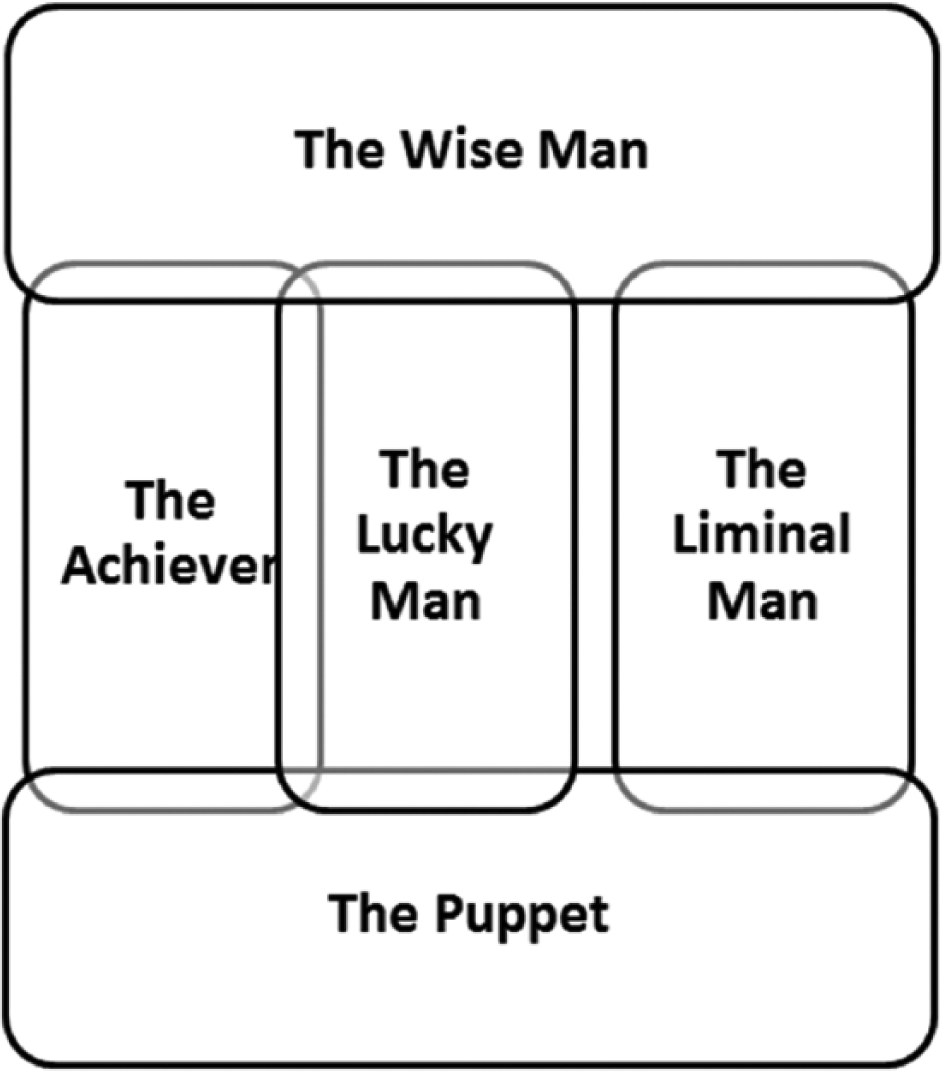
Alan’s narrative repertoire.
Discussion
As noted earlier, narrative analysis has become an important tool for social scientists in general and criminologists in particular in understanding how people make sense of their lives. Research in the constitutive tradition had identified particular narrative identities in the stories told by offenders, including redemption and condemnation scripts (Maruna, 2001). Scholars highlighted the commonality of flexibility or elasticity in stories through the coexistence of conflicting or contradictory narrative identities (Maruna, 2001; Sandberg, 2013). However, these previous studies had not engaged with men who had experienced psychotherapy, an intervention characterised by interrogation and reconstruction of narrative. Studies of TCs had explored the narratives used by men engaged in psychotherapy, as they were scrutinised and reframed in the formulation of plans for a good life (Brookes, 2010a, 2010b; Stevens, 2012, 2013). Narrative identities became altogether more positive in nature during the therapeutic process; hope, confidence, and self-efficacy emerged (Stevens, 2013) to challenge the “conventional ‘con’ self-narratives” (Stevens, 2013, p. 159), characterised by defeatism, inevitability, and a lack of agency. The purpose of this study was to explore the nature of narrative beyond the gates of HMP Grendon by focusing on one former resident—Alan. Were his stories infused with hope and confidence? To what extent had he left conventional “con” self-narratives behind? Having explored the narrative identities that emerged in Alan’s research encounter with one of the authors, we present the following points.
Given existing insights into the narrative reframing that takes place within HMP Grendon (Stevens, 2012, 2013), where residents are confident and hopeful about their futures, one might anticipate the centrality of something akin to a redemption script (Maruna, 2001) in the narrative repertoires of former residents. And indeed, while the Achiever and the Wise Man were largely positive in nature, emphasising the reward of success by legitimate means and highlighting a capacity for critical self-reflection, they were joined by narrative identities that were potentially problematic for Alan, most notably the Liminal Man and the Puppet, which were characterised by a lack of control and sense of inevitability. Alan often switched between narrative identities when telling his story, presenting himself as a series of different characters (McAdams, 1993). However, Alan was able, at times, to draw upon the Wise Man to reframe or temper a story narrated by the Puppet or the Liminal Man. However, this appeared to apply more to the narration of past rather than present events. While empathising with criminal justice staff in developing a new understanding of past difficulties with “the system,” the Wise Man did not stretch—or was not sufficiently flexible—to enable similar understandings of the police within the present day. Therefore, we suggest that Alan is continuing to reconcile coexisting, contradictory narrative identities. The Puppet and the Liminal Man are still present, which is not unexpected—they are presented as long-standing components of Alan’s story. They are akin to smouldering embers, which can be controlled but may reignite if Alan does not evoke the Wise Man to cool them down. Alan’s role in managing his narrative identities then would appear to be one of a firefighter, who has the skill to keep the fire under control but continues to be challenged when it flares up again.
In addition, narrative reframing at HMP Grendon takes place within the social environment of the TC in which feedback and constructive criticism from fellow residents and staff are accessible and ongoing. Our concept of the self is a socially situated one (Mead, 1934). Previous research has emphasised that the stories of offenders are conditioned by culture and context (Presser, 2009; Sandberg, 2013). Therefore, the narratives explored within HMP Grendon are unique to the “supportive and affirmative social climate” (Shuker, 2010, p. 463) of the prison. Beyond HMP Grendon, the environment into which the resident progresses, whether mainstream prison or release, will, of course, be significantly different. The Wise Man, which had been nurtured and strengthened throughout the therapeutic process, was now operating in a different social context, in which the same degree of peer and professional support was largely absent. Alan was continuing to adapt the Wise Man to the outside world, where the culture of therapy is the exception rather than the rule. However, Alan was able to draw upon the support of a former Grendon resident, who he kept in touch with by phone. These conversations maintained a spirit of therapy and enabled the continued development of Alan’s Wise Man.
Alan differs from the participants in previous research in that he is aware of the importance of narrative having engaged in therapy and acknowledges its centrality to his life beyond HMP Grendon; to use Bruner’s (2004) terms, for Alan, “a life as led is inseparable from a life as told” (p. 708). Alan’s therapy at HMP Grendon was not a magic bullet. Therapy provided a forum in which narratives conducive to a good life could be nurtured. The redemption script that we envisage a resident clutching as they move on to their post-Grendon destinations was, for Alan, a work in progress rather than a finished product, much in the way that Mead (1934) describes the self as never complete but as continuously adapting and evolving. The repertoire of narrative identities presented in his interviews conveys a process of adaptation to a harsher, less supportive outside world. The Wise Man is one that Alan finds challenging; while it was recognised and accepted by his audiences within the social and cultural context of the DTC at HMP Grendon, it does not make as much sense to his audiences outside, the only receptivity coming from a friend who is also a former resident. For Alan, the process of adaptation and reshaping of narrative identity is a continuous one. He continues to be challenged, constantly revisiting and restructuring his repertoire in response to his personal and social circumstances as he struggles to narrate present day experiences through the Wise Man rather than the Puppet and the Liminal Man, a battle that he appeared to be in the midst of at the time of his interviews.
This study has explored the narrative identities of one former HMP Grendon resident during qualitative research encounters. As such, our study is vulnerable to the widely voiced criticism that one cannot generalise on this basis. However, such a criticism is premised on the standards of the experimental approach of the natural sciences, which tests factors and variables. Here, we have not tested factors and variables but have engaged on an exploratory study in the context of discovery (McAdams, 2012). We indeed acknowledge that our interpretation of Alan’s narrative identities may not be the interpretation of others. We do not deny our degree of connectedness to the particulars of Alan’s case and the constitutive nature of our approach in which we acknowledge our role in creating the narratives. Indeed, we have actively embraced this throughout the research and concur with Riessman (2008) in her statement: “An analyst can bring information from the interview context to bear, which other readers may not have access to” (p. 11). We intend this study as a contribution to a new pathway for research into life beyond a TC, particularly in terms of the continuation of narrative identity reframing.
In conclusion, we argue that the narrative identities of HMP Grendon ex-residents should be understood as works in progress, which require ongoing maintenance and adaptation as they are taken beyond the supportive social climate of the DTC into environments and circumstances that are less supportive. Here, redemptive identities—such as the Wise Man in Alan’s case—compete with the longer established condemnatory identities—the Puppet and the Liminal Man in Alan’s case. In the absence of the professional and peer-based support of the TC, we suggest that ex-residents may struggle to reconcile the contradictory and competing narrative identities, and thus threatening their maintenance of a good life.
Narrative identities are amenable to change and adaptation (Maruna, 2001; Ward & Marshall, 2007). As such, rediscovery of redemptive narratives holds the potential to reinforce the rehabilitative process, enabling more meaningful and sustainable behaviour change post-release. It is therefore important that interventions enabling critical reflection upon narrative, for example, as seen at HMP Grendon, are available more widely throughout the criminal justice system. However, those who have engaged in such a process may require support to nurture and maintain their redemptive narrative identities beyond prison gates, and this should be a key consideration for the relevant services.
Footnotes
Declaration of Conflicting Interests
The author(s) declared no potential conflicts of interest with respect to the research, authorship, and/or publication of this article.
Funding
The author(s) received no financial support for the research, authorship, and/or publication of this article.