




Abstract
Toward the end of 2006, a pilot program was launched in Israel wherein licensed-released prisoners were put under electronic monitoring (EM). In addition to EM, the pilot program, operated by the Prisoners’ Rehabilitation Authority, provides programs of occupational supervision and personal therapy and is designed to allow for early release of those prisoners who, without increased supervision, would have been found unsuitable for early release. The aim of this study was to ascertain whether participation in the EM program among licensed-released prisoners in Israel might bring about lessened recidivism. For that matter, rates of arrests and incarceration were examined during a follow-up period of up to 4 years, among the entirety of licensed-released prisoners participating in the EM program between the years 2007 and 2009 (n = 155). To compare recidivism rates, a control group was assembled from among the entirety of released prisoners who were found unsuitable for early release in judicial conditions, and had therefore served the full term of their incarceration, to be released between the years 2005 and 2006 (a period of time during which an EM program was not yet operated among licensed-released prisoners in Israel). Study findings clearly show that while among the control group, 42% of released prisoners were re-incarcerated, at the end of a 4-year follow-up period, only 15% among the study group had returned to prison. These findings can be explained by combining the Social Control theory and the Self-Control theory which consider the period of time under EM program and the occupational and familial integration tools for reducing criminal connections and enhancing pro-social behavior.
Introduction
Toward the end of the 1970s, Ralph Schwitzgebel (1968, p. 99) wrote . . . Recent developments in electronic technology in the correction system may assist in gaining control over criminal behavior, resulting in significance reduction in the need for incarceration. This technology may allow us to set many offenders free without risk to public safety . . . (in Renzema, 2010)
Four decades later, it is clear that Schwitzgebel’s optimistic predictions cannot be properly examined without breaking this complex subject down to a number of distinct issues.
Electronic monitoring (EM) programs implemented in various sites worldwide differ in a wide array of variables, a fact which makes adequate comparison of success or failure rates attributed to the program very difficult to exact (Renzema, 2010). Different studies show different goals or expectations underlying the EM program (for description of various studies, see Renzema & Mayo-Wilson, 2005). The difference in expectation brings about a different definition of failure or success. Differences between programs, however, are not characterized solely in attributed expectations. These programs also differ in targeted populations, stages of criminal procedure during which it is applied, its beginning or end, the emphasis put by the program on occupational integration, intensity of sessions with supervisory entities or therapists, duration of program participation, and more (e.g., Bales et al., 2010; Marklund & Holmberg, 2009; Padgett, Bales, & Blomberg, 2006). In addition, the last few decades had seen great technological developments affecting EM methods implemented by law enforcement systems to an extent that converging them all under one cluster labeled “EM program” would be misleading.
Previous research conducted by the authors of this article has shown a low level of recidivism (10%), among early-released prisoners during participating in an EM program (Shoham, Yehosha-Stern, & Efodi, 2013). The present article examines whether participation in the Israeli EM program also reduces the recidivism rate among early-released prisoners after the conclusion of the program.
Recidivism at the Conclusion of the EM Program
Renzema and Mayo-Wilson (2005) claimed that, when referring solely to those studies preserving detailed description of the program’s components and a control group as suitable as possible, it is concluded that participation in an EM program does not necessarily change the rates of recidivism at programs conclusion.
These studies depict a complex picture regarding the effectiveness of the EM program. Some had found negative impacts of the program on recidivism, manifested in recurring arrests and incarcerations during the time of participation in the EM program (Gainey, Payen, & O’Toole, 2000), while other studies had found recidivism completely unaffected (Bonta, Wallace-Capretta, & Rooney, 2000a, 2000b; Finn & Muirhead-Steves, 2002), while Bonta et al. (2000b) showed a positive influence on recidivism among criminals classified at higher risk levels who participated in the EM program and had additionally received cognitive-behavioral therapy.
In recent years, several meticulous studies had been published, such as that of Marklund and Holmberg (2009) in Sweden, which was conducted among early-released prisoners who participated in an EM program and were compared with prisoners who completed the full term of their sentence. The study shows a clear and significant decline in rates of recidivism within a 3-year follow-up period following the conclusion of the EM program.
Gainey, Payne, and O’Toole (2000) had claimed over a decade ago that long incarcerations raise recidivism, while long-term EM supervision reduces recidivism, as during this time, the criminal’s bonds with normative society through family and occupation is strengthened up to a degree where the supervised released prisoner is disinterested in putting his achievements at risk of loss, which significantly narrows down chances of recidivism.
It is further suggested by Payne and Gainey (2004) that EM will be provided only after a period of incarceration. After incarceration, the released prisoner receives the tools and time to ponder and reflect on his wrongdoings and plan his future, which, according to researchers, diminishes criminal behavior. Moreover, the researchers claim that post-incarceration EM is also in line with public need for retribution: incarceration first, rehabilitation later. These studies, which show mixed results regarding the effectiveness and impact of the EM program on recidivism, emphasize the need for further research to expand our understanding of the many complexities of EM programs (Padgett, Bales, & Blomberg, 2006).
Several relevant theories might serve as a framework for predicting the impacts of EM programs and explain them, whether these impacts are positive, negative, or non-existent. Among those are the Social Control and Self-Control theories. According to the Social Control theory, criminal behavior takes place when an individual’s affiliation with society is weak. Lack of social control due to an absence of connection with normative society leaves one devoid of interest in keeping conformity, hence one’s tendency to criminality (Gottfredson & Hirschi, 2003; Hirschi, 1969; Hirschi & Gottfredson, 2001; Pratt & Cullen, 2000). Despite the Social Control theory’s limitations (for Social Control theory criticism, see Goode, 2001), it is in line with findings from recent studies in the field of EM, claiming that EM forces a normative lifestyle otherwise absent in a criminal’s life, thus establishing social connections with the family and promoting the development of life-skills.
The solution, therefore, is to ensure that the rehabilitation program will integrate the released prisoner within society in as many ways as possible, most of all through familial and occupational connections, so that he would have much more to lose if he breaks the law (Payne & Gainey, 2004).
In addition to the social brakes which stand at the center of the Social Control theory, the Self-Control theory places importance on inner brakes as responsible to criminal behavior. According to the Self-Control theory (Ellis & Walsh, 2000; Hirschi & Gottfredson, 2001; Muraven, Pogarsky, & Shmueli, 2006), an individual’s inability to control impulses increases his tendency to violent or anti-social behavior. This theory basically negates the equation established by the social theory: It is not the social brakes that influence an individual’s behavior, but his own personal brakes that affect his internalization or acceptance of social control. Self-control is defined as the ability of a person to shape his behavior, by choosing a less attractive behavior than the one he preferred. To exercise self-control, a person must weigh possibilities and competing options to select the most effective behavior for him. Most of the time, this process involves waivers (Muraven, 2010; Muraven, Collins, Shiffman, & Paty, 2005). Self-control is a set of behavioral skills that can be learned, as with any behavior. Behavioral strategies are based on the theory that learning processes play a critical role in the development of maladaptive behavioral patterns, as well as pro-social behavior. Through therapy programs, using Relapse Prevention (RP) model, individuals learn to identify and correct problematic behaviors (Larimer, Palmer, & Marlatt, 1999).
The RP model developed by Marlatt (1985 in Hendershot, Witkiewitz, George, & Marlatt, 2011) provides both a conceptual framework for understanding relapse and a strategy for reducing the likelihood of relapse after problematic behaviors have ceased or reduced. Research has indicated that the skills individuals learn through RP remain after treatment has ended (Hendershot et al., 2011).
Although the RP model was originally designed as a behavioral therapeutic method for treating addictions, it can be applied as part of any treatment fundamentally concerned with behavioral change (Hendershot et al., 2011), such as coping skills training, motivational interviewing or programs such as EM. The EM program in Israel incorporates the principles of the RP model, with a strong emphasis on supervised participation in a framework of occupation and therapy. This stems from an understanding that reducing recidivism is highly contingent on teaching prisoners adaptive behaviors, particularly self-control.
To examine recidivism rates among licensed-released prisoners following their participation in the EM program, is it necessary to address various issues such as the populations targeted by the Israeli program; the duration of program participation; the additional existing components, and so on. The next chapter will describe the EM program among licensed-released prisoners in Israel.
EM Program Among Early-Released Prisoners in Israel
The EM program in Israel relies on the Criminal Procedure Code (Enforcement Authorities-Arrests) (1996), and serves as an alternative for prison incarceration, after a prisoner has served two thirds of their prison term. The Israeli program allows for a customized, personal monitoring regime, tailored separately for each early-released prisoner (i.e., on judicial conditions), according to their personal characteristics, the type of the offenses committed, and rehabilitative needs. It is thus possible for a supervised released prisoner to leave for work, receive medical attention or participate, and perform other rehabilitative activities (A. Shoham, Yehosha-Stern, Efodi, & Diamant, 2010).
The population of released prisoners able to participate in Israel’s EM program includes the following characteristics (from an interview with the National Supervisor of the Prisoners’ Rehabilitation Authority, July 5, 2009):
Prisoners demonstrating a “weak personality,” who are easily manipulated by others, and who require intensive supervision during the critical period after release to prevent them from contacting criminals, and who without EM would not have been designated suitable for early release.
Prisoners who committed serious offenses, but who participated in therapeutic programs while in prison.
Prisoners who had previously been in a therapeutic monitoring program, and for whom EM would be an opportunity to tighten their monitoring conditions.
All those prisoners are defined as unfit for early release, except under EM monitoring.
The Internal Security Ministry and the State Attorney have decided, by principle, that the EM program will not be aimed at sex offenders, domestic violence crimes, and drug dealers. This is due to the possibility of committing felony from the supervised site—that is, their home—as well as because of their high level of dangerousness. Most released prisoners put under EM are men, and the period of monitoring is usually up to 1 year (in cases of long-term incarceration, the monitoring period is 2 years). The monitoring and its duration are set by the Parole Committee, while the Israeli Prisoners’ Rehabilitation Authority is a consulting entity on the subject. The Prisoners’ Rehabilitation Authority’s advisers and coordinators conduct tests to identify suitability of prisoners applying for a licensed early release under the EM project, and provide their recommendations to the Parole Committee regarding the need and/or compatibility of the prisoner to EM. All EM released prisoners are obligated to maintain continuous jobs in normative community-based workplaces as well as participate in various rehabilitative activities. (For the role of solid and continuous occupation among released prisoners, see Gillis & Nafekh, 2005; Graffam, Shinkfield, Lavelle, & Hardcastle, 2004; Maruna, Immarigeon, & LeBel, 2004; McGuire, 2002; Petersilia, 2004.) The Israeli EM program does not rely solely on supervision. Rather, it is an integrated program, aiming to combine the supervision model with treatment models such as individual treatment and community reintegration activities.
Method
The EM project assessment study spans over a follow-up period of up to 4 years among all prisoners participating in the EM project between the years 2008 and 2009 (n = 155), who were early-released from incarceration on judicial conditions. The participants’ group included only early-released prisoners who were under EM supervision for at least 6 months. Recidivism data for this group was received from the Israeli Prison Service and referred to re-arrest or re-incarceration from conclusion of EM period until mid-2012.
To allocate a control group, we have chosen all the prisoners who had been designated as unsuitable for early release, due to the high level of risk for recidivism that was attributed to them by the Parole boards during the period of 2 years prior to the operation of the EM program. The details of those prisoners were obtained from a list of 10,793 prisoners who had declined early release before the EM program began operating (2005-2006), and therefore served their full prison terms. The released prisoners who had participated in the EM program were also prisoners designated as unsuitable for early release due to high level of risk, but who eventually were granted early release due to the introduction of the EM project when it began at the end of 2006. From the list of 10,793 prisoners defined as unsuitable for early release before the EM program was launched, 160 released prisoners were randomly sampled for a control group.
Table 1 details the characteristics of participants in the study group compared with those of the control group, according to data received from the Israeli Prison Service. Unfortunately, the Israeli Prison Service provided only partial information about the prisoners to maintain their anonymity. Nevertheless, Table 1 shows that, even though the prisoners who participated in the EM program were granted early release, their criminal record was more severe than that of the control group prisoners, who had been declined early release.
Background Data (in Percentage) Among Study Group Participants Versus Control Group.
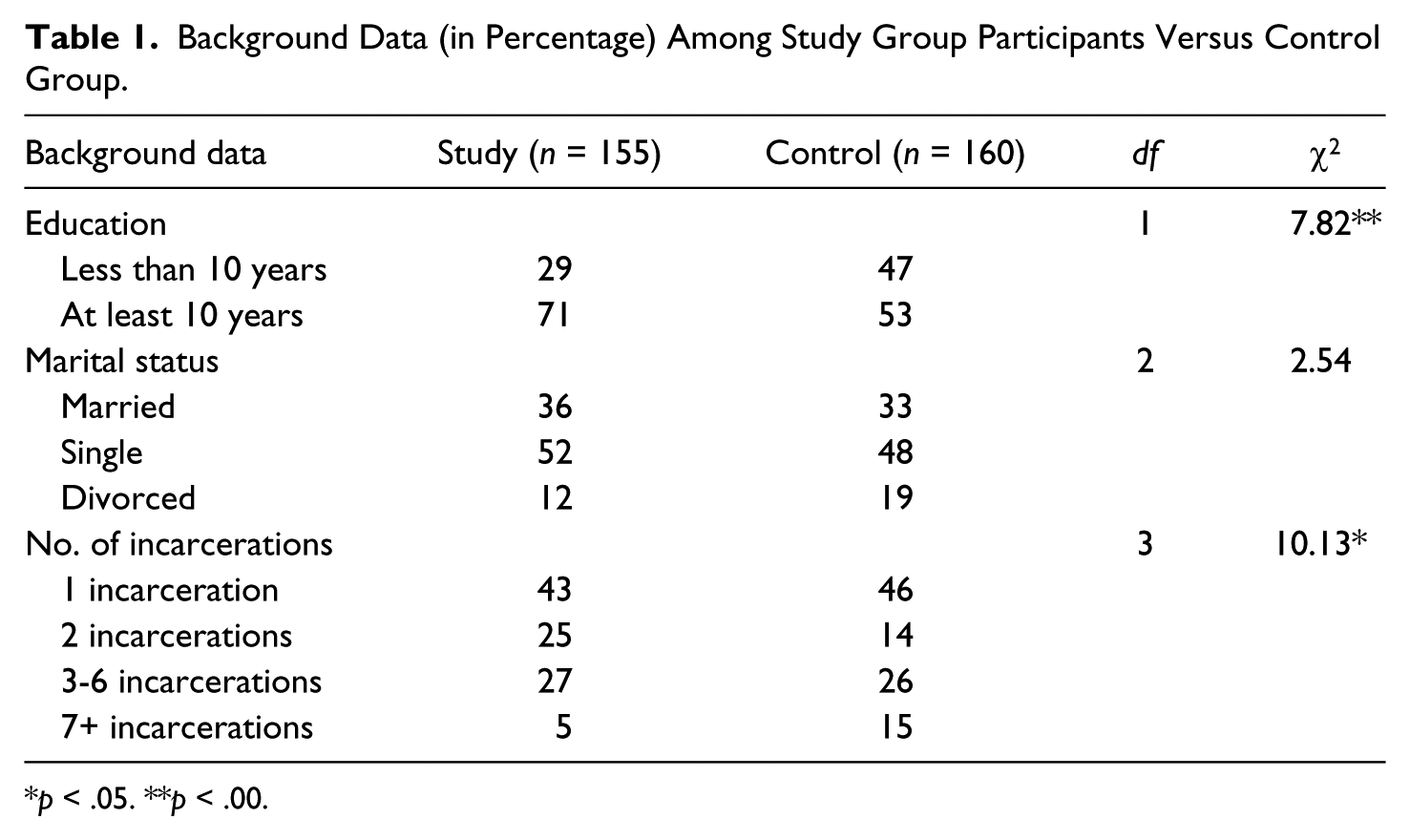
p < .05. **p < .00.
Of course, this method of selecting a control group is far from being ideal and it would have been preferable to have developed an experimental design (or at least a semi-experimental design) using Propensity Score Matching (for more on this method, see Weisburd et al., 2013). However, as we were not able to obtain additional information from the Israeli Prison Service regarding the control group, we decided to use a very large number of prisoners, who showed similar basic characteristics to the EM early-released prisoners. Both groups were deemed unsuitable for early release; the study group was eventually granted early release because they were selected to participate in the EM program, whereas members of the control group were declined early release and had to complete their full prison terms.
Table 1 shows a significant difference between the groups regarding criminal records and the duration of incarceration among the supervised released prisoners, as compared with the control group. As opposed to 15% of the study group with 7 past incarcerations or more, only 5% of the control group are serving their seventh incarceration or more, χ2(3) = 10.13, p = .017.
The comparison also shows a significant difference in the duration of last incarceration between the two groups. Duration of last incarceration was significantly longer in the study group (p < .01 Z = −8.9 Mann–Whitney U = 3,502.5). (As distribution of the last term of incarceration is positive-asymmetrical, we have chosen to describe it via median and interquartile range, and the difference between groups was therefore tested with Mann–Whitney test.)
An additional significant difference concerns the education variable. The percentage of released prisoners in the control group with more than 10 years of education (53%) is lower than that of the study group (71%).
No significant difference was found between the groups in the released prisoner’s age factor, t(287) = 1.22, p = .223, with the average age of released prisoners in the study group at 34.2 (SD = 10.1) and age averages at 32.7 (SD = 10.3) in the control group. In addition, no significant difference was found between groups with regard to the released prisoner’s marital status.
Whereas the median of duration of last incarceration of the control group is 7 months (interquartile range 15 months), the median of duration of last incarceration of the supervised released prisoners under EM (the study group) is at 24.9 months (interquartile range = 23.5 months).
As significant differences were found between the groups in some of the socio-legal attributes, these variables shall be monitored later on with the Cox’s Proportional Hazard model.
Findings
As mentioned before, this article aimed to examine the rate of recidivism among early-released prisoners in a follow-up period of up to 4 years following the conclusion of the EM supervision period. The recidivism rates of this group were compared with those of a control group of released prisoners who served their complete term of incarceration, as they were not found suitable for early release in years prior to the operation of the EM program.
The recidivism rates were measured by two indexes: re-arrest and re-incarceration. Each of these indexes is lacking in over-inclusion (includes individuals who should not be considered as recidivists) and in under-inclusion (does not include individuals who should be considered as recidivists; Ben Zvi & Wolk, 2011). Despite these limitations, the index of an additional arrest or incarceration (Lyman & LoBuglio, 2006) is the one most frequently used in studies examining recidivism among released prisoners. Using re-incarceration as an index for recidivism had also been recommended by the Criminal Justice Policy Council (Maxfield & Babbie, 2008).
Re-Incarceration
To examine the rate of re-incarceration during the follow-up period, that is, since the conclusion of the EM supervision for the study group or the full release from prison for the control group (during the first, second, third, and fourth year), a “Survival Function” was assessed, with re-incarceration marking the end of the process. Figure 1 shows that among the study group 95% of the released prisoners “survived” (i.e., did not re-offend) during the first year, 91% “survived” for 2 years, 88% for 3 years and 85% survived for 4 years.

Comparison of re-incarceration curves by groups (study/control).
Among the control group, antithetically, 78% of released prisoners “survived” the first year, 69% “survived” for 2 years, 66% for 3 years, and 58% survived for 4 years. In other words, while within the study group, 15% of released prisoners were re-incarcerated after 4 years, 42% of the control group had returned to prison. A significant difference was found in the Survival Function of the two groups (Wilcoxon [Gehan] Statistic = 26.44, df = 1, p < .001).
To control for the possible impact of variables such as age, education, marital status, number of incarcerations, or duration of last incarceration on re-incarceration, Cox’s Proportional Hazard model was used. This model examines the hazard ratio, when “larger than 1” means that the independent variable is a hazard factor (raises the chance of re-incarceration). Hazard ratio smaller than 1 means that the independent variable is a shielding factor, that is, it reduces the chance of re-incarceration. The model’s results are shown in Table 2.
Factors Related to Prisoner’s Survival From Re-Incarceration, Cox’s Multi-Variable Model.

Note. Assumption of constant hazard function exists—tested with log-minus log plot. HR = hazard ratio; CI = confidence interval.
p < .01. **p < .05.
Table 2 shows that age has a positive impact on survival. Each 1 year increase reduces the chance of re-incarceration by 3% 1/0.97 = 0.03.
Another finding shows that the number of past incarcerations is a risk factor for re-incarceration. The chance of re-incarceration for prisoners with 3 to 6 incarcerations is as much as 2.14 times higher than prisoners with one past incarceration. Prisoners who have served seven incarcerations or more are 3.63 times more inclined toward re-incarceration than those with one past incarceration. No significant difference was found between prisoners with one or two incarcerations.
Variables such as education, marital status, and duration of last incarceration did not show significant impact on chances of survival.
After controlling for all the factors that were available for this study (these variables are the entirety of variables obtained from the Israeli Prison Services, and it is possible that other relevant variables were not examined), it was found that prisoners from the study group have higher chances of survival (HR = 0.27) when compared with that of prisoners in the control group. In other words, study group prisoners have a smaller chance of re-incarceration, which is 1/0.27 = 3.7 times lower than that of the control group.
Re-Arrest
Re-arrest was also examined by survival analysis among the two study groups. A life-table analysis for the two groups, shows a significant difference in chances of survival with regard to re-arrest as well (Wilcoxon [Gehan] Statistic = 4.22, df = 1, p < .048).
Figure 2 shows that among the study group, by the end of the first year 84% of released prisoners survived, 73% survived (were not re-arrested) by the end of the second year from release, 66% survived by the end of the third year and 62% survived at the end of the fourth year.

Comparison of re-arrest curves by groups (study/control).
In the control group, however, at the end of the first year, only 76% survived (were not re-arrested). By the end of the second year, 64% survived; by the end of the third year, 57% survived; and at the end of the fourth year, 49% of the control group’s released prisoners survived.
However, as can be seen in Table 3, after applying Cox’s regression to control additional hazard factors, the significant difference disappears.
Factors Related to Prisoner’s Survival From Re-Arrest, Cox’s Multi-Variable Model.

Note. Assumption of constant hazard function exists—tested with Log-minus log plot. HR = Hazard Ratio; CI = confidence interval.
p < .01. **p < .05.
As shown in Table 3, hazard factors for re-arrest are similar to those of re-incarceration. An increase in the released prisoner’s age reduces the risk of arrest. The number of previous incarcerations is a hazard factor for arrest. Prisoners with 3 to 6 incarcerations are 2.43 times more at risk of re-arrest than prisoners with 1 past incarceration. Released prisoners with 7+ past incarcerations are 4.82 times more likely to be re-arrested than prisoners with 1 past incarceration. No significant differences were found between prisoners with one and two incarcerations. Variables such as education, marital status, and duration of last incarceration had no significant impact on chances of surviving arrest.
Nevertheless, once all the variables were controlled for, no significant difference was found in chances of survival from re-arrest between the early-released prisoners who participated in the EM program and the control group of prisoners who completed their full term of incarceration and did not participate in the EM program.
Discussion
Many goals are set to the use of EM programs, some of which are economic, some are penal, and some are rehabilitative (Renzema, 2010). While these programs have operated within the criminal justice system framework for over three decades, there is no consensus over the impact of these programs on recidivism rates, once concluded.
The EM program operating in Israel among early-released prisoners is defined as a pilot program, not yet codified via criminal legislation. This program is operated by the Prisoners’ Rehabilitation Authority, an agency responsible for the entirety of community-based supervision among released prisoners. The EM program in Israel is designed mostly for those prisoners characterized as having a “weak personality” or easily goaded, or prisoners, who committed serious offenses and who, in spite of participation in treatment during incarceration, would not have been released early without this program. All released prisoners in the program are required to work, and are put into group or one-on-one therapy program, according to the prisoner’s needs and various attributes (Shoham et al., 2010).
One of the major problems accompanying recidivism studies such as the present one is allocating an appropriate control group (Hucklesby, 2009). To provide a solution, albeit a limited one, to this issue, all prisoners who attended the Parole boards and were declined early release due to the assessment of the boards regarding high level of risk of the prisoners, in the period of 2 years prior to the operation of the EM program, were sampled.
Despite the fact that comparing the socio-legal data of released prisoners in both groups showed that the control group’s criminal record was significantly more severe than that of the study group, life-tables used in the study clearly show that during the 4 years following the conclusion of the EM program, the lower rates of re-incarceration were found among released prisoners participating in the EM program.
Whereas 42% of prisoners in the control group were re-incarcerated, among the study group, by the end of a 4-year follow-up period, only 15% were re-incarcerated. Ben Zvi and Wolk (2011) who have studied recidivism rates among the entirety of released prisoners in Israel in 2004 show that after a 4-year period, recidivism rates among early-released prisoners are at 30% (the rates of re-incarcerated prisoners after a 4-year period, among prisoners released after full term, was found very similar to those of the re-incarcerated prisoners in the control group in this study).
Two variables were found as associated with hazard of re-incarceration among prisoners participating in the EM program: age and number of previous incarcerations. Much like empirical literature in the subject (e.g., Crowe, 2002; O’Toole, 2004; Weisburd, Shoham, Barak, Menspfeiser, & Gideon, 2005), the present study had also shown that the EM program is more efficacious among older prisoners with a smaller number of past incarcerations. On weighing all hazard factors, it was found that released prisoners in the control group were at risk of re-incarceration 3 times higher than that of released prisoners participating in the EM program.
Empirical literature dealing with recidivism distinguishes between two factors which might influence the re-incarceration of released prisoners, static factors, and dynamic factors (Weiss, 2008). While static factors are constant and unchangeable, participating in programs like the EM program could change various criminogenic dynamic factors such as occupational integration, anti-social behavior, self-image, social beliefs, and so on. E. Shoham, Efodi, and Yehosha-Stern (2014), in their study on satisfaction among licensed-released prisoners in the EM program, note that most released prisoners interviewed in their study claimed that occupational integration helps them feel as if they had turned over a new leaf, that they feel like they belong again to mainstream society. The early-released prisoners taking part in the EM program also declared that they had a good relationship with their supervisors; they felt as if they had someone to turn to, and that their case was attended to.
The reduction in recidivism among the study group, as mentioned above, can be explained within the premise of the Social Control theory (Gottfredson & Hirschi, 1990; Hirschi, 1969; Pratt & Cullen, 2000). A rehabilitation-therapeutic-oriented EM program which reintegrates the released prisoner into society in a variety of connections, especially occupational, domestic, and therapeutic relationships, basically enforces a normative lifestyle on the criminal. Once a released prisoner achieves and deepens his social connections—the ones he lacks so—he would feel like a part of society, and would be less interested in losing these connections.
Another theoretical premise which might explain the relatively low rates of re-incarceration among the study group is the self-control theory (Muraven, 2010; Muraven et al., 2005) and the behavioral theory (Hendershot et al., 2011). Self-control is a series of skills required to obtain a desired behavior, where there is a conflict between two different behaviors. As a person becomes more accustomed to the desired behavior, he or she needs to invest less effort to perform it. Therefore, the aim is to make the desired behavior a habit so that its execution becomes automatic.
One of the main ways to obtain self-control is through environmental planning, which requires a reorganization of a person’s environment and the conditions that will allow that person to execute a desired behavior: the EM program allows environmental planning which supports a change in a prisoner’s way of life, and leads to a reduction in criminal involvement via occupational integration and the strengthening of social relations and bonds. Desistance is a dynamic and a gradual process, which includes several turning points which can make a person renounce a criminal career. One of the most significant turning points of learning self-control and acquiring pro-social behavior is occupational integration (Savolainen, 2009; Uggen, 2000). When a person experiences life events such as finding a job, his or her social capital can increase, through the creation of new social bonds. These life events can be considered turning points which direct a person away from crime (Sampson & Laub, 1993; Someda, 2009).
The Israeli EM program for licensed-released prisoner demonstrated how, along with supervisory components, there are also rehabilitative processes, which include therapeutic aspects alongside training and which are aimed at the acquisition of new, pro-social, and adaptive behavioral patterns. These processes are a significant part of the Israeli EM program, and many efforts have been invested to prevent recidivism.
There are no programs for therapy or supervision of those prisoners who have completed their full prison terms in Israel, and despite findings showing a higher success rate among prisoners released under EM, Parole Boards in Israel do not seem inclined to put their trust in these rehabilitation programs. Efodi (2013) found in her study that prisoners who had an EM rehabilitation program prepared for them were 5.4 times more likely to be rejected by the Parole Board—a rate higher than that for any other community-centered rehabilitation program. While the legal characteristics of those prisoners referred to the EM program are usually more severe than those referred to other programs, the findings of our study shows that they actually have a greater chance to achieve high success rates.
The main claim of this study is that the EM program allows those prisoners defined as inappropriate candidates for early release to still be granted early release to a monitoring and supervision program within their community. This monitoring program changes the balance between legal and illegal opportunities available to the released prisoner. While prisoners who were released early and entered a community-centered supervision program have social assets such as a steady place of work, familial bonds, and personal escort; prisoners released after completing their full prison terms usually only have the negative labels and stigmas that accompany released prisoners, which make it very hard for them to be integrated into normative society.
It should duly be noted, on discussion of comparison of the control and study groups, that no data could be obtained with regard to released prisoners’ integration in society or workplace once supervision period had been concluded or once fully released from prison. The findings in this study are based on data received from the Israeli Prison Service, and because Prisoners’ Rehabilitation Authority’s data are not yet computerized, it is impossible at the moment to refer to additional variables other than those describing re-arrest or re-incarceration after the conclusion of supervision period or full release from prison.
Another restraint to the study’s result is due to the fact that it is impossible to clearly state whether significant differences in rates of recidivism between groups is due to the supervision component of the program, or whether it is due to the treatment component and the good relationship between the released prisoners and their program supervisor. Nevertheless, one might hypothesize that the entirety of program components—including intensive psycho-social therapy, EM and continuous, normative occupation, all aid in reducing recidivism and allowing better survival of the study group.
Conclusion
The recidivism study’s findings are a part of a comprehensive assessment study investigating the results of the EM program among early-released prisoners by judicial conditions in Israel. The Israeli EM program is designed for a population of prisoners with a medium level of dangerousness who, without EM supervision, would not have been found suitable for early release.
The program’s approach is derived from the understanding that supervision alone is not enough to promote a change in lifestyle. To achieve a reduction in recidivism, not just during the supervision period, but also after its completion, there is an additional need for rehabilitation processes, which include treatment and the acquisition of new life-skills to alter old lifestyles and maladaptive preconceptions such as criminality.
It seems that among these prisoners, specifically for prisoners with dependent, weak, and easily goaded personality traits, or those who had committed grave felonies and participated in treatment programs while incarcerated, the EM program allows for balancing the will to integrate released prisoners in as wide circles of society as possible, and the need to protect the public from re-criminality.
The study’s findings support the premise that the unique characteristics of the EM program in Israel, based on an authoritative therapy discipline alongside continuous occupational integration and group- and personal-therapy sessions, contribute to the enhancement of pro-social behavior, not only during the supervision period itself (for low levels of criminal behavior during supervision, see Shoham, Yehosha-Stern, Efodi, & Diamant, 2010), but in ensuing years as well.
Much like recidivism studies among prisoners participating in EM program (Renzema, 2010; Renzema & Mayo-Wilson, 2005) conducted in other places in the world, the Achilles Heel of the study is in locating the right control group. As it is impossible to randomly divide participants in EM programs to a study group and a control group, the entirety of prisoners who served their full incarceration terms due to the fact that they were found unsuitable for an early release for various reasons, served as the control group for this study. Although this group has been identified as the most suitable pool from which to assemble released prisoners for a control group, it is still far from ideal. That said, it is interesting to note that comparison between the two groups shows that the EM program’s released prisoners show a harder criminal profile in comparison with that of the average criminal profile of the control group.
In addition to the theoretical aspects of the study, stressing the importance of social connections and normative lifestyle which significantly promote a reduction in recidivism, the applicable contribution is exceedingly important. In Israel, as mentioned, legislation regulating EM use as a penal alternative in criminal procedure is yet to be passed. The findings of this study reinforced those supporting the authorization of the bill regulating the use of EM among early-released prisoners. The positive findings of the present study reinforce the need to legally apply the use of EM as an appropriate alternative for prisoners otherwise unsuitable for early release into traditional community-based supervision programs.
Footnotes
Declaration of Conflicting Interests
The author(s) declared no potential conflicts of interest with respect to the research, authorship, and/or publication of this article.
Funding
The author(s) received no financial support for the research, authorship, and/or publication of this article.