



Abstract
This article examines the life-history narratives of 25 successful ex-offenders professing Christianity as the source of their desistance. Unstructured in-depth life-history interviews from adult male desisters affirm use of a “feared self” and “cognitive shifts” regarding perceptions of illegal behavior. “Condemnation scripts” and “redemption narratives,” however, differ radically from those uncovered in previous research. Stories of behavior change and identity transformation achieved through private religious practice and energetic church membership dominate the narratives. Findings suggest there are diverse phenomenologies of desistance and that by more narrowly tailoring research to explore subjectivities in the desistance process, important discrepancies in perceptions of agency and structure are revealed. Three prominent desistance paradigms—Making Good, Cognitive Transformation, and Identity Theory—are used to examine the narratives.
A large number of respondents within the sample make at least some reference to God . . . Some narratives were almost completely dominated by such references. Consistent with our perspective, these experiences linked to cognitive as well as associated behavioral changes.
Introduction
While many ex-offenders find it impossible to overcome society’s dogged and often totalizing definition of them as irredeemable, successful desisters frequently espouse spirituality and religion as a source of positive behavior change and re-conceptualized self-identity (Adorjan & Chui, 2012; Giordano et al., 2002; Giordano, Longmore, Schroeder, & Seffrin, 2008; Maruna, 2001; Paternoster & Bushway, 2009; Schroeder & Frana, 2009). Religious spirituality has been found to be a highly salient resource for many successful desisters, especially under conditions of low emotional support and weak informal social control (Giordano et al., 2002; Kerley, Copes, Tewksbury, & Dabney, 2011). Phenomenological analyses of the desistance process reveal that religion and spirituality frequently help offenders construct stories of change that become vital to an altered sense of self (Giordano et al., 2002, p. 1018; Maruna, 2001; Paternoster & Bushway, 2009). More importantly, religiosity seems to help desisters undertake preliminary agentic moves that, while often not outwardly visible to family members or justice officials, are the beginnings of an evolving self-narrative that is both pro-social and provides a redemptive path (Giordano et al., 2002; Maruna & Remsden, 2004; Schroeder & Frana, 2009; Jang & Johnson, 2005). 1
Specifically, life-history narratives highlight agentic moves that draw on stories of change emphasizing the ways religious practice and spirituality provide emotional, cognitive and linguistic resources utilized by desisters in their daily lives (Adorjan & Chui, 2012; Giordano et al., 2002; Schroeder & Frana, 2009; Terry, 2003; Shover, 1996; for the centrality of narratives, see also Denzin, 1987). As Giordano et al. (2002) summarize the issue:
Thus, in addition to its relative accessibility, religion seems to have potential as a mechanism for desistance because many core concerns within religious communities and the Bible relate directly to offenders’ problem areas. Even more importantly, religious teachings can provide a clear blueprint for how to proceed as a changed individual. (Giordano et al., 2008, p. 116; see also Goodwin, 2001).
For purposes of this study, Giordano et al.’s (2008) conceptualization of religiosity as inclusive of both corporate religious participation and private spirituality as two dimensions of religiosity is used. While some view spirituality and religion as entirely separate concepts (e.g., Fetzer Institute National Institute on Aging Working Group, 2003), criminologists exploring addiction and criminal desistance have not treated them as mutually exclusive (Adorjan & Chui, 2012; Farrall & Bowling, 1999; Giordano et al., 2002; Giordano et al., 2008; King, 2012; Maruna & Remsden, 2004; Maruna, Wilson, & Curran, 2006; Ronel, Frid, & Timor, 2013; Schroeder & Frana, 2009). 2
This article explores the desistance narratives of 25 adult male ex-offenders who attribute their success to Christianity, using lenses of three prominent theories of desistance for analysis: “Making Good,” “Cognitive Transformation,” and “Identity Theory” (Giordano et al., 2002; Maruna, 2001; Paternoster & Bushway, 2009). The research utilizes a Symbolic Interactionist theoretical framework to explore specific linguistic and cognitive elements of Christianity that desisters biographically associate with their own desistance (see Giordano et al., 2002; Giordano et al., 2008). All 25 respondents reported being both active churchgoers and deeply spiritual, stressing the importance of both church communities as well as private devotional practice in effectuating their desistance.
Agency Versus Structure in Criminal Desistance Research: “Making Good,” “Cognitive Transformation,” and “Identity Theory”
While much of criminal desistance research is focused on life-course perspectives and Control Theory, recent scholarship stresses a more interactionist approach (Giordano et al., 2002; King, 2012; Sampson & Laub, 1993, 2003; Schroeder & Frana, 2009). From a strict control perspective, life events such as securing a job or getting married are understood as turning points that inhibit deviance “by providing a stake in conformity as well as the informal social controls needed to promote and maintain a state of non-offending” (Bakken, Gunter, & Visher, 2013, p. 2). Johnson and Jang (2011) offer a detailed summary of the predicted control effects of religiosity on crime, arguing that fear of supernatural sanctions (“hellfire”) and strong social bonds promote conventional behavior (see also Akers, 2010; Cochran & Akers, 1989; Hirschi & Stark, 1969).
Control Theory interpretations of criminal desistance, however, tend to depict “passive desisters” who are “changed by events” yet not consciously participating in their own desistance as a result of any particular change of heart. As Knepper (2003) points out about religion and Control Theory, “From this perspective, faith is merely a proxy for one or another social process” (pp. 339, 340). Thus, as Paternoster and Bushway (2009) characterize desisters from the perspective of Control Theory: “They react and respond but do not act or create,” resulting in a kind of “accidental desistance” (p. 1148).
Subsequent phenomenological accounts of the desistance process, however, reveal levels of human agency not accounted for by Control Theory (Giordano et al., 2002; Giordano et al., 2008; King, 2012; Schroeder & Frana, 2009). Recent scholarship exploring the meaning of desistance for actual desisters emphasizes a more complex interaction between agency and structure that is only now being fully investigated. “The findings of such studies imply that desistance cannot be attributed solely to the existence of social attachments acting as external forces which determine the individual’s behavior. Rather, what matters is what these ties mean to offenders” (Weaver & McNeill, 2007, p. 5, emphasis added). As Giordano and colleagues (2002) also note, while high levels of religiosity are certainly compatible with Control Theory, religiosity also accounts for important “up front agentic moves” taken by offenders “who manage to change their life direction even in the absence of traditional frameworks of support and resources like those provided by a spouse or a good job” (p. 992).
In sum, while Control Theory tends to view the propensity for offending as fixed, with external forces of social control limiting behavior, interviews with actual desisters reveal such controls only partially capture the meaning of desistance for them. Indeed, given that marriage proposals and job applications presumably involve some agency on the part of “applicants,” strict control-based interpretations of desistance have proven un-compelling to many scholars, likely revealing marriage and employment “to be correlated with, although not necessarily causal of, desistance” (Weaver & McNeill, 2007, p. 4). 3
Identity Theory
In contrast to Control Theory, Paternoster and Bushway (2009) offer a deeply elaborated “Identity Theory” of desistance, locating responsibility for behavior change in the volitional choice making power of offenders themselves. Identity Theory has much in common with Giordano et al.’s emphasis on “cognitive shifts” while also highlighting the importance of personal agency in “structural” events such as marriage and employment. They write:
Our theory of desistance casts the decision to quit crime as just that—a decision by an offender that she has “had enough” of crime and being a criminal and desires a change in what she does and who she is. (pp. 1108-1109)
Thus, for Identity Theory, desistance is a highly volitional process of weighing out the costs of maintaining a transgressive working identity against being “the kind of person one wishes to be—and more importantly, not be—in the future” (p. 1105). The decision to stop offending comes after a “crystallization of discontent,” in which “previously isolated dissatisfactions” become linked in the conscious mind of the offender, resulting in “a distinct change in how offenders think about ‘who they are’” (p. 99). Paternoster and Bushway use the notion of a “feared-self”—an image of what the person does not want to become—as a motivator for “intentional self-change” (pp. 1106-1107). Desistance comes about only after the costs of a transgressive working self are linked together, with the threat of a negative feared self engulfing one’s identity: “Because of the crystallization of discontent and the accumulation of dissatisfactions, this change in identity is motivated at first by ‘avoidant motives’ of not becoming the feared self” (Paternoster & Bushway, 2009, p. 99).
In sum, for Paternoster and Bushway, desistance comes about due to the active cognitive agency of desisters thinking about their futures, weighing out costs and benefits of deviance against a future self, and ultimately making a clean break with the past. Three markers of identity change highlighted by Paternoster and Bushway are (a) crystallization of discontent, (b) changes in institutional/social relationships, and (c) a “break from the past” as key markers in redefining self (see also Young, 2011).
Making Good
In his book Making Good: How Ex-Convicts Reform and Rebuild Their Lives, Maruna (2001) presents extensive life-history interviews exploring the phenomenology of desistance from more than one hundred ex-offenders, many but not all of whom identified religious conversion as a source of their desistance. Maruna summarizes his model of desistance in Making Good as follows:
Although each story is of course unique, the self-narratives of the desisting sample feature a number of key plot devices with striking regularity . . . The redemption script begins by establishing the goodness and conventionality of the narrator—a victim of society who gets involved with crime and drugs to achieve some sort of power over otherwise bleak circumstances. This deviance eventually becomes its own trap, however, as the narrator becomes ensnared in the vicious cycle of crime and imprisonment. Yet with the help of some outside force, someone who “believed in” the ex-offender, the narrator is able to accomplish what he or she was “always meant to do.” Newly empowered, he or she now also seeks to “give something back” to society as a display of gratitude. This process might be characterized as “making good.” (p. 87)
Thus, for Maruna, the cognitive transformation essential for desistance is not a change in identity from “bad” to “good,” but reassertion of a fundamentally positive identity that existed all along—yet that, in the minds of successful desisters, was corrupted by external forces inducing them to offend. “Making good, in this framework, is not a matter of being resocialized or cured,” writes Maruna, “but a process of freeing one’s ‘real me’ from these external constraints . . . This process of self-discovery results from empowerment by ‘some outside source’” (Maruna, 2001, p. 95). Importantly, for Maruna’s successful desisters, construction of a “redemption script” becomes key to the cessation of offending, even as this script may involve “willful, cognitive distortion” of the culpability of the ex-offender for their previous criminality. “I describe this process of willful, cognitive distortion as ‘making good’” (Maruna, 2001, p. 9).
No Agency in “Making Good?”
While Maruna does an excellent job of telling readers what to expect from desisting offenders, he offers very little by way of how, why and under what conditions one should expect such desistance. 4 In suggesting that “each story is of course unique,” Maruna’s account fails to offer much in the way of phenomenological detail about the desistance process itself—lumping religion, new romantic partners, and drug treatment together into one somewhat tautological “generative” category “X.” As Maruna (2001) states, “Several desisting interviewees used some variation of the following theme: ‘If it weren’t for X (organization, new philosophy or religion, some special individual, God, etc.), I would still be involved with crime’—as their explanation of desisting” (p. 96). 5 Maruna addresses this lack of specificity regarding the how of desistance—as opposed to the what of it—as a by-product of the state-of-the-art of applied corrections, noting, “Leslie Wilkins once described the field of corrections as ‘applied mythology.’ By this, he meant that very little of what is done in the name of offender treatment is based on grounded evidence about how people change” (p. 111).
In Maruna’s paradigm, then, making good involves a particular story, a redemption script, that features regular characteristics of the narrator being a victim of society caught in a cycle of crime and punishment, yet saved by redemptive forces not of his own making and that facilitate cognitive distortion of his own deviance. Persistent offenders, on the other hand, maintain “condemnation scripts” asserting their experience as victims of society trapped in deviant lifestyles while lacking the personal wherewithal to overcome their circumstances (pp. 74-75, 76). 6
Cognitive Transformations and “Hooks for Change”
More recent phenomenological explorations of criminal desistance are pushing the field forward, however, offering more finely tuned and detailed accounts of the desistance process (see Calverly, 2013; King, 2012; Weaver, 2012). These accounts affirm a role for both agency and structure, while highlighting complex nuances in perceptions among and between desisters of different racial and gender backgrounds (Calverly, 2013; Giordano et al., 2002). Marked differences in the “inner logic and inner experience” of desisters show important variations in the subjectivity of desistance, highlighting the need for more narrowly focused scholarship (Denzin, 1987, p. xi). Maruna’s account ignores subjective interpretations of agency and structure by using the mere fact of desistance as evidence of making good.
Unfortunately, this glosses over distinctions in the subjectivities of desistance that may be important for successful treatment, similar to differences uncovered between races in phenomenological research exploring recovery from alcoholism (see Denzin, 1987). As Giordano et al. (2002) put the challenge, “A key point here is that the identity transformation potential presented by the various hooks for change needs to be distinguished conceptually from its qualities of control” (p. 1002). In other words, what one ex-offender may view as a structural barrier another may experience as a sociological asset (see also Calverly, 2013). Giordano et al. turn to Symbolic Interactionism as an appropriate theoretical base for conducting more detailed research, using in-depth life-history interviews as a means of accessing subjective accounts of desistance and spirituality (Giordano et al., 2002; Giordano et al., 2008).
Drawing on the work of George Herbert Mead, Giordano et al. detail a nuanced process of “cognitive transformation” among desisters, varied by gender and race, that is also more “agentic” and self-directed than implied by Control Theory accounts of the desistance process (Giordano et al., 2002; Giordano et al., 2008). 7 While subjective pathways to desistance vary greatly according to Giordano and her team (2002), “our fundamental premise is that the various cognitive transformations not only relate to one another, but also inspire and direct behavior” (p. 1002). Four cognitive shifts identified by Giordano et al.’s model of cognitive transformation are (a) openness to change, (b) exposure to hooks, (c) envisioning of a “replacement self,” and (d) acquiring negative views of former deviance (pp. 1000-1002). As Giordano and colleagues point out, variations in the subjectivities of cognitive transformation also characterize the research. 8
Method
Qualitative methods are frequently used for the purpose of inductively advancing knowledge about poorly understood social phenomena or hidden populations (Guba & Lincoln, 1994; Maruna, 2001; Maruna, 2000). Maruna (2001) notes that “[p]henomenological criminology is an attempt to understand criminal decision making through an examination of the offender’s self-project—the self-image they are hoping to uphold and their strategies for creating meaning in their lives” (p. 33). This article examines life-history narratives of 25 adult male ex-offenders who self-attribute Christianity as the source of their criminal desistance. 9 Life-history interviews are frequent sources of qualitative data for criminologists exploring subjective accounts of criminal desistance (see Denzin, 1987; Irwin, 2009, 1970; Terry, 2003). Using phenomenological methods, the purpose of this project is to explore the self-projects and meanings of desistance for religiously motivated desisters and to contrast these accounts with three prominent theories of desistance.
Participants were recruited through a snowball sampling process facilitated by a network of church volunteers active in prison visitation and offender reentry programming in a large Florida city. Average length of desistance for respondents was 8.7 years, while average age was 47. Seven respondents were African American and 18 were White/Caucasian. Six of the men were convicted of murder (4) or attempted murder (2); 3 were convicted of non-violent sex crimes and the remainder for property and drug crimes resulting from what respondents described as problems with addiction. Sixteen were non-denominational Protestants, 4 were Catholic, and 5 Southern Baptist. Desistance is defined as no arrests or incarcerations (in either jail or prison) for a minimum of at least 2 years prior to the date of the interview. Participation was totally voluntary and no financial incentives were provided. 10
In open-ended fashion, respondents were invited to share in-depth life histories recounting the story of their criminal desistance as it relates to their religious faith. To acquire authentic recountings of the self-projects of respondents uninfluenced by reactivity to promptings regarding theories of desistance, absolutely no attempt was made during interviews to structure responses by citing elements from the three theories. Interviews generally lasted about 1 hr and were conducted in a discrete private dining area of a local chain restaurant during non-peak hours. Interviews were recorded and transcribed. While space constraints limit ability to fully explore the narratives here, excerpts below contain elements of statements from 10 of the 25 respondents. As in all phenomenological research, a limitation of this study is that narrative reflections of respondents depict subjective assessments that are not generalizable. Nevertheless, in-depth inquiries exploring subjective perceptions of agency and structure among successful ex-offenders continue to reveal markedly contrasting depictions of the meaning of desistance. As such, this article argues that more phenomenological research is necessary for the development of a broader set of theoretical perspectives (see also Calverly, 2013; Ronel et al., 2013; Weaver, 2012; Weaver & McNeill, 2007).
Findings/Coding Summary—Three Perspectives on Desistance
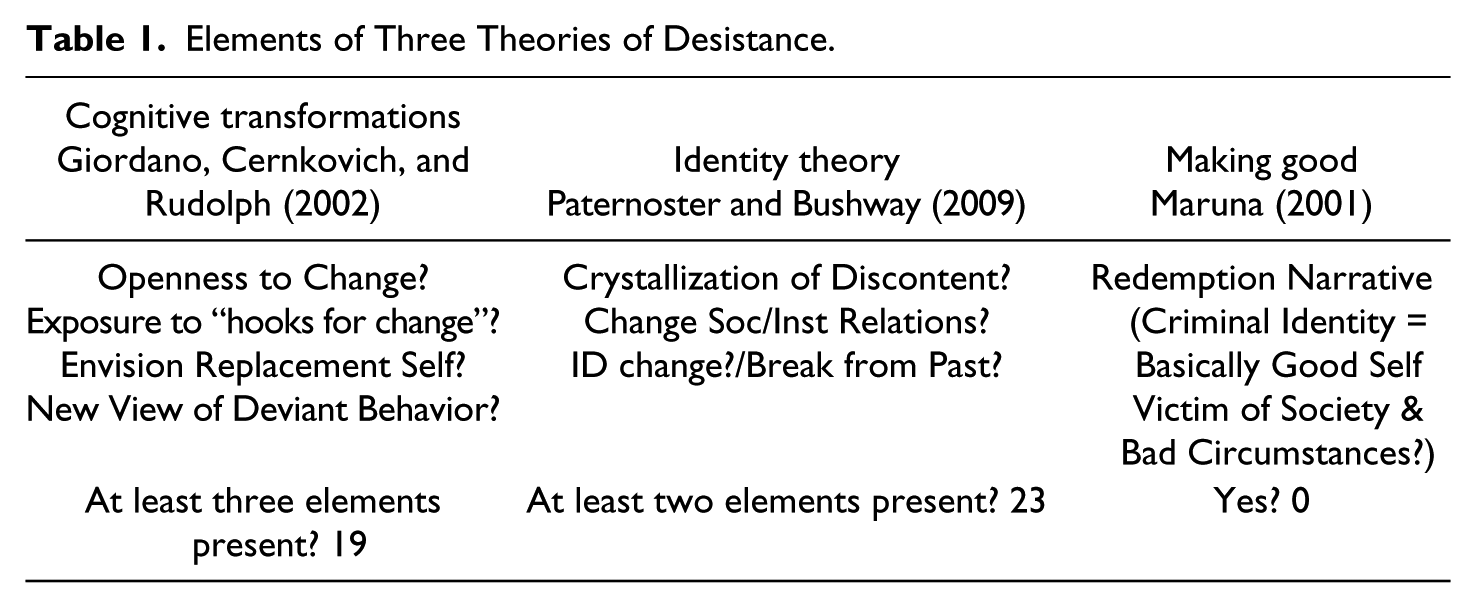
Using the rubric in Table 1 above, each narrative was reviewed and coded according to its “basic fit” with each perspective on desistance. To be included in the final analysis as representative of a particular model, narratives had to contain evidence of a majority of the model’s elements as determined separately by two reviewers. For a particular narrative to be considered indicative of “cognitive transformation,” three of the four elements of Cognitive Transformation theory had to be present. For a narrative to be considered indicative of “Identity Theory,” at least two of three elements of the theory had to be present. Finally, with regard to “Making Good,” in cases where narratives indicated the respondent using “willful cognitive distortion” to define themselves as basically good yet saved by “outside forces” requiring no personal agency, the theory of “Making Good” was affirmed (see Maruna, 2001, p. 87).
Elements of Three Theories of Desistance.
Cognitive Transformation Theory
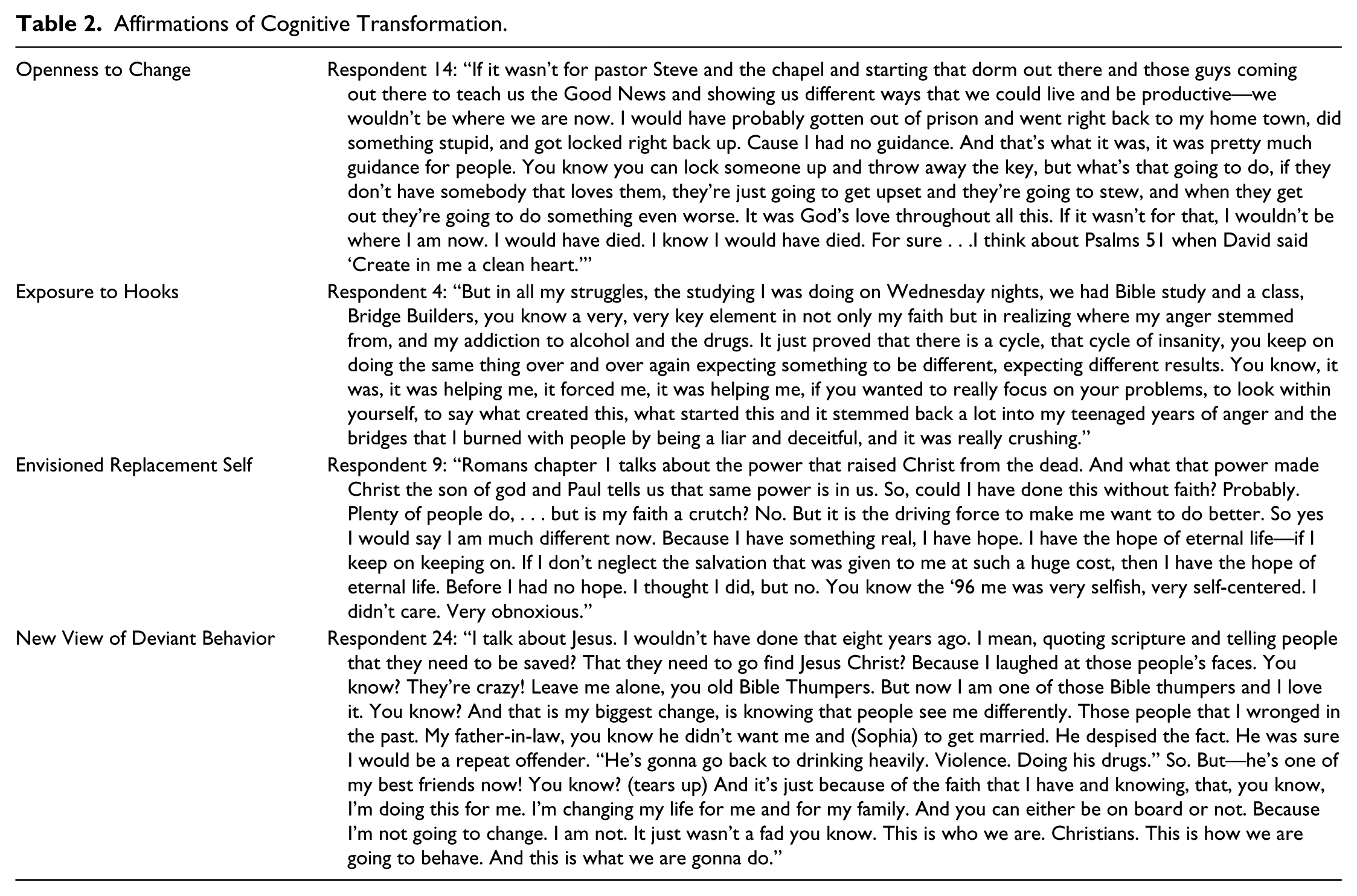
Respondent narratives demonstrated high fidelity to Giordano et al.’s model of Cognitive Transformation. A strong majority of narratives collected for this research (19 or ~75%) contained at least three elements of “cognitive transformation” as defined by the elements above—articulating openness to change, exposure to hooks, elaborate replacement selves, and revised views of deviant behavior. Nearly all respondents for this research (23 or 92%) had been “exposed to hooks” of religion in prison, through Bible study programs and prison evangelism while regularly participating in ongoing religious education and private devotional study. As converts to Christianity, respondents offered clear articulations of a “replacement self” distinct from their past criminal selves and defining themselves as “born again” or “new men in Christ.” Fourteen of the 25 narratives (56%) were rated as having all four elements of Cognitive Transformation present. All 25 narratives were rated as containing at least some elements of both “Cognitive Transformation” and “Identity Theory.” Consistent references to a sense of personal “brokenness” as the impetus for change and negative views of past selves also characterized the narratives (see Table 2).
Affirmations of Cognitive Transformation.
Identity Theory
While Paternoster and Bushway suggest fear of negative labels prompts successful desisters to make “avoidant” moves toward conventional behavior, our respondents expressed “feared self” identities had become fully realized aspects of their lives, with great repetition. Respondents described crushing moments of brokenness, marked breaks with the past, and new identities in being “born again” or finding a “new self in Jesus.” Through emotional support provided by church volunteers and daily religious practice, however, acceptance of the feared self was described as the catalyst for change. That is, rather than pursuing “avoidant motives” or attempts to deny or prevent full realization of the “feared self,” these religiously motivated desisters came to embrace their “feared selves” as a touchstone for behavior change.
Respondents also reported making sharp breaks with past associates after religious conversion, while choosing to seek out and maintain close ties to church members in order to “hold themselves accountable.” Finally, while “brokenness” was often described as a volitional turning point in the journey toward desistance, these religiously motivated desisters also stressed that their new identities were dependent upon the support of church communities and daily private spirituality for growth and development. In contrast to Paternoster and Bushway’s account, however, these respondents came to embrace their “feared selves” rather than avoid them, both as a turning point and as a useful resource in narrative recountings of their “new selves” (see Table 3).
Affirmations of Identity Theory.

“Making Good”/Redemption Narratives
Finally, religiously motivated desisters offered redemption narratives that contrasted markedly with those uncovered by Maruna (2001). While all respondents achieved “making good” in the sense of non-offending for an extended period, they were reticent about describing themselves as such, even persisting in their self-descriptions as “sinners” long after criminal desistance had been achieved. In contrast to the redemption scripts offered by Maruna’s Liverpool Desistance Study respondents, these men saw their best hope for redemption through full acknowledgment of their sinful natures and repentance through spiritual practice and devotion to their “church families.” They remained circumspect regarding any certainty they would never return to prison, noting this as a possibility best defended against by staying “close to God,” through prayer and strong ties to spiritual advisors and church.
In contrast to Maruna’s desisters, then, rather than asserting their long-standing basic goodness and victimization by society, these successful desisters referenced characterizations of “stinking thinking” as evidence of cognitive shifts while staying reticent about their chances for permanent desistance. Not a single respondent in these interviews characterized themselves as a victim of society—which many arguably were—but instead articulated both their criminal histories and their desistance itself as products of their own volition. The importance of both social support and personal responsibility were nevertheless stressed as essential for sustaining agentic moves away from offending, with no sharp distinctions between community versus private spiritual resources being offered. As opposed to desistance being achieved through either personal willpower or social capital, both positive choice making and social capital acquired through useful friendships were attributed to “God working” in respondents’ lives 11 (see Table 4).
Making Good?

“I Need Community to Succeed”: Agentic Social Control and Redemptive Choice Making
As noted, narratives highlighted agentic moves away from offending that respondents asserted were important to desistance, referencing both private religiosity and church membership as resources for behavior change. Put another way, these desisters made no sharp distinctions between the social capital benefits of their faith lives and its spiritual benefits, often conflating the two, but placing great value on both. Scripture was frequently referenced as a vital cognitive and linguistic resource for successful desisters; however, immersion in scripture was described as facilitated by a larger social network of prison volunteers and church members. Respondents described jealously guarding their “church time” and actively cultivating “accountability” through social bonds acquired through church. In sum, in marked contrast to strict Control Theory accounts of criminal desistance, these religiously motivated desisters repeatedly affirmed the importance of both personal agency and social support in the desistance process (see Table 5).
Agency and Community in Criminal Desistance Narratives.

Conclusion: The Bad Self and Multiple Pathways of Desistance
Criminologists use life-history interviews to gain perspectives on social problems unavailable through prepared surveys or statistical analysis (Gilligan & Lee, 2004; Presser, 2010). This project examined desistance narratives of 25 adult male ex-offenders who attribute conversion to Christianity as the source of their behavior change. Respondents were encouraged to describe their “self-projects” in their own words, with narratives subsequently examined in reference to three prominent theories of desistance: Making Good, Identity Theory, and Cognitive Transformation. Findings largely affirm these three theories, but also add to them in important ways.
First, while respondents offered characterizations of having “made good” in their lives, accounts differed markedly from those captured by Maruna. While Maruna’s desisters used willful cognitive distortion that emphasized offenders’ basic goodness amid no real change of heart that might explain their desistance, this study uncovered desisters’ use of highly negative characterizations of self as catalysts for change. Narratives emphasized the importance of painful self-confrontations and outwardly making sharp demarcations between “old selves” and “new selves” as key to desistance. 12 Narratives also contrast greatly with Control Theory accounts that de-emphasize the importance of personal agency in the desistance process (Maruna, 2001; Sampson & Laub, 1993). For these religiously motivated desisters, the importance of both personal responsibility and social support was articulated as essential for sustaining agentic moves away from criminal behavior. Respondents stressed the necessity of both “doing their part” and “feeding themselves” spiritually, while also stressing the importance of strong social bonds and church membership.
Second, while Paternoster and Bushway’s (2009) Identity Theory argues an explicit decision to break with the past is prelude to criminal desistance, such decision making comes about only after the perceived costs of continued deviance prompt “avoidant motives” that prevent successful desisters from “becoming their feared self” (p. 1126). Respondents in this research, however, described painful confrontations with their feared selves as pivotal to both identity change and desistance. Full embrace and recognition of the “feared self,” in fact, comprised much of the spiritual work and social networking described as useful for achieving desistance. Religiously motivated desisters, in fact, highlighted the importance of their “feared self” as a resource for identity change, holding it in sharp contrast to their “new self in Jesus.” Identity change in this context was described, not as a Herculean struggle against temptations of the past, but instead as a resource for building on and embellishing their new Christian identity and behavior change.
Finally, while respondents demonstrated high fidelity to Giordano et al.’s rubric for “cognitive transformation”—repeatedly articulating openness to change, exposure to hooks, replacement selves, and revised views of deviant behavior—desistance here was not simply described as the result of respondents individualistically strapping on their “spiritual bootstraps” in isolation from social support acquired through prison volunteers and church membership. While Giordano et al. (2002) seek to “emphasize the actor’s own role in creatively and selectively appropriating elements of the environment” for successful desistance, these respondents stressed the importance of social support for both cognitive transformation and religiosity (p. 1016). These narratives militate against any suggestion that abandoning ex-offenders to their “spiritual bootstraps” would achieve very much in the way of desistance, without also emphasizing the meaningful social support that generally accompanies mature faith practice.
As these narratives reveal, pathways to desistance involve highly subjective assessments of agency and structure amid radically differing explanations for success. Emerging research highlights subjectivities in the desistance process and foregrounds the importance of phenomenological research in criminology. Helping ex-offenders develop narrative re-definitions of self that honor their subjective experiences should be a central goal for criminal justice practitioners. Calverly (2013), for example, recently published an ethnographic study of desistance among minority ethnic offenders in London, revealing that Indian verses Bangladeshi desisters had much more collective involvement in their desistance as compared with Black and dual heritage offenders’ desistance, which he describes as “a much more individualistic endeavor” (p. 184). 13 Desistance research is arguably still in its infancy, and as such, phenomenological inquiry should continue apace with renewed energy and focus.
Footnotes
Acknowledgements
Thanks first to Peggy Giordano. Thanks also to Byron Johnson, Sung Joon Jang, Hal Pepinsky, John Johnson, Shadd Maruna, Alision Liebling and Pastor Daryl Townsend.
Declaration of Conflicting Interests
The author(s) declared no potential conflicts of interest with respect to the research, authorship, and/or publication of this article.
Funding
The author(s) received no financial support for the research, authorship, and/or publication of this article.