



Abstract
Two groups of male inmates (n = 31, n = 31) participated in the Positive Re-Entry in Corrections Program (PRCP). This positive psychology intervention focused on teaching offenders skills that facilitate re-entry into the community. Offenders participated in weekly lectures, discussions, and homework assignments focused on positive psychology principles. The two groups differed in duration of treatment (8 weeks and 12 weeks). Participants completed pre- and post-intervention measures of gratitude, hope, and life satisfaction. Using a 2 × 2 mixed design ANOVA, we hypothesized that the intervention (with two between-subjects levels of 8 and 12 weeks) and duration (with two repeated measures levels of pre and post) of treatment would moderate pre- to post-intervention change. Results indicated significant differences on pre- and post-intervention scores for both groups of offenders on all measures. The analysis did not yield statistically significant differences between groups, demonstrating no additive benefits from the inclusion of four additional sessions, thus saving time and money for correctional programming and funding. This research supports the use of positive psychology in prison interventions.
Introduction
As of 2008, it is estimated that 1.6 million men and women, or 1 out of every 100 adults, is incarcerated in prison or jail (Sabol, West, & Cooper, 2008; Warren, Gelb, Horowitz, & Riordan, 2008), and roughly 95% of those incarcerated are released from jail and re-enter their local communities (Bahr, Harris, Fisher, & Armstrong, 2010). Negative outcomes have been linked to these increased incarceration rates including reduced funding for other agencies, familial discord, public safety, and economic and emotional strains. Upon offenders’ release from incarceration, many experience difficulty reintegrating into their local communities and have trouble finding stable housing, employment, and social support (Shinkfield & Graffam, 2009). Incarceration is the optimal time to provide offenders with the skills and tools necessary to re-enter society; however, previous interventions targeting the reduction of specific problem behaviors have found reduced or limited positive effects (Wright, 1993). Positive psychology interventions offer unique—yet unexplored—possibilities for effective change for offenders during incarceration. Consequently, the purpose of this study is to evaluate a positive psychology intervention utilized with incarcerated offenders.
In-depth meta-analyses have been performed to examine different programs offered to offenders during incarceration. Overall, behavioral treatments have been found to be more effective than non-behaviorally based treatments (Andrews, 1994). Aos, Miller, and Drake (2006) identified the most common prison interventions and reported such programs reduced recidivism by 6% to 15%. French and Gendreau (2006) conducted a meta-analysis examining 104 effect sizes of 68 evidence-based practice evaluations and found the overall mean effect size across programs was small (r = .14; confidence interval [CI] = [0.09, 0.18]). The effect sizes among studies vary, and although the effect sizes are small, when taking into account the impact of these significant benefits to offenders, local communities, and taxpayers, the small outcomes are advantageous in the long term (Aos et al., 2006; Phipps, Korinek, Aos, & Lieb, 1999).
The majority of existing programs focus on treating specific problematic internal and external behaviors, such as substance use or aggression. However, the skill building taught to reduce drug use may not have the same practical application in the prison setting as in the community, because inmates may not have opportunities to practice their newly learned skills in the presence of triggers. A review of offender interventions by Gendreau, French, and Gionet (2004) suggests community-based treatments are more effective than institutional programming in reducing recidivism rates. Treatment interventions aimed at reducing or eliminating problem behaviors teach specific coping skills but do not necessarily foster the development of other protective factors more broadly. Therefore, interventions implemented in correctional settings may want to consider generalizability of treatment outcomes to community settings. Programs that incorporate behavioral interventions while focusing on utilizing strengths to bolster areas of weakness for general self-improvement and skill advancement may reveal a new pathway for intervention.
There has been growing support for treatment and rehabilitation programs to evaluate and nurture the strengths and virtues of an individual (Clements et al., 2007; Seligman & Csikszentmihalyi, 2000; Wormith et al., 2007). In recent years, scientists and scholars have become more interested in understanding character strengths and studying adaptive personality traits through scientific practice, giving rise to the field of positive psychology (Breen, Kashan, Lenser, & Fincham, 2010). Positive psychology offers an alternative route to transformation as it has been shown to build and foster talent and character strengths, and improve psychological functioning. For example, abstinence from substance abuse has been correlated with hope, higher quality of life, and well-being (Irving, Seidner, Burling, Pagliarini, & Robbins-Sisco, 1998). The association of externalizing behavior with positive psychology constructs provides rationale for a reverse pathway in which to intervene. The correlation research illustrates that perhaps substance use may be indirectly affected by increasing hope, life satisfaction, and well-being through treatment. Previous research has shown positive psychology interventions are effective in the prison environment (Pearson & Lipton, 1999), which suggests further exploration of the utility of positive psychology and problem behavior is necessary to unpack this relationship.
Positive Psychology
Positive psychology is a discipline of psychology focused on optimal functioning, as opposed to psychopathology. It emphasizes the importance of individuals becoming valuable members of society and their local communities (Robbins, 2008); therefore, it seems appropriate to have positive psychology interventions available to offenders preparing for release. These skills may benefit the offenders, the prison community, the receiving community, and society.
Previous positive psychology interventions have been implemented with prison populations, including the Good Lives Model (GLM). The GLM, developed by Ward and Gannon (2006), is a theoretically strengths-based rehabilitation program. The model assumes all people strive to obtain goals or primary goods. Primary goods are defined as personal characteristics, states of mind, activities, or other experiences that increase satisfaction and psychological well-being (Ward & Stewart, 2003). For example, increased knowledge can create stronger interpersonal bonds and increase one’s self-worth and character. Eleven primary goods were outlined by Ward and Stewart (2003) and are targeted in the GLM. Problems or maladaptive behavior develops when an individual struggles to obtain primary goods. The focus of treatment is to learn to acquire more goods pro-socially. Ward and Stewart outlined the practical and clinical applications of the GLM when working with offenders. The intervention involves identifying the primary goods the offender attempts to obtain through criminal behavior. Once identified, the offender’s strength can be used to support the areas of weakness and enhance opportunities to utilize strengths and acquire more primary goods.
GLM aligns with the objective of positive psychology, which is the pursuit of increasing well-being and one’s ability to flourish (Seligman, 2011). Similar to the GLM, the Positive Re-Entry in Corrections Program (PRCP) incorporates positive psychology principles into the intervention, instead of utilizing the eleven primary goods outlined by Ward and Stewart (2003). PRCP, however, utilizes Seligman’s (2011) theory of well-being and flourishing, which is composed of five elements (PERMA) including (a) positive emotion (thoughts and feelings), (b) engagement, (c) positive relationships that allow individuals to feel supported and connected and more immersed in positive ways of thinking and acting, (d) the meaning we prescribe to our experiences, and (e) accomplishment, defined as achieving goals and achievement for its own sake, without the gains of positive emotion or meaning.
Each element of PERMA contributes to well-being and when an individual is able to increase different elements of PERMA, he or she is hypothesized to increase his or her well-being and flourishing (Seligman, 2011). All five elements of PERMA are incorporated into PRCP through activities and assignments designed to promote mastery of these skills. Our study investigates three core positive psychology constructs that have been related to mental health outcomes and increases in PERMA: (a) gratitude, (b) life satisfaction, and (c) hope.
Gratitude
Gratitude is a combination of interpersonal strengths including positive empathic emotions, reflection, and adaptive pro-social behaviors that interact to create a sense of well-being in an individual (Breen et al., 2010; Nelson, 2009). It has been positively correlated with increased optimism (Emmons, McCullough, & Tsang, 2003), positive relationships (Breen et al., 2010; Seligman & Csikszentmihalyi, 2000; Toussaint & Friedman, 2009), and psychological and physical well-being (Breen et al., 2010). Gratitude has been inversely related to anxiety (McCullough, Emmons, & Tsang, 2002) and depression (Froh et al., 2011).
Life satisfaction
Life satisfaction has been associated with subjective well-being (Emmons et al., 2003; Nelson, 2009) and engagement in pro-social behaviors and activities (Diener, Emmons, Larsen, & Griffin, 1985). It has also been identified as a protective factor against negative affective states (McCullough et al., 2002). Individuals who report higher levels of life satisfaction display higher levels of positive emotions and decreased levels of negative affect including anger and depression (Breen et al., 2010; McCullough et al., 2002; Watkins, Woodsward, Stone, & Kolts, 2003). A study by Suldo and Huebner (2004) found that increasing life satisfaction reduces anti-social behavior, such as aggression and maladaptive relationships, and increases pro-social behavior. The interaction of life satisfaction and social behavior has important implications when designing interventions in the context of the prison environment.
Hope
Hope has previously been defined as an individual’s constructed view of future outcomes including the possible attainment of goals. Researchers have demonstrated that hope is linked with pro-social behavior (Peterson, 2000; Seligman & Csikszentmihalyi, 2000), empathy, perceived intimacy, and decreased loneliness (Marshall, Champagne, Brown, & Miller, 1997). These studies demonstrate the intertwined relationship of hope and social behavior. Martin and Stermac (2010) found an inverse relationship between hope and recidivism risk for offenders. Hope can be seen as a protective factor, which facilitates an offender’s ability to make positive changes in his or her life.
Current Study
Our study measured the effectiveness of the PRCP intervention by examining the impact of the intervention on offenders’ levels of gratitude, life satisfaction, and hope. Gratitude, life satisfaction, and hope have each been related to positive outcomes; therefore, by focusing an intervention on positive psychology constructs, offenders are able to practice skills continuously, thus increasing their mastery and experience with these constructs. By targeting these constructs in a single positive psychology prison intervention, our study is a unique contribution to the prison intervention and positive psychology literature (Gredecki & Turner, 2009). The program was first created in 2008 and was since implemented with offenders in 2009 and 2012. The program includes lectures, homework assignments, and group discussions devoted to developing pro-social behaviors. Although theoretically driven positive psychology interventions have been implemented within the prison system, few studies have evaluated the empirical evidence of such programs. We examined the program’s effectiveness with the goal of standardizing the procedures for implementation into other correctional facilities.
The purpose of our study was to evaluate the effects of a positive psychology intervention with incarcerated adult males. Specifically, we examined changes in three positive psychology outcome variables as a function of participation in the PRCP. Because the 2009 program was 8 sessions and the 2010 program was 12 sessions, the analysis also assessed the possibility of moderating effects as a function of program length.
Hypotheses
We hypothesized that participation in the program would result in increased (a) gratitude, (b) life satisfaction, and (c) hope among offenders. Furthermore, we posited that the degree of change in these three outcomes would be moderated by the duration of the program. Using a 2 × 2 mixed design ANOVA with a repeated measures factor of time (pre, post) and a between-subjects factor of group (an 8-week intervention, a 12-week intervention), we hypothesized that there would be a statistically significant interaction effect. That is, although we believed that both programs would produce significant pre–post intervention changes in outcomes, we predicted that the outcomes for the 12-week program would be stronger.
Method
Participants
Participants were from the Washington State Corrections (WCC) Facility. The facility is the receiving unit for all Washington State offenders, and offenders are housed at WCC for less than 1 year before assignment to their designated facility. Both groups were housed in a unique long-term medium security unit due to their history of good behavior. They were offered special work and educational programs not offered to the general population at WCC and, thus, were the only offenders allowed to participate in the intervention. The first group of participants (n = 31) participated in an 8-week version of the program in 2009. Thirty-five participants started the intervention, and 31 participants completed both pre- and post-test measures. Racial characteristics for Group 1 included African American (15%), Asian or Pacific Islander (5%), Native American (5%), and Caucasian (75%). The second group of participants participated in a 12-week version of the program in 2010. Thirty-seven participants started the intervention, and 31 completed both pre- and post-test measures. Racial characteristics for Group 2 included African American (8%), Asian or Pacific Islander (2%), Native American (5%), Caucasian (78%), and Other (7%). There were no significant differences among participants from either group in terms of age (M = 39, SD =10). The differences between the 8- and 12-week versions were related to depth of content. The 12-week version included more detailed discussion of the constructs of hope, gratitude, and life satisfaction; more time was also allocated to reviewing skill development and integration.
Procedures
Offenders were recruited through flyers located in recreation areas of the participating facility. An offender’s participation in the program was voluntary; however, offenders who had less than 20 weeks of sentence in the facility were excluded from participation. After the offenders signed up for the study, they were given a letter that informed them of the study, the procedures, confidentiality, the intent of the data collection, and their participation. All participants who signed informed consent prior to the study were included in the intervention.
Data collection
Pre- and post-intervention measures were given to all participants in a large group room at the facility to evaluate changes in the attributes under investigation. Participants completed pre-intervention measures immediately prior to the initial session, and post-intervention measures were obtained from offenders 1 week after the completion of the final session.
Intervention format
Participants attended weekly group seminars with facilitators. Facilitators (one to two individuals) led and navigated group discussions and provided participants with positive feedback and reinforcement of their practiced skills. Furthermore, the lead facilitator (the PRCP author) taught the lecture-based component of the intervention and assigned homework to participants to complete throughout the week. Co-facilitators had previous experience with offenders and were trained and supervised before and during the intervention by the lead facilitator, a licensed clinical psychologist. Trainings helped co-facilitators lead discussions with inmates and allowed them the opportunity to debrief with others regarding their experience. Seminars were held in common areas of the facility for approximately 2 hr per week. Each session included five components: (a) discussion of the previous session’s homework assignment, (b) lecture and demonstration of a new skill related to positive psychology themes, (c) small group discussion of the skill, (d) large group practice and discussion of the new skill, and (e) a new homework assignment. See the appendix for more detail regarding the format and material taught throughout the intervention.
Measures
Gratitude
The Gratitude Questionnaire (GQ-6; McCullough et al., 2002) is a six-item self-report measure intended to be used with various populations to assess expressions and experiences of gratitude and appreciation in one’s everyday life. Each item is rated by participants on a 6-point Likert-type scale (1 = strongly disagree and 6 = strongly agree). Examples of questions include, “I have so much in life to be thankful for” and “I am grateful for a wide variety of people.”
The GQ-6 has been found to be significantly and positively correlated with measures assessing positive affect and life satisfaction (r = .31; Froh et al., 2011), hope, and forgiveness (McCullough et al., 2002). The Big Five personality taxonomy (John & Srivastava, 1999) has been found to be positively correlated with the GQ-6 in Agreeableness (r = .17) and negatively correlated with Neuroticism (r = .18; McCullough et al., 2002), Anxiety (r = −.20; McCullough et al., 2002), Negative Affect, and Depression (rs = .30, .31; Froh et al., 2011). Currently, there are no known published reports of the GQ-6 with a prison population. Internal consistency has previously indicated alpha coefficient estimates ranging from .76 to .82 (Froh et al., 2011; McCullough et al., 2002). Alpha coefficients for pre- and post-intervention data in our study were .79 and .75, respectively, demonstrating similar internal consistency to non-incarcerated populations.
Life satisfaction
The Satisfaction With Life Scale (SWLS; Diener et al., 1985) is a five-item self-report measure designed as a brief, global assessment of an individual’s overall satisfaction with life (Diener et al., 1985; McDowell, 2010; W. Pavot & Diener, 2008). The SWLS uses a 7-point Likert-type scale (1 = strongly disagree and 7 = strongly agree). Examples of questions include, “In most ways my life is close to my ideal” and “The conditions of my life are excellent.” Currently, there are no published reports of the SWLS being used with a prison population. The SWLS has demonstrated strong psychometric properties including reliability and validity with different populations. Internal consistency indicated Cronbach’s alpha estimates ranging from .79 to .89 (Adler & Fagley, 2005; W. Pavot & Diener, 1993). Test–retest reliability correlation coefficients have ranged from .54 for a 4-year time frame (Magnus, Diener, Fujita, & Pavot, 1993), .84 for a 1-month interval (W. G. Pavot, Diener, Colvin, & Sandvik, 1991), and .82 for a 2-month interval (Diener et al., 1985). Vassar (2008) conducted a meta-analysis of more than 60 studies utilizing the SWLS and reported the mean Cronbach’s alpha across all studies to be .78. Alpha coefficients for pre- and post-intervention data in our study were .74 and .83, respectively, representing reliability similar to that of the general population.
Hope
The Adult Trait Hope Scale (AHS; Snyder et al., 1991) was designed to measure the interaction between goal-directed thoughts and actions. The 12-item measure is rated by participants using a 4-point Likert-type scale (1 = definitely false and 4 = definitely true). The measure is composed of two subscales, Thoughts (agency) and Actions (pathway), each with four items. The remaining four items are distracters. A total hope score is calculated by summing across the two subscales. Previous research on the AHS has reported reliability alphas ranging from .74 to .84 (Bailey & Snyder, 2007). Test–retest bivariate correlations were calculated at different time points: 3 weeks (.85), 8 weeks (.73), and 10 weeks (.76; Anderson, 1988; Gibb, 1990; Harney, 1989). The Hope Scale has previously been used with adult male and female inmates to show that higher levels of hope were related to a lowered risk for recidivism (Martin & Stermac, 2010). Authors found similar inmate scores on the AHS when compared with community samples. Alpha coefficients for pre- and post-intervention data in our study were .74 and .72, respectively.
Results
Data Screening/Managing Missing Data
Data were prepared for analysis by identifying and managing missing variables and evaluating continuous variables as a function of normality. Scale scores were calculated (person–mean imputation) when individuals completed 80% of the items. Using these guidelines, scores from 31 participants in Group 1 and 31 participants in Group 2 were included in the primary analyses.
The Kolmogorov–Smirnov Statistic (K-S Test; Field, 2009) was used to test each measure for univariate normality. The distribution of pre- and post-scores for the GQ-6 was significantly different than normal, whereas the SWLS and the AHS did not differ, in a significant manner, from a normal distribution.
Primary Analyses
The two treatment groups were equal in cell sizes; therefore, use of a mixed ANOVA was appropriate. Three mixed design ANOVAs each with a repeated measures factor (pre and post) and one between-subjects factor (an 8-week and 12-week treatment group) were conducted to evaluate the effects of time and the treatment condition on the three positive psychology outcome variables. Results of the Levene’s Test for Equality of Error Variance, presented in Table 1, indicated no violation of the homogeneity of variance assumption for any of the pre- and post-intervention measures.
Assessing Univariate Normality of Continuous Variables (n = 62).
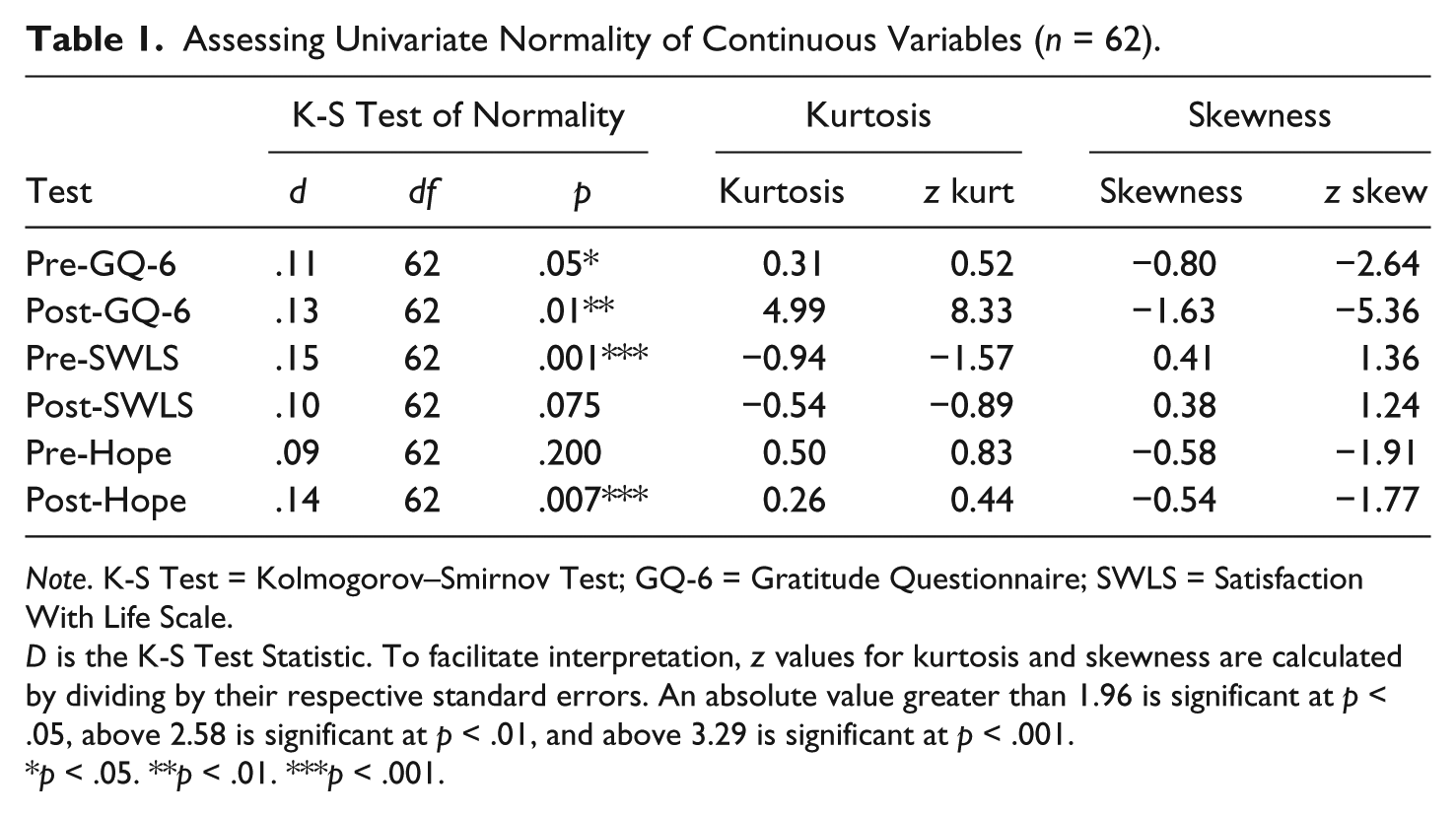
Note. K-S Test = Kolmogorov–Smirnov Test; GQ-6 = Gratitude Questionnaire; SWLS = Satisfaction With Life Scale.
D is the K-S Test Statistic. To facilitate interpretation, z values for kurtosis and skewness are calculated by dividing by their respective standard errors. An absolute value greater than 1.96 is significant at p < .05, above 2.58 is significant at p < .01, and above 3.29 is significant at p < .001.
p < .05. **p < .01. ***p < .001.
Statistical results for the evaluation of the main effects, the interaction effects, means, and standard deviations are presented in Table 2 and Figure 1. For each of the three outcome variables, there were no significant main effects for the between-subjects factor (8 vs. 12 weeks): SWLS, F(1, 62) = 0.98, p = .34, partial η2 = .015; GQ-6, F(1, 61) = 0.18, p = .67, partial η2 = .003; and the Hope Scale, F(1, 62) = 0.46, p = .50, partial η2 = .007. In addition, there was no significant interaction effect for Group × Time on each of the three outcome variables: SWLS, F(1, 62) = 1.06, p = .31, partial η2 = .015; GQ-6, F(1, 61) = 1.16, p = .29, partial η2 = .019; and the Hope Scale, F(1, 62) = 0.28, p = .60, partial η2 = .005. In other words, the 8- and 12-week groups did not differ pre- or post-intervention on these outcome variables.
Results From Three 2 × 2 Mixed ANOVAs.

Note. SWLS = Satisfaction With Life Scale; GQ = Gratitude Questionnaire. p < .001.
p < .05. **p < .01. ***p < .001.
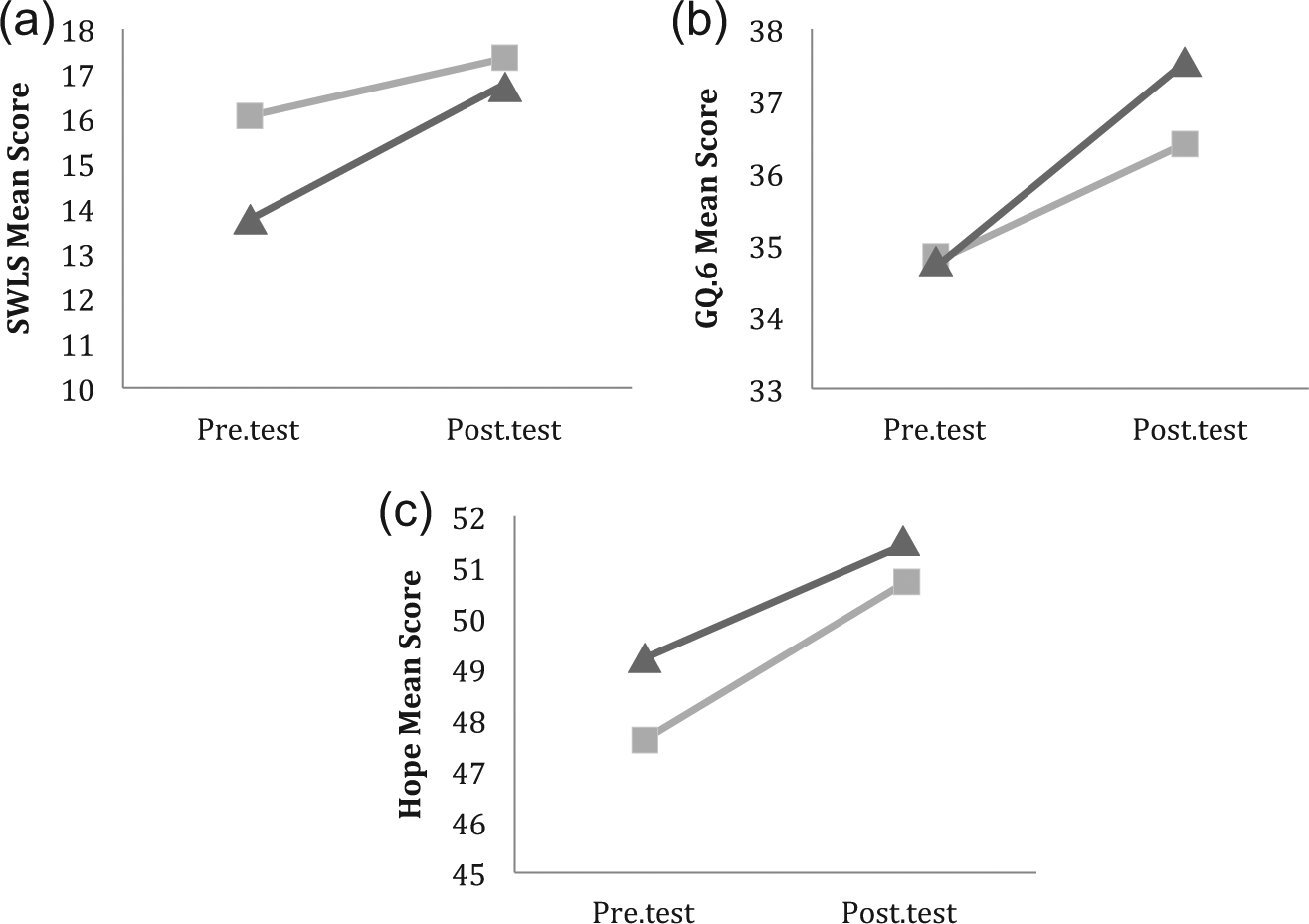
Mean scores for (a) SWLS, (b) GQ-6, and (c) Hope Scale for offenders in the 12-week PRCP (diamond points) and the 8-week PRCP format (square points) as a function of time.
There were statistically significant main effects for the repeated measures factor of time for each of the three outcome variables: SWLS, F = 6.65, p = .01; GQ-6, F = 15.73, p < .001; and the Hope Scale, F = 11.05, p < .001. Furthermore, there were gains in gratitude, satisfaction with life, and overall hope from pre- to post-intervention, irrespective of the length of the treatment condition. In fact, the intervention itself (regardless of its length) accounted for (a) 21% of the variance in gratitude, (b) 10% of the variance in satisfaction with life, and (c) 15% of the variance in hope. The amount of variance accounted for by the intervention is comparable with results of other prison programming (6%-15%, Aos et al., 2006).
Discussion
We evaluated the PRCP, a rehabilitation intervention for offenders, which is based on positive psychology principles. Offenders were introduced to positive psychology principles and practiced skills related to increasing their positive character strengths and overall well-being throughout the intervention. Results confirmed our hypotheses of significant, positive change in offender outcomes measured by gratitude, life satisfaction, and hope over time. Moreover, this change was accomplished in 8 and 12 weeks. The extra 4 weeks of course material and more detailed information and practice in the 12-week format did not produce significantly different outcomes from the 8-week format. Therefore, future interventions should utilize the 8-week format for efficiency and ease of administration.
The changes from pre- to post-intervention in gratitude, life satisfaction, and hope may be a result of participation in the intervention. Changes in these positive psychology constructs are important as they have been linked to pro-social behavior and improved mental health outcomes. Increasing constructs related to pro-social behavior and mental health is clinically relevant and imperative for offenders when considering the prison environment.
Positive psychology interventions and prison populations have had limited overlap in the literature, and little is still known about how such interventions may benefit this special population. Although previous interventions implemented in prisons have focused on changing specific behaviors, such as ceasing drug use or aggression; many programs aside from PRCP and the GLM have attempted to shape individual attributes and attitudes. Therefore, this study contributes to the growing body of literature in positive psychology, because it examines the impact of intervention modality and intervention length on treatment outcomes. Exposure to positive psychology principles may have resulted in heightened levels of offender gratitude, life satisfaction, and hope when controlling for treatment length.
The results of the study supported Aos et al.’s (2006) conclusion that the modality of prison treatment affects the effectiveness of intervention and overall outcomes. The lack of a random control trial threatens the validity of attributing positive change to the intervention; however, data regarding the length of intervention (i.e., 8 vs. 12 sessions) suggests that if the intervention is the causal agent, then 8 sessions are sufficient.
PRCP is similar to the GLM, a strengths-based rehabilitation program orientated to having individuals obtain primary goods. PRCP is a positive psychology intervention that utilizes each element of PERMA to increase an individual’s well-being and ability to flourish. Our results suggest that a group intervention is effective with this population when the goal of treatment is focused more broadly on the development and incorporation of positive characteristics. Programs such as PRCP that emphasize self-improvement and skill advancement have been shown to reduce problem behaviors during incarceration (Wright, 1993).
Results from this study add to the limited literature addressing the effectiveness and feasibility of implementing positive psychology interventions with prison inmates. The results of the study are relevant to researchers, prison administrators, government officials, and local communities. This research identifies new strategies for organizations that have limited resources (time and money) but are attempting to implement effective interventions nonetheless.
Limitations
This study was non-experimental in nature and suggests PRCP may be an active ingredient for increasing positive character strengths in offenders. Because of the lack of random assignment or a control group, our program evaluation has limited internal validity. That is, we cannot rule out the possible confound of natural maturation. It is possible that as offenders spend more time in incarceration, they adapt to their environment and experience increases in gratitude, life satisfaction, and hope without the assistance of an intentional intervention. However, no programs were offered to the offenders, other than PRCP, that directly addressed increasing positive psychological outcomes. More research is needed with the inclusion of a no-treatment (or wait-list) control group to rule out the possibility of natural maturation on outcomes.
External validity of the program evaluation is limited by self-selection into the study. That is, all participants in the study were volunteers who responded to fliers posted in the facility. Those who volunteered to participate may have been inherently different compared with those who did not and may have been more receptive to the intervention. For example, those who volunteered may have been more pro-social and open to opportunities for change. Alternatively, they may have had greater need for psychological services, which would reflect low pre-intervention scores with the potential for a larger gain in post-intervention scores (similar to regression toward the mean). Again, because of the absence of a control condition, random selection, and random assignment, differences between the participating sample groups and the remaining prison population are unknown. Although researchers reminded volunteers that participating in the program would not reduce jail time or increase the likelihood of special treatment, participants may have intentionally biased results with hopes of personal gain. The potential for offenders to have intentionally inflated post-intervention scores, because of perceived personal gain and/or the desire to please the investigator, compromises construct validity.
The program director and lead facilitator (the third author on this article) had personal investment in and enthusiasm for the program resulting in demand characteristics (i.e., subtle biases, persuasions, cues). As a result, offenders may have responded more positively pre- or post-intervention than they would otherwise. The validity of the results is strengthened because the third author was not involved in the scoring of the constructs. Furthermore, the fourth author, who was neither a creator nor facilitator of the intervention, lead data analysis and interpretation of the data.
Generalizability is limited to the intervention groups and facility. The study was conducted in a medium security male unit. The prison itself is unique, because it offers special work and educational programs for offenders with good behavior. Only males with a history of good behavior in the prison live on this unit, and thus these were the only offenders allowed to participate in the intervention. Because PRCP was not implemented as an isolated intervention, the positive changes in the three outcome variables may be the result of other concurrent institutional programming.
Although we predict the generalizability of the study to be low, the interpretive power and implication of results remain strong. The study has important clinical utility, because it proposes a new way of thinking about prison interventions. Using a general model of positive psychology to influence pro-social behaviors was effective in producing outcomes in only 8 weeks. As a result, we offer our study as a framework for future positive psychology interventions with offenders.
Future Research
Future research should target the limitations of this study. To increase generalizability, prison interventions need to be evaluated with female offenders, in prison facilities with varying levels of prison security, and with a more ethnically diverse sample. Although a significant difference was not found between an 8- and 12-week intervention, future research could continue to explore potential differences in outcomes caused by treatment duration. The difference in treatment duration should be continually evaluated. Most importantly, future research should include a control group with random assignment to establish baseline rates of change among offenders.
Results from this study reflected significant gains in positive psychology skills. The long-term goals of this intervention are to have offenders (a) master the skills they have learned and incorporate them in different areas of their life, (b) increase their well-being and ability to flourish, and (c) facilitate their ability to reduce negative behaviors. Further research should examine whether these gains (a) remain stable at post-intervention intervals using a longitudinal design, (b) translate into adaptive coping strategies upon re-entry into offenders’ local communities, (c) reduce recidivism rates, and (d) reduce problem behavior during incarceration.
Concluding Remarks
The purpose of the PRCP was to teach offenders positive psychology principles through lectures, discussions, and homework assignments to help offenders learn to self-regulate their thoughts and behaviors. Offenders learned to transfer their attention from personal deficits and problem behaviors to positive experiences and attributes. Our hope is that these skills will facilitate re-entry into society and reduce recidivism rates. The positive results from our evaluation provide support for manualization of the program for further experimental evaluation.
Footnotes
Appendix
Acknowledgements
We would like to thank the offenders and Washington State Department of Correction for participating in our study. We would also like to thank Linda Gaffney for her support, dedication, and innumerable hours of effort, care, and attention to the program.
Authors’ Note
Portions of this research were presented at the annual meeting of the Western Psychological Association, San Francisco, California, April 2012, and the Third World Congress on Positive Psychology, Los Angeles, California, June 2013.
Declaration of Conflicting Interests
The author(s) declared no potential conflicts of interest with respect to the research, authorship, and/or publication of this article.
Funding
The author(s) received no financial support for the research, authorship, and/or publication of this article.