



Abstract
Studies have often linked parenting to children’s subsequent antisocial behavior; however, the circumstances under which this might occur are less clear. The current study explores patterns in mothers’ parenting practices, and associated correlates including maternal delinquency and offending, mental health, and children’s physical aggression. This study is based on the first wave of the ongoing Vancouver Longitudinal Study; the objective of this prospective study is to identify the early risk and protective factors for aggression and violence from the earliest developmental periods. Parenting practices of 287 mothers with preschoolers are examined using a series of latent class analyses. Three different patterns of parenting emerged: Positive, Negative, and Intermittent. Patterns identified are associated with several key criminogenic, socio-demographic, historical, and developmental factors including current maternal adult offending, mothers’ mental health, ethnicity, and frequency of children’s physical aggression. Importantly, mothers who show parenting in line with the more negative classes also rely on a number of positive practices. Implications of the study suggest that parenting is influenced by mothers’ immediate situations and contexts (e.g., current offending rather that past delinquency), which can be targeted for intervention.
Introduction
Parents often remark that their distinctive traits, behaviors, and habits are reflected in their children. Intergenerational continuity of a particular parent/child behavior is referred to as intergenerational transmission (Thornberry, 2009). There is substantial longitudinal research confirming that different behaviors are transmitted from one generation to the next, such as health risk behaviors (Wickrama, Conger, Wallace, & Elder, 1999), cigarette smoking (e.g., Chassin, Presson, Todd, Rose, & Sherman, 1998; Kandel & Wu, 1995; Weden & Miles, 2012), and child maltreatment (e.g., Berlin, Appleyard, & Dodge, 2011; Pears & Capaldi, 2001). This appears to also be the case for antisocial behavior and offending, as a small number of families are responsible for a disproportionate amount of criminal behaviors (e.g., Farrington, Barnes, & Lambert, 1996; Farrington, Jolliffe, Loeber, Stouthamer-Loeber, & Kalb, 2001). Though intergenerational transmission of antisocial behavior is well supported empirically, how his transmission occurs is less clear (e.g., Moffitt, 2005; Thornberry, Freeman-Gallant, & Lovegrove, 2009). One perspective relies on a genetic explanation (for a review, see Rhee & Waldman, 2002), while another emphasizes environmental factors, particularly parenting practices (e.g., Patterson, 1998; Simons, Wu, Conger, & Lorenz, 1994), and, yet another focuses on the interaction between genetic factors and environmental factors (e.g., Kim-Cohen et al., 2006; Moffitt, 1993). Moreover, criminological research has focused on the contribution of the antisocial father in this transmission, as opposed to the mother, despite the latter’s typically primary caregiver role (for reviews, see Loeber & Stouthamer-Loeber, 1986; van de Rakt, Nieuwbeerta, & de Graaf, 2008). This study focuses on mothers, and examines whether maternal parenting practices of young children are linked to mothers’ histories of delinquency and current offending.
Literature Review
The Antisocial Parent
For more than three quarters of a century, criminological research has confirmed that children of antisocial parents are more likely to be antisocial (e.g., Farrington, 1979; Glueck & Glueck, 1950; McCord, 1979), and the focus has traditionally been on the antisocial and criminal behavior of fathers (for reviews, Loeber & Stouthamer-Loeber, 1986; van de Rakt et al., 2008; Walters, 1992). However, more recent developmental criminological research based on cohort studies has identified that mothers’ antisocial behavior could have several negative consequences. Beyond involvement in offending, mothers who were delinquent during adolescence are subsequently likely to experience adulthood problems, including mental illness, substance dependencies, high unemployment, abusive interpersonal relationships (e.g., Lanctôt, Cernkovich, & Giordano, 2007; Moffitt, Caspi, Rutter, & Silva, 2001; Pajer, 1998; Silverthorn & Frick, 1999). The social disadvantages and psychological problems that some of these women may have to face as adults are likely to influence their pregnancy and motherhood experiences. For instance, women with a history of antisocial behavior who become parents are more likely to expose their children to social deprivation and poor caregiving environments (Jaffee, Belsky, Harrington, Caspi, & Moffitt, 2006). Moreover, mothers with a history of juvenile delinquency are not only more likely to prenatally expose their children to substances (i.e., nicotine, alcohol, drugs), but they also have more physically aggressive children (Huijbregts, Séguin, Zoccolillo, Boivin, & Tremblay, 2008; Tzoumakis, Lussier, & Corrado, 2012). Therefore, it is possible that some at-risk women may contribute to the intergenerational transmission of antisocial behavior through risky behaviors and vulnerable situations they may find themselves in when they become mothers.
Given these findings, it is difficult to underestimate the theoretical importance of mothers’ antisocial/delinquent profiles and the intergenerational transmission of similar behaviors in their children. Developmental approaches in criminology suggest focusing on the identification of such early explanatory factors predating the development of behavior (e.g., Loeber & Le Blanc, 1990), and therefore examining potential influences as early as infancy and toddlerhood. Theoretically, from a developmental approach, one explanation of the intergenerational transmission of serious delinquency and criminality is based on the cumulative developmental and social adversities delinquent mothers experienced in their pregnancies/children’s births, and their children’s infancy, toddler, childhood, and adolescent developmental stages respectively (Farrington, 2005; Loeber, Slot, & Stouthamer-Loeber, 2008; Lösel & Bender, 2006). The antisocial female, who experiences cumulative deficits as a result of her history of maladaptive and antisocial behavior, may not possess the cognitive, behavioral, and social skills associated with parenting. Consequently, this could become the basis for their children repeating the delinquent and criminal trajectories of their mothers. Cumulative deficits and the greater social adversities (e.g., high unemployment, mental illness, substance dependencies) antisocial females experience in adulthood may impact the behavioral outcomes of their offspring in the early years. Particularly considering that mothers are the primary caregivers of children in early childhood, a period that is critical for the socialization of the child, and where parenting skills are pivotal (Tremblay et al., 1999).
There is some empirical support for the idea that there may be cumulative effects of the mother’s delinquency and parenting on children’s behavior. For example, an observational study found that mothers who rate high on antisocial beliefs and behaviors are more likely to exhibit hostile and harsh parenting and be less understanding of their children (Bosquet & Egeland, 2000). In turn, harsh and rejecting parenting is strongly associated with children’s antisocial and aggressive behavior in infancy, toddler, and early childhood developmental stages (e.g., Beauchaine, Webster-Stratton, & Reid, 2005; Renken, Egeland, Marvinney, Mangelsdorf, & Sroufe, 1989; Shaw, Owens, Giovannelli, & Winslow, 2001). A mother’s hostile parenting also predicts children’s high physical aggression developmental trajectories during the infant-toddler period (Tremblay et al., 2004). Similarly, during the early to late childhood (age 2 up to age 11) period, a parent’s hostile and ineffective parenting (e.g., gets angry, punishes, feels ineffective) is predictive of children’s high physical aggression trajectories (Côté, Vaillancourt, Le Blanc, Nagin, & Tremblay, 2006). However, the authors did not find an effect for positive (e.g., playing/laughing with child) or consistent parenting (e.g., getting away with things for which should have been punished) on these aggression trajectories. There is however, some evidence from studies assessing parenting interventions indicating that improving parenting practices can reduce children’s conduct problems (Shaw, Dishion, Supplee, Gardner, & Arnds, 2006; Webster-Stratton & Hammond, 1997) and aggression (Brotman et al., 2009).
The detrimental influence of negative parenting is therefore well established, and it is also likely that improving these parenting practices for more positive ones can potentially improve children’s behavior during this early developmental period. However, while the link between parenting and child behavior is evident, less is known about the specific types of parenting and techniques used by vulnerable mothers, or how their past or current offending influences parenting. Therefore, it would be important to explore the parenting skills of mothers with criminogenic risk factors, as these might impact children’s behavioral outcomes.
The Development of Physically Aggressive Behaviors
Developmental approaches in criminology emphasize the study and the impact of early life events on later antisocial behavior (e.g., Farrington, 2005; Moffitt, 1993). Parents, and especially mothers, play a critical role in early childhood development by helping to socialize their children. It is also during this early period, and in infancy, that differences in temperament and problematic behaviors begin to appear among children (Keenan, Shaw, Delliquadri, Giovannelli, & Walsh, 1998). Aggression, for instance, typically emerges in infancy at around a child’s first birthday, with peaks appearing at around 18 months old, and another at approximately three years of age (Hay, 2005). Although the capacity to use force emerges during this early developmental period, most toddlers do so very infrequently if at all (Hay, 2005). This is highlighted by findings from prospective longitudinal studies of young children. For instance, in a birth cohort, three developmental trajectories of physical aggression (a scale of six different physically aggressive behaviors) from age 17 to 60 months were identified (Côté et al., 2007). 1 Most children seldom use physical aggression, and even among those children belonging to the high trajectory, the frequency is relatively low. While physical aggression in young children is not manifestly maladaptive, it is concerning when it is frequent or severe, and especially when it persists after school entry (e.g., Baillargeon et al., 2007; Côté et al., 2006; Tremblay et al., 2004). These studies have shown that a small group of chronically physically aggressive children persist into the elementary school years, and are at risk for delinquency and offending in adolescence and adulthood, underlining the importance of understanding how physical aggression unfolds during early childhood.
The infant-toddler period is also a crucial developmental stage because it is when children learn to control their aggressive behavior (Tremblay, 2010). Prior to school entry, it is typically the parents who are responsible for the socialization of their children. Parents who are more vulnerable and who are exposed to more adversity (e.g., low socioeconomic status, more mental health issues) can have more difficulty providing adequate caregiving environments for their children (Jaffee et al., 2006; Zoccolillo et al., 2005). This highlights the importance of parenting practices during this developmental period, and the potential impact the primary caregiver can have on their children. Learning alternatives to aggression and antisocial behavior in toddlerhood is also critical because these early individual differences have the potential to result in an accumulation of risk factors that cascade from one developmental period into another (Loeber et al., 2008; Moffitt, 1993). Examining the correlates of parenting practices of vulnerable mothers during this early developmental period could therefore be informative and help to target early childhood interventions.
The Current Study
One of the foci of developmental approaches in criminology is the identification of explanatory or causal factors that both precede and influence the course of behavioral development (Loeber & Le Blanc, 1990). Moreover, key developmental theories on the development of antisocial behavior and offending propose that manifestations of antisocial behavior start early in the life-course (e.g., Farrington, 2003; Loeber, 1990; Moffitt, 1993). These theories suggest that some children are exposed to multiple disadvantages, which can have cumulative effects on an individual’s development. The current study adopts a developmental approach in exploring the specific parenting profiles of mothers during the crucial early childhood period when differences are starting to emerge among children, and when children are learning to inhibit their antisocial behavior. The focus of the study will be on mothers, a somewhat neglected area of research in criminology, at least in regard to the transmission of crime and delinquency. Some mothers who were delinquent in adolescence may be carrying the burden of this history into adulthood, influencing their current adult offending, their socioeconomic status, their intimate relationships, as well as their parenting practices (Lanctôt et al., 2007; Moffitt et al., 2001; Odgers et al., 2008;). These same mothers are also likely to be the primary caregivers of young children and thus responsible for their early socialization. Mothers can differ substantially in their approaches to parenting, which are likely influenced by a number of personal and situational factors. Therefore, this study aims to (1) identify specific patterns of parenting among mothers and (2) determine the influence of criminogenic, socio-demographic, historical, and developmental factors on types of parenting. More specifically, key study variables examined will include mothers’ past delinquency, current adult offending, mental health, ethnicity, as well as the child’s physical aggression. In sum, this study will explore the parenting profiles of mothers with young children, to explore whether delinquent/offending mothers approach and respond to their child’s behavior differently, and how it might be influencing their child’s aggression.
Method
Sample
Data from the current study are based on Wave I of the Vancouver Longitudinal Study on the Psychosocial Development of Children conducted in Vancouver, British Columbia, Canada. The goal of this ongoing prospective study is to provide policymakers with empirical information about early risk and protective factors for aggression and violence from the earliest developmental periods (Lussier, Corrado, & Tzoumakis, 2012; Lussier, Tzoumakis, Corrado, Reebye, & Healey, 2011). The current study includes 287 biological mothers and their children (3 to 5 year old boys and girls) recruited from February 2008 to August 2010 in Vancouver and the Greater Vancouver region. To obtain a wide range of families in terms of risk factors, a multi-sampling strategy was used for recruitment. The three groups, which reflect the three recruiting strategies, consist of (1) a clinical sample (n = 13) of mothers whose children were referred to the Infant Psychiatric Clinic at British Columbia Children’s Hospital for externalizing disorder; (2) a community at-risk sample (n = 181) recruited from daycare centers located in neighborhoods ranked in the lowest 25th percentile by two provincial surveys in terms of various socioeconomic and psychosocial indicators of child development (Kershaw, Irwin, Trafford, & Hertzman, 2005); and (3) a community comparison sample (n = 94) recruited from randomly selected daycare centers located in neighborhoods in the remaining three quarters of the provincial ranking.
Procedures
The current study is based on in-person interviews with biological mothers from the first wave of data collection. Interviews were completed at a research laboratory located at British Columbia Children’s Hospital, or at the families’ homes. Graduate students having received extensive training conducted the interviews following a standardized interview protocol. The data were collected using a computerized questionnaire, and the interviews typically lasted 2.5 hr. Ethics approval for the research project was obtained from Simon Fraser University, the University of British Columbia, and the British Columbia Children’s Hospital. Participants signed consent forms notifying them that the information provided was confidential and collected for research purposes only. Participants were referred from the Infant Psychiatry Clinic at British Columbia Children’s Hospital, or they contacted the research team from posters describing the project that were distributed in the community. The mothers were paid Can$40 for their participation. They were informed that participation was voluntary and that they could withdraw at any time.
Measures
The Cracow is the main instrument of the Vancouver Longitudinal Study (Corrado, Roesch, Hart, & Gierowski, 2002; Lussier, Corrado, Healey, Tzoumakis, & Deslauriers-Varin, 2011). The Cracow instrument collects information on a wide range of risk and protective factors associated with the development of serious and violent delinquency (e.g., pre/perinatal risk, parenting practices, social adversity, individual and behavioral characteristics of the child, social/peer factors, as well as neighborhood, victimization, and community violence). The current study utilizes a number of sections of the Cracow including (a) maternal parenting practices, (b) delinquency and offending indicators, (c) maternal psychological symptoms, (d) children’s physical aggression, (e) family social adversity, and (f) socio-demographic indicators. Descriptive information for the sample can be found in Table 1.
Descriptive Statistics for the Sample.

Note. Sample size varies between 272 and 287 due to missing data.
Maternal parenting practices
During the interviews, mothers were asked about their parenting practices using a revised brief version of the Alabama Parenting Questionnaire (APQ; Frick, Christian, & Wootton, 1999). The APQ is an assessment of parenting practices that examines the most important aspects of parenting relating to problem behaviors in school-age children. This instrument was originally developed to identify children with disruptive behavior disorder (Shelton, Frick, & Wootton, 1996). The APQ has been validated on different populations (Shelton et al., 1996) and age groups (ages 4 to 18) in several countries (e.g., Dadds, Maujean, & Fraser, 2003; Essau, Sasagawa, & Frick, 2006). Mothers were asked about the frequency during the past year for 10 parenting practices. 2 As shown in Table 1, mothers generally report medium or high levels of the more positive parenting behaviors, and few of them report low levels. For instance, over three quarters of mothers report high levels of frequently playing with their children (76.2%), and calmly explaining why their child’s behavior is wrong (87.2%). On the other hand, mothers tend to report low to medium levels of the more negative parenting behaviors. More specifically, slightly more than half of the mothers report low levels of ignoring and yelling at their children. The vast majority of parents (81.1%) show low levels of the more serious negative parenting behaviors such as spanking.
Delinquency and offending
Mothers were asked to provide information about their history of juvenile delinquency and their adult offending using the MASPAQ (Measurement of Adolescent Social and Personal Adaptation in Québec; Le Blanc et al., 1996). This instrument has been used and validated with males and females, different age ranges, and sample types (e.g., community sample; adjudicated youth; Le Blanc & Bouthillier, 2003; Le Blanc & Fréchette, 1989; Le Blanc et al., 1996). The MASPAQ includes 26 different delinquent/criminal behaviors. 3 Mothers were asked (a) if they had ever committed the behavior (i.e., prevalence); (b) the age at first occurrence (i.e., age of onset); and (c) the number of times in the last year (i.e., frequency). As shown in Table 1, indicators were created for maternal juvenile delinquency based on the variety (43.6% non-delinquents; 29.3% one to two types of delinquency; 27.2% three or more types), nature (43.6% non-delinquent; 31.4% non-violent delinquents; 25.1% violent delinquents), and onset (34.4% no onset; 56.6% juvenile onset; 8.7% adult onset). An indicator was also created for the participation in offending in the past year to reflect whether the mothers were still criminally active (20.8%). The most common behaviors mothers report during the previous year were taking soft drugs (9.0%), drunk driving (6.1%), shoplifting (5.0%), and throwing objects at people (3.8%). During the interviews, mothers were also asked whether they had ever been arrested or convicted for a crime (10.1%), and whether their partner or the child’s father had ever been arrested or convicted (18.4%).
Maternal psychological symptoms
The Brief Symptom Inventory (BSI) was also administered to the mothers during the interviews (Derogatis & Melisaratos, 1983). The BSI consists of 53 items designed to assess the psychological symptom status of individuals. The BSI is widely used, is evaluated as one of the best brief self-report measures, and has high test-retest, internal consistency reliability and validity (Derogatis, 1993; Derogatis & Melisaratos, 1983; Morlan & Tan, 1998). Mothers were asked how much each of the 53 symptoms distressed or bothered them during the past 7 days on a 5-point scale. Raw scores and normalized T-scores were calculated for the Hostility (α = .71), Anxiety (α = .70), and Depression (α = .79) dimensions, as well as for the Global Severity Index (GSI; α = .91). 4 Comparing the mean raw scores in the current study for hostility (M = 0.48, SD = 0.50), anxiety (M = 0.47, SD = 0.50), depression (M = 0.33, SD = 0.46), and the GSI (M = 0.42, SD = 0.39) with those found in non-patients by Derogatis and Melisaratos (hostility M = 0.35, SD = 0.42; anxiety M = 0.35, SD = 0.45; depression M = 0.28, SD = 0.46; GSI M = 0.30, SD = 0.31) suggests that the mothers in this study have somewhat higher levels of psychological symptoms on average. Moreover, a T-score of 63 or greater on the GSI can be used to screen for psychiatric disorders (Derogatis, 1993); in the current study, this consists of 15.3% of mothers.
Children’s physical aggression
Mothers were also asked to report on their children’s physically aggressive behaviors. In line with other major studies on childhood physical aggression (e.g., Broidy et al., 2003; Tremblay et al., 2004), five indicators were included: taking things away from someone; kicking, biting, or hitting others; pushing, shoving; throwing things at people; and physical fighting. Mothers were asked if their children had ever exhibited the behavior and the frequency of the behavior in the past year using a 4-point scale (never; once or twice; several times; very often). Indicators are also created for the prevalence and frequency of any of the five physically aggressive behaviors. Almost all of the children had ever exhibited any of the five behaviors (92.7%), and most had taken things away (85.4%); kicked, hit, or bit (78.5%); and pushed or shoved (70.1%), while fewer had ever thrown things (49.7%) or fought (19.4%). The pattern for frequency of physical aggression is similar, taking away things is the most frequent behavior (M = 1.7, SD = 1.0), and physical fighting is the least common one (M = 0.3, SD = 0.8). The scale for the frequency of all five physically aggressive behaviors (M = 5.0, SD = 3.2) ranges from 0 to 15 and has an alpha of .76.
Family social adversity
Mothers were also asked a number of questions regarding their (a) family income, (b) single-parent family, (c) occupation, and (d) maternal history of social assistance (i.e., ever received social assistance benefits; never received social assistance benefits). Hollingshead (1975) social status scores are calculated for the families in the study. These are computed by combining scores for the education levels and occupations of both parents, which are then weighted to obtain a single total score reflecting family social status. This score is then used to categorize families in one of five social strata as shown in Table 1. A wide range of family incomes is represented (M = Can$84,000, SD = 62,000) in the current sample. Just under a fifth of the mothers report ever having received social assistance (19.5%) and being single mothers (17.1%).
Socio-demographic indicators
The following socioeconomic indicators are also included for the mother: (a) age at the child’s birth, (b) ethnicity (i.e., Caucasian, non-Caucasian), (c) place of birth (i.e., North America, outside North America), and (d) education (i.e., high school or less; more than high school). Child indicators are as follows: (a) age at the time of interview, (b) gender, (c) presence of siblings, and (d) sample type (i.e., clinical, community at-risk, community comparison). Mothers were on average 36 years old at the time of interview (SD = 5.1). The sample reflects the cultural diversity of the city of Vancouver, just over half of the mothers are Caucasian (54.9%) and born in North America (57.8%). Most of the mothers have post-secondary education of some kind (84.4%). The children were on average 4.2 years old at the time of the interview (SD = 0.7) and slightly more than half (55.2%) are boys.
Analytical Strategy
Latent class analysis (LCA) is used in the current study to identify patterns of mothers’ parenting practices. This statistical technique identifies individuals who exhibit similar patterns of characteristics or behaviors, rather than identifying a factor structure of linear relationships among variables, as is the case with factor analysis (Collins & Lanza, 2010). LCA is considered a special type of cluster analysis, and has been found to perform better than more traditional cluster analysis such as K-means (see Magidson & Vermunt, 2002). Importantly, LCA does not absolutely assign individuals into classes, but provides a probability of membership, which is more appropriate for constructs such as parenting. Moreover, because LCA identifies individuals who respond or behave similarly, it has been associated with a person-oriented approach (Bergman & Magnusson, 1997). LCA also allows for the identification of categorical latent classes while accounting for covariates (Lanza, Collins, Lemmon, & Schafer, 2007). The strategy in the current study is to (1) identify a baseline model of classes of parenting practices and (2) conduct a series of separate models including covariates to identify key socio-demographic, historical, and developmental factors. Due to sample size restrictions, each covariate is analyzed in separate LCA models.
Model selection is completed by inspecting the G2 statistic (Agresti, 1990), the Akaike information criterion (AIC; Akaike, 1987), the Bayesian information criterion (BIC; Schwarz, 1978), the sample size adjusted Bayesian information criterion (aBIC; Sclove, 1987), and entropy (a measure of separateness between the classes ranging from 0 to 1, with higher values indicating better separation). Smaller values for the AIC, BIC, and aBIC suggest a better balance in fit and model parsimony, and recent simulation studies have shown that the aBIC is the best indicator, particularly for smaller samples with unequal class sizes (e.g., Enders & Tofighi, 2008; Swanson, Lindenberg, Bauer, & Crosby, 2011; Yang, 2006). Probabilities of class membership (γ) of the mothers in the parenting classes are identified, as well as the item response probabilities (ρ) of the mothers’ responses to the different parenting practices. All analyses are conducted using SAS, version 9.3.
Results
Baseline Model Identification for Parenting Practices
LCAs are completed for one-class to five-class models. The resulting model fit statistics are presented in Table 2. The lower values for the AIC and aBIC suggest a better three-class solution. Although the BIC value is lower for a two-class model, the entropy is lower suggesting less separation between the classes. Considering the smaller sample size in the current study (where the aBIC has been shown to be a better indicator), and the higher entropy suggesting more distinct classes, the three-class model is selected. 5
Model Fit Statistics for Latent Class Analyses of Parenting Practices.
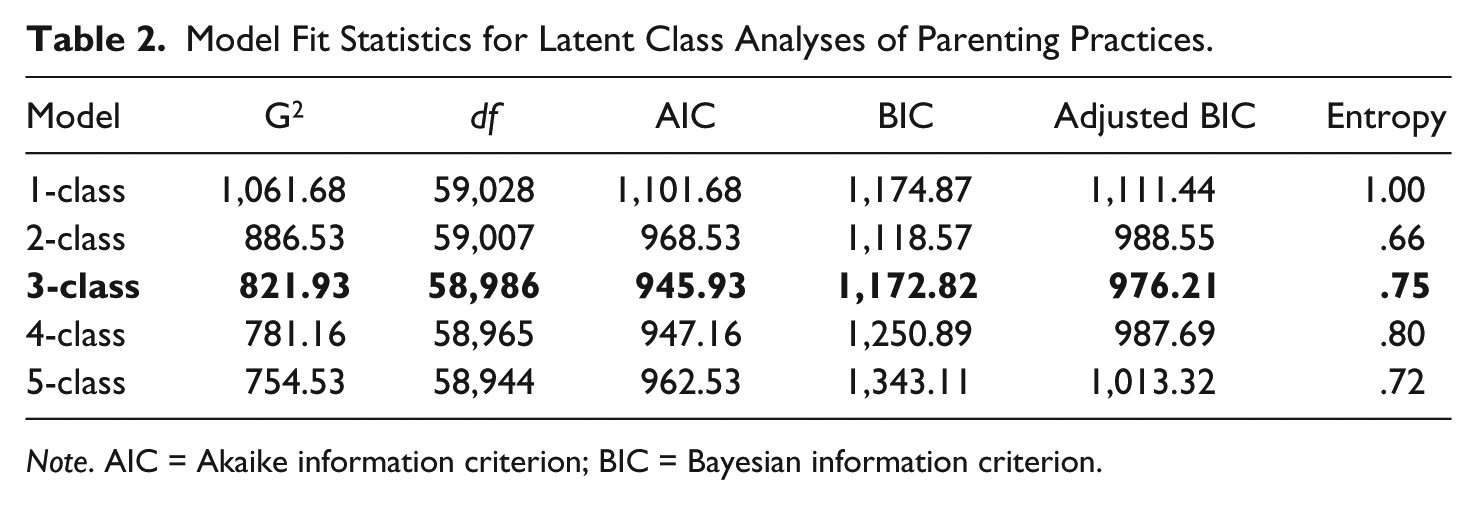
Note. AIC = Akaike information criterion; BIC = Bayesian information criterion.
Probabilities of class membership (γ) and the item response probabilities (ρ) of the resulting three-class model are presented in Table 3. The largest class (γ = 0.56), Latent Class I (Positive), is characterized by greater probabilities of frequent positive parenting practices (i.e., reward child for behaving well; play games, do other fun things with child; calmly explain why behavior wrong) and lower probabilities of the negative parenting practices (i.e., threaten to punish and then do not, getting to obey is more trouble than it’s worth, get so busy forget where child is, punishment depends on mood, ignore child when misbehaving, yell or scream at child, spank child with hand). Latent Class II (Negative), the smallest class (γ = 0.05), is characterized by greater probabilities of high levels of two inconsistent parenting practices “getting to obey is more trouble than it’s worth (ρ = 0.75, SE = 0.14) and “punishment depends on mood” (ρ = 0.67, SE = 0.15), as well as greater probabilities of other medium-frequency negative parenting practices (i.e., threaten to punish and then do not, get so busy forget where child is, ignore child when misbehaving, yell or scream at child). Although Latent Class II shows a more prevalent pattern of medium to high-frequency negative parenting practices, it should be noted that there is also a greater probability of high-frequency positive parenting practices (the ρ for the three positive parenting practices range from 0.61 to 0.77 for high frequency).
Item Response Probabilities for the Three-Class Model of Parenting Practices.
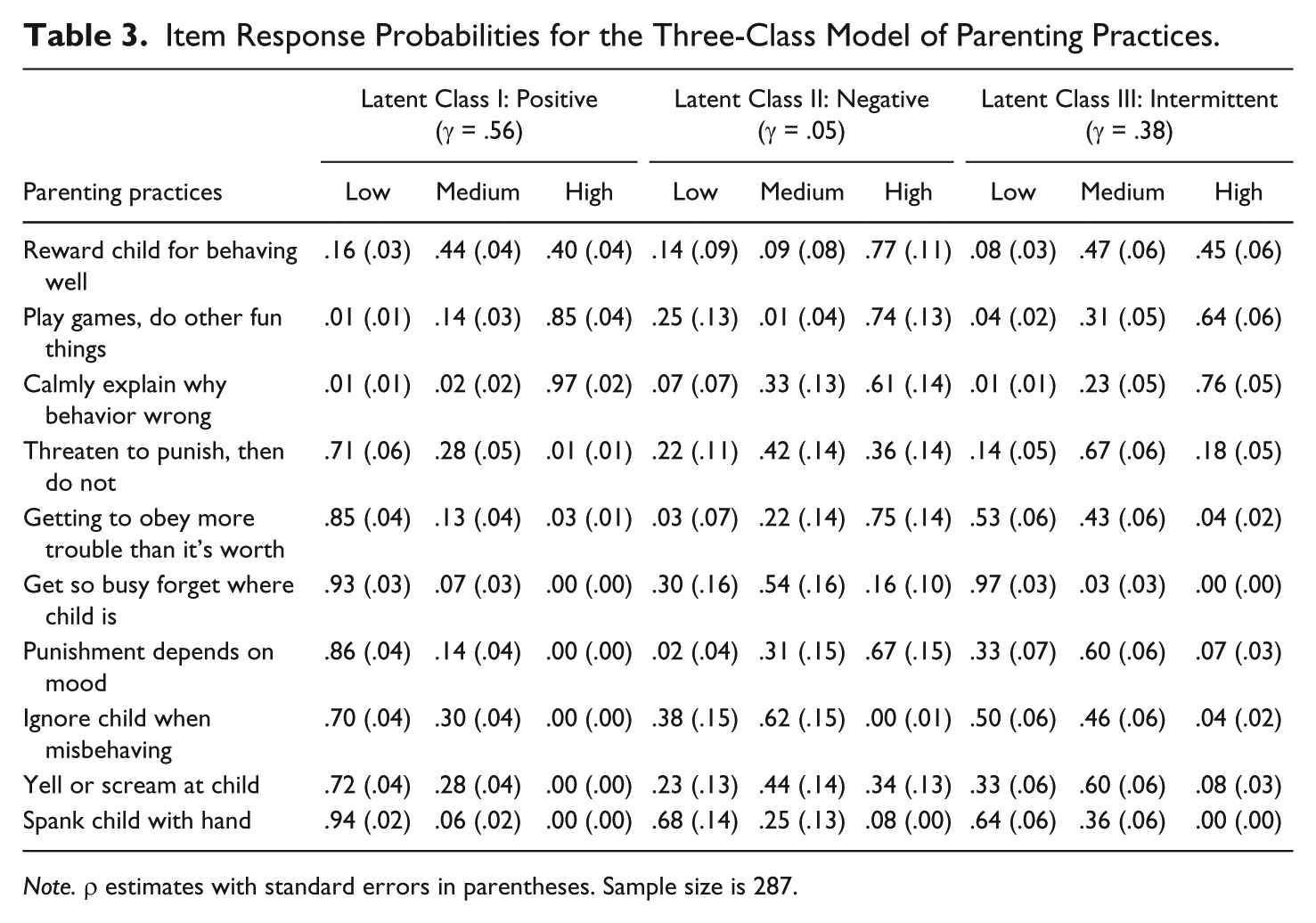
Note. ρ estimates with standard errors in parentheses. Sample size is 287.
Latent Class III (Intermittent) is situated between Classes I and II regarding size (γ = 0.38) and probabilities of the different parenting practices. This intermittent group has little probability of being high frequent on the negative parenting practices (ρ for the seven negative parenting practices range from 0.00 to 0.18 for high frequency). However, they have higher probabilities of being medium-frequent on a number of the negative parenting practices (especially compared to the Latent Class I) including threatening to punish their child and not punish (ρ = 0.67, SE = 0.06), getting to obey is more trouble than it is worth (ρ = 0.43, SE = 0.06), punishment depends on mood (ρ = 0.60, SE = 0.06), ignore child when misbehaving (ρ = 0.46, SE = 0.06), and spank child with hand (ρ = 0.36, SE = 0.06).
Covariates of Latent Parenting Classes
LCA models with covariates (i.e., socio-demographic, historical, and developmental factors) were also conducted to explore the characteristics that are associated with the parenting classes. Due to sample size restrictions, each covariate is analyzed in individual LCA models (i.e., each line in Table 4 represents one model). Odds ratios (ORs) for each covariate for the Negative and Intermittent parenting classes are shown in Table 4. The Positive Class is used as the reference category to compute OR.
Latent Class Analyses of Parenting Practices Accounting for Covariates.

Note. The individual covariates were analyzed in separate latent class models (e.g., maternal age is one model, ethnicity is a separate model, and so forth). Odds ratios are presented with 95% confidence intervals in parentheses. The reference group is Latent Class I: Positive parenting. Sample size varies between 272 and 287 across these analyses due to missing data. BSI = Brief Symptom Inventory.
Dummy variables were created for the sampling strategy, the reference group is the community control sample.
Dummy variables were created for nature of maternal delinquency, the reference group is no offending.
p < .10. *p < .05. **p < .01. ***p < .001.
Regarding maternal characteristics, age at birth of child, ethnicity, and education are all statistically significant. More specifically, mothers who were younger when they had their child are more likely to show parental practices in line with the Negative Class (OR = 0.6, p < .05) compared with the Positive Class. Mothers in the Negative Class are more likely to be of non-Caucasian ethnicity compared to those of the Positive Class. Mothers in the Negative Class also tend to be born elsewhere, although this relationship only approached statistical significance (OR = 4.0, p = .05). Mothers in the Intermittent parenting Class are more likely to have lower levels of education and to be of non-Caucasian ethnicity in comparison with mother in the Positive Class, but there are no other significant differences between the groups. None of the child characteristics are statistically significant. 6 The two statistically significant social adversity indicators (i.e., social status and social assistance) suggest that lower socioeconomic status increases the odds of Intermittent parenting. Moreover, the indicator reflecting low income (less than Can$25,000 annual income) approaches significance (OR = 4.7, p < .05, 95% confidence interval [CI] = [1.2, 17.9]), suggesting that low-income mothers tend to be in the Negative Class compared with the Positive Class.
Next, several criminological indicators are examined regarding the mothers’ and their intimate partners’ criminal history. The only significant covariate is the presence of maternal self-reported offending in the past year. The findings suggest that mothers who are currently offending as adults have higher odds of belonging to the Intermittent Class (OR = 2.8, p < .05) as well as to the Negative Class (OR = 2.1, p < .05).
Three dimensions of maternal psychological symptoms from the BSI as well as the more general GSI are also included in analyses as covariates. All of these psychological indicators are significantly associated with the parenting classes. More specifically, mothers in both the Negative and Intermittent Classes are more likely to score higher on both the Hostility and Depression dimensions. The same pattern emerges for the overall GSI T-scores, but when examining the clinical cut-off of the GSI (T-score ≥ 63), the mothers in the Negative Class seem to be more affected (OR = 7.0, p < .05). In general, these findings suggest that both of these two parenting classes are more likely to experience psychological symptoms compared with the Positive Class.
Several indicators of frequency of children’s physical aggression in the past year are also included in the LCAs. The frequency of “kick, bite, or hit” is significant and suggests that mothers in the Negative Class (OR = 2.6, p < .01) have children with a higher likelihood of exhibiting this behavior compared with those in the Positive Class. Similarly, the sum of all five physically aggressive behaviors is statistically significant. Mothers in the Negative Class are more likely to have children who are physically aggressive overall (OR = 2.0, p < .05). These two indicators of children’s physical aggression (i.e., kick, bite, hit and sum of all five behaviors) are also the most consistently correlated with maternal juvenile delinquency and adult self-reported offending (see correlation matrix in the appendix). Two of the other children’s physically aggressive behaviors approach significance (“take away” and “push, shove”) and show a similar pattern of association, with the effect being relevant for the Negative Class.
Discussion
The current study aimed to explore patterns of mothers’ parenting practices and associated socio-demographic, historical, and developmental factors as potentially contributing to the intergenerational transmission of antisocial behavior. The study focused on mothers rather than fathers given their role as the primary caregiver in the early stages of development, and examined the influence of their juvenile and adult offending on their parenting practices. Moreover, this study examined the link between a mother’s parenting and their preschool children’s physically aggressive behaviors. First, findings showed that most mothers were often positive with their children. Regardless of their parenting class, most frequently played with their children, rewarded them for good behavior, and calmly explained why their behavior was wrong. Second, despite these encouraging findings, several concerning characteristics distinguished the mothers in the Negative and Intermittent Classes from those in the Positive Class. For instance, mothers who were more likely to show parental practices in line with these two more maladaptive parenting classes were much more likely to be experiencing several psychological symptoms. Third, ethnicity was identified as an important predictor of Negative and Intermittent parenting, indicating that there may be cultural differences in parenting practices. Fourth, with respect to offending and criminal history, the study findings suggested that parenting practices might be more influenced by mothers’ current situations (i.e., offending) rather than past experiences.
Positive Parenting During the Early Childhood Period
The majority of the mothers in the current study had positive approaches to parenting their young children. Just over half of the mothers belonged to the Positive Class, characterized by frequent positive behaviors and infrequent negative behaviors. Moreover, even among mothers with more adverse parenting practices (i.e., Intermittent and Negative Classes), positive parenting behaviors were still relatively frequent. Furthermore, the most serious negative behaviors (e.g., physical punishment, forgetting where child is) were uncommon. Problematic parenting practices that were most probable consisted of a lack of discipline (e.g., getting child to obey is more trouble than it is worth), inconsistent discipline (e.g., punishment depends on mood), and reactive parenting (e.g., screaming at child). Encouragingly, these same mothers also showed a number of positive behaviors, meaning that there is an opportunity to focus on their “good” parenting while improving the other behaviors in the context of treatment. Mothers often feel guilt and are aware that certain of their parenting practices are not optimal; using their more positive behavior as a starting point could be helpful. For instance, play-based therapies, especially those including parents, are effective in improving emotional and behavioral problems including aggression in children (for reviews, see Bratton, Ray, Rhine, & Jones, 2005; Davenport & Bourgeois, 2008). Therefore, emphasizing positive therapeutic play as a point of entry with parents of aggressive preschool children could be particularly helpful.
These findings also underline that parenting is not clear-cut (i.e., some negative practices do not imply the absence of positive ones), which is why it is important to examine different types (i.e., positive and negative) as well as different frequency levels (range from low to high) of parenting behaviors. This is also one of the advantages of using a technique such as LCA (rather than factor analysis for instance), as this technique was able to capture the fact that some of the more negative mothers also relied on positive practices.
Vulnerable Mothers and Adverse Parenting
Even though positive parenting practices were generally prevalent in the current study, two classes of more adverse parenting were also identified. Fortunately, the Negative Class, consisting of the most adverse and hostile behavior, also consisted of the fewest mothers. Unfortunately, these mothers were also experiencing a number of difficulties and their children tended to be more physically aggressive. In their examination of broader family types, Le Blanc and Bouthillier (2001) identified a similar small but serious group of “punitive” families characterized by very little supervision, frequent use of punishment, significant socioeconomic disadvantage, and high frequent antisocial behavior among their adolescent children. In the current study, mothers in the Negative Class frequently showed a number of problematic parenting practices (i.e., getting child to obey is more trouble than it is worth, punishment depends on mood, get so busy forget where child is). Moreover, these mothers were more likely to be younger when they had their child, to be of non-Caucasian ethnicity, and tended to be born outside of North America. These findings suggest that these mothers may be unprepared, isolated, and experiencing difficulty dealing with the challenges of parenting. They were not only more likely to experience symptoms of hostility and depression, but also important levels of overall psychological symptoms. Finally, their children were more physically aggressive in general, and are more likely to be kicking, biting, and hitting. At this age, children’s kicking, biting, and hitting is likely directed at the mothers themselves, suggesting that there could be coercive parent−child interactions in these families (e.g., Caspi, Elder, & Bem, 1987; Patterson, 1982; Sameroff & Chandler, 1975). Therefore, these mothers were likely not equipped to appropriately punish their children’s aggressive behavior, while also being in more vulnerable situations. These types of family situations are particularly concerning because of their potential cyclical interactions between parent and child, which are difficult to break (e.g., Moffitt, 1993; Patterson, 1982).
The second largest class identified in the current study was the Intermittent Class. These mothers tended to be less consistent with their positive parenting practices, while also sometimes exhibiting a number of adverse practices. Their negative parenting behavior was not very frequent, but rather intermittent. This pattern is suggestive of a parent who is inconsistent with their parenting practices (whether positive or negative), rather than more overtly hostile or coercive. This pattern of parenting, combined with the fact that these mothers were experiencing significant socioeconomic disadvantage, suggests an overwhelmed parent who perhaps does not have the time or energy to consistently discipline their young children. Moreover, these mothers were not only more likely to be experiencing a number of psychological symptoms, but they were also involved in criminal activity as adults. In line with this Intermittent Class, Le Blanc and Bouthillier (2001) similarly identified a “deviant” family type highlighted by parental deviance, high levels of social (e.g., low parental occupation, social assistance) and structural (e.g., large family size, frequent number of moves) disadvantage. The authors found that these “deviant” families were the second most detrimental on adolescents’ delinquent and antisocial behavior.
Mothers in this Intermittent Class are likely to be experiencing a number of stressors that seem to be affecting their parenting practices. Despite these difficulties, children’s concurrent physical aggression was not related to the Intermittent Class as it was for those in the Negative Class. In line with these findings, Côté et al. (2006) did not find an association between children’s physical aggression trajectories and consistent parenting, but rather that hostile parenting was important. This could be due to the fact that in contrast to the children of the mothers in the Negative parenting latent Class, the children of mothers in the Intermittent Class may not be as aggressive in response to their mothers’ requests, thereby limiting possible escalation to coercive parenting. Moreover, it is possible that this type of intermittent parenting will have an effect on the course of children’s behavior at a later stage (in the current study, both the parenting and physical aggression were measured simultaneously, it was not possible at this time to disentangle the parent and child effects). Another possibility is that this more inconsistent type of parenting is not associated with physical aggression, but rather with other types of behavior problems such as externalizing disorders or non-compliance. Intermittent parenting could impact more indirect or covert behaviors. Overt (e.g., aggression, arguing, temper tantrums, fighting) and covert (e.g., stealing, truancy, fire setting, vandalism) behaviors are thought to be developmentally distinct underlying patterns of antisocial behavior (e.g., Loeber, 1990; Loeber & Schmaling, 1985; Patterson, 1982). Covert behaviors are unlikely to manifest at this developmental period, as they require more advanced cognitive and social abilities that are not yet developed in preschoolers. Therefore, it is possible that intermittent parenting may influence children’s covert behavior when these manifestations appear in later childhood.
Cultural Differences in Parenting Practices
The current study found a link with the more negative parenting patterns and children’s aggression, but this was not consistent across the different manifestations of physical aggression examined. This finding could also be a result of cultural differences in parenting practices and children’s aggression. Although we did not have a priori hypotheses regarding cultural differences, we discovered that culture did in fact play an important role in parenting profiles. More specifically, the current study found that non-Caucasian ethnicity was linked to the more negative parenting patterns identified, and being born outside of North America was marginally significant. This finding was surprising considering that previous analyses of the Vancouver Longitudinal Study have shown that the non-Caucasian children in the sample tend to be less physically aggressive than the Caucasian children (e.g., Lussier et al., 2012; Tzoumakis et al., 2012). In other words, the non-Caucasian children in this sample are less aggressive overall, despite the fact that non-Caucasian mothers tend to show more negative parenting practices. This relationship could explain the fact that children’s aggression was not consistently related to the negative and intermittent parenting practices.
This finding could suggest that negative parenting practices do not influence all ethnic groups in the same way. In line with this, some research has shown that the link between physical punishment and child behavior problems is culturally specific. (e.g., Deater-Deckard & Dodge, 1997; Deater-Deckard, Dodge, Bates, & Pettit, 1996; Lansford, Deater-Deckard, Dodge, Bates, & Pettit, 2004). Specifically, these studies found that physical punishment was only predictive of Caucasian children’s behavior and not African American children. However, more recent research using a large nationally representative American sample which included White, Black, Hispanic, and Asian families did not find any cultural differences on the influence of physical punishment on children’s behavioral problems (Gershoff, Lansford, Sexton, Davis-Kean, & Sameroff, 2012). Therefore, it is not entirely clear whether physical punishment is equally detrimental across all ethnic and cultural groups. In other analyses of the Vancouver Longitudinal Study, several culturally specific predictors of early childhood physical aggression were identified (Tzoumakis, Lussier, & Corrado, 2013). For instance, regarding parenting practices, the study showed that a lack of positive parenting was linked to physical aggression among children of immigrant mothers, while negative parenting was a better predictor among children of non-immigrant mothers. The Vancouver Longitudinal Study is very diverse in terms of its ethnicity and immigration profile, which could contribute to the findings in the current study. Notably, over 40% of the mothers in this sample are born outside of North America, and are non-Caucasian (20% Asian, 10% South Asian).
Considering the fact that many of the mothers in the Vancouver Longitudinal Study are foreign-born, research on the role of immigration may also clarify this finding. Studies in criminology have found evidence of a protective effect of immigration (e.g., Bui, 2009; Hagan, Levi, & Dinovitzer, 2008; Sampson, Morenoff, & Raudenbush, 2005). These studies show that first-generation immigrants tend to show the lowest levels of offending. Similarly, research examining the health of immigrants identified a “healthy immigrant effect” (e.g., Ali, 2002; McDonald & Kennedy, 2004). This research indicates that immigrants typically report low rates of physical and mental health issues, especially for those who arrived in Canada recently as well as for immigrants from Asia. Moreover, a Canadian study found that children of non-immigrant parents tended to show higher levels of behavioral problems compared with immigrant children and the children of immigrant parents (Beiser, Hou, Hyman, & Tousignant, 2002). In other words, it is possible that there is a protective effect of immigration on children’s aggression in the current study, despite the negative parenting practices of some of these mothers. Accounting for cultural differences and immigration in the study of motherhood and antisocial behavioral development in children is especially salient in multicultural nations. This has been a neglected aspect of prior longitudinal studies in criminology (see Morenoff & Astor, 2006, for a review), and most studies on the development of physical aggression in early childhood do not include diverse samples in terms of ethnicity or immigration (e.g., Côté et al., 2006; National Institute of Child Health and Human Development, 2004; Tremblay et al., 1999). Cross cultural research also underscores important variations in parenting across different groups, and have found, for instance, that cultures that value interdependence and collectivism (e.g., Asian, Latin American cultures) tend to adopt more authoritarian parenting (see Lansford & Bornstein, 2011, for a review). Future research should therefore consider examining the relationship between parenting practices, beliefs, and attitudes among different immigrant groups, and the development of childhood aggression to better understand this relationship, especially in the context of intergenerational transmission of antisocial behavior.
Maternal Delinquency and Parenting
Mothers with a history of juvenile delinquency are more likely to offend as adults, they tend to have children who are more frequently physically aggressive (see appendix), and their children also have an earlier onset of physical aggression (see Tzoumakis et al., 2012). However, in the current study, it was mothers’ current rather than their past offending that were linked to their parenting practices. This suggests that it is those mothers who are continuing to be involved in offending as adults whose parenting is more maladaptive. Although a number of mothers reported a variety of past delinquent behavior (56.4% one or more offense) such as shoplifting (33.6%), taking soft drugs (26.9%), minor theft (13.7%), and running away from home (12.9%), few of the women reported official contact with the police (10.1%). Moreover, just over 20% of these women were actively offending as adults (e.g., drunk driving, drug use, shoplifting, throwing objects at people). In line with this, Nagin, Farrington, and Moffitt (1995) found that while adolescent-limited offenders were rarely officially convicted as adults, they were not fully reformed; specifically, they continued to drink heavily and use drugs, get into fights, and commit self-reported general delinquency. Most of the women in the current study are not chronic and serious offenders, but are more likely adolescent-limited type offenders, with a small proportion that continue to participate in risky activities that do not result in official police contact (e.g., Moffitt, 1993; Moffitt et al., 2001; Nagin et al., 1995). In the current study, findings suggested that it is not so much past involvement in delinquency that affected a mother’s parenting but participation in an ongoing antisocial lifestyle as an adult. These women may be caught up in life events that have entangled them in more deviant and vulnerable lifestyles, and are unable to completely leave the consequences of their adolescent antisocial behavior behind (e.g., Hodgins, 1994; Lanctôt et al., 2007; Moffitt et al., 2001). The women in this study may not completely be reformed from their juvenile delinquency, and their persistence in antisocial behavior could be influencing their current situations, including their current parenting practices.
The parenting classes captured in the current study seem to reflect parenting as a state, something that is influenced by mothers’ situations and contexts, rather than as a trait, or a more stable individual extension of mothers’ personalities. A state dependent process in regard to offending refers to a process of contagion where the offender’s current activities worsen their life circumstances and consequently increase their future involvement in offending (Nagin & Paternoster, 2000). Similarly, the current study suggests that a mother’s personal, socioeconomic, and psychological contexts are negatively influencing their approaches to parenting. The vulnerable situations they find themselves in could be contributing to their adverse parenting. A trait-based or population heterogeneity approach on the other hand focuses on a person’s initial propensity to commit crime, and how stable individual differences in this trait or propensity affect current behavior (Nagin & Paternoster, 2000). While this might be true for some behaviors, perhaps in the case of parenting or dealing with a difficult young child, a person’s current context is more relevant. In line with this, a recent study examined trajectories of maternal harsh parenting from birth to age three, and found evidence of a developmental process of harsh parenting that was influenced by contextual factors (e.g., maternal alcohol abuse, partner aggression; Kim, Pears, Fisher, Connelly, & Landsverk, 2010). These findings therefore highlight the importance of examining individual patterns of parenting, and future studies should consider patterns of parenting over time to determine specific developmental trends and influences. Indeed, Macmillan, McMorris, and Kruttschnitt (2004) found that changes in a mother’s circumstances (i.e., poverty, divorce) exacerbate antisocial behavior in young children. The authors advocate for a dynamic approach in examining the influence of maternal and family circumstances on child behavioral development. Life events and circumstances are likely to influence trajectories of parenting, which could in turn influence children’s behavior. If parenting is more of a state dependent process, it is likely that current life events and circumstances may be more influential on adult parenting behaviors.
Limitations
The current study consists of Canadian mothers and their children from Vancouver, and the ethnic diversity of the city is reflected in the sample. A high proportion of the participants are immigrants of Asian and South Asian descent, and consequently the results may not be generalizable to other non-Canadian populations. Moreover, while the presence of siblings was not significantly associated with parenting practices, it would have been ideal to obtain additional information regarding sibling behavior and parenting practices with siblings, considering that three quarters of the children in this sample have at least one sibling. The parenting measure in the current study was a behavioral measure that specifically examined parenting practices and did not include parent−child attachment or interaction, which may have captured a different facet of parenting. However, this measure was chosen because it was specifically designed to reflect practices that are associated with disruptive child development (Shelton et al., 1996), which is in line with the main objective of the Vancouver Longitudinal Study. In addition, the current study does not include multiple informants, and all information on children’s aggressive behavior was obtained from the mother. Observational measures of children’s aggression were obtained during the interviews and will be studied in the future. However, using parent-report information is a typical approach with children of this age as self-report measures would be inappropriate, and has been found to be reliable (e.g., Kerr, Lunkenheimer, & Olson, 2007). The sample size in the current study limited post hoc analyses that could be conducted with the latent classes identified, particularly considering the small size of the Negative Class. Moreover, while the analytic strategy allowed testing individual covariates of the parenting classes, multiple covariates were not included in the model, and it is likely that a combination of covariates predict parenting behaviors. The Vancouver Longitudinal Study is an ongoing prospective longitudinal study; however, data from the second wave were not available at the time of the study. The current study is based on cross-sectional parenting and child aggression data, and as such it is currently not possible to assess temporal priority. Therefore, while this study shows that there is a relationship between negative parenting and children’s aggression, future studies will analyze the continuity of children’s physical aggressive behavior, and the effect of parenting on the development of aggression.
Conclusion
The current study examined the profiles of maternal parenting and associated factors. The aim was to explore whether delinquent/offending mothers respond differently to their child’s behavior and how it might be influencing their child’s aggression. Mothers are typically the primary caregivers of children, and yet they have not been the focus of as much attention as fathers in this transmission. More recent research has begun to suggest that the role of the mother is important, and in fact, that the risk of intergenerational and familial transmission might be somewhat stronger for females (e.g., Bijleveld & Wijkman, 2009; Frisell, Lichtenstein, & Långström, 2011). Critically, it would seem that many mothers are quite vulnerable, struggling with symptoms of mental illness, and are persisting in antisocial behavior in adulthood. Moreover, maternal mental health and stress have been linked with attachment security in children (for a review, see Atkinson et al., 2000). While parent−child attachment patterns were not included in the current study, it would be interesting to determine whether attachment influences the different parenting classes identified, and if it is linked to maternal criminogenic factors. Considering that some of these mothers are struggling with a number of stressors, it is unsurprising that they would have difficulty parenting young children, especially those children who are more difficult or aggressive. However, it is exactly these more challenging children at this particular age who need to learn alternatives to antisocial behavior, as they are most at-risk of persisting later in life (Broidy et al., 2003; Tremblay et al., 2004). Fortunately, the mothers who are exhibiting adverse parenting are still playing and rewarding their children quite frequently. This offers a starting point to intervene regarding their parenting, but it seems that providing psychological support and assistance would need to be prioritized while also being aware of the potential social and legal complications associated with mothers who persist in antisocial behavior. Moreover, considering the link found between ethnicity and the two more negative parenting classes, it would also be important to consider potential cultural differences in the development of parenting interventions. Future studies should also be conducted on cultural differences in the development of aggression in early childhood. Finally, it is unclear how the parenting classes identified in the current study will impact children’s behavior in the long term. Future studies will examine how maternal delinquency, current offending, and parenting practices affect the continuity of aggression into later childhood.
Footnotes
Appendix
Correlations Between Maternal Juvenile Delinquency, Current Offending, and Covariates
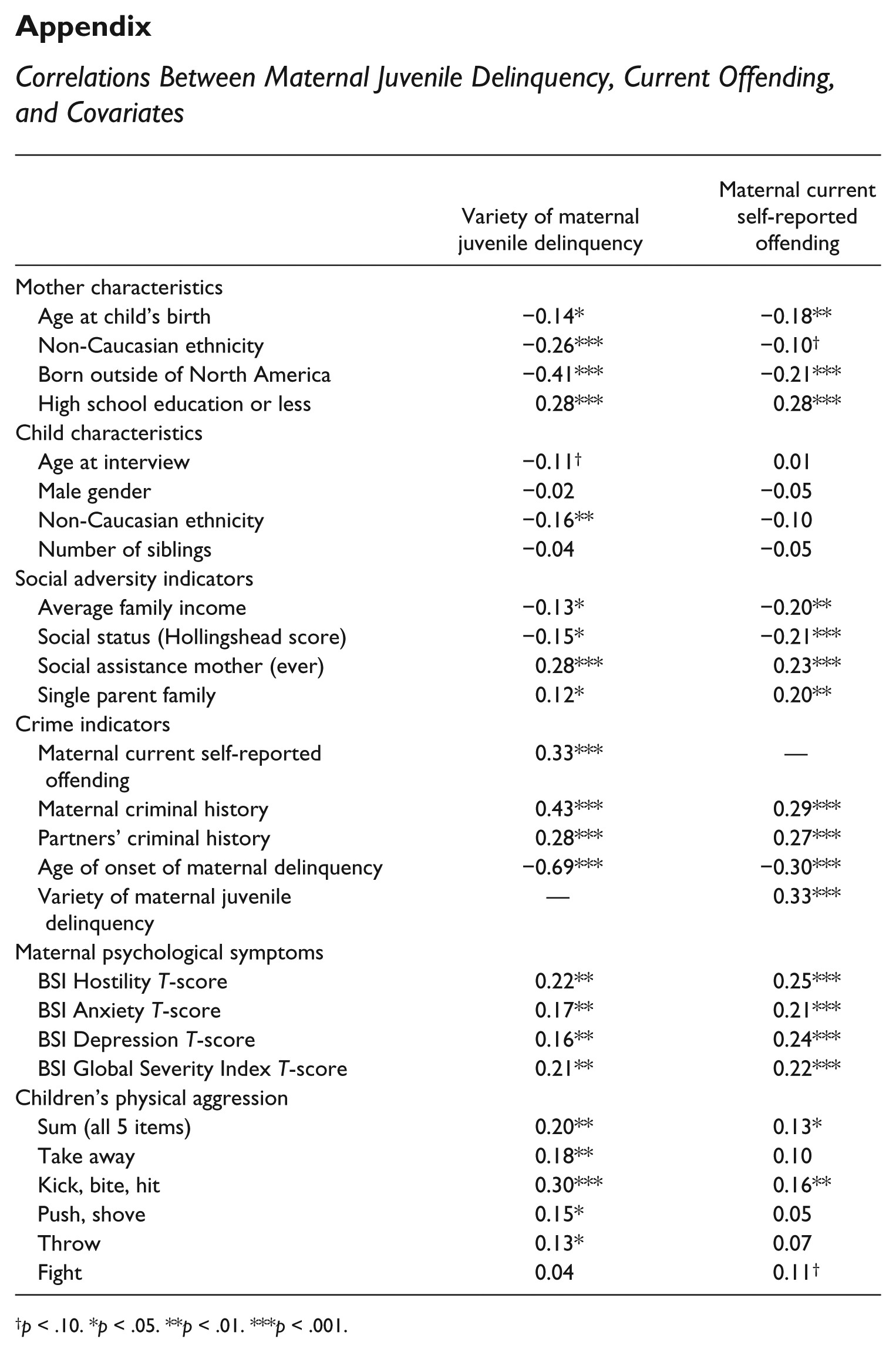
| Variety of maternal juvenile delinquency | Maternal current self-reported offending | |
|---|---|---|
| Mother characteristics | ||
| Age at child’s birth | −0.14* | −0.18** |
| Non-Caucasian ethnicity | −0.26*** | −0.10 † |
| Born outside of North America | −0.41*** | −0.21*** |
| High school education or less | 0.28*** | 0.28*** |
| Child characteristics | ||
| Age at interview | −0.11 † | 0.01 |
| Male gender | −0.02 | −0.05 |
| Non-Caucasian ethnicity | −0.16** | −0.10 |
| Number of siblings | −0.04 | −0.05 |
| Social adversity indicators | ||
| Average family income | −0.13* | −0.20** |
| Social status (Hollingshead score) | −0.15* | −0.21*** |
| Social assistance mother (ever) | 0.28*** | 0.23*** |
| Single parent family | 0.12* | 0.20** |
| Crime indicators | ||
| Maternal current self-reported offending | 0.33*** | — |
| Maternal criminal history | 0.43*** | 0.29*** |
| Partners’ criminal history | 0.28*** | 0.27*** |
| Age of onset of maternal delinquency | −0.69*** | −0.30*** |
| Variety of maternal juvenile delinquency | — | 0.33*** |
| Maternal psychological symptoms | ||
| BSI Hostility T-score | 0.22** | 0.25*** |
| BSI Anxiety T-score | 0.17** | 0.21*** |
| BSI Depression T-score | 0.16** | 0.24*** |
| BSI Global Severity Index T-score | 0.21** | 0.22*** |
| Children’s physical aggression | ||
| Sum (all 5 items) | 0.20** | 0.13* |
| Take away | 0.18** | 0.10 |
| Kick, bite, hit | 0.30*** | 0.16** |
| Push, shove | 0.15* | 0.05 |
| Throw | 0.13* | 0.07 |
| Fight | 0.04 | 0.11 † |
p < .10. *p < .05. **p < .01. ***p < .001.
Declaration of Conflicting Interests
The author(s) declared no potential conflicts of interest with respect to the research, authorship, and/or publication of this article.
Funding
The author(s) received no financial support for the research, authorship, and/or publication of this article.