




Abstract
There is no published work on different factor structures of the Psychopathy Checklist–Revised (PCL-R) for Korean offenders. The current study compared the two-, three-, and four-factor structures of the Korean version of the PCL-R. A total of 451 adult male serious offenders were included. The results suggested that both three- and four-factor models offered the best overall fit to the data. To gain better insight into the construct and predictive validities of the Korean version of the PCL-R, we recommend further analysis of the three- and four-factor models with recidivism and inmates’ implicit aggression levels.
Psychopathy has existed throughout human history and across different cultures, even though the label has been used only relatively recently. Because psychopathy often relates to personality deficiencies and behavioral problems, the routine assessment of these characteristics for clinical and forensic purposes is useful (Flores-Mendoza, Alvarenga, Herrero, & Abad, 2008; Hare, 2003; Leistico, Salekin, DeCoster, & Rogers, 2008; Neumann, Hare, & Johansson, 2012; Walsh & Walsh, 2006; Weaver, Meyer, Van Nort, & Tristan, 2006). To evaluate psychopathy, Hare’s Psychopathy Checklist–Revised (PCL-R; Hare, 2003) is one of the most broadly validated measures of this construct.
Factor Construct of the PCL-R
The Two- and Four-Factor Models
Hare first suggested the two-factor model (1991), and then revised it as the four-factor model (2003) in response to critiques by Cooke and Michie (2001), who questioned the adequacy of the two-factor model, suggesting that it was a result of “misinterpretation of congruence coefficients” (p. 173). Hare (2003), however, did not agree with their literature review and analyses (pp. 79-80).
The four-factor model is an extension of the original two-factor model (Hare, 1991, 2003). Thus, the original two factors were split into four. The original Factor 1 that reflected deceitful and callous personalities was divided into two factors: Factor 1 included interpersonal facets and Factor 2 affective traits. The original Factor 2 that represented unstable and antisocial behavioral traits was also recategorized into two factors in the four-factor model: Factor 3 as lifestyle and Factor 4 as antisocial facets.
After the emergence of Hare’s four-factor model, large and diverse samples were examined to validate the model structure. Numerous empirical findings apparently supported the viability of the four-factor model. Construct validity of the four-factor model was found not only in North American criminal populations (see reviews by Hare, 2003), European violent offenders (Neumann et al., 2012), and serious delinquents (Jones, Cauffman, Miller, & Mulvey, 2006) but also in psychiatric patients (Hill, Neumann, & Rogers, 2004), and even in noncriminal individuals (Williams, Paulhus, & Hare, 2007).
The Three-Factor Model
Cooke and Michie (2001) proposed an alternate model in response to Hare’s (1991) original two-factor model. In their three-factor model, Factor 1 in the original model reemerged as two factors—arrogant and deceitful interpersonal traits as Factor 1—and deficits in affective experiences as Factor 2. The distinct difference between the two- and three-factor models is that five antisocial items in the original Factor 2 were removed. Specifically, these items are poor behavioral control, early behavioral problems, juvenile delinquency, revocation of conditional release, and criminal versatility. Thus, the characteristics regarding impulsive and irresponsible lifestyles remained and constituted the new Factor 3 in the three-factor model. The three-factor model’s construct validity also received considerable support from different populations, including psychiatric (Skeem, Mulvey, & Grisso, 2003) and nonpsychiatric samples (Hall, Benning, & Patrick, 2004; Johansson, Andershed, Kerr, & Levander, 2002; Jones et al., 2006; Vitacco, Rogers, & Neumann, 2003; Weaver et al., 2006).
The original three-factor model used testlets, setting items to load onto specific factors based on order. Some studies followed the strategy of using testlets in their samples (Kosson, Cyterski, Steuerwald, Neumann, & Walker-Matthews, 2002; Salekin, Brannen, Zalot, Leistico, & Neumann, 2006). However, not all succeeding studies have depended on testlets. Cooke and Michie’s hierarchical model was criticized because the testlet-oriented three-factor model resulted in excessive parameterization (Skeem, Mulvey, & Grisso, 2003). Therefore, to allow items to load directly onto their respective underlying structures, some studies omitted testlets in their studies (for reviews, see Neumann, Kosson, Forth, & Hare, 2006; Sevecke, Pukrop, Kosson, & Krischer, 2009).
Psychopathy in Asia
The subject of psychopathy has yet to be studied extensively in Asia. The psychopathic nature of Asian offenders does not necessarily have to be the same as that of North American offenders. Research describing the manifestation of psychopathy in different ethnic and racial groups, primarily Caucasians and African Americans, has been addressed (for a review, see a meta-analysis by Skeem, Edens, Camp, & Colwell, 2004). These studies, however, did suggest equivalent psychopathic traits in the latter two races. A meta-analysis concluded that “[o]ur chief finding is that there is little evidence that Blacks are more psychopathic than Whites in the aggregate” (Skeem et al., 2004, p. 516).
While a number of studies have compared Caucasians with African Americans, relatively few studies have included Asians in ethnic/racial/cultural comparisons with Caucasians or African Americans (Edwards, 2009; Lynn, 2002). Because attention to psychopathy has been confined to Western society, the higher prevalence among Caucasians and African Americans than Asians (Lynn, 2002) is somewhat expected. Although Lynn (2002) did not include Koreans in his examination of the psychopathic personality, he concluded that Asians, Chinese and Japanese, showed lower levels of psychopathy than did Caucasians and African Americans. Lynn, however, noted that Asians who resided in Western society showed nearly identical levels of psychopathy as Caucasians.
Aspects of antisocial behavior have been found to be higher among young Asian adults than young Caucasians adults (Edwards, 2009). This study compared Asian international students, including South Koreans, Japanese, Chinese, Vietnamese, and Myanmarians, with Caucasian American students. Having collectivistic values was associated significantly with lower psychopathic traits only among Caucasian college students, whereas individualism was related significantly to higher levels of antisocial behavioral attitudes only among Asian international students. College students are young adults, and therefore, they are presumably at a stage in which they are shaping their values through their college experiences. It appears that among both Asian international and American students, a tendency to embrace nontraditional norms has an effect on their values and, in turn, on their psychopathic traits.
Cultural factors that affect the nature and assessment of the psychopathy construct in Asian societies have also not been investigated well. For some young Asians who are conducting their lives in a highly interconnected 21st-century global context, factors that include Westernized mass culture, anonymity in the virtual world, individualistic ideas, or a lack of perception of traditional values may be associated with diminishing discrepancies between Asian and Western cultures. It is possible that relatively younger generations in comparatively developed Asian societies, such as South Korea, have adopted Westernized thoughts as well as conventional values (e.g., using honorific language/forms of address to elders, respect for ancestors, sharing foods, and other collectivistic values). Taken together, therefore, there is a probability that relatively young Asian psychopaths, as defined by measures of psychopathy, for instance, the PCL-R, may be similar to psychopaths in Western society.
The killing spree of Young Chul Yoo, a serial killer who was defined as a psychopath, sent Korean society into turmoil. According to his confession, he mutilated his victims and ate some of them. Other serial killers were later identified; however, whether criminals in Korea have become more psychopathic in the 21st century than before has not yet been proven. Nonetheless, the existence of serial killers in Korean society shocked not only the Korean criminal justice system but also the public in general. Perhaps, this phenomenon relates to the frequent appearance of psychopathic killers in recent motion pictures in Korea.
Little research has described psychopathy in Asia. One such study found that a socially aggressive personality was correlated positively with psychopathy among Japanese undergraduate students (Yokota, 2012). V. Lee and Egan (2013) also found that psychopathy appeared as a significant predictor of aggression among female prison inmates in Singapore. Another study found a significant relationship between aggression and psychopathic personalities among females, but not males in the population of Hong Kong (Zhang & Raine, 2011). A study by Ang et al. (2014) also suggested that there is a gender difference in psychopathy. Boys who experienced early separation from their parents showed significantly higher levels of psychopathy than those who had not experienced emotional deprivation early in life. However, this association between psychopathy and early separation was not found in girls. None of the Asian research above has suggested the factorial validity of the PCL-R, yet it is obvious that psychopathic personalities do emerge among Asians.
Deficiencies in the Previous Literature Regarding the Korean PCL-R
As noted by Sohn, Webb, and Lee (2010), there was a significant positive association between the Korean PCL-R scores and problematic attitudes in prisons. The four-factor model’s better fit was suggested by one study (S. J. Lee, Ko, & Kim, 2009) published in Korea. However, no study has compared the two-, three-, and four-psychopathy factor structures in Korean offenders to evaluate the construct validity of the instrument. To demonstrate cross-cultural validity of the PCL-R, it is worth investigating offenders in different cultures (Cooke, Michie, Hart, & Clark, 2005), and therefore, it is of interest to see how the PCL-R developed primarily in Western countries manifests in the Korean sample.
Description of the Study
No study has yet compared all three models using Korean offenders assessed by the Korean version of the PCL-R. Research themes and hypotheses based on the main purpose of the study are straightforward. The study was designed to determine which model among the two-, three-, and four-factor models provides a better fit for this different ethnic offender population. Previous literature published in Korea (S. J. Lee et al., 2009) has suggested that the four-factor model provides the best fit, although comparisons of different factor structures were not conducted. Thus, this research postulates that the four-factor model will offer a better fit to the Korean sample than the two-and three-factor models.
Method
Participants
The data included 451 adult male prison inmates having PCL-R scores who were incarcerated primarily for violent crimes. Mean and median ages were 38.6 and 37 years (17-77 years). The number of prior criminal offenses averaged 5.2, with a median of 4 (0-28). Information on educational levels was available only for 286 cases. More than one third of those had not attended high school (37.3%), whereas approximately one quarter had either a high school education or above (26.2%). The majority of participants (79.2%) had committed such violent crimes as homicide, sexual violence, aggravated assault, and robbery. The remainder (20.8%) had committed nonviolent property crimes, such as larceny and fraud.
Measures
The Korean version of the PCL-R
The Korean version of the PCL-R (Cho & Lee, 2008) is a translation of Hare’s (2003) PCL-R. The Korean PCL-R is a 20-item risk assessment instrument. Trained evaluators assign scores from 0 to 2 (0 = item does not apply, 1 = item applies in some respects, and 2 = item applies) through a semi-structured interview and a file review, along with collateral records. Hare’s PCL-R reliability and validity have been supported by numerous studies (Fulero, 1995; Hare, 1991; Leistico et al., 2008; Rogers, 2001).
The psychometric properties of the Korean version of the PCL-R have been examined (Cho & Lee, 2008). The reliability (internal consistency), as indicated by Cronbach’s (1951) alpha, and inter-rater reliability assessed through Cohen’s (1960) kappa were provided. The alpha coefficient for the total PCL-R score was .87, suggesting adequate internal consistency; when a specific item was eliminated, there were no significant changes in the alpha coefficients. Alpha coefficients for each factor were .86 (affective), .74 (interpersonal), .73 (lifestyle), and .63 (antisocial), respectively. Kappa values ranged from .62 to 1.00, which demonstrated consistency between raters; a subsample of 82 subjects from the original 451 was selected for inter-rater reliability. The two raters, one male and one female, were graduate students majoring in criminological psychology who attended Dr. Hare’s workshop held in Seoul, Korea, and had prior experience in evaluating at least 15 inmates’ cases. These two raters examined the 82 inmates independently. There were strong associations (.79 to .91) between the two different examiners’ scores in both parametric (Pearson’s r) and nonparametric (Spearman’s rho) correlations.
Procedure and Analysis
The data were collected from the six districts 1 of South Korea during the validation process of the Korean version of the PCL-R (Seoul, Kyonggi, Choongchung, Kyonggsang, Julla, and Kangwan) by research teams from Kyonggi and Hallym Universities. All research-related ethical issues (e.g., human rights) were examined by the Korean Bureau of Prisons when the data collection was initiated (Cho & Lee, 2008). Interviewees were provided approximately 20 US $ in compensation for their voluntary participation.
The procedural approaches for the original two-and the later four-factor models were equivalent to that in previous research (see literature review above). The three-factor model without testlets was applied to address the criticism regarding over-creation of parameters in the model (for reviews, see Neumann et al., 2006; Sevecke et al., 2009; Skeem et al., 2003). Because the research sought to identify a model that provided an appropriate fit to the Korean offender sample, the primary data analysis was a priori (Kline, 2005). Mplus version 7 (Muthén & Muthén, 2012) was used to conduct confirmatory factor analyses (CFAs). Mplus is useful in assessing ordinal levels of measurement (such as PCL-R items). The two-, three-, and four-factor models were examined using various fit indices: chi-square values (χ2), consistent Akaike information criterion (CAIC), standardized root mean square residual (SRMR), the Tucker–Lewis index (TLI), the comparative fit index (CFI), and root mean square error of approximation (RMSEA).
Results
Table 1 shows means, standard deviations, and medians of item scores for the Korean offender sample. Whereas poor behavioral control (M = 1.37, SD = .74, median = 2) and impulsivity (M = 1.37, SD = .70, median = 1) exhibited the highest PCL-R averages, the item regarding revocations of conditional release averaged the lowest (M = .47, SD = .74, median = 0). The total PCL-R score ranged from 0 to 39 (M = 19.51, SD = 8.29, median = 19).
Descriptions of Item Scores.
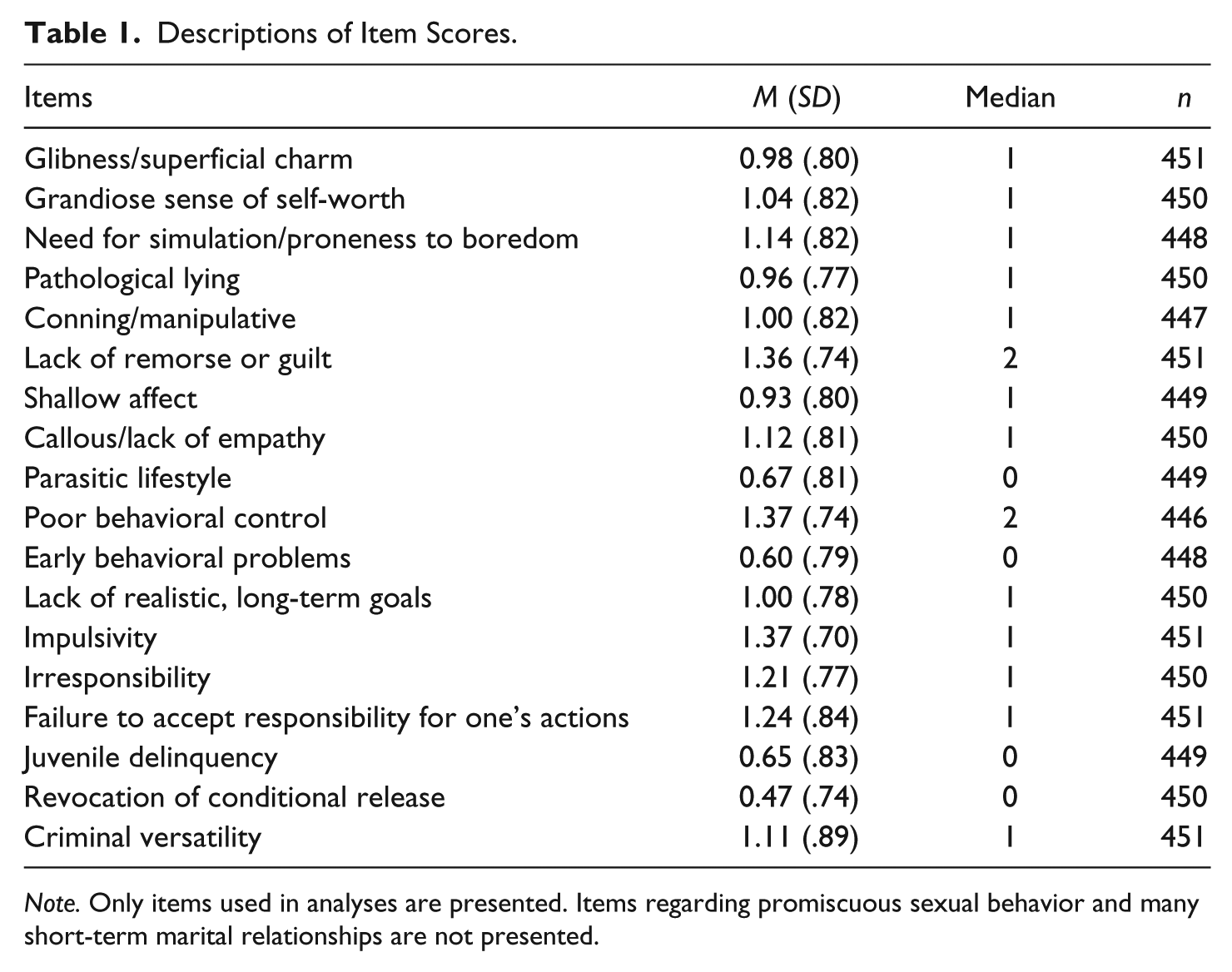
Note. Only items used in analyses are presented. Items regarding promiscuous sexual behavior and many short-term marital relationships are not presented.
Comparing Model Fits
Comparison of the two-and four-factor models
First, the study compared the nested models; therefore, a comparison was conducted between the two- and four-factor models. When models are nested, the chi-square difference test is used (Muthén & Muthén, 2012; Tabachnick & Fidell, 2007). The difference in chi-square values was greater than the critical value: Δχ2 = 141.64, p < .001, df = 5. This difference remained even after the use of model modification indices: Δχ2 = 26.40, p < .001, df = 3. The study, therefore, favored the four-factor model, which had the smaller chi-square value, over the two-factor model.
Comparison of the three-and four-factor models
Next, the four-factor and three-factor models were compared. Figure 1 shows the three-and four-factor models before the introduction of model modification indices. Only standardized coefficients for items are presented. These standardized coefficients between the three-and four-factor models did not differ significantly.
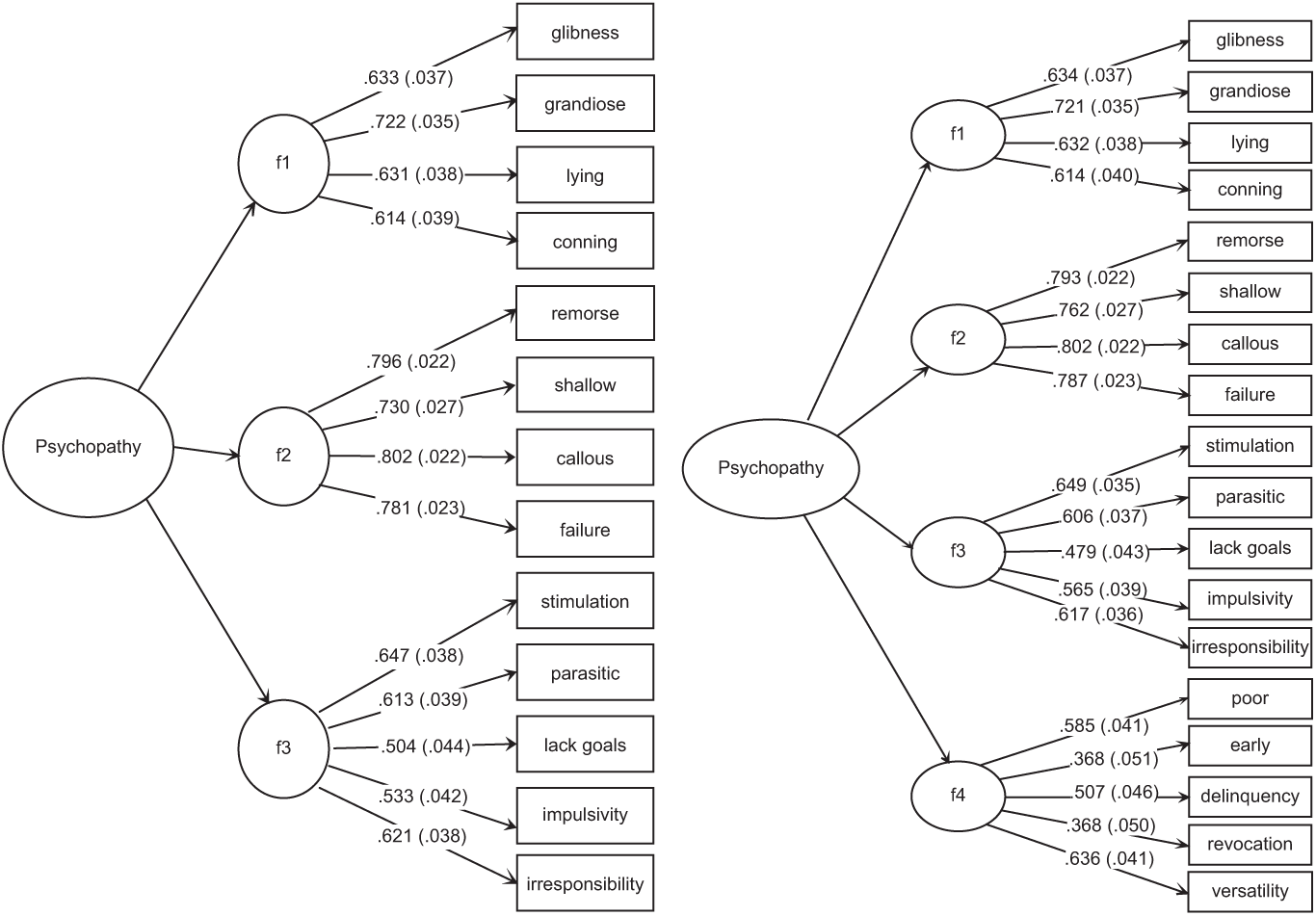
The Korean PCL-R three-and four-factor models without modification indices.
When nested relationships are not present, the existing literature has made several recommendations. The lower CAIC values suggest a relatively better model (Jones et al., 2006; Tabachnick & Fidell, 2007; Weaver et al., 2006). The SRMR is another way to examine a comparatively better model fit; alternately, comparing many fitness indices between the models may also be helpful (Hu & Bentler, 1999; Muthén & Muthén, 2012). Table 2 describes multiple fit index values across the three different models. Both “Initial” and “Modified” models are presented.
Model Fit Indices Without and With the Use of Model Modification Indices (n = 415).
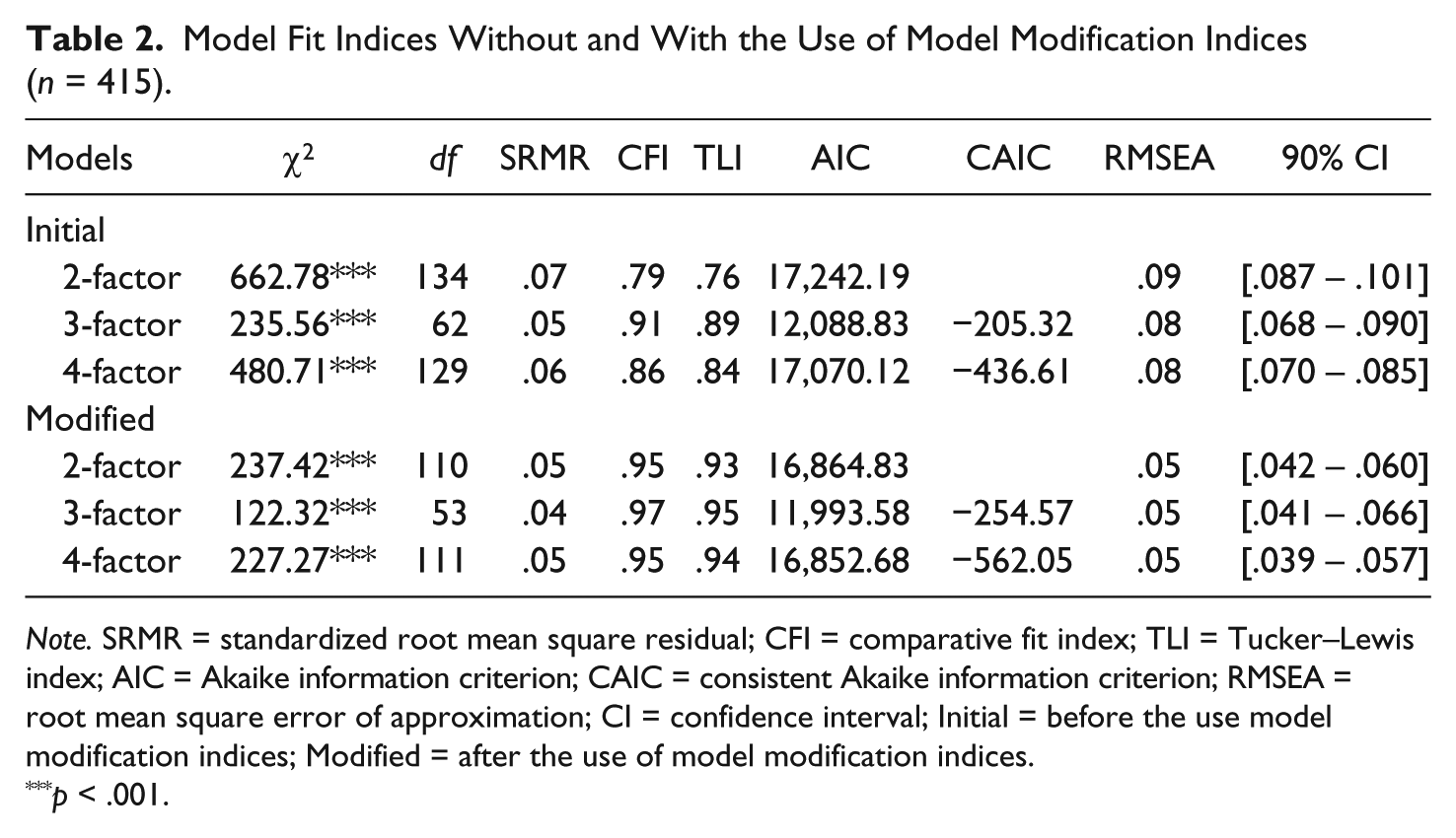
Note. SRMR = standardized root mean square residual; CFI = comparative fit index; TLI = Tucker–Lewis index; AIC = Akaike information criterion; CAIC = consistent Akaike information criterion; RMSEA = root mean square error of approximation; CI = confidence interval; Initial = before the use model modification indices; Modified = after the use of model modification indices.
p < .001.
In the model without the use of model modification indices (see “Initial” model in Table 2), neither the three-nor the four-factor model demonstrated an overall goodness of fit under the standards most advocated (e.g., RMSEA < .06, CFI or TLI > .95). However, after the use of model modification indices (see “Modified” model in Table 2), there was improvement overall, showing good fits for both the three-and four-factor models.
This research posited that the four-factor model would offer a better fit to the Korean sample than the two- and three-factor models. Instead, it seemed that the three-factor model was a better fit because the CAIC (−205.32 vs. −436.61 in Initial model in Table 2) and the SRMR (.05 vs. 06 in Initial model in Table 2) of the three-factor model were lower than those of the four-factor model. Other model fit indices (cf. CFI, TLI, and RMSEA in Initial and Modified Table 2) may also demonstrate a slightly better fit for the three-factor model. Hence, the research hypothesis in this study was supported in part: The four-factor was better than the two-factor model, but the four-factor model was not better than the three-factor model. Furthermore, examination of standardized coefficients of items for both models in Figure 1 did not demonstrate significant differences between the three- and four-factor structures. In sum, it is difficult to determine ultimately whether the three- or four-factor model provided the best fit to the data.
Discussion
In relation to statistical fits in analyses, the three-factor model provided a better model fit, followed by the four-and two-factor models. One question provokes further argument with regard to the three-and four-factor models’ meaningful use in the context of Korean culture. Should the Korean PCL-R embrace the fourth feature that measures aspects of antisocial behavior to promote the psychopathy construct of Korean offenders? Perhaps, the three-factor model is useful to examine patients in clinical settings (Skeem & Mulvey, 2001); moreover, arguments exist that the core quality of psychopathy depends more on a deviant personality than on antisocial behavioral traits (Cleckley, 1988; Cooke, Michie, Hart, & Clark, 2004; Skeem & Cooke, 2010a; Widiger & Lynam, 1998). Nonetheless, Hare (2003) emphasized the significance of the behaviorally deviant components in viewing the psychopathy construct in reality.
When model modification indices were introduced into the models, there were significant improvements in goodness of fit for both the three-and four-factor models (compare both Initial and Modified models in Table 2). The overall improvement in the goodness-of-fit index values in explaining the data was more apparent in the four-factor than in the three-factor model (e.g., see changes in CFI and TLI). These model modification indices (MIs) were numerous correlations among items—including the five aspects of antisocial behavior. 2 Therefore, the study may have to conclude that those five behavioral deviances (the fourth factor) and the other three psychopathic characteristics (interpersonal, affective, and lifestyle factors) are not mutually exclusive in evaluating psychopathy in this sample of Korean offenders. In addition, because the improvement in the four-factor model might have been due to the covariance parameters, the three-factor model without antisocial aspects also warrants the Korean psychopathy component. Consequently, this study suggests that both the three-and four-factor models support the Korean psychopathy construct.
This study sought to determine whether a uniquely Korean cultural context might demonstrate distinct features in the manifestation of the psychopathy construct. The argument that Korean offenders are by nature either more or less psychopathic than Western offenders was not supported by the evidence. Both the three-and four-factor models provided a better fit to the data, a finding consistent with research in Western society. This may be due to the fact that the offenders are comparatively young enough (median age: 37) to be Westernized and exhibit traits equivalent to those of Western offenders. Alternatively, as the majority of the sample included violent offenders, which presumably correlates more strongly with the fourth factor (e.g., delinquent and criminal behaviors), the four-factor model’s adequate fit, after the use of modifications, may not be surprising. Skeem and Cooke (2010a) believed that the fourth factor consists of antisocial behaviors “as a correlate, not a component, of psychopathy” (p. 433). Determining core psychopathic traits was not the main goal of this article, as the author has yet to illuminate the viewpoint to demonstrate better classification between the three-and four-factor models. Sohn and colleagues’ (2010) study reported correlation matrices among factors in the data. In fact, “. . . [a]ll the four features significantly and positively related to each other, except the correlations of feature 1 and feature 4” (p. 59). There were no significant relationships between Factor 4 (antisocial) and Factor 1 (interpersonal), whereas Factor 4 was correlated to Factors 2 (affective) and 3 (lifestyle). To respond to Skeem and Cooke (2010a), not all personality deviances are correlated with the fourth factor, in that interpersonal deviance did not correlate with antisocial behavioral problems in the sample of Korean serious offenders.
CFAs were an analytic plan designed to achieve results comparable with those established by empirical findings in Western studies and one other Korean study. However, to search for better fits of the models examined, it was necessary to use model modification indices, and the study found significant model improvement in both the three-and four-factor models. Therefore, even though the study began with confirmatory methods, it extended to an exploratory approach (Byrne, 2001; Kline, 2005).
Limitations and Future Directions
Some limitations should be addressed. First, because of the nature of the data collection strategy, a majority of the data in the study were from adult male serious offenders. The Korean research teams were required to demonstrate the appropriate application of the Korean version of the PCL-R to the Korean correctional population. The prevalence of psychopathy was higher among violent offenders, especially sex and homicidal offenders (Camilleri & Quinsey, 2009; Häkkänen-Nyholm & Hare, 2009; Porter et al., 2000; Prentky & Knight, 1991; Rice, Harris, & Quinsey, 1990; Woodworth & Porter, 2002). Given the applied research design of the data gathering process, a relatively larger number of violent offenders were included. This limits the generalization of the findings to the above population of adult male serious offenders.
Equivalent statistical fits between the three- and four-factor models used to assess Korean serious offenders provided construct validity of the Korean PCL-R. Some, however, may be concerned with the appropriateness of using model modification indices (MIs), arguing that their use may not fit the current research precisely because they are one of the statistical techniques used to improve overall model fit. However, given that there is no existing research to evaluate different factor structures in a Korean data sample, this study attempted to extend psychopathy research to the Asian cultural context. Consequently, the study embraced an exploratory approach to the research. For this reason, both initial and modified models were given interpretative weight in the article.
Research with regard to different Asian subjects, including female offenders, delinquents, nonserious offenders, and noninstitutionalized individuals, as well as male offenders, has not been well established. Reevaluating factor structures of the Korean PCL-R with various samples is one direction for future research. Skeem and Cooke (2010b) stated the importance of a new generation of psychopathy research. Assessing the psychopathy construct through the lens of other risk assessment instruments would offer good comparisons to psychopathy measured by the Korean PCL-R.
Although this article adds to the body of evidence pertaining to the construct validity of the Korean PCL-R, the Korean version of the instrument requires proof of its predictive validity. Predicting these offenders’ implicit aggression (problematic attitudes during incarceration) and explicit violence (recidivism), with the three- and four-factor models as predictors, can provide a clearer insight into both construct and predictive validities of the Korean PCL-R. Despite these limitations, this study offers a contribution to the existing psychopathy literature.
Footnotes
Acknowledgements
The author(s) wish to express their gratitude to the graduate students of Kyonggi University, South Korea, for their participation in data collection for this study.
Authors’ Note
Preliminary results of this research were presented at the 2013 conference of the American Society of Criminology held in Atlanta, Georgia.
Declaration of Conflicting Interests
The author(s) declared no potential conflicts of interest with respect to the research, authorship, and/or publication of this article.
Funding
The author(s) received no financial support for the research, authorship, and/or publication of this article.