



Abstract
This study examines an emotion-based theory of the conscience, which provides forensic practitioners tools for assessing the state of the conscience. It is operationalized as an emotion-regulating function, making use of empathy, self-conscious emotions, such as shame, pride or guilt, and moral judgment. This was put to test in a questionnaire survey with 59 delinquent and 275 non-delinquent juveniles. As was hypothesized, the functioning of the conscience of these groups differed, with offenders having lower levels of some aspects of empathic capacity, being less prone to experiencing shame and guilt, being more prone to experiencing pride, and being more punishment oriented than victim oriented. The research confirmed that operationalization of the conscience in terms of empathy, self-conscious emotions, and moral orientation is feasible.
Introduction
In forensic practice, a comprehensive theory for describing and assessing the functioning of conscience is still lacking (Le Sage, 2005). When defining the conscience, some refer to the level of cognitive moral development (Gibbs, 2003), others to the level of emotional moral development (Eisenberg & Fabes, 1998), to the capacity for cognitive and affective empathy (Hoffman, 2000; Jolliffe & Farrington, 2004), or to the superego (Carveth, 2013). Much research has been done on the relation between guilt, shame, and delinquency without referring to the concept of conscience. Recently, bioneurological aspects have come into focus as well (Moll et al., 2002; Popma, 2006). In this article, we present the outlines of a comprehensive theory, in which the conscience is a psychic function that develops out of the interplay between self-conscious emotions, the capacity for empathy, and moral reasoning (Schalkwijk, 2015).
We propose that the conscience is a psychic function for evaluation of one’s identity: How does what I do, think, or fantasize relate to my self? The activity of the conscience is subjectively experienced through the awareness of self-conscious emotions, such as shame, pride, guilt, or embarrassment (also referred to as moral emotions; Tangney, Stuewig, & Mashek, 2007). They have to be regulated as they touch on the self or identity (Tracy, Robins, & Tangney, 2007). As long as the self is in a relatively stable state, self-conscious emotions operate in the background to enhance the stability of the self smoothly, mostly at a non-conscious level. However, as soon as the appraisal of a situation, action, thought, or fantasy threatens the stability of this ongoing self-evaluation, self-conscious emotions come to the fore and with them, almost invariably, defense mechanisms (Lichtenberg, Lachmann, & Fosshage, 2011). The day-to-day functioning of the conscience fluctuates: In some situations, the subject might be harsh in his or her self-evaluations and engage in self-punishment, whereas under other circumstances, he or she may evaluate himself in a neutral or even positive way (Hoffman, 2000; Watt, 2007). Some individuals genuinely lack any self-consciousness, which is a sign of pathology (Shaw, 2014; Widiger & Lynam, 1998), whereas others are excessively prone to experiencing guilt or shame, suffering under their conscience (Lansky, 2005).
The first constituent of the conscience is the ability to experience self-conscious emotions, as we infer its functioning from the experience of shame, pride, guilt or other self-conscious emotions. In delinquency research, the focus is mainly on shame and guilt. People differ in the ways they cope with shame (Elison, Lennon, & Pulos, 2006). Some may react to self-esteem blows by devaluing themselves, resulting in a shame–rage spiral (Scheff & Retzinger, 1991), sometimes followed by depression (Pineless, Street, & Koenen, 2006). Others react to shame by turning anger outside, sometimes followed by offending. Research findings on the relation between shame, aggression, and delinquency, however, are equivocal due to the broad range of behaviors that define delinquency (e.g., status offenses, petty crime, theft, or violent offenses) or aggression (e.g., use of foul language), and the use of different types of aggression or delinquency measures, such as self-report questionnaires and observations of aggressive behavior in experimental or real-life situations and official or self-reported delinquency (Stuewig & Tangney, 2007; Stuewig, Tangney, Heigel, Harty, & McKloskey, 2010; Tangney, Stuewig, Mashek, & Hasting, 2011). Anticipated shaming by significant others or peers may function as an informal sanction that may inhibit offending by juveniles (Rebellon, Piquero, Piquero, & Tibbetts, 2010). The inhibiting effect of this anticipated shaming is that it offers self-control. Pride should be differentiated into authentic and hubristic pride (Mills, 2005), the latter resembling narcissism (Bosson & Prewitt-Freilino, 2007). To our knowledge, there are no systematic studies into the relation between pride and delinquency. Guilt generates empathic messages geared toward repairing and regulating behavior and mentalizes vague inner agitation (Barret, 1998). Research consistently shows a negative relation between guilt and delinquency: Guilt inhibits delinquency (Tangney et al., 2011)
The second constituent of the conscience is empathy, which regulates basic and self-conscious emotions and facilitates social interactions (Aragno, 2008). It is a temporary phenomenon, as in a more or less conscious way, the empathic capacity can be switched on and off, or function in many other in-between states. In the meta-analyses by Jolliffe and Farrington (2004) and Van Langen, Wissink, Van Vugt, Van der Stouwe, and Stams (2014), a relation was found between low empathy and offending, with a larger effect size for cognitive empathy than for affective empathy. However, the relation between low empathy and offending is affected by intelligence and socioeconomic status (SES), and thus, should be controlled for these factors if one is interested in the unique relation between empathy and offending.
The third constituent is morality, as moral beliefs form the cognitive backdrop against which behavior, thoughts, and fantasies are evaluated in relation to the self. People function at different moral levels in different situations (Hoffman, 2000), and strict individual norms can be trespassed by relational, social, and cultural norms (Gibbs, 2003). Stams et al. (2008) showed that stronger Victim-based orientation is associated with less norm-trespassing behavior in non-delinquent adolescents and more prosocial behavior in juvenile delinquents. In a study by Wissink et al. (2014), both Punishment-based and Victim-based moral orientation of adolescent students proved to be related to prosocial and antisocial behaviors (e.g., vandalism and delinquent behavior) in and outside school. The meta-analysis by Stams et al. (2006) showed that juvenile delinquents have a lower stage of moral judgment, which is lowest in juvenile delinquents with psychopathic traits and incarcerated juvenile delinquents.
When studying differences between delinquent and non-delinquent adolescents, two potential interaction variables have to be taken into account: ethnicity and gender.
Ethnicity has been shown to be associated with differences in offense patterns, in prevalence of risk factors for delinquency, and in the impact of these risk factors on recidivism (De Mey, Baartman, & Schulze, 1999; Van der Put, Stams, Deković, Hoeve, & Van der Laan, 2013). Also, we have to account for the possibility that adolescents from different ethnic groups might culturally differ in proneness to experience self-conscious emotions. In this study, ethnicity will be included as an interaction variable accounting for ethnic group differences that may moderate the relation between moral development and delinquency.
The second interaction variable is gender. In the meta-analysis by Jolliffe and Farrington, gender was not included as a potential confounding variable, as the number of studies with female juvenile offenders was too small. Meta-analyses by Stams et al. (2006) and Van Langen et al. (2014), however, found that the relations between moral judgment and empathy on one hand and delinquency on the other were stronger in boys than in girls. Cole, Cohn, Rebellon, and Van Gundy (2013) found that anticipated guilt was negatively associated with rule-violating behavior, but only for males, and Broidy, Cauffman, Espelage, Mazerolle, and Piquero (2003) found that there are subtle differences among males and females in the relation between empathy and offending.
The Present Study
To our knowledge, the present study is the first comprehensive study that encompasses all aspects that together constitute the conscience, namely, empathic capacity, proneness to experiencing shame, pride and guilt, moral orientation, and coping styles. We compared delinquent adolescents with a comparison group of non-delinquent adolescents.
Our first two hypotheses pertained to comparing the two groups on the separate aspects of the conscience. Our first hypothesis was that juvenile offenders would show less capacity for empathy, less shame and guilt proneness, more pride proneness, and more Punishment-based and less Victim-based moral orientation compared with the comparisons. The second hypothesis was that offenders would use more externalizing and less internalizing coping styles. Of course, neither over-internalizing nor over-externalizing is preferred.
The third and fourth hypotheses pertained to comparing delinquents and non-delinquents on the combined aspects of the conscience. Clinically, a mature conscience is characterized by dominance of guilt over shame and pride proneness, although authentic pride can be a positive asset. Of course, shame proneness is not to be replaced by guilt proneness in psychological maturation, but will be transformed with the development of guilt. “Mature” is relative rather than absolute, representing gradual differences in empathic capacity, proneness to experiencing self-conscious emotions, and moral orientation. Therefore, our third hypothesis was that guilt would show dominance over shame and pride in comparisons, but not in the group of offenders. In a mature conscience, dominance of internalizing coping styles over externalizing coping styles is expected, as internalizing implicates more appropriating the emotion as belonging to the self than externalizing (Vaillant, Bond, & Vaillant, 1986). Thus, our fourth hypothesis was that comparisons would use more internalizing coping styles, whereas offenders would predominantly use externalizing coping styles. In the analyses, ethnicity and gender were included as potential interaction variables.
Method
Participants
A total of 334 adolescents between 13 and 18 years of age from Amsterdam and two rural cities participated. The comparison group consisted of 275 adolescents (60% male, 40% female), most of whom were attending regular schools; some were in special education classes for children with behavioral or learning problems. In the Dutch school system, different levels of educational achievement are clearly separated in different types of schools. In the research, all levels were included, with an overrepresentation of the lower levels. A total of 70% of the adolescents were Dutch (“Caucasian White”), which implies that they had two Dutch parents, and 30% were immigrants, having an ethnic minority background: 4% from South Mediterranean countries, 10% from the former South American Dutch colonies, and 16% from other countries. 1
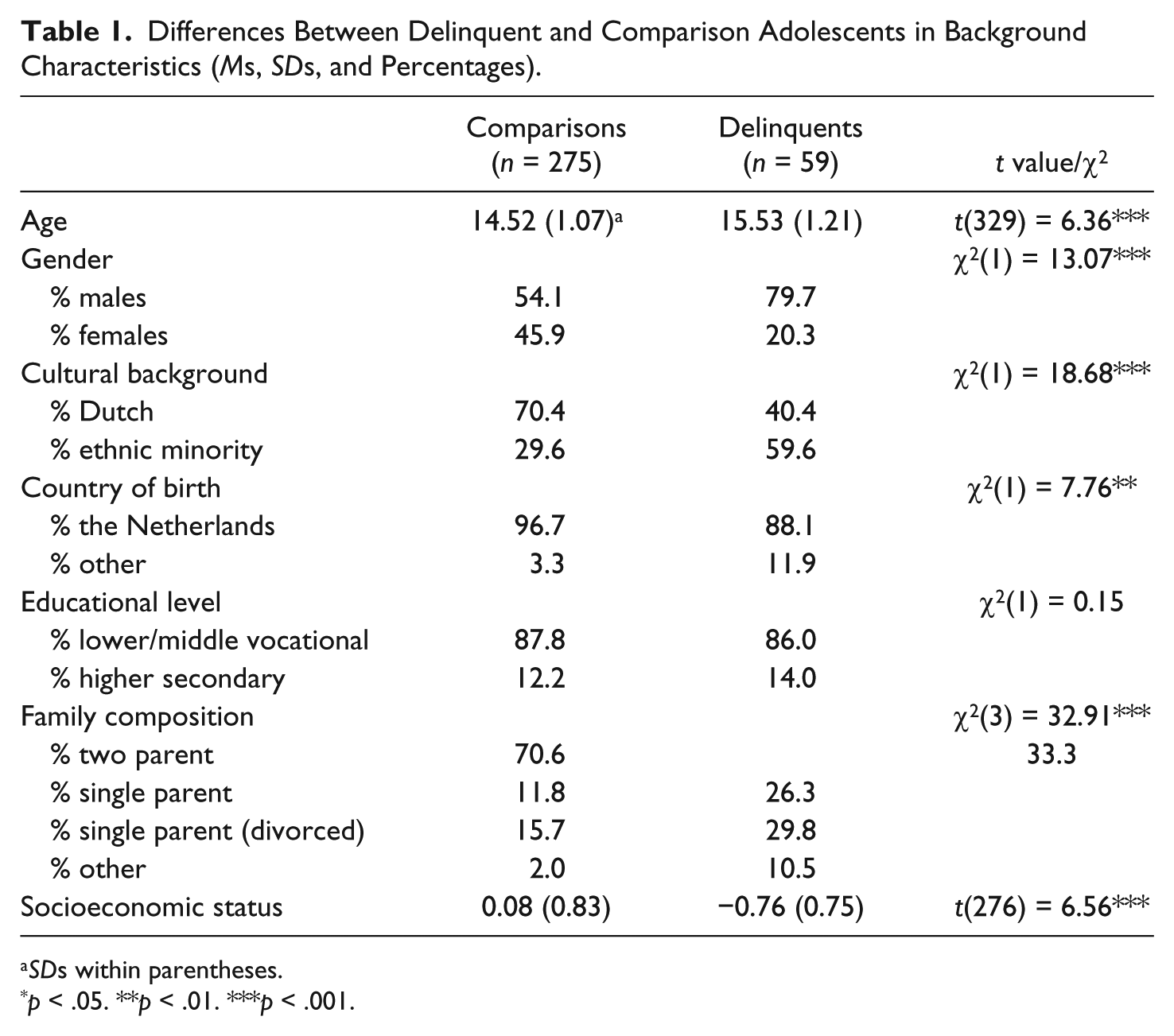
The delinquent group consisted of 59 adolescents, who completed the questionnaire while being psychologically evaluated (before trial, some of them incarcerated): 80% male, 20% female. Forty percent of the adolescents were originally Dutch (“Caucasian White”), and 60% were from ethnic minority backgrounds: 13% from South Mediterranean countries, 16% from the former South American Dutch colonies, and 31% from other countries. The largest part of this group (n = 39) were adolescent suspects. Table 1 presents the demographic data of the participants.
Differences Between Delinquent and Comparison Adolescents in Background Characteristics (Ms, SDs, and Percentages).
SDs within parentheses.
p < .05. **p < .01. ***p < .001.
A series of t tests and chi-square analyses showed that delinquent and comparison adolescents significantly differed in age, gender, cultural background, country of birth, family composition, and SES. On average, the juvenile delinquents were 1 year older than the juvenile comparisons. More juvenile delinquents had an ethnic minority background and/or had not been born in the Netherlands. Most adolescents from the comparison sample came from intact two-parent families (71%), whereas most adolescents from the delinquent sample were raised in single-parent or divorced families (59%). SES was the standardized summation of the family income and educational background of both parents (four variables, Cronbach’s α = .74). The SES of the delinquent sample was lower than that of the comparison sample.
The offenses the adolescents were charged with included theft (with or without violence), robbery (with or without violence), a hold-up, or stick-up. There were no charges of sexual offenses. Below, the juvenile comparisons will be addressed as “comparisons” and the juvenile delinquents as “offenders,” even if they were only charged with an offense.
Procedure
The comparisons were found by asking schools to participate in the project, whereas the juvenile delinquents were found with forensic psychologists examining juveniles before trial, in juvenile detention centers (waiting for trial or being sentenced). All participants participated on a voluntary base. The delinquent juveniles received €7.50 as a token of gratitude.
Informed consent was obtained from both parents and their children. The research was introduced to the participants as “a survey on the opinions of adolescents to help teachers better understand adolescents.” In the questionnaire, references to delinquency were not made, but after all the questions had been answered, additional biographical questions on social-cultural background, school career, and delinquency were asked. The comparisons completed the questionnaires in their classroom during a regular lesson. Not all participants completed all questionnaires. Therefore, the number of respondents may differ somewhat across different measures in the statistical analyses. Offenders completed the questionnaires on a voluntary basis at home, at school, or in prison.
Questionnaires
Interpersonal Reactivity Index (IRI)
The IRI (Davis, 1983) was devised to measure empathy. Using 5-point Likert-type scales, four seven-item subscales each tap a separate aspect of the global concept “empathy”: (a) “Perspective Taking” (PT) refers to spontaneous attempts to adopt cognitively the perspective of other people; (b) “Fantasy” (F) is the tendency to identify with characters in movies, novels, plays, and other fictional situations; (c) “Empathic Concern” (EC) designates the respondent’s feelings of warmth, compassion, and concern for others; and (d) “Personal Distress” (PD) represents self-oriented feelings of anxiety and discomfort that result from observing another’s negative experience. Davis (1983) reported satisfactory internal and test–retest reliabilities (.71-.77 and .62-.71, respectively).
In the meta-analysis of Jolliffe and Farrington (2004), the Perspective-Taking subscale was assumed to assess cognitive empathy and the Empathic Concern subscale to assess affective empathy. In their meta-analysis, they did not use the total sum score of empathy, as in most studies, the Fantasy scale was not used and the Personal Distress scale does not seem to measure empathy properly. However, Pulos, Elison, and Lennon (2004) found two principal factors in a second-order factor analysis: Empathic Concern, Fantasy, and Perspective Taking representing the traditional notion of empathy and Personal Distress being a separate factor (subscale reliabilities between .75 and .82). In our study, we will analyze both possibilities. A sum core will be calculated following Pulos et al.’s findings (EC, F, and PT), but the subscales will be used separately too, following Jolliffe and Farrington. In contrast to Jolliffe and Farrington, we find the PD scale clinically significant as it might refer to the (neuro)biological component of the empathic capacity, the empathic distress, which functions as a prosocial motive (Hoffman, 2000). Personal Distress seems to be more of a focus on one’s own (negative) emotions in a situation of heightened emotion.
In the present study, internal consistency reliabilities in terms of Cronbach’s alpha ranged between .69 (Perspective Taking) and .79 (Personal Distress) for the subscales. Reliability for the Empathy scale consisting of three subscales was .85.
Test of Self-Conscious Affect for Adolescents (TOSCA-A)
The TOSCA (Tangney, Wagner, & Gramzow, 1989) was devised to measure the disposition or proneness to experience shame, guilt, and pride. In this research, the version for adolescents was used, the TOSCA-A (Tangney & Dearing, 2002). A basic tenet of the emotion theory underlying the TOSCA-A is that the emotion is elicited when some aspect of the self is scrutinized and evaluated with respect to moral standards (Tangney et al., 2007). The adolescent indicates his or her propensity to experience shame and guilt in scenarios about different situations on a 5-point Likert-type scale. The Guilt scale is a measure of mild and adaptive forms of guilt, whereas the Shame scale is a measure of maladaptive aspects associated with shame (Luyten, Fontaine, & Corveleyn, 2002). The TOSCA-A also measures Alpha Pride and Beta Pride. However, reliabilities of the latter two scales tend to be rather modest, as they are based on only few items each. Two scales are included that tap coping styles: Externalization of blame and Detachment from the situation. These coping styles aim at minimizing the emotional impact on the self.
In the present study, reliabilities for Shame and Guilt were .82 and .83, respectively. The reliabilities for Alpha Pride and Beta Pride were insufficient, with .51 and .43, respectively. However, the reliability for overall Pride, a composite measure of alpha and beta pride, proved to be satisfactory, with alpha = .70. The reliability for Detachment was .60 and for Externalization .78.
Compass of Shame Scale (CoSS)
This relatively new instrument assesses individual differences in coping with shame and showed satisfactory construct validity (i.e., close model fit in confirmatory factor analysis) and high internal consistency reliability (Elison, Lennon, & Pulos, 2006; Elison, Pulos, & Lennon, 2006). The CoSS asks the adolescent how he or she handles shame when he or she experiences it. The CoSS consists of four 10-item scales representing the poles of Nathanson’s (1992) compass of shame theory: (a) “Attack Self” represents inward-directed anger and self-blame, (b) “Avoidance” is the tendency to hide or withdraw when shamed, (c) “Denial” represents disavowal and emotional distancing or minimization of the situation in something neutral or positive, (d) “Attack Other” represents outward-directed anger (i.e., aggression) and blaming others. A fifth scale assesses adaptive responses to shame, with a minimum of distortion of the shame emotion: “Adaptive” captures the acknowledgement of shame and motivation to apologize and/or make amends.
The basic tenet of the CoSS is that it is a measure of emotion-focused coping. In Attack Self and Avoidance, the negative emotion, be it shame or not, is acknowledged, and the self is experienced as failing, whereas in Denial and Attack Other, experiencing negative emotions is minimized, leading to a diminished experience of shame. A sixth, small scale measures the proneness to experience shame. The developmental order of the CoSS scripts would ideally be reflected in increasing scores from Denial, through Attack Other to Avoidance, Attack Self, and Adaptive, indicating the dominance of appropriating shame and internalization of it. In clinical practice, shame is often associated with aggression and consequently in the CoSS, two of four coping styles refer to this: Attack Self and Attack Other.
In the present study, Cronbach’s alpha reliabilities were as follows: Attack Self (α = .86), Avoidance (α = .75), Denial (α = .75), Attack Other (α = .76), Adaptive (α = .77), and Shame (α = .87).
Moral Orientation Measure (MOM)
The MOM (Stams et al., 2008) is an 18-item self-report measure, assessing the adolescent’s proneness to a Punishment or Victim-based moral orientation. The MOM presents nine morally relevant situations, each including a perpetrator and a victim. The respondent is asked to evaluate how serious the consequences are for the victim and how serious the punishment is for the perpetrator on a 4-point Likert-type scale, varying from “not serious” to “very serious.” If a respondent generally considers the consequences for the victim as very serious, showing consideration for or identification with the victim, he or she is said to have a strong Victim-based orientation. If a respondent generally considers the consequences for the perpetrator as very serious, he or she is said to have a strong Punishment-based orientation. The validation study showed good internal consistency reliabilities and support for construct, concurrent, convergent, and divergent validity.
In the present study, internal consistency reliability for Punishment-based orientation was .88, and for Victim-based orientation .93.
Statistical Analyses
First, missing values (less than 5%) were estimated by means of expectation maximization (Dempster, Laird, & Rubin, 1977). To preserve adequate statistical power, first, a series of t tests was conducted to examine differences in empathy, moral orientation, self-conscience emotions, and coping styles between juvenile offenders and comparisons. Next, it was examined in univariate ANCOVAs whether these differences remained significant after controlling for age, SES, family composition, and birth country, taking into account possible interactions with gender and ethnic minority status. The magnitude of the effect sizes were interpreted in terms of Cohen’s d: Effect sizes of d = .20, d = .50, and d = .80 were considered as indices of small, medium, and large effects, respectively (Cohen, 1988). Finally, differences in shame, guilt, and pride preferences as well as differences in preferences for coping styles between offenders and comparison were examined in ANOVAs.
Results
Differences in Empathy, Moral Orientation, and Self-Conscious Emotions
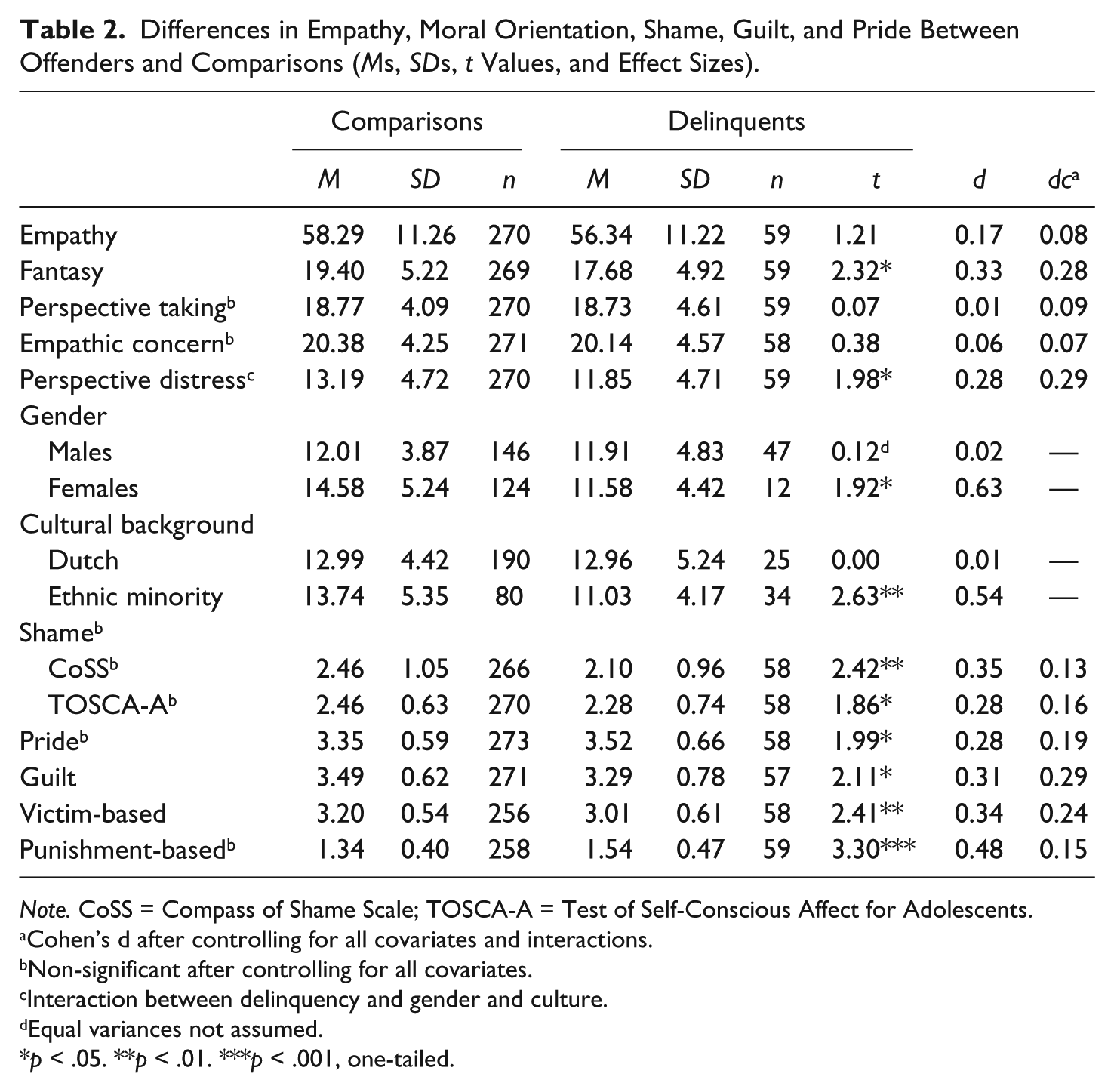
The first hypothesis was that juvenile offenders would show less capacity for empathy, less shame and guilt proneness, more pride proneness, and more Punishment-based and less Victim-based moral orientation compared with the comparisons (Table 2).
Differences in Empathy, Moral Orientation, Shame, Guilt, and Pride Between Offenders and Comparisons (Ms, SDs, t Values, and Effect Sizes).
Note. CoSS = Compass of Shame Scale; TOSCA-A = Test of Self-Conscious Affect for Adolescents.
Cohen’s d after controlling for all covariates and interactions.
Non-significant after controlling for all covariates.
Interaction between delinquency and gender and culture.
Equal variances not assumed.
p < .05. **p < .01. ***p < .001, one-tailed.
It can be derived from the t tests in Table 2 that offenders showed lower levels of Fantasy/identification, Personal Distress, Shame, Guilt and Victim-based moral orientation, and higher levels of Pride and Punishment-based moral orientation (effect sizes were small to medium). We did not adjust for multiple testing, as these separate t tests should be considered as preliminary analyses, followed by ANCOVA. Main effects for delinquency status on Fantasy/identification, Personal Distress, Guilt, and Victim-based moral orientation remained significant after controlling for covariates and interaction effects in a series of 2 (offenders vs. comparisons) × 2 (males vs. females) × 2 (Dutch vs. ethnic minority background) univariate ANCOVAs, with age, SES, family composition, and birth country entered as covariates. A significant interaction effect was found between delinquency status and both gender and cultural background on Personal Distress: F(1, 315) = 6.79, p < .05, and F(1, 315) = 4.12, p < .05, respectively. Offenders reported lower levels of Personal Distress than comparisons, but only in female offenders and in the ethnic minority sample, with medium effect sizes of d = .63 and d = .54, respectively.
Main effects were found for gender on Empathy, F(1, 315) = 31.92, p < .001; Fantasy, F(1, 314) = 18.66, p < .001; Perspective Taking, F(1, 315) = 19.13, p < .001; Empathic Concern, F(1, 315) = 18.12, p < .001; Shame (CoSS), F(1, 310) = 13.41, p < .001; Victim-based moral orientation, F(1, 301) = 17.67, p < .001; and Punishment-based moral orientation, F(1, 302) = 11.45, p < .001, which indicated that females reported higher levels of Empathy (d = 1.04), Fantasy (d = 0.62), Perspective Taking (d = 0.63), Empathic Concern (d = 0.62), Shame as measured with the CoSS (d = 0.72) and Victim-based moral orientation (d = 0.61), and lower levels of Punishment-based moral orientation (d = 0.49) than males. Finally, main effects were found for cultural background on Shame as measured with the TOSCA-A, F(1, 314) = 5.11, p < .05, and Pride, F(1, 317) = 13.21, p < .001, indicating that adolescents with a cultural minority background reported lower levels of Shame (d = 0.25) and higher levels of Pride (d = 0.53) than did Dutch adolescents.
Differences in Coping Styles
The second hypothesis was that offenders would use more externalizing and less internalizing coping styles. In the CoSS, Denial and Attack Other represent externalizing coping styles, whereas Attack Self and Avoidance represent internalizing coping styles. Offenders were also expected to score lower on the Adaptive subscale of the CoSS. On the TOSCA-A, offenders were expected to be more prone to Externalization (“Others are responsible for the situation and my feelings about it”) and Detachment (“This has nothing to do with me”).
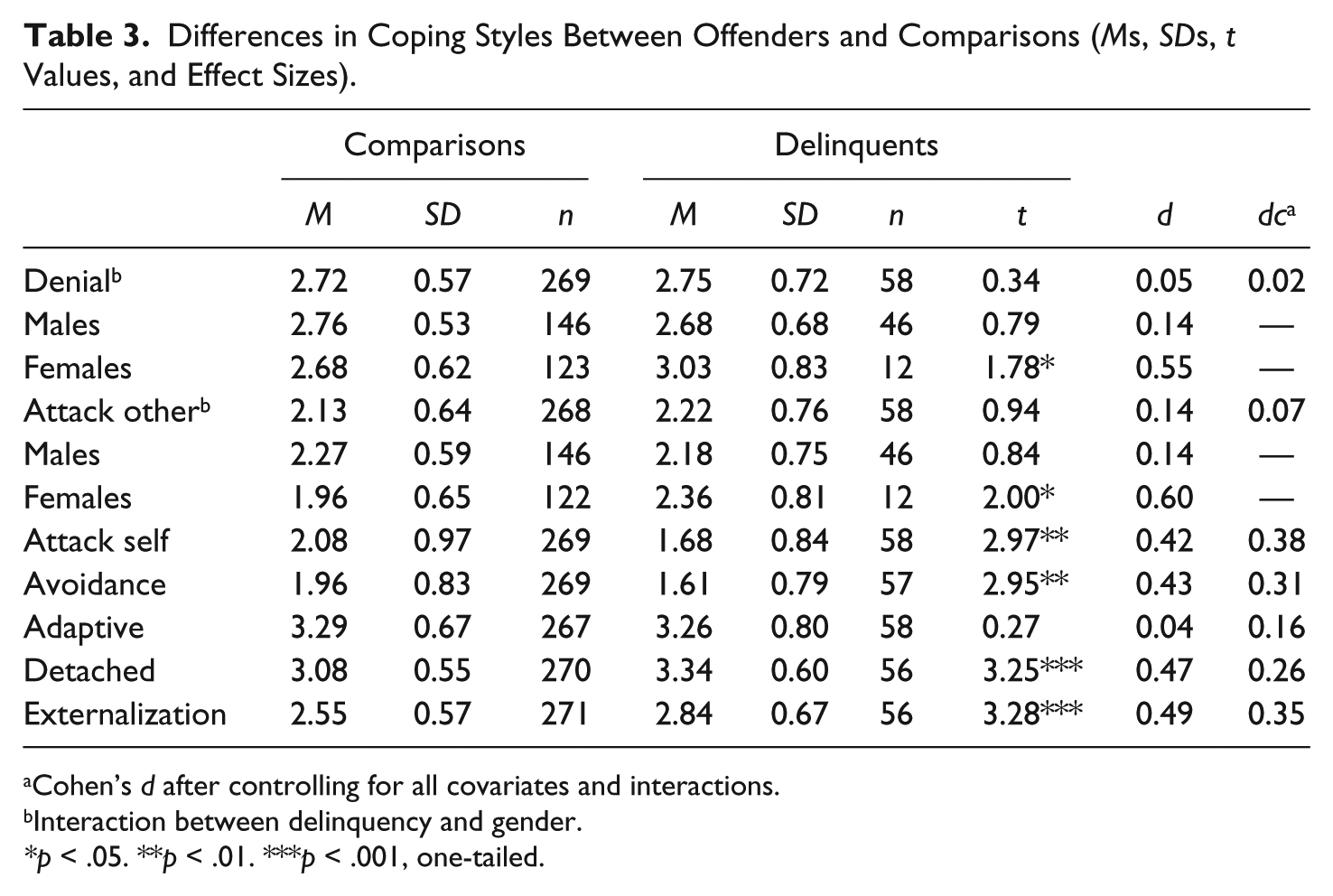
It can be derived from Table 3 that offenders showed indeed less Attack Self and Avoidance (both CoSS) and more Detachment and Externalization (both TOSCA-A). Effect sizes were medium. Again, we did not adjust for multiple testing, as these separate t tests should be considered as preliminary analyses, followed by ANCOVA. A series of 2 (delinquents vs. comparisons) × 2 (males vs. females) × 2 (Dutch vs. ethnic minority background) univariate ANCOVAs, with age, SES, family composition, and birth country as covariates, yielded significant main effects for delinquency status on Attack Self, Avoidance, Detachment, and Externalization, confirming previous t test analyses (effect sizes were somewhat reduced). Two significant interaction effects were found between delinquency status and gender on Denial, F(1, 313) = 4.45, p < .05, and Attack Other, F(1, 312) = 4.67, p < .05. In contrast to the hypotheses, only female offenders reported more Denial and Attack Other than did comparisons, with medium effect sizes of d = 0.55 and d = 0.60, respectively.
Differences in Coping Styles Between Offenders and Comparisons (Ms, SDs, t Values, and Effect Sizes).
Cohen’s d after controlling for all covariates and interactions.
Interaction between delinquency and gender.
p < .05. **p < .01. ***p < .001, one-tailed.
Main effects were found for gender on Externalization, F(1, 313) = 13.36, p < .001; Attack Others, F(1, 312) = 12.31, p < .001; Attack Self, F(1, 313) = 11.57, p < .001; and Avoidance, F(1, 312) = 9.36, p < .01, which indicated that females reported lower levels of Externalization (d = 0.41) and Attack Other (d = 0.39), and higher levels of Attack Self (d = 0.38) and Avoidance (d = 0.34). No further main effects or interactions were found.
Differences in Preferences for Shame, Guilt, and Pride
The third hypothesis was that guilt would show dominance over shame and pride in comparisons, but not in the group of offenders. It can be derived from Table 4 that there was an interaction between shame, pride, and guilt proneness and delinquency status, as hypothesized: F(2, 650) = 5.80, p < .01. A series of Bonferroni corrected post hoc tests (p < .05) revealed that comparisons were more prone to experiencing Guilt than Pride, and subsequently Shame, whereas juvenile offenders showed no differences in Pride and Guilt.
Differences in TOSCA-A Shame, Guilt, and Pride Preference Between Delinquent and Comparison Adolescents (Ms, SDs, t Values, and Effect Sizes).
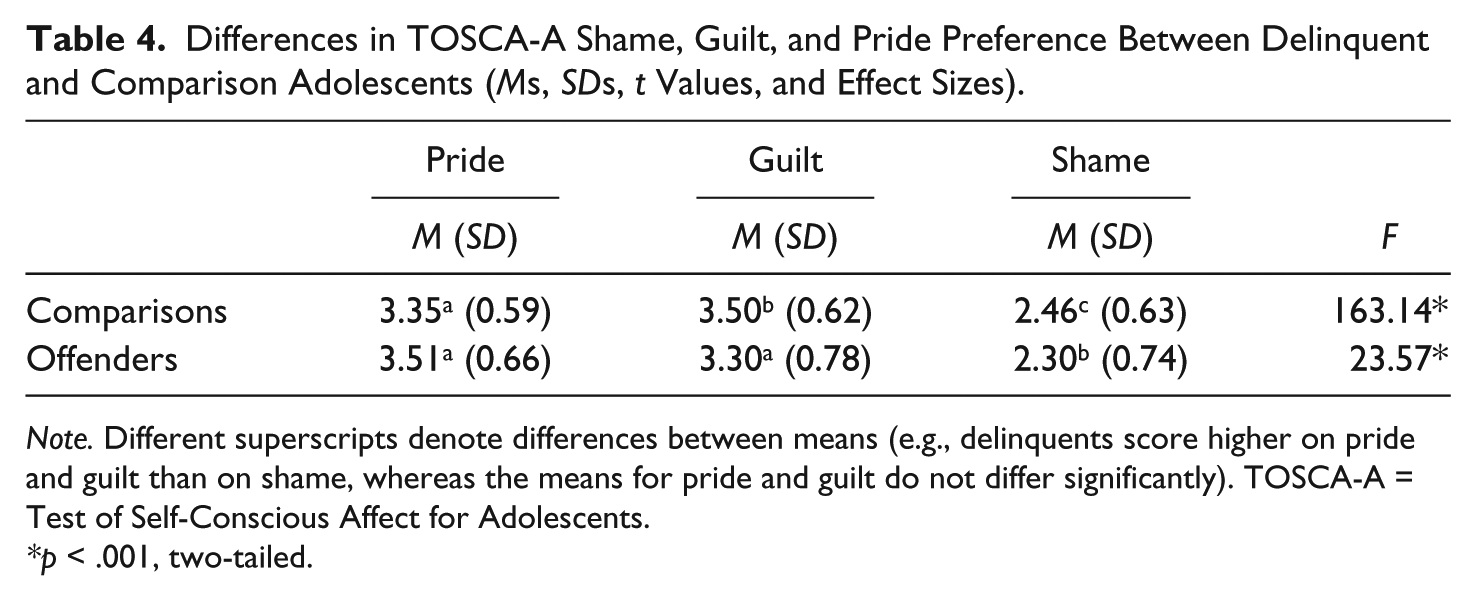
Note. Different superscripts denote differences between means (e.g., delinquents score higher on pride and guilt than on shame, whereas the means for pride and guilt do not differ significantly). TOSCA-A = Test of Self-Conscious Affect for Adolescents.
p < .001, two-tailed.
Differences in Preferences for Coping Styles
Finally, our fourth hypothesis was that comparisons would used more internalizing coping styles (CoSS Attack Self and Avoidance), whereas offenders would predominantly use externalizing coping styles (CoSS Denial and Attack Other).
It can be derived from Table 5 that, contrary to the hypothesis, offenders and comparisons shared the script-sequence “Adaptive—Denial—Attack Other—Attack Self—Avoidance.” Leaving Adaptive aside, this is a developmental order starting with the least consciousness and most externalizing of the shame experience. There was, however, an interaction between coping style and delinquency status: F(4, 1283) = 5.92, p < .001. Comparisons did not differentiate between Attack Other and Attack Self, whereas offenders did not differentiate between Attack Self and Avoidance.
Differences in CoSS Preference of Coping Styles Between Offenders and Comparisons (Ms, SDs, t Values, and Effect Sizes).
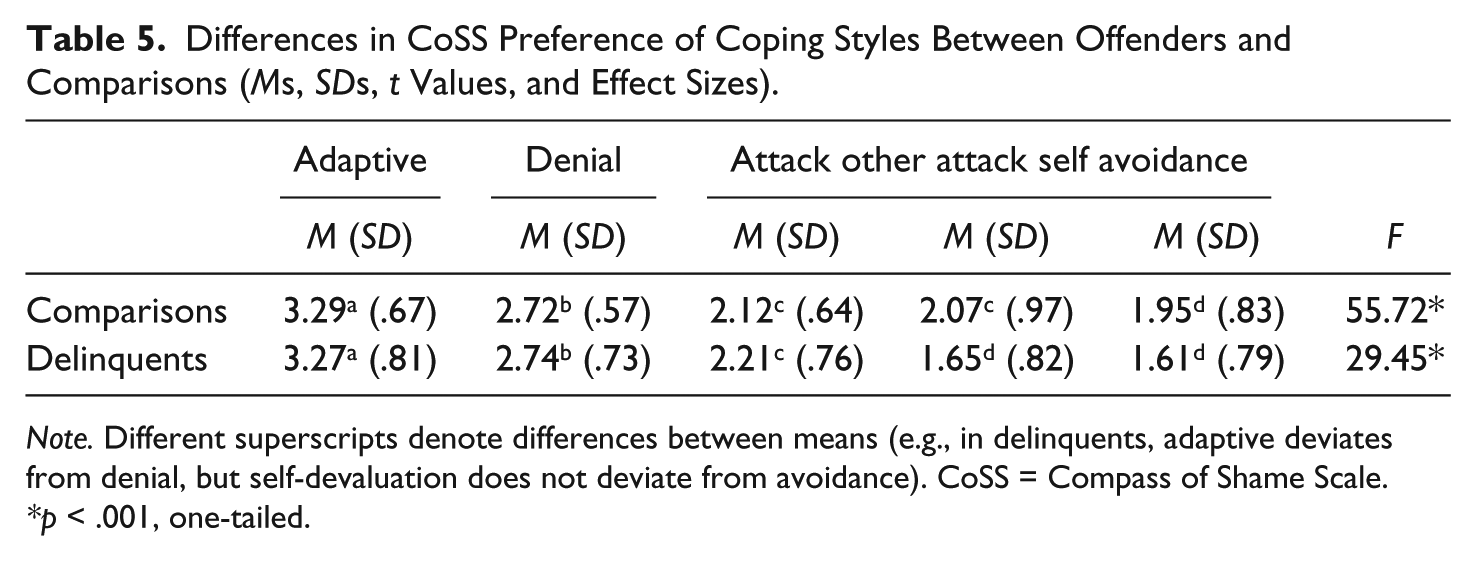
Note. Different superscripts denote differences between means (e.g., in delinquents, adaptive deviates from denial, but self-devaluation does not deviate from avoidance). CoSS = Compass of Shame Scale.
p < .001, one-tailed.
Discussion
In summary, offenders tend to be less capable of identifying with others and are physically less aroused by empathic processes. They are hardly shame prone, moderately guilt prone, and they regulate their self-esteem more by feeling pride than guilt or shame. Also, their regulation of self-esteem is based more on external reactions to their behavior and their own gain. Considering the coping styles, as predicted, male and female offenders tend to use internalizing CoSS strategies less: They are less prone to self-devaluation and avoidance. Externalizing shame experiences were restricted to female offenders: They appropriate shame less. Considering TOSCA-A’s externalizing coping strategies, offenders were more prone to detaching themselves from the situation and externalizing the cause of their behavior or emotion. The coping of the comparisons proved to be more healthy: Although age-appropriate externalizing styles did dominate, the internalizing coping styles were also used. It should be noted, however, that differences between delinquent and non-delinquent adolescents were small.
Constituents of the Conscience: Empathy, Shame, Guilt, Pride, and Moral Orientation
The first hypothesis, that offenders would score higher on Punishment-based moral orientation and Pride and lower on Victim-based moral orientation, Empathy, Shame, and Guilt, was not confirmed on all constituents. Offenders were less prone to trial identification with the offenders, less physically aroused when witnessing others’ discomfort, less prone to experiencing shame and guilt, more prone to experiencing pride, and more punishment oriented than victim oriented. However, the offenders did not differ from the comparisons on the total empathy score nor on the cognitive and affective empathy subscales.
When looking at the various aspects of empathy, more precise inferences can be made. In contrast to the negative relation found in Jolliffe and Farrington’s (2004) meta-analysis of empathy and offending, our two groups did not differ in cognitive empathy (Perspective Taking) or in affective empathy (Empathic Concern). Offenders did score lower than the comparisons on the Fantasy scale, although with a small effect size. This might indicate that offenders are less inclined to a trial identification: “How would I feel if I were in their place?” It might be that they are empathic to those who are near, whereas in relation to their often unknown victims, this aspect of their empathic capacity falls short (Van Vugt et al., 2012). We hypothesized the PD scale to represent empathic distress, and the lower scores of the offenders may indeed point to callous-unemotional traits. This was strongest for female offenders and offenders from ethnic minority backgrounds. This finding will be discussed below. Callousness facilitates offending, but research findings “do not indicate that callousness serves as a confound on the longitudinal relations between moral disengagement and offending” (Shulman, Cauffman, Piquero, & Fagan, 2011, p. 1630). Thus, in the treatment of male offenders, an approach might be needed which starts from the assumption that offenders do have an empathic capacity but that they lack the developmental step of generalizing it to those who are not very near.
This study showed that offenders were less shame prone than their comparisons, although with a small effect size. However, both groups scored lower on shame proneness than on all other TOSCA-A scales: All juveniles were hardly shame prone, but offenders even less so. Especially in early adolescence, shame feelings that threaten identity mount to high intensities, so it could well be that shame is strongly defended against by adolescents (Briggs, 2008). Denial of shame (CoSS) had indeed the highest scores of the four coping styles.
Offenders proved to be guilt prone; more so than shame prone, but less than the comparisons. Again, the effect size was small. A popular speak polarity between shame ridden offenders versus guilt prone comparisons is not feasible. Instead, a developmentally based conclusion is at hand: The conscience of all adolescents matures in the course of their development, but in some more than in others (Steinberg, 2009; Tangney et al., 2007). Offenders were more prone to experiencing pride than their comparisons, with a small effect size. Offenders scored lower on Victim-based orientation and higher on Punishment-based orientation than their comparisons, with small effect sizes. But, again, this difference was not all-to-none, as, at the same time, both groups scored higher on Victim-based orientation than on Punishment-based orientation. The relatively higher Punishment-based orientation would clinically mean that offenders regulate their self-esteem more on the basis of external reactions to their behavior and instant self gain, and less on empathy with others.
Coping Styles and Maturation
The second hypothesis was that offenders would use more externalizing and less internalizing coping styles. In this research, externalizing coping strategies are represented in the CoSS and in the TOSCA-A. On the CoSS, male offenders and their comparisons did not differ in externalizing the shame experience, which might be explained by the fact that for male adolescents (temporary), heightened externalizing coping is a relatively normal developmental process (De Wied, van Boxtel, Matthys, & Meus, 2012). However, the female offenders did differ from their female comparisons (see below). On the TOSCA-A, two externalizing coping styles are differentiated: Detached and Externalization (not exclusively externalization of shame, as with the CoSS subscales). The offenders detach themselves emotionally more from a negative feeling and externalize the cause of the emotion, with small/medium effect sizes. Shulman et al. (2011) showed that moral disengagement in convicted juveniles tends to decline over time, and with it, offending.
Internalizing is represented in the CoSS subscales Attack Self and Avoidance. Offenders and comparisons differed on both scales, the former being less prone to self-devaluation and avoidance, with medium effect sizes. Contrary to the expectation, however, no differences were found on Adaptive (Table 5), implying that all participants see themselves as persons who are willing to accept shame and make amendments.
It is in the psychological maturation to internalizing scripts that differences come to the fore, confirming the third and fourth hypotheses: Comparisons preferred Attack Other and Attack Self to the same extent, whereas the offenders used Attack Other more than Attack Self and Avoidance. The development of the comparisons is relatively more healthy: Although age-appropriate externalizing dominates, the internalizing coping strategies are also available. The comparisons experienced more shame and defended against it by devaluating others and themselves, whereas the offenders experienced less shame, but still defended against it by attacking others.
Gender and Ethnic Differences
In all delinquency statistics, males are by far overrepresented, and it is only in recent decades that the frequency of female offending rises (Van der Laan & Blom, 2011). Clinically, females are known to be more other and relation oriented than males, and thus usually score higher on measures of empathy and shame. Longitudinal research also showed that their higher empathy level remains stable across adolescence, whereas boys showed a decrease from early to middle adolescence with a rebound to the initial level thereafter (Van der Graaff et al., 2014). On Personal Distress, an empathy subscale, female offenders scored significantly lower than the female comparisons, and even lower than male offenders. Female offenders also scored higher than the female comparisons on the two externalizing CoSS subscales Denial and Attack Other, again even a little higher than the male offenders. A clinical implication of this finding would be that male and female offenders should not be offered the same treatment program for enhancing empathic skills.
Ethnic differences were found on the Personal Distress subscale, with offenders from an ethnic minority cultural background scoring significantly lower than comparisons from an ethnic majority. They seem to feel less anxiety or discomfort observing negatively valued situations of others. They also reported being less shame prone.
Pride and ethnic minority were also associated with delinquency: Adolescents with a cultural minority background reported higher levels of pride than did native Dutch adolescents. These effects can be understood as a reflection of the position of a relative outsider: Being member of a minority, often with a negative connotation, can be coped with by distancing oneself from the majority and experiencing the outsider status as a source of pride. Dartington (1998) argued that some amount of temporary outsidership is a necessary phase in the adolescent process of differentiating between being a child in a family and being an adult in society.
Limitations of the Study
Although much effort has been given to engaging a sufficient number of juvenile delinquents, the number of 59 adolescents is still small. This limits the possibility of generalizing from our sample to the total population of juvenile delinquents. Also, the small sample size made it impossible to take severity of offenses into account, although these data were obtained. A second limitation is found in relatively low reliabilities of some TOSCA-A scales. We therefore had to combine the alpha and beta pride scales into one pride scale, which leads to loss of information. Also, the reliability of the Detachment scale was low, although sufficient.
This research confirmed that operationalization of the conscience in terms of empathy, self-conscious emotions, and moral orientation is feasible. The level of functioning of the offender is indeed less mature than that of non-delinquent youth. When interpreting the data, however, it should be kept in mind that personality traits are never all-or-none phenomena. In some situations, traits may come to the fore that in other situations remain hidden. Thus, statistically significant differences have to be interpreted as relative differences. There is no such differentiation as “all bad” offenders versus “all good” comparisons.
Footnotes
Acknowledgements
The authors would like to thank the reviewers for their stimulating and wise suggestions, which certainly improved our article.
Declaration of Conflicting Interests
The author(s) declared no potential conflicts of interest with respect to the research, authorship, and/or publication of this article.
Funding
The author(s) disclosed receipt of the following financial support for the research, authorship, and/or publication of this article: The corresponding author received financial support from the Dutch Foundation for Psychoanalysis for the research of this article.