



Abstract
A growing body of literature has documented the dismal outcomes of youth placed in juvenile correctional facilities (JCFs) upon their return to the community. However, very little is known as to how well equipped are the youth with the necessary skills for reintegration. In the current study, the authors examine self-reports of readiness for independent living among adolescents in correctional settings on the verge of leaving care, and explore how individual, placement, and social support characteristics predict such perceived readiness. A sample of 116 adolescents (aged 15-20) placed in Israeli JCFs responded to structured self-report questionnaires. The results indicated that most adolescents perceived their readiness to leave care as high, with girls showing significantly lower levels of perceived readiness when compared with boys. Higher levels of self-esteem and optimism as well as support from peers and staff were related to better readiness. From these findings, implications for theory and practice are proposed.
Introduction
In the last decades, young people from Westernized societies take more time to assume full adult responsibilities (Arnett, 2000). During this time, they continue to rely heavily on the emotional and financial support of their parents (Douglass, 2007). Young offenders placed in juvenile correctional facilities (JCFs) are faced with especially high risks when transitioning to adulthood, due to their personal and environmental circumstances (Gagnon & Barber, 2010). In Israel, these youth typically leave state care at the age of 18. In the absence of the support of their birth families, upon returning to the community, they are often required to deal with the multiple tasks of adulthood alone. Literature in the field has focused primarily on the high rates of recidivism of reintegrating young offenders (Lipsey, 2014). Nevertheless, findings testify to problematic outcomes in additional life domains such as education and employment (Altschuler & Brash, 2004; Inderbitzin, 2009). Evaluations of various reentry programs indicate strongly that such interventions should begin while youth are still in care and be tailored to match their unique needs, capacities, and preferences (Abrams, Shannon, & Sangalang, 2008; Griller Clark, & Unruh, 2010). Nevertheless, little is known on what are the needs and readiness to independent living among young persons in the period before leaving JCFs (Mears & Travis, 2004).
The present study addresses this gap in the literature and examines self-reports of readiness for independent living among adolescents in correctional settings on the verge of leaving care and identifies factors that may be associated with their perceived readiness.
Readiness for Independent Living
Readiness for independent living pertains to individuals’ ability to provide for their needs, to feel comfortable with themselves, and be satisfied with relationships with significant others (Maluccio, Krieger, & Pine, 1990). To achieve these goals, youth in care need to be ready to pursue further education, obtain a job and keep it, maintain intimate relationships, and so on. These skills can be divided into tangible (e.g., the ability to prepare a meal or manage a budget) and intangible skills (e.g., problem-solving or decision-making skills); both types are important to examine to obtain a comprehensive view of readiness (Nollan, Horn, Downs, Pecora, & Bressani, 2001).
Studies in Israel and elsewhere on readiness to leave foster or residential care have shown that young people on the verge of leaving care are unprepared for independent living in several life domains and need considerable help to cope with the challenges arising through this transition period. This was reported by both staff (English, Kouidou-Giles, & Plocke, 1994; Zeira & Benbenishty, 2011) and youth (Freundlich, Avery, & Padgett, 2007; Sinclair, Baker, Wilson, & Gibbs, 2005). To our knowledge, Benbenishty and Zeira (2008) conducted the only study focusing on readiness to leave care among adolescents in JCFs. Professional staff assessed readiness for independent life of 152 adolescents on the verge of leaving correctional facilities. Their findings suggest significant problems in youths’ readiness. For instance, only 65% were expected to be able to effectively search for a job, and less than half of the adolescents were assessed as being able to look for accommodation or avoid associating with peers who may have a negative influence.
Although these staff reports are preliminary indications of the gaps in readiness for independent living of adolescents in JCFs, it is important to examine youths’ own perspectives (Ben-Arieh, 2005). For one, their subjective perceptions of readiness may affect their reactions to the anticipated transition. These perceptions may also have a bearing on their motivation to engage in services and programs designed to improve preparedness. Clearly, both perspectives, that of the care workers and that of the youth, offer a unique contribution to the understanding of readiness to leave care (DePoy & Gilson, 2003). While they may correlate, they may also differ, reflecting two divergent views of readiness (Benbenishty & Magnus, 2008). Although the predictive power of either perspective with respect to long-term outcomes is yet to be established, recent evidence from a longitudinal study among youth in residential care in Israel suggests that youth reporting higher levels of readiness while still in care do in fact fare better after leaving (Sulimani-Aidan, Benbenishty, Dinisman, & Zeira, 2013). Therefore, in the current research, we chose to examine the youths’ perspectives. Furthermore, the study examines factors that may predict self-assessments of readiness to leave care.
Factors Contributing to Readiness for Independent Living
Knowledge of factors associated with readiness to leave care may serve to identify vulnerable groups and guide programs to prepare and support independent living among care leavers. A review of the literature reveals that predictors of readiness to leave care among adolescents in JCFs have, to the best of our knowledge, not yet been studied, with the exception of a single study. This study focused on various types of relationships with staff as predictors of readiness (Marsh & Evans, 2009). In contrast, more studies were carried out in child welfare foster and residential care institutions, not designated for juvenile delinquents. These studies have suggested a range of factors associated with readiness. Although the experiences of leaving care of the two groups (juvenile delinquents and other adolescents in care) are somewhat different (e.g., vulnerability to negative social stereotypes and post-care assistance eligibility), similarities in institutional characteristics have led us to base our selection of predictors of readiness for independent living on the general care literature.
Iglehart (1994) examined the contribution of various factors to the readiness of 152 adolescents living in foster care in the Los Angeles area. She reports that individual, placement, and support features contributed significantly to youths’ readiness. These factors included school performance and working hours at the individual level, contact with biological father and positive relationships with the caretaker, and number of prior placements. In Israel, Dinisman and Zeira (2011), who interviewed a sample of 277 adolescents living in 27 residential settings, found that youths’ independent living skills were associated with adolescents’ personal attribute of self-esteem and with levels of support from peers and staff but not with institutional level characteristics. Finally, studies also suggest gender effects with regard to readiness for independent living; however, the picture is yet unclear as findings are inconsistent. Thus, although some studies show that girls experience greater difficulties transitioning to life after care (Pecora et al., 2003), others suggest that girls are similar to boys, or even better, in being prepared for the challenges of independent life compared with boys (Dworsky, 2005).
Current knowledge on youths’ readiness to leave child welfare substitute care—foster or residential—suggests that the factors associated with higher levels of readiness can be divided into three domains: individual, placement, and social support characteristics. Major resilience studies such as Project Competence (Burt & Masten, 2010) or Add Health (Wickrama, Conger, Lorenz, & Jung, 2008) that have followed birth cohorts from childhood to adulthood have similarly stressed that individual traits (e.g., planfulness and self-confidence) and functioning (e.g., maintaining schooling), as well as peer and adult supports, work together to “counteract” high levels of adversity. Stability of placement over time has also been well established as a central marker for successful coping in independent life (Avery & Freundlich, 2009; Stein, 2006).
In summary, the purpose of this exploratory study is twofold. First, we examine self-reports of readiness for independent living among adolescents in correctional settings on the verge of leaving care. Second, we investigate the associations between readiness and individual, placement history, and support characteristics. Specifically, we hypothesized that each dimension—the individual domain, comprising of background and functioning characteristics (i.e., gender, country of origin, criminal history, academic achievements, and employment experience) as well as the personal strengths of self-esteem and optimism; the placement history domain (i.e., age at first placement, number of facilities, and length of stay); and the social support domain referring to perceived support provided by family, peers, and caretakers—will have a unique contribution to youths’ perceived readiness to leave care.
Method
Population and Sample
JCFs in Israel are a form of coercive rehabilitative care belonging to the welfare system. They include a variety of facilities ranging from community halfway houses accommodating 14 adolescents to larger locked facilities accommodating 80 young persons. Of approximately 1,500 adolescents living in these facilities, 60% are offending youth and the rest are adolescents who due to extreme risk behavior pose a serious threat to themselves (Moreno, Sabah, Feldmann, & Schiff, 2012). The population of this study was all adolescents aged between 15 and 20 who lived in JCFs in Israel at the time of study. The estimated size of the whole population was about 200 adolescents (no official data on the exact number). Out of this population, we were able to recruit 116 adolescents from 25 facilities (estimated response rate of 58%). This less than optimal response rate was mainly influenced by difficulties in collaboration with some particular facilities, which found it difficult to get parents’ consent for their children’s participation or allocating time for the survey. As far as we could assess, these difficulties were the result of some transient issues they experienced (such as leadership turnover). We could not detect any systematic differences at the organizational or the client level between these facilities and the rest.
The age of youths ranged from 15 to 20 with a mean of 17 (SD = 1.11) and a median of 17.33 years. The majority of the adolescents were boys (57.8%). The majority of the youth (58.2%) came from homes where the parents were not living together, in most cases due to divorce or separation. About 12% were orphans from either parent or both. Youth whose mother was Israeli-born comprised the largest cultural group (37.4%) followed by youth from the Former Soviet Union (28%). Mothers of 14% of the youth emigrated from Ethiopia. These figures of non-Israeli born adolescents were much higher than the proportion in the general population (National Council for the Child, 2012).
Procedure
Letters of consent to participate in the research were sent to all parents, or legal guardians, in their absence, of adolescents aged 15 to 20 living in Israeli JCFs at the time of the study in which they were asked to return a letter in case they objected to their children’s participation. Self-report questionnaires were administered in most of the cases in small groups in the facilities, and representatives from the research staff and from the facility staff attended. In some cases, staff helped participants who had learning difficulties, making all efforts to maintain anonymity. Questionnaires were anonymous and the study was conducted according to the ethical guidelines of the authors’ university and the Israeli Ministry of Welfare.
Measurements
Individual characteristics
Background and functioning characteristics
Background and functioning characteristics included the following six variables: gender, age, country of origin, criminal history (i.e., number of criminal records), academic achievements, and employment experience. Academic achievements included questions about type of school, history of special education, learning disabilities, overall academic performance, and intentions to take matriculation exams. Employment experience included items about work experience, current work, and number of work hours per week.
Self-Esteem
Self-Esteem is a 10-item instrument (e.g., “sometimes I think I’m useless”) developed by Rosenberg (1965) and translated into Hebrew by Hobfoll and Walfisch (1984). Responses were based on a 4-point scale ranging from 1 = strongly agree to 5 = strongly disagree (α = .85).
Optimism
Optimism is measured by the Life Orientation Test–Revised (LOT–R; Scheier, Carver, & Bridges, 1994). This 10-item scale (e.g., “I’m always optimistic about my future”) includes 4 filler items that were not included in the final score. Responses were based on a 4-point scale ranging from 1 = strongly agree to 4 = strongly disagree. Internal reliability in the present study was relatively low, α = .60.
Placement history
Participants were asked about the age of their first out of home placement, number of placements, and the length of stay in the current placement.
Social support
Family support
Family support was measured by a short version of the Relationship With Father/Mother Questionnaire (RFMQ; Mayseless & Hai, 1998; Scharf, Mayseless, & Kivenson-Baron, 2004). The short version consists of 11 items that refer to the mother, father, and another close relative, separately (e.g., “she gives me advice on how to cope”). The participants were asked to rate their feelings about each of them on a 5-point scale, ranging from 1 = not at all true to 5 = very much true. The questionnaire has been used in Israel in previous studies showing good face validity (Scharf et al., 2004). Internal reliability was α = .86, α = .80, α = .73 for the father, mother, and other close relative, respectively.
Peer support
Peer support was measured by the Medical Outcomes Study (MOS; Sherbourne & Stewart, 1991) that consists of 19 items that refer to various types of support (concrete, emotional, affectionate, informational, and positive social interaction). Each item started with “Do you have someone from your peers that . . . ” continuing with a phrase describing the provision of a form of support by peers, such as “will accompany you to the doctor if the need arises.” The participants were asked to indicate on a 5-point scale how often each type of support was available to them, ranging from 1 = never to 5 = always (α = .95).
Staff support
Staff support was measured by a version of the MOS (Sherbourne & Stewart, 1991) that consists of 11 items, used to assess the perceived support provided to the juveniles by their staff. Each item started with “Do you have someone from your staff that . . . ” continuing with a phrase describing the provision of a form of support by staff, such as “understands your problems.” The participants were asked to indicate on a 5-point scale how often various support measures were available to them, ranging from 1 = never to 5 = always (α = .91).
Readiness for independent living
The instrument was designed by Benbenishty and his associates (Benbenishty & Schiff, 2009; Benbenishty & Zeira, 2008). This self-report questionnaire consists of 26 items, each starting with “When you leave care do you think you will be able to . . . ” Responses were measured on a 4-point scale ranging from 1 = yes, for sure to 4 = no, for sure. The following areas were included: higher education (two items, for example, “register for higher education”), employment (4 items, for example, “search for a job”), housing (4 items, for example, “pay rent on time”), household maintenance (4 items, for example, “shop for groceries”), health (2 items, for example, “make an appointment for the doctor”), relationships (4 items, for example, “give or receive love from a romantic partner”), and normative behavior (5 items, for example, “avoid associating with negative peers”). In the present study, a score for perceived readiness for independent living on each of the seven domains was computed (a range of α = .62 for health domain to α = .81 for normative behavior) as well as a total perceived readiness score (α = .92).
Analytic plan
Descriptive data about the participants’ personal and placement history characteristics and their perceived readiness for independent living are presented. Then follow bi-variate analyses (Pearson correlations, t tests, and one-way ANOVAs), conducted to examine the associations between predictive factors and self-reports of readiness. We then present a hierarchical multivariate linear regression where perceived readiness for independent life was the dependent variable and the independent variables were predictive factors found significant in the bi-variate analyses.
Results
Background Characteristics and Covariates
Table 1 describes the main features of the adolescents in the sample. The majority of participants reported having been criminally charged (68.1%) with an average of 3.54 (SD = 4.55) criminal records. Only 19% were studying in regular high schools in the community while half of the participants were studying in specialized tutoring programs in the facilities, targeting the completion of 10th grade, 12th grade, and the matriculation exams. An additional 9.5% were not studying at all. More than a quarter (29.3%) had studied at some stage of their lives in special education and 45.7% have been diagnosed with learning disabilities. Most participants reported high or medium overall academic performance. Most of them reported studying for matriculation exams (54.3%). The large majority of the sample (89.7%) had some employment experience, yet less than half (44.8%) reported working at the time of the study, at an average of 28.5 (SD = 19.5) hours per week.
Distribution of Individual (Background and Personal Attributes), Placement History, and Social Support Characteristics.

Most of the participants first entered the care system (foster, residential, or secure) in adolescence at an average and median age of 14 (SD = 2.51), and have spent an average of 1.31 years in the current secure facility (SD = 1.13). While the majority of youth (56%) have been in one or two out of home facilities, about a fifth (20.7%) have been in four facilities or more, with an overall average of 2.4 facilities (SD = 1.08) placements.
Overall, as can be seen in Table 1, the participants experienced a fair amount of support, although only 76% indicated receiving any support from their fathers. Participants perceived their mothers as more supportive than their fathers. In addition, about half had a close relationship with a relative, a relationship that provided higher levels of support than both parents. High levels of support were also reported received from peers and slightly less from the staff.
Perceived Readiness for Independent Living
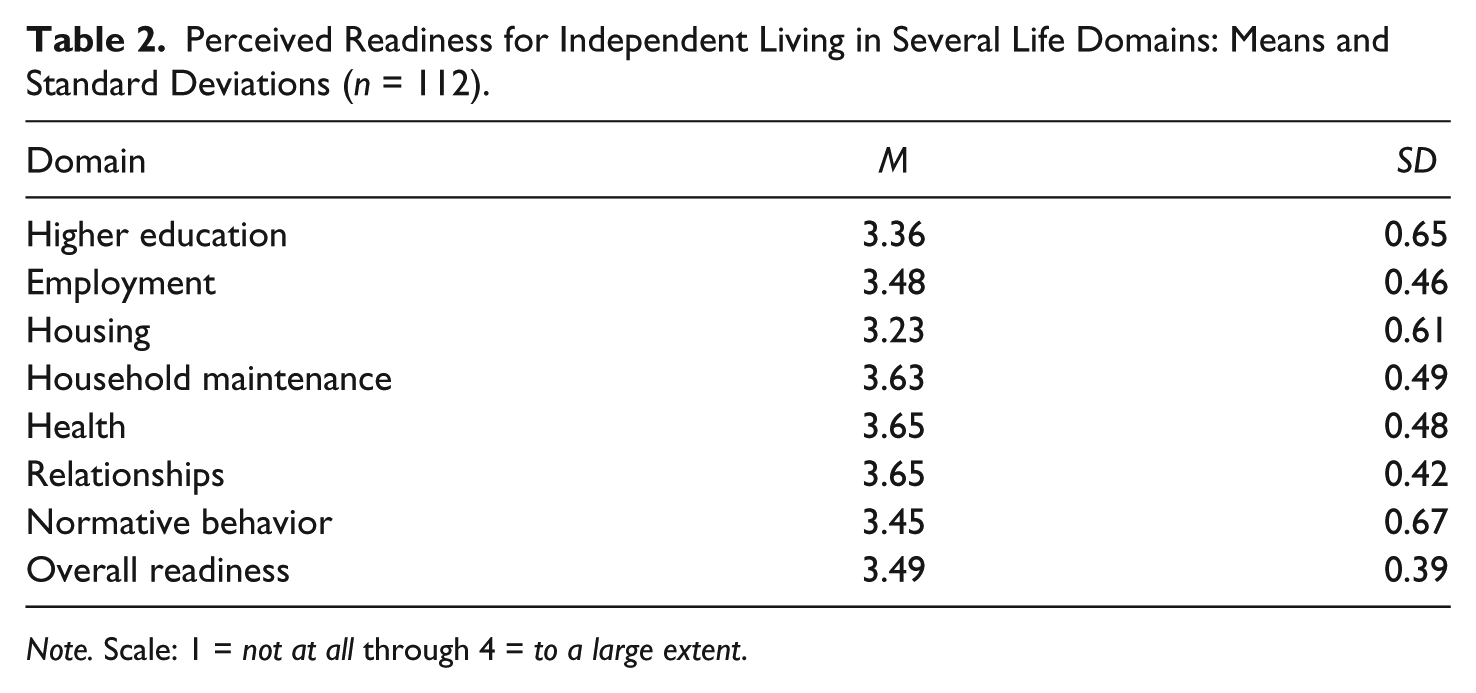
The participants’ total and domain-specific perceived readiness for independent living is presented in Table 2. As can be seen, most participants perceived their readiness to leave care as high in all the life domains assessed. Perceived readiness in respect to housing was the lowest (e.g., knowing how to pay the rent on time or knowing how to look for financial assistance for housing). Highest was their perceived readiness with respect to relationships (e.g., knowing how to give and receive love from a romantic partner) and health (e.g., knowing how to make an appointment to a physician).
Perceived Readiness for Independent Living in Several Life Domains: Means and Standard Deviations (n = 112).
Note. Scale: 1 = not at all through 4 = to a large extent.
Predicting Perceived Readiness for Independent Living: The Relationships Between Perceived Readiness for Independent Living and Individual, Placement History, and Social Support Characteristics
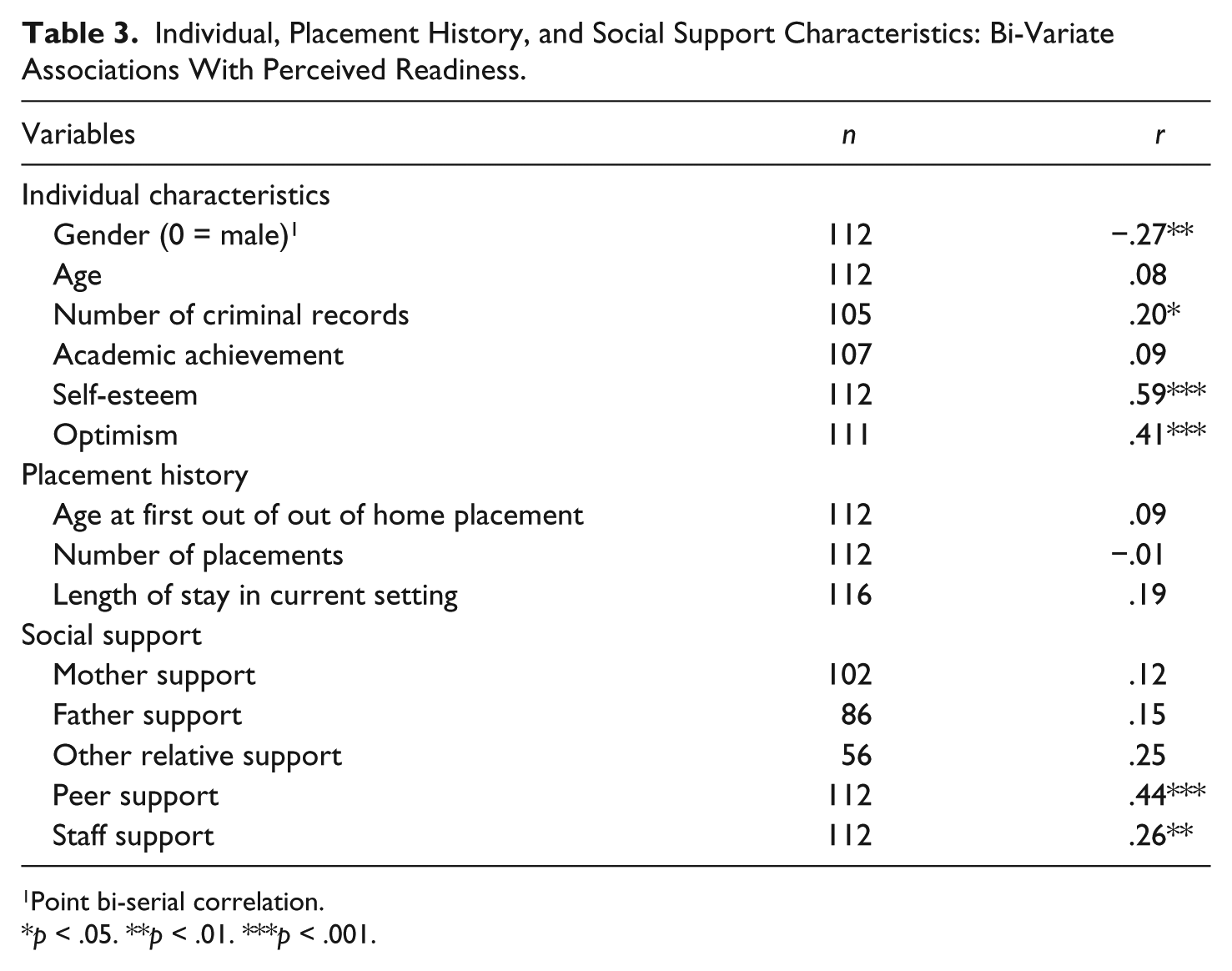
Table 3 presents the correlations between perceived readiness and individual, placement history, and support characteristics. Among individual background characteristics, gender was associated with overall perceived readiness for independent living, with boys showing significantly higher levels of overall readiness (r = −.27, p < .01). We conducted a MANOVA to examine gender effects across all areas of perceived readiness. The findings indicated a general gender effect, F(7, 104) = 2.68, p < .05. A series of ANOVA’s indicated that in four domains, gender differences were significant. The girls had lower skills for handling housing issues, F(1, 110) = 5.88, p < .05; managing their household, F(1, 110) = 13.82, p < .001; managing interpersonal relationships, F(1, 110) = 5.64, p < .05; and avoiding non-normative behavior, F(1, 110) = 4.36, p < .05.
Individual, Placement History, and Social Support Characteristics: Bi-Variate Associations With Perceived Readiness.
Point bi-serial correlation.
p < .05. **p < .01. ***p < .001.
There were no significant differences in perceived readiness between participants of different immigrant background or parents’ marital status. Age, academic achievements, and employment experience were not associated with perceived readiness. Involvement with the juvenile justice system, measured by the number of criminal records, was positively related with self-reports of readiness. That is, participants with more criminal records reported being more ready for independent living.
Two personal strengths were examined—Self-esteem and optimism. Both (as expected) had strong association with a more positive view of readiness (r = .59, p < .001, and r = .044, p < .001, respectively).
Placement history characteristics were not correlated with perceived readiness for independent living. While social support from peers and staff was positively related with readiness, support from family members-mother, father and other relative, was not associated with readiness.
We conducted a multivariate hierarchical regression analysis to explore the combined contribution of the individual and support variables to perceived readiness for independent living. Only variables correlated with readiness were included in the analysis. As shown in Table 4, both individual and support variables contributed to the prediction of perceived readiness for independent living. Of the individual background characteristics that were entered in the first step, only gender was related to readiness. The background individual characteristics’ contribution was significant and accounted for 10% of the explained variance in readiness. Of the individual attributes introduced in the second step, self-esteem was most strongly associated to readiness. This level had the strongest predictive power accounting for 32% of the explained variance. The third step added the support variables. Only staff support was found to significantly predict readiness above and beyond the variance explained by the individual characteristics (5%). Overall, the multivariate model accounted for 47% of the variance in perceived readiness for independent living.
The Associations Between Variable Levels and Perceived Readiness for Independent Living: Hierarchical Multivariate Linear Regression.

p < .05. **p < .01. ***p < .001.
Discussion
The study explored for the first time perceived readiness for independent living among youth on the verge of leaving JCFs, as well as examining those factors associated with readiness. The findings indicate that youth in this study, like those in the Israeli foster and residential care population (Dinisman & Zeira, 2011; Schiff & Benbenishty, 2006), generally reported feeling ready for independent living in most life domains. This is in accordance with other studies showing that adolescents tend to view their future positively (Nuttin & Lens, 1985; Zeira & Dekel, 2005). However, given the many reports on the multiple challenges these youth face when reentering society, this rather positive and optimistic picture warrants further attention. In fact, staff assessments of offending youths’ readiness revealed a much gloomier forecast. As many as half of the youth were assessed as lacking the skills to effectively manage their independent housing, avoid negative peer influence, or form lasting romantic relationships (Benbenishty & Zeira, 2008). Furthermore, assessments of youth were higher also when compared with other youth in foster or residential care, whom we studied, and who are at an overall lesser risk and have better chances of a successful transition (see for example, Benbenishty & Schiff, 2009). One possible explanation for this discrepancy is that the adolescents’ responses were a result of an undifferentiated social desirability effect. Whereas this option cannot be overruled, it seems unlikely as the variation of the ratings across the different domains indicates a differential response and serious consideration of each of the items. In addition, the fact that the interviews were conducted by independent researchers assuring anonymity reduces the likelihood that youth responded positively with the intention of impressing the care workers, thus expediting their emancipation. An alternative interpretation is that youths’ reports reflect their desire to have a good life and easy adjustment to society rather than their actual capabilities of doing so. Thus, it may be that young offenders, as noted by Hirschi (1969) are inclined to make “calculational errors,” confusing high aspirations with actual commitment and achievements. What they seem to be lacking is the understanding of how their current actions may affect their future positions, and the extent to which they plan and subsequently choose their behavior accordingly. Supporting these notions, empirical evidence has shown that young offenders are not only less accurate in assessing their current abilities when compared with their normative peers but also put considerably less effort to achieve expected goals (Siennick & Staff, 2008). It is the level of effort invested, which was to be the key determinant of goal fulfillment. Under these circumstances, careful planning of the concrete steps to be taken to guide their efforts and ensure goal attainment (e.g., changing place of residence to avoid associating with old acquaintances) is especially important for young offenders. Whereas young offenders have clear expectations of certain outcomes after leaving care, they only have a vague idea, if at all, of concrete strategies that will lead them there (Abrams & Aguilar, 2005; Clinkinbeard & Zohra, 2012). Consequently, the positive perceptions of readiness for independent living found in this study may be a two-edged sword. On one hand, care leavers are not paralyzed with fear of leaving care, expect to cope successfully, and are energized to reenter the community. On the other hand, extreme gaps between adolescents’ self-perceived and actual capabilities may pose serious threats to the youths’ ability to deal with the challenges of leaving care, as these challenges are left largely unacknowledged, and therefore no coping strategies are constructed (Abrams, 2012). Lacking awareness of their limitations, adolescents’ motivation and willingness to engage in life skills and reentry programs are also hindered. Hence, a critical initial step of reentry preparation should be to encourage juvenile offenders’ beliefs in their abilities, but at the same time to assist them to accurately delineate the challenges lying ahead, form concrete strategies to overcome them, and address the gaps between their perceived and actual level of independent life skills. Successful experiments carried out with inner city youth involving imagining adulthood and connecting current behavior with future attainment offer promising directions for practice (Oyserman, Terry, & Bybee, 2002).
In the present study, we examined multiple areas that may help explain variance in perceived readiness to independent living. Readiness to leave care was mostly explained by individual characteristics, especially gender and the personal attributes of self-esteem and optimism. The contribution of the social support characteristics was also significant, mainly the support from peers and correctional facility staff. Placement history characteristics, such as length of stay in care, were not associated with perceived readiness.
A key finding of the current research is that girls perceived themselves as less prepared than boys for independent living. This was true across all life domains, with significant differences in housing, house management, interpersonal relationships, normative behavior, and overall preparedness. The questions raised previously as to the meaning of youths’ reported readiness are just as relevant in interpreting this finding. It may be that girls are more realistic than boys, better assessing their abilities and the future challenges awaiting them. At the same time, it also may very well be that the greater doubts they express regarding their abilities reflect real gaps between them and their male counterparts, and they are indeed less prepared for leaving care. As previous findings concerning gender effects on readiness are also inconsistent (Dworsky, 2005; Pecora et al., 2003), there is a need for further research to unravel these issues. However, these findings do indicate that female offenders experience the transition out of care differently. As suggested by Cauffman (2008), it seems that offending girls in JCFs constitute a unique group with special needs that may be overlooked, being a minority group in predominantly male institutions (Snyder, 2004). While only a small number of girls are served by the juvenile justice system, the ones who do enter this system demonstrate very high levels of emotional and behavioral disorders, higher in fact than their delinquent male counterparts (Cauffman, 2004). Despite the unique characteristics of this group, only a handful of interventions exist within the JCFs catering for their special needs, none concerning its reentry (Cauffman, 2008). Hence, there is a critical need for gender sensitive reentry planning that will help appropriately address the unique needs of offending females, before, during, and after the transition to independent living (Mullis, Cornille, Mullis, & Huber, 2004).
As expected, we also found that a sense of self-esteem and optimism contributed to self-reports of preparedness. Both attributes have been consistently identified with resilience of at-risk children and youth (Legault, Anawati, & Flynn, 2006; Reivich, Gillham, Chaplin, & Seligman, 2005). In the context of secure care, this finding is of special importance as detained youth are especially prone to reduced self-esteem and a bleak outlook of their future as a result of enduring emotional trajectories of loss, disruption, and rejection (Oyserman & Markus, 1990; Yates & Grey, 2012). Thus, an important component of interventions supporting young offenders’ transition should be the fostering of their confidence in themselves and their futures (Steinberg, Chung, & Little, 2004).
The contribution of social support was also significant. Interestingly, whereas staff and peer support were associated with perceived readiness, the support from various familial figures was not. These findings highlight the key role of the support networks within the institutions in the lives of young offenders. When considering the role of peers, placing offending youth with adolescents with similar criminal tendencies raises major concerns as it may serve to reinforce existing deviant profiles (Dishion, 2000) increasing the likelihood of reoffending upon reentry (Bayer, Hjalmarsson, & Pozen, 2009). However, corroborating previous evidence from the general population regarding the protective role of peers (Kiuru, Aunola, Vuori, & Nurmi, 2007), our findings point out to the less documented positive effects in secure care as well. Careful planning and implementation of group interventions are recommended to make proper use of pro-social peer effects within the institutions (Steinberg et al., 2004).
Regarding staff, previous research has similarly found that positive relationships with staff in juvenile secure settings are important in promoting change in young offenders (Roush, 1996) and enhancing perceived likelihood of success on release (Marsh & Evans, 2009). Staff members in such settings are often faced with multiple and often conflicting demands from both highly difficult adolescents and management (Biggam & Power, 1997). For them to maintain a supportive stance conducive to their clients’ rehabilitation and readiness to exit care albeit these challenges, ongoing training and supervision are recommended.
The fact that familial support did not contribute to the young people’s readiness is not surprising given the well-documented conflictual nature of their relationships with their families and the families’ own high-risk propensity (Granello & Hanna, 2003). Nevertheless, when these young people exit care and the institutional supportive networks are no longer available to them, it is to these families they typically return (Garfinkel, 2010). It is therefore vital to include the renegotiation of familial relationships within reentry planning, identifying and strengthening sources of support within the family when possible, or ensuring alternative ones when these are lacking (Steinberg et al., 2004).
Study Limitations and Directions for Further Research
Our findings should be seen in the light of some limitations of our study. First, readiness for independent living was measured by self-reports. Although this is an important perspective, it provides an incomplete picture that, as previously noted, raises questions as to the meaning of readiness reports. First, when analyzing youth self-reports, one cannot overrule the possibility of social desirability, leading to over positive reports. Some of the cases that required staff assistance in filling out the questionnaires (see “Method” section) may have been especially susceptible to this effect. As discussed earlier, it is also yet unclear whether youths’ reports reflect actual skills or preferred outcomes, and how they relate to external reports such as those of staff. These are all important questions as in answering them, we may learn more about offending youths’ readiness for independent living as well as other aspects of their mental or cognitive state that will help us assist them as they near termination of care. Further studies using longitudinal designs and simultaneous assessments of readiness of both staff and youth would serve to overcome youth self-report biases and contribute to our understanding of these issues.
Along the same lines, when considering the contribution of the support youth perceive to have, to their reports of readiness, it may be that it in fact reflects their belief that this support from staff or friends will be available to them upon leaving care. Thus, an interesting avenue for future research would be to examine whether indeed youths’ social support perceptions while in care are indicative of actual social support available to them after termination of care.
Another limitation is that the type and severity of crimes that brought the young people to the institutions was not available to us and therefore not controlled for. Surprisingly, the number of criminal records that was included in our analysis was found to be positively related to youths’ level of readiness. Future replications of this finding could help to further explain it. Finally, while we attempted to reach all adolescents on the verge of leaving JCFs in Israel, our response rate (58%) is less than optimal. Future studies should address these limitations.
Footnotes
Acknowledgements
We are very grateful for the helpful comments of anonymous referees on an earlier draft of this article.
Declaration of Conflicting Interests
The author(s) declared no potential conflicts of interest with respect to the research, authorship, and/or publication of this article.
Funding
The author(s) received no financial support for the research, authorship, and/or publication of this article.