



Abstract
Research has found that among juveniles weak ties to informal social control entities such as parents, school, and conventional peers increase the probability of the initiation and continuation of deviant behaviors such as drug use and crime. Given the weak ties of formal social control mechanisms in highly disadvantaged communities, informal social control mechanisms are often an important deterrent that reduce or moderate engagement in deviant behaviors among serious and persistent offenders. This analysis examines the association between long-term gang membership and adolescent informal social control processes, drug use, and delinquency. This research is based on data from a study of 160 Mexican American male gang members between the ages of 16 and 20. Findings suggest that among gang members in this context, commonly studied informal control mechanisms such as the family and schools do not function to deter long-term gang membership that is associated with serious criminal and violent behavior and drug use. The implications for future research on desistance or continuation of antisocial behavior across the life course are discussed.
Introduction
This article employs an age-graded informal social control perspective to examine factors associated with length of gang membership in a population of young Mexican American males. Evidence indicates that Mexican American and other Hispanic youth street gangs have proliferated in the United States and have spread across the country in large and small cities and in suburban and rural areas (Howell & Egley, 2005). Many of these Mexican American gangs are located in economically disadvantaged neighborhoods characterized by unemployment, poverty, welfare dependency, and single-headed households (Rios, 2011; Telles & Ortiz, 2008). During the past decade, a great deal of national attention has focused on prevention and intervention programs and gang suppression approaches by law enforcement in Hispanic and African American communities (Klein & Maxson, 2010). Nevertheless, adolescents and young adults involved with gangs continue to be at disproportionate risk for criminal and violent offending and victimization. This article examines the association between selected social control processes (family and school), delinquent behaviors, and length of time in the gang. The article contributes to a greater understanding of the influences of informal social control processes on serious and persistent delinquent minority youth offenders and the implications long-term gang membership may have on the continuation of criminal behavior in adulthood.
Age-Graded Theory of Informal Social Control and Gangs
Developmental and life course theories of criminal and deviant behavior focused on social control have gained much attention. Social control broadly refers to the regulation of behavior and is a factor that varies across people’s lives, which may account for stability or change in antisocial behavior (Hirschi, 1969). Institutions of both formal and informal social control vary across the life span (Laub & Sampson, 2003; Sampson & Laub, 1993). Whereas formal social controls are more institutionalized, informal social controls emerge from role relationships across key social institutions such as families, schools, friendship networks, or community-based associations (Kornhauser, 1978; Silver & Miller, 2004; Warner, 2014). Informal social control emphasizes the structure of interpersonal bonds linking individuals to one another and to social institutions. One of the key assumptions for this article is that delinquent behaviors are more likely to occur when an individual has a low level of attachment and bonds to society. It is argued that parental, neighborhood, and school-based controls are important deterrents for both direct delinquency and peer-level contexts for delinquency. One of the most prominent theories using the life course perspective is that of Sampson and Laub’s (2008) age-graded theory of informal social control. The theory posits that while persistence in crime is explained by a lack of social controls, structured activities, and purposive human agency, these characteristics vary by age over the life course. These age gradients contain life events or transitions that occur over a longer life trajectory (Elder, 1985).
While social controls and behaviors are age graded, the consequences tend to follow defined trajectories. Trajectories are age-graded patterns of development usually linked to major social institutions such as family, school, and employment over the life course. Transitions are identified as events that occur when people move in and out of a trajectory, typically in a socially ordered manner. For delinquent adolescents, transitions are often characterized as precocious given their untimely occurrence, which includes such events as dropping out of school, early cohabiting, and teenage parenthood (Thornberry, Krohn, Lizotte, Smith, & Tobin, 2003). Krohn, Lizotte, and Perez (1997) argue that these precocious transitions make it more difficult to acquire the human and social capital to make a successful transition to adulthood. It has been documented that delinquent or antisocial behavior follows long-term trajectories that can be interpreted as pathways of development over the life span (Hser, Hoffman, Grella, & Anglin, 2001; Hser, Longshore, & Anglin, 2007). For instance, continuities in antisocial behavior beginning in childhood are often maintained throughout adulthood across such domains as alcohol abuse, domestic violence, and crime. Moreover, salient life events and social bonds in adulthood (i.e., attachment to the labor force and cohesive marriage) explain variations in criminal behavior independent of prior differences in criminal propensity.
The life course approach has provided a theoretical framework for understanding and organizing gang membership and related gang processes over time (Pyrooz, Decker, & Webb, 2014). Utilizing this framework, existing research on initiation and continuation of adolescent gang membership has documented not only increases in delinquency and offending but also fewer associations with prosocial peers, decreased school commitment and parental monitoring, and related factors including anger identity, unstructured socializing, and violence neutralization (Decker, Melde, & Pyrooz, 2013; Matsuda, Esbensen, & Carson, 2012; Maxon, 2011; Medina Ariza, Cebulla, Aldridge, Shute, & Ross, 2014; Melde & Esbensen, 2011, 2014; Weerman, Lovegrove, & Thornberry, 2014). This research supports the “enhancement model” of gang membership (Thornberry et al., 2003), which argues that while youth who join gangs are different from their peers, it is the gang membership that alters their delinquent trajectories. In other words, gangs “facilitate” crime among its members (Krohn & Thornberry, 2008). More recently, studies have begun to focus on gang membership as a turning point in the lives of adolescents as they transition out of the gang. Specifically, this research has documented the detrimental impact of gang membership, including lower levels of overall educational attainment, increasing future offending, and low bonds to conventional institutions (Pyrooz, 2014a; Pyrooz, Sweeten, & Piquero, 2013; Sweeten, Pyrooz, & Piquero, 2012).
While the existing studies document the relationship between gang involvement and a reduction in positive social bonds and increased delinquency, methodological limitations have precluded the close examination of long-term gang involvement among serious and persistent youth offenders. For instance, many of the previous studies have tended to rely on samples with histories of gang membership of less than 3 years (with most averaging 1 year), school-based recruitment, and small sample sizes at follow-up periods. Only limited studies have focused on the population of gang members who maintain their affiliation for longer periods of time that have been characterized as contributing to greater lethal violence (Egley, Logan, & McDaniel, 2012; Pyrooz, 2014b; Watkins & Moule, 2014). Moreover, given the nature of existing samples of gang members, findings have primarily focused on “cafeteria style” general delinquency, making it more difficult to understand more serious forms of criminal and violent behavior for youth with more extensive gang membership trajectories. Long-term gang members may have greater “gang embeddedness” (Hagan, 1993; Pyrooz, Fox, Katz, & Decker, 2012), may be more isolated from conventional prosocial influences and institutions, and may be more likely to have a greater commitment to gang values and norms including serious criminal and violent behaviors (Curry & Decker, 1998; Moule, Decker, & Pyrooz, 2013; Sweeten et al., 2012; Watkins & Moule, 2014). Because of these previous limitations, the generalizability of the association between gang membership, social bonds, and delinquency remains unclear.
The current study examines the unique role of “long-term gang membership” on commonly measured factors including informal social control processes, drug use, and general and violent delinquency among street-recruited youth. Recent research from Krohn, Ward, Thornberry, Lizotte, and Chu (2011) suggests a closer examination as to what places youth at risk for stable long-term gang membership given the potential deleterious short- and long-term outcomes. This article also contributes to existing research by examining a non-institutionalized high-risk group of community-based, street-recruited Mexican American male youth affiliated with street gangs. Focusing on key components of the age-graded theory approach, we identify two hypotheses. First, we hypothesize that informal social control processes will deter long-term gang membership among these street-oriented youth. Second, it is hypothesized that substance use, general and violent delinquency, and other risk behaviors will be positively associated with length of gang membership. In the analysis, we will control for other variables including individual and family characteristics. We discuss how level of informal social control during adolescence is likely to have lasting impacts on young adulthood behaviors.
Method
The data come from a research project aimed at identifying and distinguishing the relationship between gang violence and drug use in San Antonio, Texas. Contrary to school- and institutional-based samples used in previous life course gang research, the subjects are drawn from a community-based sample in a disadvantaged urban context. Accordingly, we expect our sample to be more likely to be overrepresented among those who experience adverse health, behavioral, and social consequences related to gang involvement.
A stratified proportional sample of 160 gang members was drawn from the rosters of 26 gangs located in the West Side of San Antonio. Two indigenous field workers conducted social mapping of this community using systematic field observations and recorded extensive field notes. The social mapping stage of the study lasted approximately 6 months, although fieldwork and collection of field notes was a continuous process lasting the length of the project. Social mapping assisted in the identification of gangs and congregation sites, such as public parks, public housing spaces, playgrounds, recreational centers, downtown areas, neighborhood businesses, and specific neighborhoods. In conducting this initial fieldwork, field workers were able to establish “an ethnographic presence” (Sifaneck & Neaigus, 2001) and maintain a high visibility within the targeted recruitment area to help legitimize the project in the community. After this was accomplished, the field workers began to make contacts with the gang members, gain their trust, and obtain access to their social networks.
The fieldwork resulted in identifying all 26 active youth gangs and their respective rosters in this area whose cumulative membership totaled 404 persons. The validity and accuracy of gang rosters were checked using at least three of four collateral sources: “gatekeepers,” gang member contacts, key respondents, and field workers’ observations. Gatekeepers are those who control access to information, other individuals, and places (Atkinson & Hammersley, 1994). This information was used as the study’s sampling frame parameters and was used to design a stratified sample that generated the 160 gang members for inclusion in this study (see Peterson & Valdez, 2005; Yin et al. 1996) for a detailed description of this sampling procedure).
Using a multi-methods approach, including questionnaires, ethnographic methods, focus groups, and life history intensive interviews, we draw on a sample of native born Mexican-origin male gang members between the ages of 16 and 20 years.
Variables
Individual and family characteristics are measured in this study. Individual characteristics include current employment, number of children, marital status (single), and ever arrested. Family characteristics include having relatives ever involved in illegal activities, having relatives using drugs, attending church with family, and family ever lived in public housing.
Gang membership is categorized according to the gang’s organizational structure and involvement in drug dealing (Valdez & Sifaneck, 2004). Street gangs are traditional territorial-based gangs that are not typically identified by organized crimes. Drug-related gangs are hierarchically organized, criminal, and tied to the drug market. Delinquency in drug-related gangs is more systematic and is focused less on territorial issues and more on maintaining and not calling attention to the drug trade. We also assess respondents’ length of time in a gang. Given the relatively long periods of gang involvement, a dichotomous variable is coded into less than 5 years and 5 years or more.
Family social control processes include parental supervision, attachment to parent, a family attachment activities index, and harsh discipline. Respondents were asked to identify how often they had seen or talked with the person who raised them during the past year. Responses were measured using a 5-point scale ranging from 0 = never to 4 = everyday. Attachment to parent assessed what kind of relationship the respondent had with the person who raised them. The 4-point scale ranged from 0 = no relationship to 3 = good relationship. Respondents were also asked if they had taken part in each of 10 family activities during the past year (0 = no, 1 = yes). The items were summed to create a composite score for participation in family activities ranging from 0 to 10. The final construct is the family social control process of “harsh discipline.” It was measured by asking respondents whether, compared with other people their age, they thought they were physically abused, beaten, or hit more by their family at home. A 3-point measure ranging from 0 = less to 2 = more was used.
School social control processes includes skipping school, suspended from school, expelled from school, and school performance. Skipping school is coded on a 5-point scale ranging from frequent attendance (3 or more times a week) to never attend. School performance used a 4-point scale from 0 = poor to 3 = excellent. School suspensions and expulsions are coded if they occurred or not.
Lifetime prevalence, current prevalence, and frequency of substance use are measured for seven substances including alcohol, marijuana, cocaine, heroin, speedball (heroin and cocaine mix), psychedelics, and benzodiazepines. Lifetime prevalence is assessed using a standard drug measure that identifies whether an individual has ever used any of an array of these substances. Current prevalence employed the same measure for the past month. Respondents were also asked to report the number of days per month they used each substance to assess frequency of use. Research assessing the validity of self-reported drug use among gang members finds that disclosure rates among gang members are robust and do not differ significantly from non-gang members (Katz, Webb, & Decker, 2005; Webb, Katz, & Decker, 2006).
General delinquency, violent delinquency, and violence risk was assessed using self-reported measures. The general delinquency measure was adapted from the National Youth Survey (NYS). Items ask respondents how often they have been involved in each of 19 activities during the past year. Responses range from 0 = never to 5 = very often. Items include behaviors such as running away, selling drugs, shoplifting, and vandalism. A reliability alpha of .77 for this index is observed for our sample. Similar to the delinquency index, the violent delinquency index includes six violent acts they engaged in during the past year ranging from never to very often. Items include fighting, bringing a weapon to school, arson, violent acts (drive-bys, assault), armed robbery, and carjacking. The alpha coefficient for this index is .63. For our violence risk measure, we use the Plutchik Feelings and Acts of Violence Scale (PFAV; Plutchik & Praag, 1990). The PFAV measures the degree to which respondents engaged in violent acts when they were growing up. The scale consists of a 12-item questionnaire with a proven high reliability and validity. Eleven questions are measured on a 4-point scale. The final item requires a “yes” or “no” response. The violence risk score is calculated as the total numeric weight on the 12 items. Scores range cumulatively from a low of 0 to a high of 34. Respondents scoring at least five affirmative answers (“affirmative” is defined as any response other than “never”) are classified as potentially violent. Alpha coefficient levels for the PFAV is .85 in the sample.
Gang-related activities include specific behaviors that are associated with gang involvement. Specifically, we assessed whether the respondent had ever fired a gun in a gang fight, had used a weapon to harm someone, or had been shot at while selling drugs.
Analysis
We first present descriptive statistics for all study variables and compare key characteristics (i.e., gang membership, delinquency, violence, and drug use) with a school-based sample of youth gang members collected by Thornberry and colleagues (2003) in Rochester, New York. This study is selected for comparison for three reasons. First, it is among the first to apply a life course perspective to gang membership, similar to the present study. Second, it relies on a school-based sample, which provides an interesting comparison with our street-based sample. And third, it uses comparable measures for variables of interest (e.g., years of gang involvement, delinquency, drug use, drug sales, etc.). The next step in the analyses is an examination of bivariate correlations between general delinquency, violent delinquency, and substance use and the informal social control processes. Pearson’s correlation is used to examine these associations. We then use bivariate logistic regression to examine the relationship between each of the study variables and length of time in the gang (0 < 5 years, 1 ≥ 5 years).
Results
The respondents have a mean age of 18.6 with an average education level of 9.3 years. Thirty-one percent have children, 33% were employed at the time of the interview, and 15% are currently or have ever been married. In addition, nearly 70% of the sample has lived in public housing at some point in their life. The majority of the adolescents have been arrested at least once in their lifetime (88%). Almost three fourths of the sample had relatives engaged in illegal activities when they were growing up (73%). Half had relatives who used drugs (51%).
We find a high level of parental supervision, with 69% of the sample indicating that they experience everyday parental supervision. We find that only 26% of our sample indicates that their attachment to their parents was bad, strained, or that they lack a relationship. The family attachment activities index report a mean value of 3.9, with a standard deviation of 2.28. Harsh discipline is relatively low in the sample (M = 0.71, SD = 0.75). More than 80% reported that compared with other people their age, they had the same or less amount of harsh disciple (physical abuse) from their parents. When asked if they had ever been suspended from school, more than 60% of respondents indicated suspension from school at least once and 53% indicated that they have been expelled from school. We find a mean school performance value of 0.70, with only 15% of the sample indicating good or excellent performance.
Exceptionally high lifetime use was reported for alcohol (98%), marijuana (98%), and cocaine (90%). More than half of the sample reported lifetime use for heroin (57%), psychedelics (58%), and benzodiazepines (74%). In addition, a large percentage reported lifetime use for speedball (44%; injected heroin and cocaine). Current use (past 30 days) is also high for alcohol (83%), marijuana (75%), and cocaine (53%), with one quarter reporting heroin use. Marijuana had the highest frequency of use (mean days per month 20.3, SD = 11.35). The lowest is psychedelics which reflected 1.8 days per month (SD = 0.13). Frequency of heroin use in the past month is notably high with a mean of 12.2 days (SD = 11.16). This frequency is higher than alcohol (M = 11.7, SD = 9.70), cocaine (M = 7.6, SD = 7.73), and benzodiazepines (M = 3.8, SD = 4.50). The mean frequency of speedball use is also relatively high at 6.1 days (SD = 8.42).
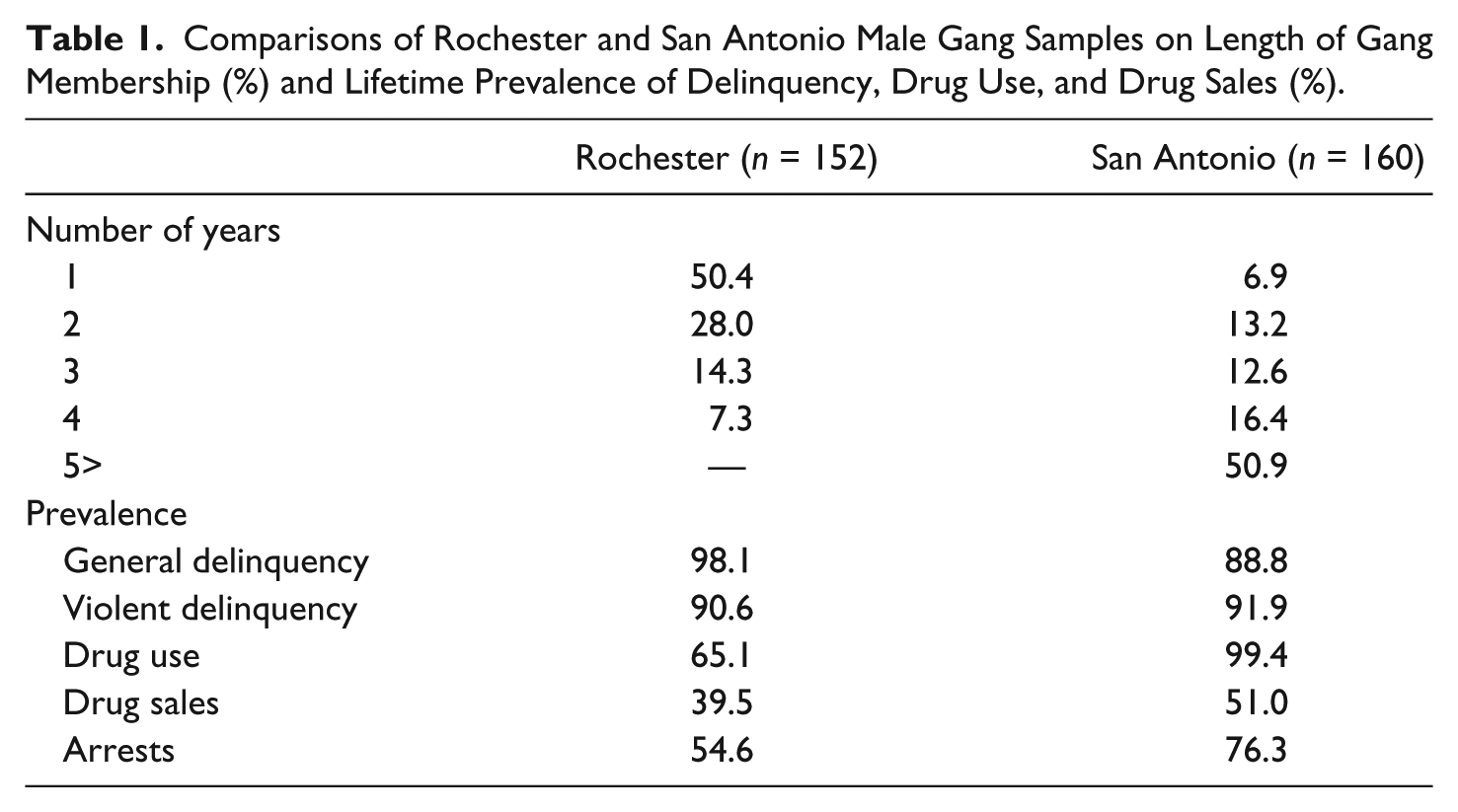
We also find a high level of long-term gang membership among our respondents reflecting a larger proportion of long-term gang members than previous studies. Table 1 compares length of time in gang and lifetime prevalence of delinquency and drug use for the San Antonio sample and the gang members in Thornberry’s Rochester study. Thornberry et al. (2003) find that approximately 50% of gang members indicated 1 year of membership, compared with 6.3% in our sample. In contrast to the Rochester sample where 100% were in the gang for 4 years or less, in the San Antonio sample 50% were members for 5 years or more. However, we find very similar levels of delinquency among the two samples, with 88% and 92% of the San Antonio sample indicating engagement in general and violent delinquency, respectively, compared with 98% and 90% in the Rochester sample. Differences between the two samples appear in drug use, drug sales, and arrest. The San Antonio gang members had higher levels of drug use (99%), drug sales (51%), and arrests (76%). In addition, violence risk is elevated in the San Antonio sample with a mean of 17.4 on the PFAV scale (SD = 3.79; not shown). Almost all of the respondents had fired a gun in a gang fight (88%) and used weapons to harm someone (83%) in their lifetime while almost one fifth had been shot at while selling drugs (19%).
Comparisons of Rochester and San Antonio Male Gang Samples on Length of Gang Membership (%) and Lifetime Prevalence of Delinquency, Drug Use, and Drug Sales (%).
Bivariate correlation analyses reveal significant relationships between several of the family and school informal social control processes and delinquent and violent behavior variables. For example, a stronger attachment to a parent was associated with a decrease in the violent delinquency index score (r = −.169). Also, we find that ever having been expelled from school was associated with a higher score on the violent delinquency index (r = .203) and the violence risk scale (PFAV; r = .245). Next, we examine the correlations between substance use prevalence and each of the informal social control processes. First, we find that lifetime use of inhalants was negatively correlated with parent supervision, with less parental supervision associated with a higher likelihood of ever using inhalants (r = −.160). School attachment variables are found to be correlated with prevalence of drug use. Lifetime cocaine use has a modest positive relationship with suspensions in school (r = .182). Similarly, lifetime benzodiazepines (r = .200) and alcohol (r = .205) use were correlated with the school attachment variable of skipping school. In addition, use of inhalants was positively correlated with ever being expelled from high school. Lifetime use of acid and speedball was negatively correlated with school performance (r = −.187).
Substance use frequency is also associated with informal social control processes. Harsher discipline is positively correlated with alcohol use in past 30 days (r = .189) and parental supervision was inversely correlated with frequency of speedball (r = −.519). School attachment as evidenced by not skipping school is negatively associated with frequency of alcohol (r = −.178) and marijuana (r = −.268) use. Never being suspended was negatively correlated with frequency of alcohol (r = −.264) and school performance was inversely related to the frequency of adolescent marijuana (r = −.209).
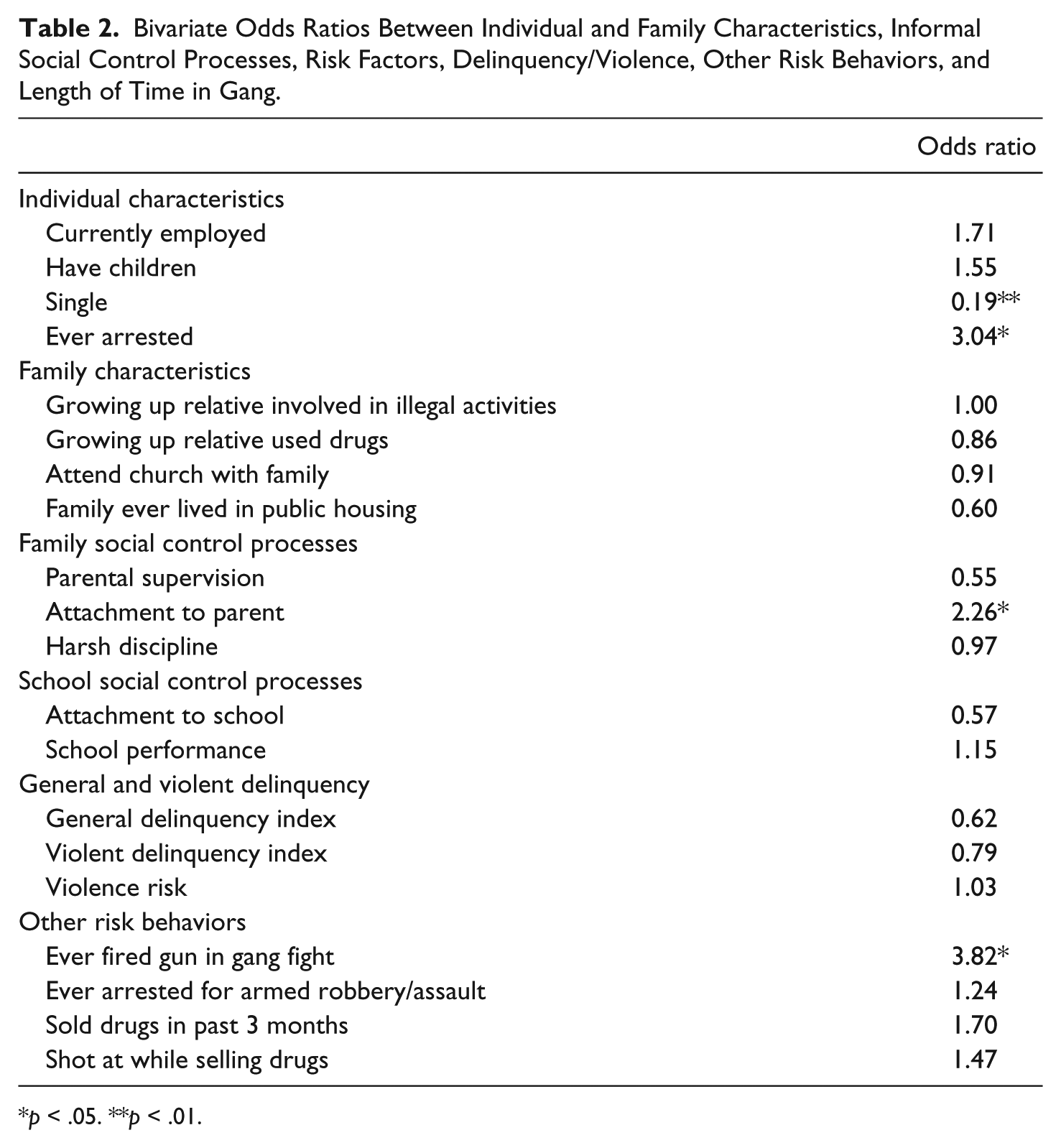
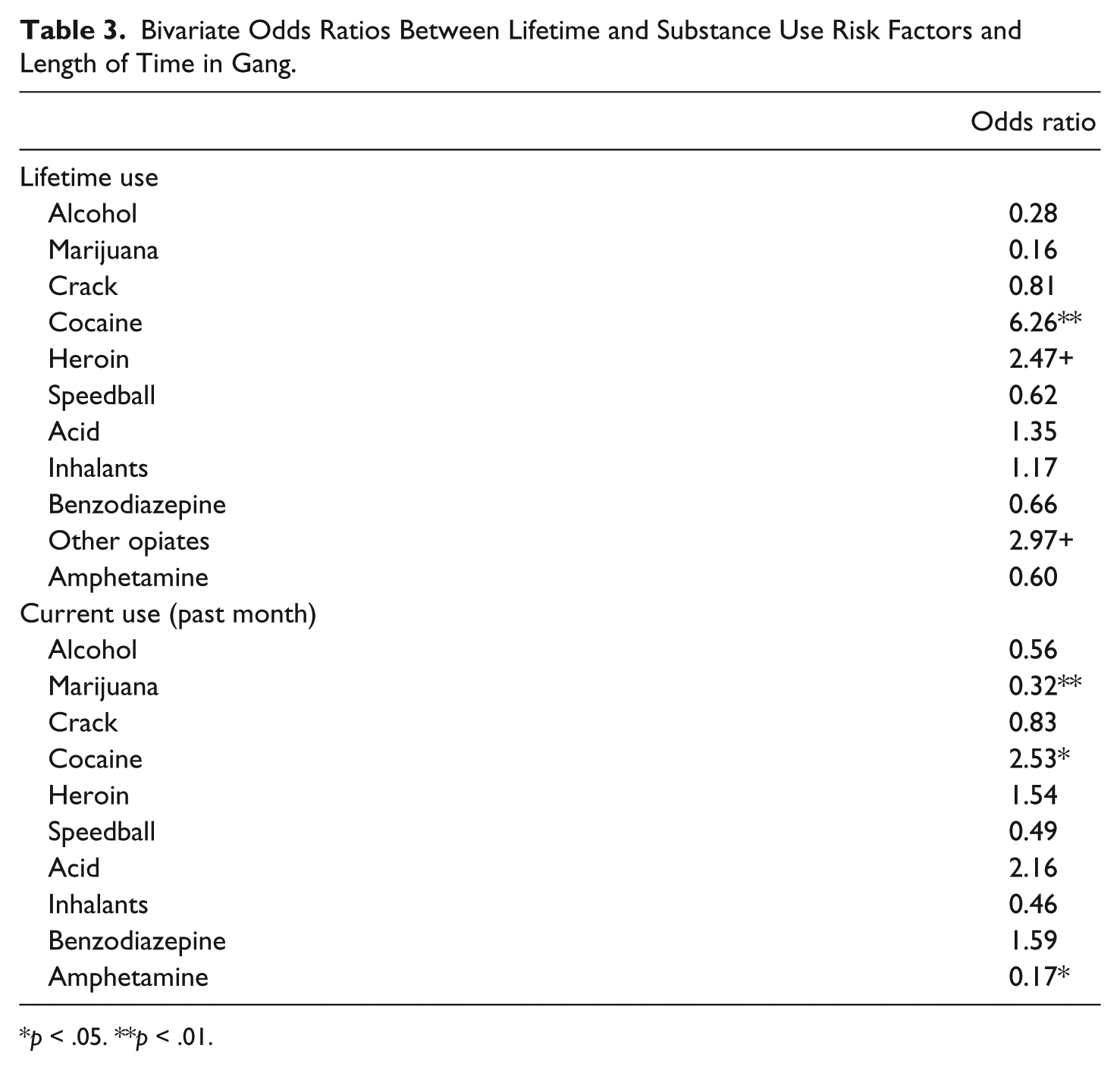
Building on the associations between the variables, we aim to understand the relationship of both risk factors and informal social controls and gang membership. In Tables 2 and 3 we present an examination of the bivariate relationships between informal social control and substance use risk factors and individual characteristics with subsequent length of time in a gang. We present the odds ratios from bivariate logistic regressions to provide simple estimates of the strength of the associations.
Bivariate Odds Ratios Between Individual and Family Characteristics, Informal Social Control Processes, Risk Factors, Delinquency/Violence, Other Risk Behaviors, and Length of Time in Gang.
p < .05. **p < .01.
Bivariate Odds Ratios Between Lifetime and Substance Use Risk Factors and Length of Time in Gang.
p < .05. **p < .01.
An examination of individual-level characteristics shows that being arrested has a strong relationship with gang membership. We find those gang members who have ever been arrested have 3 times the odds of being in a gang for a longer period of time.
Risk factors include the delinquency indexes, individual delinquent behaviors, and substance use. While general and violent delinquency do not appear to significantly affect the odds of a respondent being in a gang for a longer period of time, the opposite was found for more serious risk behaviors. For instance, firing a gun in a gang fight indicates higher odds of a longer duration in a gang by almost 4 times as much (odds ratio [OR) = 3.82, p < .05). Similar trends are observed for the remaining three indicators (armed robbery, drug selling, and shot at while selling) representing the severity of risk behaviors as respondents immerse themselves in gang life for longer periods of time.
The lifetime prevalence of cocaine is significantly associated with increased time in gang membership. Although a trend, heroin use is also associated with a greater likelihood of long-term gang membership. Importantly, we see that lifetime cocaine use appears to be the most important risk factor for predicting length of time in gang among this sample (OR = 6.26, p < .01). Similarly, the frequency of cocaine use also has a strong positive relationship with increased length of gang membership. We also find that frequency of marijuana use has a negative association with length in gang.
Finally, we provide results from the informal social control variables. Surprisingly, neither family nor school social control processes had a statistically significant relationship. The most striking finding was counterintuitive from the point of the view of life course theory. Attachment to parent increases the odds more than 2 times of being a member of the gang for 5 or more years.
Discussion
The age-graded life course approach allowed us to explore the risk and protective factors associated with long-term gang membership trajectories among young adolescent gang members. Contrary to what we hypothesized based on Sampson and Laub’s (2008) informal social control theory, it was found that the social control processes of family and school were not associated with reducing and deterring long-term membership as has been documented in previous studies on gang youth (Alleyene & Wood, 2011). This may be explained by the criminogenic characteristics of the gang member’s families. As our data show, almost three quarters of the respondents were raised in households where relatives participated in illegal activities and more than half had relatives who use drugs. This finding supports previous research that has documented the significant effect of parental gang membership on longer periods of adolescent gang membership (Hagedorn, 1998; Kissner & Pyrooz, 2009). In our gang population, family involvement may be contributing to more dedicated and embedded gang membership than the transitory membership that is found in other gang studies (Peterson, Taylor, & Esbensen, 2004; Pyrooz, 2014a; Thornberry et al., 2003).
Moore’s (1994) seminal research has identified Mexican American gang members’ families with multiple generations of criminality, incarceration, drug use, and street-oriented connections as “cholo families.” Instead of being supporters of conventional societal norms, intergenerational members in this context among these families may actually facilitate their participation in gangs and other street-oriented activities (Covey, Menard, & Franzese, 1992). This “intergenerational closure,” that has been described by scholars as having prosocial effects on African American youth in Chicago, seems to have a reverse effect on Mexican Americans gang members in San Antonio (Moore & Chase-Lansdale, 2001; Sampson & Laub, 1993). This is supported by the finding that stronger attachment to parents is positively associated with a longer trajectory in the gang. Also, our findings reflect the cholo families’ potential negative perceptions and hostility toward schools and other secondary institutions such as local governments, criminal justice system, and organizational religion. These youth, similar to other gang members, seem to be drawn to the gang and remain for longer periods of time because traditional institutions are not meeting their perceived needs (Hagedorn, 2008). Vigil (1988) argues that involvement in gang activities for Mexican American young males is a type of coping strategy that is explained by a constellation of ecological, socioeconomic, and psychological factors. More recently, Rios (2011) contends that urban minority youth are subjected to a hypercriminalization process which results in increased gang and other criminal activity. As a result, those involved in gangs isolate themselves from institutions through which more normative youth acquire human and social capital. This process may be further alienating these adolescents from traditional cultural systems making their future transition to adulthood more difficult. However, this should be interpreted cautiously given the absence of a comparison group that would allow us to conclude definitively that our finding is related to an ethnic context that is unique to Mexican Americans or Latinos.
As hypothesized, longer exposure to gang life shows strong associations and trends of being associated with more serious risk behaviors, such as firing guns, selling drugs, shot at while selling drugs, and arrests. As found in similar studies, we contend that engaging in these risk behaviors facilitate the development of specific norms and values which encourage the continual participation in gang activities (Decker & Van Winkle, 1996; Thornberry et al., 2003). Participating in these deleterious behaviors means that these young men are more susceptible to felony charges, which are a serious legal barrier to leading more conventional lives as adults. In particular, participating in a gang may directly affect their ability to fulfill adult roles and responsibilities successfully and make it difficult to desist from criminal behaviors. This is particularly salient during the past few decades with the process of deindustrialization, the dismantling of social service programs, and expanded use of prison time for lesser crimes (Travis, Western, & Redburn, 2014).
The strongest finding in our analysis is that lifetime prevalence of cocaine was more than 6 times more likely to be associated with long-term gang membership. Current cocaine use (past month) is also significantly associated with longer time in the gang. The cocaine trajectory from initial use to current use appears to closely parallel the gang trajectory. Similarly, there is a strong trend for heroin and other opium use to be associated with longer time in the gang. It should be noted that the finding regarding heroin use is in contrast to results from previous studies that have generally found an association with only cocaine use (Katz et al., 2005). Finally, our findings show an inverse relationship between both marijuana and amphetamine use and length of time in the gang. Overall, this reveals that a harder drug use history is tightly interwoven with the life course trajectory of gang involvement that adds to the existing gang literature.
Sampling strategies may explain some of the differences between our findings and those reported in most of the gang literature. For example, in Thornberry’s Rochester seminal study, there are no long-term gang members (5 years or more) in his school-based sample compared with ours. These school-based samples are more likely to underestimate the influence of the gang trajectory on study outcomes. This is reflected in the findings that 55% of our street-based sample has been expelled from school. Nonetheless, despite the methodological strengths of this study, certain limitations should be mentioned. Our analysis has largely been descriptive and the research design is cross-sectional. The bivariate results that we report need to be tested in more extensive multivariate analyses controlling for confounding variables. Furthermore, future research should be longitudinal in design to fully understand the consequences of long-term gang membership during the life course.
Lastly, the findings from this study need to be cautiously interpreted. That is, these youth are embedded within a socioeconomic environment that is an exposure risk independent from the risks stemming from their individual and family characteristics. The scarcity of meaningful employment and social and educational opportunities within the community shapes the experiences of these adolescents. Within this context, economic and social realities necessitate that they maintain bonds with their families that oftentimes include drug use and criminally involved members. Indeed, the factors that may help to explain long-term gang membership needs to be taken into account given the social, economic, and cultural context of these San Antonio neighborhoods that have a strong stable gang presence and a history of heroin use. This is especially salient given that previous research has documented the importance of the presence of gangs, gang ties, and gang desistance for victimization and other negative outcomes (Pyrooz et al., 2014).
This study illustrates the need to develop interventions that are relevant for this distinct sub-population of disadvantaged Mexican American youth and their families. That is, tailored and culturally informed interventions and treatments for these young men need to go beyond existing models that have been widely used with previously studied populations of gang members. For instance, new interventions must incorporate strategies that include adult family members that help families reconnect with social institutions (i.e., schools, health system, conventional employment, etc.; Santisteban et al., 2003; Santisteban, Suarez-Morales, & Szapocznik, 2006; Valdez, Cepeda, Parrish, Horowitz, & Kaplan, 2013). Furthermore, a targeted neighborhood intervention focused on community-level structural factors for adolescents and young adults are essential. Overall, interventions need to take into consideration the nuances and experiences that are unique to these types of youth and their families to curtail and reduce the risks associated with length of gang involvement.
Footnotes
Declaration of Conflicting Interests
The author(s) declared no potential conflicts of interest with respect to the research, authorship, and/or publication of this article.
Funding
The author(s) disclosed receipt of the following financial support for the research, authorship, and/or publication of this article: Funding for this study was provided by the National Institute on Drug Abuse Grants R01 DA08604 and R01 DA023857; the NIDA had no further role in study design, in the collection, analysis and interpretation of data; in the writing of the report; or in the decision to submit the paper for publication. Additional support was provided to Kathryn M. Nowotny by the Interdisciplinary Research Training Institute on Hispanic Drug Abuse (NIDA R25DA026401) and the CU Population Center (NICHD R24HD066613).