




Abstract
The existing literature on turnover intent among correctional staff conducted in Western societies focuses on the impact of individual-level factors; the possible effects of institutional contexts have been largely overlooked. Moreover, the relationships of various multidimensional conceptualizations of both job satisfaction and organizational commitment to turnover intent are still largely unknown. Using data collected by a self-reported survey of 676 custody staff employed in 22 Taiwanese correctional facilities during April of 2011, the present study expands upon theoretical models developed in Western societies and examines the effects of both individual and institutional factors on turnover intent simultaneously. Results from the use of the hierarchical linear modeling (HLM) statistical method indicate that, at the individual-level, supervisory versus non-supervisory status, job stress, job dangerousness, job satisfaction, and organizational commitment consistently produce a significant association with turnover intent after controlling for personal characteristics. Specifically, three distinct forms of organizational commitment demonstrated an inverse impact on turnover intent. Among institutional-level variables, custody staff who came from a larger facility reported higher likelihood of thinking about quitting their job.
Keywords
Introduction
Although a great deal of research has been conducted pertaining to turnover intent among correctional staff in Western societies (Byrd, Cochran, Silverman, & Blount, 2000; Camp, 1994; Griffin, Hogan, & Lambert, 2014; Lambert, 2006; Lambert & Hogan, 2009; Lambert & Paoline, 2010; Matz, Wells, Minor, & Angel, 2012; Slate & Vogel, 1997), this important area of research has been largely overlooked in Taiwan. Recently, staff retention has become a significant problem as a consequence of more severe punishments being mandated for violent and sexual offenders, as well as for repeat offenders since July 2005; the nation’s “get-tough-on-crime” policy took effect at that time (Kuo, 2009). Prison and jail populations began to rise and correctional facilities became more crowded, in time leading to a greater incidence of violent misconduct among inmates. Simultaneously, the inmate/staff ratio has gone up and the workloads assigned to the correctional staff have become more onerous. These consequences resulting from the adoption of this punitive policy have increased the stresses of work in correctional facilities, stresses felt by administrators and the correction staff alike (Jou, Lee, Lin, & Hebenton, 2011). As expected, more correctional officers than ever, specifically those employed as custody staff, are considering quitting their correctional jobs at the very time greater numbers of correctional facility jobs are needing to be filled.
Many correctional officers who are considering quitting do not actually leave their positions in Taiwan; for example, the turnover rate among correctional officers has ranged consistently from 3% to 5% over the past decade (Agency of Corrections [AOC] Personnel Office, 2011). However, their disaffection and tentative searching for other jobs can have a devastating effect on the correctional facility workforce. For example, Kuo (2009) found that the absenteeism among those correctional officers was commonplace in Kaohsiung prison, resulting in overtime pay to have another staff member cover the post vacated by the absent person and overstaffing. Peng’s (2011) study indicated many correctional officers have prepared for public servant positions outside of the correctional system, suggesting that the Chinese proverb of “holding a temporary position while seeking for a better job” is a strategy widely in practice among employees in Taiwan’s correctional workforce. Hence, exploring the correlates to turnover intent among Taiwanese custody officers is clearly timely and warranted.
Given the fact that there is no prevailing theory to explain this phenomenon in Taiwan’s correctional literature, this study attempts to borrow factors and models commonly utilized in Western societies for providing practical insights for identifying high-risk correctional employees whose turnover intent is detrimental to the correctional facilities in which they work. For example, Lambert and Hogan’s (2009) causal model is applicable. In line with their argument, the effects of multidimensional concepts of job satisfaction and organizational commitment on turnover intent for correctional officers are still relatively unknown. At the same time, the results drawn from prior studies conducted in Western societies reveal that personal demographics and workplace factors affect the levels of turnover intent among correctional staff (for more review, see Lambert, 2006). However, what have been missing from the empirical research into the turnover intent of correctional staff are factors relating to the institutional characteristics, specifically the capacity of inmates and number of correctional staff in a facility.
This study attempts to fill this research gap by examining the effects of both individual- and institutional-level factors on turnover intent among correctional custody staff. Three specific concerns are addressed here: (a) To what extent is the Western theoretical model of turnover applicable to a non-Western society, Taiwan? (b) To what extent do two multidimensional factors of job satisfaction and organizational commitment predict turnover intent? and (c) To what extent do the institutional contexts exercise an effect on turnover intent? The data were collected through a self-administered questionnaire survey of 676 Taiwanese custody staff in 2011. Of note, the hierarchical linear modeling (HLM) statistical method was employed appropriately in this study given the need to investigate the individual-level and contextual factors at play simultaneously.
Literature Review
The Importance of Studying Turnover Intent on Correctional System
Turnover is an issue of practical significance for correctional agencies in every country, and it is one that has been associated with a variety of problems for correctional systems. Among those are the costs related to hiring and training of new personnel, and the expense of excessive use of overtime compensation to manage workforce shortages. Similarly, the increased workloads for existing staff to cover tasks of the workers who have quit create yet other problems of lower levels of motivation and increased workplace stress (Lambert, 2006). While a high level of actual turnover has been shown to be a harmful and detrimental condition for correctional organizations (Mitchell, MacKenzie, Styve, & Gover, 2000), the difficulty of precisely assessing turnover rates has led to a noteworthy increase in the attention being paid to turnover intent in recent years (Matz, Woo, & Kim, 2014). Turnover intent refers to an employee’s desire to leave a given organization (Price & Mueller, 1986), a state of mind that reflects a cognitive analysis and reasoned planning process (Mobley, Griffeth, Hand, & Meglino, 1979). Normally, turnover intent is measured with reference to a specific time interval, and has been described as the last in a sequence of withdrawal-related cognitions, a sequence to which thinking of quitting and intent to search for alternative employment belong (Matz et al., 2014). Compared with actual turnover, it is necessary to measure turnover intent by means of a survey or interview process (Lambert, 2006).
Several advantages of studying turnover intent have been revealed in the extant research. First, Steel and Ovalle (1984) pointed out that turnover intent has consistently been linked to an individual’s decision to voluntarily quit or resign. As Lambert (2006) noted, “turnover intent is the best predictor of voluntary turnover” (p. 57). Understanding this intention represents a substantial step in examining the turnover process (Lambert & Paoline, 2010). In other words, if the precursors to intent to quit can be found before leaving, concerned employers could possibly institute changes to reduce the levels of turnover intent present among their workforce (Dalessio, Silverman, & Schuck, 1986).
Second, due to the many regulations in place on human subjects review and privacy relating to personal identification of the subjects of study, it is often quite difficult for corrections administrators and outside researchers to gain access to employees’ administrative records and to understand what factors lead to them quitting their jobs (Mitchell et al., 2000). Third and most importantly, self-reported turnover intentions or plans are the most immediate and the best predictor of employees’ voluntary turnover among comparable non-criminal justice persons (Steel & Ovalle, 1984). For example, Van Breukelen, Van Der Vlist, and Steensma (2004) conducted a longitudinal study in which 296 respondents serving as career professionals in the Royal Netherlands Navy completed questionnaires; they found that behavioral intentions proved to be the best predictor of turnover even when the effects of a number of other intervening and control variables were accounted for. It is clear that the dynamics of turnover intent are ubiquitous and that the application of the turnover intent model derived from non-criminal justice fields of employment to corrections is at once possible and practical (Lambert & Hogan, 2009).
The Factors Which Affect Turnover Intent Among Correctional Officers
The following literature review focuses on two categories of hypothesized influences: individual-level and institutional-level factors. First, this study summarizes findings from the literature on the effects of individual-level factors. Second, although there has been only limited work done in this area, this study also presents the noteworthy research that has explored the effects of institutional-level factors on turnover intent.
Individual-level factors
Most studies that have examined the topic of turnover intent among correctional staff have been conducted in the United States (Matz et al., 2014). Prior studies have commonly used three principal theoretical approaches—personal characteristics, work environment factors, and job attitudes—to explain turnover intent among employees (Byrd et al., 2000; Lambert, 2006; Lambert & Hogan, 2009; Lambert & Paoline, 2010). For the purpose of this study, the current study focuses on work environment factors and workplace attitudes. Personal characteristics have been treated as control variables. 1
First, work environment factors concern the influences of tenure and supervisory oversight on correctional officers’ turnover intent. The research has found that younger and frontline staff (viz., non-supervisory personnel) were more likely to think about leaving their jobs than their workplace superiors (Byrd et al., 2000; Camp, 1994; Lambert, 2006; Lambert & Paoline, 2010). Unfortunately, there has been rather little research to determine whether workplace victimization is associated with turnover intent. In this regard, Lai, Wang, and Kellar (2012) found that those who were documented victims in the Taiwanese correctional system report a lower level of perceived workplace safety. It was assumed that workplace victimization would have a significant impact on turnover intent even when controlling for the effects of other variables featured in multivariate analyses.
Second, the workplace attitudes category refers to factors preoccupying employees’ subjective perceptions within their workplace. Research consistently documents that correctional employees’ job stress is associated with correctional staff turnover intent (Griffin et al., 2014; Hsu, 2003; Lambert, 2006; Lambert & Paoline, 2010; Slate & Vogel, 1997). Interestingly, the relationship between job dangerousness and turnover intent is inconsistent, with most studies finding no relationship (Lambert, 2006; Lambert & Hogan, 2009; Lambert & Paoline, 2010), whereas other studies have reported a negative relationship between these two variables (Griffin et al., 2014; Matz et al., 2012). Regarding job satisfaction, Rainey (2003) noted that job satisfaction consists of three core elements: Welfare satisfaction refers to higher payment and hygiene, intrinsic satisfaction refers to sufficient promotion and performance opportunities, and organizational harmony comprises a positive relationship between supervisors and coworkers, a good working atmosphere, and compliance with organizational requests. The literature in this area overwhelmingly indicates that employees who are satisfied with their jobs are less likely to express a desire to leave (Byrd et al., 2000; Kuo, 2009; Lambert, 2006; Lambert & Hogan, 2009; Lambert & Paoline, 2010; Leip & Stinchcomb, 2013; Matz et al., 2012), but the effect of each distinct form on turnover intent is still largely unknown.
Organizational commitment refers to the bond between a person and the employing organization, and this bond has been conceptualized in a three-component model featuring affective, continuance, and normative commitment elements (Allen & Meyer, 1990). The affective component refers to employees’ emotional attachment to, identification with, and involvement in the organization; the continuance component refers to the type of commitment that is based on the costs that employees associate with quitting their current job. Finally, the normative component refers to employees’ feelings of obligation to remain with the organization. Past studies have treated organizational commitment as a unidimensional factor and have consistently reported an inverse effect on correctional officers’ turnover intent (Camp, 1994; Griffin et al., 2014; Lambert, 2006; Lambert & Hogan, 2009; Lambert & Paoline, 2010; Matz et al., 2012). More recent studies have pointed out that organizational commitment is actually a multidimensional construct that empirically predicts employees’ turnover intent (Griffin & Hepburn, 2005; Lambert, Hogan, & Jiang, 2008). For example, using two forms of organization commitment to predict turnover intent among private prison personnel, Garland, Hogan, Kelley, Kim, and Lambert (2013) found that affective commitment is more powerful than continuance commitment in predicting an inverse relationship on turnover intent among private prison personnel in a Midwestern UnitedStates state.
Institutional-level factors
Camp (1994) has noted that the organizational environment within which correctional staff found themselves tends to vary along some key dimensions that may have an impact on the propensity for turnover. Specifically, some factors that have been found to be important for various reasons are institutional security level, size of the inmate population (overcrowding level), misconduct rates, and number of correctional staff. For example, using data collected from a subsample of 1991 Prison Social Climate Survey conducted by Federal Bureau of Prisons, Camp found that staff working in a low-security institution reported a high level of turnover. Although institutional-factors are thought to be highly associated with turnover intent, unfortunately only very limited studies have been done to explore these factors up to this point.
In this study, only the size of the inmate population (used as a proxy measure of facility overcrowding level), number of correctional staff, and inmate/staff ratio at the facility level were examined because the standard of security level to classify correctional facilities has not been adopted in Taiwan (Huang, 2010). In addition, although the inmate misconduct rate has been increasing over the past years in Taiwan, such incidents are pretty rare compared with their frequency in Western societies (Jou et al., 2011). Traditionally, overcrowding has been regarded as a significant institutional factor in the incidence of prison violence in the literature on inmate misconduct (Camp, Gaes, Langan, & Saylor, 2003; Wooldredge, Griffin, & Pratt, 2001). Overcrowding likely complicates facility management and exacerbates stress among staff. The more inmates who are housed in a facility, the more staff are required when problems arise (Stohr, Lovrich, Menke, & Zupan, 1994). Therefore, it is assumed that as the population of a facility gets larger, the inmate/staff ratio gets higher and workplace challenges get more difficult to address; staff disaffection rises and turnover intent grows (Cullen, Link, Wolfe, & Frank, 1985).
In summary, simultaneously using both institutional-level and individual-level data for 22 separate correctional facilities with 676 respondents, the current study attempts to deepen our understanding of turnover intent among correctional officers by testing the hypothesis that facility context factors have an independent impact on turnover intent among correctional officers in a non-Western society, that of Taiwan. Using HLM, we control for the effects of personal characteristics at the individual-level while investigating the impact of institutional-level factors.
Method
Participants
Participants in the study were custody staff (sworn staff) employed by the AOC, Ministry of Justice (MOJ), in Taiwan. In the spring of 2011, the total population of custody staff in both prisons and jails in Taiwan represented 3,837 employees working in 36 units (AOC Personnel Office, 2011). According to the AOC, prisons and jails are classified into three groups: (a) units housing 2,500 or more inmates = Category A, (b) units housing between 1,500 inmates and 2,499 inmates = Category B, and (c) units housing between 500 inmates and 1,499 inmates = Category C.
Accordingly, a stratified random sampling method was used featuring the following three steps. First, the research team obtained the total number of custody staff in each correctional institution for all shifts (two shifts in Taiwan 2 ). Second, 900 respondents were expected to be surveyed randomly. In Category A, researchers randomly selected 9 out of 14 units in which 50 questionnaires were distributed to each unit. In Category B, 6 out of 10 units were selected, and 40 questionnaires were distributed to each unit. In Category C, 7 out of 12 units were randomly selected in which 30 questionnaires were distributed to each unit. A total of 22 units were sampled at random from the 36 correctional facilities spread throughout Taiwan.
Third, the researchers contacted the representative of each facility to schedule visiting dates and times. Given the AOC policy that agency employees are not allowed to take part in any face-to-face survey or interview during his or her shift, in April of 2011 a total of 900 self-administrated questionnaires containing an enclosed notice letter explaining the purpose of the survey and guaranteeing that all respondents would remain anonymous were delivered by the research team to the 22 selected correctional facility units. The research team utilized the assembly time at the start of the workday to explain the purpose of this study, as well as to inform employees of their right to refuse participation with no adverse consequences. Those employees present were encouraged to participate in the survey and were asked to complete the questionnaires voluntarily while off prison grounds. Meanwhile, the research team left a secured box with a solid lockup locker in the Division of Custody office. After completing the survey, the volunteer participants were instructed to place their questionnaire in an envelope provided and deposit the envelope in the secured box. Only the research team has access to the questionnaires in that secured box. Once the survey process was completed, a representative at each facility contacted the research team and all secure boxes were assembled and the questionnaires collected for coding and analysis.
Over the course of a month, approximately 868 questionnaires were returned of the 900 distributed, producing an initial 96.4% response rate. After deleting all void, defaced, and substantially incomplete questionnaires, 676 valid questionnaires remain for the final analysis (the adjusted response rate is 75%). A series of t tests and chi-square analyses were performed to determine whether there was any difference between those who answered these questions and those who did not, based on demographic characteristics and work attitude variables. 3 No significant difference was found.
Measurement
Dependent variable
Turnover intent was the dependent variable, which was captured by four items taken from Lambert and Hogan (2009) and Mobley et al. (1979): (a) thinking about quitting, (b) a desire to leave the current job, (c) searching for alternative employment or preparing for official exams, (d) undecided about staying during the next year. Response options provided a 5-point Likert-type scale ranging from 1 (never) to 5 (always). The four items were summed together and divided by 4 to form the turnover intent index (see the appendix).
Independent variables
The independent variables included in the analysis were grouped into two levels: individual-level and institutional-level predictors. Also, the individual-level category consisted of three subgroups—workplace variables, work attitudes, and control variables.
Workplace variables
This subgroup of variables included tenure of service, supervisory versus non-supervisory position, and experience with workplace victimization. Tenure was measured as an ordinal variable on which (1) represented less than 3 years, (2) represented 3 to 6 years, (3) represented 6 to 10 years, and (4) represented 10 years and above. Supervisor was measured as a dichotomous variable designed to determine whether respondents were supervisors (coded as 0) or frontline officers (coded as 1). Workplace victimization was a dichotomous variable developed by asking if respondents had been the victim of any physical threat, assault, or attacks or verbal forms of aggression from inmate(s) or coworker(s) in the correctional workplace during the past 12 months prior to this survey; (0) represents no victim experience and (1) represents victim of at least one experience on this measure.
Work attitudes
Job stress was measured using eight items from Crank, Regoli, Hewitt, and Culbertson (1995) and Hsu (2003), items that have been used in prior job stress studies in Taiwan with correctional officers. Eight items allowed respondents to assess their overall job stress in their workplace, including difficulty, tension, anxiety, frustration, worry, emotional exhaustion, and distress (see the appendix). The response options of 5-point Likert-type scales ranged from 1 (strongly disagree) to 5 (strongly agree). This index was calculated as the sum of scores of the eight items, divided by 8. Higher scores represented a higher level of perceived job stress.
Job dangerousness, drawn from the work by Lambert and Hogan (2009), dealt with the degree to which an employee sees his or her job as potentially harmful to him or her (Cullen et al., 1985). Perceived dangerousness of the job was postulated to be positively linked with turnover intent. Job dangerousness was measured using six items (see the appendix). The response options of 5-point Likert-type scales ranged from 1 (strongly disagree) to 5 (strongly agree). This index was calculated as the sum of scores of the six items, divided by 6. Higher scores on this measure represented a higher level of perceived job dangerousness.
Job satisfaction was measured using 15 items revised and translated from Weiss and Lofquist’s (1967) instrument. The measure consisted of three subscales: Intrinsic Satisfaction (7 items), Welfare Satisfaction (4 items), and Organizational Harmony (4 items). The measure required the respondents to indicate how satisfied they are on each of the 15 job satisfaction items. Example items included the following: I am satisfied with fair opportunities to be promoted (Intrinsic), I am satisfied with the services and welfare in my job (Welfare), and I do not like to talk about my job with others (reverse coded, Harmony; see the appendix). The participants responded to each item on a 5-point Likert-type scale, ranging from 1 (strongly disagree) to 5 (strongly agree). Higher scores represented a higher level of job satisfaction.
Organizational commitment was measured by translating 15 items from the work of Allen and Meyer (1990), researchers who argue that organizational commitment is most appropriately conceptualized and measured in terms of a three-component model featuring affective, continuance, and normative components. In this study, the affective commitment component was captured by 6 items (e.g., I would be very happy to spend the rest of my career with this unit), the continuance component was measured by 4 items (e.g., It would be too costly for me to leave my organization now), and the normative component was measured by 5 items (e.g., I do believe that a person must be loyal to his or her organization; see the appendix). The response options of 5-point Likert-type scale ranged from 1 (strongly disagree) to 5 (strongly agree). Higher scores represented a higher level of perceived organizational commitment.
Control variables
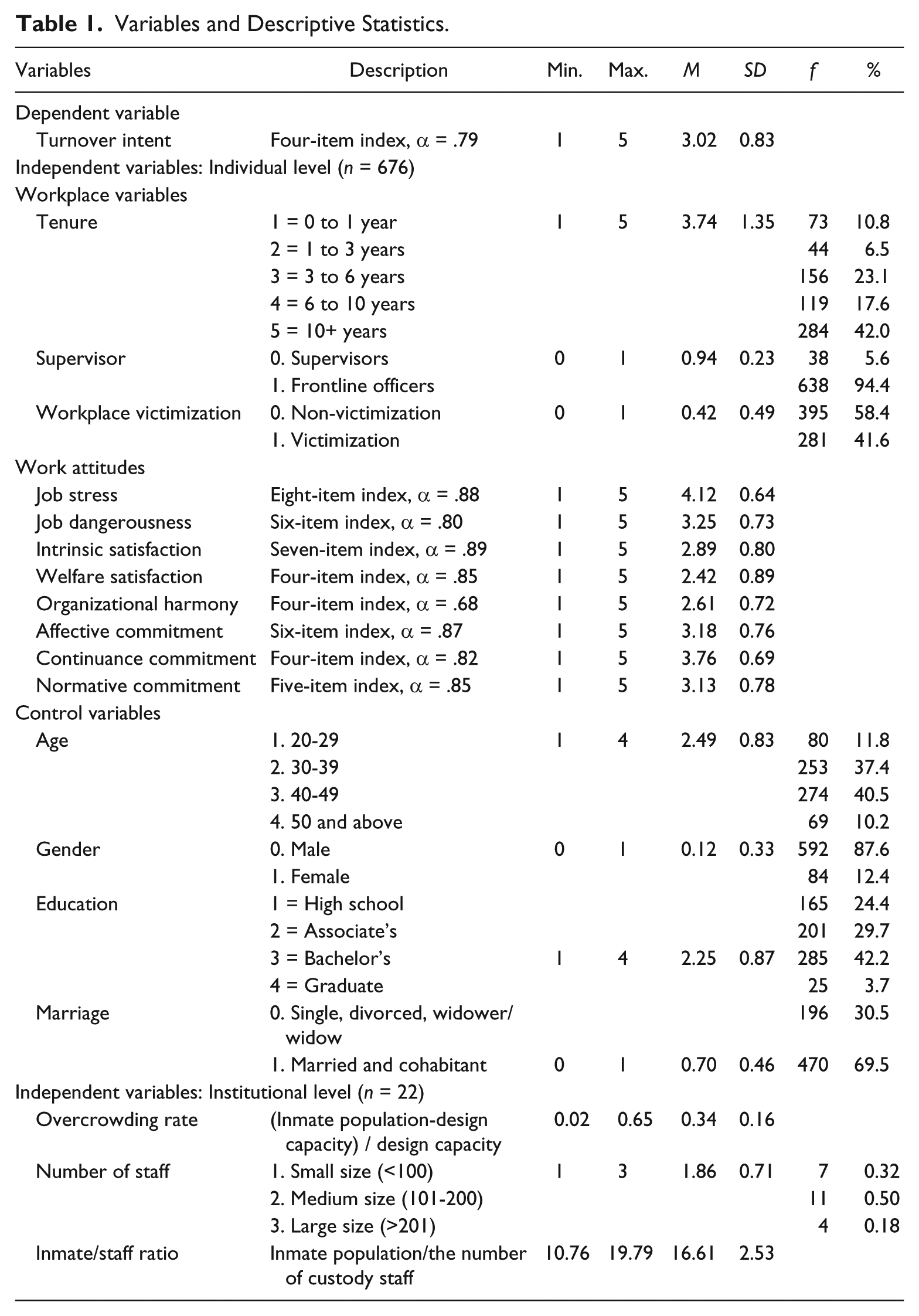
The personal characteristics of gender, age, educational-level, and marriage status were included in the study as control variables. These variables are commonly employed as control variables in this type of research (Griffin et al., 2014). Table 1 provides detail on how these variables were measured.
Variables and Descriptive Statistics.
Institutional-level variables
Three variables were examined in this regard: overcrowding rate, number of staff, and the ratio of inmate to staff (inmate/staff ratio). Overcrowding rate was computed by this formula: (the average inmate population in May 2011 − the design capacity) / the design capacity. The number of staff refers to the actual custody officers staffed in each sampled facility in May 2011. 4 The 22 sampled facilities were grouped into three categories: (a) small size refers to the number of custody officers staffed being less than 100, (b) medium size refers to the number of custody officers staffed ranging from 101 to 200, and (c) large size refers to the number of custody officers staffed more than 200. Finally, inmate/staff ratio was computed as the ratio of the average inmate population in May 2011 to the number of custody staff in those selected units.
Statistical Modeling
The data used in this study warranted multilevel analysis because they are clearly structured in two distinct conceptual levels of analysis (Luke, 2004). At the individual level, 676 randomly selected respondents completed the questionnaires with detailed information on demographics and workplace factors provided via a survey process. At the same time, these individuals were nested in 22 distinct correctional facilities. The characteristics of each facility such as overcrowding rate, number of staff, and inmate/staff ratio may partially explain the levels of turnover intent for respondents working there. Differences between these selected facilities play an important role in the current study. Therefore, the model accounts for both variation within a facility and variation among the facilities.
The simplified two-level HLM used in this study can be represented using the following equations, with one predictor variable each at both levels:



The Level 1 part of the model is similar to a typical ordinary least squares (OLS) multiple regression model. It features a dependent variable, Yij, and the j subscripts represent a different Level 1 model being estimated for each of the j Level 2 units. At Level 1, β0j is the intercept of the Level 1 dependent variable Yij, and β1j is the slope or effect of the Level 1 predictor Xij. The basic two-level multilevel analysis treats the Level 1 intercept as outcomes of Level 2 predictors.
The Level 2 part of the model indicates how each of the Level 1 parameters is a function of Level 2 predictors and variability. At Level 2, β0j is the Level 1 intercept in the Level 2 unit j; γ00 is the mean value of the Level 1 dependent variable, controlling for Level 2 predictor Wj; γ01 is the slope of the Level 2 predictor Wj; and u0j is the error for unit j. The key feature of this model is that only the intercept parameter in the Level 1 model, β0j, is assumed to vary at Level 2. Bringing the right parts of the Level 2 equations into the Level 1 equation produces a mixed-effect model.
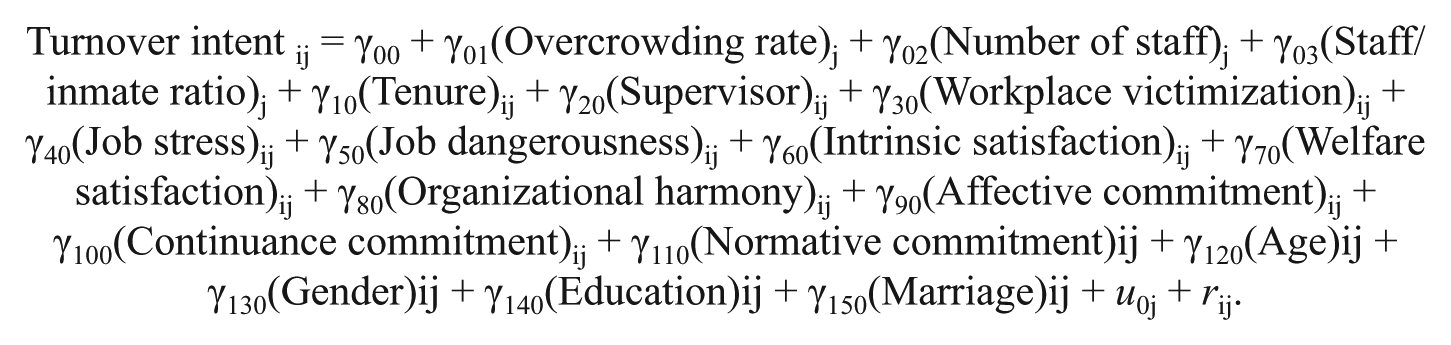
Specifically, the composite model of the current study can be expressed in the following equation.
Findings
Characteristics of Sampled Staff and Facilities
Table 1 presents descriptive statistics for the sampled correctional staff. The mean for age was 2.49, which indicates that on average the respondents’ age was between 30 and 39 years. Eighty-eight percent (n = 592) were male and 12% (n = 84) were female. With regard to the study participants’ educational-level, 24.4% had a high school degree, 29.7% had some college degree, 42.2% had a bachelor’s degree, and only 3.7% had a master’s degree level education. For the purpose of statistical analysis, educational-level was recoded into a dummy variable (0 = some college degree and below; 1 = bachelor’s degree and above) and regressed with other independent variables in the HLM analysis. In terms of marriage status, approximately 70% of respondents reported that they are either married or live together as married. The mean of tenure was 3.74, suggesting that on average the participants had worked in the correctional system from 3 to 10 years at the time of our survey. More than 94% of participants were frontline officers. Approximately 42% of the participants reported that they had victimization experiences in the past year either at the hands of inmates or coworkers.
Table 1 also displays three variables measured at the institutional-level (Level 2). The overcrowding rate ranged between 0.02 and 0.65, and the average rate was 0.34. As for the number of staff, the mean was 1.86, suggesting that a majority of sampled facilities were medium sized, featuring numbers of staffed custody officers ranging from 101 to 200 during the period of the survey. With respect to the inmate/staff ratio, that figure ranged from 11:1 to 48:1, and the average ratio was 16:1.
Multilevel Analyses
Before presenting the multilevel analysis, statistical multicollinearity is an issue that must be addressed. Although not a perfect method for examining multicollinearity, variance inflation factors (VIFs) were computed by regressing each independent variable on other variables in the model. Many researchers consider this to be a useful indicator of the problem (Tabachnick & Fidell, 1996). In this study, the VIFs were well below the customary cutoff level of 4, which indicated that multicollinearity was not a problem for this study.
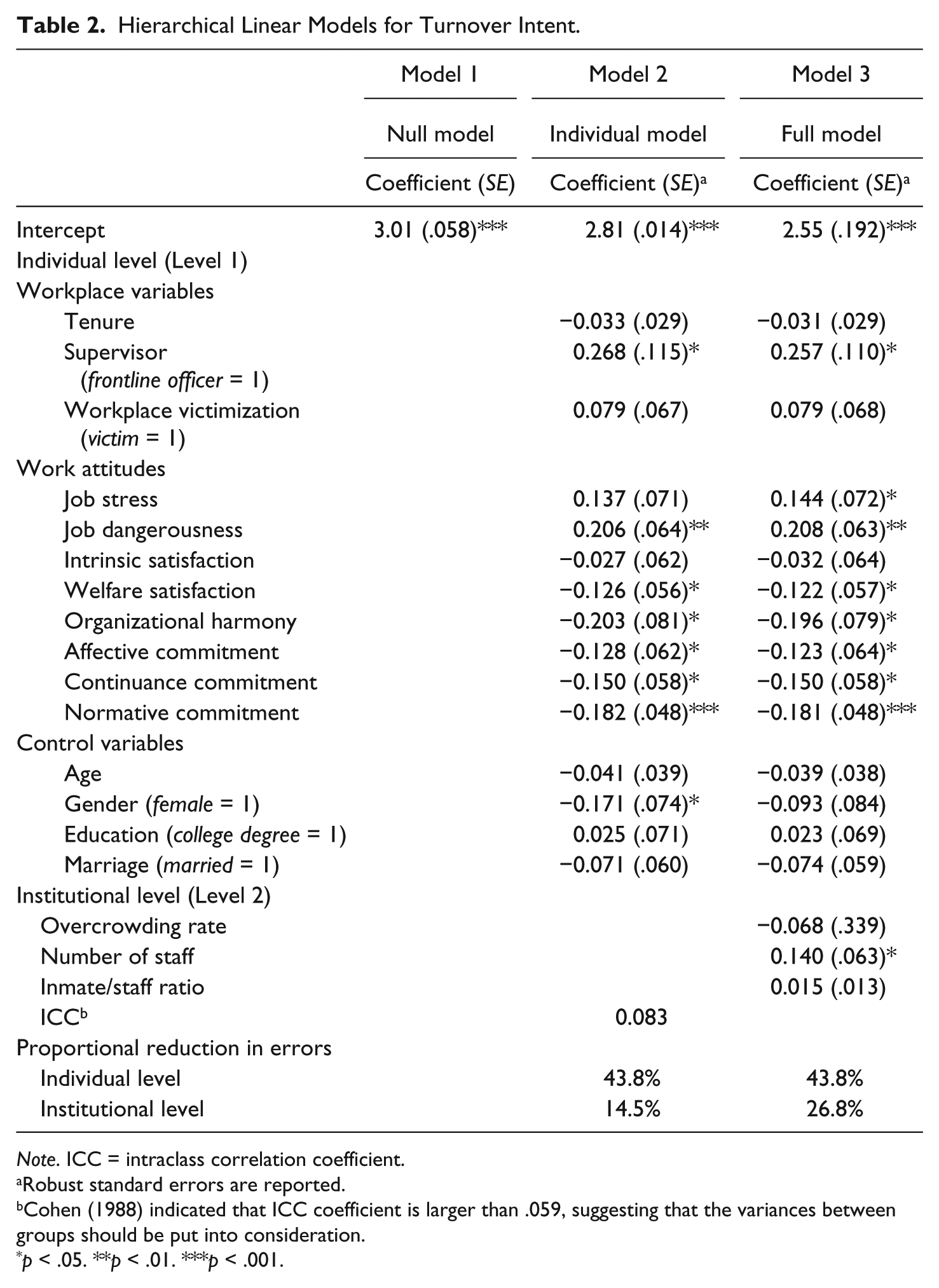
The parameter estimates and the R2 for each model were reported in Table 2. A three-step modeling strategy was employed. First, an ANOVA with random effects was estimated. The intraclass correlation coefficient (ICC) showed that approximately 8.3% of the variation in turnover intent was explained by the institutional-level factors. This finding suggests that the level of turnover intent does vary significantly across facilities, and therefore multilevel analysis is necessary to understand the dynamics underlying turnover intent (Cohen, 1988). Next, a random coefficient regression model that included all of the individual-level variables was estimated. The dependent variable, turnover intent, was treated as an interval-level measure. Unlike commonly used OLS regression methods, a random coefficient model allows the intercept to take different values in each of the study institutions. Results of our analysis indicate that none of the individual-level variables had effects that varied across the institutions, and thus we specified all individual-level slopes as fixed (no random effects) across institutions. Finally, to assess the respective contributions from the individual-level and institutional-level variables, two separate models were run.
Hierarchical Linear Models for Turnover Intent.
Note. ICC = intraclass correlation coefficient.
Robust standard errors are reported.
Cohen (1988) indicated that ICC coefficient is larger than .059, suggesting that the variances between groups should be put into consideration.
p < .05. **p < .01. ***p < .001.
The results of this two-model analysis indicate that the multilevel model was the best model compared with the base model and the model featuring only the individual-level variables. This finding is supported further by the deviances test. The improvement in proportionate reduction in error at the institutional-level increased from 14.5% in Model 2 to 26.8% in Model 3, suggesting that the inclusion of the institutional-level variables is clearly warranted. Most importantly, the magnitudes and signs of coefficients at Model 2 (individual model) almost consistently remain the same when additional variables at the institutional level are added to the equation (Model 3). The following interpretation was based on the findings from Model 3, the full model presented in Table 2.
Eight of 15 variables at Level 1 were significant predictors of turnover intent among Taiwanese correctional officers: supervisory status, job stress, job dangerousness, welfare satisfaction, organizational harmony, affective commitment, continuance commitment, and normative commitment. Frontline officers reported higher levels of perceived turnover intent than supervisors. Those who perceived higher levels of job stress and job dangerousness were more likely to envision quitting their jobs, whereas those who reported lower levels of welfare satisfaction, organizational harmony, affective commitment, continuance commitment, and normative commitment expressed higher levels of turnover intent. Of note, two out of three forms of job satisfaction—welfare satisfaction and organizational harmony—were significantly associated with dependent variables. At the same time, three distinct forms of organizational commitment have an inverse relationship with turnover intent. Overall, the results of this study are highly consistent with those reported in previous studies conducted in the Western societies. The Level 1 coefficients in general showed that workplace variables exert more important impacts on staff turnover intent than do personal characteristics.
At the institutional-level (Level 2), one predictor in particular, the number of staff, was significantly related to turnover intent in the hypothesized direction. The custody staff who worked in bigger facilities reported higher levels of turnover intent. The other two variables, overcrowding rate and inmate/staff ratio, were also statistically insignificant, but with somewhat less impact. Overall, among all the variables demonstrating a statistically significant impact, supervisory position exerted the greatest impact on corrections custody staff turnover intent, followed by job dangerousness, organizational harmony, normative commitment, continuance commitment, job stress, the number of staff, affective commitment, and welfare satisfaction.
Discussion
Drawn from the literature and theoretical models developed in Western societies, this study examined both the effects of individual-level and institutional-level influences on turnover intent among Taiwanese correctional staff. Although this is an important issue for the effective operation of the nation’s correctional system, it is one that has been largely overlooked up to this point. Using the appropriate analytical technique of HLM for the assessment of systematically collected survey data in combination with correctional facility characteristics, the results of this study lead to three significant observations.
First, custody staff from larger facilities report higher levels of turnover intent than do those from smaller ones. Due to the adoption of a “get-tough-on-crime” policy by national political authorities, many more violent offenders, sexual predators, and repeat offenders have been swept into the prisons and jails of Taiwan in recent years (Lai et al., 2012). For example, the AOC constructed in Taipei, Taichung, Tainan, and Kaohsiung four prisons featuring more than 2,500-bed capacities to house violent and sexual offenders (Huang, 2010). Consequently, correctional agencies have deployed more custody staff to work in bigger facilities. Generally speaking, large facilities are more bureaucratic and would thus logically have more rules and less opportunity for officers to receive promotions or material resources (e.g., physical equipment, training courses, and extra-shift pays). To make the situation worse, they earn the same salary and receive similar material benefits with those who are working in smaller facilities (Huang, 2010). As Byrd et al. (2000) noted, employees are more likely to quit their job when they believe they are receiving low pay, have poor benefits, receive insufficient training, and have limited opportunities for advancement, and so on. The custody officers staffed in a larger facility are more likely to entertain an attitude of “holding a temporary position while seeking for a better job.”
Second, this study confirms the ubiquitous nature of work attitude salience in both Western and Taiwanese societies. Among workplace attitude variables, as anticipated, the job stress, job satisfaction, and organizational commitment dimensions matter a great deal in the explanation of turnover intent among Taiwan correctional staff. The results noted in this study are consistent overall with previous studies conducted in the United States. (Byrd et al., 2000; Camp, 1994; Lambert, 2006; Lambert & Hogan, 2009; Lambert & Paoline, 2010; Matz et al., 2012; Slate & Vogel, 1997). Specifically, three distinct forms of organizational commitment successfully predicted an inverse relationship to turnover intent, suggesting that the continuing enhancement of employees’ organizational bonds should be the priority for correctional facility administrators (Garland et al., 2013). Of note, although the variable of perceived job dangerousness has been insignificant in previous studies (e.g., Lambert, 2006; Lambert & Hogan, 2009; Lambert & Paoline, 2010), it really matters in the Taiwanese correctional system and should be discussed more fully. In this regard, the AOC has reported that the total number of inmate misconduct incidents has risen steadily in recent years. For example, although the total incidents of inmate misconduct have only increased from 10,338 in 2007 to 11,008 in 2009, the violent disciplinary cases (i.e., fighting and assault) have risen by 19% over that same time period (Jou et al., 2011). The unpredictability of prison violence appears to be making Taiwanese correctional facilities an increasingly unsafe workplace. As Lai et al. (2012) have noted, workplace safety is the bottom line of basic needs for the nation’s custody officers and deserves the careful, ongoing attention of corrections administrators.
Finally, the results reported here also supported the common finding that frontline officers have a higher level of turnover intent than their supervisors (Byrd et al., 2000; Slate & Vogel, 1997). The combination of greater numbers of violence-prone inmates, more insecurity in the workplace, and heavier workloads in larger institutional settings is taking a toll on job commitment among frontline correctional staff in Taiwan and in other nations where a “get tough on crime” or “war on drugs” policy prevails (Lai et al., 2012). The frontline corrections officers are the veritable backbone of any prison or jail (Huang, 2010); they are charged with the primary duties of supervising the daily activities of inmates (e.g., the duties in the workshops and cells), enforcing prison rules, and maintaining order and security within the institution (Griffin et al., 2014). Without their efforts and commitment to public service, there is no hope of making a prison or a jail a “correctional” facility as opposed to a simple warehouse of troubled humans. Hence, how to keep those frontline officers motivated and committed to their professional goals has been a tough nut to crack for correctional administrators, whether they are in Taiwan or the United States and other countries in the West.
Policy Implications
Beyond providing an initial examination of correctional officers’ inclinations to quit, it is also our hope that this study might provide some policy implications through which AOC would reduce the levels of turnover intent among custody officers in Taiwan. First, AOC should be encouraged to enhance more extrinsic rewards for those custody officers staffed in larger facilities (Byrd et al., 2000; Griffin et al., 2014). For example, AOC should provide more promotion opportunities and better pay or extra-shift pay for those larger facilities staffed with more than 200 custody officers. Those custody officers would be more motivated and encouraged to strive toward higher levels of performance in their jobs. Moreover, as noted previously, those frontline officers staffed in a large facility generally face more difficult challenges than their counterparts employed in smaller facilities. Likewise, the AOC would be wise to recruit more frontline staff to reduce the workloads in those bigger facilities. Kiekbusch, Price, and Theis (2003) indicated that correctional officers who perceived realistic promotional opportunities and better pay were less likely to quit their jobs, suggesting that cultivating career plans matters considerably in the correctional field.
Second, Lambert (2006) noted that providing channels involving organizational decision-making input, instrumental communication, integration, and fairness are important antecedents in helping to shape commitment among correctional officers, leading them to stay with correctional jobs (Lambert & Hogan, 2009). In addition, correctional administrators should continuously strive to enhance open communication channels and improve harmony in relationships between supervisory-level and frontline officers by providing staff with a relaxed atmosphere and praising them for outstanding work on an ongoing basis (Garland, 2004; Garland et al., 2013).
Third, and most importantly, as pointed out by Kiekbusch et al. (2003), turnover can be reduced if correctional administrators focus on reducing the reality and perception of job dangerousness. Reducing the presence of unsafe conditions (e.g., dangerous workshop settings and unobserved and supervised blind spots) is paramount to improving the work environment in the larger correctional facilities. As a recommendation, correctional administrators should have additional closed circuit televisions (CCTVs) installed, employ staff duress alarm systems, and build emergency reporting and safe evacuations systems. For example, in this area of concern, correctional administrators in the United States recently began to explore ways in which geographic information systems (GIS) could assist with safety promotion in daily facility operations (Karuppannan, 2005). Based on the “get-tough-on-crime” policy, maintaining workplace safety and reducing the levels of dangerousness are the first steps in lowering turnover intent among correctional staff (Triplett, Mullings, & Scarborough, 1996). Finally, Lambert and Paoline (2010) recommended that a continuous loop consisting of positive assessments, change, and feedback should to be created.
Limitations
As with any research, our study is not without limitations. First, we examined the perceptions and attitudes held only by custody officers rather than all correctional personnel (e.g., non-custody personnel including counselors, case managers, medical personnel, etc.); therefore, the results may not be applicable to other staff members employed in jails and prisons. Second, some attitude measurement instruments are likely somewhat problematic. For example, measures of workplace victimization and items used to capture job satisfaction are likely suboptimal. As pointed out by Herzberg (1968) and Rainey (2003), job satisfaction is not a one-dimensional concept, but rather a complex mix of expectations and experiences processed through a combination of evaluative filters; the measures used here are broad ones, and the measure for organizational harmony used here as an exploratory variable reflects a yet immature subfield of organizational behavior studies.
Third, due the short-term research period available to the research team, the current study features a rather haphazard selection of work environment variables. Future researchers should include some additional workplace variables, such as input into decision making, organizational fairness, job variety, and quality of supervision to strengthen the explanatory power of the multivariate analysis. Finally, this is an exploratory study in which institutional factors have been examined along with other individual factors drawn from previous Western studies. Given the fact that Taiwanese prisons are classified based on inmate capacity rather than security-level, the institutional factors found to significantly contribute to turnover intent in Taiwanese prisons would not have a similar influence in the UnitedStates system.
Conclusion
Overall, this study features a comparative approach to the study of turnover intent, using the perceptions and experiences of correctional staff in Taiwan to test findings drawn from prior studies of correctional staff turnover intent in Western countries. In addition, this study provided evidence that both workplace-based attitudes and institutional contexts simultaneously affect turnover intent. The findings reported here, although not perfectly derived in every respect, nonetheless suggest with some confidence that correctional administrators need to be more concerned with reducing job dangerousness, increasing organizational commitment, and providing more promotional opportunities and compensation for those staff employed in progressively larger correctional facilities. The dynamics of institutional corrections operations seem to be directed toward ever-larger facilities with increasingly bureaucratized operational systems for the workforces employed in them. As a catalyst for further timely study, this article hopes to spark future research into turnover intent among correctional staff, both in Western and Asian societies.
Footnotes
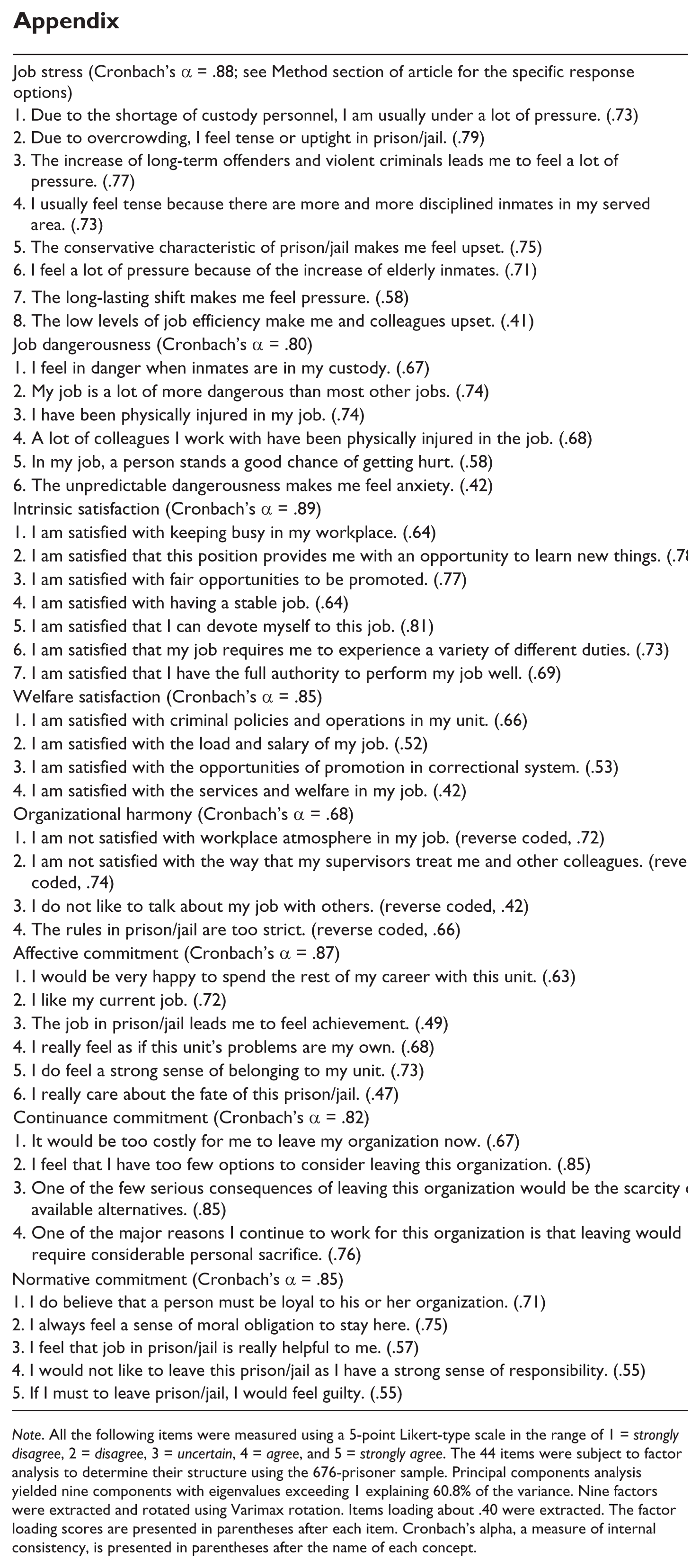
Appendix
| Job stress (Cronbach’s α = .88; see Method section of article for the specific response options) |
| 1. Due to the shortage of custody personnel, I am usually under a lot of pressure. (.73) |
| 2. Due to overcrowding, I feel tense or uptight in prison/jail. (.79) |
| 3. The increase of long-term offenders and violent criminals leads me to feel a lot of pressure. (.77) |
| 4. I usually feel tense because there are more and more disciplined inmates in my served area. (.73) |
| 5. The conservative characteristic of prison/jail makes me feel upset. (.75) |
| 6. I feel a lot of pressure because of the increase of elderly inmates. (.71) |
| 7. The long-lasting shift makes me feel pressure. (.58) |
| 8. The low levels of job efficiency make me and colleagues upset. (.41) |
| Job dangerousness (Cronbach’s α = .80) |
| 1. I feel in danger when inmates are in my custody. (.67) |
| 2. My job is a lot of more dangerous than most other jobs. (.74) |
| 3. I have been physically injured in my job. (.74) |
| 4. A lot of colleagues I work with have been physically injured in the job. (.68) |
| 5. In my job, a person stands a good chance of getting hurt. (.58) |
| 6. The unpredictable dangerousness makes me feel anxiety. (.42) |
| Intrinsic satisfaction (Cronbach’s α = .89) |
| 1. I am satisfied with keeping busy in my workplace. (.64) |
| 2. I am satisfied that this position provides me with an opportunity to learn new things. (.78) |
| 3. I am satisfied with fair opportunities to be promoted. (.77) |
| 4. I am satisfied with having a stable job. (.64) |
| 5. I am satisfied that I can devote myself to this job. (.81) |
| 6. I am satisfied that my job requires me to experience a variety of different duties. (.73) |
| 7. I am satisfied that I have the full authority to perform my job well. (.69) |
| Welfare satisfaction (Cronbach’s α = .85) |
| 1. I am satisfied with criminal policies and operations in my unit. (.66) |
| 2. I am satisfied with the load and salary of my job. (.52) |
| 3. I am satisfied with the opportunities of promotion in correctional system. (.53) |
| 4. I am satisfied with the services and welfare in my job. (.42) |
| Organizational harmony (Cronbach’s α = .68) |
| 1. I am not satisfied with workplace atmosphere in my job. (reverse coded, .72) |
| 2. I am not satisfied with the way that my supervisors treat me and other colleagues. (reverse coded, .74) |
| 3. I do not like to talk about my job with others. (reverse coded, .42) |
| 4. The rules in prison/jail are too strict. (reverse coded, .66) |
| Affective commitment (Cronbach’s α = .87) |
| 1. I would be very happy to spend the rest of my career with this unit. (.63) |
| 2. I like my current job. (.72) |
| 3. The job in prison/jail leads me to feel achievement. (.49) |
| 4. I really feel as if this unit’s problems are my own. (.68) |
| 5. I do feel a strong sense of belonging to my unit. (.73) |
| 6. I really care about the fate of this prison/jail. (.47) |
| Continuance commitment (Cronbach’s α = .82) |
| 1. It would be too costly for me to leave my organization now. (.67) |
| 2. I feel that I have too few options to consider leaving this organization. (.85) |
| 3. One of the few serious consequences of leaving this organization would be the scarcity of available alternatives. (.85) |
| 4. One of the major reasons I continue to work for this organization is that leaving would require considerable personal sacrifice. (.76) |
| Normative commitment (Cronbach’s α = .85) |
| 1. I do believe that a person must be loyal to his or her organization. (.71) |
| 2. I always feel a sense of moral obligation to stay here. (.75) |
| 3. I feel that job in prison/jail is really helpful to me. (.57) |
| 4. I would not like to leave this prison/jail as I have a strong sense of responsibility. (.55) |
| 5. If I must to leave prison/jail, I would feel guilty. (.55) |
Note. All the following items were measured using a 5-point Likert-type scale in the range of 1 = strongly disagree, 2 = disagree, 3 = uncertain, 4 = agree, and 5 = strongly agree. The 44 items were subject to factor analysis to determine their structure using the 676-prisoner sample. Principal components analysis yielded nine components with eigenvalues exceeding 1 explaining 60.8% of the variance. Nine factors were extracted and rotated using Varimax rotation. Items loading about .40 were extracted. The factor loading scores are presented in parentheses after each item. Cronbach’s alpha, a measure of internal consistency, is presented in parentheses after the name of each concept.
Acknowledgements
The author thanks Dr. Nicholas P. Lovrich, for editing the article. In addition, the authors thank the anonymous reviewers and Drs. Ruth R. Zhao and Hung-En Sung for their comments and suggestions. Also, highly appreciation shall be addressed to Mr. Peng S. for his assistance to collect survey data.
Declaration of Conflicting Interests
The author(s) declared no potential conflicts of interest with respect to the research, authorship, and/or publication of this article.
Funding
The author(s) received no financial support for the research, authorship, and/or publication of this article.