



Abstract
In recent qualitative studies, posttraumatic growth has been highlighted as a possible sign of change in how offenders relate to their basic existential needs. In this article, we present results of a pilot study with a mixed-method design on posttraumatic growth and psychological stress in a sample of sexual offenders (n = 30) in ongoing therapy. We performed univariate analyses and subsequent hierarchical analyses, and the results affirmed our hypothesis that posttraumatic growth is negatively associated with psychological stress. We used phenomenological analysis to identify themes in the participants’ reflections on posttraumatic growth. We found that prison experiences forced the participants to change. Prisoners experience emotional support from others during incarceration as crucial to positive change. Taking responsibility for the crime helped them engage in the therapy more fully and resulted in more posttraumatic growth.
Introduction
The purpose of offender therapy has slowly been shifting from solely risk management to also supporting offenders to lead a more fulfilling and meaningful life (Wormith et al., 2007). This gradual change has been induced by newer theoretical visions of rehabilitation such as the Good Lives Model, positive criminology, and humanistic approaches toward crime (Gunst, 2012; Polizzi, Braswell, & Draper, 2014; Ronel & Elisha, 2011; Ward & Brown, 2004). The tenet of the Good Lives Model is that offenders have the same basic existential needs as any other individual. Just like anybody else, they long to love and to be loved, to develop meaningful relationships, to experience mastery, and to have a purpose and meaning in life (Ward & Brown, 2004). The way offenders try to achieve these basic needs is often through antisocial behavior (e.g., through abuse, violence, fraud, or theft), or by deviant or conflicting means (such as sexual intimacy with children, haughtiness, absolute power, materialism; Ward & Fortune, 2014). The Good Lives Model suggests that therapy should help to redirect the way offenders try to fulfill their needs. From this point of view, finding well-adjusted ways to meet these basic needs and living a meaningful life would help the offender to desist from crime (Ronel & Segev, 2014; Ward & Fortune, 2014).
In the general population, significant changes in how people relate to their basic existential needs have been reported and described as “posttraumatic growth.” Posttraumatic growth was originally described as the positive change in victims after struggling with a distressing life event. This change can be understood as a significant shift in one’s connection to oneself, in stronger relationships with others, in a deeper appreciation for life, in an increased sense of personal strength, in different priorities, and in a richer spiritual life (Tedeschi & Calhoun, 2004). Every aspect of this kind of growth indicates a fundamental change in how one encounters her or his basic existential needs.
Posttraumatic growth is the hard-earned result of suffering from and working through the issues that have arisen in the wake of a distressing life event (Tedeschi & Calhoun, 2004). Characteristic of the onset of this growth process is that the distressing life event would challenge one’s fundamental beliefs or global meanings about oneself, the other, the world, and one’s subjective sense of meaning in life (Park, 2010). This kind of change can neither be taught nor trained; it can only be achieved in an experiential way (Tedeschi & Calhoun, 2004). Interestingly, people who experience posttraumatic growth are more resilient and better equipped to deal with future adversities and stressful life events (Calhoun & Tedeschi, 2006).
Posttraumatic Growth in Offenders
In contrast to the extensive array of studies on posttraumatic growth in a variety of populations and situations (for an overview, see Calhoun & Tedeschi, 2006, 2013), posttraumatic growth among offenders and prisoners has not been studied very much. After scrutinizing databases such as PsycInfo and Google Scholar, we did not find any articles that report on quantitative analysis regarding posttraumatic growth among offenders, except for a few studies focusing on political prisoners and prisoners of war. This is remarkable, particularly because the limited qualitative studies available, as well as some theoretical papers, suggest that both the committed offence and incarceration can challenge the offenders’ global meanings and prompt a profound search for meaning (Braswell & Wells, 2014; Ferrito, Vetere, Adshead, & Moore, 2012; Guse & Hudson, 2014; Mapham & Hefferon, 2012; Maruna, Wilson, & Curran, 2006; Ronel & Elisha, 2011; Ronel & Segev, 2014; van Ginneken, 2014).
Qualitative studies confirmed that a search for meaning in therapy resulted in posttraumatic growth. One study used interpretative phenomenological analysis to analyze the reports of seven offenders about their therapeutic process. The researchers reported that the search for new meaning after committing the crime took a central role in the prisoners’ therapeutic change (Ferrito et al., 2012). Mapham and Hefferon (2012) used inductive thematic analysis in a sample of 20 offenders who attended a therapeutic program, to study their experiences about the impact of the treatment. One of the recurrent reported themes was a positive shift of the offenders’ sense of meaningfulness, and a higher appreciation of relationships and of life in general. The authors conclude that the positive shift in the offenders’ perception of leading a more meaningful life could be understood as posttraumatic growth, and that this could be a key in desisting from crime.
In van Ginnenken’s (2014) study, six female prisoners were interviewed about their current prison experience. They each experienced posttraumatic growth after coping with the initial entry shock of being imprisoned. van Ginneken reported positive changes in the prisoners’ self-perception, a higher sense of self-efficacy, and the emergence of new meanings. These prisoners experienced their incarceration as a turning point in their lives. Guse and Hudson (2014) describe in their qualitative study how ex-prisoners who made a successful reentry into the society experienced posttraumatic growth during their incarceration. In their small sample (n = 3), prisoners developed new virtues and meanings as a reaction to their imprisonment, such as the increased capacity to engage with people, a shift in self-perception, wisdom, persistence, and a changed philosophy of life. The interviewees were clear about the fact that these new strengths were crucial for them to reintegrate into the society. Guse and Hudson argued that posttraumatic growth includes different qualities that are known to improve the offenders’ ability to desist from crime: enhanced relationships, important shifts in self-perception and self-awareness, and new meaning in life. These same qualities reflect also a prosocial way of meeting one’s basic existential needs.
In a qualitative study of 38 imprisoned male sex offenders, Elisha, Idisis, and Ronel (2013) analyzed the changes that these prisoners experienced during their prison time. Most of the participants (30) experienced positive shifts in their attitudes toward their victims and a deeper understanding of the severity of their offences. These same prisoners experienced incarceration as an opportunity to change their lives. Crucial in this process of growth was the role of social acceptance in different kinds of human relationships. The acceptance of these relationships was marked, on one hand, by respect for the sex offender as a person but, on the other hand, also by asking the offender to take responsibility for the crime. This type of acceptance was a necessary condition for sex offenders to find the courage to deal with the consequences of incarceration, to face the consequences of their deeds, as well as to learn how to cope with the pain of their own experienced childhood abuse. The total process of change was marked by profound shifts in the quality of their relationships, new spiritual meanings, and personal changes.
The Treatment of Sex Offenders and the Process of Personal Change
An important difference between the reported process of posttraumatic growth in these qualitative studies and the aspired change in treatment programs of sex offenders is the fact that the process of posttraumatic growth arises from an inner necessity. The threat of global meanings is induced by an outside factor (e.g., the crime or incarceration), but the change process itself departs from an internal need to make sense of what happened and to find a new direction in life (Joseph, 2011; Park, 2010).
Specialized treatment programs for sex offenders, on the other hand, are generally coerced group therapies and the participants of these programs often do not start with an inner necessity for change (Walji, Simpson, & Weatherhead, 2014). Coercion can be disastrous for motivation, especially with offenders who often do not feel the need to change (Burrowes & Needs, 2009; Walji et al., 2014). A meta-analytic study showed that coercive therapies have lower outcomes than voluntary therapies with offenders (Parhar, Wormith, Derkzen, & Beauregard, 2008). As a consequence, motivating offenders to get involved in a change process has been a real issue in rehabilitation programs (Ward, Mann, & Gannon, 2007). More concretely, the lack of motivation of the clients and the program’s failure to focus on the individual needs have been blamed for only minor therapeutic outcomes (Ward et al., 2007). In a meta-synthesis of qualitative studies on sex offenders’ experiences with therapy, Walji et al. (2014) found that a shift from extrinsic to intrinsic motivation was essential in generating therapeutic change.
As an answer to this problem, the Good Lives Model introduced a new rehabilitation framework which incorporated a different approach toward the etiology of sexual delinquency, different ideas about the treatment of sex offenders and a different desired outcome of the treatment (Ward & Brown, 2004). As we mentioned, this model argues that the way sex offenders try to meet their basic existential needs often runs through antisocial behavior. Sexual delinquents might not be aware of the fact that they are searching to fulfill these basic needs. Distorted global meanings about themselves and others (e.g., “children like sex”) might also lead them to pursue the wrong goals to meet their needs (Ward et al., 2007). Sex offenders might also lack essential skills to achieve their basic existential needs in a prosocial way. More concretely, affective problems and attachment issues—which are common among sex offenders—make it harder for them to engage in stable adult relationships (Day, 2009; Howells, Day, & Wright, 2004; Jamieson & Marshall, 2000; Lyn & Burton, 2005; Ward et al., 2007). Cognitive distortions might also help sex offenders to deny their responsibility for the offence (e.g., “She seduced me”), which makes reoffending in the future possible (Burn & Brown, 2006).
In line with these etiological assumptions, treatment focuses on reducing risk by targeting cognitive distortions, but also by optimizing the offenders’ awareness and skills to achieve a more fulfilling life (Fortune, Ward, & Willis, 2012). For the latter, Ward and his colleagues (2007) proposed an assessment of the offenders’ desired basic existential needs, possible conflicts between these needs, and the (lack of) skills to meet these needs. In their vision, treatment should provide an opportunity to become aware of one’s basic needs and values. Therapy should also provide ways to improve one’s social skills and to strive for a change in one’s narrative identity (Ward & Marshall, 2007). By adding a positive life project that focuses on a better and more meaningful future, the Good Lives Model offers a rehabilitation program that should increase the motivation of the coerced participants (Ward et al., 2007).
In our opinion, joining and facilitating the process that leads to posttraumatic growth—which might be simmering on the surface but not be attended upon by the therapist—might increase the clients’ intrinsic motivation and might even provide a straighter road to a change in one’s narrative and purposes in life.
Integrating the Facilitation of Posttraumatic Growth
In general, therapy can facilitate the process that leads to posttraumatic growth by integrating a more experiential and existential approach (Calhoun & Tedeschi, 2013). The experiential therapist attunes to the actual process and helps the client to change elements that might block this process. In the case of sex offenders, typical process blockages are a lack of contact with their inner experiences and an under- or overregulation of emotions (Day, 2009; Gunst, 2012; Howells et al., 2004). Therapy can help the client by offering “expert companionship” in the form of deep empathic listening, emotion regulation, containment, experiential processing, and by fostering an openness toward existential themes (Calhoun & Tedeschi, 2013).
To get attuned to the process that leads to posttraumatic growth, the therapist needs to listen to the experienced losses as a consequence of the crime, incarceration, and traumatic childhood experiences. On a content level, it is important to listen for global meanings that have been challenged by the distressing life experiences (e.g., “I thought I was a good person,” “I thought she loved me,” “I lost everything,” “I wasted my life”). The therapist can help the client to access and articulate his or her own inner experience regarding their losses (Joseph & Linley, 2006). Experiential exploration of these lost global meanings helps the client to engage into a deeper existential questioning about one’s own identity, the significance of one’s life and the future (Joseph, 2011). The therapist supports this existential questioning without imposing new meanings, but by granting space to mourn over the lost meanings and by being fully present as a companion (Calhoun & Tedeschi, 2013). By processing the distressing life event in this way, the client starts to integrate these events into his or her narrative (Calhoun & Tedeschi, 2013). Subtle themes of growth need to be picked up by the therapist and need to be explored too (e.g., “I lost a lot of friends, but my relationship with my partner grew deeper,” “the whole experience brought myself back to the essence,” “I lost everything, I don’t care that much anymore about material belongings”). By integrating both the losses and the new areas of possible growth, the client and the therapist engage in a forward moving process which leads to personal change and a reset of what really matters in life (Joseph & Linley, 2006).
Joining a process that leads to posttraumatic growth should increase both client’s motivation and the therapy’s efficacy. Elements of this process—such as attending traumatic childhood experiences and identity issues—have been found to be essential in increasing therapy engagement and therapeutic change in sex offenders (Walji et al., 2014). At the same time, these topics are often bypassed by forensic therapists (Walji et al., 2014). However, joining the process leading to posttraumatic growth demands the incorporation of a more experiential and existential approach. Rehabilitation programs that integrate such an approach are rare, but they exist (e.g., Gunst, 2012; Morgan & Winterowd, 2002; Pascual-Leone, Bierman, Arnold, & Stasiak, 2011; Polizzi et al., 2014; Vanhooren, 2006, 2011). Gunst (2012) gives an example how experiential group therapy can be integrated within a relapse prevention program for sex offenders. The experiential part of the treatment leads to the creation of new meanings, more openness to experience, and more fulfilling lives (Gunst, 2012).
More attention to posttraumatic growth and the implementation of experiential and existential attitudes and methods that facilitate posttraumatic growth could help accomplish the therapeutic goals described by the Good Lives Model. Within this framework, the occurrence of posttraumatic growth would mean that offenders found a different way to meet their basic existential needs. For therapists, the emergence of this kind of growth could be a sign that the offender moved along on his or her path to desistance. Knowing that posttraumatic growth only occurs after working through one’s issues, which are brought out by life stress, it would be expected that the level of experienced distress would be lower once posttraumatic growth has occurred (Park, 2010). This would certainly be the case if posttraumatic growth would indicate that one’s basic existential needs are being met better than before. Given that humanistic therapies are believed to be well-suited to fostering posttraumatic growth (Joseph, Murphy, & Regel, 2012), we would expect humanistic forensic therapies to enhance posttraumatic growth during therapy and result in lower levels of distress.
Aim of This Study
Given the lack of quantitative findings on posttraumatic growth among offenders (van Ginneken, 2014) and that qualitative studies showed posttraumatic growth to be associated with desired therapy outcomes among offenders (Guse & Hudson, 2014; Mapham & Hefferon, 2012; van Ginneken, 2014), this pilot study aimed to investigate the relationship between posttraumatic growth, the experience of distress, and the duration of therapy in a sample of sexual offenders in ongoing postprison experiential group therapy. 1 Based on the existing theoretical models and the empirical findings in other populations (Park, 2010; Ward & Fortune, 2014), we hypothesized that the experience of posttraumatic growth will be negatively related to distress. We also expected a positive relationship between the duration of therapy and the level of posttraumatic growth. To test these hypotheses, we opted for a quantitative approach. Because posttraumatic growth among offenders is relatively understudied, we augmented our study by incorporating qualitative group interviews to get a more in-depth understanding of posttraumatic growth in this sample. We were especially interested in the relationship between the content of posttraumatic growth, former prison experiences, and the ongoing psychotherapy. In sum, we chose a mixed-method design to enable us to (a) clarify and quantify the relationship between the experience of stress and posttraumatic growth and (b) investigate in more depth what the core themes are in this relationship according to the offenders themselves.
Method
Participants
All participants were recruited from FIDES (“Forensisch Initiatief voor Deviante Seksualiteit”), a postprison treatment program for sexual offenders, with an in- and outpatient program in Belgium. The inpatient program (FIDES-R, PC St. Amandus) and the outpatient program (FIDES-A, CGG Prisma) both include a double therapeutic track. The patients attend a cognitive relapse prevention program and a experiential group therapy. The goal of the experiential therapy is to stimulate self-reflection and experiential meaning making. The experiential group therapy holds a space to work on the offenders’ own traumatic experiences as well as to work on their “offender” side. Clients are assigned to the inpatient or outpatient group depending on the seriousness of their offence (e.g., exhibitionists are sent to the outpatient group, pedophiles to the inpatient residential group). All patients (n = 44) were invited to participate in the study with the exception of seven who were attending a special program for sexual offenders with a serious mental disability. Because this study served as a pilot for a broader prisoner study, another seven participants were excluded because they did not have any experience with incarceration. The study was conducted in November and December 2013.
The participants (n = 30) ranged from 20 to 70 years old (M = 46.47; SD = 10.78). All but one of the participants were male. Their educational level was measured by their highest diploma: 17.2% finished only primary school, 51.7% finished secondary school, 27.6% graduated with a bachelor’s degree, and 3.4% had a postgraduate degree. In the group, 56.67% were attending the inpatient program; 43.33% were attending the outpatient program. Regarding their childhood experiences, 37.04% had been sexually abused, 44.44% had been physically violated, 51.85% witnessed violence at home, and 48.15% were bullied at school, whereas 14.82% reported not having experienced any of these traumatic experiences. All participants had been convicted for serious sexual assaults, ranging from exhibitionism to rape to child abuse. More than two thirds (66.70%) had been convicted and imprisoned one time. The rest were recidivists: 26.7% served two prison sentences, 3.3% served three times, and 3.3% were imprisoned four times or more. The time spent in prison for the most recent incarceration varied from 4 months to 216 months (M = 44.13; SD = 42.90). The time the participants spent in therapy within FIDES ranged from 1 to 54 months (M = 20.38; SD = 15.45). A minority (20.00%) attended a form of therapy during their prison time.
Procedure
All participants received an explanatory letter about the purpose of the study. Their participation was fully voluntary and did not have any consequences regarding their involvement in the therapeutic program. There were no incentives given. All the identified patients volunteered to participate and all signed an informed consent document. The study consisted of a quantitative part focusing on posttraumatic growth, distress and the duration of therapy, and a qualitative part focusing on the content of the experienced growth, former prison experiences and the ongoing therapy. With regard to the quantitative part, they completed the questionnaire at the inpatient or outpatient clinic. The questionnaires were anonymous, and the envelopes were sealed by the participants themselves. On average, the participants spent 30 minutes completing the questionnaire. Once the data analysis was concluded, the participants were invited to reflect on the results of this study in three group debriefing sessions, which provided qualitative embellishment of the findings.
The informed consent letter, the questionnaire, and the study itself were approved by the ethical commission of the University of Leuven (Belgium).
Measures
The Posttraumatic Growth–Inventory (PTG-I, Tedeschi & Calhoun, 1996), a widely used measure of posttraumatic growth, is a 21-item scale comprising five subscales: “New Possibilities” (e.g., “I established a new path for my life”); “Relating to Others” (e.g., “I have a greater sense of closeness with others”); “Personal Strength” (e.g., “I know better that I can handle difficulties”); “Spiritual Change” (e.g., “I have a better understanding of spiritual matters”); and “Appreciation of Life” (e.g., “I can better appreciate each day”). Each item is scored on a 6-point Likert-type scale, ranging from 0 (I did not experience this change as a result of my crisis) to 5 (I experienced this change to a very great degree as a result of my crisis). Higher scores on the PTG-I indicate more growth. It has an internal consistency of .90 and a test-retest reliability of .71 (Tedeschi & Calhoun, 1996). Because no Dutch translation was available, a translation team (consisting of two native Dutch speakers and one native English speaker) provided a Dutch version of the scale. In our sample, the translated Dutch PTG-I had a Cronbach’s alpha of .91.
The General Health Questionnaire-12 (GHQ-12; Goldberg & Williams, 1988) is a widely used scale to measure psychological problems and stress, as well as the lack of well-being. The GHQ-12 has been shown to be a valid measure of distress and mental health in prison (Baumann, Meyers, Le Bihan, & Houssemand, 2008; Hassan et al., 2011; Liebling, Durie, Stiles, & Tait, 2011; Sinha, 2010). The GHQ-12 consists of 12 items that are scored on a 4-point Likert-type scale, ranging from 1 to 4. The higher the score, the worse the mental state is. Examples of items are as follows: “Have you recently felt constantly under strain” and “Have you recently lost much sleep over worry.” The internal consistency of the scale ranges from .77 to .93, depending on the study. In our study, the Cronbach’s alpha was .90.
Socio-demographic information obtained through the questionnaire included age, gender, level of education, amount of time in prison, and duration of therapy.
Qualitative interviews were done once the quantitative data-analysis was concluded. The participants were invited to reflect on the results of this study in a group debriefing session. All participants participated. To create more time, space, and confidentiality for each participant to reflect on the results, we opted to split up the participants in three different focus groups. For practical reasons, the three already existing therapy groups were chosen as the best format for the qualitative interviews. The first group consisted of 8 participants, the second group of 10, and the third group consisted of 12 participants. The participants were eager to join these group sessions; they had already been wondering about the results of the quantitative research.
The participants were asked to reflect freely on their experience of incarceration, the role of this therapy in their lives, the emergence or absence of posttraumatic growth, and the loss and emergence of new meanings. They were also invited to reflect on the distress they experienced during their incarceration and during therapy. These subjects were briefly introduced by the first author, who also facilitated the group process and helped the participants to explore the subjects in a deeper way (the first author is an experienced group facilitator and therapist himself).
Each group reflection session lasted two hours. Because the participants objected to being audiotaped, notes were taken during the sessions. At the end of each session, the researcher checked with the participants whether the notes of the session reflected the statements of the members and the group process. The participants were invited to give feedback on these conclusions before the session finished. A phenomenological analysis (McLeod, 2011) was performed on the notes taken during the session, which resulted into identifying the themes that were commonly experienced by the participants.
Results
Quantitative Analysis
Preliminary analyses
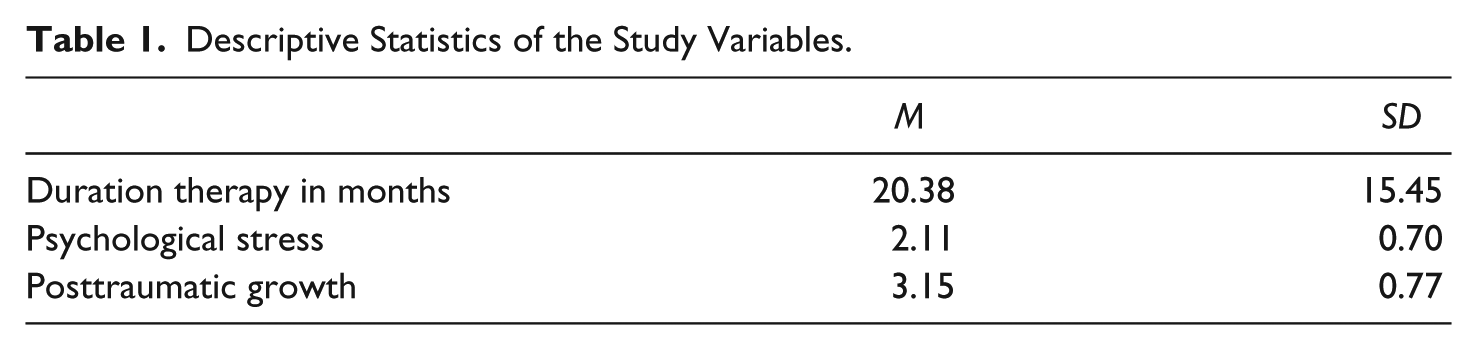
Descriptive statistics of the study variables can be found in Table 1. Univariate analyses were conducted to investigate mean-level differences. With regard to sociodemographic variables, inmates who graduated high school reported significantly higher levels of posttraumatic growth (M = 3.57, SD = .61) than inmates who were college graduates (M = 2.48, SD = .72), F(3, 25) = 5.09, p < .01. The mean level of experienced psychological stress, F(3, 25) = .87, ns, or of the duration of therapy, F(3, 24) = .56, ns, did not differ between the achieved educational levels. Age was not related with any of the study variables (Table 2). With regard to imprisonment-related variables, no significant differences regarding the number of convictions were found on posttraumatic growth, F(3, 26) = .87, ns; psychological stress, F(3, 26) = .34, ns; or on duration of the therapy in FIDES, F(3, 25) = .61, ns. Furthermore, no significant differences with regard to the number of in-prison sentences were found for posttraumatic growth, F(4, 25) = .85, ns; psychological stress, F(4, 25) = .81, ns; or duration of the therapy in FIDES, F(4, 25) = .27, ns. Offenders who were already in therapy during incarceration showed significantly lower levels of psychological stress (M = 2.00, SD = .59) than their counterparts who were not in therapy in prison (M = 3.58, SD = .12), F(1, 28) = 13.83, p < .01. No significant differences were found in posttraumatic growth, F(1, 28) = 2.38, ns, although the concrete means seem to indicate a (non-significant) pattern with offenders who were in therapy during incarceration reporting higher levels of posttraumatic growth (M = 3.20, SD = .76) and those who were not enrolled in therapy in prison (M = 2.35, SD = .44). The small sample size might cause the non-significance. As expected, higher levels of psychological stress were significantly related to lower levels of posttraumatic growth. Duration of therapy was also significantly positively related to the level of posttraumatic growth (Table 2).
Descriptive Statistics of the Study Variables.
Correlations Between Age, Duration Therapy, Posttraumatic Growth, and Psychological Stress.
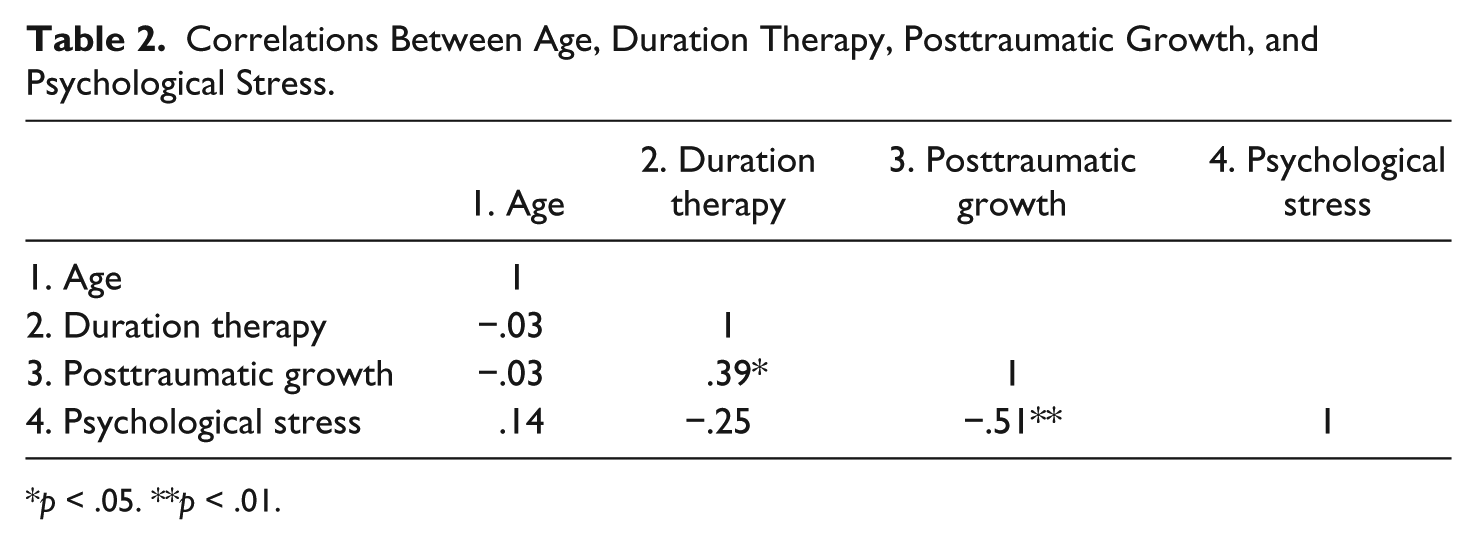
p < .05. **p < .01.
Primary analyses
Subsequent hierarchical analyses were performed with levels of posttraumatic growth as dependent variable (Table 3). In a first step, educational level and gender were entered as control variables in the prediction of posttraumatic growth. These variables, however, did not significantly predict posttraumatic growth (R2 = .17), F(2, 27) = 2.58, ns. In a second step, standardized scores of psychological stress and duration of therapy were entered, which added significantly to the prediction of posttraumatic growth (R2 = .58), F(4, 27) = 7.96, p < .01. This was due to the significant negative effect of psychological stress (β = −.51, p < .01). Duration of therapy, on the other hand, showed a marginal positive effect in the prediction of posttraumatic growth, failing, however, to reach significance (β = .29, p = .05). In a final step, the interaction between psychological stress and therapy duration was entered but did not reach significance (R2= .59, β = .11, ns).
Hierarchical Regression Predicting Posttraumatic Growth.
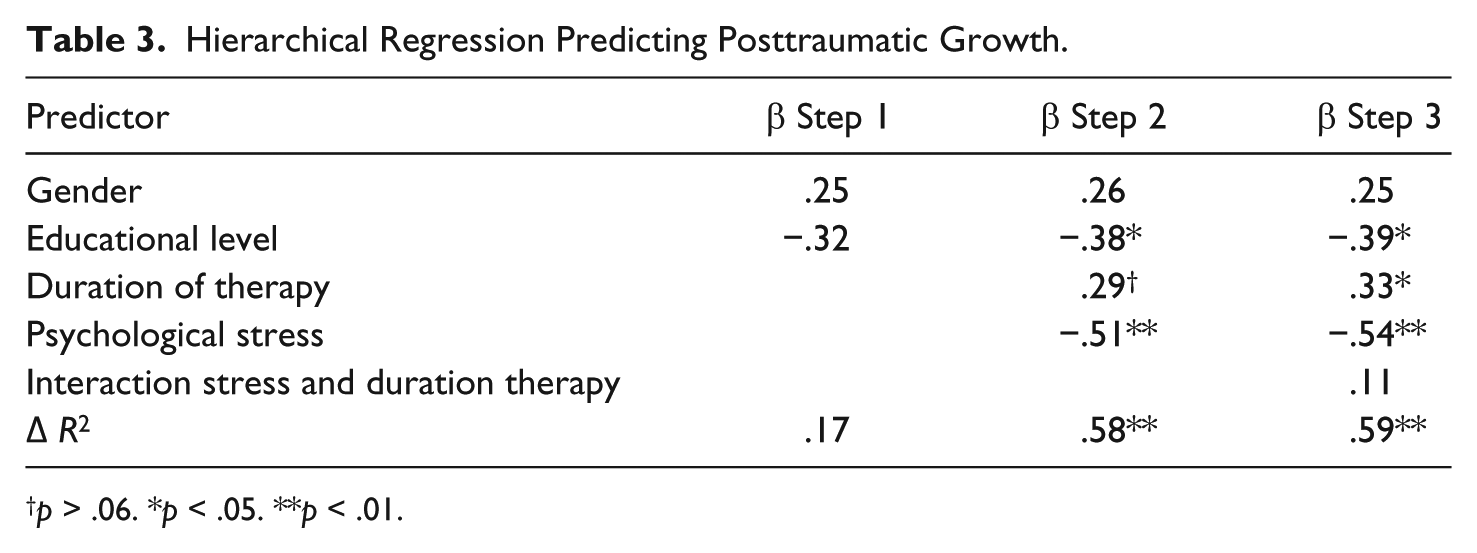
p > .06. *p < .05. **p < .01.
Qualitative Analysis
A phenomenological analysis was performed on the notes that were taken during the three group sessions. We used the “Duquesne method” (McLeod, 2011) which proposes a stepwise phenomenological analysis: extraction of significant statements of the participants, elimination of irrelevant information, identification of central meanings implicit in the statements, and integration of the meanings into a single description of the phenomenon. The following central themes were identified: prison experiences and emerging posttraumatic growth (emotional support, appreciation of life, purpose in life, and personal change), integrating and deepening posttraumatic growth during postprison therapy, and the current experienced posttraumatic growth.
Prison experiences and emerging posttraumatic growth
The participants took the opportunity to vent about their past prison experiences. As such, incarceration was primarily experienced as highly negative, but it challenged them to change in one way or another.
Alex,
2
50-year-old man, gave a typical example of his prison time: You lose everything . . . your dignity, your self-confidence, your job and many so-called friends. I also felt constantly scared. I was literally chased by other prisoners. I was often looking behind me if nobody would attack me, which happened in fact a couple of times. The guards knew what was happening but they didn’t intervene. The only thing I could do was surviving and reminding myself that I would be free one day.
The experience Alex had in prison was not exceptional. In each reflection group, there were participants who gave similar examples of their prison experience. Their testimonies remind us of many qualitative studies that have described the entry shock of incarceration, which is often accompanied with anxiety, a loss of control, a loss of relationships, and a loss of self (Liebling & Maruna, 2011). As an answer to these experiences, participants started to question themselves and embarked on an existential search for what was essential to them in life. Alex continued, “Eventually I started to ask myself the question, why on earth I had to stay alive. I also started to think about the past and about what really mattered to me in life.”
As a result of this existential questioning, important changes were initiated during their prison time such as a deeper appreciation of relationships, a deeper appreciation of life, and a shift in purposes and meaning in life.
For example, the experience of incarceration helped the offenders to value more deeply the emotional support of others important in their lives, such as family members and agents, which helped them to cope with prison. George, a 60-year-old man, expressed his gratitude for his wife during this imprisonment: Without her constant support and her visits, I wouldn’t have survived this hell. I lived from visit to visit; it was the only thing to look forward to. Since then, I really started to appreciate her and I had the feeling that I finally got to know her better. Too bad this had to happen first.
Marc also appreciated the support of some guards and therapists: There was one guard who took some time for me now and then. He asked me how I was doing and he was really interested in me. He gave me the feeling that I was still a human being. Afterwards I realized how important it is to take care of other people. Not for your own interest, but for the sake of the other.
At the same time, people became more important as a goal to live for: moments of despair and humiliation during incarceration became bearable because the participants felt they had to go on for the sake of their loved ones. Another aspect in the social realm that emerged during incarceration was the importance of being able to help other people, as a way of having something and someone to live for. Phillip told us how crucial it was for him to help an inmate with whom he shared his prison cell: He was an older man and he had physical problems. He was not able to carry any weight and couldn’t even tie his shoes. For me, it was almost a gift that I could help him. It felt that I still meant something for another person and that my life was not totally meaningless.
Some participants articulated that they appreciated life more fully. For example, they enjoyed the “little pleasures” of life now, like walking at the beach or in nature. Ali explained how he was looking forward to do small things when he was set free, which would have felt trivial before he was imprisoned: I was really looking forward to walk along the seashore, or even just to walk in and out my house and to leave the backdoor open. I also wanted to taste simple dishes that reminded me of my childhood or to sit in my backyard.
Besides the importance of relationships as a purpose in life, some participants also found new purposes. Some made plans to go to university or to take a different job. Remarkably, some participants saw the opportunity to stop the cycle of intergenerational sexual abuse as an important goal in life. Bart explained how this was his purpose in life: It became clear to me that I had to stop this cycle. I was sexually abused by my father, but he never acknowledged that he actually abused me. The only way to stop this cycle of abuse was to admit that I abused my son and to take responsibility for it. I don’t want him to go through the same feeling as I did. Interrupting this cycle of abuse in our family is the most important goal in my life.
There was a difference between group members who had joined some form of therapy during incarceration and those who had not (often because there was no therapy available in the institution where they were incarcerated). Those who were in therapy during their incarceration experienced their prison time as more meaningful, less stressful, and less harmful than did the others. They also experienced forms of personal change. Bart expressed that the fact that he already started with therapy and self-analysis during incarceration made him feel that he used that time well: I have the feeling that I really used my time well in prison. I immediately asked for therapy, and I read a lot of books about sexual abuse while I was waiting for my therapy to start. Slowly, I started to gain more insight in who I really was and how everything went wrong. It is weird, but as I gained insight and started to see differently, I also had the feeling that guards were better for me and that people looked at me through a different lens.
It is remarkable that the participants’ experiences of growth during their incarceration were very intertwined with their experiences of loss and suffering. In a way, this makes their growth indeed “posttraumatic” or stress related. It also suggests that this kind of change would not have occurred without the experience of loss. One of the participants suggested as follows: “It is weird. Prison was one of the worst episodes in my life, but at the same time, it gave me the opportunity to change for the better.”
Integrating and deepening posttraumatic growth during postprison therapy
A second theme that arose in the group reflections was that postprison therapy accelerated the growth process and deepened the changes that were already emerging during incarceration. Specifically, the changes in prison emerged from a necessity to survive the daily challenges. Once in therapy after incarceration, there was time to integrate these changes into the prisoners’ personalities and future life plans. The participants emphasized the importance of acknowledging and confronting the crime. Joseph was very clear: If you’re not honest with yourself, there is no reason to sit here. It is not easy though. It is very hard, but it is the only way. Once you made that step, you feel relieved and you can finally start to build up yourself and your life again.
Thierry added that facing one’s own childhood traumas was equally important: “I was really scared to talk about my own abuse, but by going through those experiences again, it became clear to me how much it determined my life. I also became aware of how my victims must have suffered.”
The participants were clear about the importance of accepting the full responsibility for their crimes. It shifted their attitude toward their therapy and they became intrinsically motivated and more personally involved in therapy. It changed their perception of their own past and future and it accelerated the therapeutic process. This resulted in more posttraumatic growth, especially by providing personal insight and through changed interactions with other people. For example, Jonas noticed that he was more able to listen to other people because of the therapy.
All the participants experienced decreased stress levels as therapy moved forward and as they experienced growth, but this didn’t occur in a linear fashion. At times, therapy itself became a source of stress, especially when they opened up to talk about their crimes or about their previous childhood experiences of abuse and physical violation.
Experienced posttraumatic growth at the current moment
The participants reported different areas of posttraumatic growth as a result of their incarceration and their therapy. Posttraumatic growth was experienced in changes in their self-narratives and self-knowledge (“I know better who I am now”; “I know now what led myself to do these things”), in taking responsibility for their own crime (“You need to be honest with yourself and acknowledge that you did it”; ”I want to take responsibility for the abuse because that’s important for my victim”; “Being in therapy is taking responsibility”), in a deeper appreciation of relationships (“My family is my top priority”; ”Without the support of my wife and this group, I would never have come this far”), and in changed purposes in life (“I want to work now and lead an honest life”; “I want to study”; ”I don’t care that much anymore for material belongings, it is who you are and your relationships that count”). Interestingly, the participants enjoyed talking about posttraumatic growth. Alex expressed it this way: “Actually, it is nice to talk about the growth. I have the feeling that this put things in a different perspective. Talking together about growth and about what matters in life makes me thinking.” Reflecting on these experiences of growth by the participants was mostly accompanied by feelings of hope, relief, and the belief that their lives were not fully wasted after all.
Discussion
In a sample of 30 sex offender, posttraumatic growth was studied with a sequential research design offering quantitative data as well as in-depth, qualitative insight. Within this pilot study, our hypotheses with regard to psychological stress and posttraumatic growth were confirmed. We found that higher levels of posttraumatic growth were associated with lower levels of psychological stress. We also found a pattern positively associating posttraumatic growth with the duration of the therapy, but this association failed to reach significance which might be due to our small sample. Offenders who were in therapy during incarceration—prior to the current therapy—showed lower levels of psychological distress during their current therapy, but they did not show a higher level of posttraumatic growth.
From a theoretical perspective, the fact that posttraumatic growth is negatively related to psychological stress seems to underscore one of the basic tenets of humanistic, existential approaches, and the Good Lives Model regarding offenders (Polizzi et al., 2014; Ronel & Elisha, 2011; Vanhooren, 2006, 2011; Ward & Brown, 2004). These approaches predict that when offenders meet their basic existential needs in a more adjusted way, their experience of psychological stress will be lower. Posttraumatic growth is experienced when people meet these needs in a new way. In our sample, higher levels of posttraumatic growth were indeed associated with less psychological stress, which could mean that these offenders found a new way to relate to their basic existential needs. This was confirmed by the qualitative data that we gathered during the debriefing sessions. For example, the participants explained how family became more important to them, how they appreciated the support of group members and other people, how it became important to take care of others, and how they tried to give a new direction to their lives. These experiences of posttraumatic growth were accompanied by feelings of hope, relief, and the belief that their lives were not fully wasted after all.
The feedback of the participants on the interaction of stress and the duration of therapy was very clarifying. As therapists often experience, the interaction of psychological stress, growth, and the therapeutic process is not a straight story. The participants explained how the therapeutic process itself is at certain moments a source of stress. For example, as the therapeutic process evolves, the offender’s ability to face his crimes and the consequences grows. This confrontation initially elicits psychological stress, before the client finds a way to live with this truth. This may explain why the interaction of the duration of therapy and psychological stress does not predict posttraumatic growth.
Participants who were in therapy during incarceration explained how therapy in prison helped them to experience their incarceration as a more meaningful time, which reduced the stress experienced in prison. They saw their prison time as less harmful compared with those who did not get help. They experienced their current therapy as a continuation of the therapeutic process that started during their incarceration.
In many ways, the findings of this pilot study confirmed the results of previous qualitative studies on posttraumatic growth with sex offenders and offenders in general. Consistent with the earlier studies, we found signs of changes in the appreciation of relationships and personal growth and in shifts in meanings and purposes in life. Interestingly, the participants in our sample put a lot of emphasis on the importance of emotional support during their incarceration, which confirms the findings of Elisha et al. (2013). In their qualitative study with sex offenders, acceptance relationships were experienced as the crux to change. We also found that relationships were experienced as an important source of meaning in life. This is not different from the general population. Relationships play a major role in experience meaning in life (Stillman et al., 2009). This only confirms the role of meaningful relationships as a basic existential need. Our qualitative study also confirmed the earlier findings that for those prisoners who experience posttraumatic growth, prison itself is experienced as a turning point in life. Earlier qualitative research pointed out that incarceration is often experienced as a place where their global meanings about themselves, the others and the world are being challenged (Braswell & Wells, 2014; Guse & Hudson, 2014; Maruna et al., 2006; van Ginneken, 2014). This is completely in line with the research of posttraumatic growth over different populations: Posttraumatic growth only occurs in individuals whose lives are markedly disrupted by a stressful life event (Calhoun & Tedeschi, 2006). We also confirmed the earlier findings of Elisha et al. (2013) about the importance of taking responsibility for the committed crime as a form of posttraumatic growth. We found that the participants experienced the acceptance of their responsibility to be a source of growth: It shifted their attitude toward their therapy and their perception of their personal past and their own future. Acknowledging their responsibility increased their involvement in therapy and deepened their posttraumatic growth considerably.
Much harder to interpret is our finding of a negative association between education and posttraumatic growth. In some studies with cancer-patients and HIV-patients, higher education and socioeconomic status were positively associated with posttraumatic growth (Milam, 2006; Stanton, Bower, & Low, 2006). In a study on posttraumatic growth with political prisoners, higher educational levels were also associated with higher rates of posttraumatic growth (Salo, Qouta, & Punamaki, 2005). As the qualitative studies on posttraumatic growth and offenders did not include any information about the educational levels of the offenders, we do not know whether our findings suggest a trend in offender populations or not.
Limitations
Our pilot study on posttraumatic growth has certain limitations that should be taken into account. Our sample size was small, which limited the possibilities of statistical analysis. The research was cross-sectional, which made it impossible to search for causal relationships and for effects of variables over time. Another limitation was that all the measures were self-reported. We could have compared the self-reported results of the participants with reports about these participants by the group therapists, but this might have endangered the confidentiality of the study. Another limitation is our study did not include a control group, which makes it impossible to compare the results with sex offenders who did not receive any therapy.
Taking these limitations into account, the results of this pilot study provide a first indication of important relationships between posttraumatic growth and psychological stress among offenders, and they point in directions for further research. More work is needed to clarify the meaning-making processes that lead to posttraumatic growth in this population of sex offenders, the therapeutic process that accompanies growth, and the relationship between posttraumatic growth and desistance from crime.
Conclusion
Posttraumatic growth has been described as the positive outcome of processing important losses of meaning caused by stressful life events (Tedeschi & Calhoun, 2004). In our sample, we discovered that incarceration was experienced by all participants as a distressing life experience, and that existential questioning arose from this experience. We found that higher levels of posttraumatic growth were associated with lower levels of psychological stress. Therapy helped the participants to integrate new perspectives and meanings in their narrative, and to shape their life in a more prosocial way. These outcomes correspond to the anticipated results of newer rehabilitation models. For example, the Good Live Model aims for a new redemptive self-narrative, new values and purposes in life, and new ways to meet one’s basic existential needs (Ward & Marshall, 2007). Facilitating posttraumatic growth can help to increase intrinsic motivation, therapy engagement, and the achievement of the therapy goals.
Footnotes
Acknowledgements
The authors would like to thank Ilana Sumka, Howard Sumka, Marc Berkers (CGG Prisma), Dirk Debbaut (FIDES), Sarah Vandewalle (FIDES), Dominiek Derore (FIDES), Ellen Gunst (FIDES), Julie Pecceu (FIDES) and Sabine Van Acker (CGG Prisma) for their full support and genuine interest during the study.
Declaration of Conflicting Interests
The author(s) declared no potential conflicts of interest with respect to the research, authorship, and/or publication of this article.
Funding
The author(s) received no financial support for the research, authorship, and/or publication of this article.