




Abstract
General strain theory (GST) has been one of the most frequently tested criminological theories. According to GST, strain tends to generate negative emotions, which create pressures for corrective action, such as crime and delinquency. Although GST has received strong empirical support, one under-addressed issue is the lack of diversity in sampling population in assessing the generalizability of the theory. Using survey data collected from 335 incarcerated women in four Chinese prisons, this study examined the impact of strain and negative emotions on the level of female criminality. The strain variable, physical abuse, and discrimination, exerted a positive effect on female inmates’ levels of criminality, whereas negative emotions were not significantly related to female criminality. Two control variables, age of current offense and educational attainment, were predictive of female criminality, with younger and less-educated women having more serious criminality. Implications for future research and policy are discussed.
Introduction
One of the most commonly tested criminological theories is the general strain theory (GST). Agnew (1992, 2006) identified three general sources of strain. First, strain may arise because the individual fails to achieve positively valued goals, such as good school performance and stable income. Second, strain may be generated by the removal of positive valued stimuli—that is, when the individual loses something valued, such as a romantic relationship. Finally, strain may occur because of the presence of noxious stimuli, such as abusive parents and perceived discrimination. According to GST, strain tends to generate a host of negative emotions, with anger being the most salient, but the presence of negative emotions does not necessarily lead to deviant and criminal behavior. Individuals who experience negative emotions and fail to use positive copying mechanisms, which could be cognitive, behavioral, and emotional, are more inclined to engage in crime and delinquency (Agnew, 2001).
A substantial body of empirical studies have assessed GST’s core arguments and generally found supportive results (e.g., Agnew & White, 1992; Aseltine, Gore, & Gordon, 2000; Baron, 2004; Broidy, 2001; Capowich, Mazerolle, & Piquero, 2001; Hay, 2003; Hay & Evans, 2006; Hoffmann & Miller, 1998; Hoffmann & Su, 1997, 1998; Mazerolle, Burton, Cullen, Evans, & Payne, 2000; Sigfusdottir, Farkas, & Silver, 2004). Although the basic premise of GST has been established, the concept of strain has been criticized for being too broad to be falsifiable (Jensen, 1995). In response to this criticism, Agnew (2001, 2006) added four characteristics of strain that are inclined to cause delinquent and criminal behavior. Specifically, a strain is most likely to lead to criminal and delinquent coping responses if it is perceived as unjust, high in magnitude, associated with low social control, and creating an incentive to commit crime. Agnew (2001, 2006) also posited that the types of strain that can cause criminal and delinquent behavior may be attributed to one-time individual events or several reoccurring, cumulative events.
The primary purpose of this study is to examine the impact of strain and negative emotions on the level of criminality among Chinese incarcerated women. We do not intend to comprehensively test GST as the use of secondary data precludes our ability to do so, but we believe that this study can contribute to the general literature of strain and crime, including GST, in two ways. First, by using a sample of incarcerated women, this study directly addresses the concern about the lack of diversity in research samples in assessing criminological theories (see Brezina, 1996; Mazerolle & Piquero, 1998). Most of criminological studies drew conclusions based on conventional samples, especially school-based youth, which tended to capture minor or more conventional forms of criminal involvement (Hagan & McCarthy, 1997). Despite constant calls for expanding theoretical testing to more diverse populations, especially serious offenders (see Broidy & Agnew, 1997; Messner & Rosenfeld, 1994; Nagin & Paternoster, 1991), criminological research on serious offending remains limited, and GST research using samples of serious offenders is even more sporadic. As members of at-risk groups are more likely to experience crime-prone strain, such as negative social relations, than regular people (Bernard, 1990; Pearlin, 1989), utilizing a sample of incarcerated population has the advantage of directing our attention back to the more serious crimes and the risk factors associated with them. Such a study is even more valuable when it has a focus on female inmates, whose experience is generally less known compared with their male counterparts and whose needs are often neglected in prison.
Second, criminological theories have been assessed based chiefly on data from Western, industrialized countries, most notably the United States. Nevertheless, theories developed in highly industrialized, modernized countries may or may not be applied, to the same extent or in the same way, to less developed nations, such as China. Scholars have argued that researchers need to adapt and test a theory in varied cultural and societal contexts to increase the generalizability and foster empirical development of the theory (Piquero & Sealock, 2000). Thus, examining a non-Western sample from the world’s most populated country can improve the external validity of GST and enhance our understanding of stressful experiences in general (Hoffmann, Cerbone, & Su, 2000; Hoffmann & Su, 1998). China is also a highly relevant testing site of strain and crime as its rapid social and economic changes over the past three decades have resulted in high levels of inequality and anomie, and accordingly a rapid increase in crime (Cao, 2007; J. Liu, 2005; Wu & Sun, 2009).
Using survey data collected from 335 female inmates in China, this study examined the effects of strain and negative emotions on women’s degrees of criminality. Specifically, this study attempted to address three primary questions: (a) Does strain lead to negative emotions, (b) does strain influence the level of female criminality, and (c) do negative emotions mediate the relationship between strain and the level of female criminality? Given the rarity of empirical testing of Western-based theories using a Chinese offender sample, this study can enhance our understanding of the connection between female strain and criminality and advance theoretical elaboration regarding the conditions under which theoretical arguments of GST hold (or do not hold) in a non-Western context. This study can also assist policy makers and criminal justice practitioners in both China and the United States in designing better crime prevention strategies and programs for women.
Strain and Female Criminality
The relationship between GST and female criminality has been proposed and assessed in several studies. For instance, Broidy and Agnew (1997) argued that GST might be able to explain gender difference in crime in three ways. First, males and females are subject to different strains, with male strain more conducive to crime. Specifically, males are more inclined than females to encounter financial strain and interpersonal conflicts, whereas females are more likely than males to experience network-related stressors and gender-based discrimination. Second, males and females are different in their emotional responses to crime, with male responses more conductive to crime. Finally, males are more inclined than females to respond to strain and negative emotions using criminal coping strategies.
Researchers (Agnew, 2006; Broidy & Agnew, 1997) have also pointed out that GST’s arguments were consistent with feminist theorists’ contention that the oppression of women was the primary source of strain and stress for many females (Chesney-Lind, 1989; Chesney-Lind & Shelden, 2004). GST targets several important sources of crime-producing conditions for females, such as sexual discrimination, physical abuse, and financial stress (Agnew, 2006). Sexual discrimination, for example, is “likely to create a sense of injustice, particularly given the increased emphasis on justice norms that stress equal treatment for males and females” (Broidy & Agnew, 1997, p. 291).
Most empirical studies examined gender differences in the likelihood of committing a crime (e.g., Baron, 2007; Hoffmann & Su, 1997; Jang & Johnson, 2005; Kaufman, 2009; Ostrowsky & Messner, 2005; Robbers, 2004; Sharp, Brewster, & Love, 2005), rather than focusing on female criminality. This line of research sheds some light on common risk factors associated with both women and men, including prior victimization (Kaufman, 2009; Ostrowsky & Messner, 2005; Robbers, 2004), relational problems (Agnew & Brezina, 1997; Jang & Johnson, 2005), negative life events (Hoffmann & Su, 1997), physical and sexual abuse (Sharp et al., 2005), and family strain (Hay, 2003). While forming a solid knowledge foundation for uncovering gender influence under the GST framework, these studies provide only limited evidence regarding the nature, characteristics, and risk factors of criminal behavior among women in general and at-risk female population in particular.
Several exceptions are worth mentioning. Using a sample of young adult women, Eitle (2002) analyzed the impact of perceived discrimination and recent life events on criminal behavior. He found that both gender-based and non-gender-based discrimination as well as recent negative life events were related to substance abuse and other criminal involvement (e.g., breaking and entering). Slocum, Simpson, and Smith (2005) used a sample of female offenders to examine the relationship between strain and violent and non-violent crime (e.g., drug dealing) as well as substance use. They found that stressful life experiences increased all three types of crime, but victimization was only associated with violent offense. A third study (Piquero & Sealock, 2004) used a sample of detained juveniles to test the strain–delinquency relationship. They found that strain increased the probability of property offending and interpersonal aggression for males, but not for females. Finally, using data collected from female inmates in two sites, Proctor (2004) compared and contrasted the effects of variables derived from three criminological theories (GST, social control, and differential association) on female criminality. She found that the GST construct was significantly associated with the level of criminality from both samples. Considering the inconsistent results from these studies, the strain–crime relationship of at-risk females, especially incarcerated women, remains unsettled.
Recent studies also produced some important findings related to negative emotions. For example, research has distinguished between trait (or dispositional) anger and state (or situational) anger and found that their influences on the strain–crime connection could be different, with the latter displaying stronger mediating effects between strain and crime (see Capowich et al., 2001; Mazerolle, Piquero, & Capowich, 2003). Researchers also found that negative emotions co-occurred in affecting criminal behavior (Ganem, 2010). The co-occurrence of negative emotions, for example, was found to be more typical among female victims of stalking than male victims (Ngo & Paternoster, 2013).
The past decade has witnessed the emergence of a small number of studies on GST using data collected from Chinese societies, including mainland China (Bao & Haas, 2009; Bao, Haas, & Pi, 2004, 2007; R. Liu & Lin, 2007), Hong Kong (Cheung & Cheung, 2008, 2010), and Taiwan (Lin & Mieczkowski, 2011). Their findings generally support the linkage between strain and delinquent and criminal behavior. Among these studies, three touched on gender issues and female offending. Based on a sample of 8th to 11th grade students in mainland China, Bao and colleagues (2007) found gender differences in coping behavior, but the strain–delinquency relationship was similar across genders. Using middle school Chinese students as samples, R. Liu and Lin (2007) showed that boys’ strain over status achievement was related to delinquency, whereas girls’ strain over physical well-being was associated with delinquent behavior. In Hong Kong, Cheung and Cheung (2010) found that female juveniles who experienced higher levels of school-related strain were in greater risks of delinquency. These studies, although insightful, are limited in using conventional juvenile samples. The extent to which the strain–crime nexus and the mediating effect of negative emotions can be applied to at-risk non-Western women remains unknown. Furthermore, the connection between three types of strains commonly associated with adult women and offending (i.e., physical abuse, gender discrimination, and financial stress) and female criminality is largely unclear. These limitations are addressed in this study.
Chinese Female Offenders
China has experienced dramatic social changes since starting its economic reform in the late 1970s. The rapid economic development has not only greatly improved the quality of life for ordinary citizens but also unfortunately led to some social conditions conducive to criminal activity, such as weakened informal social control, increased income inequality, higher population mobility, rising divorce rate, and poor police–community relations (Wu & Sun, 2009). Indeed, China has endured a significant increase in crime over the past three decades, especially such economically motivated crimes as larceny, robbery, and fraud (Cao & Dai, 2001; J. Liu, 2005).
An overall rise in crime rates was accompanied by a steady growth in female criminal offending. For example, the proportion of women in correctional facilities had more than doubled in two decades, expanding from about 2% in the 1980s to nearly 5% in 2008. The average number of incarcerated women between 1983 and 1992 was 28,400 (Tong, 1995). Nonetheless, the total number of women inmates enlarged by 39,000 between 2000 and 2006 and reached more than 80,000 in 2008, with an average annual augment of 15% (Zhang, 2008). Although women remain a small portion of the total prison population, an escalation of female representation within the Chinese correctional system has apparently been a trend over the past two decades.
Similar to their U.S. counterparts, Chinese female offenders and inmates were more inclined to be young, have low educational attainment, come from mid to low socio-economic status (SES) families, and be victims of physical and sexual abuse (Lai, 1997; Wang, 2002). A recent survey of more than 1,400 inmates in a provincial-level women prison revealed that nearly 40% of the inmates were between 26 and 35, and another 30% were between 36 and 50 (Jiang, 2007). The same study also showed that 85% of the women prisoners had only a middle school or lower educational background.
Although Chinese and the U.S. female offenders share some common characteristics, several noticeable differences in cultural and legal traditions and recent societal changes between the two societies may contribute to divergent experiences of women and female offenders in these societies. In the United States, for example, multiple waves of women’s movement from the 18th century to the 1970s have significantly improved gender equality in society. These movements evolved around various issues of women’s property rights, voting rights, reproductive rights, equal employment and pay, and access to higher education and medical professions. In contrast, although Chinese women’s social status and rights have certainly improved over the past several decades, China remains largely a patriarchal society, where men’s superiority and women’s inferiority are heavily embedded in various aspects of social life (M. Liu & Chan, 1999). Discrimination against women in family life, education, and employment lingers, leading scholars to argue that there is still a long way to go for genuine gender equality in China (Evans, 2007; Stockman, 1994).
Domestic violence, which has been a high risk factor associated with female offenders, is a good example to illustrate how Chinese women’s rights are severely under-protected compared with their U.S. counterparts. In the United States, a country-wide trend of strengthening official intervention into domestic violence has been observed in the past three decades. This movement was influenced primarily by findings from the pioneering study conducted in Minneapolis (Sherman & Berk, 1984), litigations brought up against police departments by victims of domestic violence, and legislations and policies in regulating governmental response and protecting victims’ rights (Sun, 2007).
Although domestic violence has surfaced as a noticeable social problem in China (Parish, Wang, Laumann, Pan, & Luo, 2004; Xu, Campbell, & Zhu, 2001), China does not have a national law dealing specifically with domestic violence. Legal protection for victims of domestic violence is mainly prescribed in the Marriage Law of the People’s Republic of China (Sun, Su, & Wu, 2011). Although the law empowers Chinese police to administratively sanction violators of minor offenses, police officers seldom use this power against offenders of domestic violence. The Chinese police do not actively intervene into domestic violence incidents, and when they do respond, their actions are likely to be simply asking about the nature of the conflict and taking reports instead of apprehending the offenders (J. Liu, 2004).
Chinese women are not only subject to under-enforcement as victims of domestic violence but also the targets of over-enforcement for other offenses. Prostitution comes into mind for over-policing of Chinese women. “Imprisoning the woman and fining the man” has been the general principle of handling commercial sex transactions for many decades (Wang, 2002). Female prostitutes are commonly punished more severely than their male clients. A number of detention and reeducation centers are established throughout the country to confine female sex workers, whereas very few such facilities are in place for male offenders. Although chivalry theories (Steffensmeier, 1980), which posit that female offenders are treated more leniently than their male counterparts by the criminal justice system because of protective and benevolent societal attitudes toward women, receive some empirical support in the literature (e.g., Daly & Tonry, 1997; Spohn, 1999), their validity in the Chinese context is virtually untested.
In brief, although Chinese women’s status in social, political, and economic systems has improved since the 1950s, they are still highly vulnerable to various strain-producing conditions in daily lives, such as the feudal tradition embedded in Chinese culture that causes discrimination in family roles and job market, the lack of adequate legal and police protection of women subjected to family abuse and violence, and a market-driven economy that leads young women to cities for employment and leaves older women behind in rural homes for sole care responsibility. These conditions of gender inequality, income disparity, and violence against women are likely to pose various sources of strain for Chinese women. This study examined the impact of different types of strains and negative emotions on female criminality.
Method
Data Collection and Sample
Data used in this study were collected as part of a large project conducted by the Ministry of Justice (MOJ) of People’s Republic of China. The main purpose of the project was to investigate factors related to female criminality, which have been severely under-researched. Researchers from MOJ’s Crime Prevention Institute carried out surveys with inmates housed in four provincial-level women prisons between May and September, 2009. The survey questionnaire, which consisted of 65 items, was divided into three sections, tapping into offense-related information and personal background and experiences before and after 18 years old.
In general, each Chinese province has a women prison. These four sample prisons were selected because they are located at different regions in the country. 1 The numbers of female inmates in these prisons ranged from 1,750 to 2,280, and in each prison, inmates were housed in 9 to 12 wards with approximately 200 to 300 women in each ward. Based on the information provided by prison staff, MOJ researchers selected one ward within each prison that had a high degree of mixed inmates with different offenses and sentences as the sampling units. Every other woman on the prison roster in those wards was then selected as potential survey participants. Inmates were informed that their participation in the survey was completely voluntary. Those who agreed to participate convened and completed the survey at a cultural education room in a prison. All correctional officers and staff were asked to leave the room. MOJ researchers explained in details the purpose of the study and informed the respondents the principles of voluntariness and anonymity. A total of 495 surveys were distributed, and 405 valid surveys were returned, resulting in an 82% overall response rate. 2 It took the respondents roughly 30 minutes on average to finish the survey. Inmates who were illiterate completed the survey with the help from fellow offenders who read the questions to them. Cases with missing values were dropped from the analysis, resulting in a final sample of 335 female inmates.
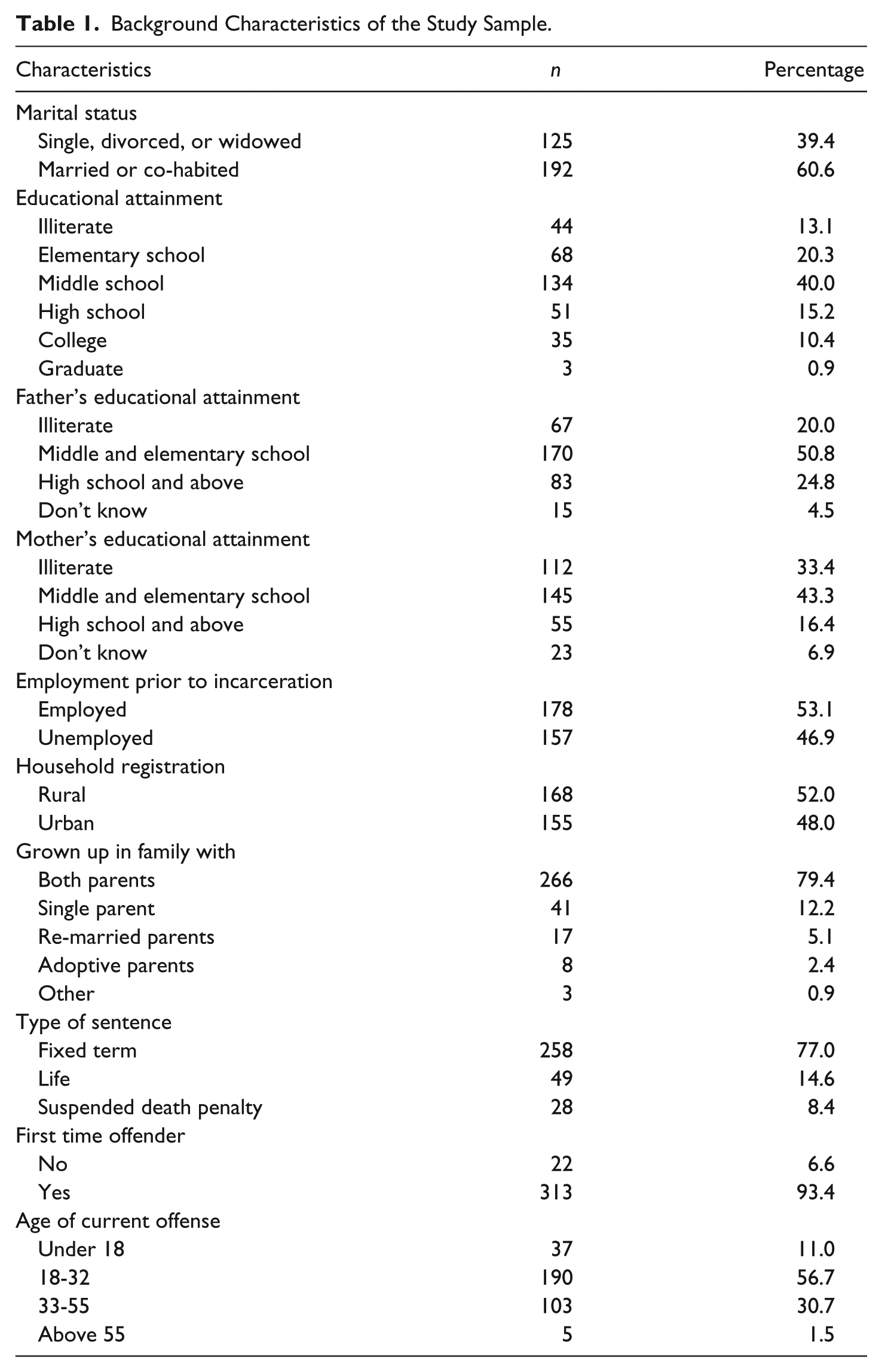
Table 1 displays the key background characteristics of the sample women. About 60% of the women inmates were currently married or lived with a partner before incarceration. In line with the low level of educational attainment reported by previous research on Chinese incarcerated women (Lai, 1997), more than 70% of the participants had no more than middle school education, with 13% of them being illiterate. In addition, the parents of these inmates were also poorly educated. Less than one fourth of the respondents’ fathers and 17% of the respondents’ mothers had high school or higher than high school education. Slightly more than half of the surveyed women (53%) were employed before incarceration. Fifty-two percent had a rural household registration. One in five of the women experienced some kind of family disruption (e.g., divorce, re-marriage, and adoption) while growing up. Regarding their sentences, 77% were serving a fixed-term sentence, 15% were serving a life sentence, and the remaining 8% were sentenced to death with 2-year suspension. 3 The vast majority of the sample (93%) was first-time offenders, and close to 60% committed the offense while they were between 18 and 32 years old.
Background Characteristics of the Study Sample.
Variables
The dependent variable used in this study is the level of criminality. Following Proctor’s (2004) work on female criminality, the variable was constructed by summing the level of the severity of inmate’s most serious offense based on China’s Penal Code, the length of her sentence, and her participation in delinquent and criminal behavior. The respondent was asked to identify the most serious offense that she was sentenced for her current imprisonment and the length of her sentence. The respondent was also asked to select all delinquent and criminal behavior that she had engaged in before serving her time. The scale thus captured several important aspects of criminality, including the type of the offense, the severity of official sanction, and the pre-incarceration involvement in criminal and delinquent behavior. Table 2 displays a detailed list and coding of these items. A higher score indicates a higher level of criminality.
Descriptive Statistics for Variables (N = 335).
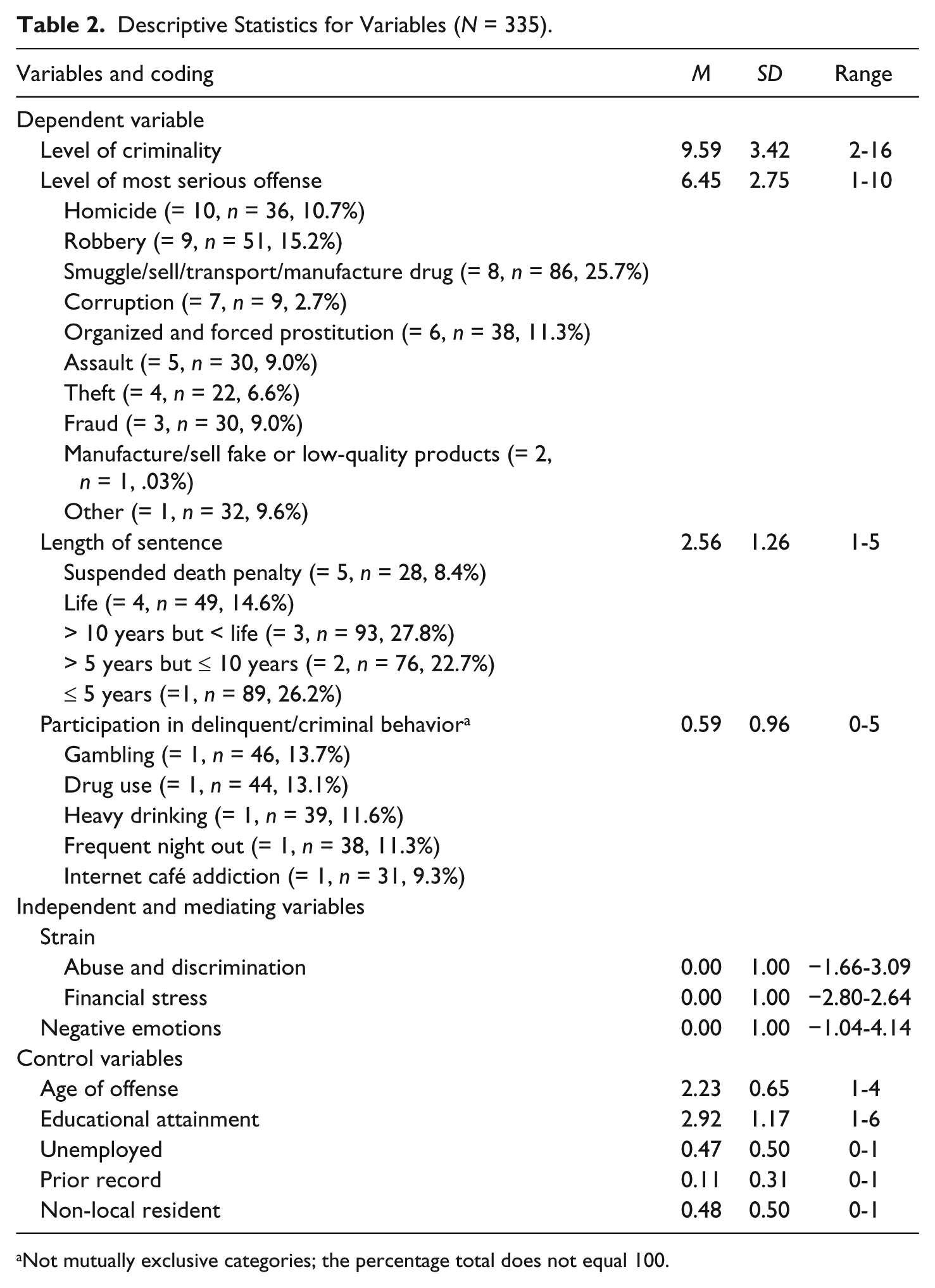
Not mutually exclusive categories; the percentage total does not equal 100.
Independent and mediating variables consisted of two variables measuring strain and one variable indicating negative emotions. The survey contained six items related to strain: The respondent was asked (a) whether she was physically abused by family member(s) before 18 years old, (b) whether she was physically abused after 18, (c) whether she had stable income before incarceration, (d) to rate their levels of economic life compared with people in their surroundings, (e) whether she agrees that the society discriminates against women, and (f) whether she has personally or vicariously experienced any gender discrimination in seeking employment and promotion. Factor analysis of the six items generated two factors. The first and last two items (e.g., Items a, b, e, and f) loaded high onto one factor with an eigenvalue of 1.86 explaining 31.1% of the variance. The middle two items (c and d) loaded onto a second factor with an eigenvalue of 1.29 accounting for 21.5% of the variance. Factor scores were used in the analysis with the former indicating abuse and discrimination and the latter signaling financial stress. 4
The instrument also included three items reflecting negative emotions. The respondent was asked whether she (a) often felt angry or depressed because of her disadvantaged situations (e.g., poverty and poor health), (b) felt inferior for being a woman, and (c) felt angry or pain because of gender discrimination. Factor analysis revealed that all three items loaded high onto one factor with an eigenvalue of 1.83 explaining 61% of the variance. The factor score was used in statistical analysis to reflect negative emotions.
Control variables included age of committing current offense, educational attainment, employment status, 5 prior record, and local residence status. Age of offense is a four-category variable (1 = under 18; 2 = 18-32; 3 = 33-55; 4 = above 55). Educational attainment is a six-category variable with attributes ranging from illiterate (= 1) to graduate study (= 6). A high value thus indicates a higher level of educational attainment. The remaining three variables were constructed as dummy variables with 1 representing unemployment before incarceration, prior detention or re-education through labor experience, 6 and non-local residency. Table 2 displays the descriptive statistics for all variables used in this study. It should be noted that the means and standard deviations for abuse and discrimination, financial stress, and negative emotions all equal 0 (means) and 1 (standard deviations) because factors scores were standardized. The value of these variables thus ranged from a negative number to a positive number. A negative value indicates that the inmate experienced lower than the average level of strain or negative emotions and vice versa. Table 3 shows the correlation matrix of all variables.
Correlation Matrix.

Results
To answer our research questions, four regression models were estimated. As shown in Table 4, Model 1 tested the direct impact of the two strain variables on negative emotions. Model 2 assessed the direct effect of the same strain variables on the level of criminality. In the next model (Model 3), the negative emotions variable was added into the regression analysis to examine the effects of both strain and negative emotion variables on female criminality. The final and full model (Model 4) included both strain and negative emotion variables and all control variables.
Multiple Regression Summary.

p < .05. **p < .01. ***p < .001.
Starting with Model 1, abuse and discrimination was significantly related to negative emotions, whereas financial stress was not a significant predictor of negative affect. The two strain variables explained 15% of the variation in negative emotions. In Model 2, as we expected, women inmates with higher levels of strain were more likely to have a higher level of criminality. The two variables together explained about 9% of the variation in female criminality. Looking at Model 3, contradictory to our expectation, adding the mediating variable, negative emotions, into the analysis did not influence the significant effects of both strain variables on the level of criminality. That is, the mediating variable failed to achieve a statistically significant effect on the degree of female criminality, and the explanatory power of the model remained unchanged, compared with that of Model 2.
In Model 4, one of the strain variables, abuse and discrimination, stayed as a significant predictor of the level of criminality, whereas the significant effect of the other strain variable, financial stress, disappeared. Negative emotions continued to be unrelated to female criminality. Two control variables, age of the current offense and educational attainment, exerted a significant influence on the level of criminality. Younger offenders when committing the crime and less-educated offenders were more likely to have a higher degree of criminality. All variables together accounted for 13% of the variation in female criminality.
Discussion
This study represents a first attempt to test the applicability of GST on incarcerated Chinese women. It addresses the questions about whether strain and negative affect influence women inmates’ levels of criminality. We found both congruence and incongruence between our results and the existing Western evidence. First, incarcerated Chinese women who experienced physical abuse and gender discrimination were more likely to have a higher degree of involvement in delinquent and criminal behavior. This finding confirms the strain–crime connection commonly found in past studies. It also echoes the Western literature on imprisoned women, which revealed that these women tended to experience physical and sexual abuse and grow up in families with high drug abuse and frequent encounters with the criminal justice system (Girshick, 1999). To cope with traumatic sexual and physical abuse, young girls and women were frequently forced to run away from home and engage in coping criminal activities such as prostitution and using and selling drugs (Gilfus, 1992). The context of incarcerated women’s lives in both Chinese and Western societies displays a similar pattern characterized by various types of strain endured during both childhood and adulthood. Future research should continue to investigate the linkage between women’s life experiences, especially their negative relationships with others, and their engagement in crime and delinquency.
Second, different types of strain have varying effects on negative emotions and criminality among the incarcerated Chinese women. We found that abuse and discrimination exerted a positive impact on negative emotions, whereas financial stress was not related to negative emotions in a statistically significant way. This finding partially supports Broidy and Agnew’s (1997) arguments that females are more likely than males to experience gender-based discrimination but are less likely to be subject to financial stress. We also found that the influence of financial stress on criminality was non-significant after controlling for background characteristics. These findings call for more research to further analyze the effects of different types of strain on negative emotions and crime within and across gender. Future research should also pay special attention to the role that personality traits, such as negative emotionality and low constraint, play in conditioning the effect of strain on delinquency (Agnew, Brezina, Wright, & Cullen, 2002).
Third, although strain associated with physical abuse and gender discrimination led to greater negative emotions, the direct effect of negative emotions on criminality was weak. Past research has indicated that such a linkage is complicated, often conditioning on gender and types of negative emotions and offenses. For example, Broidy and Agnew (1997) contended that although males and females are equally likely to respond to strain with negative emotions, the anger experienced by females is qualitatively different from that experienced by males. Piquero and Sealock (2004) found that anger was predictive of property offending for males (but not for females), but depression was unrelated to property offending for both genders. They also found that anger was significantly associated with interpersonal aggression for females only. Their findings suggested that different forms of negative emotions may be linked to different types of offenses (see also Mazerolle et al., 2000), which might account for the weak connection between negative psychological states and female criminality found in our study, a measure composed of multiple forms of crime and delinquency. We encourage future research to take this possibility into consideration by measuring various types of negative emotions and criminal offenses to further test the GST hypotheses.
We also found that the effect of strain on criminality did not greatly diminish after negative affect was included in the analyses. Strain, therefore, had quite direct effects on female criminality that were not significantly mediated by negative emotions among the study sample. This finding does not come as a complete surprise given that previous research has shown a strong relationship between early abuse and neglect experience and later violent behavior (Widom, 1989) and a continuous effect of strain on offending after controlling for negative emotions (Mazerolle et al., 2000). Future research should continue to explore the role that negative emotions play in criminality and possibly refine the GST theoretical models based on data from diverse samples.
Finally, our findings indicate that background characteristics of female inmates, particularly their educational attainment and age of offending, play an important role in predicting their criminality, with younger and less-educated women engaging in higher levels of crime and delinquency. The significant effect of education on criminal activity is expected as schooling can increase one’s stakes in conformity, improve one’s patience and risk evaluation capacity, and enlarge one’s legitimate goal pursuing channels. The greater relative risks of engaging in crime and delinquency by younger women is also explainable. As shown in Table 1, the profiles of these Chinese female inmates were largely in line with the characteristics of women offenders in the United States (Greenfeld & Sneld, 1999). That is, socially disadvantaged women (e.g., young and poorly educated) experienced higher risks of strain and criminal offending, regardless of the cultural context.
Before discussing implications for future research and policy, several limitations associated with this study should be acknowledged. First, the sample prisons were not randomly selected. Selection bias thus could be an issue. It is possible that our findings are not generalizable to the larger population of incarcerated women. Second, an important element of testing GST, positive coping mechanisms, was not included in this study due to data constraint. Our findings thus should be interpreted with caution. Finally, our study did not contain measures of situational negative emotions, which may exert differential effects on the strain–crime relationship than trait negative emotions (Capowich et al., 2001; Mazerolle et al., 2003). Future studies thus should consider incorporating situational anger into analysis.
Several directions for future research should be considered. First, despite the popularity of GST, empirical test of the theory in cross-cultural context remains scarce and deserves more attention. Better designed, culturally sensitive survey instruments supplemented with in-depth interview data will provide much-needed evidence in assessing and elaborating the theory. Second, future research should consider using other social groups in China, such as juvenile delinquents and homosexual teenagers, as samples to test different forms of strain. Finally, future research should use refined measures that tap into different aspects of strain, such as types (e.g., goal blockage, the removal of positive stimuli, and the presentation of negative stimuli), sources (e.g., from family, friends, school, community), nature (e.g., objective disadvantage versus perceived injustice), magnitude, recency, duration and clustering of negative events, and coping strategies (conventional versus deviant coping).
Our findings have some implications for policy. First, Chinese government must enhance their protection of women victims of physical abuse and gender discrimination. Our data indicate a strong connection between such negative experiences and the level of criminal offending. To effectively protect abused victims and prevent the reproduction of criminality, government agencies, especially police departments and social service agencies, need to work closely together to intervene into these incidents at an early stage. Appropriate policies and regulations should be in place to train public school teachers and health providers to recognize and report any suspicious abuse incidents. This will not be an easy task given that corporal punishment is still widely regarded as an acceptable parenting method in China to promote children’s academic performance and behavioral compliance. Strong and firm government support for gender equality coupled with meaningful educational policies and programs on parenting are needed to better protect women’s rights.
Second, our findings support the old wisdom that education prevents crime. Local governments and schools thus should try their best to keep young female students, especially those with poor academic performance and disadvantaged family background, from dropping out of school. Working collaboratively with parents and other significant people in students’ lives to ensure adequate assistance to and supervision on adolescent and young women and providing vocational training to those who do not pursue college education are possible ways to keep them from leaving school too early. Effectively protecting the rights and interests of socially disadvantaged groups including women should be the first step to establish a harmonious and safer society.
Footnotes
Declaration of Conflicting Interests
The author(s) declared no potential conflicts of interest with respect to the research, authorship, and/or publication of this article.
Funding
The author(s) received no financial support for the research, authorship, and/or publication of this article.