




Abstract
A neglected area of research within criminality has been that of the experience of the offence for the offender. The present study investigates the emotions and narrative roles that are experienced by an offender while committing a broad range of crimes and proposes a model of criminal narrative experience (CNE). Hypotheses were derived from the circumplex of emotions, Frye, narrative theory, and its link with investigative psychology. The analysis was based on 120 cases. Convicted for a variety of crimes, incarcerated criminals were interviewed and the data were subjected to smallest space analysis (SSA). Four themes of CNE were identified: Elated Hero, Calm Professional, Distressed Revenger, and Depressed Victim in line with the recent theoretical framework posited for narrative offence roles. The theoretical implications for understanding crime on the basis of the CNE as well as practical implications are discussed.
Narrative theory proposes that individuals make sense of their lives by developing a story or narrative with themselves as the central character (Baumeister & Newman, 1994). A narrative is composed of a unique sequence of events, mental states, and happenings involving human beings as characters or actors (Bruner, 1990). Narrative data consist of stories people tell about their life episodes, or in some cases, about their lives as a whole. These stories relate how people understand the significance of things that have happened to them and of the things they have done. From the time of Homer to the present day, people have relied on stories to explain everything from the origins of the universe to what will happen to them. Thus, data consisting of people’s narratives provide researchers with the richest and thickest source for explicating their “subjects’” understanding of their own lives (Polkinghorne, 1996).
McAdams (1985) has built on a resurgence in psychology of the personological approach by proposing a life-story model of identity based on an individual’s narrative. For McAdams, the basic motivational structure underpinning personal stories is the tension between agency (power) and communion (intimacy) in a person’s life. Agency motivation refers to a striving to be in control of the environment, to achieve success and mastery, to be powerful, competent, autonomous, and separate from others. Communion, by contrast, refers to a striving to develop close relationships; is the desire for connection to others, interdependence, and nurturance. Love and intimacy are key values for people with a high need for communion. Personal stories express the position adopted by the person on an agency-communion dimension.
Polkinghorne (1988) has argued that there are few compelling ways of telling a story and sees important connections with studies of literature (Polkinghorne, 1988). These plots and/or characters vary in numbers (i.e., Booker, 2004, argued there were seven master plots, Propp, 1969, suggested eight characters, Tobias, 1993, proposed 20 master plots and so on). Although there are many frameworks, all show some underlying similarity in distinguishing between narratives with happy endings and those with a sad ending (Youngs & Canter, 2011). McAdams argued that life stories can be conceptualised by one of four archetypal story forms, the origins of which can be found in Frye’s (1957) “Theory of Mythoi.” In his book, The Anatomy of Criticism, Northrop Frye attempts to classify a number of classic stories, dating from ancient times to the modern day. Taking his lead from Aristotle’s Poetics, Frye proceeds inductively by noting commonalities of plot in a variety of the most renowned narratives. The result is the delineation of four fundamental story forms, or what he terms four “mythic archetypes”: comedy, romance, tragedy, and irony.
Stories of the hero’s birth, of revival and resurrection, of creation, and of the defeat of the powers of darkness, winter, and death come under comedy. In the classic comedy (which may or not be funny or “comic”), the main characters are young heroes, usually in the pursuit of true love, happiness, and stability in life with others, by minimising interference from environmental obstacles and constraints. They seek simple and pure pleasures, are generally optimistic, and the recurrent emotions that they experience are generally positive, such as contentment. They are free from anxiety and guilt and are given the opportunity to provide a happy ending to their story on earth. This narrative is a story of overcoming obstacles in pursuit of pure and joyful objectives. This produces an underlying emotional tone to this myth of elation.
In romance, an aspect of life is configured as a successful quest or a pilgrimage to some desired end, consisting of three stages: a perilous journey with preliminary minor adventures, usually some kind of battle in which either the hero or his foe, or both, must die, and the exaltation of the hero. The protagonist is ever-moving as he tries to overcome adversity and take control of the new challenges to emerge victorious throughout life’s journey. This is a story of the protagonist’s victorious mastery of his environment. In this way, the underlying emotional tone of this myth is one of calm satisfaction.
In tragedy, there are wrathful gods or hypocritical villains who attempt to manipulate the tragic hero to evil ends. The protagonist is generally pessimistic and ambivalent as he has to avoid the dangers and absurdities of life, in which he finds that pain and pleasure and happiness and sadness are always mixed. The recurring emotions are sadness and fear. He is perceived as a victim of his nemesis. In the tragedy, the “extraordinary victim” confronts inescapable dangers pursued by life’s nemesis. Included in tragedy are stories of “the fall,” dying gods and heroes, violent death, sacrifice, and isolation. In the classic tragedy, the hero finds himself separated in some fundamental way from the natural order of things. The separation makes for an imbalance of nature, and the righting of the balance is the tragic hero’s nemesis. The underlying emotional tone of this myth is distress.
The archetype of darkness and the dissolution phase is irony. The action of irony is designed “to give form to the shifting ambiguities and complexities of unidealized existence” (Frye, 1957, p. 223). The hero of irony can assume numerous forms. One favourite is the successful rogue of the picaresque novel who employs satire (what Frye calls “militant irony”) to expose the absurdities underlying convention. Frye (1957) defined the irony mythos as the “‘realistic’ level of experience” (p. 366). The term refers equally to a genre or a style of film characterizing “a dark, corrupt and violent world.” His definition of irony is rooted in Socrates as an eiron or self-deprecator (Frye, 1957, p. 172). Socrates pretended not to have any knowledge to draw out those around him. Frye (1957) defined a satirist as somebody more interested in surviving everyday life than in espousing some moral imperative. During the irony phase of the cycle, the idealistic young hero has become the world-weary old king that lives in a world of repulsiveness and idiocy, a world without pity and without hope. As such, the underlying emotional tone of this myth is depression.
Offence Narrative Roles and Their Relationship to the Emotional Experience of Offending
Much of the work on narratives focused on the life stories of generally non-criminal individuals. Presser (2009) argued that an offender’s narrative is an immediate antecedent of offending and thus has a direct impact as a key instigator of action. She implies that offending is the enactment of a narrative. Using the narrative approach, Presser (2012) demonstrated the power narrative identity has and how the role offenders take on within their lives becomes central to their criminal actions. The value of the narrative approach has also been articulated in a number of important studies and treatment models in relation to rehabilitation and desistance processes (e.g., Laws & Ward, 2010; Maruna, 2001; Ward & Marshall, 2007). Maruna (2001) suggested that different self-narratives are implicated in whether or not offenders reconstruct their identities so that criminality is not part of them. He showed that while persistent offenders told self-narratives of “Condemnation,” desisters were able to provide stories of redemption for themselves.
The value of this perspective can therefore be seen both for understanding the instigation of crime and desistance from it. The first explorations of criminality utilising narrative theory are attributed to Canter (1994). He proposes that narrative theory can contribute to the stories criminal activities reveal. To understand the actions of many criminals, it is useful to consider the self-created narratives that help to give shape and significance to their actions. This process of embedding the view of the self in an unfolding personal story, called by Canter an “inner narrative,” helps to explain many aspects of the criminal activity.
An understanding of why individuals commit crimes requires an analysis and understanding of those internal stories; the narratives they are drawn upon (Canter, 1994; Canter & Youngs, 2009, 2012; Youngs & Canter, 2011, 2012). This has led to a number of studies in investigative psychology, which have been able to apply narrative interpretations that have their origins in the work of Frye (1957) and McAdams (1985) (Youngs & Canter, 2012). Youngs and Canter (2011, 2012) argued that the core dimensions of power and intimacy, that McAdams discusses, are also reflected in models of interpersonal personality. As well as mirroring the core dimensions, numerous studies have now identified underpinning offending style within criminal behaviour (e.g., Canter & Fritzon, 1998; Canter & Ioannou, 2004b; Salfati & Canter, 1999; Youngs, 2004). Such narrative themes have been proposed for crimes, including rape, stalking, serial homicide, robbery, burglary, and arson (Canter & Youngs, 2009; Youngs & Canter, 2012).
Narrative analysis has been used in a number of other recent studies, and its potential for understanding the way harmful and criminal actions are motivated and sustained has been demonstrated through work on crack cocaine use (Copes, Hochstetler, & Williams, 2008), drug dealing (Sandberg, 2009), white-collar crime (Klenowski, Copes, & Mullins, 2011), street violence (Brookman, Bennett, Hochstetler, & Copes, 2011), cannabis use (Sandberg, 2012), mass murder (Presser, 2012), terrorism (Joosse, Bucerius, & Thompson, 2015; Sandberg, 2013), drinking (Tutenges & Sandberg, 2013), violence (Brookman, 2015), decision-making strategies of carjackers who steal cars using violence (Copes, Hochstetler, & Sandberg, 2015), and female lawbreaking in relation to cocaine trafficking (Fleetwood, 2015).
Sandberg, Oksanen, Berntzen, and Kiilakoski (2014) analysed Anders Breivik’s acts to reveal how the perpetrator was influenced not only by political rhetoric but also by the cultural script of a school shooting. Sandberg, Tutenges, and Copes (2015) examined stories of violence among incarcerated Norwegian drug dealers and identified four widespread story types: business narratives, intimidation narratives, moral narratives, and survivor narratives. Previous work by Canter, Kaouri, and Ioannou (2003), Canter and Youngs (2009), and Youngs and Canter (2011, 2012) found that the roles played by criminals could be categorised into distinct narrative themes. Youngs and Canter (2011, 2012) delineated a theoretical framework that drew together emotional, cognitive, and identity components of narrative roles. These authors report empirical evidence of four narrative roles that are understood in terms of the major narrative themes that have been delineated in the works of Frye (1957) and McAdams (1985). The narrative roles they delineate are as follows: the Professional role, which is one of competency and mastery of the environment. This can be related to Frye’s archetypal story of romance. The second contrasting role Youngs and Canter describe is the Revenger role of distress and blame. This can be related to Frye’s tragedy myth. The Victim role is one of disconnectedness and despair that can be seen to have its roots in Frye’s generalised irony myth. Finally, they identify the Hero role, concerned with the hubristic taking on and overcoming of challenges. This would be consistent with Frye’s comedy archetypal myth.
Following and expanding on Presser (2009), it was argued (Youngs & Canter, 2012) that one of the components of a particular narrative is the emotional qualities of the event for the offender. Katz (1988) argued for the central relevance of affective states to crime. He offers in-depth descriptions of “sneaky thrills,” humiliation, feelings of righteousness, and cynicism as enticements to offend. This suggests that there are also emotional aspects of the experience of crimes that are relevant to understanding different offence narratives.
Several major lines of research on affective structure indicate the presence of two major bipolar dimensions. Studies include analyses of facial and vocal emotional expressions (e.g., Abelson & Sermat, 1962; Schlosberg, 1954), judged similarities among mood words (Russell, 1980), and semantic differential ratings of mood terms (Averill, 1975). A number of investigators have examined emotional components of personality traits and found evidence of bipolarity (Leary, 1957). In these studies, pleasantness–unpleasantness (terms such as happy, enthusiastic, content vs. afraid, sad) and degree of arousal or activation (excited, tense vs. relaxed) have considerably emerged as the two major dimensions of mood (Watson & Tellegen, 1985). Russell (1979, 1997) has developed this framework further by hypothesising a circular order of emotions, or “circumplex” that incorporates these two bipolar axes, arousal–non-arousal and pleasure–displeasure while recognising that emotional states merge into one another, a proposal that has been supported in a number of studies (Fisher, Heise, Bohrnstedt, & Lucke, 1985; Plutchik, 1962; Russell, 1979; Schlosberg, 1954; Watson & Tellegen, 1985). Four broad classes of mood are generated by these two axes: elation, distress, depression, and calm. In a very general sense, a circumplex is a two-dimensional model that describes expected relationships among a number of variables (Guttman, 1954).
Research is discovering, increasingly frequently, that the structure of the categories of emotions can be schematically represented as a circumplex (Feldman, 1995; Fisher et al., 1985; Plutchik, 1962; Remington, Fabrigar, & Visser, 2000; Russell, 1980; Schlosberg, 1941; Watson & Tellegen, 1985). Circumplex models have been used to describe other interpersonal domains, including facial expressions (Myllyniemi, 1997), vocational interests (Tracey & Rounds, 1997), parent–child relations (Schaefer, 1997), social acuity or empathy (Gurtman, 1997), and social support (Wiggins & Trobst, 1997).
Although, as evidenced from the above studies, there exists a vast body of research for the emotions and feelings that are experienced by a “normal” population, research into the emotions that criminals experience while committing their crimes has been scarce. A number of empirical studies (e.g., Adler, 1999; Åkerström, 1999; Feeney, 1999; Indermaur, 1996; Wright, Decker, Redfern, & Smith, 1999) have investigated the part that emotions play in the causation of crime and violence. The emotion of anger is widely evoked in studies of violence, but in an unsystematic way. Batchelor (2005) found that young women convicted for violent offending experienced anger and aggression related to their experiences of family violence and abuse. Unacknowledged grief has been posited to be a cause of violence, but only on theoretical and clinical grounds (Mitscherlisch & Mitscherlisch, 1975). Of all the emotions that might be involved in the genesis of crime and violence, shame and humiliation has got the most attention (Hagan & McCarthy, 1997; Luckenbill, 1977; Scheff & Retzinger, 1991; Sherman, 1993; Winlow & Hall, 2009). In a pilot study, Canter and Ioannou (2004a) examined the emotional experience of offending and found among other findings that the structure of the emotions that were experienced by the offenders they interviewed did reflect the circumplex of emotions proposed by Russell (1997). They revealed not only the strong emotions experienced by a criminal during their crimes, as Katz (1988) proposed but also that a methodology similar to that used for the examination of narrative roles can be feasibly used with offenders to describe their emotions when committing their crimes. This thus provides a clear method for exploring the links between emotions and narrative roles.
The Present Study
As mentioned above, careful consideration of the structure of offence narratives indicates that they carry affective components as well. As for any dramatic plot, there are distinct emotions associated with it. Mancuso (1985, cited in Miall, 1989) suggested that the type of emotion is dependent on the current role of the individual. Sarbin (1995) argued that to avoid a limited, quasi-physiological, exploration of emotion that treats any feeling as merely a general state, it is necessary to understand the roles actors see themselves as playing in the events that form the context of the experience. These roles provide the psychological framework for making sense of the emotions as well as connecting with the broader life narratives that underlie the person’s actions.
The overall aim of the study is to investigate the experience of committing a crime and propose a framework of criminal experience bringing together emotions experienced and narrative roles acted out while an offender commits his crimes. The narratives suggest particular ways in which the specific emotions that have been implicated in criminality (Katz, 1988) may combine. Hypotheses can be advanced about the emotional states that may be associated with differences in roles offenders adopt during offending (Youngs & Canter, 2012). It is therefore proposed that the structure of the emotions experienced and narrative roles acted out by criminals when committing their crimes would form four distinct criminal narrative experience (CNE) themes, and that these would reflect the circumplex of emotions (Russell, 1997) and Frye’s archetypal stories (mythoi).
The Professional role is an opportunity for the offender to demonstrate his strength and expertise. The Professional role is one of calm, competency, and mastery of the environment. It is therefore anticipated that the emotional state that facilitates the adoption of this role during the commission of the offence is one of calm.
The Hero role is about taking on and overcoming challenges in pursuit of joyful objectives. The Hero seeks simple and pure pleasures, is generally optimistic, and the recurrent emotions that they experience are generally positive. It is therefore expected that the emotion associated with this role is one of elation.
The Revenger role is one where the offender sees himself as strong and powerful. This role is generally pessimistic and is associated with a negative emotional state. It is a role of distress and blame, and therefore, it is anticipated that the emotion associated with this role is one of distress.
The Victim role is one where the offender sees the offence as a consequence of his powerlessness at the hands of others. Responsibility is attributed to others, and the offender is in a negative emotional state interpreting the crime as a result of him being confused and helpless. The Victim role is one of the disconnectedness and despair, and it is expected that the emotional state dominant in this role is depression.
Method
Sample
A total of 120 convicted criminals participated in this study. The offenders were incarcerated in a prison in the north of England. All the participants in the study were male with an age range of 21 to 72 years (M = 34; SD = 10.07 years) and had been convicted for a range of crimes covering robbery, murder, rape, theft, and so on. Table 1 summarises the offences and their frequency within the sample.
Number of Offenders Interviewed for Each Offence Type.
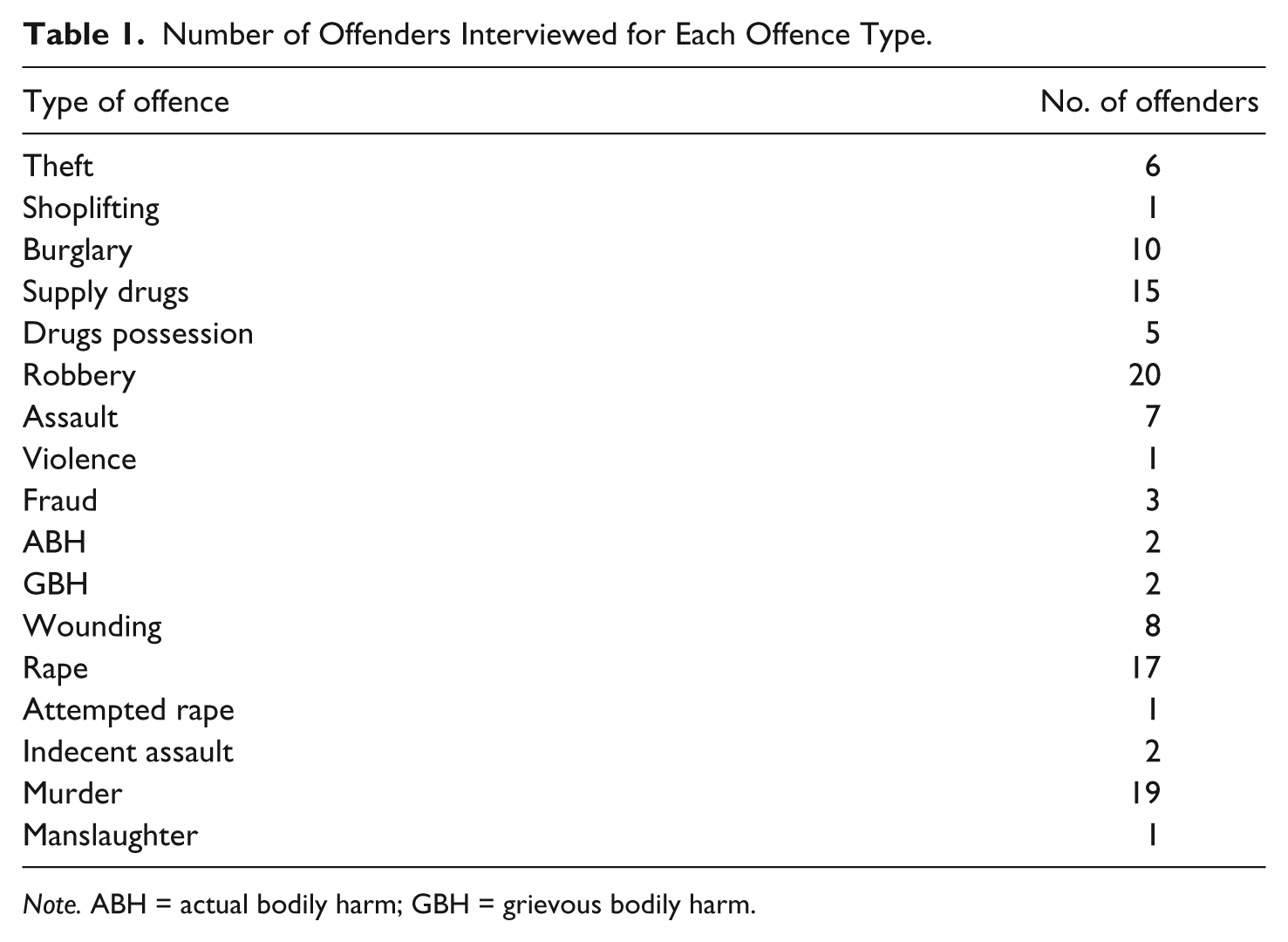
Note. ABH = actual bodily harm; GBH = grievous bodily harm.
Materials
Participants were asked to complete two questionnaires.
Emotions Questionnaire
Twenty-six statements hypothesised to represent the emotions the offender felt while he was committing his crime. These were selected to cover the full gamut of Russell’s (1997) circumplex and were developed from pilot research (Canter & Ioannou, 2004a) that had shown that emotions made sense to criminals as possible descriptions of their feelings during a crime they could clearly remember. Examples of the emotion statements are “I felt excited,” “I felt scared,” “I felt safe,” “I felt depressed,” and so on.
Narrative Roles Questionnaire (NRQ)
This study used the first version of an NRQ that has been further developed by Youngs and Canter (2012). Thirty-three statements hypothesised to represent the role the offender was acting out during crime were derived from intensive interviews carried out with offenders in pilot research by Canter and a number of his students over two decades (see Youngs & Canter, 2012, for description).
A 5-point Likert-type scale was used in both questionnaires in which offenders indicated the extent to which each of the statements described what it was like while they were committing their crime, ranging from not at all (1) to very much indeed (5) with 3 being the midpoint some. Such a scale allows for more elaboration on the subject’s answers, providing more detail than a simple yes/no format. The items of both questionnaires can be seen in Table 2.
The Emotions and Narrative Roles and Analysis Labels.

Note. E = Item from Emotions Questionnaire; R = Item from Narrative Roles Questionnaire.
Procedure
The questionnaire was presented as part of an extended interview in which various background characteristics and offence history were recorded. The interviews were conducted by one of the authors in the prison in a cell specially made available for the interview so that a moderately quiet and completely confidential environment could be created for the interviewer. Interviewees were recruited on a voluntary basis; they were reminded that their participation was completely voluntary and that they could leave at any time if they wished. It was also emphasised that their responses were completely confidential to the research team and would not be made available to the prison authorities or the legal system in any way that would allow identification of individuals. It was thus explained to them that their answers could not play any role in any appeal or request for parole that they might be making or any privileges within the prison. They were then given a brief explanation of the study and asked to give an honest account of their experience of committing an offence they had committed, that they could remember very clearly, and to consider what they felt while they were in the process of carrying out that crime.
They were then asked to read through a list of emotions and narrative roles statements describing how people may feel when committing crimes and to indicate the extent to which the statements reflected their own particular feelings during the crime they had already described. It was stressed that they should answer the questions having in mind that particular crime and to consider what they felt while they were in the process of carrying out that crime, not before or after. Once they had completed the questionnaire, they were asked to describe briefly the crime of which they had been thinking. This is the list of crimes in Table 1.
Analysis
Data generated from the questionnaire responses were analysed using smallest space analysis (SSA-I; Lingoes, 1973). SSA is a non-metric multidimensional scaling (MDS) procedure based on the assumption that the underlying structure, or system of behaviour, will most readily be appreciated if the relationship between every variable and every other variable is examined.
SSA represents the co-occurrence of variables, in our present study, emotions and narrative roles, as distances in a geometrical space. The SSA program computes association coefficients between all variables. It is these coefficients that are used to form a spatial representation of items with points representing variables. The closer any two points are to each other on the spatial configuration, the higher their associations with each other. Similarly, the farther away from each other any two points are, the lower their association with each other.
A number of studies from intelligence (Guttman, 1954) to criminal actions (e.g., Canter & Fritzon, 1998; Canter & Heritage, 1989; Salfati, 2000) have found such MDS models to be productive. The particular power of SSA-I comes from its representation of the rank order of co-occurrence as rank orders of the distances in the geometric space (the use of ranks leads to it being considered non-metric MDS).
To test hypotheses, an SSA configuration is visually examined to determine the patterns of relationships between variables and identify thematic structures. Narrative roles and emotions with similar underlying themes are hypothesised to be more likely to co-occur than those that imply different themes. These similarly themed narrative roles and emotions are therefore hypothesised to be found in contiguous locations, that is, the same region of the plot. The hypothesis can therefore be tested by visually examining the SSA configuration. The coefficient of alienation (Borg & Lingoes, 1987) indicates how well the spatial representation fits the co-occurrences represented in the matrix. The smaller the coefficient of alienation, the better the fit, that is, the fit of the plot to the original matrix. However, as Borg and Lingoes (1987) emphasised, there is no simple answer to the question of how “good” or “bad” the fit is. This will depend on a combination of the number of variables, the amount of error in the data, and the logical strength of the interpretation framework.
In summary, the SSA was used to explore the co-occurrences of narrative roles and emotions and allowed for the testing of the hypothesis that they will be differentiated into themes.
Results
Figure 1 shows the distribution of the 59 statements. The three-dimensional SSA solution has a Guttman–Lingoes coefficient of alienation 0.12486 in 36 iterations, showing a very good fit between the Pearson’s coefficients of the narrative roles and emotions variables and their corresponding geometric distances in the configuration. The labels are brief summaries of the full questions (see Table 2).
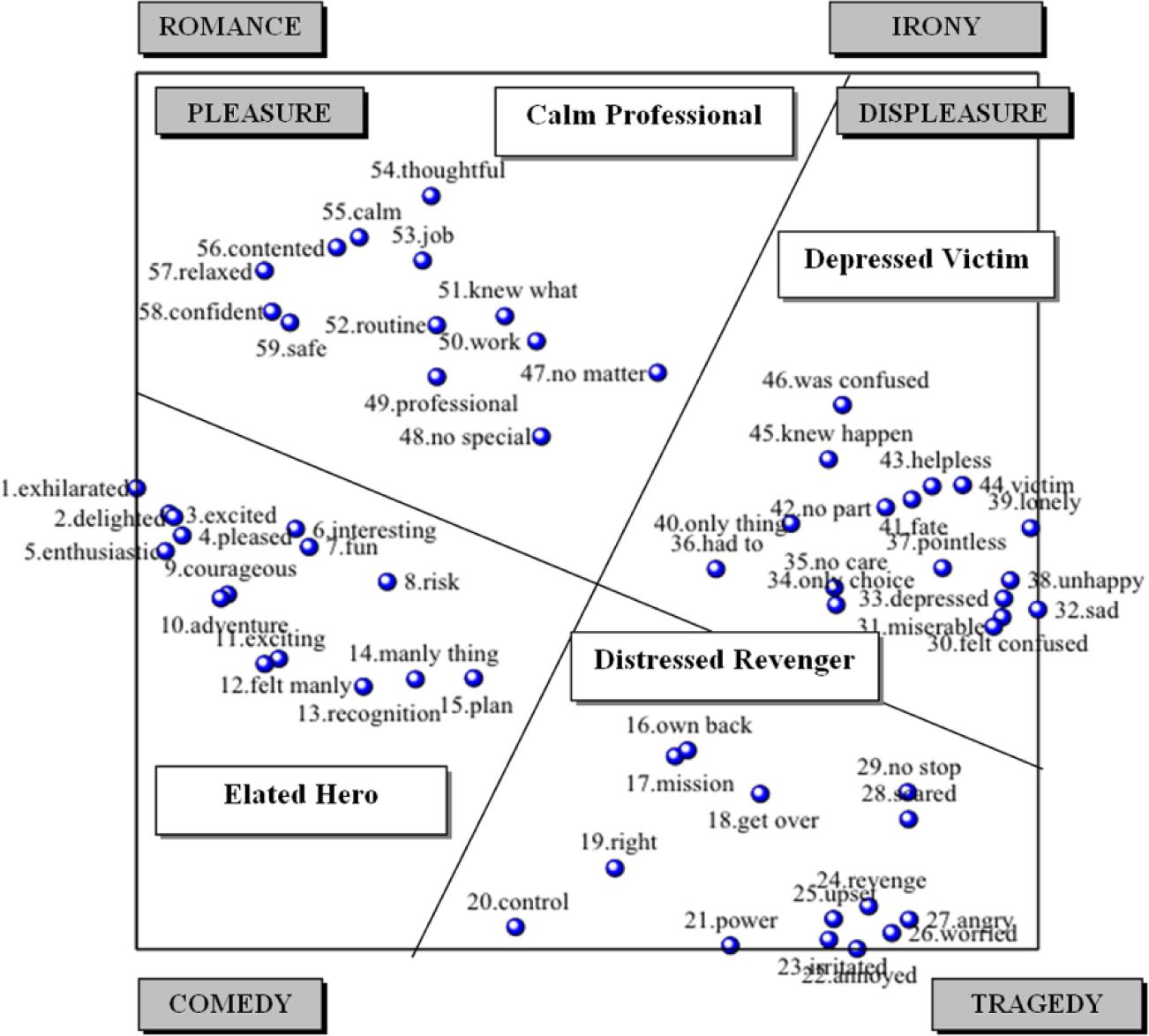
One by two projection of the three-dimensional smallest space analysis of emotions and narrative roles with regional interpretation (pleasure–displeasure axis and Frye’s story forms [mythoi]).
Regional Structure of the SSA
First examination of the SSA plot in relation to emotions only reveals that there are four distinct themes that do reflect the circumplex of emotions posited by Russell (1997) and correspond to the distinct emotion categories he used: elation, calm, distress, and depression. In addition, it can be observed that those emotions that are pleasurable, such as exhilarated, pleased, and contented are all clearly to the left of the plot and the negative emotions, such as anxious, angry, and depressed are to the right. This division accords directly with the dominant axis in Russell’s model of pleasure–displeasure. It is interesting to note that some of the emotions introduced as of particular relevance to criminal experience find their place within this division. Emotions such as upset or annoyed are clearly negative, whereas calm and excited are positive. Russell’s dominant axis is therefore clearly relevant to the experience of crime as previous research has shown (Canter, Kaouri, & Ioannou, 2003). This first finding indicates how strong is the division of pleasure and displeasure. Criminals are indicating that their experiences of committing crimes are either pleasurable or not with little in the way of gradations between these extremes.
The arousal axis is less differentiated than the pleasure axis. However, a region is present at the bottom of the configuration in which more aroused states can be seen, for example, “annoyed,” “irritated,” “power,” “control,” and so on. At the top are the less energised emotions such as “thoughtful,” “calm,” and so on. There seems to be some variation between crimes in the level of arousal they engender, but the level of arousal is not clearly differentiated as there are variables like “exhilarated” that are above less energised variables like “depressed.” This is possibly due to the fact that all crime has some degree of arousal associated with it.
Themes of Emotions and Narrative Roles
The next stage in the interpretation of the SSA is to test the hypothesis that the emotions and narrative roles would form identifiable regions. By examining the SSA configuration (Figure 1), it is apparent that the emotions and narrative roles could be differentiated into four dominant themes of CNE that draw together the previously identified narrative offence roles with the emotional qualities attributable to Frye’s archetypal mythoi: Elated Hero, Calm Professional, Distressed Revenger, and Depressed Victim.
Elated hero
The 15 elements that can be conceptually linked as Elated Hero are (a) exhilarated, (b) excited, (c) delighted, (d) pleased, (e) enthusiastic, (f) courageous, (g) manly, (h) it was fun, (i) it was interesting, (j) it was like an adventure, (k) it was exciting, (l) I was looking for recognition, (m) it all went to plan, (n) it was a manly thing to do, and (o) I knew I was taking a risk.
This region consists of the Elation theme of emotions and the Hero theme of roles. Therefore, this type of offender could be described as an individual that perceives the experience of crime as a manly and brave thing to do, as an interesting and enjoyable adventure that he involves himself in. He gets pleasure from committing his crimes, feeling excitement and enthusiasm while he is committing his offences. He knows he is taking risks, but probably that is what makes this an exciting adventure where he embarks looking for recognition.
Calm professional
The 13 elements that can be conceptually linked as Calm Professional are (a) calm, (b) confident, (c) thoughtful, (d) relaxed, (e) contented, (f) safe, (g) I was like a professional, (h) it was routine, (i) I was doing a job, (j) I knew what I was doing, (k) nothing else mattered, (l) for me, it was just like a usual days work, and (m) there was nothing special about what happened.
This region consists of the Calm theme of emotions and the Professional theme of roles. Therefore, this type of offender could be described as an individual, who is acting professionally, perceives his crime as a job, therefore, part of the routine of his life, and this is why he is calm and feels relaxed and safe while he is committing his crimes, acknowledging his criminal behaviour. He is engaged in criminal activity in a qualified, specialised, and confident manner, which implies that he could be portrayed as a highly skilled, intelligent, and competent individual who bases his actions on his criminal experiences.
Distressed revenger
The 14 elements that can be conceptually linked as Distressed Revenger are (a) angry, (b) scared, (c) annoyed, (d) irritated, (e) worried, (f) upset, (g) it was right, (h) I was in control, (i) it was a mission, (j) I had power, (k) I just wanted to get it over with, (l) I could not stop myself, (m) I was trying to get revenge, and (n) I was getting my own back.
This region consists of the Distress theme of emotions and the Revenger theme of roles. Therefore, this type of offender justifies his criminal behaviour, feeling that it is right to take revenge being on a mission, because he feels angry and upset while he is committing his crimes. He sees himself in control of the situation feeling powerful and has the sense that he could not help himself.
Depressed victim
The 17 elements that can be conceptually linked as Depressed Victim are (a) depressed, (b) confused, (c) sad, (d) lonely, (e) miserable, (f) pointless, (g) unhappy, (h) I had to do it, (i) I was helpless, (j) it was my only choice, (k) I was a victim, (l) I was confused about what was happening, (m) I did not care what would happen, (n) what was happening was just fate, (o) It was like I was not part of it, (p) it was the only thing I could think of doing, and (q) I guess I always knew it was going to happen.
This region consists of the Depression theme of emotions and the Victim theme of roles. Therefore, this type of offender can be described as the victim of the situation, who does not regard himself responsible for, and part of, his crime. He had unpleasant emotions while he is committing his crimes, feeling confused, depressed, and lonely. He believes that he had no other choice, but to commit his offence as this was something that could not be avoided due to his belief that the events in his life are a function of luck, chance, fate, or other external factors beyond his control or manipulation.
Figure 1 shows the SSA configuration with regional interpretation (pleasure–displeasure axis) and corresponding Frye’s story forms (mythoi).
Scales of CNE Themes
The four themes of emotions and narrative roles were proposed to reflect distinct themes to any given crime. This implies that the sets of emotions and narrative roles identified as representing each of those themes should form a scale in the sense that their combined existence is a reasonable indication of some underlying dimension. Cronbach’s alpha was utilised to determine the reliability coefficient or each of the sets of emotions and narrative roles that define a region. The emotions and narrative roles and the alphas for each theme are given in Table 3.
Scales of Criminal Narrative Experience Themes.
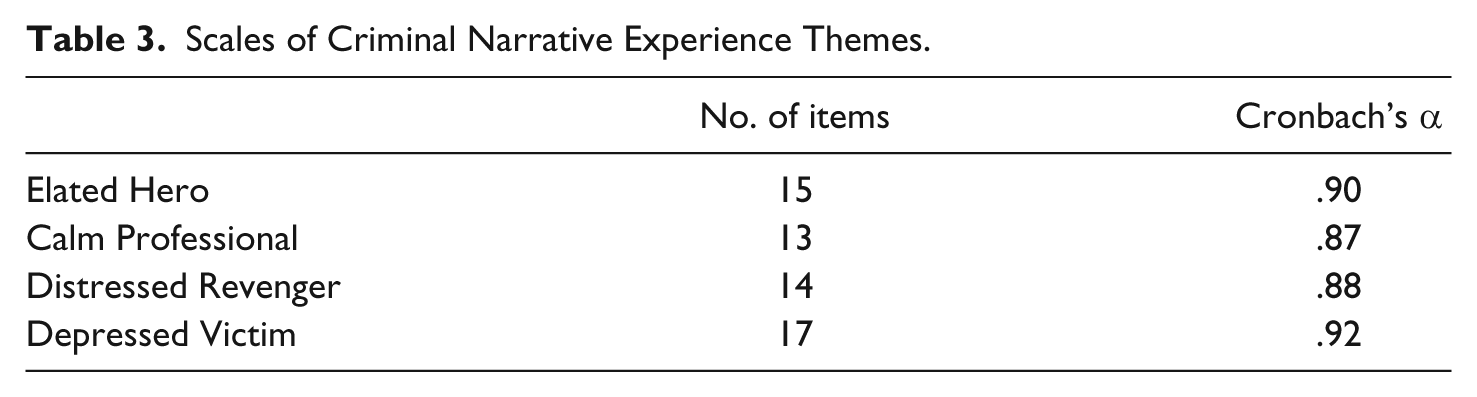
As can be observed for the Elated Hero theme with 15 items, the alpha coefficient was .90, for the Distressed Revenger with 14 items .88, for the Depressed Victim theme with 17 items .92, and for the Calm Professional theme with 13 items .87, indicating a high degree of association between the variables in each of the four themes.
Testing the Framework
Although the SSA indicates that the offenders’ CNE can be classified in terms of four distinct themes, it does not classify the offenders themselves. To test the regional thematic split of the SSA of the criminal’s experiences (the emotions and narrative roles themes together), each of the 120 cases was individually examined to ascertain whether it could be assigned to a particular theme on the basis of the offenders’ criminal experiences while they were committing their crimes. Every case was given a percentage score for each of the four themes, reflecting the proportion of Elated Hero, Calm Professional, Distressed Revenger, and Depressed Victim. Percentages were used rather than actual numbers because the four themes contained unequal numbers of variables. Any individual case was classified as belonging to a particular theme if the proportional score for that dominant theme was greater or approximately equal (±5%; only five cases in our study) to the score for the other three themes added together. For example, in Case Number 9, 72% of the variables occurred in the Elated Hero theme, 35% in the Calm Professional, 7% in the Distressed Revenger, and 4% in the Depressed Victim theme, thus making it a predominantly Elated Hero theme. This method of classification was also used by Canter and Fritzon (1998) and Salfati (2000).
A case was considered to be a hybrid between two themes if it contained the same proportion of variables for each of those themes. A case was not classified as either pure type or hybrid if it contained less than a third of the variables in any theme or if it contained equal numbers of variables from more than two themes or simply when there was no predominant theme.
By using such criteria, more than two thirds of all the cases, 68.3% (n = 82), could be classified as pure types, while 0.83% as hybrid, making a total of 69.1% of the sample classifiable. The most frequent pure type was Distressed Revenger, representing 25% (n = 30) of the cases. This was followed by Calm Professional, representing 15.8% (n = 19) of the cases, Elated Hero, representing 15% (n = 18) of the cases, and finally, Depressed Victim, representing 12.5% (n = 15) of the cases. There also existed one hybrid, which was a combination of Distressed Revenger and Elated Hero. This is a combination, which is supported by the SSA framework in that they are adjacent regions. Table 4 shows the distribution of cases assigned to the four themes.
Number of Cases Assigned to Each Criminal Narrative Experience Theme.
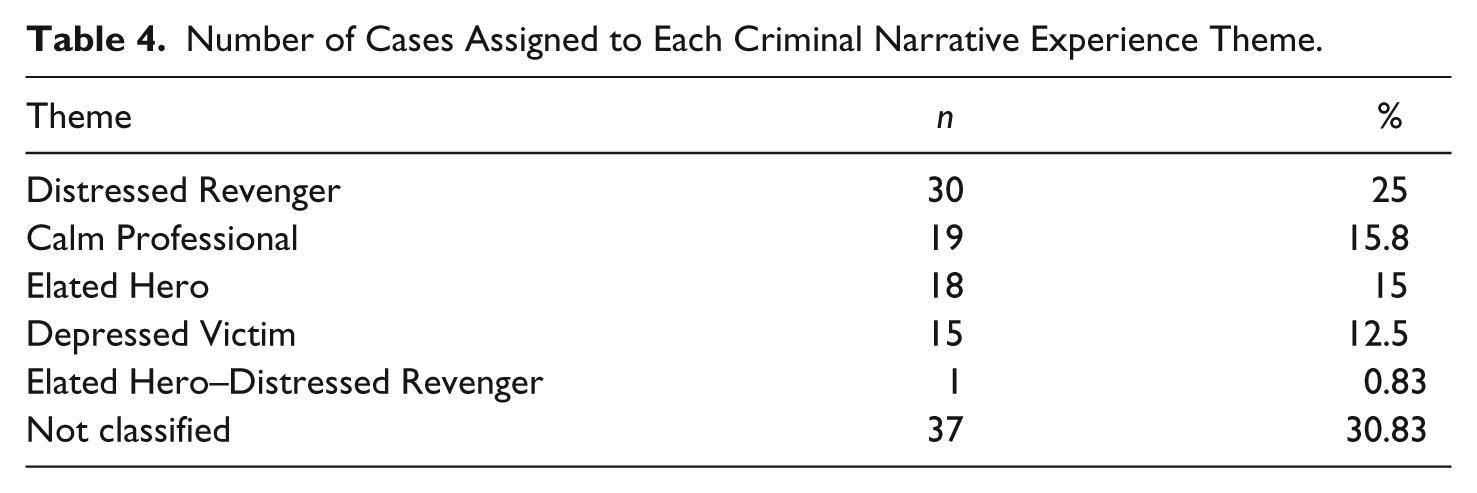
The fact that almost three quarters (69.13%) of the cases could be classified into one of the four emotion and narrative role themes validates the hypothesis that the SSA structure represents different types of criminal experience. Even in the case of hybrids, they all are from contiguous regions. The above analysis shows that using the stringent criterion, in the current data set, as many as 30.83% of the offenders had a criminal experience representative of more than one theme. However, the above results support the notion of describing criminals’ experience of crime in terms of their predominant themes of emotions and narrative roles. In other words, the CNE (emotions and narrative roles) could be described as Elated Hero, Calm Professional, Distressed Revenger, and Depressed Victim or some cases were more Elated Hero, Calm Professional, Distressed Revenger or Depressed Victim than others.
Discussion
The present study investigated the offenders’ CNE, the emotions that are experienced, and the narrative roles that are acted out, during a variety of offences. Four themes of CNE were identified. The resulting SSA could be differentiated in terms of pleasant and unpleasant CNE and the four themes related to Frye’s (1957) four story forms to the narrative offence roles of the Hero, the Professional, the Revenger, and the Victim (Youngs & Canter, 2012).
The Elated Hero CNE theme reflects the comedy story form where the main character is overcoming obstacles in pursuit of pure and joyful objectives. It describes offenders who perceive their criminal behaviour as an enjoyable and fascinating adventure. They are seduced by their desire for other people’s belongings, and when they complete their crime, they experience a euphoric appreciation of its significance.
The Calm Professional CNE theme reflects the romance story form. This is an offender who sees himself as simply carrying out a task; he is an expert when committing his offence referring to his cruel behaviour as a job. Therefore, he acknowledges and justifies his offences without caring about the consequences, as it is part of the routine in his life. Both the Elated Hero and the Calm Professional CNE themes are positive and pleasant experiences.
The Distressed Revenger CNE theme is related to the tragedy story form. It describes a type of offender who feels that he has been wronged and, in gaining revenge, is defending moral equality. The protagonist struggles for revenge because he feels that he has to bring back what belongs to him so as to escape humiliation.
The Depressed Victim CNE theme is related to the irony story form. The main character has been defeated by fate and circumstances and confronts dangers in life arousing pity and fear. He is generally pessimistic for being defeated by the experiences of the world; yet, his misfortune, and in this case, his punishment, is not wholly deserved. The offending experience is seen as one against the offender’s will, out of their control, and beyond their understanding. Both the Distressed Revenger and the Depressed Victim CNE themes are negative and unpleasant experiences.
Reliability analysis found very high alpha and therefore indicated a high degree of association between the variables in each of the four themes. In addition, by assigning cases to the four CNE themes and using stringent criteria, it was shown that almost 70% of the cases in the present study were classifiable.
The present findings have theoretical implications for our general conceptualisation of crime as they advance an understanding of offenders’ experiences, in particular, and of crime, in general, by moving away from traditional explanations. The study of the CNE provides a theoretical framework for exploring an important concomitant of criminal behaviour. This study offers a new perspective on offenders’ behaviour as the information was gathered directly from offenders themselves regarding crimes they committed. It offers an insight into the emotions that were experienced and the narrative roles acted out while offenders were committing their crimes, demonstrating their significance in relation to criminal behaviour.
Beyond the theoretical implications, this work has several practical implications in terms of treatment of offenders, especially the persistent ones. The identification of four different types of offenders according to their CNEs suggests that different treatment programmes would be appropriate for each of these. Conceiving of offenders’ emotions and narrative roles while he is committing his crimes provides the therapist with an understanding of his perception of reality/crime. It indicates which emotions, feelings, actions, and roles are likely to feature prominently in the person’s conceptualisation of what happened, and these may become targets for change. If, for example, the emotional reward of the crime motivates an offender to commit burglary, because he feels adventurous and wants to “get” these positive emotions that he experiences when he commits one, the primary objective of treatment would be for the offender to learn more functional and less destructive ways of “acquiring” this state and emotions. Similarly, in the case of an offender viewing himself as a Distressed Revenger, where obviously the CNE, emotions and narrative roles, is different to the Elated Hero in the previous example, what needs to be addressed during the therapeutic session is the inappropriate and extreme reaction to the sources of frustration.
Crime represents just one of a range of reactions or tools in acting out a role or experiencing an emotion, and this has to be addressed during treatment or intervention programmes. This framework of CNE has the beneficial implications that it leads to suggestions for tailoring treatments to individual cases. Treatment or intervention programmes targeting offenders can be separated according to their CNE, as this would allow more targeted interventions. The therapist can uncover the offenders’ emotions and to recognise their significance for the individuals. As therapy is aimed at modifying behaviour, knowledge of the CNE is a powerful tool in enhancing the effectiveness of treatment. Therapy can help a criminal invest energy and care into new and more promising aspects or domains.
In addition, the identification of different CNEs can have implications for interviewing techniques. A line of questioning that may be productive with a rapist that sees himself as victim probably will not work with a thief that sees himself as a hero. Therefore, interviewing techniques can be tailored to individual cases according to their CNEs (Youngs & Canter, 2009).
The present study can only be regarded as a step toward understanding the role that the CNE plays in the development and continuation of offending. However, there are still areas that need to be investigated to gain a fuller understanding of the different emotions and roles that lead to crime.
To fully understand the CNE, it is important to examine it in relation to different types of offences and the background and personality characteristics of the offenders. Further research also needs to establish to what extent offenders experience different or the same emotions and act out different or the same roles when they commit the same type of crime. To examine this in more depth, offenders need to be questioned about how they felt and what roles they acted out during not only one (as it was the case in the present study) but also more crimes.
Offenders were asked to describe a crime of their choice that they could remember very well. Almost all the participants described the crime that they were currently serving a sentence for or a similar one. The reason for the offenders describing the crime that they were currently serving a sentence for might be that it was the most recent one, and they could recall the details easier or for other personal reasons, such as not wishing to talk about something that they were not sentenced for or something that was in their past or they felt that the researcher was interested in that specific crime. Of particular interest is also the fact that in the case of offenders who did not give a description of the crime they were in prison for, they described a similar one. The selection of a crime might be an important factor influencing the resulting emotions and narrative roles descriptions in several ways, and that needs to be studied in more depth. Therefore, it is suggested that future studies address the issue of the selection of the crime the offenders are describing, something that was not addressed in this study, particularly the fact that even if the offenders did not describe the crime they were currently serving a sentence for, they chose to describe a similar one. This issue could be addressed by asking offenders to talk more about the reasons behind their choices; why they chose to describe the specific crime and not another one.
A limitation of the present study, which has implications for the development of the CNE framework, is that it only investigated the emotions and associated narrative roles of male offenders from the northwest of England. If this model stands any value, further studies with larger data sets, female offenders, offenders from different classes, cultures, and countries, as well as other forms of criminality beyond the ones reported by the sample here, need to be investigated. A cross-cultural investigation would be particularly useful as there is the issue of the cross-cultural application of how offenders use concepts such as different emotions and different narrative roles in different countries. For instance, British murders are very different in quality to murders committed in United States. There are more suicides following murder in Britain, which has been put down to issues of culturally encoded feelings of remorse. And in other countries, such as Greece, murder is still very much the domain of conflict between individuals that have previously established an interpersonal relationship, whether they are intimate partners or family members. In addition, further studies should look into serial offenders and/or examine more in depth ongoing offences such as drug supply to establish whether there are variations in the CNE over time, something that was not addressed in the present study.
It should also be noted that the statements are postoffence verbalisations. As such, even if the offenders in the study reported that they remembered the details of the offence well, they may be distorted by memory issues as well as postoffence developments such as conviction. All participants described an offence for which they were caught and convicted. Future research should explore the impact of different offence outcomes. It is possible that people may report more positive affect in the experiences of offences that remain undetected.
The issue of postoffence rewriting raises, of course, a broader issue about the validity of self-reported narrative accounts generally. The phenomenological approach takes the stand that a person’s account is their subjective perception and should be taken at face value. It does not have to be believed as objective fact but can be taken to indicate the constructs and related perspectives the individuals brings to the issues at hand. It may show how they wish to be seen, which is relevant to setting up interviews and therapeutic interventions. Even if what the offenders offer are implicit justifications, they are demonstrating the storyline they consider the most relevant to their own understanding of their circumstances. It is that personal account that forensic psychologists have to work with either in investigations or in therapeutic interventions.
Conclusion
One bridge between the external influence and the internal agency, which has tended to be neglected, is the experience of the offence by the offender. This experience is what encourages the offender to carry out the crime, providing the phenomenological, internal reasons for the crime and the emotional benefits that help to sustain the criminal activity.
A necessary step has been taken in the development of a framework of CNE, notably through the identification of the variations that exist among offenders in terms of their emotions and their thematically associated narrative roles. The current work is a unique attempt to examine criminals’ experiences during crimes and link emotions, roles, and crime. The results showed that such a relationship exists promoting a better understanding of the CNE and a number of theoretical and practical implications. This study offers the foundations for a bridge between the concern with agency that is central to the legal process and the concern with cause that is at the heart of social science studies of crime. Emotions and narrative roles have much to offer in the comprehension and analysis of criminal behaviour.
Footnotes
Declaration of Conflicting Interests
The author(s) declared no potential conflicts of interest with respect to the research, authorship, and/or publication of this article.
Funding
The author(s) received no financial support for the research, authorship, and/or publication of this article.