



Abstract
Prior research has shown that attention deficit/hyperactivity disorder (ADHD) relates to various negative outcomes in adolescence, including academic failure, behavioral problems at school, and criminal behavior. However, this line of research has generally failed to explore whether ADHD connects to criminal behavior through its effects on school factors. Using data from the National Longitudinal Study of Adolescent to Adult Health (Add Health), this study finds that a retrospective account of ADHD symptomatology during childhood and early adolescence predicts weakened school attachment, lower grades, and higher risks for both out-of-school suspension and crime. School attachment, grades, and out-of-school suspension have the expected effects on crime among females and males. Among females, these school factors mediate the effects of ADHD symptomatology on crime. The effect of ADHD symptomatology on crime among males remains significant when controlling for school factors. Implications of the findings for policy and theory are discussed.
Attention deficit/hyperactivity disorder (ADHD) is an important contributor to problematic outcomes during adolescence. ADHD has been linked to school failure, behavioral problems in school, and various antisocial behaviors (Schilling, Walsh, & Yun, 2011). Although these linkages between ADHD and problematic behaviors have been made clear in the literature on ADHD and its impact on individuals, there have been only a few works that try to identify whether ADHD simply shapes all these outcomes concurrently, or if these negative effects unfold in a particular order. This article examines whether these effects of ADHD play out by shaping adolescents’ school experiences, which then in turn shape their involvement in criminal behaviors.
This article draws on prior research on the impact of ADHD on adolescent behavior and social bonding theory to examine the relationship between ADHD symptomatology, school factors, and criminal behavior. Although previous research has tended to simply focus on the litany of issues that ADHD symptoms cause without regard to time ordering, the current study tests whether ADHD symptoms shape school experiences, which then shape criminal behavior. Analyses look at the effect a retrospective account of ADHD symptomatology during childhood and early adolescence has on several school measures (school attachment, grades, out-of-school suspension) and on criminal behavior in middle to late adolescence and whether the school measures mediate the effects of ADHD symptomatology on crime. Figure 1 presents the conceptual model guiding the present study. The present analysis utilizes data from the National Longitudinal Study of Adolescent to Adult Health (Add Health), a nationally representative sample of American adolescents. Given the documented differences in both the prevalence of ADHD and the nature of its symptoms by gender (Cuffe, Moore, & McKeown, 2005; Gaub & Carlson, 1997), separate models are presented for females and males.
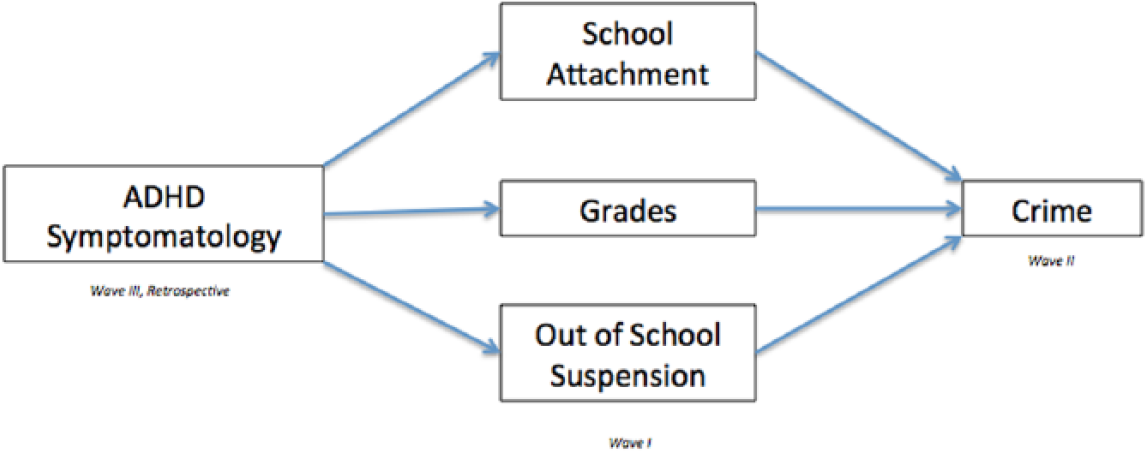
Conceptual model.
ADHD, School Achievement, and Antisocial Behavior
Among children and adolescents, ADHD is one of the most commonly diagnosed disorders (Schilling et al., 2011). The clinical definition of ADHD defines it as a disruptive behavior disorder that includes, in the Combined Type, issues of inattentiveness (i.e., disorganization, difficulty following instructions or conversation, easily distracted, forgetful) with issues of hyperactivity–impulsivity (i.e., constantly moving, restless, impulsive; American Psychiatric Association [APA], 2013). Although all healthy children will occasionally display symptoms of ADHD, in an individual that is officially diagnosed, these symptoms occur so often that they constitute a syndrome that is not simply “kids being kids.” Even among those officially diagnosed with ADHD, however, the symptoms vary widely in their severity and frequency of occurrence. A recent systematic review and meta-analysis of the ADHD prevalence research literature estimates that approximately 7% of children have ADHD (Thomas, Sanders, Doust, Beller, & Glasziou, 2015).
Most likely because of this prevalence of ADHD in the general population, there has been a vast amount of research conducted that looks into the effects that ADHD symptoms have on behavior and functioning among children, adolescents, and adults. This literature has thus far been in agreement that ADHD has consistent, robust effects on a number of negative outcomes early in the life course, including academic struggles and increased delinquent and criminal behavior, and ADHD correlates with other neuropsychological deficits (Aebi et al., 2010; Barkley, 1997; Burke, Loeber, Lahey, & Rathouz, 2005; Dick, Viken, Kaprio, Pulkkinen, & Rose, 2005; J. Gordon & Moore, 2005; Hinshaw, 1992; Kessler et al., 2006; Moffitt, 1990; Nigg, Hinshaw, Carte, & Treuting, 1998; Pratt, Cullen, Blevins, Daigle, & Unnever, 2002). The various criminal behaviors that ADHD has been tied to include minor delinquency, drug abuse, and serious property and violent crime (Ellis & Walsh, 2000). ADHD has also been found to be highly correlated with two important externalizing disorders in the psychology literature, oppositional defiant disorder (ODD) and conduct disorder (CD) 1 (Aebi et al., 2010; Schilling et al., 2011), but even in the absence of ODD and/or CD, ADHD remains a significant risk factor for delinquency and crime (Loeber, Green, Keenan, & Lahey, 1995; Moffitt, 1990; van Lier, van der Ende, Koot, & Verhulst, 2007). Also, the correctional population includes a disproportionate number of individuals that have been or can be diagnosed with ADHD, and individuals with ADHD have more frequent contact with the criminal justice system (Gudjonsson, Sigurddsson, Young, Newton, & Peersen, 2009; Mannuzza, Klein, & Moulton, 2007; Rösler et al., 2004; Savolainen et al., 2012; Young et al., 2009).
Due to the very nature of the disorder, the severity of ADHD symptoms is an important predictor of school outcomes among children and adolescents. ADHD can make the school experience and achieving academic success very difficult. A study by Ek, Westerlund, Holmberg, and Fernell (2011) backs this up, with individuals with ADHD having lower overall grades and IQ (most strongly measured by verbal capacity) after ninth grade than a matched sample of adolescents without ADHD or any other learning disability. A meta-analysis of the ADHD-achievement literature by Frazier, Youngstrom, Glutting, and Watkins (2007) finds that no matter how achievement and ADHD are assessed in a given study, ADHD has consistent, negative effects on academic achievement throughout the empirical literature dating back to 1990. Another recent study by Kent and colleagues (2011) finds in a sample of adolescent males in Pittsburgh that individuals with ADHD perform worse academically, are more likely to be absent or tardy, and are more likely to drop out than a demographically similar sample of males without ADHD.
In addition to problems with school, ADHD has been found to be a strong predictor of involvement in delinquent and criminal activity during adolescence. In a meta-analysis of the literature on the ADHD–crime link, Pratt and colleagues (2002) find that across 20 empirical studies, the effect of ADHD on delinquent and criminal behavior is consistent and robust. In a widely cited study of a birth cohort of 435 boys followed through adolescence, Moffitt (1990) finds that the problems of attention deficit disorder (ADD) are exacerbated by early delinquent behavior, with the criminal trajectories of boys with both ADD and early delinquency problems projected to continue into adulthood. ADHD and its associated problems may thus be a causal factor in offending careers that continue into adulthood rather than ceasing during later adolescence. That ADHD has these consistent and long-lasting effects on delinquency and criminal offending is not surprising given that ADHD and its symptoms correlate highly with an oft-cited and widely studied predictor of crime and delinquency in the criminological literature, low self-control (Chapple, Vaske, & Hope, 2010; Schilling et al., 2011; Unnever & Cornell, 2003; Unnever, Cullen, & Pratt, 2003; Vaughn, DeLisi, Beaver, & Wright, 2009).
Although ADHD has been tied to both negative school experiences and criminal behavior, these literatures have, for the most part, been considered distinct, with few efforts made to incorporate these separate findings and examine if ADHD simply affects these two outcomes simultaneously or if the relationship between ADHD, school experiences, and criminal behavior unfolds in a particular causal order. The lack of a stronger connection within this literature is made more surprising given that there is a well-documented link between school failure and criminal behavior (Bowen & Bowen, 1999; Henry, Knight, & Thornberry, 2012; Lynam, Moffitt, & Stouthamer-Loeber, 1993; McEvoy & Welker, 2000).
The studies that do exist that look at the relationship between ADHD, school experiences, and criminal behavior are generally marked by one major weakness, the use of small, non-representative samples. One such study of a sample of Seattle adolescents from high-crime neighborhoods found that the effects of teacher-rated hyperactivity and inattentiveness on violence in early to middle adolescence were in part mediated by academic performance (Herrenkohl et al., 2001). Another study of a birth cohort from two provinces in Finland found that ADHD and low-verbal ability were strong predictors of criminal offending in emerging adulthood, but that although educational social bonds also shaped offending, they did not significantly mediate the ADHD and low-verbal ability effects on offending (Savolainen et al., 2010). In a separate study using the same sample, Savolainen and colleagues (2012) find that the effects of “antisocial propensity,” in part measured as hyperactivity, on risks for criminal conviction in late adolescence were mediated by academic performance and school achievement in middle adolescence. Utilizing a more direct measure of ADHD, Savolainen and colleagues (2015) find in the same Finnish sample that ADHD effects on felony criminal conviction were in part mediated by academic performance.
Although a strong argument can be made that ADHD influences delinquent behavior, which then undermines academic success, an equally strong argument could be made in the other direction as well. Perhaps, ADHD symptomatology affects one’s attachment to school and his or her academic success, and in the case of nonattachment and academic failure, delinquency and criminal behavior follow or are increased. Relying on Hirschi’s (1969) social bonding theory and the prior research cited above, this is the direction of the relationship between ADHD, school factors, and antisocial behaviors that will be examined in this study.
Social Bonding Theory
An individual’s experience with school, especially early in the life course, represents a strong social bond that keeps adolescents out of trouble (Herrenkohl, Huang, Tajima, & Whitney, 2003; Longshore, Chang, & Messina, 2005; Payne, 2009; Savolainen et al., 2010). Social bonding theory is one of the most frequently tested and widely endorsed theories of crime and delinquency, and the body of research it has produced tends to offer support for the theory’s central tenants (Akers & Sellers, 2012). Developed by Travis Hirschi (1969), social bonding theory is different among theories of crime and delinquency. Although most theories of crime ask why offend, Hirschi’s theory asks, Why not offend? Hirschi’s theory assumes that criminal motivation is uniform across individuals and that most people would offend if they could get away with it. The answer according to Hirschi’s theory for why more people do not offend is because of the social controls placed on us as individuals in the form of social bonds. A social bond is a force in an individual’s social and/or physical environment that connects them to society and its moral constraints (Winfree & Abadinsky, 2009). In this literature, social bonds usually refer to interpersonal relationships and/or bonds to social institutions, both their quantity and quality. Through social bonds we are attached to conventional others, committed to conventional norms, involved in conventional and prosocial activities, and we come to believe in the moral force behind society’s norms. Thus, social bonding theory explains crime and delinquency as the result of an individual’s bond with society being weakened, broken, or nonexistent (Hirschi, 1969).
The previous literature on ADHD and academic outcomes has focused, without often noting it, on social bonds by examining academic achievement, which has been used as a measure of an individual’s bond to school (Herrenkohl et al., 2003; Klika, Herrenkohl, & Lee, 2013; Savolainen et al., 2010). The current study looks at academic achievement, measured by grades, but additionally focuses on school attachment or how positively someone identifies with his or her school, classmates, and teachers. It may be the case that ADHD symptoms shape antisocial behaviors not only through their effect on academic achievement in the form of grades but also through the key social bond of school attachment. In this way, ADHD symptoms act as an etiological factor for delinquent and criminal behavior because they undermine and/or break down an important social bond that keeps young people from engaging in antisocial behavior.
The Current Study
This study seeks to build on the existing literature concerning ADHD, school outcomes and experiences, and antisocial behaviors. This will be accomplished by testing a model whereby ADHD symptoms first shape several school factors that then shape criminal behavior. Although prior research has occasionally put these three concepts together—ADHD, schools, and antisocial behavior—it has generally failed to identify if these variables relate in any particular causal order, and prior research has failed to utilize a nationally representative sample like Add Health. Following social bonding theory, I propose that ADHD symptomatology deteriorates during adolescence, the important social bond that is one’s positive identification with school, and with this social bond deteriorated or broken, individuals then engage in more antisocial behaviors.
Drawing on previous research concerning ADHD and expectations based on social bonding theory, three hypotheses are tested in the current study. Hypothesis 1 predicts that a retrospective account of ADHD symptomatology in childhood and early adolescence measured at Wave 3 will significantly and negatively affect several school measures (school attachment, grades, and out-of-school suspension) at Wave 1 of Add Health data collection. Hypothesis 2 predicts that ADHD symptomatology will significantly and positively affect an index of criminal behavior from Wave 2 of Add Health. Finally, Hypothesis 3 predicts that the Wave 1 school measures will mediate the ADHD–crime relationship. 2 This means that ADHD symptomatology will produce its effect on crime through the school measures, with the ADHD effect on crime becoming statistically insignificant once controlling for the school measures.
Data and Method
Sample
The current study draws on data from Waves 1 through 3 of Add Health. Briefly, Add Health is a nationally representative sample of American adolescents who were first recruited during the 1994-1995 school year while they were in Grades 7 to 12 (Harris et al., 2003; Udry, 2003). Add Health utilized a multistage stratified sampling process to select 80 high schools and 52 middle and junior high schools for inclusion in the study. Ninety thousand students completed in-school self-report surveys, and a subsample of this group was randomly chosen for the Wave 1 in-home component of Add Health. A total of 20,745 adolescents and 17,700 of their primary caregivers participated in the Wave 1 in-home component (Harris et al., 2003). Wave 2 data were collected approximately 1 to 2 years after Wave 1, while Wave 3 data were collected during 2001-2002 when respondents were between 18 to 26 years old.
It is important to note that the overall analytic sample size in the current study is affected by decisions made by the Add Health research team, who did not attempt to re-interview every single Wave 1 in-home respondent again until Wave 4, and the number of individuals interviewed at Waves 2 and 3 was significantly smaller than the 20,745 individuals interviewed at Wave 1. Analyses are restricted to respondents that were interviewed at Waves 1, 2, and 3, resulting in a sample size of 10,541 (5,579 females and 4,962 males) in the current study. Table 1 presents descriptive statistics for the full sample and separately for females and males, with mean comparisons by sex.
Descriptive Statistics.

Note. Because these statistics are weighted and adjusted for survey design, standard errors are produced rather than standard deviations. Mean one-way ANOVAs denote significant sex comparisons.
ADHD = attention deficit/hyperactivity disorder.
p < .05. **p < .01.
Measures
Crime
The dependent variable consists of 15 items drawn from Wave 2 that asked respondents about various criminal activities they may have engaged in during the year prior to being interviewed. These items are a mixture of property and violent offending, and one item asked about drug selling. Property offending measures included asking respondents how often they painted graffiti, damaged property, stole cars, stole items worth more and less than US$50, or burglarized buildings. Violence measures included asking how often respondents used or threatened to use a weapon to get something from someone, took part in a group fight, used a weapon during a fight, hurt someone badly enough to need a doctor, carried a weapon at school, pulled a knife or gun on someone, or actually shot or stabbed someone. The distribution of these items is highly skewed, with the vast majority of respondents reporting no involvement in any of these activities. Therefore, the 15 items were recoded into binary measures of whether the respondent reported engaging in these behaviors in the past year (1 = yes) and were then summed them into a measure that emphasizes the prevalence of criminal offending during Wave 2 (α = .80 for the full sample). Consistent with expectations, males evidence significantly greater involvement in crime (F = 305; p < .01), with most respondents, female and male, reporting very low levels of involvement.
Retrospective ADHD symptomatology
Wave 3 of Add Health includes retrospective accounts of ADHD during childhood and early adolescence. 3 Respondents were asked to think back to when they were young and offer answers to questions that best describe them when they were at that age. There are 18 items in total, all of which begin with “When you were between 5 and 12,” followed by a statement that reflects some aspect of ADHD symptomatology. This set of questions is heavily influenced by the Strengths and Weaknesses of ADHD symptoms and Normal behavior rating scale, or SWAN (Swanson et al., 2012), a relatively new ADHD measurement tool. Examples of these kinds of statements include asking respondents if they failed to pay close attention to details or made careless mistakes in their work, fidgeted with their hands or feet or squirmed in their seat, did not listen when spoken to directly, felt restless, or were easily distracted. The complete list of these 18 items can be found in the appendix. For all the items, the possible response categories were never or rarely, sometimes, often, and very often. The responses from these 18 items were summed to create a global measure of retrospective ADHD symptomatology during childhood and early adolescence in the Add Health data set (α = .90 for the full sample). The purpose of this index in this study is not to officially diagnose ADHD, but rather to assess the level of ADHD symptoms a respondent reports when they were between 5 and 12 years old. Prior research suggests that self-assessment of ADHD symptoms tends to result in underreporting in terms of severity (Kooij et al., 2008); therefore, the current measure may be fairly conservative. As might be expected given the large difference in official ADHD diagnoses by sex, males report significantly more ADHD symptoms in childhood and early adolescence than do females (F = 370; p < .01; see Table 1).
School factors
Three items represent the school factors that potentially mediate the ADHD–crime relationship during adolescence. School attachment consists of eight items from Wave 1 that reflect the degree to which a respondent is attached and committed to their school, teachers, and classmates. These items ask respondents about whether they have had trouble getting along with teachers or fellow students, if they feel close to people at school, feel like a part of their school, believe their fellow students are prejudiced, are happy to be at their school, whether teachers treat students fairly, and if they feel safe at their school. These items were combined into an additive measure of school attachment where higher scores denote stronger attachment (α = .74 for the full sample). There are no differences in school attachment by gender (see Table 1).
Academic achievement is represented in the current study by the variable grades, which combines information about the letter grades respondents reported receiving in their most recent grading period in four different subjects when interviewed at Wave 1; English or language arts, mathematics, history or social studies, and science. They were able to report their grade as either A, B, C, or D or lower. Given that some respondents report taking certain subjects and not others, their average grade across the courses they did take was multiplied by four to produce a measure where higher scores indicate better overall grades. Females report significantly higher grades at Wave 1 than males (F = 220; p < .01).
Out-of-school suspension consists of one item that asks respondents at Wave 1 if they have ever received an out-of-school suspension (1 = yes). Males are more likely than females to have received an out-of-school suspension during their lifetime (F = 341; p < .01).
Controls
A large number of controls are included in all analyses to test the robustness of the effect of ADHD symptomatology on school factors and crime during adolescence. Among the general controls are age, race/ethnicity, and several measures of socioeconomic status, including target respondents’ parent’s education (1 = 4-year degree or more), target parental employment status at Wave 1 (1 = employed), parental receipt of public assistance at Wave 1 (1 = yes), and family income in thousands of dollars at Wave 1.
To further test the robustness of the relationship between ADHD symptomatology and school factors and crime, additional controls for a number of variables that are theoretically important correlates of school and behavioral outcomes are included in all the models presented (Bellair & McNulty, 2005; Watts & McNulty, 2013). These include a measure of how close the respondent feels to their mother at Wave 1, which combines two items that ask how close the respondent feels to their mother and how much they think she cares about them. Also included is a measure of peer delinquency, which combines three questions that ask how many of the respondent’s three closest friends at Wave 1 smoke cigarettes, drink alcohol, and smoke marijuana. There is a measure included that asks the target respondent’s parent at Wave 1 if the respondent has a bad temper (1 = yes). Low self-control is reflected in a five-item scale drawn from Wave 1 that asks respondents about their approach to problem solving and decision making, with higher scores denoting lower self-control. Finally, minor delinquency at Wave 1 is controlled for, which consists of three items that ask respondents how often in the past year they lied to their parents about their whereabouts or what they were doing, ran away from home, or were loud, rowdy, or unruly in a public place, with higher scores denoting more frequent minor delinquency.
Analytic Strategy
The tables presented include coefficients from ordinary least squares (OLS), logistic, and negative binomial (NB) regression models, where appropriate. Both school attachment and grades have distributions that are only moderately skewed. 4 Variance Inflation Factors (VIFs) show that multicollinearity is not a problem in any of the presented equations. NB regression is utilized as the most appropriate analytic technique in the case of crime at Wave 2 because it is a highly skewed count measure that violates the assumption of normality required for OLS regression (Gardner, Mulvey, & Shaw, 1995). The appropriate weight, cluster, and strata variables are utilized in all analyses to account for the complex survey design found in Add Health. Because of the complex Add Health survey design, all the tables include standard errors rather than standard deviations. Separate models are run for females and males throughout the analyses. Table 3 examines the effect of retrospective ADHD symptomatology on school factors at Wave 1. Table 4 examines the effect of retrospective ADHD symptomatology on crime during Wave 2 and whether the three school factors separately or together mediate this relationship.
Results
Descriptive Statistics
Table 2 presents the correlation matrix for the full sample for the study variables. These correlations line up with expectations based on prior research and theorizing. The retrospective ADHD account is significantly and negatively related to school attachment and grades in the full sample and significantly and positively related to out-of-school suspension and criminal behavior at Wave 2. In addition, school attachment and grades are significantly and negatively related to crime at Wave 2, whereas out-of-school suspension is significantly and positively related to crime at Wave 2.
Correlation Matrix for the Full Sample (N = 10,541).
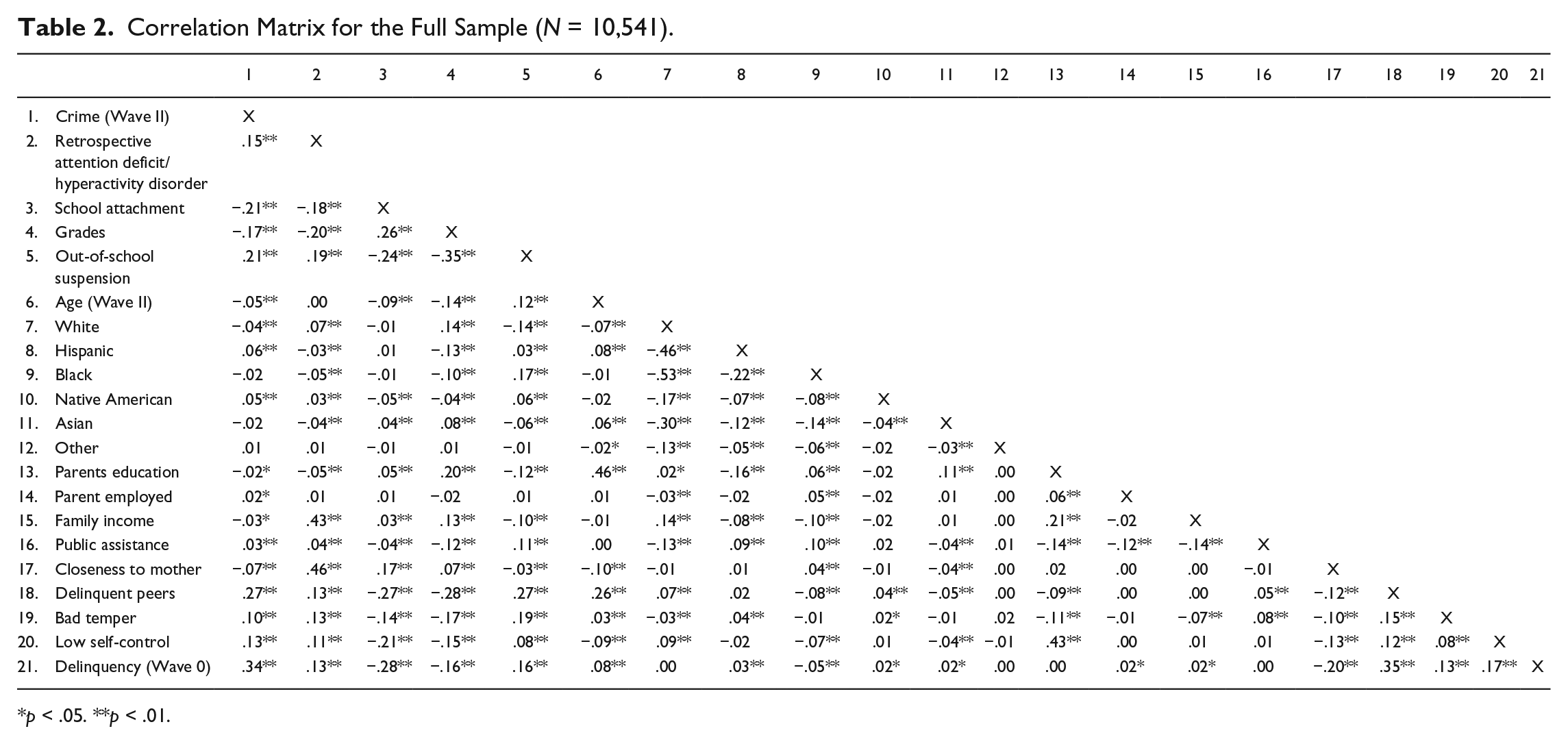
p < .05. **p < .01.
Multivariate Analyses
Turning to the regression analyses, Hypothesis 1 is examined in Table 3, which presents the results of OLS and logistic (out-of-school suspension) regression models with the three school factors regressed on retrospective ADHD symptomatology and the controls, with separate models for females and males. In the case of school attachment at Wave 1, ADHD symptomatology has a small, negative, highly significant effect for both females and males. Turning to grades at Wave 1, ADHD symptomatology again has a small, negative, highly significant effect for both females and males. 5 Turning finally to out-of-school suspension, ADHD symptomatology has a small, positive, highly significant effect on the likelihood of receiving an out-of-school suspension during one’s lifetime among both females and males. So among females and males, and in the case of all three school variables, Hypothesis 1 is supported.
School Attachment, Grades, and Out-of-School Suspension Separately Regressed on Retrospective ADHD Symptomatology and Controls, by Sex.
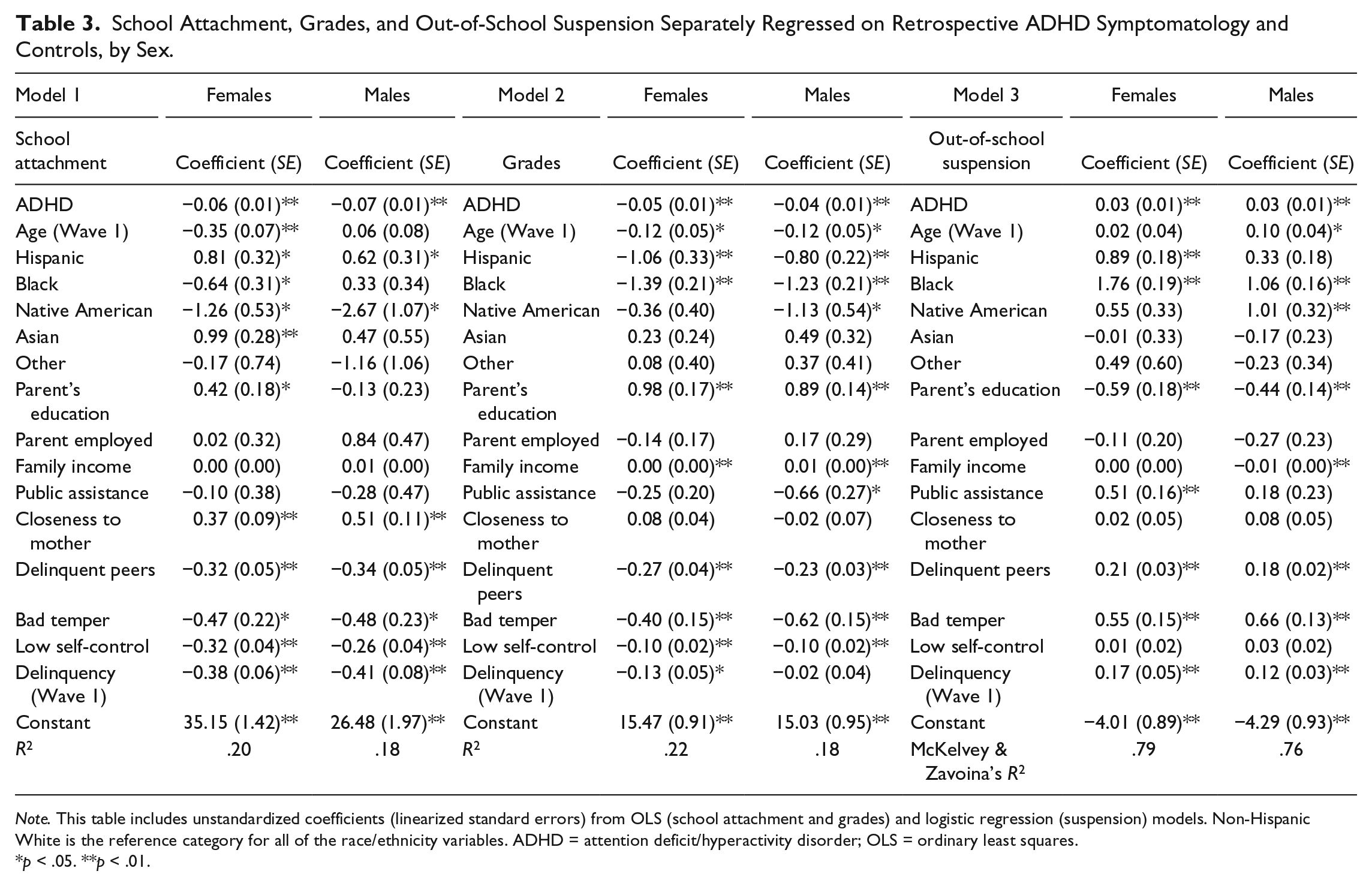
Note. This table includes unstandardized coefficients (linearized standard errors) from OLS (school attachment and grades) and logistic regression (suspension) models. Non-Hispanic White is the reference category for all of the race/ethnicity variables.
ADHD = attention deficit/hyperactivity disorder; OLS = ordinary least squares.
p < .05. **p < .01.
Table 3 establishes that a retrospective account of ADHD symptomatology has a significant effect on several school factors in Wave 1 of the Add Health data set. Table 4 shows whether this ADHD construct has a significant effect on crime during Wave 2 and whether this effect is at all mediated by these school factors. 6 The first model shows the effect of ADHD symptomatology on crime during Wave 2 while controlling for numerous important variables in the criminological literature, thus, addressing Hypothesis 2. As can be seen in Table 4, retrospective ADHD symptomatology has a small, positive, significant effect on criminal behavior during Wave 2 for both females and males, supporting Hypothesis 2.
Crime Wave 2 Regressed on Retrospective ADHD Symptomatology, School Measures, and Controls, by Sex.
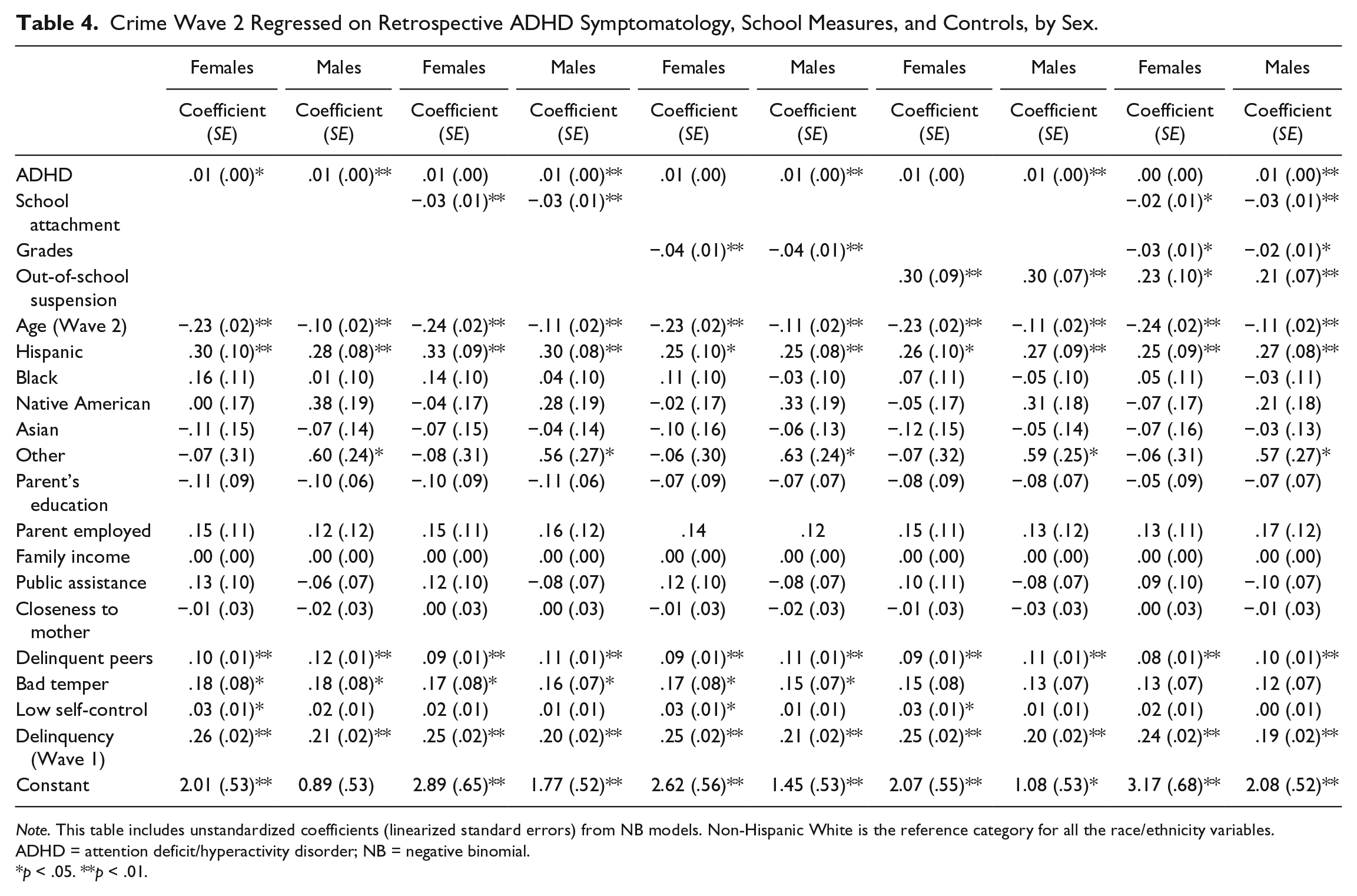
Note. This table includes unstandardized coefficients (linearized standard errors) from NB models. Non-Hispanic White is the reference category for all the race/ethnicity variables.
ADHD = attention deficit/hyperactivity disorder; NB = negative binomial.
p < .05. **p < .01.
The second, third, and fourth models in Table 4 address Hypothesis 3, with each one introducing one of the Wave 1 school factors to test whether they mediate the effect of ADHD symptomatology on criminal behavior. The second model introduces school attachment, which has a significant, negative effect on crime for both females and males. Although school attachment does not appear to mediate the effect of ADHD symptomatology on crime among males, it does mediate this effect among females, as the ADHD effect is no longer statistically significant, supporting Hypothesis 3. The third model looks at grades at Wave 1. Grades have a significant, negative effect on crime for both females and males. Similar to school attachment, grades do not appear to mediate the ADHD–crime relationship among males, showing no support for Hypothesis 3, but it does among females. Among females, the ADHD effect is made insignificant, again supporting Hypothesis 3. Turning to the fourth model, the results for out-of-school suspension are similar. Although lifetime out-of-school suspension at Wave 1 has a significant, positive effect on crime at Wave 2 for both females and males, it only mediates a significant portion of the ADHD–crime relationship among females, where the effect is no longer statistically significant, again supporting Hypothesis 3 for this group.
The final model of Table 4 also addresses Hypothesis 3, with the three school factors included simultaneously to assess how much of the ADHD–crime relationship they collectively mediate. As with the models where the school factors were introduced separately, the modest ADHD symptomatology effect on crime among males remains significant. Collectively, these three school factors mediate approximately 19% of the ADHD–crime relationship among males (coefficient reduced from .014248 to .0115015), but the ADHD symptomatology effect remains highly significant, offering little to no support for Hypothesis 3 even when accounting for all three school factors. Among females, these three school factors together mediate approximately 45.4% of the ADHD–crime relationship (coefficient reduced from .0084242 to .0046015). It appears from these results that at least in the Add Health sample, school factors play an important role in connecting ADHD symptomatology to crime in later adolescence among females, and Hypothesis 3 is supported among this group.
Discussion
This article sought to examine the relationship between ADHD symptomatology, school factors, and crime during later adolescence. Although previous research has identified ADHD as an important factor that relates to academic and behavioral outcomes at school and antisocial behavior during adolescence, this literature has generally failed to assess whether school factors mediate the relationship between ADHD and antisocial behaviors. Drawing on social bonding theory, this study attempted to address this shortcoming in the literature by utilizing data from Add Health, a nationally representative sample of American adolescents. Results from regression analyses show that a retrospective account of ADHD symptomatology in childhood and early adolescence is related to school attachment, grades, out-of-school suspension, and crime among both females and males in the Add Health sample, supporting Hypotheses 1 and 2. 7 It is only for females, however, that the ADHD–crime relationship is mediated by these school factors. Although these school factors affect criminal offending for both females and males, it is only among females that when controlling for these school factors, the effect of ADHD symptomatology on crime is significantly reduced, and thus, Hypothesis 3 is only supported among this females. These results add to the growing literature on the negative consequences of ADHD symptoms and match up well with a number of other recent studies on the relationship between ADHD and criminal outcomes (Behnken et al., 2014; Dalsgaard, Mortensen, Frydenberg, & Thomsen, 2013; Deane & Young, 2014; V. Gordon, Donnelly, & Williams, 2014; Margari et al., 2015).
Implications for Policy and Practice
Furthermore, these results provide evidence that ADHD symptomatology in adolescence plays a role in negative school experiences and increased antisocial behavior among individuals. Among females at least, these results also make clear that the effects of ADHD symptomatology at least partly work through negative school experiences to produce the ADHD–antisocial behavior relationship. A key implication for future research coming from this study, then, is to explore why this ADHD–school problems–antisocial behavior relationship is gendered in this way. In terms of policy and practice, these results suggest that perhaps for young girls with ADHD, a focus on keeping them engaged and out of trouble at school, in essence maintaining this important social bond among this group, may also keep them from having problems with delinquent and antisocial behavior both at school and elsewhere. The results in this study for boys simply reiterate what past studies have shown, which is that ADHD is consequential for antisocial behavior among this group, with ADHD symptomatology having robust and consistent effects on criminal behavior across the models.
Implications for Theory
In terms of theory, these results give evidence that at least among females, ADHD symptomatology is an important factor that can undermine social bonds, thus, potentially producing delinquent and criminal behavior. Future theorizing and research should make note of these findings and consider potentially important the role of ADHD in forming and/or breaking social bonds. The effect of ADHD on important social bonds beyond one’s relationship to school during adolescence should be explored, including not only other social bonds that are important during childhood and adolescence but also important social bonds during adulthood, such as employment status and family formation.
Study Limitations
Although this study makes a contribution to the ADHD literature, some limitations should be noted. The ADHD symptomatology construct utilized in this study is a retrospective account being given in early adulthood about behavior during childhood and early adolescence. Obviously, a more desirable measure would have come from an official ADHD symptom assessment during early childhood and adolescence, with the respondents then followed over time. Also, as previously mentioned, research suggests that self-assessments of ADHD symptomatology tend to result in underreporting, and thus, the retrospective ADHD symptomatology estimates in the current study may be very conservative, which may partly explain the very small effects found in the statistical models. Also, given that the ADHD measure is retrospective, it is difficult to say how much an individual’s school experiences and criminal offending history plays into responses for these items. Perhaps individuals with more antisocial behavior in their past inflate their own perceptions of their inattentiveness and/or hyperactivity to match up with their history of getting into trouble. It is not possible to say how big of an effect this may have had on the present results.
Although these are clear limitations in this study, the overall strength of the Add Health data set and the quality of the other measures and the robustness of the ADHD symptomatology effect in spite of all the controls put in place in the regression models mean that these results do add something important to this literature. It is also important to note that the focus on the ADHD–school factors–crime relationship in the current study is limited to looking at middle and later adolescence. The negative effects of ADHD are not limited to adolescence, as ADHD shapes behavior and outcomes throughout the life course. Thus, research that applies a similar model but extends into adulthood is an important next step.
Conclusion
This study provides evidence that ADHD symptomatology in childhood and early adolescence negatively shapes school experiences and criminal behavior during later adolescence, and that among females, these school factors mediate the relationship between ADHD symptomatology in childhood and early adolescence and criminal behavior in later adolescence. More research is needed to understand why the ADHD effect is so different by sex, while new policies for young girls geared toward improving their school experiences may help reduce the size of the ADHD–antisocial behavior link among this group. In addition, moving forward, ADHD should be considered an important variable in criminological theory because of its potential to undermine important social bonds during childhood and adolescence.
Footnotes
Appendix
Declaration of Conflicting Interests
The author(s) declared no potential conflicts of interest with respect to the research, authorship, and/or publication of this article.
Funding
The author(s) received no financial support for the research, authorship, and/or publication of this article.