



Abstract
A number of studies have evaluated associations between parenting practices, adolescent self-control, and adolescent antisocial behavior. Yet, few studies have examined associations between these constructs in early childhood or examined the extent to which both maternal and paternal self-control shapes them. To address these gaps, the current study utilizes longitudinal data collected on a sample of 117 Dutch boys and their parents to investigate the across time interrelationships between parental self-control, ineffective parenting, child self-control, and child aggression. The results provide evidence of an indirect association between maternal self-control and early childhood self-control through maternal ineffective parenting, an indirect association between maternal ineffective parenting and early childhood aggression through early childhood self-control, and an indirect association between maternal self-control and early childhood aggression through both maternal ineffective parenting and early childhood self-control. In contrast, paternal self-control and paternal ineffective parenting were unrelated to child self-control and child aggression. The implications and limitations of the study are discussed.
Introduction
Gottfredson and Hirschi’s (1990) self-control theory was formulated a full quarter century ago, and in support of the primary claim of the theory, a large body of research finds low self-control is correlated with delinquency, crime, and other forms of deviant behavior (see de Ridder, Lensvelt-Mulders, Finkenauer, Stok, & Baumeister, 2012; Duckworth & Kern, 2011; Pratt & Cullen, 2000). Given this, researchers have turned attention to testing other aspects of the theory. Pertinent to the current focus, much attention has been directed at investigating the social causes of self-control, including school socialization (e.g., Turner, Piquero, & Pratt, 2005), neighborhood context (e.g., Gibson, Sullivan, Jones, & Piquero, 2010; Pratt, Turner, & Piquero, 2004), and peer associations (e.g., Meldrum, Young, & Weerman, 2012). However, it is the question of whether parental socialization is related to child and adolescent self-control that has received the greatest amount of empirical scrutiny. On this matter, many, but not all, studies provide supporting evidence (e.g., Botchkovar, Marshall, Rocque, & Posick, 2015; Cullen, Unnever, Wright, & Beaver, 2008; Hay, 2001; Perrone, Sullivan, Pratt, & Margaryan, 2004; cf. Wright & Beaver, 2005). In addition, several studies find a portion of the association between parenting practices and delinquent behavior is mediated by self-control (e.g., Hay, 2001; Perrone et al., 2004; Simons, Simons, Chen, Brody, & Lin, 2007; cf. Wright, Beaver, Delisi, & Vaughn, 2008).
Although valuable, the existing research in this area is limited in two important ways. First, the majority of studies investigating associations between parenting practices, child self-control, and antisocial behavior have focused on the developmental period of adolescence (see Cullen et al., 2008). Relatively little research testing self-control theory has centered on how these processes operate during early childhood (Barnes, Boutwell, Beaver, & Gibson, 2013), even though this is the developmental period in which Gottfredson and Hirschi contend parenting should be consequential for self-control. Second, Gottfredson and Hirschi (1990) allude to the importance of parental self-control for instilling self-control in children, but so far only a handful of studies have investigated the role that parental self-control plays in shaping parenting practices, child self-control, and antisocial behavior (e.g., Boutwell & Beaver, 2010; Nofziger, 2008), leaving important questions unresolved.
In the current study, we seek to fill these two gaps in the literature by addressing three research questions:
To address these questions, we draw on data collected as part of a longitudinal study of Dutch parents and their young sons. Prior to describing the data, presenting our methodology, and discussing the results of our analysis, we first review prior work testing the core arguments of self-control theory. Following this, we discuss theory and research speaking to the influence of parental self-control on parenting practices, child self-control, and antisocial behavior.
Prior Research Testing Self-Control Theory
The primary argument of self-control theory (Gottfredson & Hirschi, 1990)—that self-control is a significant predictor of delinquent and criminal behavior—has been replicated across a multitude of studies (see reviews by Duckworth & Kern, 2011; Pratt & Cullen, 2000). As a result, researchers have shifted attention to testing other claims made by Gottfredson and Hirschi (1990) in A General Theory of Crime. One argument they make that is the focus of the current study concerns the etiology of self-control. In particular, they argue that parents play a pivotal role in shaping the development of childhood self-control. According to them, parental attachment, monitoring, and discipline are hypothesized to be particularly important for this developmental process during the first decade of life (Gottfredson & Hirschi, 1990). As a result, individuals who are higher in self-control should be less likely to engage in delinquent behavior as adolescents and less likely to engage in criminal behavior as adults. Summarily, Gottfredson and Hirschi contend the influence that parenting has on delinquent and criminal behavior should be mediated by child/adolescent self-control.
As it pertains to the influence of parenting on self-control, many studies find that adolescents and young adults whose parents (mothers typically being the focus) monitor and discipline their behavior and who have positive relationships with their parents have more self-control (e.g., Botchkovar et al., 2015; Burt, Simons, & Simons, 2006; Cullen et al., 2008; Hay & Forrest, 2006; Perrone et al., 2004; but see Wright & Beaver, 2005). With regard to the influence of parental socialization on delinquent and criminal behavior, a large body of research similarly provides evidence in support of this link (for meta-analytic reviews, see Hoeve et al., 2009; Loeber & Stouthamer-Loeber, 1986; but see (Wright, Beaver, DeLisi, & Vaughn, 2008). Furthermore, researchers have investigated whether the influence of parental socialization on delinquency and crime is mediated by adolescent self-control (e.g., Burt et al., 2006; Finkenauer, Engels, & Baumeister, 2005; Gibbs, Giever, & Martin, 1998; Hay, 2001; Jones, Cauffman, & Piquero, 2007; Kort-Butler, Tyler, & Melander, 2011; Perrone et al., 2004; Unnever, Cullen, & Agnew, 2006; Vazsonyi & Belliston, 2007), with many studies finding that a portion of the association between parental socialization and delinquency/crime operates indirectly through child/adolescent self-control.
Having reviewed this body of research, it is important to counterbalance it by discussing recent studies indicating that past associations found in research might be overestimated, because of the failure to account for genetic confounds (Barnes, Boutwell, Beaver, Gibson, & Wright, 2014). Specifically, although some studies find that parenting continues to exert significant effects on self-control when accounting for heritability (Cecil, Barker, Jaffee, & Viding, 2012), other studies find that once heritability is accounted for, most associations between measures of parenting and self-control are no longer statistically significant (Beaver et al., 2010; Wright & Beaver, 2005). This pattern is also evident when examining the association between parenting and delinquency. Specifically, Wright Wright, Beaver, DeLisi, and Vaughn (2008) find that parenting variables were unrelated to delinquency when analyzing data on twins who participated in the National Longitudinal Study of Adolescent Health. Thus, although there is evidence indicating that parental socialization is consequential for self-control and delinquent behavior, such findings must be tempered in light of the fact that studies that account for heritability provide more limited support for such associations.
Aside from the question as to whether parenting is consequential for self-control and delinquent behavior, it is important to point out that little research has investigated the correlates of self-control during the first years of life (e.g., Barnes et al., 2013). A focus on the developmental period of adolescence and young adulthood in past research testing self-control theory is natural given that antisocial behavior that would attract the attention of authorities typically does not emerge until early adolescence. Yet, given Gottfredson and Hirschi’s (1990) emphasis on the importance of parenting during the first decade of life, research on the development of self-control and antisocial behavior during this developmental period is important.
An additional reason that past research testing self-control theory has focused on adolescence is the convenience associated with collecting survey data on samples of middle school, high school, or college-age students who can report on the parenting practices used in their home, their own self-control, and their involvement in delinquent and criminal behavior. Focusing on these interrelationships during early childhood presents an obvious challenge—young children cannot complete survey questionnaires. Thus, reports of early childhood self-control and early manifestations of antisocial behavior must come from others sources, such as parents or teachers. The current study takes advantage of the fact that it makes use of data collected from parents of very young boys, enabling an examination of the interrelationships between parenting, self-control, and antisocial behavior during early childhood.
Parental Self-Control: Precursor to Parenting, Child Self-Control, and Antisocial Behavior
Gottfredson and Hirschi’s (1990) theoretical arguments, and the resulting body of research testing these arguments, focus primarily on the manner in which parental socialization is consequential for self-control and antisocial behavior. Yet, what has received less attention is the contributing influence of parental self-control for these relationships. Gottfredson and Hirschi (1990) briefly discuss the importance of parental self-control, noting that parents who are low in self-control are unlikely to effectively instill self-control in their children. If child self-control is posited to be the result of parental socialization, then the logical extension of their argument would be that parents who are low in self-control are unlikely to engage in effective parenting practices. Furthermore, because Gottfredson and Hirschi (1990) argue that genetic contributions to self-control are “near zero” (p. 60), we believe they would argue that any influence of parental self-control on child self-control would be indirect and operate through parenting practices; no direct effect of parental self-control on child self-control should remain after statistically controlling for parenting practices.
Given the nature of low self-control and its dimensions described by Gottfredson and Hirschi, the argument as to why parents who are low in self-control might be ineffective at parenting and produce children who are lower in self-control is rather self-evident. As Meldrum, Connolly, Flexon, and Guerette (2015) have discussed, parenting requires patience and the ability to place the needs of children often ahead of one’s own; parents who are self-centered may be less likely or less able to succeed at this task. Furthermore, parents who are short-tempered may create hostile family environments where shouting, yelling, and physical discipline are used to gain compliance. Finally, impulsive and short-sighted parents might not recognize deviant behavior in their children when it takes place and so it may go unnoticed. And, when parents who are low in self-control do recognize deviant behavior in their children, they may be inconsistent in their disciplinary practices or do things that are counterproductive, such as withdrawing love and affection, which requires less effort than teaching a child how to self-regulate and modify their behavior (see also Boutwell & Beaver, 2010, for discussion).
Relatively few studies have investigated the influence of parental self-control on parenting practices, child self-control, and antisocial behavior. In the first study we are aware of to explicitly examine the relationship between parental self-control and parenting practices, Verhoeven, Junger, Van Aken, Deković, and Van Aken (2007) find that mothers and fathers who score lower on the Grasmick, Tittle, Bursik, and Arneklev (1993) self-control scale are more likely to use harsh disciplinary practices and to use psychological control more often with their children. Focusing on approximately the same developmental period, Boutwell and Beaver (2010) find that both mothers and fathers of 3-year-olds participating in the Fragile Families and Child Wellbeing Study who were lower in self-control were less involved with their children (e.g., reading to children, showing them affection). In addition, they found that maternal and paternal low self-control maintained a significant effect on child low self-control during the same time period when accounting for a number of covariates, including parental involvement. Nofziger (2008) also investigated similar issues but during early adolescence by utilizing data from the National Longitudinal Survey of Youth (NLSY) and the NLSY Child data. Similar to what was revealed in Boutwell and Beaver (2010), Nofziger (2008) finds evidence of significant associations between a behavioral measure of maternal self-control and maternal monitoring and disciplinary practices, as well as an association between maternal self-control and adolescent self-control that remained when accounting for parenting practices.
Two more recent studies provide further evidence of the importance of parental self-control. First, Meldrum, Connolly et al. (2015) examined associations between maternal low self-control, several aspects of the family environment (including parenting practices), and officially recorded juvenile delinquency. Consistent with the above studies, Meldrum and colleagues found that maternal low self-control was negatively correlated with family cohesion and effective parenting, but positively correlated with family conflict and juvenile delinquency. Second, Meldrum, Young, and Lehmann (2015) utilized a retrospective research design to investigate the interrelationships between parental self-control, parental socialization, young adult self-control, and young adult offending among a sample of undergraduate students. Informatively, they found that a retrospective measure of parental self-control was significantly associated with a retrospective measure of parental socialization, and contemporaneous measures of young adult self-control and young adult offending. Furthermore, as was found by Boutwell and Beaver (2010) and Nofziger (2008), Meldrum and colleagues found evidence of a direct association between parental self-control and young adult self-control in addition to an indirect association via parental socialization. Such evidence calls into question Gottfredson and Hirschi’s (1990) claim that self-control has no heritable basis.
Research from the field of developmental psychology also adds to our understanding of the contributing role of parental personality for understanding child personality and child outcomes via parenting (e.g., Belsky, 1984; Prinzie, Stams, Deković, Reijntjes, & Belsky, 2009). For example, research indicates that parental conscientiousness—a personality trait tangentially related to self-control—is associated with higher quality parenting (Prinzie et al., 2009). In addition, research in this area finds that parenting is related to child psycho-pathology (Berg-Nielsen, Vikan, & Dahl, 2002). Taken together, the findings from research within criminology and its allied disciplines point to a pattern suggesting that children and adolescents whose parents are lower in self-control and closely related personality traits are more likely to be exposed to less nurturing family environments, to be lower in the self-control themselves, and to be more likely to engage in antisocial behavior.
The Current Study
Past research has examined the interrelationships between parenting practices, self-control, and a variety of antisocial outcomes during adolescence and early adulthood. Emerging evidence also indicates parental self-control is an important precursor to these processes. In the current study, we add to this literature base in three ways. First, we explicitly incorporate parental self-control as an exogenous variable into a longitudinal model examining the interrelationships between parenting, self-control, and aggression in a sample of boys; the examination of these four variables together within a longitudinal design is a unique contribution of this study. Second, we examine the unique contributions of both maternal and paternal self-control and parenting practices to child self-control and child aggression. Although not exclusively, it has been common for research testing self-control theory to focus on only one parent (e.g., Burt et al., 2006; Hay & Forrest, 2006; Nofziger, 2008; Perrone et al., 2004). Third, unlike much past research, we investigate these associations during the first years of life using prospective data. Given that child aggression has proven to be a robust correlate of later adolescent delinquency and adult offending (e.g., Olweus, 1979; Wright, Tibbetts, & Daigle, 2008), identifying the factors that are antecedent to early aggression is warranted, and self-control theory offers a plausible model to account for its development.
Figure 1 displays the hypotheses stemming from Gottfredson and Hirschi’s arguments. The first hypothesis is that there will be positive, indirect associations between maternal/paternal self-control and early childhood self-control operating over time through ineffective parenting. Because Gottfredson and Hirschi (1990) contend there is no heritable basis to self-control, we believe their position would be that any influence of parental self-control on child self-control should be mediated by parenting practices. The second hypothesis is that there will be a positive, indirect association between ineffective parenting practices and early childhood aggression operating over time through early childhood self-control. This hypothesis is consistent with Gottfredson and Hirschi’s (1990) explicit argument that the influence of parenting on delinquency and crime should be mediated by child/adolescent self-control. The third hypothesis is that there will be a negative, indirect association between maternal/paternal self-control and early childhood aggression operating over time through both ineffective parenting and early childhood self-control. This third hypothesis is a logical extension of the former two—if the previous relationships are hypothesized to be indirect, then any association between maternal/paternal self-control and childhood aggression should be mediated by ineffective parenting and child self-control.
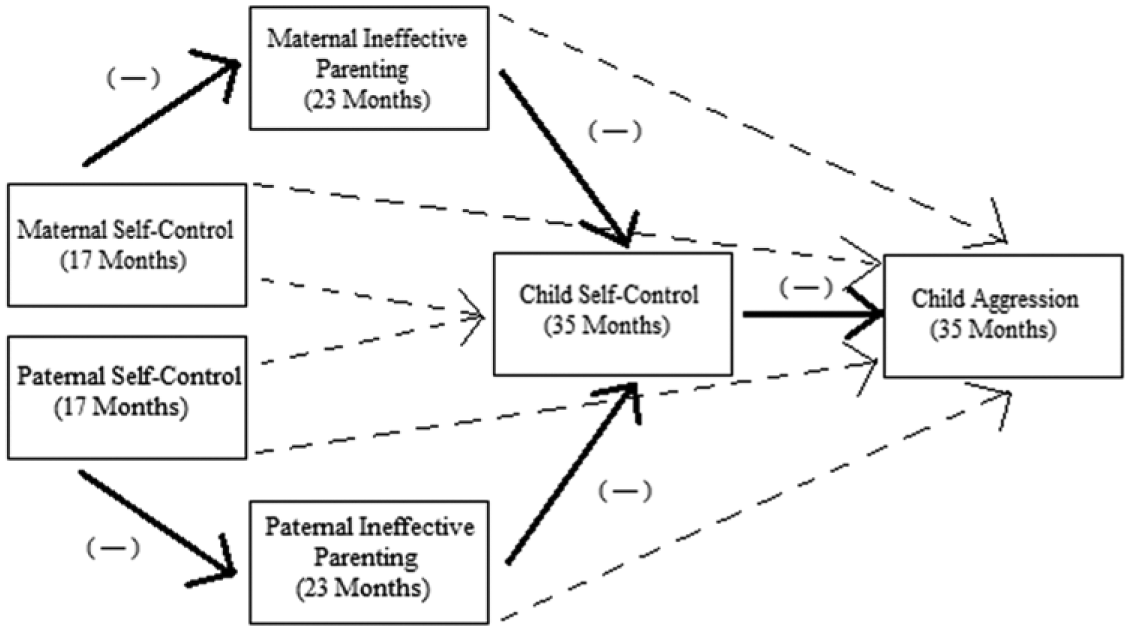
Hypothesized model.
Given Gottfredson and Hirschi’s (1990) position that the effect of parenting on delinquency should be indirect through self-control, and their implicit argument that any influence of parental self-control on child self-control should operate indirectly through parenting practices, we do not model direct effects between (a) parental self-control and child self-control, (b) parental self-control and child aggression, and (c) parenting practices and child aggression in our primary analyses. Still, it is important to recognize that, contrary to Gottfredson and Hirschi’s positions, studies have found (a) a direct association between parental self-control and child self-control remains when accounting for parenting practices (Boutwell & Beaver, 2010; Meldrum, Young et al., 2015; Nofziger, 2008) and (b) a direct association between parenting practices and child antisocial behavior remains when accounting for child self-control (e.g., Hay, 2001; Perrone et al., 2004). Given these findings, we consider the potential of direct effects in supplementary analyses discussed at the end of the “Results” section.
Data
Data for this study come from the same data source as Verhoeven et al.’s (2007) article. However, the current study is distinct from Verhoeven et al.’s (2007) article in two important ways. First, the present study examines the potential influence of maternal and paternal self-control not simply on parenting practices but also on early childhood self-control and early childhood aggression. Second, the present study makes use of multiple waves of data, whereas Verhoeven et al.’s (2007) analysis was based on a single wave of data. The data for the present study are based on a sample of 117 boys and their parents who were recruited via the records of infant welfare clinics in three cities situated in the central region of the Netherlands. Only families raising a boy were contacted, as aggressive behavior, the main research topic of the project, is more common in boys than girls (Alink et al., 2006; Webster-Stratton, 1996).
A recruitment letter explaining the goals of the project was mailed to 192 families and followed up with a telephone call. Of the 192 families who were contacted, 117 families (61%) agreed to participate in the longitudinal project from which the data used for the current study were obtained. A lack of time was the most prevalent reason for refusal of participation. Data for the current study come from self-report inventories administered by mail to parents when boys were 17 months, 23 months, and 35 months of age. This developmental period from approximately 1½ years of age to 3 years of age was chosen for the study because this is a period marked by rapid physical, cognitive, motor, and emotional regulatory growth. Furthermore, externalizing behaviors typically increase during the first 2 years of life, with the third year of life being the point at which children first start to display overt acts of aggression (Tremblay et al., 1999).
Study children were 17 months of age at the first assessment (M = 16.9 months, SD = 0.58). Their parents were primarily Dutch (mothers: 94.9%; fathers: 99.1%) and college educated (mothers: 61.5%; fathers: 66.3%), and their mean age at the first assessment was 32.9 years (SD = 3.97 years) for mothers, and 34.9 years (SD = 4.97 years) for fathers. For 48.7% of the parents, the target child was the first born child, and the average number of children in the participating families was 1.7 (SD = 0.91) at the first assessment and 1.98 (SD = 0.90) at the last assessment. Of the 117 families who participated at the first assessment, 110 remained at the time of the last assessment when boys were 35 months old. Missing data were handled using a procedure that is described after we specify how key variables were measured. All survey instruments that were originally produced in English and for which no standard Dutch translation was available were translated by means of a double-translation procedure.
Measures
Maternal and paternal self-control
The measure for maternal and paternal self-control in this study is based on the 24-item attitudinal self-control scale developed by Grasmick et al. (1993), completed by mothers and fathers when boys were 17 months old. For each of the items, parents rated themselves on a 4-point scale, ranging from 1 (strongly disagree) to 4 (strongly agree). All items were reverse-coded so that scores for each of the items reflected higher self-control. Scores for each of the 24 items were then averaged together to produce an overall score (α = .81 for mothers; α = .79 for fathers), a strategy supported by recent research (see Ward, Nobles, & Fox, 2015).
Ineffective parenting
Ineffective parenting was assessed when boys were 23 months old using two sets of indicators measuring the degree to which mothers and fathers reported they used harsh disciplinary practices and failed to provide necessary structure for their boys. These two dimensions of parenting have been consistently found as correlates of child behavior problems (e.g., Chang, Schwartz, Dodge, & McBride-Chang, 2003; Gershoff, 2002; Harvey & Metcalfe, 2012; Jewell, Krohn, Scott, Carlton, & Meinz, 2008; Straus & Field, 2003). Each of these two sets of indicators is described below.
First, harsh discipline was assessed using 17 items, originating from different questionnaires. Ten items from the Discipline Scale of the Parental Behavior Checklist (Fox, 1994) and three items of the Alabama Parenting Questionnaire (Shelton, Frick, & Wootton, 1996) measured the frequency with which each parent use physical and verbal punishment (e.g., “When my child has a temper tantrum, I spank him”; “I yell at my child for being too noisy at home”). In addition, four items from the Nijmeegse Opvoedlijst (NOV; Gerris et al., 1993) measured how often each parent used withdrawal of attention and/or affection as a disciplinary technique (e.g., “When my child misbehaves, I stop talking to him until he pleases me again”). For each of the 17 items, each parent indicated on a 5-point scale (1 = never to 5 = always) how often they used these disciplinary techniques; the items were averaged together such that higher scores represented harsher discipline (α = .83 for mothers; α = .80 for fathers).
Second, lack of structure was assessed using 15 items measuring each parents’ tendency to provide an unstructured environment by being inconsistent and unpredictable. This included 10 items from the Parenting Scale (Irvine, Biglan, Smolkowski, & Ary, 1999) regarding parental laxness (i.e., permissive and inconsistent discipline) and overreactivity (i.e., tendency to react to child’s misbehavior in an unstructured, exaggerated manner). For both laxness and overreactivity, items presented a specific parental situation, followed by two options that act as opposite anchor points for a 7-point scale. A high score indicates that parents are, respectively, lax or overreactive in their parenting. A sample item measuring laxness is, “If my child gets upset when I say ‘no’ . . . , I stick to what I said—or the opposite—I back down and give in to my child.” A sample item measuring overreactivity is, “When my child misbehaves . . . , I handle without getting upset—or the opposite—I get so frustrated that my child can see I’m upset.” For an additional five items from the Alabama Parenting Questionnaire (Shelton et al., 1996), each parent indicated on a 5-point scale (1 = never to 5 = always) how often they are inconsistent in applying discipline (e.g., “You threaten your child and then do not actually punish him”). As the 15 items tapping lack of structure are assessed on different scales (7-point scale vs. 5-point scale), all 15 items were standardized before computing a mean score; higher scores reflect a greater lack of structure in the home environment (α = .79 for mothers; α = .82 for fathers).
Early childhood self-control
When boys were 35 months old, mothers and fathers answered 13 items from the Inhibitory Control scale of the Toddler Behavior Assessment Questionnaire (TBAQ; Goldsmith, 1996) to assess the extent to which their child is able to stop, moderate, or refrain from a behavior under instruction. Although not widely recognized within the field of criminology, the scale has been utilized by child development researchers (e.g., Carlson, Mandell, & Williams 2004; Gagne & Saudino, 2010, Vaughan van Hecke et al., 2007). Example items included the following: “When told ‘no,’ how often did your child stop the activity quickly?” “When asked to sit still, how often did your child have trouble doing so?” and “When asked to wait for something (like dinner), how often did your child wait patiently?” Responses were provided by both parents on a 7-point scale (1 = never to 7 = always); some items were reverse-coded so that higher values for each of the items indicate greater child self-control (α = .90 for mothers; α = .88 for fathers). For the analysis, maternal and paternal reports of child self-control were averaged into one score based on the 26 items.
Child aggression
Six items from the Aggression Scale of the Child Behavior Checklist (CBCL 1.5-5 years; Achenbach & Rescorla, 2000) measure child aggressive behavior when boys were 35 months old. Mothers and fathers rated on a 3-point scale (0 = never to 2 = often) as to whether the following behaviors were indicative of their child: “Destroys stuff of family members or other children,” “Fights much,” “Hits other people,” “Hurts people or animals,” “Physically attacks people,” and “Yells/screams a lot.” These particular items were selected because they are reflective of behavior that, if committed by adolescents, would likely elicit the attention of school officials and/or the juvenile justice system (α = .67 for mothers; α = .70 for fathers). As was true for the measure of child self-control, maternal and paternal reports of child aggression were averaged into one score based on the 12 items.
Social-economic status (SES)
To classify the family’s SES, the education and occupation of both parents are used according to the four-factor index developed by Brandis and Henderson (1970).
Analytic Plan
Structural equation modeling (SEM) using MPlus (Muthén & Muthén, 2011) was used to test the hypothesized model linking parental self-control, ineffective parenting, early childhood self-control, and early childhood aggression. Ideally, latent variables would be used to investigate the hypothesized relationships of interest. However, given the number of indicators used to measure these constructs (e.g., 24 items to measure maternal and paternal self-control, 26 items to measure child self-control, etc.) relative to the sample size of 117, observed, rather than latent, variables were modeled. The exception to this was that ineffective parenting was modeled as a latent construct that was indicated by the observed variable for lack of structure (standardized factor loading for mothers = .60; standardized factor loading for fathers = .76)—set as a metric for the latent construct—and with the observed variable for harsh discipline (standardized factor loading for mothers = .60, p < .001; standardized factor loading for fathers = .85, p < .01).
We used full information maximum likelihood (FIML) estimation to handle missing data on two fathers who did not participate at T1 and on seven families who dropped out prior to the final assessment. Biased-corrected bootstrapping was used to estimate significance of (in)direct effects (Preacher & Hayes, 2004). This bootstrapped method makes no assumptions about the sampling distribution of direct or indirect effects, and is found to be superior to other methods to estimate indirect effects (Hayes, 2009). Confidence intervals for the estimates resulting from the bootstrapping are presented in the main table showing the structural coefficients. Both maternal and paternal effects are examined simultaneously in one statistical model. Furthermore, correlations were estimated between maternal and paternal self-control, and between maternal and paternal ineffective parenting because of the interdependence between mothers and fathers.
The following fit indices were used to evaluate model fit: the chi-square likelihood ratio statistic, the root mean square error of approximation (RMSEA), the comparative fit index (CFI), the Tucker–Lewis fit index (TLI), and the standardized root mean square residual (SRMSR). Adequate model fit is indicated by a nonsignificant chi-square statistic, CFI and TLI values ≥0.90, and RMSEA and SRMR values of ≤0.08. CFI and TLI values ≥0.95 and RMSEA values ≤0.06 indicate good fit of the model (Hu & Bentler, 1999; Kline, 2005). The descriptive statistics and bivariate correlations between all measures are provided in Table 1. As SES of the family was unrelated to all measures, we did not include this in the structural equation model.
Correlations and Descriptive Statistics (n = 117).
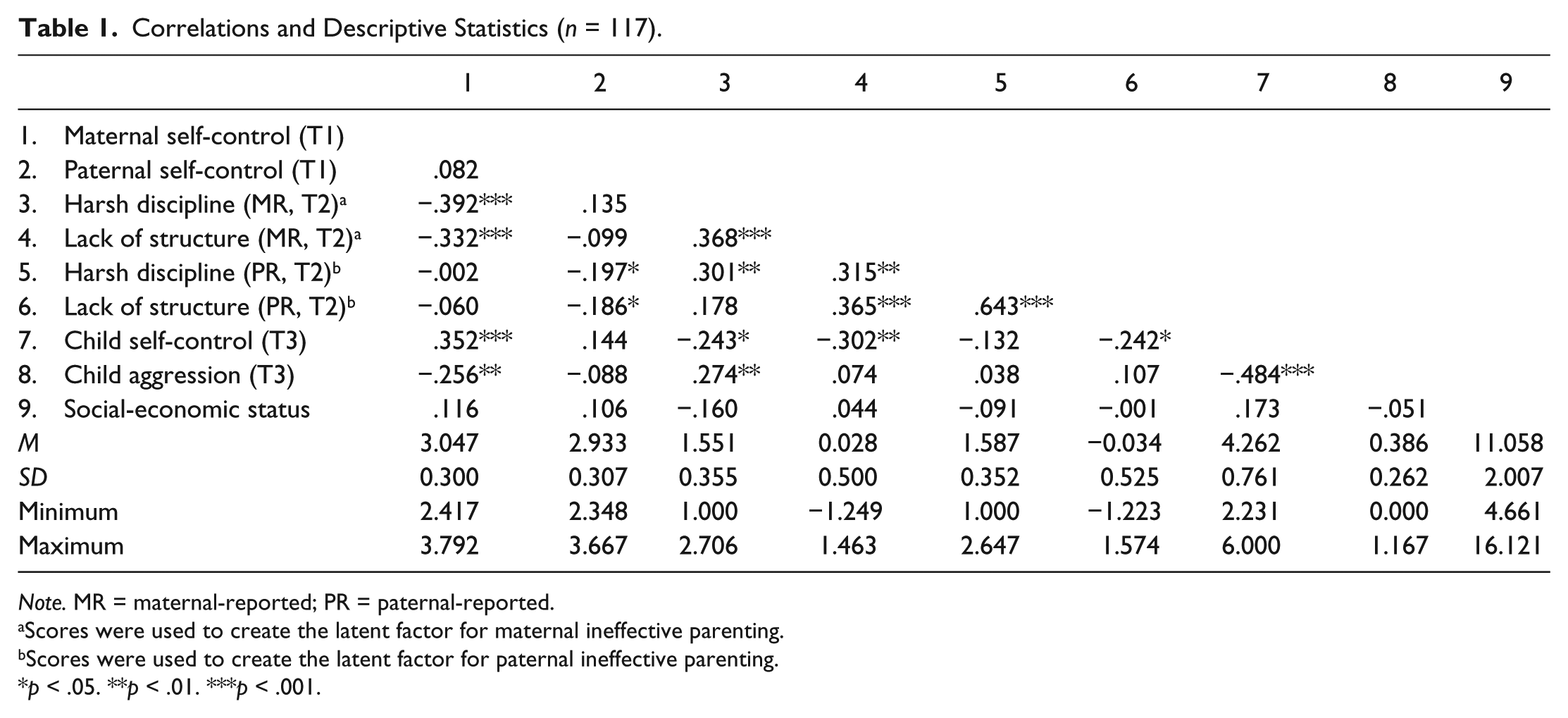
Note. MR = maternal-reported; PR = paternal-reported.
Scores were used to create the latent factor for maternal ineffective parenting.
Scores were used to create the latent factor for paternal ineffective parenting.
p < .05. **p < .01. ***p < .001.
Results
Table 2 shows the results of the structural equation used to test our hypotheses. The model shows a reasonable fit to the data; the chi-square statistic is not significant (25.45, df = 17, p = .085) and the RMSEA (0.065), TLI (0.926), CFI (0.953), and SRMR (0.054) values are all acceptable. Four endogenous variables are specified in the model: maternal and paternal ineffective parenting, early childhood self-control, and early childhood aggression. The left part of the model estimating the association between maternal self-control and maternal ineffective parenting reveals a substantively large, negative coefficient (β = −.613, p < .001). This indicates that mothers who reported they were higher in self-control when boys were 17 months old were less likely to engage in ineffective parenting practices when boys were 23 months old. With regard to the effect of paternal self-control on paternal ineffective parenting, a similar, but less pronounced, association is observed (β = −.226, p < .05).
Structural Equation Model Examining Associations Between Parental Self-Control, Ineffective Parenting, Child Self-Control, and Child Aggression (n = 117).
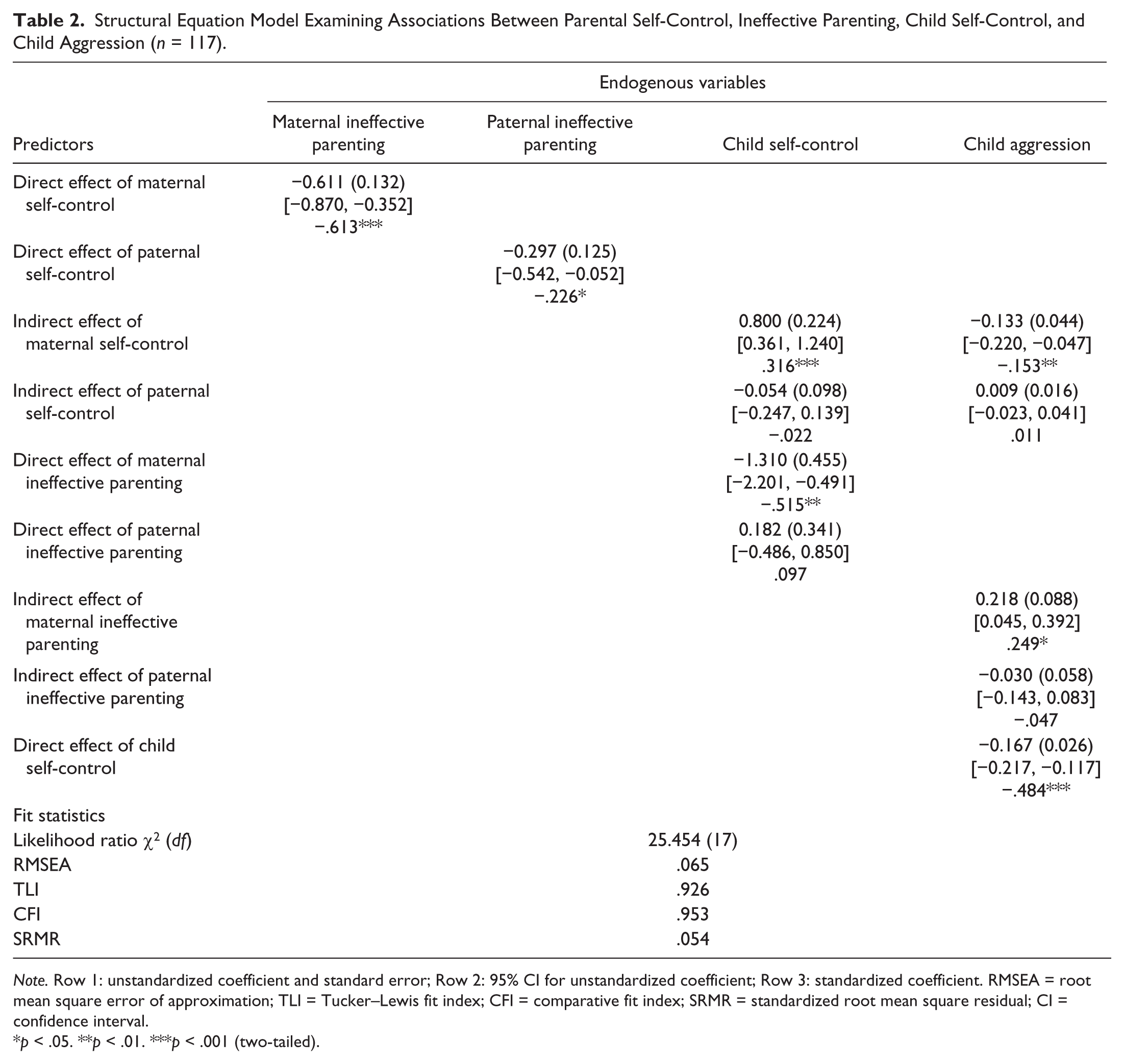
Note. Row 1: unstandardized coefficient and standard error; Row 2: 95% CI for unstandardized coefficient; Row 3: standardized coefficient. RMSEA = root mean square error of approximation; TLI = Tucker–Lewis fit index; CFI = comparative fit index; SRMR = standardized root mean square residual; CI = confidence interval.
p < .05. **p < .01. ***p < .001 (two-tailed).
Moving to the part of the model that considers the direct association between ineffective parenting and early childhood self-control and the hypothesized indirect association between parental self-control and early childhood self-control operating through ineffective parenting, the estimates provide mixed support for the hypothesized model. First, a negative association between maternal ineffective parenting when boys were 23 months old and early childhood self-control when boys were 35 months old is observed (β = −.515, p < .01). However, there is no significant association between paternal ineffective parenting and child self-control (β = .097, p = .594). Second, a positive, indirect association between maternal self-control when boys were 17 months old and early childhood self-control when boys were 35 months old operating through maternal ineffective parenting when boys were 23 months old is found (β = .316, p < .001). For fathers, this indirect effect was not significant (β = −.022, p = .585), a result that is not surprising given the lack of an association between paternal ineffective parenting and child self-control.
The final part of the model examines the direct and indirect associations between parental self-control, ineffective parenting, early childhood self-control, and early childhood aggression. As expected, early childhood self-control at 35 months of age is contemporaneously associated with less aggressive behavior at 35 months of age (β = −.484, p < .001). In addition, the model provides partial support for our second hypothesis. Specifically, it reveals a positive, indirect association between maternal ineffective parenting when boys were 23 months old and early childhood aggression at 35 months of age operating through early childhood self-control at 35 months of age (β = .249, p < .05). This indicates that maternal ineffective parenting results in later aggressive behavior because of the negative influence that ineffective parenting has on early childhood self-control. At the same time, the model provides no evidence of an indirect effect of paternal ineffective parenting on child aggression via child self-control (β = −.047, p = .577), which runs counter to the hypothesized model.
Partial support for Hypothesis 3 is also found, as the model provides evidence of an indirect, negative association between maternal self-control when boys were 17 months of age and early childhood aggression at 35 months of age operating through both maternal ineffective parenting at 23 months of age and early childhood self-control at 35 months of age (β = −.153, p < .01). Yet again, there is no evidence for an indirect effect of paternal self-control on child aggression via paternal ineffective parenting and child self-control (β = .011, p = .588). Figure 2 provides a visual representation of the standardized effects estimated by the structural equation.
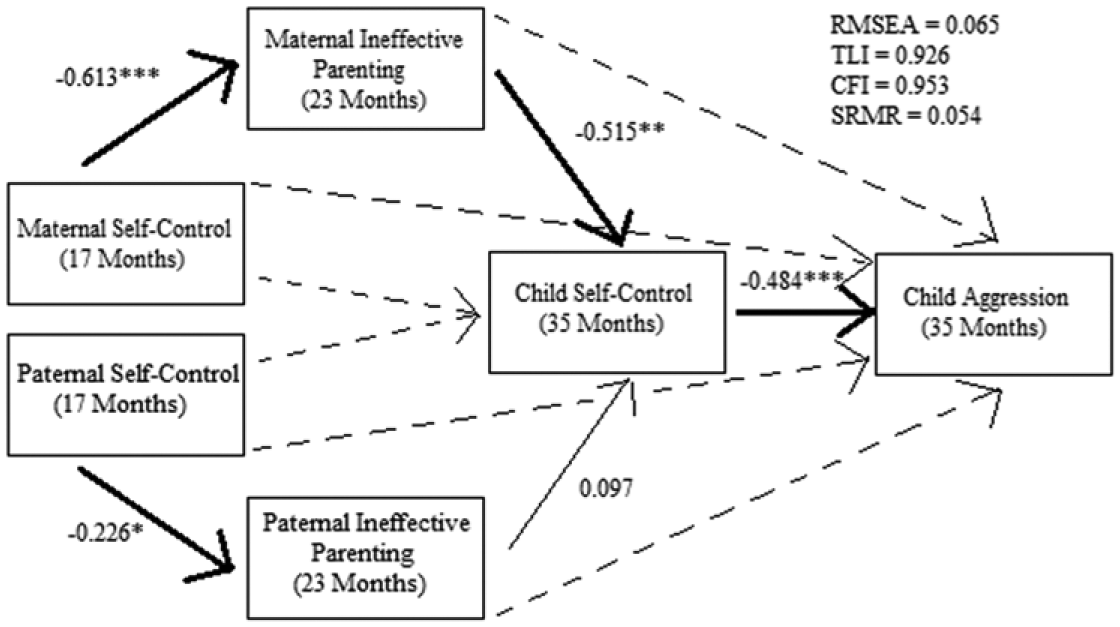
Standardized parameter estimates from structural equation.
Supplementary Analyses
Given prior research finds a direct effect of parental self-control on child self-control after accounting for parenting practices (e.g., Nofziger, 2008), as well as a direct effect of parenting practices on antisocial behavior after accounting for self-control (e.g., Perrone et al., 2004), we estimated a second SEM in which direct effects between (a) parental self-control and child self-control, (b) parental self-control and child aggression, and (c) ineffective parenting and child aggression were estimated. The results of this SEM (available on request) indicated that none of the paths were statistically different from zero. Because of this, coupled with Gottfredson and Hirschi’s explicit and implicit assertions regarding the indirect nature of the associations between parental self-control, parenting practices, child self-control, and antisocial behavior, we omitted the direct paths from Table 2.
Discussion
This study set out to achieve three goals. First, it sought to investigate the interrelationships between parenting practices, self-control, and aggression during the first years of life, something which few studies have done within the context of testing Gottfredson and Hirschi’s (1990) self-control theory (Barnes et al., 2013). Second, we sought to incorporate parental self-control into an elaborated model of self-control theory to better understand the extent to which parental self-control is associated with the primary variables implicated by the theory. Third, we sought to examine the unique contributions of maternal and paternal self-control and parenting practices on child self-control and child aggression. To accomplish these things, we made use of longitudinal survey data collected on a sample of Dutch parents and their young boys.
The results of our analysis partially supported the hypothesized model, revealing significant indirect associations between (a) maternal self-control and early childhood self-control through maternal ineffective parenting, (b) maternal ineffective parenting practices and early childhood aggression through child self-control, and (c) maternal self-control and early childhood aggression through maternal ineffective parenting and child self-control. Informatively, these findings are consistent with studies that have investigated similar relationships of interest during adolescence and young adulthood (e.g., Hay, 2001; Meldrum, Connolly et al., 2015; Simons et al., 2007). However, the findings of the current study are unique in that they reveal parenting practices utilized by mothers as early as the second year of life appear to account for differences in child self-control as early as 3 years of age. In addition, this is the first study we are aware of that has sought to investigate the interrelationships between the four theoretical constructs of interest during early childhood using longitudinal data.
At the same time, it is also important to point out that these associations, by and large, were not observed when the focus was fathers. In fact, the only significant association between paternal self-control and any of the endogenous variables in the SEM was paternal ineffective parenting; paternal self-control and paternal ineffective parenting were unrelated to child self-control and child aggression. Thus, based on our findings, it is possible that the influence fathers have on the development of child self-control and child aggression might be limited relative to the contribution of mothers. However, for reasons that are addressed in greater detail later in this section, we caution readers that this is but one way to interpret our findings.
Also of note, our supplementary analysis revealed a lack of evidence that there are direct associations between (a) maternal self-control and child self-control, (b) maternal ineffective parenting and childhood aggression, and (c) maternal self-control and childhood aggression. Although these findings are consistent with Gottfredson and Hirschi’s arguments, they are inconsistent with other studies (Boutwell & Beaver, 2010; Meldrum, Young et al., 2015; Nofziger, 2008; Perrone et al., 2004). Although only speculative, there are several potential explanations for why the findings of the current study diverge from this body of research. First, the current study focused on an earlier developmental period than the majority of these studies; it is possible that the processes examined operate differently at different ages. Second, relative to some studies that considered more limited measures of parenting (e.g., Boutwell & Beaver, 2010), the current study examined a more robust measure of parenting. To the extent that maternal parenting practices mediate the effect of maternal self-control on child self-control, the current data would perhaps be better suited than prior work for eliminating any direct effect of maternal self-control on child self-control. Third, the relatively small sample size employed in the current study could also be a contributing factor—such a small sample size poses a threat to generalizability. Thus, the current findings should be interpreted with the above in mind, and future research should seek to replicate out model with larger samples.
While being cognizant of such issues, it is important to consider the theoretical and policy implications of this study. From a theoretical standpoint, parental self-control should take on greater prominence within self-control theory. This study, coupled with recent research (Boutwell & Beaver, 2010; Meldrum, Connolly et al., 2015; Meldrum, Young, et al., 2015; Nofziger, 2008), points to the fact that to understand why some parents produce children who are higher in self-control than other children, we must consider parental self-control. By adding parental self-control into an elaborated theoretical model as antecedent to parenting practices, we can better appreciate how deficits in self-control and involvement in antisocial behavior get transmitted across generations.
Whether such intergenerational continuity is the result of parental socialization or not is currently being debated. As with most studies, we found evidence of significant associations between parenting practices, self-control, and antisocial behavior, at least for mothers. However, we were unable to consider the role that heritability plays in the processes investigated and whether the associations found are spurious because of genetic predispositions that cross generational lines. This is a limitation of our analysis because although some studies indicate that parenting practices continue to exert significant effects on self-control after accounting for heritability and genetic confounds (Cecil et al., 2012), other studies have found the opposite to be the case (Wright & Beaver, 2005). Nonetheless, we see significant merit in further investigating the role of parental self-control in shaping home environments and influencing the development of child self-control and antisocial behavior to better understand the intergenerational connections between these variables.
Implications for policy flow from this discussion. If self-control is transmitted across generations, disrupting the continuity of deficits in self-control should be considered a priority, especially given what we know about the consequences and costs of low self-control later in life for individuals, the criminal justice system, and society. Although attempts to modify parental self-control might be particularly difficult, evidence-based interventions that aim to change the manner in which parents care for their children, such as the Nurse-Family Partnership (see Olds et al., 2007) and Parent–Child Interaction Therapy (PCIT; Thomas & Zimmer-Gembeck, 2011), have been found to improve children’s outcomes in terms of, among other things, antisocial behavior. To the extent that programmatic efforts increase the potential that parents can help to promote growth in self-control among their children, either via socialization or otherwise (e.g., limiting exposure to lead, ensuring adequate nutrition and sleep, etc.), the cycle of low self-control within families across generations might be attenuated, something research suggests is possible (see Piquero, Jennings, & Farrington, 2010).
With these considerations in mind, we should discuss certain limitations of our study. First, although key variables were drawn from multiple waves of data, the study itself is correlational and therefore cannot fully establish causality. Furthermore, given research indicating less than perfect temporal stability in self-control among children, adolescents, and adults (e.g., Burt et al., 2006; Burt, Sweeten, & Simons, 2014; Kochanska, Murray, & Harlan, 2000) and the 16-month gap between the measurement of parental and child self-control in this study, it is possible a direct effect of parental self-control on child self-control would be found if the two constructs were assessed contemporaneously (see Boutwell & Beaver, 2010). Second, the analysis was based on a small, non-representative sample. As such, it is possible that the estimates generated could be biased in unknown ways.
Third, data were only collected on boys and we cannot assume our findings apply equally to girls given research indicating the etiology of self-control and aggression may be gendered (e.g., Chapple, Vaske, & Hope, 2010). Future research should therefore seek to replicate our findings when focused on a sample that is inclusive of girls. Fourth, the complex nature of the data and the model tested relative to the sample size prevented us from being able to model latent variables, which is what is traditionally done when using SEM. Also, we were not able to examine reciprocal effects between the variables of interest. Parenting practices may elicit behavioral responses from children, but children’s behaviors can also elicit certain parenting practices (e.g., Jackson & Beaver, 2015).
In conclusion, this study adds to the literature on self-control theory and the development of early childhood aggression by bringing to the forefront the importance of parental self-control in understanding why parents engage in certain parenting practices, resulting levels of early childhood self-control, and the emergence of early childhood aggression. Given the consistency with which parental self-control is proving to be a significant correlate of parenting, child self-control, and antisocial behavior, we hope that future theoretical refinements of self-control theory will take this empirical reality into account. Doing so opens up a number of intriguing questions about the ways in which the intergenerational transmission of self-control and antisocial behavior might be mediated and/or moderated by certain environmental and/or biological and genetic factors.
Footnotes
Declaration of Conflicting Interests
The author(s) declared no potential conflicts of interest with respect to the research, authorship, and/or publication of this article.
Funding
The author(s) received no financial support for the research, authorship, and/or publication of this article.