



Abstract
Fostering positive future selves in mid-adolescence has shown promising results in reducing problematic behaviour, though little work has been done outside the United States or with younger children. We explored the link between future selves and delinquency in a younger sample of boys (Mage = 12, SD = 0.73, N = 126) in the United Kingdom, at the nascent stage of self-identity and anti-social behaviour. Participants, who varied in degree of self-reported delinquency and risk, described their short- and long-term possible selves and strategies to achieve them. Unlike findings for older samples (14+), we found no association between delinquency and future selves. Exposure to criminogenic risk revealed some differences regarding the nature of future selves. Those with delinquency and higher risk had fewer strategies for reaching goals. Findings are discussed in relation to self-identity theory and the timing and nature of interventions for children of this age.
Introduction
During adolescence, individuals begin to develop a sense of self that is rooted in socio-historical and cultural contexts, thus reflecting personal interests, values, knowledge, and experiences (Elmore & Oyserman, 2011; Erikson, 1968; Paternoster & Bushway, 2009). Identity can provide meaning to action and regulate behaviour as outlined in the identity-based motivation model (IBM; Oyserman & Destin, 2010), it is reasonable to suggest that people will lean toward behaviour that is consistent with who they are and who they intend to become. However, the process of identity development itself can leave the young person confused and susceptible to negative outside influences, including delinquency if there is sufficient exposure to criminogenic risks. Having positive future possible selves has been empirically linked to improved educational attainment (Destin & Oyserman, 2009), more gainful employment (Lee & Oyserman, 2009), and reduced riskiness in sexual behaviour (Clark et al., 2005).
Most research examining self-identity and delinquency focuses on adolescents in their mid-teens at around 14 years of age (Newberry & Duncan, 2001; Oyserman & Markus, 1990). The purpose of the current study was to understand more about the period of self-identity exploration much earlier in adolescence, from around 11 years old, before delinquency is typically thought to become problematic. But for those who are already entrenched in problematic behaviour at such a young age, positive life chances are greatly reduced. Children who offend prior to adolescence stand a much greater risk of becoming serious, violent, and chronic offenders in adulthood compared with those who become involved later (Loeber & Farrington, 2001; Moffitt, 2006). Yet, despite them being considered criminally responsible in the United Kingdom from 10 years old, research often neglects these younger age groups from whom we may learn valuable lessons, as fixed offending outlooks may not have yet formed (Farrington & Welsh, 2007).
What makes the relationship between delinquency and identity potentially more interesting is that both these developmental trajectories appear to start at a similar time. The well-established age-crime curve has consistently shown the relationship between age and crime pictorially as an asymmetrical bell shape, showing the percentage of offenders in a population accelerating swiftly from approximately 15 years old before declining in the early 20s (Gottfredson & Hirschi, 1990), although variations to the curve do exist for specific types of offender or offence (Loeber et al., 2012). The traditional, generic age-crime curve, however, corresponds well with the rapid exploration of possible identities in early adolescence and the subsequent selection and adoption of one of these identities (Erikson, 1968). Our aim was to further the understanding of any existing relationship between these two trajectories that might help to expand the “what works” literature and assist in efforts to prevent or divert young people from criminality.
It is the increased abstract reasoning ability that develops in early adolescence that allows young people to start considering “possible selves” for the future (Oyserman, 2001). The future aspect of the self-concept has been extensively researched in the past two decades under various designations, including Possible Selves (Markus & Nurius, 1986; Oyserman & Markus, 1990), Future Orientation (Nurmi, 1987), and Ought or Expected Selves (Higgins, 1987). Whatever name is chosen, research in this domain ultimately concerns the cognitive structures relating to individuals’ potential for the future. Such possible selves have been described as the ideal selves that we would like to become (hoped-for selves) or the selves we expect to become (expected selves). Possible selves also include the selves we are afraid of becoming; our “feared” selves (Oyserman & Markus, 1990). Feared selves are formed from past experiences of failure, humiliation, and guilt (Ogilvie, 1987) and thus are said to have an intense emotional potency. For clarity, we will use the term possible selves to refer to any future orientation, but hoped-for selves and feared selves to distinguish between positive and negative future selves.
A popular methodology in this area is to consider only short-term possible selves (i.e., up to a year in the future). Indeed, Oyserman and James (2011) suggested that adult possible selves were unlikely to result in any positive action due to their lack of proximity to adolescents’ current lives. However, van Gelder, Hershfield, and Nordgren (2013) manipulated the strength and vividness of young people’s longer term possible selves over two studies (by asking participants to write letters to themselves in the future for Study 1 and use digital imagery to “age” their photographs for Study 2). They found participants in Study 1 were less likely to make delinquent choices on a subsequent questionnaire about five dilemmas than a control group and also that they were less inclined to cheat on tasks compared with controls in Study 2. Further supporting the importance of long-term possible selves are the findings of Brezina, Tekin, and Topalli (2009), who posited that when young people feel they have no long-term future, they have little to lose by engaging in crime or violence. It could be crucial therefore that young people are able to envisage their adult future selves to protect against this risk of drift, and this is worth further exploration.
Possible Selves and Delinquency
Seminal research findings from the early 1990s demonstrated how possible selves can distinguish between delinquent and non-delinquent young people (Oyserman & Markus, 1990) with substantive ongoing research concurring with these findings (for a review, Oyserman & James, 2011). In large samples of mid-adolescents (age 14+), it has been found that delinquent groups report fewer hoped-for selves and more feared selves than non-delinquent groups (Newberry & Duncan, 2001), although the focus of hoped-for selves (while remaining largely positive) can change according to delinquency; for example, non-delinquent young people appear to be more oriented to academic achievement than their delinquent peers (Oyserman & James, 2011; Oyserman & Markus, 1990).
While studies have shown that most adolescents articulate largely positive hoped-for selves (Atherton, Cymbir, Roberts, Page, & Remedios, 2009; Oyserman, Johnson, & James, 2010), many do not go on to reach these aspirations in adulthood. In a rare U.K.-based study, Mainwaring and Hallam (2010) suggested that students with conduct problems were less likely to consider difficulties they may face in achieving their hoped-for selves and concluded that students had not planned for these accordingly, that is, they did not consider strategies to reaching their goals adequately. This corresponds well with research from the United States regarding strategies for achieving possible selves (Oyserman et al., 2010), whereby delinquent young people were found to have fewer feasible strategies to reach their goals than their non-delinquent peers. One possible reason why strategic thinking might be uncommon in delinquent young people is that they are not yet neurologically equipped to invest time planning how they might attempt a task (Gogtay et al., 2004).
One other possible reason why delinquent young people may not contemplate strategies is simply due to a lack of positive role models achieving pro-social goals and ultimately a lack of vicarious learning. The aforementioned IBM theory posits that identities are highly malleable and constructed in a social context (Oyserman, 2001). It follows then that any strategies adopted to achieve these identities would also be socially grounded and selected as would any approach to any arising difficulties (Oyserman, 2015). Any strategy not aligned with identity will be rejected in preference for strategy that is identity-congruent. A metaphor is provided within IBM literature that a path links current and future selves and that certain paths may feel impossible to navigate (“people like me don’t go to college”) or may be unknown due to their distance (“I don’t need to think about college yet”). Relevant here is Atherton et al.’s (2009) claim that an internalisation of societal expectations can lead young people to outcomes that only reflect the nature of their class, gender, and ethnic background, rather than actually reflecting their real aspirations. We know that the expectations of significant others are given increasing prominence by late adolescence, and social identity theorists would argue that to ensure their somewhat fragile identities are kept intact, young people are likely to choose similar activities as their peers, ultimately developing similar attitudes and preferences (Brown et al., 1992). With the intended sample, 11- to 13-year-olds, it was unknown whether this influence would have already taken place.
Although research into delinquency and future selves has become somewhat plentiful, the impact of criminogenic risks on the generation and pursuit of possible selves is less well researched. Given that we were considering those at the onset of delinquency and we know the criminogenic risks that intrinsically link children with adult offending, we felt it important in our exploration of future selves to include an assessment of exposure to criminogenic risks. It might be that early adolescents with criminogenic backgrounds, but no delinquency (as yet), would benefit from working on possible selves just as much as those with established delinquency, but at an earlier stage, to enable them to more positively commit to a possible self and withstand negative societal pressures and influences.
We predicted that (1) delinquent and high-risk young people would give fewer hoped-for selves and more feared selves than non-delinquent participants (Newberry & Duncan, 2001); (2) there would be no difference in the qualitative content of hoped-for selves and feared selves generated by delinquent or high-risk young people, compared with their non-delinquent or low-risk peers (Oyserman & Markus, 1990); (3) delinquent and high-risk participants would be able to generate fewer strategies for reaching their goals (Oyserman et al., 2010); and finally, (4) there would be no difference in the long-term aspirations of the participants, regardless of their delinquency or exposure to risk (Oyserman & James, 2011).
Method
Design
This study used a cross-sectional design, exploring the hoped-for and feared selves of 126 young people with a variety of behavioural histories at one point in time. Variables of interest were exposure to criminogenic risks, self-reported delinquency, number of possible selves articulated (both short and long term), and the number of strategies given for achieving these possible selves.
Participants
This was a purely male sample since males are more likely to commit crime than females. Participants were 126 schoolchildren from South-East England, aged between 11 and 13 years (M = 11.73, SD = 0.73 years). Most participants were 12 years old, attended school, and did not have extensive criminal involvement, as would be expected in a group of children this age. We used a purposive sampling method to ensure there were offending children in the sample.
Contact was made with 78 secondary level, comprehensive schools in this location. A comprehensive school is a state run school that has no academic selection criteria and accepts children at age 11 from the local area. About 90% of British pupils attend comprehensive schools. Only three schools eventually took part in the study, and the overwhelming reason given for non-participation reflected the austerity measures that have been implemented in public services in recent years in England, which have left education staff just too stretched to take on any non-curriculum activity.
The majority of participants attended one inner city comprehensive school that is located in an area of low socioeconomic status (n = 71; 57%). A further 10% of participants (n = 12) were recruited from a comprehensive school in a more affluent suburban location. The final school was a boys’ grammar school, which screens children at 11 years old on their academic ability and offers places to only the highest achieving boys (n = 24; 19%).
To ensure there was sufficient representation from offending boys, a pupil referral unit (PRU) was included: for those excluded from school due to unacceptable behaviour (n = 14; 11%) as well as a Youth Inclusion Project (for young people referred by the police due to offending; n = 4; 3%).
Forty-two percent of participants described themselves as “White British” with 31% describing themselves as Black, 12% mixed ethnicity, 8% Asian, and 7% reporting that they described themselves as a different ethnicity to those listed. Although not representative of the ethnic breakdown across the United Kingdom, it does reflect the more diverse nature of London, where 38% of respondents on the last national census described themselves as “White British” (Office for National Statistics, 2011). As the sample was small and not stratified and there was no association between ethnicity and delinquency, χ2(7) = 12.42, p = .77, or age and delinquency (given they were mostly aged 12; r = .024, p = .821), we decided not to involve these variables in the testing of hypotheses.
Materials
Exposure to criminogenic risks
Information on six criminogenic risk factors was gathered for each participant via just six self-report questions. The risks are listed below with the percentage of participants who had experienced them. As participants were only 12 years old on average, it was inappropriate to use existing scales due to their complexity or length. In addition, due to anonymity and independence from schools/services, it was impossible to gather any background information on participants that may have helped toward a more comprehensive measure of risk. Therefore, a short scale was devised by the researchers. The risks chosen, however, did cover the four domains from which risk factors have been identified: family, community, school, and individual (Herrenkohl et al., 2000).
School discipline problems (21%), determined by asking specifically whether the young person has experienced any of the following “being on report,” “being suspended,” or “being excluded.”
Parental unemployment/low socioeconomic status (48%), determined by asking who the young person lives with, whether that person goes to work, and if so, what they work as. This was then ranked with guidance from an established guide regarding measuring socioeconomic status (Nam & Boyd, 2004).
Familial criminality (21%), determined by asking whether their mother, father, step-parents, or siblings have been in trouble with the police.
Living in a high-crime area according to police data (10%), determined by asking for participants’ postal codes and checking these, where possible, with a U.K. police website to identify how the rate of crime in that area compares with other locations across the United Kingdom.
Living with six or more others, that is, a large family (9%), determined by using the answers to the aforementioned question about who the young person lives with.
Having attention-deficit/hyperactivity disorder (ADHD; 8.5%), determined by asking the young person directly.
On average, this was a low-risk sample, and the mean number of criminogenic risks was 1.47 (SD = 1.43). However, the full range of zero to six risks had been experienced by participants in this study.
Self-reported delinquency
For this age group, there is no robust objective measure for delinquency in the United Kingdom bar self-report. The age of criminal responsibility in the United Kingdom is 10, but until the mid-teens, children are unlikely to appear on the official offenders’ index unless they are offending at an especially prolific or serious level, probably due to the hesitation of criminal justice personnel to label such young individuals as criminals (Nee, Ellis, Morris, & Wilson, 2012). The offenders’ index would be even more unreliable for our sample, the majority of whom were not offending at a high level.
Therefore, to assess delinquency, participants completed a self-report measure designed by the researchers. They were asked how frequently they had engaged in 12 anti-social acts in the previous 6 months. The scale was derived from one used in a government study exploring problem behaviours in U.K. children as young as eight (Bowen, Heron, & Steer, 2008). Participants in the current study were questioned on acts that included being disruptive in class, theft, substance misuse, fire-setting, cruelty to animals, damaging property, and fighting. They were asked to state how frequently they had engaged in each of the acts, with possible answers being never, sometimes, often, and every day.
Possible Selves Questionnaire (PSQ)
The PSQ (Oyserman, 2004) was utilised because of the age group of the children and its free-responding methodology (participants openly report their hoped-for selves and feared selves along with their strategies for achieving/avoiding them) and for comparability with previous work. The PSQ has been used in a plethora of empirical studies since its inception in 1990 (see Oyserman, 2004, for a partial review). The PSQ has been found to have interrater reliability with Cronbach’s alphas ranging from .9 (Knox, Funk, & Elliott, 1998) to .95 (Oyserman & Markus, 1990), with a test–retest correlation of .45 after a 3-week period for participants listing the same three possible selves and .90 for those listing at least two of the three (Oyserman & Markus, 1990). The measure asks participants to list three hoped-for selves and three feared selves (counterbalanced) for the next year, with strategies for achieving them. Although instructed to generate up to three hoped-for selves and three feared selves, many participants gave only one or two (range = 0-6). Only 30% completed all three hoped-for selves and only 10% completed all three feared selves. This may be due to the younger age of participants who would consequently be less cognitively mature. The mean number of hoped-for selves was 1.97 and the mean number of feared selves was 1.16. A Pearson’s correlation was conducted between the number of hoped-for selves articulated and the number of feared selves articulated. This was significant; r(114) = .450, p=.02 which suggests that the participants were equally able to understand both instructions and future concepts. We also asked participants to write down a long-term expected self (LTES) for the future, which was a slight addendum to the original measure.
Handling Data
Exposure to criminogenic risks
The continuous data were used for Hypotheses 1 and 3. For Hypotheses 2 and 4, which explored the qualitative content of responses and required non-parametric analysis, data were dichotomised into two categories: high and low risk. Of the full sample (126), 121 participants provided information on all six risk factors. Fifty-three percent of these (n = 64) were categorised as low risk (having none or one risk), and 47% (n = 57) were categorised as high risk (having two or more risks). This categorisation was based on an understanding of the literature (Herrenkohl et al., 2000) indicating children exposed to two or more of these risk factors should be considered to be at higher risk overall. They also had a higher than average exposure within this participant sample as a whole.
Self-reported delinquency
Responses were coded for each of the 12 acts as never = 0, sometimes = 1, often = 2, and everyday = 3, and their total delinquency score was calculated by summing the 12 scores they had obtained across the different acts, with a possible range of 0 to 36. Again, for Hypotheses 1 and 3, this continuous data were used in analysis. For Hypotheses 2 and 4, delinquency was dichotomised into high and low as follows. Participants were categorised into one of two groups based on their scores. This was based on the judgment that those who scored 0, 1, or 2 on the scale were not reporting a lot of delinquent behaviour and were categorised as low risk (50%). Those scoring 3 or above were either reporting repeated engagement in one activity, at least three different delinquent acts that they were engaging in “sometimes,” or a combination of both and were categorised as high risk (50%). Prior to the transformation of these data into discontinuous variables, a correlation between these two variables was conducted and was significant, as would be expected; r(123) = .504, p < .01.
Possible selves
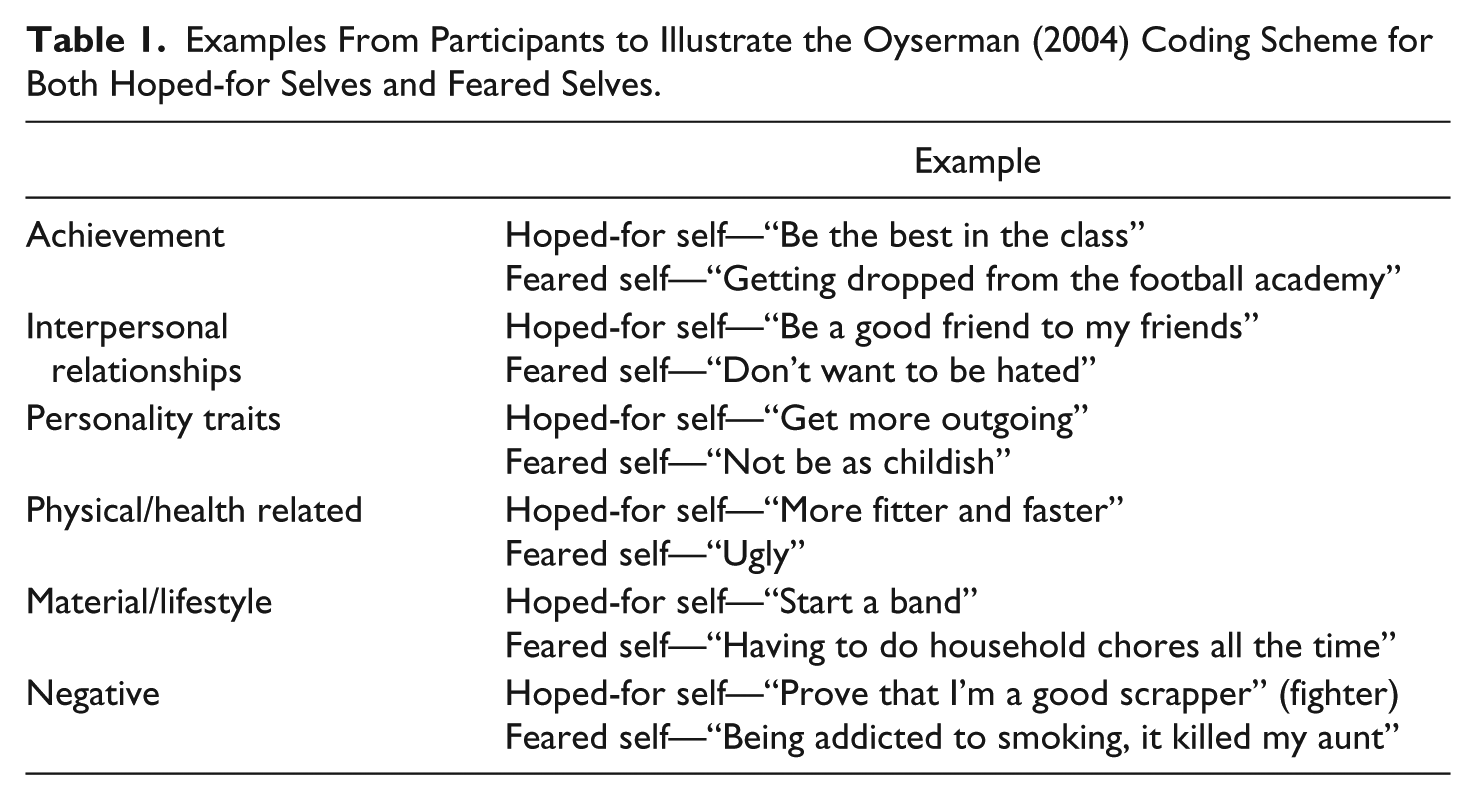
The number of hoped-for selves and feared selves given were counted and the content of responses was categorised using the established coding scheme (Oyserman, 2004). See Table 1 for examples.
Examples From Participants to Illustrate the Oyserman (2004) Coding Scheme for Both Hoped-for Selves and Feared Selves.
The number of distinct strategies given to achieve a possible self was counted for each hoped-for self and feared self. A total was calculated as well as a mean number of strategies to account for those who gave fewer hoped-for or feared selves. The mean score was then used in subsequent analysis.
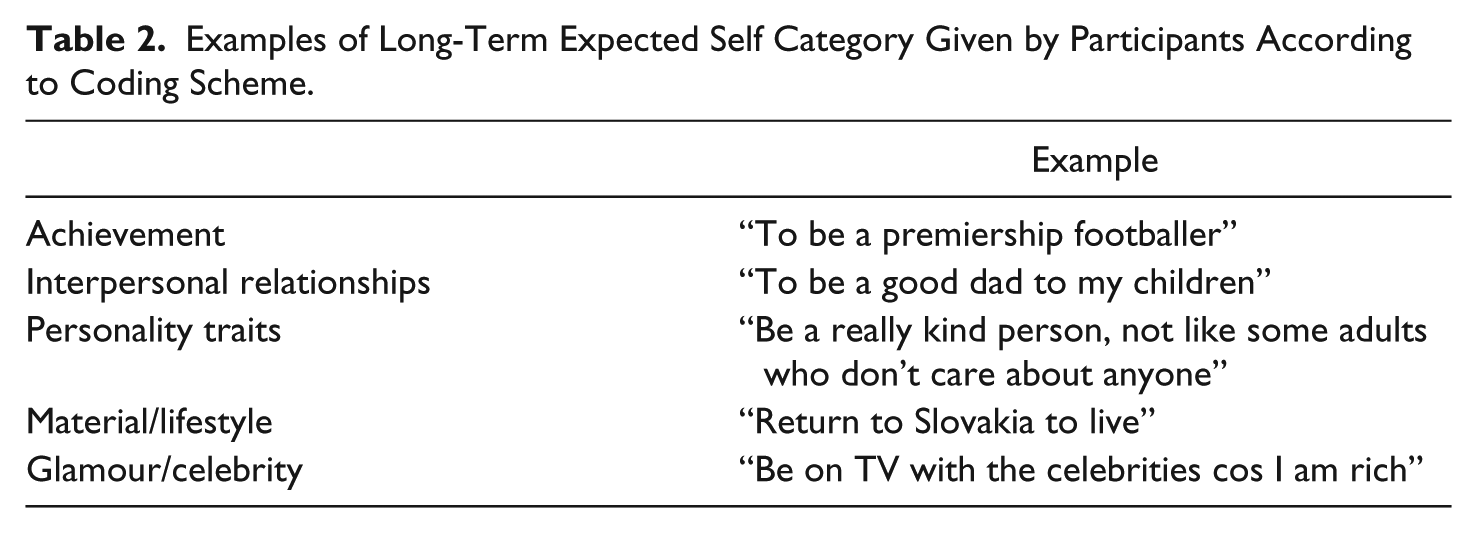
To analyse the LTESs, the same existing coding scheme was applied, but three changes were made. Because it was so heavily represented, a further code of “Glamour/Celebrity” was added, while the categories of “Physical Health” and “Negative” were not used at all. The following codes were used, and examples are included from the participants within Table 2.
Examples of Long-Term Expected Self Category Given by Participants According to Coding Scheme.
Coders for the PSQ were blind to the level of delinquency of each participant. To ensure interrater reliability, the first 30 PSQs, LTES questions, and plausibility of strategy were coded jointly by two of the researchers. Where any contention existed (20%), these researchers discussed the difference and made agreements as to how they should be coded which alleviated further problems. For the remainder of the sample, the primary researcher continued alone; however, the second researcher coded a further 15 sets of PSQs, LTES questions, and strategies randomly, and 100% agreement occurred in all cases.
Procedure
Prior to any contact with participants, full ethical approval was given by the University of Portsmouth’s ethics committee, based in the School of Psychology, abiding by the principles of the British Psychological Society.
In participating schools, all parents/carers of year 7 and 8 boys (ages = 11-13) were contacted via letter and informed that the study would be taking place in the school. They were invited to consent to the study. Young people themselves were then also asked to consent and volunteer to take part. Dependent on the length of time, the researcher was given access to the school, a random selection of consenting young people (with consenting parents) were chosen by the researcher who had no prior knowledge of their behavioural records. In the PRU and the Youth Inclusion Project, parents/carers were also informed of the study, and all those who returned their consent letters were included in the study. This is because the potential sample in these settings was much smaller, and the profiles of offending children were of paramount importance to this study.
Data were collected in small-group settings, apart from the participants who were deemed too disruptive and distractible to work in groups (n = 12). In these cases, the measures were administered individually. The researcher explained the measures to each group (or individual), and they were then asked to complete the task on their own. They were encouraged to ask for assistance when they were unsure on the meaning of any question or how they needed to respond. However, most participants understood the measures and methods without additional help.
Hypothesis 1
Contrary to our first hypothesis, we found no correlation between delinquency and the number of hoped-for selves articulated; r(123) = .068, p = .235. However, we did find a significant though weak correlation between higher delinquency scores and the number of feared selves expressed; r(115) = .198, p = .017.
In terms of exposure to criminogenic risks, we again found no significant relationship between this and the number of hoped-for selves given; r(115) = .146, p = .06, or number of feared selves given; r(116) = .011, p = .455.
Hypothesis 2
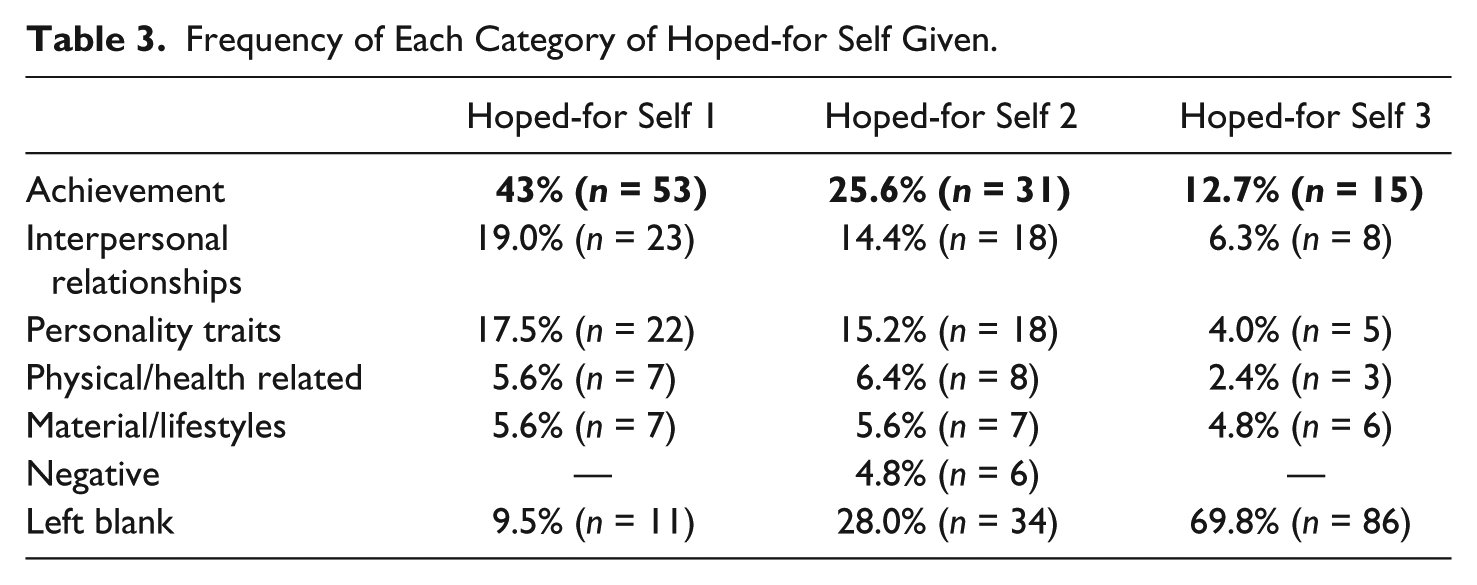
In relation to the qualitative content of hoped-for selves, the most popular hoped-for self across all participants was related to achievement in some way, as high as 43%. The most well-represented category of feared self related to negative or anti-social behaviour, such as “being in a gang” or “being even worse behaved than I am now.”
Tables 3 and 4 show the frequencies for each of the choices across all three hoped-for and feared selves, with the most popular responses (excluding those that were left blank) in bold text. Hoped-for Self 1 reflects the first answer they gave, Hoped-for Self 2 the second, and Hoped-for Self 3 reflects the third.
Frequency of Each Category of Hoped-for Self Given.
Frequency of Each Category of Feared Self Given.

To explore how the content of hoped-for selves differed according to delinquency group, we choose to look further into the first of those given for each participant (i.e., Hoped-for Self 1). This was because these would have represented a primary vision of the future for participants. No significant association was found regarding the content of hoped-for and feared selves according to delinquency group; χ2(1) = 0.617 (p = .432), χ2(1) = 4.404 (p = .036), respectively.
With regard to level of risk experienced, however, we found that there was a significant association between the risk groups with regard to two of the content codes available: achievement related or interpersonal relationship hoped-for selves. Those with higher criminogenic risks (whether or not they were engaged in delinquency) had more hoped-for selves based on interpersonal relationships than those with low-criminogenic risks, who were more associated with hoped-for selves related to achievement; χ2(1) = 5.380, p = .020.
We also used chi-square analysis to explore relationships in the category of Feared Self 1 between delinquency and risk groups. We looked to see whether there was a relationship between the number of participants in the two delinquency groups referring to either achievement based or interpersonal relationship-based feared selves. There was no significance between the groups for either achievement-based, χ2(1) = 2.571, p = .109, or interpersonal relationship-based feared selves, χ2(1) = 0.773, p = .379 (see Figures 1 and 2). This was also the case when comparing low and high criminogenic risk groups in terms of both achievement-based, χ2(1) = 0.633, p = .426, and interpersonal relationship-based feared selves, χ2(1) = 2.779, p = .095. The feared selves of both high-delinquency and high-risk groups were no different to those of low-delinquency and low-risk groups.

Categories of Hoped-for Self 1 chosen by delinquency group.

Number of participants who chose each category for Feared Self 1.
Hypothesis 3
In relation to the third hypothesis, participants with greater delinquency had significantly fewer strategies to reach their hoped-for selves, r(110) = −.201, p = .018, and to avoid their feared selves, r(79) = −.298, p = −.004. Those with higher exposure to criminogenic risks were also found to have significantly fewer strategies to avoid their feared selves, r(79) = −.310, p = .003, and reach their hoped-for selves, r(109) = −.154, p = .055.
Hypothesis 4
The fourth hypothesis predicted that there would be no difference in the long-term aspirations of the participants, regardless of their delinquency or exposure to risk.
Figure 3 shows that the most popular LTES category for the low-delinquent group was achievement, whereas the most popular LTES category for the high-delinquent group was glamour/celebrity status. However, regardless of delinquency level, expected selves that related to some form of celebrity or glamorous status were surprisingly popular (n = 36; 29%).
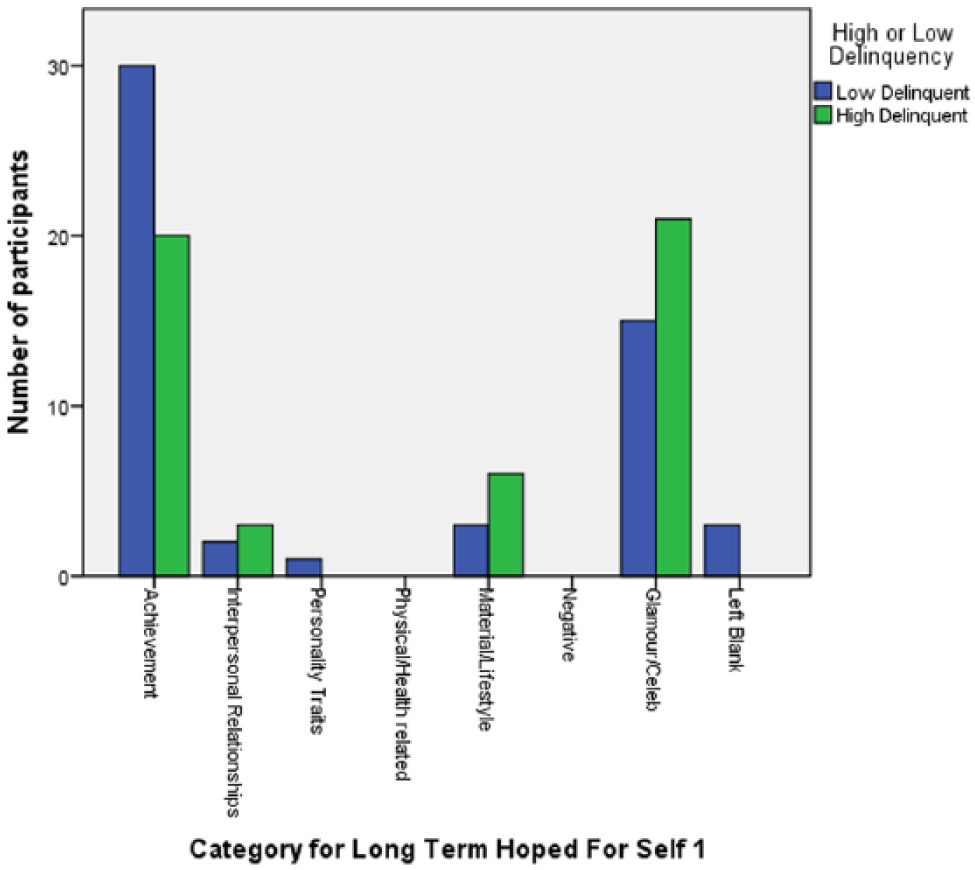
Categories of long-term expected selves chosen according to delinquency group.
Despite the apparent difference in the number of delinquent and non-delinquent participants choosing an achievement-based expected self, there was no statistical association found, χ2(1) = 2.517, p = .113. The association between the number of delinquent young people choosing glamour-based expected selves (which is more than those in the low-delinquency group) is approaching significance, χ2(1) = 3.790, p = .052. Given this p value and looking at the raw differences, this may warrant some further investigation in future studies. When examining criminogenic risk alone, a significant association was found in the number of high- and low-risk participants choosing an achievement-based expected self, χ2(1) = 7.308, p = .007, r = .2788. Furthermore, there was a greater relationship between glamour-based future selves and the high-risk group than the low-risk group, χ2(1) = 7.068, p = .008, r = .2742).
Discussion
An important finding of this research was that, at this very early stage of adolescence, participants with higher delinquency and/or higher exposure to criminogenic risks articulated just as many positive hoped-for selves as those with low-delinquency and/or low-criminogenic risks. Established theory states that identity is shaped according to social context, but in our sample, short-term hoped-for selves were reasonably homogeneous (Oyserman, 2011). At this young age, the social environment appeared to be having less impact.
Given the seemingly shared positivity of our sample across the delinquency groups, we considered whether at this early point in adolescence there was not sufficient development of reflective judgment to enable those with delinquent behaviour to appreciate how this may affect their futures. Furthermore, those with high exposure to criminogenic risks may not have internalised the potential barriers that are known to face young people from these backgrounds (Hemsley-Brown, 1999), making them more open to positive intervention. This corresponds with Mello’s (2009) findings that low-income pre-teenage children in the United States expect to do just as well at school as high-income children, although the reality can be quite different. It seems that, in our sample at least, the bubble had not yet burst, and there is potential for this to be capitalised on. This finding, with appropriate further study, could be critical in terms of the timing of preventive interventions, which could focus on the fostering of social contexts in which children’s hopes and aspirations feel congruent and achievable regardless of upbringing and socioeconomic status. It could be that maintaining this sense of hope will act as a protective factor against developing criminality and as such deserves further exploration.
Although the participants seemed to be equally positive in terms of their hoped-for selves, the high-delinquency group had significantly more feared selves than their less delinquent peers even though all were asked to give three. Given that those who have experience of offending are likely to have increased experience of personal negative outcomes, this finding supports IBM literature in terms of social expectations affecting possible selves, although in this case, only feared selves. Phillips, Silvia, and Paradise (2007) supported Ogilvie’s (1987) finding that feared selves could have a more pronounced effect on emotional well-being than hoped-for (or ought) selves.
In terms of the content of future selves, regardless of delinquency or risk group, the most hoped-for selves in our sample of young adolescents were related to personal achievement in some way, which was again encouraging, that is, this was valued by the majority. There were differences worth highlighting, however, in terms of the need to explore the qualitative content of the answers as well as simply coding them. One example is a participant who scored highly on the self-reported delinquency scale had the achievement goal of “I want to get back on track with my homework.” This stands in contrast to another whose goal was “I want to be sitting my GCSEs [General Certificate of Secondary Education] a year early.” Although both relate to achievement, they are qualitatively very different since one relates to an over-achiever, whereas the other appears to be an under-achiever. The aspirations of the more delinquent child does, however, represent a first step in improving achievement, and may well be realistic for him. Another example might be the participant who responded “Be a good dad to my children,” with strategies relating to kindness as opposed to abuse. This was coded in the same way to a participant responding that he wants to expand his social circle, as interpersonal relationships, but considering responsible fatherhood at the age of 12 is considered by the researchers to be less conventional than expanding friendships.
As predicted, both the high-delinquency group and those with high exposure to risk reported fewer strategies to reach their short-term goals than their less delinquent peers, as with older adolescents. This is important because, pragmatically speaking, those who engage in delinquency the earliest are also likely to have the most obstacles to overcome to reach their goals, such as higher than average levels of abuse, bereavement, and mental health problems in their daily lives (Jacobson, Bhardwa, Gyateng, Hunter, & Hough, 2010).
Parallels can be drawn here with the seminal findings of Spivack, Platt, and Shure (1976) relating to interpersonal cognitive problem solving (ICPS) skills. This research found that adolescents who were deficient in ICPS skills (such as thinking of multiple solutions, considering consequences, and constructing “means” to desired ends) were more likely to be engaged in delinquency. Offending behaviour interventions with adults and young people have built on these findings for decades, and they still heavily affect the rehabilitative interventions offered to offenders across the English-speaking world. Our results (and those of possible selves researchers before us) appear to concur that the more delinquent participants are not able strategically and are therefore deficient in ICPS skills. There is, of course, a notable difference in research method between ICPS researchers (Spivack et al., 1976) and possible selves researchers. The strategies (or means) participants were asked to generate for reaching their hoped-for selves or avoiding their feared selves in the PSQ are more personal than the more hypothetical problem-solving tasks utilised by ICPS researchers. Nonetheless, both approaches require the cognitive capacity to say “how can I get from A to B?” Recent offender cognitive skills interventions have previously been criticised for being impersonal and disconnected with offenders’ lives (McMurran & McCulloch, 2007); however, relating the “means-end” thinking skills taught to realistic possible selves might well prove more effective, and this requires further exploration. (What about coping skills?)
Although no statistically significant differences and relationships were found in terms of the number and content of longer term expected selves in relation to delinquency, differences were found in relation to criminogenic risk. This is a novel contribution to existing theory that focuses predominantly on short-term possible selves rather than those in the future. Of interest was the high number of young people (regardless of delinquency) who were aiming for a glamorous or very wealthy lifestyle. This was an unexpected finding and may be representative of a culture where images of a glamorous lifestyle are readily available. Such long-term possible selves included the following:
To be in a band and have a concert at Wembley
Live in Barbados in a house like Simon Cowell’s
Win the lottery and drive a Lamborghini and “pull” the girls
Although common to both groups, long-term aims relating to glamour, wealth, and celebrity were statistically more associated with higher exposure to criminogenic risks. This was an interesting finding, given their exposure to negativity and disadvantage. As stated, it is, of course, unlikely that anyone of the participants who expressed a desire to “make it” in Hollywood or in the English Football Premiership will indeed “make it,” but this does not suggest these young people should be dissuaded from aspiring in this way. Indeed, Markus and Nurius (1986) claimed that possible selves are important as they foster hope that the self is not unchangeable, leaving the door open for positive influence regardless of background. Yet, a report by The Prince’s Trust (2004) stated that disadvantaged young people’s ambitions only begin to seem remote when they reach the age of 18 and start to notice barriers as they leave school.
Interventions do exist in the United States with those later in adolescence to foster possible selves (Oyserman, Terry, & Bybee, 2002; Clark et al., 2005). Evaluations have shown such programmes to reduce negative outcomes such as sexually risky behaviour or academic failure. To our knowledge, no similar interventions exist in the United Kingdom, especially not in relation to stemming offending behaviour. Our study has demonstrated that young people hold similarly positive ambitions in early adolescence, which could be an important platform from which to teach additional skills. Such an intervention would be a primary prevention method defined as “Stop the bad before it happens” (Snyder, Lopez, & Pedrotti, 2010, p. 354). Working with schoolchildren during regular scheduled classes would avoid stigmatisation and also avoid positive discrimination, aiding all children, rather than “rewarding” those who misbehave.
Hemsley-Brown (1999) suggests that in early adolescence, children are in the “development” phase of constructing aspirations and are looking heavily to their family and peer group for an understanding of whether their possible selves are acceptable or not. Furthermore, Thomson and Holland (2002) claimed that young people’s future aspirations are mediated by class, race, locality, and normative ideals. This is particularly important for those with high exposure to criminogenic risks, where personally known positive role models may be less prevalent than those from the media. An impoverished council estate (where approximately half of our sample was recruited from) is less likely to invoke aspirations than the dizzy heights of stardom displayed on TV and the Internet. However, through intervention it is possible to alter this. Destin and Oyserman (2009) demonstrated that low-income children as young as 12 plan to work more on their homework when they are primed to consider that higher education is actually an option for them, by discussing financial aid rather than emphasising the high costs.
Although Oyserman and James (2011) have suggested that long-term possible selves are unlikely to influence current behaviour, the results in our study question this. Young people with possible (or indeed expected) selves to become a rap-star may not invest the time and energy necessary to finish secondary school with good grades as it is simply not part of a strategy to become a rap-star. Unfortunately, if the individual then fails, there is little to fall back onto. One 12-year-old boy stated for his long-term aim “Just to be rich.” He was verbally asked about his strategies, but he simply stated, “I don’t know how but I’ll figure it out somehow.” Without the guidance to achieve his goal pro-socially and the opportunities to learn and develop, it is possible that this void might be filled by delinquency in time.
Our evidence, and that of previous studies, strongly suggests that tackling adolescent delinquency from a possible selves perspective provide another resource for practitioners tasked with managing this complex social problem, but further research is needed to generalise these findings. There are limitations in the design of this study. For example, actual delinquent behaviour was relatively low for the vast majority of the sample, but the distribution was still more delinquent than for the age group as a whole due to efforts to recruit those with established offending behaviour. Furthermore, we would reconsider the measures if we were to undertake a similar piece of work in the future. For example, although the PSQ has been used in studies with slightly older age groups, more fine-tuning may be needed to find crucial differences at this age group. Also, although guided by standardised tools for older participants, the risk and delinquency measures were designed by the researchers to be specifically appropriate for this cohort as no established measures were suitable. Furthermore, it would have been useful to include a measure to assess for cognitive development to understand whether this had had any bearing on the way in which the measure was used.
Encouraging and supporting pro-social possible selves even earlier in adolescence will help to establish some degree of personal agency, a factor well recognised in the adult desistence literature (Laws & Ward, 2011) although research remains ambiguous as to whether internal or external changes are more powerful in encouraging and maintaining change in offenders (LeBel, Burnett, Maruna, & Bushway, 2008). Further longitudinal research is needed, to discover at what point lofty ambitions change, how they change (for instance, does hope dwindle or do plans become more realistic), and what triggers the change. This would help us to appreciate the way that offending can replace other goals. Interventions, mostly in the United States, have been shown to assist in mediating negative behaviour and increasing goal attainment. We propose that similar efforts are made in other countries and particularly the United Kingdom to give early adolescents the very best chances of achieving non-criminal possible selves for the future. Simply increasing penalties for offending behaviour may be ineffective with these young people, once their aspirations have been lost (Brezina et al., 2009).
Footnotes
Declaration of Conflicting Interests
The author(s) declared no potential conflicts of interest with respect to the research, authorship, and/or publication of this article.
Funding
The author(s) disclosed receipt of the following financial support for the research, authorship, and/or publication of this article:
The first author was funded, in part, by an Economic Social Research Council (ESRC) CASE studentship and in part by Kids Company, a registererd charity for the support of neglected children in the UK.