




Abstract
Despite an increasing interest in desistance from sexual offending, a comprehensive theoretical account of the process has yet to be provided. This study examines the narratives of 60 men interviewed in the community, who were incarcerated for sexual offenses and released. Recent findings from this research conclude that men desist from sexual offending, but they seldom follow the processes described by traditional criminology. In many cases, in fact, they desist in spite of their inability to pursue Sampson and Laub’s “informal social controls” or Giordano et al.’s “hooks for change.” The relentless impact of current public policies such as community notification and electronic monitoring further impedes their likelihood of experiencing Maruna’s “Pygmalion effect” or achieving true cognitive transformation or agentic change. The descriptive model introduced here identifies four styles of desistance from sexual offending: “age,” “resignation,” “rote,” and “resilience.” Relevant implications are discussed.
Although it is growing, the body of literature on desistance from sexual offending remains small (Farmer, Beech, & Ward, 2012; D. A. Harris, 2014, 2015; Laws & Ward, 2011). This is likely due to the persistent emphasis placed on risk and recidivism by the related fields of offender management and research (D. A. Harris, 2014; Willis, Levenson, & Ward, 2010). It is undeniable that the majority of sex offenders, like the majority of general criminals, eventually stop engaging in these behaviors (Laws & Ward, 2011), but our theoretical understanding of this process is lacking. The development of desistance theory in traditional criminology is certainly better developed, and the parallel advances in psychology’s understanding of change are also robust. Although some authors have recently begun to address the phenomenon of sexual offending from a criminal career paradigm (Blokland & Lussier, 2015; Lussier & Cale, 2013) there is still much to do. The direction of the present work was inspired by the limitations of available criminological and psychological theories described elsewhere (D. A. Harris, 2014, 2015; D. A. Harris & Cudmore, 2015). 1
The present study expands on previous work (D. A. Harris, 2014, 2015) by including a larger sample collected over 2 additional years. This particular study benefits from and builds on the preliminary conclusions from the earlier investigation by targeting men convicted of more serious offenses, incarcerated for longer custodial sentences, and who have lived in the community for considerably longer periods of time. Here, I explore the nature and extent of desistance from sexual offending in men, paying particular attention to the way the men themselves described their understanding and experience of that process. Specifically, I used content analysis to examine the themes that emerged naturally and focused on those elements that were unique to the desistance process and identity transformation. A qualitative approach offers an especially valuable insight into this issue for two reasons. First, because so little is understood about desistance from sexual offending, it is useful to start from a “beginner’s mind.” Qualitative strategies that privilege open-ended inquiry best facilitate that goal by seeking, very basically, to tell a story. Second, there is a brief but rich tradition of criminologists using a narrative approach in the study of desistance, and it has been argued that this tactic lends itself especially well to understanding this phenomenon (Laub & Sampson, 2003).
Method
Participants
Sixty men were interviewed between 2011 and 2013 in the Northeastern United States. All participants had committed a sexual offense, had served a custodial sentence, and were living in the community. Consistent with much research conducted in the field of sexual aggression, the ethnic diversity of the men was limited, and almost everyone (88%) identified as White. The men had an average age of 53 years (range = 24-78 years). The average length of their most recent custodial sentence length was 10.1 years (range = 4 months-38 years) for a sexual offense, and all participants had been living in the community for a mean of 4.1 years (range = 4 months-21 years). All participants denied offending sexually since their most recent release. Most men still participated in some kind of (individual or group) treatment. Although some men were on probation, for many, this treatment was no longer a requirement of their community supervision, and their participation was voluntary.
Almost all the participants (86%) had child victims. Most of the men had committed acts of extra-familial child molestation (n = 28) or incest (n = 14). A smaller group of men had raped adults (n = 8), and six men had records for noncontact sexual offenses exclusively (including possession and/or distribution of child pornography or voyeurism). Four men had been convicted of child molestation or statutory rape but are referred to here as “Romeo and Juliet” cases. In these cases, they indicated that the age difference between themselves and their victim was minimal and that the incident occurred in the context of a long-term relationship. A child was born in two of these circumstances.
In earlier work (D. A. Harris, 2014, 2015), I excluded men whose sexual offenses were exclusively noncontact (such as possession of child pornography). The peer validation and debriefing that has occurred since the publication of those articles has led me to reconsider this decision. I wish to briefly explain here my justification for including them in the current sample. Desistance research is complicated by the way the phenomenon itself is defined (e.g., Healy, 2010; Kazemian, 2007; Laws & Ward, 2011; Lussier, McCuish, & Corrado, 2015) and the need to demonstrate that one has done something sufficiently severe (on a sufficient number of occasions, over a sufficient period of time), from which to meaningfully stop. That is, an interest in desistance largely presupposes an established pattern of behavior and is evidently less meaningful in a first-time offender or after a comparatively trivial offense. Initially, (and indeed, compared with the full spectrum of convictions received) pornography possession and voyeurism did not seem worthy of inclusion as a serious sexual offense. However, the emphasis in the present study was placed on one’s internal narrative and master status (Becker, 1973). So, these men’s opinions about what they had done, how deserving they were of punishment, how the law treated them after arrest, and how society viewed them upon release made it clear that the narratives of men with exclusively noncontact convictions were not unique and, in fact, belong with the rest of the sample. In many cases, they are indeed subject to the same laws and registry requirements as men convicted of say, crimes against multiple stranger victims over a period of years. They are also all equally required to attend and participate in the same group therapy sessions. Indeed, being “tarred with the same brush” emerged as an important theme of discontent among the men and is the subject of further discussion below.
Participant recruitment
Participants were recruited in three waves between 2011 and 2013. In the first two waves (B1-B21, M1-M29), therapists in cooperating outpatient treatment programs advertised the study to potential participants, and their first names and contact phone numbers were forwarded to the author. These men agreed to participate on the promise of anonymity, so it was not possible to access their official records to verify their offending histories or to assess their risk of reoffending using extant actuarial tools. Their outpatient therapists indicated that these men generally constituted a fairly low risk of reoffending sexually. Participants in the third wave (D1-D16) were selected based on their incarceration at a particular facility purpose built for sexually dangerous persons, and available data included their official criminal histories and archival records. Table 1 provides descriptive statistics for each participant including age, race, offense type, sentence length, and street time.
Demographics, Offense Types, and Sentence Lengths of Interview Participants.
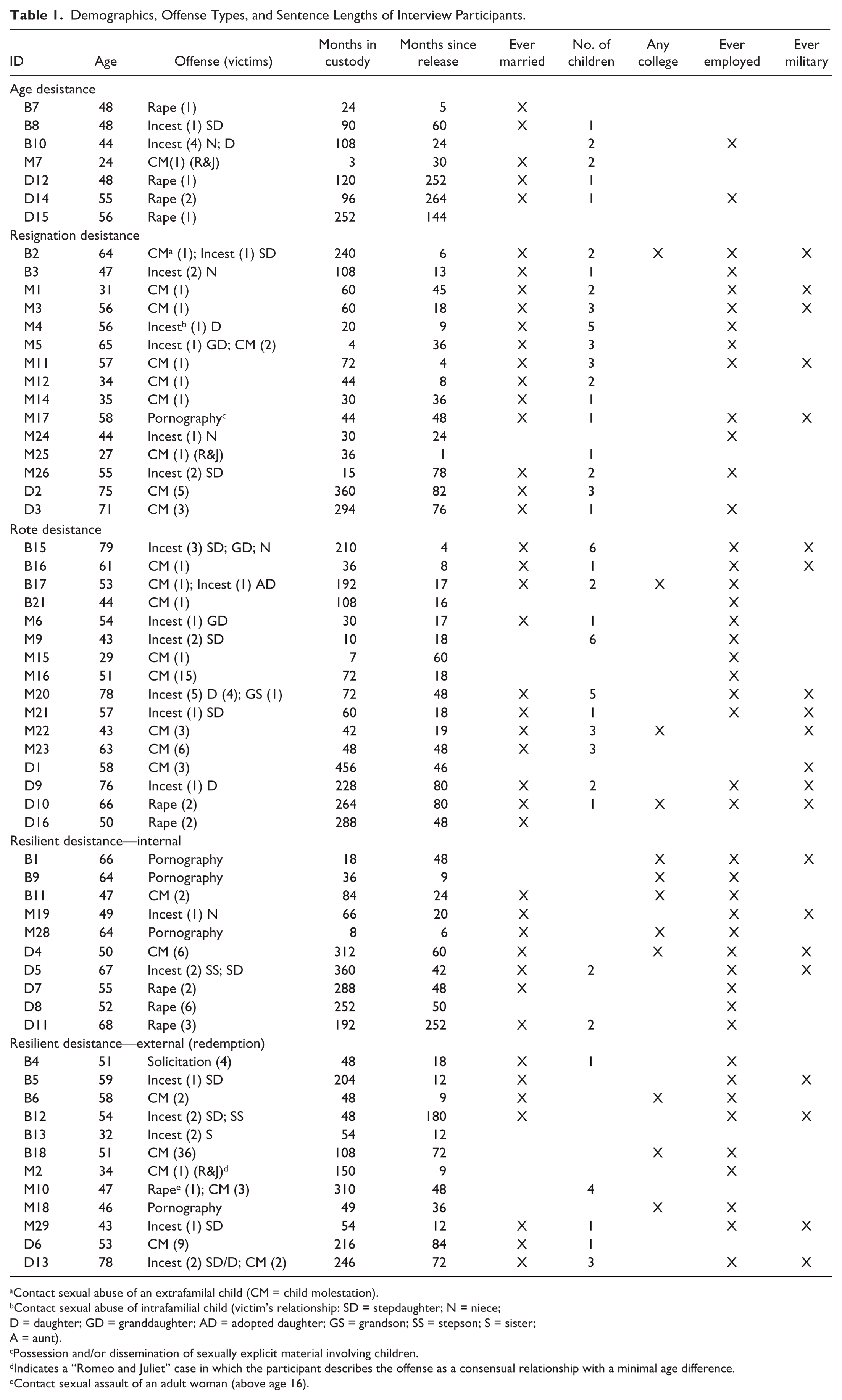
Contact sexual abuse of an extrafamilal child (CM = child molestation).
Contact sexual abuse of intrafamilial child (victim’s relationship: SD = stepdaughter; N = niece; D = daughter; GD = granddaughter; AD = adopted daughter; GS = grandson; SS = stepson; S = sister; A = aunt).
Possession and/or dissemination of sexually explicit material involving children.
Indicates a “Romeo and Juliet” case in which the participant describes the offense as a consensual relationship with a minimal age difference.
Contact sexual assault of an adult woman (above age 16).
Data Collection
The semi-structured individual, face-to-face interview lasted an average of 90 min and followed McAdams’s (1993) Life History Interview Protocol (see also, Laws & Ward, 2011; Maruna, 2001). Interviews were conducted individually in the private offices of a church, at various probation departments, or in centrally located homeless shelters, all of which were familiar to and easily accessed by the men. All participants consented to having their interviews recorded digitally. Participants were informed that their involvement in the study would have no bearing on their probation or parole status (if applicable) and would not affect their progress in outpatient treatment. Participation was voluntary, and participants received a US$25 gift card for a local grocery store or pharmacy for their cooperation. The study received the approval of the university’s institutional review board and the research review board of the state’s Department of Corrections.
Data Analysis
The interviews were transcribed, coded, and analyzed following the techniques described by Atkinson (1998) and Presser (2008). The interviews were transcribed verbatim to preserve the participant’s actual speech (e.g., where appropriate, “gonna” was retained instead of the more correct “going to”). Significant pauses and relevant nonverbal actions (e.g., wiping away tears) were noted. Verbal ticks or fillers (e.g., “like” or “y’know”) were retained unless especially distracting. Each transcript was checked against the original recording for accuracy at least twice by the author.
Similar to the method described by Farmer et al. (2012), data analyses focused on exploring the post-release experiences of the participants, the descriptions they provided about their experiences, and how they understood the meaning of their behavior (see also, Martinez, 2009). Interview transcripts were coded by at least three independent raters (trained graduate students) using NVivo software (Version 10). Coders categorized participants’ speech into various themes of desistance (drawn from those articulated in the available criminological literature). Emergent themes of both success in and obstacles to reentering the community and living offense-free lives were also considered. These emergent themes will be discussed in more detail below.
Themes were identified when multiple transcripts contained the same or similar experience or feeling. To ensure accuracy, themes were only recorded if they were identified by at least two independent raters and discovered in at least two transcripts. As Becker (1998) recommended, both positive and negative themes of desistance were coded. Positive themes refer to occasions when firm evidence of the presence of the theories anticipated were identified. Negative themes refer to cases where there is evidence of the opposite condition of the expected theme. The absence of a theme (i.e., if a participant simply does not mention a theme or its opposite) was not considered.
Results
Four “styles” of desistance emerged during the interviews, and each one represented a coherent constellation of themes, with some overlap. The individuals who best fit a particular style shared numerous personal, personality, and offense characteristics (presented in Table 2). It should be noted that although these styles are distinct, they are not unique enough to constitute “types” or mutually exclusive groups. For that reason, and after much deliberation and peer validation, I refer to these common themes of desistance as “styles.” The results below present the common features (or themes) of each of these four styles.
Continuous Variables and Emergent Themes for Desistance Styles.
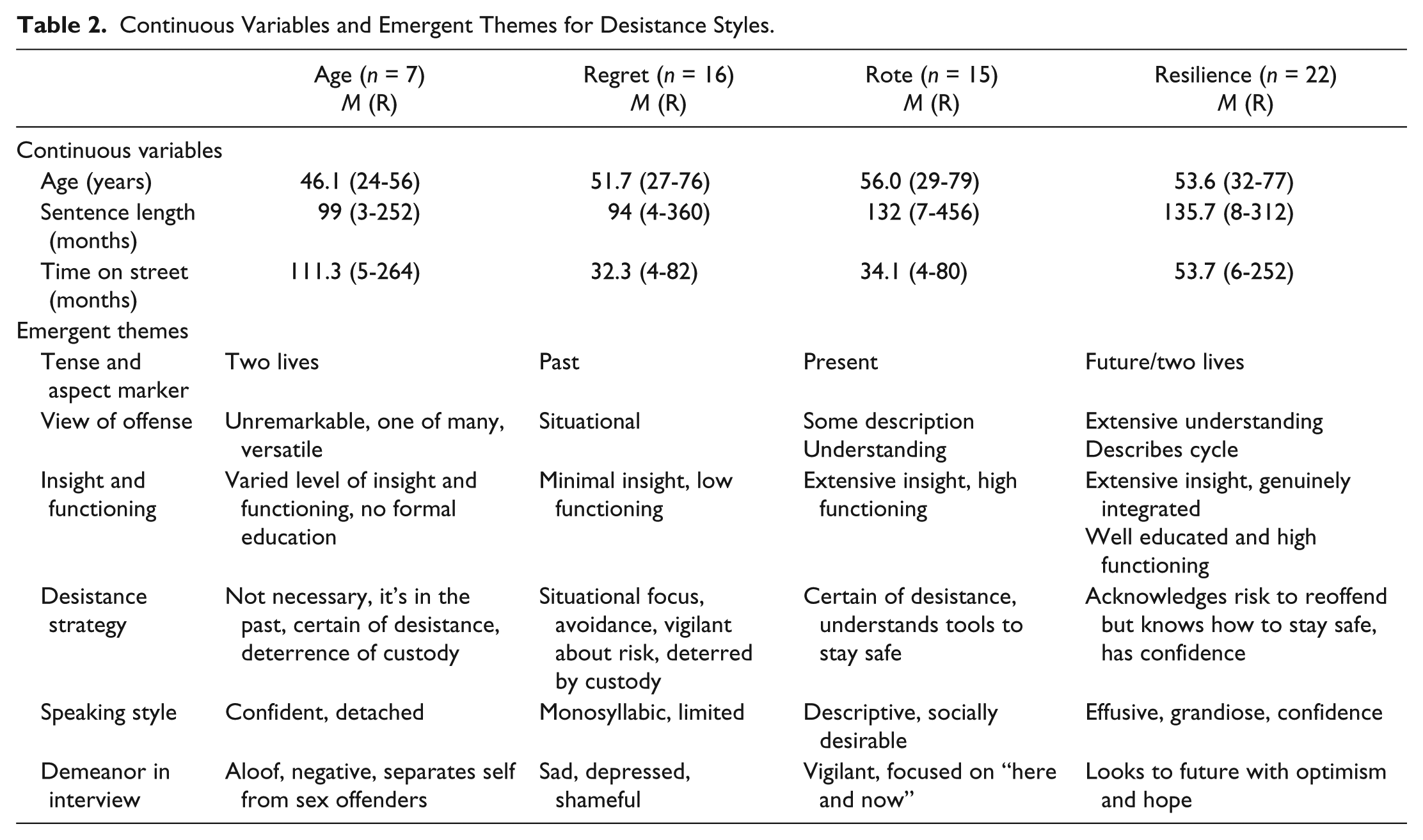
The first style of desistance that emerged was “age” and clearly reflected the standard criminological observation of one naturally maturing out of crime. The remaining three styles seemed to suggest a continuum of cognitive transformation and are referred to as “resignation,” “rote,” and “resilience.” 2 The main factor that distinguished the latter three styles and the reason they are differentiated at all (not to mention, the reason that a continuum remains tempting), was the aspect markers used during the interview. Resigned desisters were stuck in the past and used a lot of negative language, often in the past tense. Rote desisters were focused on the “here and now” and used the present tense. Resilient desisters tended to look to the future with hope and optimism and spoke convincingly about their recovery and rehabilitation. Some individuals appeared to have stagnated at a particular point, and others might reflect a “later” stage without having experienced an apparently “earlier” stage, for example.
Desistance by Age
The first style resonated particularly well with seven participants but was mentioned to some extent by a number of other men. To be clear, although the concept of maturity was a key component in their interviews, it was certainly not unique to these men. They frequently emphasized the process of getting older and growing up in their explanations of desistance. Noticeably, these men did not mention any of the characteristics of the other styles mentioned above. They were certain they would never reoffend and attributed that certainty to being too old, too tired, and to not having it “in them” (B8) anymore.
So I guess it was an epiphany. I just finally woke up . . . I was tired of doing time . . . but now I’ve decided I just don’t want to do it anymore. (M2)
These men tended to use the “old me/new me” language of knifing off (Maruna, 2001) and some spoke of having had two lives. Ironically, these desisters were, on average, the youngest of all the styles. They were almost exclusively rapists with long criminal histories of nonsexual, versatile offending. Most reported an early criminal onset and had served multiple stints in custody, beginning in early adolescence. None of these men identified themselves as sex offenders and expressed frustration that they were required to participate in treatment for something that they often described as a “one-off,” blamed on substance abuse, and/or maintained was part of a consensual relationship. 3
Resignation
Regret and resignation were the most prominent themes for a quarter of the men (n = 15). These men tended to be low functioning, gave short, mumbled, and often monosyllabic responses, minimized the seriousness of their offenses, and provided little insight into how and why their crimes had occurred.
Yes I have [learned my lesson] a little better. You know, I can’t say a lot. More a lot, than half. You know what I mean? A little more than half, I have. Yes. Now I’m just thinking in my head and I think I have, you know? I think it’d be better if I say that. Yes. I think I have. I’d say about 95% I have. Yes. With another 5% saying that I do. (M24)
They described their offenses in very situational terms with little consideration or explanation of motivation and tended to place at least some of the blame for their crimes on their victims.
They were both 14 years old and I um, so, you know, at the time I knew [one of the girls] so [I said] “okay, come on in.” I was talking but anyways, unfortunately I didn’t know the other girl. They started talking and I didn’t know what to do. Next thing you know, I wound up raping, you know? 14 year-olds can’t have consensual, no matter what they say, so, I wound up raping her. (B2)
Many of these men described themselves as loners with almost no social supports; they had lost contact with friends (or never had any), had lost custody of their children, and were not confident about forming friendships or relationships in the future. They were pessimists with fairly defeatist views of themselves and of their restricted position in the community.
I was never good at anything except being an asshole. (M3) I lost the trust of my family and . . . I don’t know if they’ll ever talk to me again, maybe someday I hope . . . to prove to them that I have improved that I am a different person from when I was. Just takes time. You just can’t make a mistake and expect people to forgive you. It just don’t go that way. (M5)
All these men participated in treatment and used some of the “treatment talk” that the other men used, but they did not appear to have internalized it as fully. Although they were all adamant that they would never reoffend, they could seldom articulate why (beyond wishing to avoid prison). Even though this might be sufficient to effect behavioral change, it did not yet appear to be evidence of discernable cognitive change.
I don’t want to ever reoffend again because I know the result [sentence] will be worse than they was before. (M5) I don’t want to go back. I have to follow the rules. I have to do what they say so I can live with my life. (M25)
As considered during the peer-validation process (with fellow qualitative researchers in different but related fields), these themes are consistent with some of Giordano, Cernkovich, and Rudolph’s (2002) participants who spoke of a “change theme” but whose “stories lack[ed] depth and definition” (p. 1030).
I don’t want to go back to prison. It’s not the place for me. I like to live outside and just live with my life. Like I was before. (M24) I know I won’t [reoffend] because I ain’t going through that shit again. I’ve been through hell with this. (M26)
For the few who had acknowledged the harm that their offense had caused, they still had not found a way to move beyond the shame and guilt that they felt over their crimes and were very much resigned to the fact that there was no escape and that this [the sex offender registry] was their life now.
The hurt and embarrassment that I caused my family was the biggest, the biggest. (M3) I feel horrible about what I did and I hope that my victim is able to move on. (M12) All the time it is in the back of my head. The shame, the guilt, the pain that I am dealing with. The flashbacks of what went on. (M14)
Although all these 15 men felt paralyzed by shame, remorse, and embarrassment, it is interesting that they were by no means responsible for the most serious offenses or for the largest number of victims. In fact, there was a considerable range in the types of offenses (against known children) for which these men had been convicted. Their offenses mostly included biological incest over a period of years (n = 2), soliciting a minor online (and driving across three states to meet her in a hotel), and “Romeo and Juliet” cases of statutory rape (n = 3).
Even through their negativity, most of the men tried to portray themselves in a positive light and described themselves as fundamentally good people: All the good that I’ve done over the course of my lifetime is now shattered by one bad decision and I don’t think that’s fair . . . I mean, I didn’t kill nobody. I don’t mean to minimize my crime but I didn’t kill nobody and somebody that did can overcome that and still become a positive person, so why can’t I? (M12)
Especially telling is that even when being asked about the future, any hopes for atonement or redemption still tended to be expressed in the past tense: [My biggest challenge is] trying to right the wrong that I did. Trying to do the unhurt that I caused, you know? How do I word that? Undo the hurt that I caused, and make it up, you know? (M3) [I want to] straighten my life out and then move to the next step which would be to correct, to bring myself to where I was good. I was bad, then come up to the category that I’m gonna be good again…I know they say everything can’t come back to normal but I hope in time it will. (M5)
Rote
A quarter of the sample (n = 16) were observed to fit the characteristics of a “rote” style of desistance where they were adept at “talking the talk” and parroting buzzwords they had learned during therapy. Compared with the other desistance styles, the men who shared these characteristics were the oldest and had served an average of 11 years in custody. The distributions of both age and sentence length were considerable for this group with ages ranging from 29 to 79 years and total time spent in custody ranging from 7 months to 16 years. The offenses for which these men were convicted most often included child molestation (n = 7) and step-child incest (n = 2) with many cases including multiple victims. As a group, they had the most persistent histories of sexual offending with seven men reporting post-release recidivism and having received multiple, separate custodial sentences for their sexual crimes. The dominant themes in these “rote” narratives included the value of treatment and the applicability of this therapy to their behavior, but they were often delivered in a rehearsed (or even manufactured) style.
Treatment brought up some good points. I learned my triggers. I did a plan so it wouldn’t happen again. I learned something every day in treatment. (B16) It’s got to do with the program. They taught you with the tools, saying “hey, you made a mistake, you know what your triggers are, find a way to stop those triggers.” (M16)
These men had been participating in treatment for some time, and the messages of the Relapse Prevention Model (Pithers, 1990) and the standard “cycle of offending” resonated strongly with them—they recognized and praised the benefits of treatment, and all spoke highly of their therapists, in a very socially desirable way. During the interviews, they were eager to demonstrate their newly gained insight regarding offending and self-governance. They willingly shared their knowledge of triggers, tools, and risk situations and spoke in the present tense about their ability and commitment to stay safe. Some went as far as offering to provide me with additional material including their written homework and autobiographies. They tended to express pride in their grasp of offending cycles and situational characteristics—this is what they felt “good at.” I’ve already wrote a relapse prevention plan, and I’ll tell you, when you write that relapse prevention plan it takes you from everything from a pretend normal day until the time you offend, and there’s always a place you can intervene. I know my intervention points. I know what I can do, what I can’t do. This is what I’ve been concentrating on. (B15)
Like the other styles described above, most of these men were confident that they would not reoffend, but justified this certainty with a newfound personal insight and knowledge of triggers and risk situations.
I won’t reoffend. Treatment made me see my triggers. It won’t happen again. (M6) I have the tools that I can use to prevent myself from committing another crime. (M15) I know what happened. I know how it happened and it won’t happen again. I can be 100% positive it won’t happen again. They’re going to say, “No, you can’t. You can never be 100% positive.” But I am. (M21)
When discussing the ways they keep themselves from offending, they tended to emphasize the situational nature of their risk and subscribed to a “routine activities” approach that prioritized daily structure (D. A. Harris & Cudmore, 2015): The warning sign for me is when I don’t have a structure. Right now I have structure. Right now I have a full-time job, I come to group, I go to probation, and there’s a couple of other things I do during the week. I go and see my grandmother. . . . So for me, my biggest thing is giving myself a structure. ‘Cos when I have structure that’s when I succeed. When I lose a piece of my structure, that’s when I start screwing up. (M15)
This focus on situational variables (rather than individual differences or psychological predisposition) was also observed in the “resigned desisters” described above. The strongest emergent theme and the narrative that really united the rote style was their focus on the “here and now,” their everyday routines, and the way they described staying safe as a kind of job. They spoke in the present tense, and they thought about their offending cycle and how to manage their risk on a daily basis. They highlighted the importance of “working at it” and not taking things for granted. Their words and aspect markers are reminiscent of Giordano et al.’s (2002) thoughts on the use of the present tense as suggesting that “the[ir] journey is very much in process or incomplete” (p. 1030).
My job is remaining free and safe out here, that’s my biggest job. (D5) It’s on my mind every day. I’m not looking for trouble or making trouble. I’m doing everything that I’m supposed to be doing . . . My primary goal is to stay out of trouble and do what I’m supposed to do. (B17) I think about it every day . . . I’m writing a log so every day I get to be accountable for the day. (M9)
Resilience
The final style of desistance is “resilience” and includes a constellation of characteristics that emphasize recovery and redemption. This final style was marked by a strong desire to move on from their offending past as well as emphasizing a demonstrated pattern of success upon release. Like the age desisters, the resilient desisters also spoke of having had two lives and of “knifing off” (Maruna, 2001). Akin to Giordano et al.’s (2002) “complete desisters,” these men tended to describe their offending in the past tense, thus placing a “great deal of distance between their old, discarded selves and those they currently claim” (p. 1031). Two specific orientations were observed—those who were internally motivated to manage their desistance (n = 10) and those who were externally motivated to help and mentor others (n = 12). The first aptly demonstrated that they “walked the walk.” They had moved far beyond the “rote” style of learning buzzwords and had internalized the lessons taught by their therapists. They were subsequently confident in their ability to live an offense-free life. The second orientation was directed externally. These men shared the characteristics of the first but in addition, were committed to serving as mentors to other men convicted of sex offenses. In many cases, this service was identified as the best thing they had ever done, how they experienced considerable pride, and how they hoped to achieve redemption.
The resilient desisters had served the longest sentences for the most serious crimes and had lived in the community for the longest time. Many had served more than a decade behind bars. Their offenses ranged from solicitation (of multiple young men) or protracted periods of incest to child molestation of both strangers and acquaintances. One man admitted to contact offenses with 36 separate male and female children, and the two men with exclusively adult victims also reflected this style. In attempting to understand this style, McNeill (personal communication, March 2015) helpfully reasoned that perhaps these were the men with the most for which to atone. In that way, it makes sense that the narrative provided by treatment is the most appropriate for men with some of the more serious criminal histories. The resilient men were particularly open about their offending, and many had engaged in treatment for a considerable number of years. In fact, a majority of these men continued to participate in therapy, at their own expense, far beyond that which was required by the conditions of their release.
I had done everything that I could do, but I wanted more. (B6)
The many benefits of treatment almost always emerged in an educational context where participants spoke of feeling empowered and “equipped with tools” for success. The themes that emerged here are consistent with Maruna’s (2001) point that ex-offenders need to account for and understand their criminal pasts as well as understand and explain why they are now not like that anymore (M. K. Harris, 2009).
I understand my cycle forward and backward and every aspect of my life I live in my cycle. I know what all my risky emotional states are, I know what triggers I have, I know what my core beliefs are, I know what seemingly unimportant thoughts and decisions I make are, you know, I think of my whole life in terms of my cycle, every aspect, I understand all of that. (B4)
A common theme that emerged in the resilient men was that they reported having “wanted help” at some point and therefore appeared to be at least somewhat amenable to change when they entered treatment (D. A. Harris, 2015): I wanted to get it. I wanted the counseling, I wanted that help. (M14)
These men were generally optimistic about their ability to live an offense-free life and attributed their confidence to the invaluable knowledge they had gained through treatment.
I learned coping mechanisms and I learned managing skills for my deviancy. I got tremendous insight into what my pedophilia is. (B18)
This newfound knowledge enabled them to describe their triggers, tools, and relapse prevention plans in considerable detail, far beyond that which was demonstrated by the “rote” style described above. The main characteristic that set these men apart from the other desistance styles was that they were realistic in acknowledging the risk that they might reoffend.
I push it in groups, “don’t come in here saying you’ll never reoffend because that’s crap, you fell once, you can fall again. And if you try and say that you never will, you get complacent” and that’s the whole thing, we’ve gotta guard against that. (M18) I don’t know [if I’ll reoffend] and that keeps me safe . . . I’m taking care of the day to day. But knowing that I did it once, that I have to be on guard, ‘cos the minute I say “no, I’m not going to reoffend,” then I stop looking. Then I stop working. (D4)
One final feature that truly separated those men in this category from those identified in earlier styles was an emphasis on the “bigger picture.” In his desisters, Maruna (2001) found a “desire to make some important contribution to their communities” (p. 12). The men who described these themes clearly demonstrated a broader focus of generativity to benefit the community at large or future generations.
I want the opportunity to prove my worth and value to my community. And by community I mean everything from my neighbors, to my state, to my country, to my world. (M19) I spend time trying to make things up for my daughter who is a collateral victim of all this, it broke up her family, it ruined her mother and it shamed her, you know? (B12)
When asked why they will not reoffend, or how they know they will not do it again, their explanations were a lot more developed, nuanced, and less selfish than the styles mentioned earlier (who, for the most part, were almost entirely motivated by avoiding custody): I wish that I won’t put anybody in my shoes. By creating another person that I chose to victimize. The reason I say that is because to realize, 27 years later that I was abused, and then realize that I’ve already passed on the cycle, I, I don’t want to wish that on anyone. Not even my worst enemy. (B13) I don’t want to offend because first of all, I don’t want to victimize another person, and not only the victim, him or herself if that was to be the case, but the echo effect. My family, my friends, and by no means least, my lastly, my own self. (B11)
These men shared more ambitious goals for the future and spoke with optimism about what lay ahead. Their aspect markers were distinct—their offenses were distant memories, and their focus was on the future. Resilience was the only style where even the possibility of identity transformation ever emerged.
People can change their life, you know? Even sex offenders. (M5) I know it’s a label and I’ll have the label for the rest of my life no matter which way I look at it . . . but it’s how I use the skills that I learned from group and all these other resources that I do have now, will hopefully, will be a better life for me. (M6)
The externally motivated resilient desisters reflected Brown’s (1991) concept of the “professional ex” or “desistance missionary” (Maruna, 2001, p. 103). As Farrall and Calverley (2006) observed, helping others is characteristic of the final emotional phase in the desistance process. “The desire among reformed deviants to help others” is well documented (Maruna, 2001, p. 103). Consistent with previous research, the narratives in this group reflected the generativity model well.
We are all more emotionally attached than any other . . . I would think that the guys who know each other and who go through the group together, ideally they can support each other emotionally, that you can’t get anywhere else. You know? No one else is going to understand it; especially if they haven’t been through it. Even after I graduated the program, I was still there another year and a half as a peer counselor with these guys too. (M29) It’s good to hear their stories and I think it helps them to hear my story. And uh how I benefited from treatment. . . . Uh how to be able to uh, take my, the negative situations around me and not let it affect me by ah twisting a negative into a positive. I think I have to care for any sex offender. I think treatment for any sex offender is a win/win. (B5)
It should be noted that mentoring other sex offenders is certainly not a required component of desistance. As Farrall and Calverley (2006) observed, some (and in fact, most) desisters are simply “ordinary people” (p. 14) with everyday concerns like not being late for work or what to have for dinner. Many men in the sample had convincingly desisted from offending and were specifically concerned with maintaining a low profile and concentrating on their own immediate concerns (such as work and family). Many different motivations to mentor others emerged in the narratives of the men. In some cases, they felt the need to “give something back,” and for some, it was about being productive and having a purpose. In others, it was a way of regaining control over what was previously a powerless situation.
And, you know, what’s my purpose? How can I make my life productive? One of the ways I can is by being willing to share my story. (B18) Right now, my thing is to give back to as much as possible. (M29)
Those who did speak about their “professional ex” status did so with pride. As Goffman (1963) explained, when a stigmatized person attains a high position, “a new career [emphasis added] is likely to be thrust upon him, that of representing his category” (p. 26). So, it might be that they have embraced this status not because they chose to, but because it was the best option available to them.
The therapy narrative that is provided in the cognitive-behavioral therapy group sessions best applies to these men. They all constitute the “typical case” for which the initial treatment protocols were developed and, as McNeill has suggested, it provides them with a suitable “backstory” to understand why they did what they did and offers an appropriate and achievable path forward. Perhaps, most importantly, these groups also provide the men with a language to express their thoughts and feelings, as well as a community of like individuals.
Unsurprisingly, the men who appeared to benefit the most from these approaches and who best fit the resilient style of desistance were the ones who possessed stronger social bonds and intellect to begin with. Each of the resilient men were comparatively high functioning, educated, and equipped with the necessary intelligence to participate in, and benefit meaningfully from, cognitive-behavioral therapy. This result underscores the need for extant treatment programs to accommodate those who might be lower functioning, under- or unemployed, developmentally delayed, learning impaired, and/or possess comparatively lower social competence.
Two men (one from each of the first two waves) were adamant about their successful desistance but were so vehemently opposed to the treatment “industry” (M8) that they constituted negative cases who did not reflect any of the characteristics described above. They were subsequently excluded from the analysis here. Initially, they might have looked “resilient,” but neither of them described what it was they had overcome and instead positioned themselves as victims of a system that had misdiagnosed them with imaginary problems. Their exclusion is an evident limitation of the study, but they were beyond the scope of this particular focus and will certainly be the subject of a future project. Indeed, the themes that emerged in their interviews were especially noteworthy and deserve specific attention elsewhere.
Another question that was outside the scope of the present investigation is the extent to which the apparently high functioning and socially competent “resilient desisters” might also share many of the characteristics of Factor 1 psychopathy. Although beyond the scope of this work, this question remains of great interest as my exploration of these men continues.
Discussion
Contrary to public opinion, recidivism is not an inevitable consequence of releasing a convicted sexual offender to the community. An additional finding is that this process was observed with or without formal intervention. The logical next question to ask is “why?” The process of desistance was articulated to varying degrees by all participants and was most often viewed as a simple and visceral aversion to returning to custody (deterrence) or as a product of extensive sex offender–specific treatment. Emergent themes of how and why the men had stopped offending were arranged into four styles of desistance: aging out, resignation, rote, and resilience. It could be hypothesized that there is a temporal progression within the last three styles, reflecting a dynamic process of intra-individual change, but this remains conjecture at this time, for the methodological reasons identified earlier. I recommend that this be the subject of further study.
Almost all participants in the sample described how individual therapy and group treatment meetings had helped them, but at times, the language they used felt forced or manufactured. The resigned desisters had not yet internalized the lessons offered in treatment. The age desisters maintained that they did not need the lessons in the first place. The resilient desisters had long moved on. In contrast, the available treatment protocols seemed to be especially well suited to the rote desisters—it gave them the opportunity (and the framework) to understand themselves and their offending histories in a useful and meaningful way. Perhaps, most importantly, it also provided a language for them to describe the tools they could now utilize to live offense-free lives in the community.
Offense types were not arranged in an organized way. Men with adult victims were no more or less likely than men with child victims, for example, to desist in a particular way. This underscores the profound heterogeneity of the sample and reinforces the false dichotomy of categorizing individuals based solely on their offense or victim characteristics. The reader will also note my insistence on avoiding the labels of “rapist” or “child molester” in the text of the manuscript. Furthermore, as Willis (personal communication, March 2015) and others have advocated, I have jettisoned the derogatory “sex offender” label and instead refer to the participants simply as men.
Limitations
The study is not without limitations. To that end, sample bias and generalizability are discussed specifically. The conclusions in this study were drawn from a group of predominantly White men who were incarcerated for a sexual offense and released to the community. These findings are therefore not generalizable to more ethnically diverse samples and it was not possible to observe or discuss any true cultural differences. Furthermore, given that much of the sample was recruited from specific outpatient programs, these results are unlikely to represent the more serious end of the offending spectrum (although there were a few outliers with especially prolific criminal histories of particularly violent sexual crimes). Finally, the fact that the sample included only those men who had experienced the formal intervention of the criminal justice system means that it was impossible to capture the desistance process of those who committed sexual crimes and desisted without receiving formal sanctions. Taken together, these limitations suggest that the present results be interpreted with caution, but given the youth of this area of study, the findings are still valuable. Recruiting a more diverse sample to address each of these constraints is a goal for future work.
The desistance narrative that was presented to the men as part of their therapy basically aligns with Maruna’s redemption script. It requires them to acknowledge the harm they have caused, admit that they are at risk, consider the terrible things that might have happened that could have led them to this place, but recognize that they are not defined by those experiences. It is possible to live a healthy, safe, offense-free life if one has the right tools. But if their experience does not mesh with this model (their offense was impulsive or they maintain the relationship was consensual), they cannot identify themselves on the spectrum of “desistance” or “relapse prevention” or “healthy sexuality,” and it is irrelevant.
The present sample included men who had “advanced” to resilience in a relatively short period of time and men who had been in therapy for decades and still appeared to be regretful and resigned, speaking in the past tense and unable to move forward. The important central point is that they each reported living offense-free lives regardless of “where they were” (or rather, the themes that emerged in their interviews) and if our goal is to prevent sexual abuse, it seems futile to assess whether they have desisted “enough.” In fact, the fear that they could never again be trusted was a strong emergent theme: You’ve gotta give me the chance. You’ve gotta give me the opportunity. No one is going to believe me until the day after I die. That’s when they’ll start trusting me again. That’s when they’ll look back and go “Wow he did live another 40 years without doing anything wrong.” But until then, until the day after I die, they’re gonna keep watching me. And that’s a rough way to live. (M19)
Conclusion
This study examined the desistance process as described during interviews with 60 men convicted of sexual offenses and released into the community. The strongest and most frequently mentioned themes were arranged into four distinct constellations of characteristics that best represented four styles of desistance.
Although four distinct styles of desistance were identified, some themes (such as the deterrent effect of custody, the value of treatment, and the obstacles created by restrictive legislation) were consistent across all cases. Support was found for natural desistance and aging out, as well as some variations on the theme of redemption, identify transformation, and resilience. Of particular interest is the fact that three of the four styles (resignation, rote, and resilience) bore little resemblance to the emphasis in the criminological literature on the achievement of informal social controls or to the psychologically informed explanations of cognitive transformation. Furthermore, that the typical areas of emphasis in sex offender–specific treatment (that emphasizes individual differences and etiology of offending) were seldom valuable is concerning and should be the subject of further study.
Some people will desist from offending on their own, without needing formal intervention. Some will begin therapy motivated to understand themselves, amenable to change, and will benefit immensely from sex offender–specific treatment, and others might profit simply from reconnecting with their family of origin, or from the opportunity to earn an honest living. Still others, whether simply overcome by the stigma of their offense or by genuinely understanding the consequences of their crimes, may decide quite rationally to never offend again, if only to avoid returning to custody. Furthermore, it seems that only a few appear to truly warrant the kinds of enhanced supervision or protracted treatment to which so many are now subject.
In conclusion, this study indicates that an individualized focus is necessary in better understanding the desistance process and that attributing all types of desistance—like all kinds of offending—to a single variable, or cluster of variables, is short-sighted. More research is necessary to establish the most useful therapeutic approaches and the most successful collections of circumstances that can best facilitate desistance. Being able to identify and understand the mechanisms of desistance would allow scarce resources to be redistributed in a more meaningful and impactful way, thus moving us closer to the goal of prevention of sexual violence.
Footnotes
Declaration of Conflicting Interests
The author(s) declared no potential conflicts of interest with respect to the research, authorship, and/or publication of this article.
Funding
The author(s) disclosed receipt of the following financial support for the research, authorship, and/or publication of this article: This research was partially funded by the Harry Frank T Guggenheim Grant for Prevention of Violence Research received by the author.