



Abstract
Studies have revealed that self-control theory, social learning theory, and strain theory are useful in explaining criminal activity in China. Previous research with Chinese data, however, has focused almost exclusively on samples of adolescents and the minor types of offending that are typically captured in such samples. The present study builds upon prior work by considering the extent to which these three major etiological theories of crime can help differentiate between profiles of Chinese prisoners categorized with respect to re-incarceration status. Specifically, we derive hypotheses that predict prisoners’ status as first-time inmates or inmates with multiple incarcerations. These hypotheses are assessed with recently collected data for a sample of approximately 1,800 prisoners in Southern China. The results reveal that indicators of peer criminality, low self-control, and negative emotions (a theorized outcome of experiences of strain) are all positively associated with re-incarceration status.
Introduction
Comparative criminology has followed a rather curious life-course over the years. As Howard, Newman, and Pridemore (2000, p. 141) observed in their essay prepared for the National Institute of Justice’s four-volume report Criminal Justice 2000, “comparative criminology is as old as criminology itself.” Prominent Enlightenment scholars such as Bentham, Voltaire, Helvetius, and Quetelet recognized the value of comparative inquiry, systematically contrasting features of crime and justice in their own nations with those of others. Interest in such comparisons waned throughout much of the 19th and early 20th century, “as nations looked inward” (Howard et al., 2000, p. 141). Comparative inquiry once again began to capture the interest of criminologists in the middle years of the 20th century—a development that Bennett (1980) characterized as an especially beneficial “revival.” Yet 20 years after Bennett’s pronouncement of this welcome development, Farrington (2000, p. 5) offered a less optimistic appraisal of the vitality of comparative criminology in his 2000 Presidential Address to the American Society of Criminology. He lamented that “cross-national comparative studies in criminology are important but relatively infrequent.”
The situation has changed dramatically during the past decade and a half following Farrington’s address. A burgeoning literature in criminology has emerged that has been “comparative,” although understood in different ways. As Bennett (2004) explained in his Presidential Address to the American Academy of Criminal Justice Sciences, two important dimensions that differentiate among comparative strategies are their scope and their data. 1 Some comparative studies entail comparisons for two nations or for a small number of nations with data collected from each of those nations. Another type of comparative research is multinational in the sense of being based on multivariate statistical analyses of data recorded for large samples of nations. Yet other studies are comparative in the sense of taking theories that were developed in a particular sociocultural context and assessing their applicability in a single nation that provides a very different sociocultural context from that in which the theories were originally formulated. Such studies are typically directed toward assessing the generalizability of criminological theories (see also Bennett, 1980; Kohn, 1987).
Our analyses pursue this latter objective of comparative criminology. Specifically, we build upon the fairly substantial and growing body of work that has examined the extent to which prominent Western criminological theories can be generalized to contemporary China. China constitutes a particularly strategic setting for assessing the generalizability of Western theories because, as Chen emphasized in his comparative analyses of the role of formal and informal controls, Chinese society exhibits “unique cultures and traditions.” As a result, Chinese and Western societies represent “two different extremes with respect to the nature of social and legal control” (Chen, 2004, p. 523).
Despite these pronounced sociocultural differences, three prominent etiological theories—social learning theory, strain theory, and self-control theory—have proven to be useful in explaining delinquency in China, although the patterns occasionally differ somewhat from those more commonly reported in the West. A limitation of previous research, however, is the almost exclusive focus on samples of adolescents and on the minor types of offending that are typically captured in such samples. 2 The purpose of the present research is to build upon prior work by considering the extent to which these three major etiological theories of crime—social learning theory, strain theory, and self-control theory—can help differentiate between profiles of Chinese prisoners categorized with respect to re-incarceration status. Specifically, we derive from these theories hypotheses that predict prisoners’ status as first-time inmates or inmates with multiple incarcerations. These hypotheses are assessed with recently collected data from a sample of approximately 1,800 prisoners in Southern China.
The Research Context
Applications of Western Etiological Theories to the Chinese Context
As Cullen, Wright, and Blevins (2006) observed in their monograph dedicated to “taking stock of the status of criminological theory,” three theoretical paradigms have dominated the discipline over the course of the last several decades—differential association/social learning theory, control theory (bonding and self-control), and anomie/strain theory. Contemporary social learning theory directs attention to the mechanisms that underlie “the acquisition, maintenance, and change in criminal and deviant behavior” (Akers & Jensen, 2006, p. 38). Particularly prominent among these mechanisms is that of differential association. 3 The theory predicts that association with criminal or delinquent others increases the likelihood of deviant behavior. A fairly large body of research in the West has offered support for this prediction. Indeed, the number of associations with criminal or delinquent peers has emerged as one of the most robust predicators of criminal involvement (Lilly, Cullen, & Ball, 2011, p. 57; see also Pratt et al., 2010).
Agnew’s (1992, 2006) general strain theory (GST) focuses on negative experiences that increase strain or stress and in so doing, serve as the impetus for crime and delinquency in the absence of effective coping mechanisms. A wide array of strains has been theorized as being criminogenic, but they can be organized with reference to three general types—the inability to realize positively valued goals, the removal of positively valued stimuli, and the presentation of aversive stimuli (Agnew, 2006, p. 101). Not all claims of GST have been confirmed in the empirical literature, but “there is consistent evidence that exposure to strain increases the likelihood of criminal offending” (Lilly et al., 2011, p. 77).
As a variant of control theory more generally, self-control theory puts forth an explanatory framework that is, in Schulz’s (2006, p. 218) terms, “parsimonious to the extreme.” The theory postulates that all crime, at all times, in all places, can be explained with reference to a single, overarching propensity—low self-control (Gottfredson, 2006, p. 83). Persons lacking self-control “will tend to be impulsive, insensitive, physical (as opposed to mental) risk-taking, short-sighted, and nonverbal” (Gottfredson & Hirschi, 1990, p. 90). Individuals possessing such traits are predicted to be predisposed to commit crimes, contingent on the available opportunities to do so. A truly voluminous literature assessing the claims of self-control theory has accumulated since its introduction in A General Theory of Crime (Gottfredson & Hirschi, 1990). Although the bold claim that self-control is the sole factor responsible for criminal behavior has not fared very well, there is ample evidence that low self-control is a salient predictor of crime and delinquency. Measures of low self-control are consistently related to increased risks of criminal offending (for comprehensive reviews of the literature assessing self-control theory, see Engel [2012]; Pratt and Cullen [2000]; and Schulz [2006]).
Given their prominence in Western criminology, it is not surprising that much of the comparative research has focused on the applicability of these three theoretical perspectives within other sociocultural contexts. The research based on data from China is relatively limited in comparison with studies in the West, but it has been expanding appreciably over recent years. 4 A considerable portion of the criminological literature with Chinese data has been conducted in areas in the most southern part of China, such as Hong Kong and Guangzhou (e.g., Cheung, 2014; Cheung & Cheung, 2008; D. S. Wong, 2001), while only a handful of studies have employed samples from northern areas, such as Beijing and Shijiazhuang (in Hebei province; e.g., Bao, Haas, & Pi, 2007; Cretacci, Rivera, & Ding, 2009). Among these comparative studies in China, some attempt to test one particular theory, while others are more interested in examining the general applicability of the Western criminology theories by testing two or more of them in a single study, adopting the common strategy of testing theories “against one another” (Cullen et al., 2006, p. 4).
For example, D. S. Wong (2001) interviewed 63 male youth from Hong Kong and Guangzhou to explore possible pathways to delinquency by applying four criminological theories, including strain theory, differential association theory, labeling theory, and social control theory. Of particular interest for present purposes, D. S. Wong discovered that the initiation and escalation of deviance by youth in both areas were related to association with delinquent peers in a positive direction, thus, providing support for the differential association component of social learning theory. In contrast, strain theory was only partially supported. D. S. Wong found that delinquency was directly related to social and financial strain only for youth in Guangzhou but not for those in Hong Kong. For youngsters in Hong Kong, social disadvantage was more likely to affect delinquency by undermining social control by parents.
In a very similar effort to explore predictors of delinquency, Ngai and Cheung (2005) employed data from 229 marginal youth recruited through outreaching social work teams in Hong Kong to study the generalizability of social control, social learning, strain, and cognitive development theories in China. Similar to D. S. Wong (2001), the authors found that delinquent peer association appeared to be a moderate but significant predictor for delinquent involvement. Strain, however, failed to show expected positive association with the likelihood of offending. On the contrary, by showing a negative relationship with delinquency, strain in the study appeared to discourage a marginal youth from engaging in delinquent activities.
Looking at the same set of theories, Bao, Haas, Chen, and Pi (2014) examined how social control and social learning variables mediate the effect of repeated strain in school and at home on delinquency using a sample of 615 middle- and high-school students in Guangzhou and Shijiazhuang. The authors found that repeated negative treatment by teachers increased delinquency through both weakened conventional bonds and beliefs, and through higher association with delinquent peers. Repeated negative treatment by parents, however, affected delinquency only through weakened conventional bonds. Bao and colleagues (2014) also discovered that association with delinquent peers was a significant predictor of delinquency, but its effect was weak in magnitude. They suggested that this may be a reflection of the greater control of Chinese authority figures than their Western counterparts in resisting the challenge by youth subcultures against the existing order.
Extending the list of delinquency predictors, Cheung and Cheung (2008) used self-report data collected from 1,015 Chinese secondary school students in Hong Kong to study the effects on deviance of self-control, along with many other social factors. The authors discovered that while low self-control in a bivariate regression was positively correlated with delinquency as predicted by Gottfredson and Hirschi (1990), it became nonsignificant after the introduction of a range of social factors, such as disrupted social bonds, labeling by parents and teachers, delinquent association, and strains. Among other findings, Cheung and Cheung found that both association with delinquent peers and strains demonstrated the expected positive relationship with delinquency.
Rather than seeking delinquency predictors in general, other studies have limited their scope to a single theory or two theories that could be bridged by mediation or moderation process. Research on self-control using Chinese data has provided considerable empirical support for self-control theory, notwithstanding the null effects reported by Cheung and Cheung (2008) noted above. Assessed in various ways, self-control has generally been shown to be negatively associated with deviance measured as violent and property crimes (Chui & Chan, 2013b), bullying behaviors (Chui & Chan, 2013a), gambling and intoxication (Cheung, 2014), or using a general delinquency scale (Cretacci et al., 2009). However, opposing evidence to the impeding effect of self-control on delinquency was reported in an early study based on a rather limited measure of self-control. Using data collected from 527 adolescents in Southern China, G. T. Wang, Hengrui, Shaowei, and Zhang (2002) showed that adolescent impulsivity was not related to either substance use or deviant behaviors. In addition, contrary to the expectation of the self-control theory, the authors found that their persistence variable, which was used to assess the capacity of exercising self-control, was positively rather than negatively related to substance use (G. T. Wang et al., 2002).
Although there have been some exceptions, as noted above, strain theory has received a fair degree of support in China. For example, using data from 1,026 secondary school students in Guangzhou and 1,116 in Hong Kong, Cheung, Ngai, and Ngai (2007) discovered that family strain, measured as parental agitation, sibling agitation, family problems, and the like, exhibited positive effects on violence and status offense. In a similar effort to test the GST, Bao et al. (2007) employed data from 615 middle- and high-school students from rural and urban China areas located in and around Guangzhou and Shijiazhuang. Using a general strain scale, the authors found that strain had a positive association with delinquency. In addition, they discovered that boys and girls differ in how they cope with strain. Specifically, their study suggests that girls are more likely to use cross-domain support resources in managing interpersonal problems taking place in family, school, and peer group, whereas boys are more susceptible to delinquent peers in their adaptation to interpersonal strain in all domains. Two other studies by Cheung and Cheung (2008) and by Liu (2011b) also studied strain along with its potential moderators. Using data from Hong Kong (Cheung & Cheung, 2008) and Fuzhou city (Liu, 2011b), both studies found that strain exhibited a positive association with delinquency. In addition to this key finding, Cheung and Cheung (2008) also found that self-control mitigated the effects of certain strains on delinquency for females but not for males, and Liu (2011b) found a moderation process whereby the negative association between parental attachment and delinquency became weaker as adolescents report greater status or achievement strain.
In a more recent effort to test strain theory in China, Sun, Luo, Wu, and Lin (2016) employed survey data collected from 335 incarcerated women in four Chinese prisons to examine how strain variables were associated with inmates’ levels of criminality, operationalized on the basis of features of the offenses committed and self-reports of delinquent and criminal behavior prior to incarceration. The results offered mixed support for strain theory. Their measure of physical abuse and discrimination exhibited positive associations with criminality, while indicators of financial stress and negative emotions failed to yield significant effects in the fully specified model. It is worth noting that the research by Sun et al. (2016) is one of the few studies that employed adult samples and applied the theory to serious offenders in China.
We noted above that studies by D. S. Wong (2001) and Ngai and Cheung (2005) informed by the logic of “competitive theory testing” both reported that association with delinquency peers was positively related to delinquency, consistent with social learning theory. Support for social learning theory has been observed in other studies as well. For example, based on self-report data from 1,139 secondary school students in Hong Kong, Cheung (1997) found that peer and parental deviant behavior, among other predictors, such as preference for violent/obscene content and imitation of media characters, exhibited significant positive associations with delinquency. Also conducted in Hong Kong, the study by Davis, Tang, and Ko (2004) employed data collected from 718 Chinese adolescents to explore the relationships among family, peer, and school factors on delinquency. The authors discovered that negative peer and family influence was the most salient predictor of delinquency. Among the handful of longitudinal studies on peer association and delinquency in China, Ma and colleagues collected data from 56 Hong Kong Chinese adolescents in two waves, in 1996 and 1998. Based on their analysis, the authors found that students who maintained a relatively high level of deviant behavior across the two waves tended to show higher peer influence, and that there was a positive correlation between peer influence and delinquent behavior at Time 1 and Time 2 (Ma, Shek, Cheung, & Tam, 2002).
Table 1 presents a summary of key features and findings of studies that have assessed the applicability of elements of social learning theory, strain theory, and self-control theory with Chinese data. Taken together, the literature based on data from China can sustain several general conclusions. First, as previously noted by Sun et al. (2016), the data employed are heavily concentrated on adolescents. Adult offenders have been largely left out of the picture. 5 Second, the sources of the data have not been very diverse and have come mainly from Guangzhou and Hong Kong. China is not only socially and culturally different from Western society, but also highly diversified internally. Therefore, data from other locations should also be collected and used to assess the utility of Western theories. Third, while Western criminology theories have enjoyed much support, exceptions have also been found. These exceptions could, of course reflect idiosyncratic methodological factors (e.g., sampling, measurement, statistical model specification), but they also raise the possibility that the Chinese context is so different from Western ones that some theoretical revisions are warranted. Thus, there is good reason to explore further the generalizability of the leading criminological theories to the Chinese context, especially by considering the relatively neglected population of adult offenders, and the kinds of criminological outcomes that are relevant to such populations, such as experiences with the formal institutions of social control (prisons) in the form of re-incarceration.
Summary of Assessments of Criminological Theories With Chinese Data.

Re-Offending and Social Control
Our focus on the re-incarceration status of prisoners represents not only a shift in the domain of criminal activity commonly studied in Chinese research, it also entails the introduction of processes of social control. A good deal of research has accumulated in the West that is directed toward the general issue of repeat offending or recidivism (see MacKenzie, 2012 for a comprehensive review of this research). These studies reveal that relatively large numbers of those released from correctional institutions are re-arrested, convicted, and sentenced again, at least within the United States. Much of the Western recidivism research has been devoted to assessing the effectiveness of various treatments intended to reduce the likelihood of reoffending that can be applied within the prison setting. Of course, imprisonment presupposes not only offending but apprehension, conviction, and sentencing, that is, criminalization. The core Western criminological theories under consideration in the present analyses are theories of the etiology of crime. They purport to identify determinants of criminal offending. Nevertheless, it is plausible to anticipate that some of the very same factors are likely to be related to the risks of criminalization.
A consistent finding in policing research in the West is that attitudes and demeanors of suspects often have a strong impact on the arrest decisions made by police officers (Worden, Shepard, & Mastrofski, 1996). Not surprisingly, suspects showing disrespectful or hostile attitudes or demeanors toward the police are more likely to be arrested (Engel, Sobol, & Worden, 2000; Smith & Visher, 1981). It seems reasonable to surmise, therefore, that whatever the level of offending might be, association with criminal peers might increase the likelihood of detection and processing by the criminal justice system because this delinquent association may increase the likelihood that offenders will exhibit disrespect and hostility toward the police, given that such association is likely to foster values, beliefs, and attitudes that favor deviant behaviors. Similarly, offenders with a high level of strain and low self-control might be especially likely to get caught up in the web of formal social control. According to GST (Agnew, 1992), one type of strain that is most likely to give rise to crimes is strain considered to be unjust. Under such circumstance, offenders tend to justify their crimes as a way both to alleviate their strain and to correct the injustice done to them. Thus, when caught by the police, it is very likely for such offenders to demonstrate hostile attitudes and thereby run a higher risk of being arrested or being punished in a more severe way. In a similar vein, people who are low in self-control may also be more likely to be arrested as they tend to be impulsive, risk-taking, and short-sighted (Gottfredson & Hirschi, 1990) and, thus, have a greater tendency to confront the police.
Similar to the United States, much Chinese research has addressed the general issue of repeat offending or recidivism (e.g., Z. Q. Wang, 2002; Z. Q. Wang, 2010; Yuan, Han, Zheng, & Wang, 2014). Related to the shift of focus of our present article, a number of Chinese studies focus on the re-incarceration of offenders previously released from correctional institutions (e.g., Han & Li, 2007; He, Qin, & Hu, 2012; Shang & Lu, 2014; Yu & Tan, 2007; Zeng, 2011). For example, a study by Zeng (2011) found that among 1,391 incarcerated offenders in Zhejiang Province prison, 26.41% of the inmates are re-incarcerated a second time. A number of Chinese studies addressed the effects of the correctional programs in reducing risk of re-incarceration, particularly the reform through labor and educational programs traditionally used in the Chinese prison based on the belief that laziness leads to criminal propensity. Studies also explored effects of programs for prevention of reoffending and incarceration (e.g., Liu, 2011a; Yu & Tan, 2007). These studies suggested the importance of a general understanding of etiology for re-criminalization (Dong & Zhang, 2015; Han & Li, 2007; He et al., 2012). One current interest of Chinese research is to investigate the etiology of re-criminalization for those who were on community correction programs—probation and parole (Shang & Lu, 2014; Z. Q. Wang, 2010).
A broader range of causes, including general etiological factors, has been suggested and studied. For example, research by Han and Li (2007) and by He et al. (2012) suggested that many of the general causes of criminal offending are relevant to re-incarceration, including criminal associations, strain, negative emotions, and low self-control. Similarly, Zeng (2011) conducted analyses of the risk of re-incarceration and found that this risk is related to delinquent friends before incarceration. Han and Li found that released offenders tend to have a limited social circle that is mainly comprised of previous peers and friends acquired in prison. They observed that released offenders tend to associate with other offenders during their incarceration and learn criminal techniques and values, leading to a higher chance of re-offense and re-incarceration after release. Han and Li also maintained that the negative experience of imprisonment leads to isolation from mainstream society, increasing the chances of re-incarceration.
In short, similar to the work in the West, research by Chinese scholars provides a rationale for anticipating that many of the same factors that affect criminal offending in general are also likely to be related to re-incarceration risk. However, studies have not yet incorporated predictors from the main etiological theories in an integrated analysis. Our data set is particularly well suited for pursuing this objective.
The Current Study
Our research is, thus, intended to extend prior research by analyzing the re-incarceration status for a sample of inmates currently serving time in prisons. By studying prisoners, we are able to examine an adult population and a domain of offending behavior that is not typically examined in prior work. Sentences for the prisoners in our survey encompass the serious offenses of robbery, burglary, rape, homicide, and kidnapping.
We include in the analyses an indicator from each of the influential Western theories that have guided much of the previous criminological research, both in the West and in China. The key independent variables are association with criminal peers, low self-control, and a potentially salient manifestation of strain, that is, negative emotions. We also include in the regression models measures for sociodemographic characteristics to serve as control variables. Age is a particularly important control variable for present purposes because older respondents obviously have been “at risk” of multiple incarcerations for longer periods of time than have younger respondents. Our main hypotheses are straightforward: Net of the control variables, the greater the degree of exposure to criminal peers, the higher the level of negative emotions, and the lower the degree of self-control, the higher is the likelihood that the prisoner has experienced repeated incarceration.
Data and Method
Sampling and Data Collection
The respondents in the survey were inmates who were serving their sentences in prisons in a southeastern coastal province of China. To select the respondents, we employed a stratified random sampling design. There are 14 prisons in the province, nine provisional prisons and five municipal prisons. In the first stages of sampling, four prisons were selected to represent each of four different types of prisons determined with respect to the inmates’ terms of sentences and gender. One type is populated by male inmates who serve a sentence above 15 years. A second type is populated by the next level of male offenders in terms of seriousness, that is, inmates who serve a sentence below 15 years but more the 3 years. A third type is populated by comparatively less serious male offenders who serve a sentence below 3 years. The final type of prison is populated by female offenders who serve a range of sentences. The prison with the less serious male offenders was selected from the municipal prisons. The other three prisons, including the women’s prison, were selected from the provisional prisons.
We randomly selected a target survey of 500 inmates in each of the four prisons. It was not possible to administer the survey in a relatively small number of cases; completed surveys were obtained from 1,936 inmates. Information on re-incarceration status is available for almost all of the respondents (93.2%). Missing data on independent variables have been imputed using multiple imputation with Stata. As the missing data display a non-monotone missing pattern, we implemented multiple imputation with the MICE (Multiple Imputation by Chained Equations) method. The sample N after the multiple imputation is thus 1,804.
Members of our research team administered the survey in the four selected prisons in July and August of 2014. Prison staff assisted with security but otherwise were not involved in the data collection. In each survey site, the general procedure was similar. First, the research group leader introduced all the group members, who were members of a juvenile delinquency research society in the province. Second, he explained the academic nature and the scope of the survey. The group leader stressed that the questionnaire was totally anonymous and that the respondents could choose not to answer any questions if they did not want to. He also assured the inmates that the data would be used only for academic research and would not be shared with the prison administration or any other official agencies. Third, the group leader explained that the results of the research would hopefully be beneficial to inmates, stimulating better public policies with respect to rehabilitation and future job prospects. The respondents were advised to fill in the questionnaire carefully based on their own situation and understanding of the questions. They were allowed to ask the researchers on-site for clarification if necessary. In the very small number of cases with illiterate inmates (four in the prison with sentences from 3-15 years, and nine in the women’s prison), the researchers assisted the respondent in completing the questionnaire with his or her permission.
Measures
Dependent variable
Our primary dependent variable is a measure of re-incarceration status. Respondents were asked in the questionnaire how many times they had been sentenced to prison. We constructed a dummy variable that is coded as “1” if the number of incarcerations is equal to or greater than two, and coded as “0” if the respondents’ current imprisonment is the only one. Given the dichotomous nature of the dependent variable, we estimate logistic regressions in the multivariate analyses.
Independent variables
As noted, the three primary independent variables in our hypotheses are associations with criminal peers, negative emotions, and low self-control. Our operationalization of associations with criminal peers follows well-established practices in Western research (see, especially, Akers & Jensen, 2006, p. 47). The questionnaire asked respondents to report how many of their friends were involved with four types of offending—drug use, burglary, robbery, and aggravated assault. For each item, respondents could respond none, a few, many, and all. To measure association with criminal peers, we created a component score based on principal component analysis using the four items. The items are well represented by a single component, with the loadings for these offenses ranging from .663 to .800.
The data set does not include direct measures of strain, but it does include multiple indicators of negative emotions, which according to GST, are theorized to serve as key mediating variables between experiences of strain and criminal offending. 6 Inmates were asked how often in the 12 months prior to imprisonment they had experienced fear, anger, depression, and shame. The answers could range from 1 (very often) to 4 (never). The four items were reverse-coded so that higher values on each indicate greater levels of strain. Once again, principal component analysis indicated that the 4 items loaded well on one dimension with an Eigenvalue greater than 1 and component loadings from .714 to .837. We, accordingly, computed a component score based on these items to operationalize strain.
The questionnaire features 9 items intended to measure the level of self-control of respondents. These questions were selected from the original, widely used Grasmick, Tittle, Bursik, and Arneklev (1993) scale for low self-control. The questions ask whether the respondents would “act without thinking and planning carefully, only care about short-term happiness, enjoy risky activities, and etc.” (See the appendix for the full list of items.) The 9 items tap into four of the six dimensions of low self-control (Gottfredson & Hirschi, 1990), which include impulsivity, risk-seeking, self-centeredness, and short temper. The response set for these items followed a Likert-type format ranging from 1 = strongly agree to 5 = strongly disagree. To construct the measure for low self-control, all nine questions were reverse-coded so that higher values on each indicate lower self-control. We started with all 9 items in preliminary principal component analysis with varimax rotation. All loadings on the first component were above .5, which is the conventional standard for an adequate loading to represent a single dimension. However, we decided to exclude the item asking respondents if they “act on the spur of the moment without stopping to think” because its loading is only marginally larger than .5. (Results are substantively unchanged if this item with a comparatively low loading is included in the composite scale.) The final principal components analysis with a single-component solution was conducted using the remaining 8 items, yielding the component scores for the measure of low self-control. The resulting loadings are all reasonably high, ranging from .604 to .832.
Control variables
Our multivariate analyses incorporate a number of control variables that have been conventionally included in criminological research, including demographic characteristics of the respondents. Age is measured as a continuous variable coded in years ranging from 16 to 68. For gender, we created a dummy variable coded as 1 if the respondent is male and 0 if female. The variable for marital status was originally coded as married, single, divorced, or widow/widower. We constructed a dummy variable differentiating married respondents (coded 1) from unmarried respondents (coded 0).
We also include as a control variable an indicator of exposure to a criminogenic residential context, that is, crime in the neighborhood. Neighborhood crime is measured with responses to a single item based on subjective perceptions. Respondents were asked about their level of agreement with the statement: “There is a lot of crime in my neighborhood.” The answers could range from 1 (strongly agree) to 4 (strongly disagree). To create the appropriate polarity of the measure, the item was reverse-coded so that higher scores indicate greater perceived crime in the neighborhood.
One final control variable reflects distinctive features of the Chinese context. Since 1978, rural-urban migrants have played a crucial role in both the success story of “Made in China” and the epic urbanization (Chan, 2013). It has been estimated that the total amount of rural migrant labor approached 155 million as of 2010 (Cai, 2011). In addition, during the past 30 years, China’s urban population increased by around 440 million as of 2009 (Chan, 2010). Moreover, of the 440 million, about 340 million of the increase was said to be attributable to net migration and urban reclassification (Chan, 2013).
A related and important factor relevant to migration in China is the Hukou system. The Hukou system is a registration program originally instituted to regulate population mobility and especially movement from the rural areas to urban areas. Those living in rural areas register to receive rural Hukou, while urban residents register to receive urban Hukou. The Hukou system has long been considered a major source of hardship for migrant workers in Chinese urban areas as it plays a decisive role in their life chances (see Alexander & Chan, 2004; Loong-Yu & Shan, 2007). Discriminatory policies can be found in social services and welfare benefits, including education, vocational training, income inequality, health insurance, and so on. Given these disadvantages, it is not surprising that a number of scholars have attributed rising crime rates in China since the economic reform to offending by rural migrants to cities (see Ma, 2001; F. Y. Wong et al., 2010; Xu, 2013). We, accordingly, created a categorical variable to reflect migrant/Hukou status. One category captures the population allegedly at particularly high risk for offending given Hukou status in China—rural migrants to the cities who lack urban Hukou. A second category reflects respondents who are likely to be in an advantaged position, that is, respondents who were urban non-migrants with urban Hukou. The remaining category is comprised of inmates with “other” migrant and Hukou status (e.g., rural non-migrants, urban migrants, those not registered). In the regression analyses, the urban non-migrant category serves as the reference category for the dummy variables.
Results
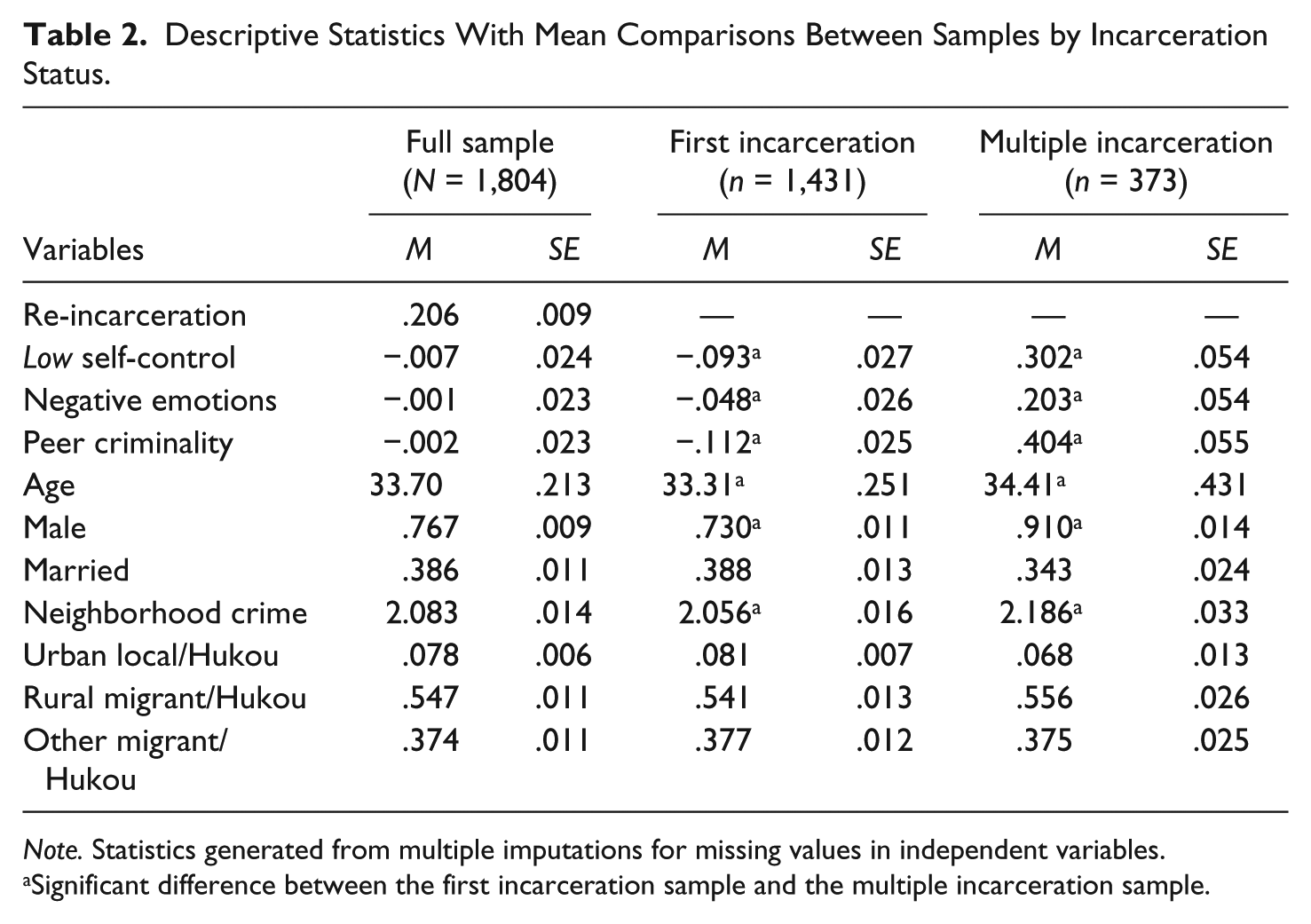
Descriptive statistics for the full sample of inmates and for the subsamples differentiated by re-incarceration status are reported in Table 2. Beginning with the full sample, approximately 20% of the prisoners in the sample were experiencing a repeat incarceration. The average age of respondents was about 34 years old, while more than three quarters were male (76.7%) and more than a third (38.6%) were married. Prisoners from urban areas who had rural Hukou (i.e., rural migrants to the cities) comprised a slight majority of the respondents (54.7%), while non-migrants in urban areas with local Hukou constituted about 8% of the sample. The “other category” (non-migrants with rural Hukou, urban migrants, and those not registered) constituted slightly more than a third of the sample.
Descriptive Statistics With Mean Comparisons Between Samples by Incarceration Status.
Note. Statistics generated from multiple imputations for missing values in independent variables.
Significant difference between the first incarceration sample and the multiple incarceration sample.
The final two columns in Table 2 display the contrasts between inmates experiencing their first incarceration and those who have repeated incarcerations. Consistent with expectations, the means for the theorized “risk factors” are all significantly higher for the multiple incarceration subsample. The means for age, proportion male, and reported neighborhood are also significantly higher for the multiple incarceration subsample. In contrast, the two subsamples do not differ significantly with respect to marital status or migrant/Hukou status.
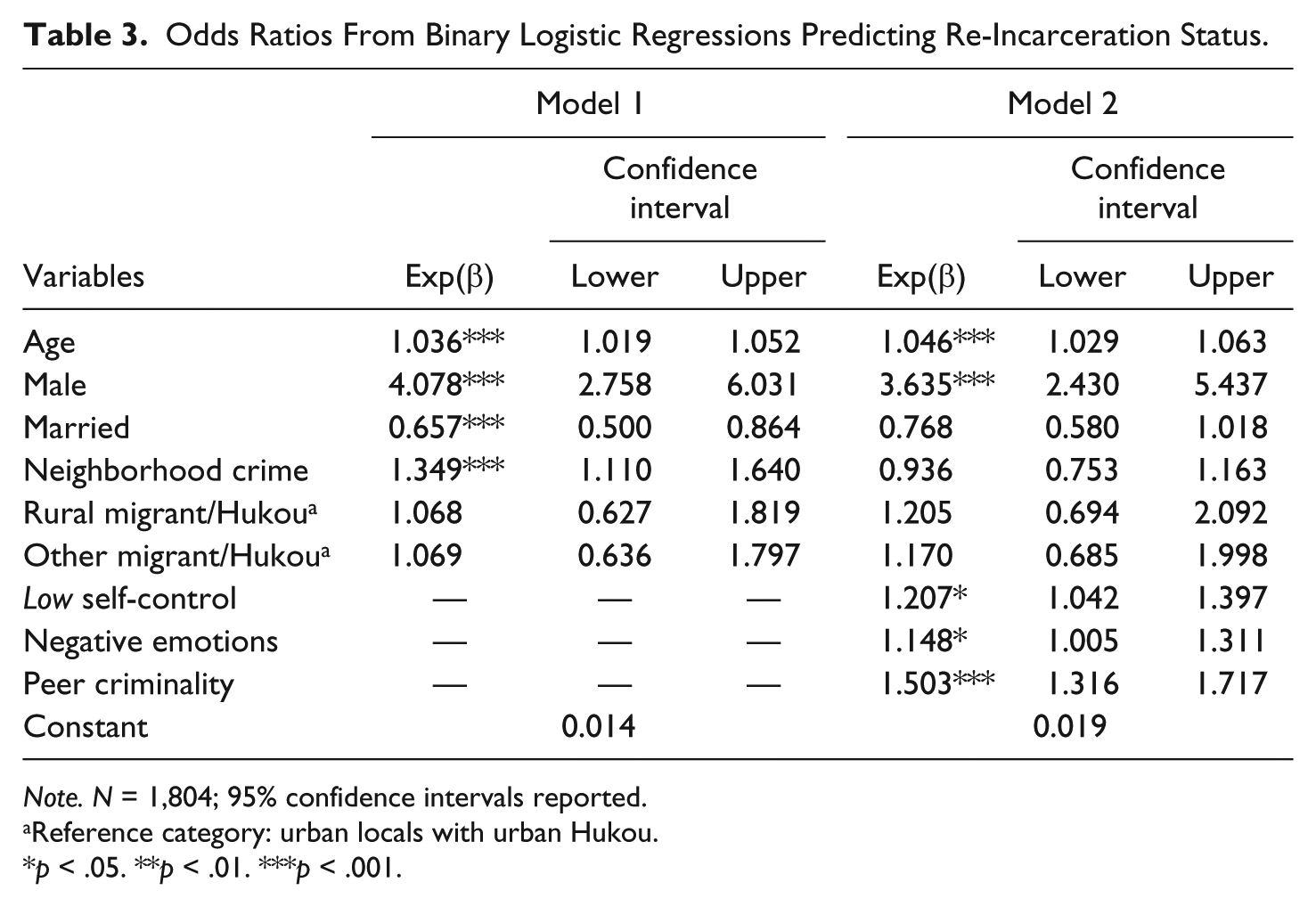
Odds ratios and their 95% confidence levels from the multivariate logistic regression analyses are reported in Table 3. Model 1 is a baseline model that includes only the control variables. As expected, age is positively related to re-incarceration status. For each additional year, the likelihood that the inmate was serving a repeat incarceration rather than a first-time sentence increases by about 4%, Exp(β) = 1.036. The findings for the other sociodemographic variables are consistent with patterns that have been widely observed in analyses of criminal offending. The likelihood that males had re-incarceration status is approximately 4 times greater than that for females, whereas married inmates exhibited about a 35% lower chance of being a re-incarcerated inmate. The indicator of residential location also exhibits a significant effect on re-incarceration status. As the perceived level of crime in the prisoner’s neighborhood prior to going to prison increases, so does the likelihood that the prisoner was serving a repeat incarceration. Migration/Hukou status, in contrast, is not significantly related to the re-incarceration measure.
Odds Ratios From Binary Logistic Regressions Predicting Re-Incarceration Status.
Note. N = 1,804; 95% confidence intervals reported.
Reference category: urban locals with urban Hukou.
p < .05. **p < .01. ***p < .001.
The key independent variables are added to the equation in Model 2 of Table 3. All of the coefficients for these variables are in accord with the hypotheses. The likelihood of re-incarceration status increases along with the lack of self-control, level of negative emotions, and reported association with criminal peers. With respect to the control variables, the results for age, gender, and migrant/Hukou status are largely unchanged. In contrast, the significant effects for marital status and for neighborhood crime become nonsignificant in Model 2 in comparison with the results in Model 1.
A plausible interpretation of the findings for neighborhood crime is that exposure to criminal peers statistically interprets the significant association observed in the baseline model. Inmates residing in areas with high levels of crime have greater opportunities to associate with criminal peers, which could then be reflected in the increased likelihood of being an inmate serving a repeat sentence. To explore this possibility, we estimated an ordinary least squares (OLS) regression model with the measure of peer criminality as the dependent variable and perceived neighborhood crime as an independent variable, along with the other variables as predictors (excluding the measure of re-incarceration status).
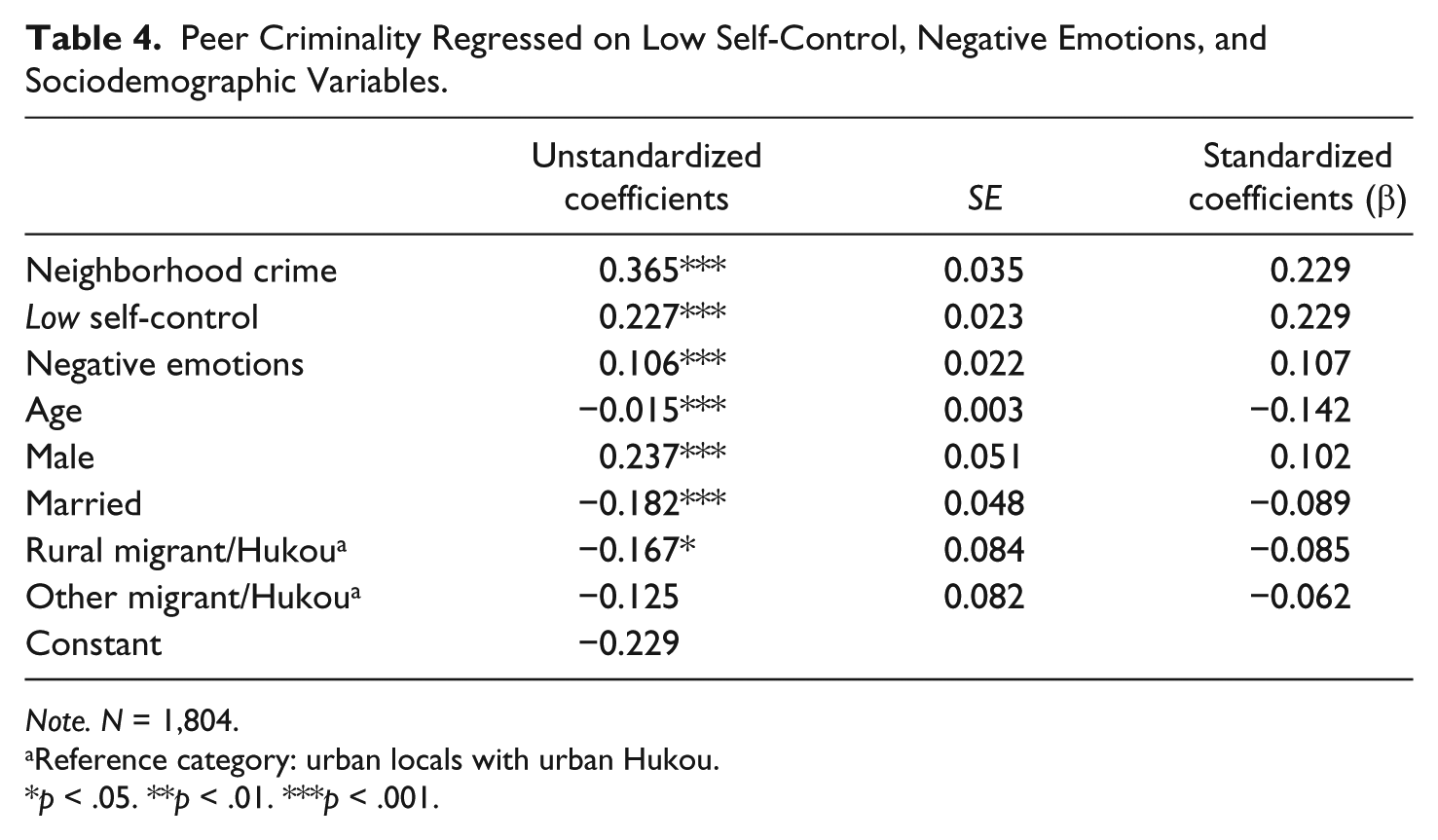
The results are presented in Table 4. Consistent with our speculative interpretation, inmates perceiving higher levels of crime in their neighborhood prior to incarceration are significantly more likely to report higher degrees of exposure to criminal peers (β = .229). The measures of both low self-control and negative emotions also yield significantly positive coefficients (β = .229 and .107, respectively). The former relationship accords with the arguments in the general theory of crime that persons with low self-control tend to seek out criminally or delinquently oriented peers (Gottfredson & Hirschi, 1990, pp. 157-158). The finding for negative emotions is also compatible with some type of “selective association” process, although we caution that causal order is ambiguous for these variables (criminal peer associations could foster negative emotions). With respect to the control variables, males also report higher degrees of exposure to criminal peers, whereas older inmates and married inmates report less criminal peer exposure. A particularly interesting finding emerges for the migrant/Hukou variable. Rural migrants exhibit lower levels of association with criminal peers than do urban residents with local Hukou (the reference category for the dummy variables).
Peer Criminality Regressed on Low Self-Control, Negative Emotions, and Sociodemographic Variables.
Note. N = 1,804.
Reference category: urban locals with urban Hukou.
p < .05. **p < .01. ***p < .001.
The interpretation of the changing coefficients for marital status across Models 1 and 2 in Table 3 is uncertain. In their general theory of crime, Gottfredson and Hirschi (1990) maintain that self-control is formed relatively early in life and that it, thereafter, becomes a stable personal characteristic. The lack of a significant association between marital status and re-incarceration in Model 2 of Table 3 would, accordingly, be suggestive of a spurious association in Model 1. Persons with low self-control are less likely to get married and are more likely to “achieve” re-incarceration status. Other research, however, has challenged the “stability” postulate in self-control theory (Burt, Simons, & Simons, 2006), which raises the possibility that marriage might foster greater self-control. We do not engage this debate but simply note that unmarried inmates have significantly higher average levels of low self-control, which would be consistent with either a mediating relationship (marriage fosters greater self-control) or a spurious association (low self-control is positively associated with both being unmarried and repeat incarceration status).
Summary and Conclusion
We have analyzed data from a recently conducted survey of inmates incarcerated in Chinese prisons. This data set has allowed us to examine criminological outcomes for adult offenders, a population that has been relatively neglected in previous research in China. In addition, we have been able to extend the focus beyond the forms of offending commonly studied in self-report studies of adolescents—minor delinquency—to encompass involvement with the formal institutions of social control that deal with serious offenders. Our specific focus has been on differentiating between inmates who were in prison for the first time from those who had experienced repeated incarcerations. Drawing upon three of the more influential theories in the discipline—social learning theory, self-control theory, and GST, we have derived hypotheses about characteristics of prisoners that might serve as useful predictors of their re-incarceration status, and we have assessed these hypotheses in multiple logistic regression analyses with an array of sociodemographic controls.
The results of our statistical analyses indicate that the hypotheses derived from Western criminological theories perform very well. The measure of association with criminal peers, a key indicator from social learning theory, is positively associated with the likelihood that a prisoner was serving a repeat incarceration rather than serving a first-time sentence. Similarly, as anticipated on the basis of self-control theory, the likelihood of repeat incarceration increases along with higher levels of low self-control. Finally, our measure of negative emotions—which has been theorized to be a typical outcome of experiences of strain—is significantly associated with re-incarceration status. Inmates with higher recorded levels of negative emotions exhibit increased likelihoods of having served multiple incarcerations. We acknowledge that strain is not the only source of negative emotions, and, thus, more definitive assessments of GST will require more direct measures of core concepts. In addition, it would be particularly instructive in future research to include indicators of distinctive strains that are likely to follow the experience of incarceration, such as stigma associated with the label of being an ex-inmate and associated experiences of discrimination.
More generally, we recognize that despite the benefits of studying a prison sample noted earlier, the design of the study precludes definitive inferences about the determinants of the overall risk of recidivism. Our analyses allow us to identify factors that effectively differentiate between inmates who were serving a prison sentence for the first time from those who had experienced previous incarcerations. However, the extent to which prisoners serving their first-time sentence are representative of the population of prisoners who will ultimately experience no more than a single incarceration is unknown. We have no information about the actual fate of first-time offenders upon their release, and the extent to which they reoffend and encounter the formal agencies of social control. In addition, although it is plausible to presume that certain etiological and criminalization processes work in tandem as explained above, our analyses cannot distinguish between them. A more rigorous strategy would entail identifying a cohort of incarcerated prisoners, following them over an extended period of time upon release, and modeling the hazards of re-incarceration, allowing for the censoring of some cases (i.e., the released inmates who manage to avoid another incarceration during the time frame under investigation). The logistical difficulties of conducting such a study are formidable, and we are unaware of any such data. Implementing such a design is nevertheless a worthy goal for future research.
With these caveats in mind, it is notable that the overall pattern of results conforms rather closely to what would be expected if the inmates currently serving a sentence for the first-time are, in fact, representative of the population of offenders who end up having experienced a single incarceration. In addition to the results consistent with social learning theory, strain theory, and self-control theory noted above, the findings for the sociodemographic control variables are in accord with what would be expected given previous research on crime and delinquency more generally. The likelihood of re-incarceration status is higher for males and for those residing in neighborhoods where crime is more prevalent (as perceived by the respondents), while this likelihood is significantly lower for married than for unmarried respondents. 7 Our analyses would, thus, seem to provide at least suggestive, albeit indirect, evidence about some of the factors that affect an important aspect of criminal careers in China—the likelihood of re-incarceration—and they lend further credibility to the utility of transporting theoretical insights from Western criminology to very different sociocultural contexts.
By way of closing, we call attention to some policy implications of our findings. The recidivism research in the West referred to briefly above has yielded mixed results, but one of the more consistent findings is that effective programs are those that are “cognitive-behavioral or behavioral in nature, skill oriented, and multimodal . . . Effective programs create cognitive transformations” (MacKenzie, 2012, p. 468). These Western findings are consistent with the Chinese belief that behavior is determined by thoughts and cognitive processes. Indeed, Chinese culture, grounded in Confucian philosophy, emphasizes the malleability of people (Fei, 2015; Yang, 2008).
Our analyses point to two areas in which cognitive transformations are likely to be particularly important—building self-control and enhancing coping mechanisms to deal with negative emotions. Although Gottfredson and Hirschi (1990) theorized that low self-control is cultivated at young ages and tends to be fixed thereafter, subsequent research has challenged the stability postulate (Burt et al., 2006). Moreover, research informed by GST has underscored the importance of cognitive skills as effective coping with strains and dealing with negative emotions in non-criminal ways. Some Chinese research has claimed that program failures in prisons are due, in part, to the lack of success in promoting good thoughts and character; these programs were not able to touch the heart of offenders (Han & Li, 2007; He et al., 2012). Although the terminology differs from that in the West, the same theme of cognitive transformation emerges in this literature. Finally, our finding that criminal peer associations is a significant correlate of re-incarceration status reaffirms some previous research in China, and it underscores the importance of promoting pro-social contacts and bonds upon release to reduce the risks of re-incarceration.
Footnotes
Appendix
Acknowledgements
We are grateful to Professor Jin Cheng, Zhejiang Police College in China, for assistance with the data collection, and to Professor Tse-Chuan Yang, University at Albany, State University of New York (SUNY), for advice on statistical modeling.
Declaration of Conflicting Interests
The author(s) declared no potential conflicts of interest with respect to the research, authorship, and/or publication of this article.
Funding
The author(s) disclosed receipt of the following financial support for the research, authorship, and/or publication of this article: Jianhong Liu received financial support from the University of Macau to assist with aspects of the research.