



Abstract
Desistance as a process to forgo delinquent habits is an important target for intervention into youth at risk of delinquency. The intervention through social work services, nevertheless, has not clearly demonstrated its effectiveness. For such a demonstration, the present study examines the contribution of social work services with reference to the voluntaristic theory of action. The theory suggests that promoting the youth’s voluntarism underlying desistance, encompassing appreciation, facilitation, observation, and identification concerning desistance is essential. The suggestion leads to the hypothesis that social work services promote the youth’s desistance through the promotion of voluntarism for desistance. This hypothesis gets support from this study of 586 at-risk youths in Hong Kong, with data collected from both the youths and their responsible social workers. The support implies the value of social work services for sustaining the youth’s desistance.
Desistance as a process of forgoing delinquent habits is a target for intervention among youth at risk of delinquency (Leone, 2008). Identification of such at-risk youth based on their manifest or reported delinquency is a task of social workers concerned with tackling delinquency (White, 2009). Notably, social work services, including contact and counseling, are supposed to be effective in fostering desistance in the youth (Lee, 2013; Skiba, Monroe, & Wodarski, 2004). However, the effectiveness appears equivocal, in view of some contradictory findings (Farrington & Welsh, 2007; Schilling, Dornig, & Lungren, 2006). An approach to circumvent the equivocality is tracing the pathway of the effectiveness (Beach & Pedersen, 2013). A necessary pathway, according to the voluntaristic theory of action, is voluntarism, which means having freedom to choose (Munch, 1987; Parsons, 1968; Sciulli, 1986). Specifically, voluntarism refers to the agent’s demonstration of adaptation, goal attainment, integration, and latency as opposed to submission to the manipulation and regulation of the authority or system. With reference to the theory, the study seeks to trace the effects of social work contact frequency, service duration, and counseling consistency on voluntarism for and practice of desistance successively in the at-risk youth in the real-life setting. The real-life study aspires to uphold ecological validity in social work practice (Polcin, Nayak, & Blacksher, 2008).
Desistance refers to the youth’s reducing, avoiding, forgoing, or stopping the habits of delinquency or violation of law or regulation (Brighouse, 2006; F.-Dufour, Brassard, & Martel, 2015; Fox, 2006; Massoglia & Uggen, 2010). Crucially, desistance is effortful, manifested as an action (Lloyd & Serin, 2012). As such, desistance should be explicable by a theory of action, such as the voluntaristic theory of action.
Voluntaristic theory centers on the actor’s voluntarism as the necessary basis for action (Munch, 1987; Parsons, 1968; Sciulli, 1986; Silver, 2011). Principally, the theory holds that any action depends on four preceding sub-actions to fulfill the four functions of adaptation, goal attainment, integration, and latency. Adaptation means appreciation of the benefit as opposed to the cost of action. Appreciation involves calculation, optimization, or rational choice. Goal attainment means facilitating an action or making it easy through goal setting and mobilization of power or resources. Facilitation embraces encouragement, strengthening, or gathering of strengths for their realization. Integration necessitates learning or observation about action, notably from other people. Observation is the condition for conformity to others’ action or compliance with the social norm to uphold the match to the social group. Latency requires identification with personal nature to maintain it. Identification is the foundation for sustaining cognitive, idealistic, or symbolic consistency within the actor. Hence, appreciation, facilitation, observation, and identification are integral components of voluntarism for preparing an action. Voluntarism particularly prevails in the late modern time, thanks to the individualization, which increases personal responsibility for action (O’Brien, 2015).
Voluntaristic theory is especially pertinent to explanation for action to maintain social order (Parsons, 1968; Silver, 2011). Accordingly, the theory evolves to address the puzzle of conformity, compliance, or law-abiding, which is not directly or overtly beneficial to the individual actor. The theory therefore maintains that optimizing personal gains is not only a basis for abiding. Similarly, the theory also holds that abiding is not only a result of realizing personal goals, ideals, and identity. The theory essentially takes abiding as a product of observing and learning social norms, as well as optimizing personal gains, and realizing personal goals, ideals, and identity.
Voluntarism is applicable to desistance in the following ways: Appreciation of desistance involves the understanding of gain from desistance and loss from delinquency (Farrall, Hunter, Sharpe, & Calverley, 2014). Facilitation of desistance rests on recognition of personal capability and readiness for desistance (Lloyd & Serin, 2012). Observation of desistance happens in finding others’ desistance (Bahr, Harris, Fisher, & Harker, 2010). Identification with desistance means understanding about personal identity for desistance (Fader & Traylor, 2015).
Apart from voluntarism, social work services concerned with youth delinquency is also likely to raise the youth’s desistance, as well as other favorable outcomes (Lee, 2013). In this connection, social work services would strive to sustain abiding by just and reasonable law (Fenton, 2012). Given the just law, social work services attempt to encourage abiding or desistance through some action, as reckoned in contact (frequency), service duration, and counseling consistency. Social work contact with the service user is a means of social work input to the user (Paulus, 2001). The contact encompasses counseling, encouragement, monitoring, teaching, helping, and other forms of communication, exchange, or interaction (Rubbins, Chatterjee, & Canda, 2006). Social work service duration taps exposure to social work influence. Among the services, counseling is vital (Peters, 2011). Particularly, the consistency or completeness of counseling is a marker of effectiveness (Najavits, 2003). What is more, social work services advocate and facilitate the enactment of just law to make it reasonable for abiding (Dunlop & Fawcett, 2008). For fostering youth’s desistance, as a whole, social work services thus encompass counseling, advocacy, brokerage, referrals, and instrumental aid to satisfy youth’s needs for welfare, accommodation, education, employment, friendship, and others (Cooney, 2010; Cortis, 2012). When these services aim to empower youth, they are compatible with attempts to induce the youth’s voluntarism through facilitating the youth’s capability, modeling for the youth to learn, affirming the youth’s ideas and identities, and reinforcing the youth’s choice (Graybeal, 2007; Shamai, 2003).
Social work services, including counseling consistency, contact frequency, and duration, have not appeared to be uniformly effective in raising the youth’s desistance or law-abiding (McBeath et al., 2010; Peters, 2011). Notably, the effectiveness can vary among different counseling and intervention modes. In general, interventions that use skill-building, cognitive-behavioral techniques, and those that target reducing pro-criminal attitudes, increasing non-criminal skills, and building connections to non-criminal peers have appeared to be effective, whereas interventions that are punishment-oriented, unstructured, and peer-driven are not effective (Dodge, Dishion, & Lansford, 2006; Greenwood, 1995; Lee & Lee, 2003; Lowenkamp, Latessa, & Holsinger, 2006; Stinchcomb, 2005). Possibly, the interventions that enhance the youth’s agency or voluntarism tend to be effective. As such, voluntarism is likely to characterize the pathway for social work services to manifest their effectiveness.
Hong Kong Context
For illustrating the contribution of social work services to the desistance of the at-risk youth, the Chinese metropolis of Hong Kong is the chosen site. Such an illustration is informative because of the socioeconomic similarity and relevance of Hong Kong to other developed societies. Remarkably, Hong Kong has systematic infrastructures and services to tackle crime and delinquency in the market-oriented economy (Adorjan & Chui, 2012). As such, Hong Kong has established social work services to help at-risk youth desist from crime or delinquency (Lee, 2013). Meanwhile, crime and delinquency are not particularly serious in Hong Kong, thus echoing the harmonious tradition in Chinese society (Fung, 2012). In the society, crime and delinquency are the objects for stigmatization (Wong, Holroyd, & Bingham, 2011). Hence, desistance is particularly socially desirable in Hong Kong (Adorjan & Chui, 2012). Despite such features, Hong Kong serves as a bridge between China and the West in the diffusion and consolidation of information and knowledge (Lui, 2014). All these features make Hong Kong a crucial place for research and development (Fung, 2014).
To tackle youth delinquency, social work and police services play primary and complementary roles in Hong Kong, as well as in other places (Adorjan & Chui, 2014). The complementarity happens in the integration of the rehabilitative approach in social work services and punitive approach in police services (Cheung & Ngai, 2009). Specifically, social work services, mostly sponsored by government, include outreaching, school, probation, community support, and youth centers services (Chui & Chan, 2011; Lee & Lee, 2003). They share the rehabilitative approach of empowerment, advocacy, and client-centeredness in safeguarding the youth’s rights and interest (To, 2009). On one hand, the approach is likely to strengthen youth’s voluntarism for desistance through encouraging, modeling, social networking, and others (Lee, 2013; Lee & Lee, 2003). On the other hand, the approach can sometimes lead social work services to query and confront the law, police, or punitive services (Cheung & Ngai, 2009; To, 2009). Such queries and confrontation pose an uncertainty about the contribution of the social work services to the youth’s desistance. To address the uncertainty, the study of the social work contribution is necessary. In this regard, the study visualizes the contribution within the framework of the voluntaristic theory of desistance.
Voluntarism for Desistance as a Determinant of Desistance
With respect to voluntaristic theory, voluntarism for desistance would be a determinant of desistance. The theory posits that action evolves from four components of voluntarism for the functions of adaptation, goal attainment, integration, and latency (Munch, 1987). These functions take the forms of appreciation, facilitation, observation, and identification to integrate various factors for desistance.
In the case of desistance, appreciation represents the rational choice or rationality generally to maximize gains from the desistance (Frisher & Beckett, 2006). The contribution of appreciation of desistance is consistent with those of expected or experienced gain from desistance (Lloyd & Serin, 2012). The gain can stem from reintegration into the community through desistance (Kao, Huang, & Wang, 2009). Conversely, the perceived harm of crime has appeared to hinder desistance (Harris, 2014). The harm can include feelings of shock and tiring, and fear about imprisonment (Farrall et al., 2014). In addition, conflict with parents can be a cost of crime to initiate desistance (Kim, 2009). Expected gain from delinquency has also posed an obstacle to the youth’s desistance (Abbey, Wegner, Pierce, & Jacques-Tiura, 2012). Moreover, depreciation of law in general has stood as a barrier to desistance (Emery, Jolley, & Wu, 2010).
The contribution of facilitation of desistance registers the value of the power, strength, agency, capability, or other personal resources for activation or realization (Healy, 2013; Lloyd & Serin, 2012). Such resources can be useful for cognitive transformation to envision an alternative to crime to justify desistance (Giordano, Cernkovich, & Rudolph, 2002). Another resource is self-control, which functions to discount the value of crime to buttress desistance (Paternoster & Bushway, 2009). A similar resource for desistance is the internal locus of control (Healy, 2013). More specifically, self-efficacy for desistance is another resource to exercise desistance (Fader & Traylor, 2015). Self-control and self-efficacy furthermore represent one’s resiliency to overcome obstacles to desistance (Walker, Bowen, & Brown, 2013). Conversely, criminal opportunity such as being in a mob that reduces self-control or nullifies self-efficacy would undermine desistance (Farrall et al., 2014). In addition, difficulty in desistance, which implies personal incapability, has appeared to discourage desistance (Harris, 2014).
Observation of others’ desistance would sustain desistance from the process of social learning and conformity (Bahr et al., 2010). The sustenance is possible through association with law-abiding others (Hay, 1998). These people can foster one’s desistance by reintegration into the law-abiding community (Kao et al., 2009). As such, these people exert social control to regulate desistance (Fader & Traylor, 2015). They also provide acceptance, which encourages desistance (Farrall, 2005). Furthermore, they can be role models for desistance (Bahr et al., 2010). Particularly, significant others can impose pressure to urge desistance (Walters, 2000). Conversely, association with law-violating people would discourage desistance (Bahr et al., 2010). As an alternative, marginalization by others would impede desistance (Fader & Traylor, 2015). In all, association, observation, and social control are influential on desistance (F.-Dufour et al., 2015).
Identification with desistance exerts its contribution through establishing or reshaping one’s identity in favor of desistance (Fader & Traylor, 2015). In the first place, law-abiding identity sustains desistance (Giordano, Cernkovich, & Holland, 2003). Moreover, the qualities of law-abiding identity, such as empathy, purposiveness, meaningfulness, future orientation, and openness to change, champion desistance (Farrall et al., 2014; Healy, 2013). The practice of redemption or redefinition to create a new identity is also essential to desistance (Giordano, Minter, Longmore, Johnson, & Manning, 2015). Conversely, identity characterized by anger, pessimism, or fatalism is antithetical to desistance (Healy, 2013).
As a whole, voluntaristic theory is compatible with some integrated attempts to explain desistance or delinquency. One attempt incorporates various attitudes, beliefs, and traits about self-efficacy, power, resources, knowledge, and skill (Reynolds et al., 2010). Another attempt encompasses various exposures to law-abiding services and people, identity transformation, evaluation of deviance, and abilities for desistance (Fader & Traylor, 2015; Giordano et al., 2002). That is, the attitude and evaluation represent appreciation; the beliefs about self-efficacy, power, resources, knowledge, skill, and abilities signify facilitation; the exposures imply observation; and traits and identity denote identification.
Social Work Contribution to Desistance
Social work services are likely to contribute to desistance in the at-risk youth through various services, including counseling and its consistency. Essentially, the contribution would need contact frequency, duration, and consistency to realize (Barber, 2009). The contribution is reasonable, in light of voluntaristic theory through the functions of adaptation, goal attainment, integration, and latency. That is, optimization, facilitation, learning, and identification underpin the four functions, as suggested by the theory.
Social work services can enhance the client’s rational thinking to optimize gains (Schram, 2012). As such, they are likely to help the at-risk youth to calculate and optimize the reward and cost of desistance. Accordingly, social work services provide rewards for improvement (Ellis, Ellett, & DeWeaver, 2007). Meanwhile, the services can take a punitive role concerning law violation (Abramovitz, 2012). Besides, the services can clarify the reception of reward for desistance and punishment for delinquency (Rubbins et al., 2006). Reward from social work services is likely to be important to the youth, as the services are trustworthy (Breton, 2004).
Social work services can inform, enlighten, educate, and empower the youth (Jeffs & Banks, 1999; Shamai, 2003). Hence, the services are likely to function as resources to facilitate desistance in the at-risk youth. As such, the services can provide information, guidance, material resources, and tangible assistance for the service user to achieve goals (Rubbins et al., 2006). In addition, the services can serve as support to strengthen or encourage the service user (Early & GlenMaye, 2000). The services can also enlarge the social support network for the service user to access more resources (Seikkula et al., 2003). In addition, the services can offer empowerment to the service user (Ussher, Kirsten, Butow, & Sandoval, 2006). To be voluntaristic, the service user can find resources in social work services to realize and develop strengths (Glicken, 2004). Moreover, the youth can ascertain and sharpen his or her strengths through social work services (Malekoff, 2004). The at-risk person can also set the goal of desistance through support from social work services (Lee, 2013; Skiba et al., 2004).
Social work services can exemplify proper social norms such as cooperation (Gil, 2012). Thus, the services are likely to contribute to learning and conformity to requirement for desistance in the at-risk youth. As such, social work services can provide the model, reference, lesson, and norm for desistance (Rubbins et al., 2006). Furthermore, the services can impose control for the learning and conformity (Toseland, Jones, & Gellis, 2004). That is, the service user can learn and conform to the rule espoused in social work services and their related arrangements (Kurtz, 2004).
Social work services can enhance the client’s self-awareness and self-reflection (Yan, 2008). Thereby, the services are likely to enhance identification and consistency with the identity of the at-risk youth. Accordingly, the services help clarify and affirm the identity through encouragement for self-reflection and reevaluation (Rubbins et al., 2006; Ussher et al., 2006). The services also help the redefinition of identity and adherence to it (Fisher, 2004). Furthermore, the services safeguards self-determination in the service user to maintain consistency with the user’s identity (Trevithick, 2003). As such, the service user realizes, redefines, and adheres to the identity affirmed in social work services.
Overall, social work services are likely to engender the youth’s voluntarism through empowerment. Accordingly, empowerment aims to champion the youth’s ability and will to choose to optimize interests (Graybeal, 2007; Shamai, 2003). Empowerment in terms of skill enhancement or training for coping has appeared to prevent one’s violence or sustain one’s desistance (Ganguly & Sharma, 2002; Murray & Graves, 2013). Furthermore, empowerment in terms of vocational training has appeared to sustain one’s desistance (Shepard & Reif, 2004). Consequently, empowerment has counted as an effective element of social work services (Skiba et al., 2004).
Voluntaristic theory also suggests that social work services contribute to desistance indirectly through enhancement of voluntarism for desistance, which underlies the appreciation, facilitation, observation of, and identification with desistance. The contribution is likely to arise from the law-abiding stance of social work. Accordingly, social work is required to uphold the law and law-abiding (Fairbanks, 2012). Meanwhile, social work services embrace value clarification to enhance the appreciation of certain values (Yip, 2005). They also highlight the strengths of the service user for capitalization and realization (Shamai, 2003). Alternatively, social work services empower the service user to facilitate actions (Freedberg, 2015). Social work services also exert control to regulate the user’s conformity to the values (Abramovitz, 2012). The services can gather prosocial people for the service user to observe and emulate (Andrews, 2001). Moreover, the services can establish the prosocial identity and encourage the service user to identify with the identity (Ussher et al., 2006).
Specifically, the effects of social work services operate through contact frequency, duration, and counseling consistency. First, contact frequency is the concrete way for the services to inform, help, and thereby affect the service user (Wilson, Lipsey, & Derzon, 2003). Meanwhile, the service user can learn and receive help from the contact to make changes (Forste, Clarke, & Bahr, 2011). In addition, contact implies the attempt to maintain the relationship, influence, and exposure to the services (Marcus, King, Bock, Borrelli, & Clark, 1998). Particularly, contact is important in social work services to show care, empathy, and regard to induce the service influence (Davies, 2000). Contact is also a precursor to satisfaction with the services and thus their effectiveness (Fukhoury, McCarthy, & Addington-Hall, 1996). Second, service duration is important to maintain the service influence over time (Hohman, 2000). Accordingly, service influence relies on the stability or persistence of services (Ravndal, 2003). More generally, duration is a condition for learning through the maintenance of exposure and susceptibility (Akers, 1998). Duration is a measure of service intensity, especially when the service increases its efforts and inputs with time (Sin & Lyubomirsky, 2009). At least, duration indicates intensity as an accumulation of services. Third, counseling or essentially its consistency is the typical means for social work services to exert their help or influence (Gordon, Kinlock, Couvillion, Schwartz, & O’Grady, 2012). Accordingly, counseling provides information, guidance, and various ideas to shape or change the feelings, reasoning, attitudes, beliefs, knowledge, skills, and behaviors of the service user (Calhoun, Glaser, & Bartolomucci, 2001). The effectiveness of counseling may be due to the closeness, relevance, and believability of the counseling to the user (Griffiths, 1999). Particularly, the effectiveness hinges on the consistency of counseling to deliver its influences thoroughly and appropriately (Najavits, 2003). The consistency is likely to be deficient as counseling is dynamic, interactive, and convoluted (Barber, 2009). Deficient consistency is crucially responsible for the ineffectiveness of counseling (Miller & Rollnick, 2002). Moreover, counseling is a major part of social work contact, thus making it indistinguishable from the contact. All these reasons warrant counseling consistency as another distinctive indicator of social work services.
Hypotheses
Voluntaristic theory and related research thus propose the following hypotheses concerning the at-risk youth and his or her responsible social worker.
The hypotheses are in need of testing because of uncertain and contradictory findings in some existing studies. Principally, social work services have not demonstrated a clear contribution to desistance in the at-risk youth. That is, social work services have not appeared to be clearly effective in enhancing desistance, crime or delinquency prevention, or rehabilitation (Schilling et al., 2006). Similarly, counseling has not exhibited its effectiveness in preventing crime or delinquency (Rhodes et al., 2001). In particular, counseling consistency is possible to be counterproductive to the effectiveness of counseling (Prendergast, Podus, Chang, & Urada, 2002).
Adequate testing of the hypotheses requires controlling for possible confounding factors. The most remarkable confounding is likely to stem from the prior state of desistance, which may affect social work services as well as subsequent desistance. This confounding tends to echo the continuation of desistance effort (Kang, Deren, & Colon, 2009). In this connection, desistance 1 year ago serves as a control factor in predicting desistance in the previous 2 months. Besides, such background characteristics as the youth’s gender, age, education, and residency, and the gender, age, and social work experience of the social worker have possible effects on desistance and social work services. On one hand, desistance has appeared to be higher in one who is female, older, or higher in education (Bahr et al., 2010). On the other hand, service use has appeared to be more likely in one who is a girl, older, or lower in education (England, 2006). The work experience of the social worker is also likely to sustain the worker’s job performance (Rosenthal & Waters, 2006). In addition, such response characteristics as acquiescence and lying are in need of controlling. Acquiescence refers to rating all items highly and indiscriminately, whereas lying refers to the tendency of telling lies to present a socially desirable image (Paulhus, 1991). These response characteristics are especially biases in examining desistance (Hughes & Short, 2005).
Method
Participants
A sample of 586 at-risk youths and their 91 responsible social workers completed questionnaires for the youths and social workers, respectively. These youths and social workers joined 10 social work units located in various parts in the Chinese city of Hong Kong. These units had the major responsibility for identifying and serving at-risk youths to help them desist from crime or delinquency. Their social workers thereby identified youths according to their risks of delinquency, engaged them in social work services, and eventually invited the youths to participate in this study voluntarily according to professional and ethical codes. The risk could be any manifest or reported delinquency act, including runaway, truancy, theft, fighting, vandalism, drug abuse, and affiliation with a gang. On average, each worker invited 6.4 youths.
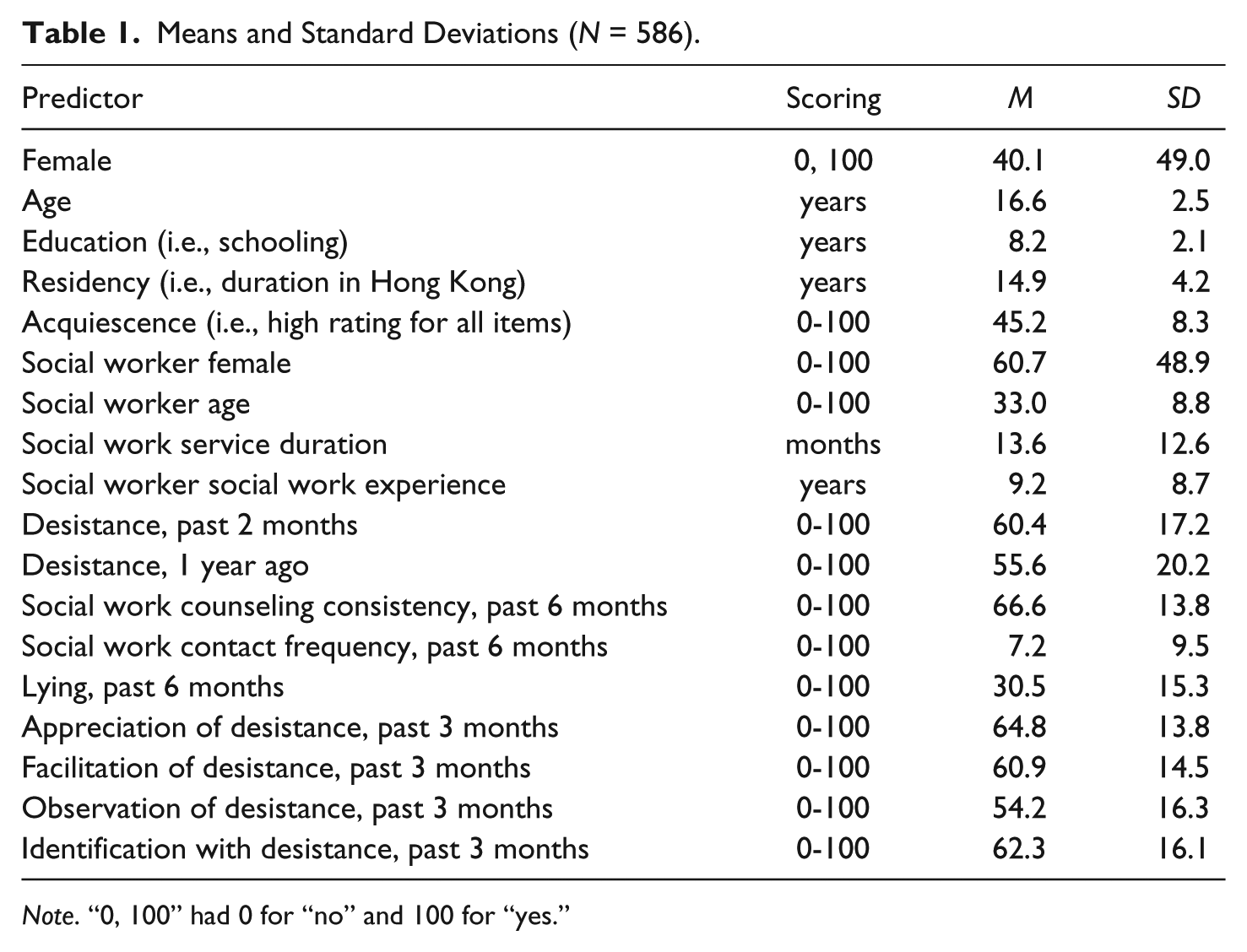
The youths had ages ranging from 12 to 24 years, with an average of 16.6 years (see Table 1). They had an average of 8.2 years in education (with 1 year for Grade 1, 2 years for Grade 2, etc.). Their residency or duration of residence in Hong Kong was 14.9 years on average. Among them, 40.1% were girls. Meanwhile, their social workers had an average age of 33.0 years. Their experience in social work services was 9.2 years on average. Among the workers, 60.7% were female.
Means and Standard Deviations (N = 586).
Note. “0, 100” had 0 for “no” and 100 for “yes.”
Measurement
The questionnaire for the youth included a number of questions to measure the youth’s desistance in the past 2 months and 1 year before, and appreciation, facilitation, observation, and identification regarding desistance in the previous 3 months, and lying as well (see Table 2). Meanwhile, the questionnaire for the social worker included a number of questions to measure the worker’s contact with, service duration, and counseling consistency regarding the corresponding youth. All the questions collected ratings on a 5-point scale. The scale then generated scores ranging from 0 to 100, with the score of 0 for the lowest point, 25 for the second point, 50 for the middle point, 75 for the fourth point, and 100 for the highest point. Such scoring facilitated interpretation and comparison (Preston & Colman, 2000). The questions were interspersed randomly within some sections in the questionnaires to minimize the bias due to the clustering of similar questions (Tourangeau, Rips, & Rasinski, 2000). Moreover, some of the questions were negatively phrased and required reversals in scoring.
Standardized Factor Loadings.

Desistance in the previous 2 months and 1 year before each combined the same six items, such as “giving up your delinquent habit” (Leone, 2008). That is, the youth, who had personal experience in delinquency, indicated the extent of giving up delinquent habit. The six items showed a composite reliability coefficient of .745 for desistance in the previous 2 months and .775 for desistance 1 year before.
Appreciation of desistance in the previous 3 months combined seven items, such as “reckoning the gain from stopping delinquency” (Wild, Cunningham, & Ryan, 2006). That is, the youth reported the extent of reckoning the gain from stopping delinquency. The items displayed a composite reliability coefficient of .617.
Facilitation of desistance in the previous 3 months combined seven items, such as “knowing how to inhibit your anger” (Forste et al., 2011). That is, the youth reported the extent of knowing how to inhibit anger. The items displayed a composite reliability coefficient of .648.
Observation of desistance in the previous 3 months combined six items, such as “significant others’ law abiding” (Bahr et al., 2010). That is, the youth reported the extent that significant others abided by law. The items displayed a composite reliability coefficient of .614.
Identification with desistance in the previous 3 months combined six items, such as “realizing that you should be a law-abiding person” (Walker et al., 2013). That is, the youth reported the extent of realizing that one should be a law-abiding person. The items displayed a composite reliability coefficient of .623.
Voluntarism for desistance in the previous 3 months combined appreciation, facilitation, observation, and identification concerning desistance as a second-order factor. Its composite reliability was .921.
Lying in the past 6 months combined three items such as “being glad to bless people whom you disliked” (Paulhus, 1991). Its composite reliability was .602.
Social work counseling consistency in the previous 6 months was a composite of three items, such as “(not) having a break in counseling the target about law abiding” (Najavits, 2003). That is, the youth reported the frequency of a break in counseling about law-abiding. Its composite reliability was .841.
Social work contact frequency in the previous 6 months was a single item about the number of times that the social worker contacted the target youth in that period. Meanwhile, social work service duration was a single item about the duration that the social worker had provided counseling and other services to the target youth. In addition, the social worker’s service duration referred to experience in social work services.
Acquiescence was the average of all rating items completed by the youth. It showed the youth’s tendency to rate all items highly regardless of item content. Based on confirmatory factor analysis in structural equation modeling, this measure identified the method factor required for minimizing any bias due to acquiescent rating.
Procedure
The study first obtained the consent of at-risk youths and their responsible social workers affiliated with the 10 social work service units to participate in the study. The youths and social workers then completed their questionnaires separately. Notably, each youth had a specially assigned code for pairing the questionnaires completed by the youth and responsible social worker. Eventually, a complete case for each youth encompassed data provided by the youth and social worker.
Analysis of the data principally relied on structural equation modeling via Mplus (Muthen & Muthen, 2006). The modeling had the merit of fitting a model that integrated measurement and structural relation parts in a cluster sampling design (known as the complex design in Mplus). Integration of measurement and structural relation was necessary because of the interdependency of measurement and structural relation to uphold a complete theory, known as nomological validity, which assembled convergent validity, discriminant validity, and predictive validity predicated on theoretical grounds (Lucas, 2003). The measurement part involved the identification of the eight first-order trait factors of desistance recently and 1 year ago, appreciation, facilitation, observation, identification regarding desistance, social work counseling consistency, and lying, along with the method factor of acquiescence. That is, each item rated by the youth loaded on a trait factor and method factor. This was to distill the trait factor, which was separate from the method factor. The first-order trait factors of appreciation, facilitation, observation, and identification in turn identified the second-order trait factor of voluntarism for desistance. All the trait factors were suitable for structural relation analysis for prediction of desistance, together with the background characteristics of the youth’s gender, age, and education, and the gender, age, and social work experience of the social worker. In addition, the modeling adjusted for random variation among the 91 social workers, by means of the generalized estimating equations method in structural equation modeling (Hardin & Hilbe, 2003).
The aim of the modeling was to fit a model to the data to ensure the adequacy of estimated factor loadings and effects (see Figure 1). Notably, the modeling decomposed the effects into direct and indirect ones, and their sums gave total effects. The fitting relied on robust maximum likelihood estimation, which was robust to violation from the normal distribution in the data. Estimation of the indirect effects notably relied on the delta method in structural equation modeling (Hayes & Preacher, 2010). Nevertheless, estimation by bootstrapping was not possible because of the nesting of cases within social workers. The desirable good fit of the model handling 53 input variables would have a comparative goodness of fit index (CFI) above .90, standardized root mean square of residuals (SRMR) below .05, and root mean square error of approximation (RMSEA) below .07 (Marsh et al., 2004).

Significant estimates from the model predicting desistance by desistance voluntarism and background characteristics.
Results
Based on their raw scores (rather than factor scores), the averages of all the desistance recently and 1 year ago, appreciation, facilitation, observation, and identification regarding desistance, and social work counseling consistency were at a modest to moderately high level (M = 54.2-66.6, on a 0-100 scale, see Table 1). Among them, social work counseling consistency was relatively high (M = 66.6). Notably, the youth’s desistance showed an improvement from 1 year before to recent 2 months (M = 60.4 vs. 55.6). In contrast, the youth’s lying was low, on average (M = 30.5).
The structural equation modeling exhibited a good fit, L2(1206) = 1,799, SRMR = .040, RMSEA = .029, CFI = .921. This fit warranted the adequacy of the estimates of factor loadings and effects. Eventually, the analysis provided good explanations for desistance and voluntarism for desistance (R2 = .826 and .366).
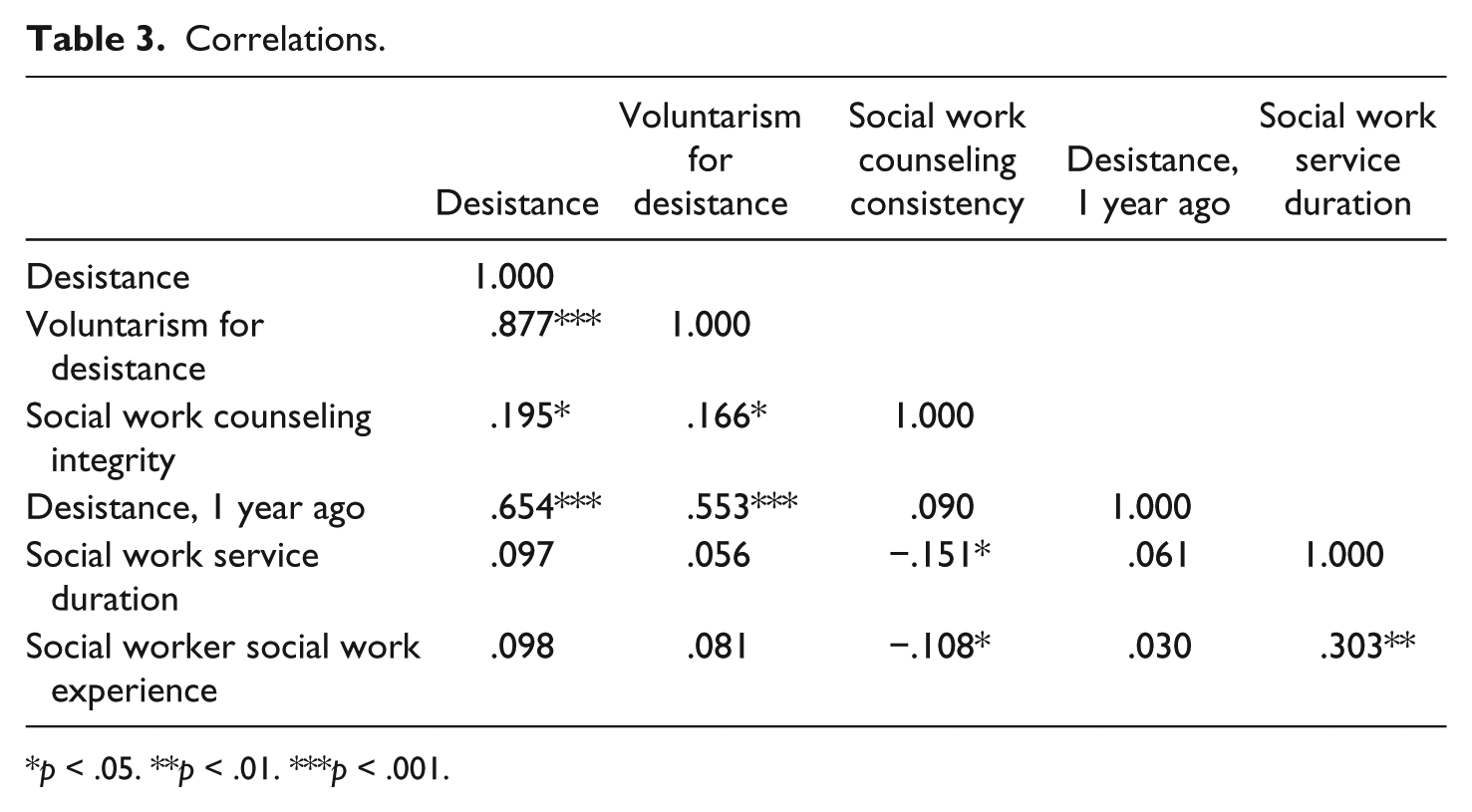
The structural equation modeling successfully identified the eight first-order trait factors and the second-order trait factor. Essentially, all the trait factors demonstrated substantial factor loadings, even in the presence of the method factor of acquiescence (see Table 2). That is, each of the trait factors manifested convergent validity and discriminant validity in having its respective indicators loading substantially and exclusively, given the separate factors. What is more, voluntarism for desistance stood as a second-order trait factor identified by the four first-order trait factors of appreciation, facilitation, observation, and identification. Meanwhile, the modeling indicated the need for controlling for the method factor, because its factor loadings were not negligible. Eventually, the trait factors of desistance, voluntarism for desistance, lying, and social work counseling consistency were involved in the structural relation analysis. These factors turned out to maintain varying degrees of correlations among themselves (see Table 3). These correlations were subject to the part of structural relation analysis in structural equation modeling to unpack hypothesized effects (see Figure 1).
Correlations.
p < .05. **p < .01. ***p < .001.
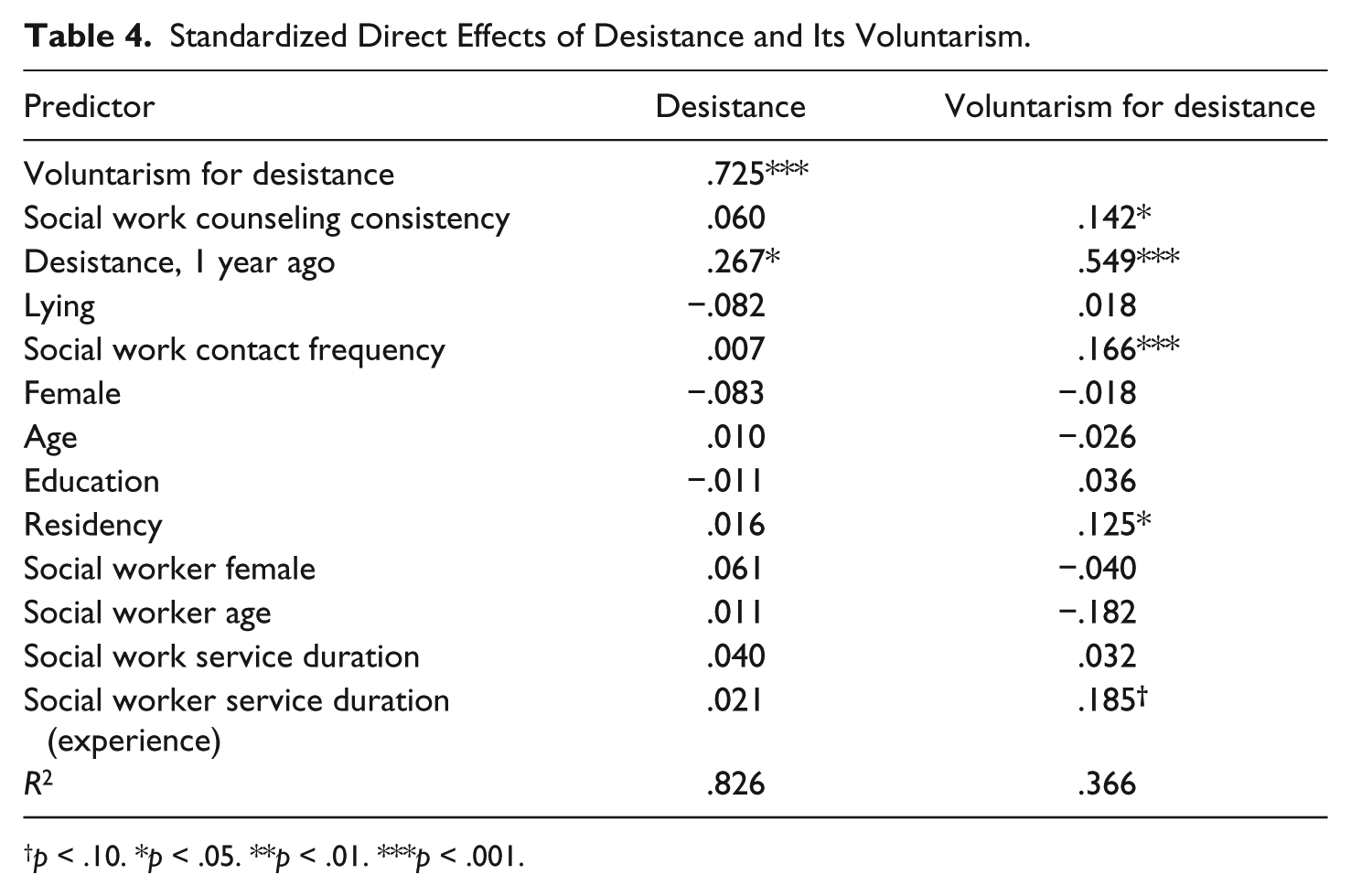
The structural relation analysis part of the structural equation modeling demonstrated the significant positive direct effect of voluntarism for desistance in the previous 3 months on desistance in the previous 2 months (β = .725, see Table 4). The effect was a net one, after controlling for the significant effects of desistance 1 year ago (β = .267) and others. This net effect supported Hypothesis 1. Meanwhile, desistance in the recent 2 months was lower in the female youth than in the male youth.
Standardized Direct Effects of Desistance and Its Voluntarism.
p < .10. *p < .05. **p < .01. ***p < .001.
The structural relation part also revealed the significant positive effects of social work contact frequency (β = .166, see Table 4) and counseling consistency (β = .142) on the youth’s voluntarism for desistance. These net effects, after controlling for others, supported Hypotheses 2a and 2c. Nevertheless, social work service duration did not indicate a significant positive effect on the youth’s voluntarism for desistance (β = .032). Besides, desistance 1 year ago exhibited a significant positive effect on voluntarism for desistance in the recent 3 months.
The structural relation analysis furthermore unfolded the significant positive total effects of social work contact frequency (β = .127), service duration (β = .066), and counseling consistency (β = .164) on desistance in the recent 2 months (see Table 5). These effects supported Hypothesis 3, encompassing all its three parts, pertaining to social work contact, service duration, and counseling consistency. In addition, the indirect effects of social work contact frequency (β = .120) and counseling consistency (β = .103) on desistance through its voluntarism were significant. As a control factor, the social work experience of the social worker also displayed a significant direct and indirect effect on the youth’s desistance (β = .155 and .134).
Standardized Total and Indirect Effects on Desistance.

p < .10. *p < .05. **p < .01. ***p < .001.
Discussion
Social work services appeared to raise the youth’s desistance, according to structural equation modeling. In this connection, the services were in terms of social work contact, service duration, and counseling consistency. Their effectiveness in raising desistance appeared to rely on mediation by law voluntarism. Specifically, social work contact and counseling consistency tended to sustain the youth’s voluntarism for desistance first and eventually desistance, thanks to the contribution of voluntarism for desistance. In addition, the social work experience of the social worker tended to contribute to the youth’s desistance through voluntarism for desistance. The total effects of these indicators of social work services on the youth’s desistance were significantly positive. They thus demonstrated the effectiveness of social work services in the real-life setting.
The effectiveness of social work services is justifiable. First, social work services represent the forefront to identify, contact, and help at-risk youth (Skiba et al., 2004). This means that the services are close, personal, pertinent, considerate, and responsive to the youth (van Wormer & Davis, 2003). These are effective service features for rehabilitation (Durnescu, 2012). Second, social work services emphasize alliance building through contact to be enduring (Peters, 2011). Such an emphasis and practice are also effective in rehabilitation (Najavits, 2003). Third, social work services tend to build on the health, strength, or capability of the service user (Peters, 2011). This approach may uphold service effectiveness through the user’s collaboration and otherwise engagement in the services (Ward & Langlands, 2009). Moreover, the approach conveys the kindness, understanding, and empowerment in the services to consolidate their effectiveness (Durnescu, 2012; Skiba et al., 2004). Fourth, social work services are prone to engage the family, peers, and other significant others in various ecological systems to help the service user (Peters, 2011). Such combination of efforts and resources can be effective in rehabilitation (Dodge et al., 2006). In all, social work services emphasize sustaining the self-determination of the service user (Fenton, 2012). This emphasis is consonant with voluntaristic theory and thus its voluntarism effect.
Among the three indicators of social work services, social work counseling consistency and contact frequency exhibited more positive effects on desistance than did social work service duration. The contributions of social work contact and counseling consistency may reflect the merit of closeness, responsivity, and relevance of the service indicators to the service user (Davies, 2000). These closeness and relevance may furthermore reflect the effectiveness through the delivery of services to the user (Husband & Platt, 1993). By contrast, service duration does not necessarily mean service delivery. Besides, a complication of service duration is that it also reflects problem duration, which poses an impediment to service effectiveness (Milton, Crino, Hunt, & Prosser, 2002). Therefore, the net effect of service duration became weaker than that of the other indicators. Anyhow, the significant effects of the three indicators showed that each indicator had a unique contribution. That is, the indicators were not redundant in the contribution.
Limitations and Future Research
This study has limitations in the single site and single time design, which discounts the generalizability and validity of the study results. On one hand, the Chinese society of Hong Kong is the single site whose sociocultural characteristics may determine the results and thus make them specific to Hong Kong. Such characteristics as social and harmony orientations and stigmatization to crime may facilitate social work services for rehabilitation to achieve its effectiveness (Fung, 2012). This facilitation would rest on the principle of multisystem support for service effectiveness (Dodge et al., 2006). Whether this sociocultural context affects the effectiveness requires future research. To examine such contextual effects, future research needs to collect data from diverse contexts to clarify the generality or specificity of the service effectiveness. On the other hand, the one-time measurement of the present retrospective design cannot ensure the causal influence of social work services on desistance and its voluntarism. Further research needs to use a prospective design to ascertain the influence from earlier services on later outcomes.
Specifically, the study findings are not conclusive due to a number of risks. First, the study has a risk due to the participants’ selectivity into the study. The study has no information to adjust for the selectivity risk. Second, the study has a risk due to the omission of mediating factors such as empowerment. Hence, the operation of the service effects is not transparent and traceable. Third, the study has a risk due to the constraint of the structural equation model. Accordingly, no technique is available to guarantee the indirect effect in a complex design that nests cases within social workers.
Future research can elaborate the present study by clarifying the contributions of the details of social work services on desistance and its voluntarism with voluntaristic theory. Such details essentially refer to different forms of counseling and assistance. Furthermore, processes responsible for the service contributions according to the theory need to be transparent in future research. That is, the research is necessary to reveal how the at-risk youth uses social work services to optimize and appreciate, facilitate, learn about, and identify with desistance. Examples in the services are rewarding, empowerment, prosocial gathering, and identity clarification. With the measurement of these service and application components, future research can show mediating processes sustaining the service contributions.
Implications
Given the contribution of social work services to desistance in the at-risk youth through the promotion of the youth’s voluntarism for desistance, the services are worthwhile for the youth’s rehabilitation. Thus, social work services can be more prominent in the rehabilitation (Peters, 2011). All the service contact frequency, duration, and counseling consistency deserve promotion and support to demonstrate their effectiveness in encouraging the youth’s desistance. According to voluntaristic theory, the roles of social work services in rewarding, empowering, modeling, and clarifying of identity or strength merit promotion (Lee, 2013; Skiba et al., 2004; Ward & Langlands, 2009). Particularly, the at-risk youth who is female or has a shorter stay in the city is lower in desistance or its voluntarism than is the other, and thereby has a greater need for social work services to uphold desistance.
Footnotes
Declaration of Conflicting Interests
The author(s) declared no potential conflicts of interest with respect to the research, authorship, and/or publication of this article.
Funding
The author(s) received no financial support for the research, authorship, and/or publication of this article.