




Abstract
This article describes the use of a questionnaire to measure offenders’ belief in the likelihood of their making a successful re-entry into society after having committed crime, a “belief in redeemability” (BIR) as described by Maruna and King. The 37 items for the scale were taken from statements by offenders about their prospects of making good. This set of items was tested with a pilot group of offenders recruited from clients on parole or on supervised bonds at community corrections offices in metropolitan Sydney, Australia, and their responses were coded to yield a score we called the “BIR” score. We found that scores displayed variance skewed toward an optimistic view, and we then used the items in a card sort task with a panel of graduate psychologists to explore whether the panel could identify underlying components of the broader BIR. There was a measure of agreement on three underlying components and these were further tested using five raters. We called the components that emerged the following: Belonging, Agency, and Optimism; Cronbach’s alphas for these indicated acceptable internal consistency. The results are discussed in terms of their congruence with findings in the literature and their use in correctional practice.
You gotta have a dream If you don’t have a dream How you gonna have a dream come true?
Introduction
Since the emergence of a narrative view of desistance from crime (Maruna, 2001), a number of authors have interviewed offenders and found that their life stories follow a few repeated patterns. These patterns are evident both in people’s life histories (the events), and in the way that people talk about their life stories (the narratives). Each of these authors has categorised the patterns in a different way using face-value, intuitive concepts to name their categories, and hardly any have used a priori theories or statistical methods to test their findings. One concept that has been related to a priori theory is that of “belief in redeemability” (BIR; Maruna & King, 2004, 2009), used to describe attitudes of the general public toward the prospect of offenders being able to reintegrate and lead genuinely good, crime-free lives. We have taken it as a useful construct with which to examine offenders’ beliefs about the possibility that they will desist from crime, testing its variance across offenders and its possible predictive validity regarding desistance. We have taken redeemability to mean the possibility of regaining a valued place in society (valued by the ex-offender as well as by the general public).
Much of the public’s thinking appears to be shaped by the media (Casey & Mohr, 2005), and a recent survey (Roberts & Indermaur, 2009) showed that respondents in an Australian sample had almost no confidence that anything could be done about the rate of crime. An innovative study by Tamara Rice Lave (2011) found that negative public assertions by U.S. governors concerning rehabilitation of sex offenders showed a disregard of the published evidence that such treatment was highly effective. The perception of hopelessness about ceasing to offend is common despite the existence of extensive literatures on therapeutic programs, early intervention, and situational crime prevention.
Research into recurrent crime has followed two main approaches, and it is worth examining their differences and similarities: the “risk-reduction/risk management” approach and the “desistance” approach. The former has largely been developed by psychologists, and the latter has mostly been the province of criminologists.
The Risk-Based Reducing Reoffending Approach
The risk-reduction approach is exemplified by the risk, needs, responsivity (RNR) model (Andrews & Bonta, 2010). The analysis focuses on the intra-individual elements that put the individual at risk of reoffending, and these elements are commonly measured by actuarial instruments such as the Level of Service Inventory-Revised (Andrews & Bonta, 1995). These instruments are used to identify those at greatest risk of reoffending and to identify the risk factors or “criminogenic needs” for the individual. These needs are then targeted in correctional interventions.
The risk principle states that more intensive treatments or interventions should target offenders who are at greatest risk of reoffending. This is not only because research has shown that those at greatest risk of reoffending are likely to benefit most from interventions but also that exposing low-risk offenders to inappropriate group programs may increase their risk of reoffending (Andrews, Bonta, & Wormith, 2006). The needs principle indicates that programs should focus on offenders’ criminogenic needs, the dynamic factors that research has shown to be reliable predictors of recidivism. These include a “big four” (most influential) and a “modest four” (less influential; Andrews et al., 2012). The “big” four are a history of criminal behaviour, an antisocial personality pattern, antisocial attitudes, and antisocial associates. The “modest” four concern how the person functions in the domains of family/marital life, school or work, leisure and recreation, and substance abuse. The responsivity principle refers to the need to take into account all the issues that may affect the participants’ ability to engage with and respond to the delivery of the program, eliminating those that hinder and maximising those that help. These include issues like the offenders’ motivation and their learning style or literacy levels, mental health, and ability to comprehend concepts. They also include the individual’s social and interpersonal skills and style and his or her ability to exert sufficient behavioural control to participate in the group’s work. The therapist’s or program facilitator’s skills, characteristics, knowledge, and style can also affect the effectiveness of program delivery (Marshall, 2005; Marshall et al., 2003).
The risk-reduction model is a deficit-based approach where risks are identified and interventions designed to lessen those risks. The issue as conceived by this approach is, “Here is a person who is likely to offend—how do we stop them?” The intervention is on a medical treatment model: We provide a certain dosage of treatment and observe what happens. To measure the effectiveness of the treatment, we observe how long it takes until the offender reoffends, and if this happens, we may administer another “dose” of treatment. This has been, and continues to be, an important and useful contribution to public safety, but it externalises the problem and focuses on what needs to be “done to” the offender by the correctional system or the clinician. It considers the offender “as part of an aggregate risk-averse management strategy” (Liebling, Hulley, & Crewe, 2011, p. 368).
The Desistance From Crime Approach
An order to “Cease and desist!” requires the subject party to stop what they are doing and not start again; they must stay “stopped.” Desistance research is about what it means to stop and not begin again rather than just what it means to stop. However, actual criminal histories are often a work in progress and there may be various “stops” and “starts” along the way. What is happening in the in between periods? When an offender is not offending, is he or she an offender? The focus of desistance research is not on what the correctional system does to the offender, but rather on what happens in the offender’s life that leads to both stopping the commission of crime and to “staying stopped.” Farrall and Maruna (2004) had used the terms primary and secondary desistance to describe this process. Primary desistance is any instance of stopping and secondary desistance is the effort that the former offender makes, once having stopped committing crime, to make a good life for him or herself. More recently, McNeill (2014) had used the term “tertiary desistance” to describe a more enduring, settled, state that emerges from a sense of belonging to the community.
Until the late 1990s, the explanations for desistance were loosely in two camps: the ontogenic view and the sociogenic view. The ontogenic view (see, for example, Gottfredson & Hirschi, 1990; Hirschi & Gottfredson, 1983) is that whatever happens is a function of the individual’s own internal maturation: As people get older, they simply stop committing crime, and this happens regardless of any extraneous factors. The sociogenic view (see, for example, Laub & Sampson, 1993) considers the life events, the milestones, the turning points in a person’s life that make a difference.
The Narrative Approach to Desistance
Prior to 1997, investigators used the term “narrative” in the context of desistance research, but they used it to describe a method of data collection rather than a heuristic or explanatory process. In 1998, Maruna completed the Liverpool Desistance Study, later published as Making Good (Maruna, 2001), which used extensive interviews and text analysis to elicit offenders’ own views on what the important variables were in “making good.” Maruna identified two “scripts” or consistent personal stories that he labelled the “redemption” and “condemnation” scripts, the former being associated with desistance from crime and the latter with persistence in crime. Although both persisters and desisters regarded themselves as victims of circumstances, the redemption script was characterised by a belief that the individual had agency, the ability to take control of their own life, make choices, and achieve goals. They believed strongly in this possibility even though the new way of being, “making good,” represented a change from their former life of crime. In contrast, the condemnation script was characterised by a sense of being unable to control the forces that bound them to their fate and relying on chance events (such as winning the lottery) to effect change in their lives. Maruna’s work was the first to use narrative in the sense of “self-story” conceptualised as a means of change and not simply a description of change. With Maruna, “narrative” began to be used in the sense in which it is used in narrative theory as in the work of Theodore Sarbin (1986) and narrative therapy, as in the work of Michael White and David Epston (Epston & White, 1992; White & Epston, 1989). This is an approach that privileges not the events themselves, but rather the individual’s account of them: the narrative.
In the same way as others use the idea of scripts (Tomkins, 1987) or schemas (Young, Klosko, & Weishaar, 2003), narrative theorists and therapists use the metaphor of a “narrative” or storyline to account for characteristic patterns of behaviour. The individual lives a life according to this storyline in much the same way that a character behaves in predictable ways in a novel or film. The predictability is based on a personalised heuristic that is referred to as the “dominant” story, a kind of rule of thumb that makes sense at once of the past and of the future. This basic story is revealed in life through assertions like “I’m not (or I am . . . ) the kind of person who does that kind of thing.”
The process of change in narrative approaches entails the envisioning of an alternative self, underpinned by an alternative way of viewing the past, called an “alternative story.” The individual comes to recognise and acknowledge that what she or he is enacting day-to-day is not the whole story, not the only possible version of events. The individual seeking change comes to realise that there is a more comprehensive account of himself or herself, an account that contains elements that may be more useful than those in the dominant story. It is important to note that the individual does not somehow “create” a new story, but rather “recognises” hitherto ignored parts of the self that nevertheless have always been there, and that, when focussed on, give a new perspective, a new take on the past and the future. For this reason, the alternative story has been called the “new-old story” (Hewson, 1991).
The alternative story has also to be actively acknowledged by the individual seeking change. We may indeed glimpse facets of self that are counterintuitive that would not be predicted by the dominant story, but we may not be able to transition from the well-rehearsed, problem-saturated story to a new narrative characterised by hope rather than despair (Burnett & Maruna, 2004), by agency rather than helplessness, or redemption rather than condemnation (Maruna, 2001). This acknowledgment and recognition is central to the endeavour of identifying a new story.
Desistance and Reoffending: The Two Literatures
So is the literature on desistance just the inverse of the reoffending literature? In other words, are the risk factors that contribute to crime by their presence, the same ones that contribute to desistance by their absence? The answer is sometimes, and this is well described in a recent review by de Vries Robbé, Mann, Maruna, and Thornton (2015). Where they do not overlap, there may be two reasons. First, the risk factors are derived by looking at the circumstances and characteristics of people who reoffended, not people who did not. The risk-based reoffending literature has not and does not systematically examine the characteristics and circumstances of the large number of people who succeed in desisting for good. This is not surprising because from a public risk point of view, these people are of no concern, by definition, and so attract little attention from risk-oriented psychologists interested in crime.
Second, as discussed above, the reoffending literature sits largely within a medical treatment paradigm of deficit and intervention, and researchers measure this survival in arbitrarily agreed periods of “one year survival,” “two year survival,” and so on. What may get lost in this model is the exploration of any variables that may not necessarily be implicated in reoffending, but may be important in not reoffending. This is the area of interest to desistance. The question that is posed by desistance researchers is not: “Here’s a person who is likely to offend—how do we stop them?” but rather, “Here’s a person who is no longer offending, how did they do that?” or “What will it take for this person who is offending to no longer do that?” The difference in focus is about the locus of change: In reoffending, the locus of change is the effort of the criminal justice system, in desistance, the locus of change is that of the individual and/or society.
In the same way that offenders struggle with self-belief and the possibility of change, so too does the general public, and the present study borrows a phrase used by Maruna and King in a 2009 study that examined public punitive attitudes or “penal populism” (Bottoms, 1995; Garland, 2002). Using data from the Cambridge Recidivism Study, Maruna and King used attribution theory to test what they called “belief in redeemability”, the sense that it really is possible for ex-offenders to reconstruct their lives. The present study uses this construct but applied to offenders themselves. Redeemability is understood as a sense that the individual can assume a valued social role and “redeem” (as in “pay for” and “buy back”) a non-criminal identity. This study describes the initial work to compose a measure of this BIR and to test the variance of the scores in an offender sample.
“Redeemability” is not a widely used term in the literature, being present in few articles other than the work of Maruna and King (2004, 2009). If it is to be useful, it is important to explore its components. Historically, writers have used such positive terms as hope, optimism, belief in self and narrative continuity, and such negative terms as shame, stigma, regret, and disdain to refer to the set of beliefs that offenders have about themselves and their prospects for a “straight” life (O’Sullivan, Kemp, & Bright, 2015). This study will further explore the construct of BIR.
Aims
Study Part 1: To create a questionnaire assessing beliefs about successful desistance from crime and see whether responses vary across respondents.
Study Part 2: To explore the components of “BIR” with a view to constructing a scale to measure them.
Method—Study Part 1
Participants
Participants in the questionnaire study were 51 attendees at a variety of correctional rehabilitation programs held in Community Corrections (Probation and Parole) offices in metropolitan Sydney, Australia. All participants were male, had a Level of Service Inventory-Revised (LSI-R) score of “moderate” or above, and were between the ages of 18 and 60. Other demographic details were not recorded, as the only criterion for inclusion was that participants be on a bond or a parole order under the supervision of New South Wales (NSW) Community Corrections. Participants were told that this was the beginning of a larger study to find out how people made major changes in their lives, such as desisting from crime. The researcher used a script to ensure that the same explanation was provided to each group. Chocolate biscuits were provided for the program tea-break to thank participants for their time.
Materials
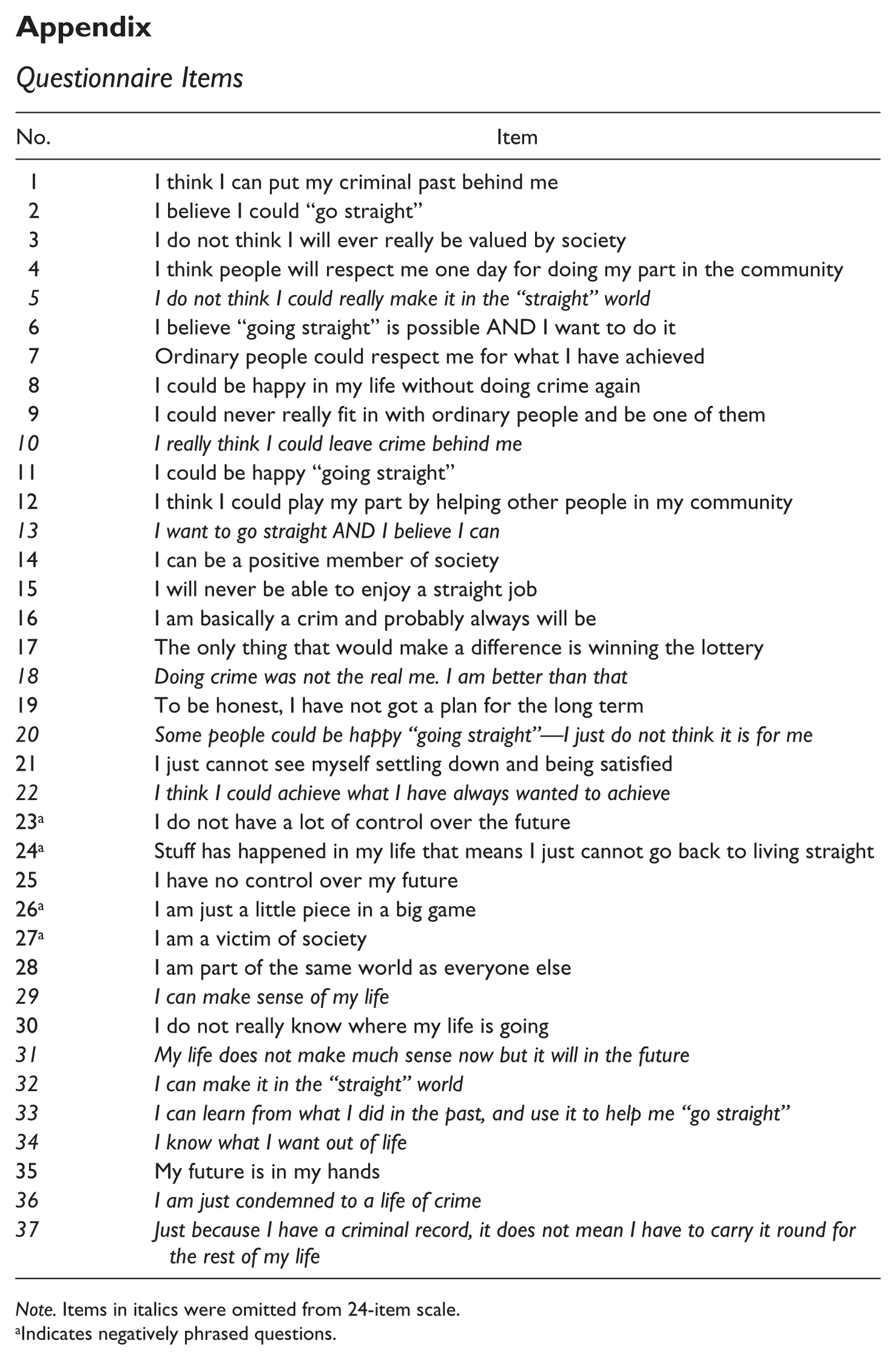
A questionnaire was constructed using phrases reported in the literature and supplemented by phrases recorded in interviews with ex-offenders in the Sydney Desistance Project (O’Sullivan, 2014). Sometimes, the phrases were used verbatim, and sometimes, they were amalgamated or revised for the sake of literacy level. The phrases were chosen for their face-value relation to the idea of “redeemability.” In all, there were 37 phrases to which participants responded using a 5-point Likert-type scale that was scored as follows: strongly agree (5), agree (4), not sure (3), disagree (2), and strongly disagree (1). The items were prefaced with the explanation: “Here are some things that men and women have said about “going straight” and staying away from crime. Please tick the number that best describes how strongly you agree or disagree with each statement in your own life.” Twenty-one of the statements were positive and 16 were negative to minimise acquiescence bias. Positive items included statements such as “I could be happy in my life without doing crime again.” Negative items included statements such as “I don’t think I could really make it in the ‘straight’ world.” Final wording of the items was reviewed to ensure readability at a literacy level of year 7 (11-12 years old). The items are listed in the appendix. Negative items were reverse coded, and the scale was scored such that a higher score indicated stronger BIR.
Procedure
Participants were invited to fill in the questionnaire to assist with finding out which questions should be included in a later version. It was emphasised that the questionnaire was entirely anonymous and that they were not to put their name or identifying number on the page. They were also told that participation was voluntary. Two attendees said they did not wish to fill in the questionnaire, and two left more than half of the questions blank. The respondents appeared to be able to understand the questionnaire, and 51 usable sets of data were collected.
Results
Variance in the concept of “BIR”
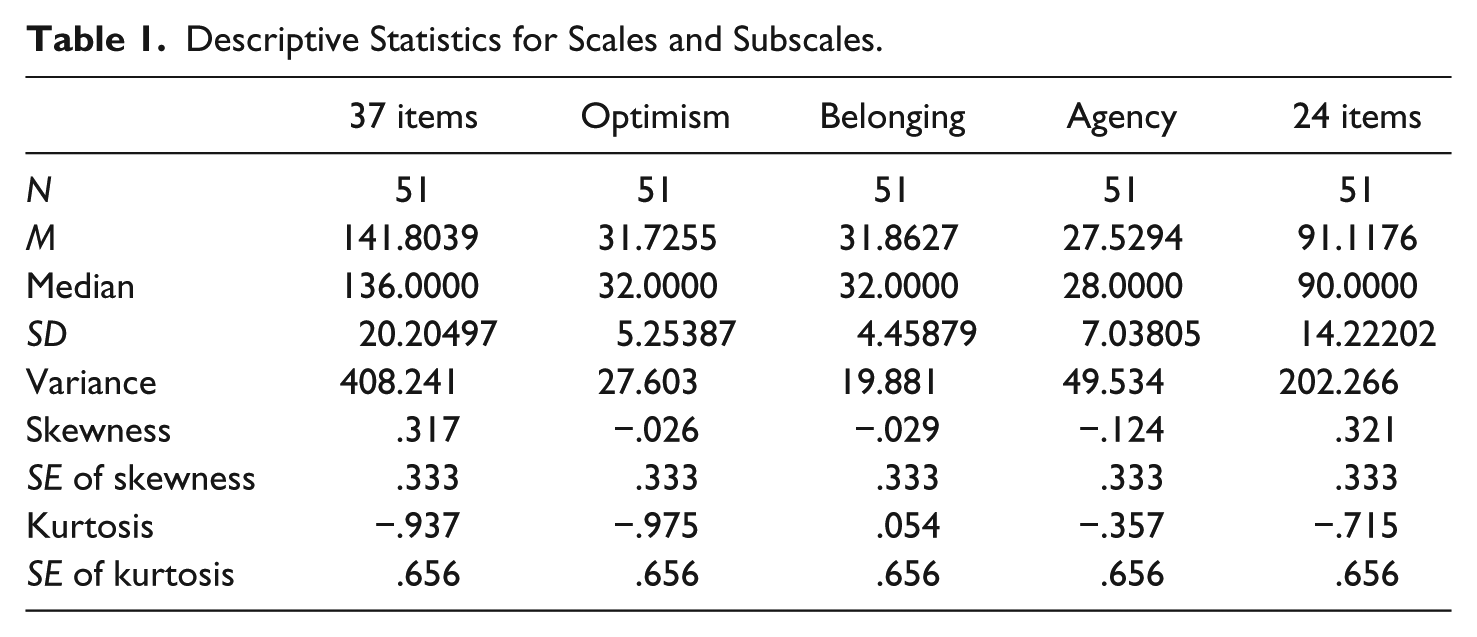
As described, the scores on the negatively worded questions were reversed and then summed with the scores on the positively worded questions to calculate an overall BIR score. These scores demonstrated variance and appeared to be skewed to the higher side (N = 51; M = 3.93; SD = .68). Given the relatively large number of variables (37) and the relatively small number of observations (51), regression analysis was not possible. In the second part of the study, which we now describe, we have adapted the methodology used by Polaschek, Calvert, and Gannon (2009), and this provides an alterative way of exploring the set of questionnaire items.
Method—Study Part 2
Participants
Participants were intern psychologists rotating through a forensic psychology clinic in Sydney, Australia. Interns were in their fifth or sixth year of study and were about to graduate from a master’s program in forensic psychology. The researchers considered that postgraduate psychologists were a suitable panel population because although they were naïve as to the ultimate aim of the questionnaire study, we could reasonably assume that they had the psychological literacy to be able to categorise the statements.
Materials
To address Aim 2, a card sort task was used. As this is the first time this concept has been tested with offenders, the researchers wished to explore whether it had underlying components. All 37 statements in the pilot questionnaire were individually coded and submitted to a panel of 20 postgraduate psychology interns in a forensic psychology clinic. Each participating intern was told that these statements had been gathered from interviews with offenders about the general issue of desisting from crime and specifically about their chances of doing so. They were asked to categorise as many of the statements as they could into a small number of categories according to the personal belief that seemed to underlie them. No candidate “beliefs” were offered to the experts in order not to influence their thinking. The code numbers of the items were recorded for each set that the participant created.
Procedure
The interviewers (Y.H. and R.W.) placed the cards in random order on a table in front of each participant and used a script to invite the participants to categorise them. The script said in part, Here are 37 cards. They each show a statement that people have made about staying crime free or “going straight.” We’re interested in the underlying beliefs expressed by these statements. Please sort the cards into piles based on the different main themes of these beliefs. You decide the number of piles and what the themes are. There is no right answer.
The researchers then used an example to demonstrate the card sort process in the manner of the introduction to the Wisconsin Card Sort Test (Heaton, Chelune, Talley, Kay, & Curtiss, 1993). When participants had formed their categories, they were asked to provide a description of each category, and these were recorded verbatim, and the researcher noted the numbers of the items that made up each category. Participants were thanked and no further feedback was given.
Results
Participants suggested between three and eight categories each. In some instances, one category was the reverse of another, such as where “a sense of belonging” was described as accounting for a number of statements and “a sense of not belonging” was described as accounting for others. Categories like these were not amalgamated unless the participant wished to do so. Participants produced 80 categories.
Several statistical approaches were considered to explore the data, including factor analysis and pile-sort methods. As there was no a priori theory about the constructs that might be found, and the data set was relatively small, none of these methods was appropriate, and a grounded theory approach was used based on Strauss and Corbin (1990) and on the recent application of this by Polaschek et al. (2009). To begin with, participants’ verbatim descriptions of their categories were compiled into a text file, and this was submitted to a simple word-count analysis using Wordle software (Wordle, 2015). This yielded such indicative terms as “control,” “society,” “crime,” “change,” “future,” and “straight.” Using these terms as a basis for further categorisation, one author (KOS) reviewed all 80 categories to see how they related to the Wordle terms. This process yielded three themes that accounted for 56 (70%) of the 80 categories. In a similar way to the process used by Polaschek et al. (2009), the authors and two independent raters, working separately, then assigned each of the 37 statements provisionally to one or more of these categories on the basis of semantic similarity. The raters agreed on the allocation of 24 items to the three categories with 13 items omitted because they were categorised with less than 80% interrater reliability. The interrater reliability for the final categories was either 100% (15 items) or 80% (nine items).
To test the internal consistency of the three main categories, we compiled subscales using the items that related to each and called the subscales Belonging, Agency, and Optimism (as discussed below). The Cronbach’s alphas for the three subscales were as follows: Belonging (.689), Agency (.829), and Optimism (.681). Table 1 gives descriptive statistics for all scales.
Descriptive Statistics for Scales and Subscales.
Discussion
We have attempted to construct a measure of self-belief specific to the perceived prospect of successful desistance among offenders. As far as we are aware, this is the first time such a scale has been created. We found that respondents in Study 1 appeared to be able to understand the questionnaire, and 51 sets of data were available for analysis even though, at 37 items, the form was quite lengthy. We received feedback that some of the participants had commented that the study was “interesting” and worthwhile. There was no question of gain for the respondents in answering the questionnaire, as the forms were entirely anonymous.
The scores displayed variance indicating that respondents had a range of opinion in their beliefs about the prospect of change and desistance. The questionnaire does not replace the richness of qualitative interviews, but given that the statements are derived from such interviews with offenders and ex-offenders rather than devised by the researchers, scores that reflect a level of concurrence with these statements have arguable face validity.
While the data were skewed (as they were not distributed normally between the lowest possible score and the highest), scores below an average of three were not really expected as this would have indicated a strong belief in the inevitability of committing crime rather than a weak belief in the possibility of “going straight” which is what the questionnaire was attempting to elicit.
In the card sort task, the participants in the panel were able to identify categories underlying the construct of BIR and among these there were three that accounted for 70% of the categories. Other categories referred to issues such as choosing crime over desistance, the desirability of pro-social conduct, and uncertainty, and were difficult to amalgamate into smaller categories. Following this, we identified three subscales with Cronbach’s alphas that indicated acceptable internal consistency. The first theme concerned a sense of belonging to the larger community and having a rightful place in it. We called this Belonging. The second was about the degree to which the statement evinced a sense of control over the task of desistance. We called this Agency. The third was about the optimism the statement showed about the possibility that this change (desistance) could come about. We called this Optimism. An example of the first was “Inclusion, fitting in and having a place amongst the world of everyone else.” An example of the second was, “My life doesn’t really make sense, lack of control. I don’t really think I’ll make it.” An example of the third was, “Positive beliefs about the future, about living productively.”
A recent article (de Vries Robbé et al., 2015) names similar variables as significant desistance factors. The three factors that relate to our work are (a) having a “place within a social group or network” (Belonging), (b) “an enhanced sense of personal agency” (Agency), and (c) “hopeful, optimistic, and motivated attitudes to desistance” (Optimism; de Vries Robbé et al., 2015, pp. 26-28). In another recent article, Majer, Olson, Komer, and Jason (2015) found that self-efficacy was positively related to motivation for change in ex-offenders. Given that there are well-established psychological instruments that measure these variables, they may provide scope for testing convergent and discriminant validity.
Despite the possible benefits of a greater understanding of the role that narrative may play in desistance from crime, relatively little has been done to examine the issue, test it quantitatively and translate it into practice. It is important to understand the role that self-belief, optimism, hope, and such variables play in desistance from crime and to be able to measure it easily and reliably. Previous studies have used long life story interviews and sometimes ad hoc content analysis to try and make sense of the way that offenders think about change. These interviews, the “deep and messy qualitative work” described by Liebling et al. (2011, p. 370), offer an undoubted narrative richness but are time-consuming. Considering the realities of staffing, workloads, and physical environment in criminal justice systems, this is not a practical way to assess narrative style. It would seem useful to have access to a relatively simple measure of the thinking style of the offending population so that this could be taken into account in a case management approach that assists offenders to desist.
The study has a number of limitations, not the least of which is the small sample size. On the face of it, N = 51 is not an unreasonable sample for a pilot study, but with a small data set, the possibilities for multivariate analysis are restricted, and this is reflected in the tentative nature of the conclusions we can draw from the data. We emphasise that this article claims to be nothing more than a first, exploratory study of a quantitative measure of BIR. The study also had to deal with the challenge of securing access to offenders in the care of a correctional authority in Australia, which is not uncomplicated. Furthermore, had the study been funded, it might have been possible to incentivise participants in a way that might have secured larger participation and provided for additional qualitative input and shed more light on offenders’ understanding of the issues. Perhaps the central challenge was that of quantifying what is an intensely personal narrative in a way that is useful but at the same time, does not completely bypass the richness and nuance of qualitative accounts. It is not possible to say whether we have achieved this: We hope that future studies will clarify the issue.
Conclusion
We believe we have begun to explore a construct (BIR) that we can use to test hypotheses about the link between self-belief (self-story) and desistance. Furthermore, we may also be able to explore the several components of such a self-story. We will hypothesise in further studies that an individual incapable of envisaging a life of agency rather that helplessness will find it harder to cultivate and enact a new lifestyle than one who believes in the possibility of change. If this is shown to be the case, there may be opportunities to translate this into correctional rehabilitation practice.
Footnotes
Appendix
Questionnaire Items
| No. | Item |
|---|---|
| 1 | I think I can put my criminal past behind me |
| 2 | I believe I could “go straight” |
| 3 | I do not think I will ever really be valued by society |
| 4 | I think people will respect me one day for doing my part in the community |
| 5 | I do not think I could really make it in the “straight” world |
| 6 | I believe “going straight” is possible AND I want to do it |
| 7 | Ordinary people could respect me for what I have achieved |
| 8 | I could be happy in my life without doing crime again |
| 9 | I could never really fit in with ordinary people and be one of them |
| 10 | I really think I could leave crime behind me |
| 11 | I could be happy “going straight” |
| 12 | I think I could play my part by helping other people in my community |
| 13 | I want to go straight AND I believe I can |
| 14 | I can be a positive member of society |
| 15 | I will never be able to enjoy a straight job |
| 16 | I am basically a crim and probably always will be |
| 17 | The only thing that would make a difference is winning the lottery |
| 18 | Doing crime was not the real me. I am better than that |
| 19 | To be honest, I have not got a plan for the long term |
| 20 | Some people could be happy “going straight”—I just do not think it is for me |
| 21 | I just cannot see myself settling down and being satisfied |
| 22 | I think I could achieve what I have always wanted to achieve |
| 23 a | I do not have a lot of control over the future |
| 24 a | Stuff has happened in my life that means I just cannot go back to living straight |
| 25 | I have no control over my future |
| 26 a | I am just a little piece in a big game |
| 27 a | I am a victim of society |
| 28 | I am part of the same world as everyone else |
| 29 | I can make sense of my life |
| 30 | I do not really know where my life is going |
| 31 | My life does not make much sense now but it will in the future |
| 32 | I can make it in the “straight” world |
| 33 | I can learn from what I did in the past, and use it to help me “go straight” |
| 34 | I know what I want out of life |
| 35 | My future is in my hands |
| 36 | I am just condemned to a life of crime |
| 37 | Just because I have a criminal record, it does not mean I have to carry it round for the rest of my life |
Note. Items in italics were omitted from 24-item scale.
Indicates negatively phrased questions.
Declaration of Conflicting Interests
The author(s) declared no potential conflicts of interest with respect to the research, authorship, and/or publication of this article.
Funding
The author(s) received no financial support for the research, authorship, and/or publication of this article.