



Abstract
The use of performance-enhancing drugs (PED) is common among Iranian professional athletes. As this phenomenon is a social problem, the main purpose of this research is to explain why athletes engage in “doping” activity, using social learning theory. For this purpose, a sample of 589 professional athletes from Rasht, Iran, was used to test assumptions related to social learning theory. The results showed that there are positive and significant relationships between the components of social learning theory (differential association, differential reinforcement, imitation, and definitions) and doping behavior (past, present, and future use of PED). The structural modeling analysis indicated that the components of social learning theory accounts for 36% of the variance in past doping behavior, 35% of the variance in current doping behavior, and 32% of the variance in future use of PED.
The use of performance-enhancing drugs (PED), or doping, is not a new problem in professional athletics. Doping is the term for the illicit consumption of PED among professional and amateur athletes (Lazuras, Barkoukis, Rodafinos, & Tzorbatzoudis, 2010). These include androgenic anabolic steroids, synthetic human growth hormones (hGH), erythropoietin (EPO) and other synthetic oxygen carriers, insulin, human chorionic gonadotrophin (HCG), adrenocorticotrophin (ACTH), creatine, androstenedione (andro), tetrahydrogestrinone, other testosterone precursors, beta-2 agonists, beta blockers, diuretics, ephedra and other stimulants and amphetamines, narcotics, and many others too numerous to list.
There are a large number of cases, many of which are celebrated cases involving sports superstars, alleged or proven to have been involved in doping; this includes a large number of cases from Iran, the site of the present study. 1 Iran formally agreed to accept the guidelines of the World Anti-Doping Agency (WADA) as promulgated in the Second World Conference on Doping in Sport held in Copenhagen, Denmark, in March 2003; it also enacted national anti-doping guidelines in 2007. According to these national and WADA guidelines, any use of banned substances can lead to a suspension of 6 months to 4 years from any sport activity; subsequent use can include a lifetime ban from the sport (Iran National Anti-Doping Organization [IRANADO], 2016). The possession of these drugs without a prescription is illegal in nearly all countries, including Iran, the site of the present study. The sale/distribution of these drugs without a license and/or without a legitimate medical purpose is also illegal.
While the use of PED is not a novel problem in athletics, the extant research literature about the etiology of doping is a very limited and relatively new scholarly arena (Backhouse, McKenna, Robinson, & Atkin, 2007). To answer the question of why athletes use illicit PED, researchers have proposed a variety of relatively atheoretical personal, social, and environmental correlates/factors (Hoff, 2008, 2015; Hoff & Carlsson, 2005). These include involvement in other risky behaviors such as alcohol and drug use and crime (Hoff, 2015; Papadopoulos, Skalkidis, Parkkar, & Petridou, 2006; Wichstrøm, 2006), negative body image (muscle dysmorphia; Durant, Escobedo, & Heath, 1995; Kindlundh, Isacson, Berglund, & Nyberg, 1999), eating disorders (Blouin & Goldfield, 1995; Brower, Blow, & Hill, 1994; Cohen, Collins, Darkes, & Gwartney, 2007; Kanayama, Barry, & Hudson, 2006; Pope, Phillips, & Olivardia, 2000), infidelity to sport morality (Melzer, Elbe, & Brand, 2010), drive for muscularity or thinness (Akindutire & Olanipekun, 2015; Soltanabadi, Tojari, & Esmaeili, 2015; Zelli, Lucidi, & Mallia, 2010), social desirability (Gucciardi et al., 2016).
With regard to social/environmental factors related to athletes’ tendency to use PED, Donovan, Egger, Kapernick, and Mendoza (2002) noted that reference groups, and their socialization effects, are highly salient in the formation this behavior. For instance, Özdemir et al. (2005) showed that 41.3% of athletes in their study who had consumed PED claimed that social-environmental pressures and the role of friends had significant effects on their tendency to use illegal drugs. The role of such social and environmental pressures like friends, peers, and reference groups’ attitudes has also been confirmed by Wagman, Curry, and Cook (1995); Laure, Lecerf, Friser, and Binsinger (2004); Hoff (2015); Lucidi et al. (2008); Tavani et al. (2012); and Wiefferink, Detmar, Coumans, Vogels, and Paulussen (2008). In a study by Peters et al. (2005), athletes claimed that the use of illegal PED was first introduced by their school instructor. Kirby, Moran, and Guerin (2011) found that athletes’ tendency to use PED may be a result of a team member or trainer’s request. The results of a study conducted by Papadopoulos et al. (2006) showed that athletes who know an existing PED user were 7 times more likely to be engaged in doping activities.
Each of these studies implies a social learning process as a chief causal agent in the etiology of PED use. As past research has indicated that athlete participation in doping is directly affected by social processes, particularly interactions with coaches, fellow athletes, and family and friends, the current study assesses the hypothesis that the behaviors and attitudes of those with whom the athletes interact have a powerful influence on their own doping behavior. For example, receiving positive social feedback toward the use of PED is found to be positively correlated with engagement in doping activity. This study, concurrent with other research, seeks to address athlete engagement in doping behavior in Rasht, Iran. For this purpose, we will be using the main constructs of social learning theory—that is, differential association, differential reinforcement, imitation, and definitions—to explain an individual’s involvement in the use of illegal PED. Akers’s social learning theory is arguably the most powerful theoretical perspective with regard to its explanatory power, particularly regarding substance use behavior (see Akers, Krohn, Lanza-Kaduce, & Radosevich, 1979; Akers & Lee, 1996; Krohn, 1999; Krohn, Skinner, Massey, & Akers, 1985; Lee, Akers, & Borg, 2004; Schroeder & Ford, 2012; White, Pandina, & LaGrange, 1987). This study tests the efficacy of social learning theory on the past, current, and future/intended doping behavior of professional athletes from Iran.
Akers’s Social Learning Theory and Doping Behavior 2
Akers’s social learning theory is one of the predominant theories of criminal/deviant behavior; it has been applied successfully to a wide range of deviant and criminal behaviors (Akers & Sellers, 2004); according to Cochran, Maskaly, Jones, and Sellers (2015), it is one of the most frequently tested, most strongly supported, most widely endorsed, and most frequently cited criminological theories (Cohn & Farrington, 1996; Ellis, Cooper, & Walsh, 2008; Ellis & Walsh, 1999; Pratt et al., 2010; Stitt & Giacopassi, 1992). It has fared well when tested against rival theories (Akers & Cochran, 1985; Akers & Lee, 1999; Benda, 1994; Burton, Cullen, Evans, & Dunaway, 1994; Conger, 1976; Hwang & Akers, 2003; Kandel & Davies, 1991; Matsueda, 1982; Matsueda & Heimer, 1987; McGee, 1992; White, Pandina, & LaGrange, 1987) and it has been supported cross-culturally (Hwang & Akers, 2003; Kim & Koto, 2000; Wang & Jensen, 2003; Winfree, Griffiths, & Sellers, 1989; Zhang & Messner, 2000).
Social learning theory (Akers, 1985; Akers, 1998/2009; Burgess & Akers, 1966) seeks to explain patterns of deviant or criminal behaviors in an individual’s life, whether they are initiated for the first time, are persistent and sustained, or changing over time, and/or whether they are desisted from (Akers & Jensen, 2006). Social learning theory generally claims that a learning process plays an important role in the adoption of deviant and criminal behaviors, such as doping (Akers, 1998/2009), and stresses four principal concepts in the social learning process: differential association, differential reinforcement, imitation, and definitions (Akers, 1998/2009; Akers & Jensen, 2006; Burgess & Akers, 1966; Hwang & Akers, 2007).
Akers (1998/2009) argued that the likelihood that persons engage in criminal/deviant behavior is increased when they differentially associate with others who commit criminal/deviant behavior and espouse definitions favorable to it, are relatively more exposed in-person or symbolically to salient criminal/deviant models, define it as desirable or justified in a situation discriminative for the behavior, and have received in the past and anticipate in the current or future situation relatively greater reward than punishment for the behavior. (p. 50)
The best, most current, most fully elaborated, and most carefully explicated presentation of Akers’s social learning theory can be found in his monograph Social Learning and Social Structure (Akers, 1998/2009).
For Akers, differential association is the process through which individuals are exposed to definitions, both favorable and unfavorable, of illegal/deviant behavior as held and expressed by others with whom one interacts. Differential associations have both behavioral and normative dimensions to them. The behavioral dimension involves both the direct interaction with significant others and the indirect association and identification with members of more distant reference groups who engage in behavior. The normative dimension refers to the patterns of norms and values to which one is exposed through these associations. These associations vary in their frequency, duration, priority, and intensity, such that those that occur early in life (priority), last longer (duration), take place more often (frequency), and involve significant others with whom one is closely attached (intensity) will have the greater effect on one’s own definitions and behavior. These associations not only expose individuals to definitions both favorable and unfavorable to the violation of the law, but they are also the primary source of differential reinforcement and role models to be imitated, two other elements of social learning theory.
Definitions are a person’s own evaluative judgments, attitudes, or meanings attached to a particular behavior. They are “orientations, definitions of the situation, and other evaluative and moral attitudes that define the commission of an act as right or wrong, good or bad, desirable or undesirable, justified or unjustified” (Akers & Sellers, 2009, p. 90). The more a person’s definitions approve of an act or effectively neutralize moral prohibitions against an act, the greater the likelihood that the person will engage in the act. These definitions favorable and unfavorable to criminal behavior are developed primarily not only through differential association but also through imitation and differential reinforcement.
Definitions constitute a mind-set that makes one more or less willing to commit a particular act should an opportunity present itself; they also affect the perpetration of an act by serving as internal discriminative stimuli—cues or signals as to what behaviors are likely to yield the greatest reinforcement in a given situation. These definitions may be both general and specific and may be positive, negative, or neutralizing. General definitions are broad, widely shared normative evaluations that per se approve of conforming behavior and disapprove of criminal behavior. Specific definitions are normative evaluations unique to a particular form of behavior. Positive definitions are approving normative judgments, whereas negative definitions are disapproving. Neutralizing definitions are situation specific and serve to justify behavior that is otherwise disapproved and thereby, at least temporarily, neutralize this disapproval.
Imitation is engaging in a behavior one observed another doing. The individual observes a role model’s behavior being reinforced and emulates the behavior of the model in anticipation of receiving similar reinforcement himself or herself. Imitation plays an especially important role in the onset or acquisition of novel behavior; its impact is considerably diminished with regard to the maintenance or cessation of an established behavior pattern.
The primary learning mechanism in social behavior, according to Akers, is operant (instrumental) conditioning in which behavior is influenced (enhanced or repressed) by the stimuli that follow or are consequences of it. Behavior is strengthened and, thus, more likely to be repeated through rewards (positive reinforcements) and the avoidance of punishment (negative reinforcement); behavior is weakened and, thus, less likely to be repeated by the presentation of aversive stimuli (positive punishment) and the loss of reward (negative punishment). Reinforcements and punishments may be nonsocial (such as the direct effects physiological of drugs or the endogenous psychic rewards provided by risky thrills—see Wood, Cochran, Pfefferbaum, & Arneklev, 1995; Wood, Gove, Wilson, & Cochran, 1997) or social (e.g., acceptance or approval from significant others or criminal sanctions following arrest and conviction). Whether or not a behavior is acquired, strengthened, repeated, maintained, persists, is weakened, repressed, and/or desisted depends on the balance of past, present, and anticipated rewards and punishments attached to it relative to the balance of rewards and punishments attached to alternative behavioral options—differential reinforcement. Akers’s theory proposes that the individuals or groups that comprise the major sources of an individual’s reinforcements and punishments will have the greatest influence on that individual’s behavior.
In summation, Akers’s social learning theory posits that deviant behavior is a function of the frequency, duration, priority, and intensity of interactions with and exposure to significant others (differential associations) who serve as the primary sources of one’s own evaluative (general and specific, positive, negative, and/or neutralizing) judgments about the appropriateness of that deviant behavior (definitions); these significant others also serve as role models whose own deviant behavior is emulated (imitation) when it is observed to have been reinforced, and they are the primary source of the balance of actual and anticipated, positive and negative, rewards and punishments (differential reinforcement) for one’s own deviant behavior. Importantly, Akers’s social learning theory is a processual theory involving a complicated set of feedback and non-recursive relationships. Akers and colleagues (1979) proposed a typical temporal sequence/causal ordering of his social learning process for both the initiation/onset of behavior as well as its continuation/maintenance: As a result of differential association with family and friends, initiation of the behavior takes places through imitation, acquisition of a balance of definitions favorable to the behavior, and anticipation of positive reinforcement. Whether or not the behavior continues after the initiation . . . is a function of these same variables—except that imitation is less influential and the actual consequences of the behavior (social and nonsocial) serve to reinforce or punish the behavior. (Krohn et al., 1985, p. 458)
As such, deviant behavior is the product of differential association, imitation, definitions, and differential reinforcement. Differential association is posited to have both a direct effect on deviant behavior and an indirect effect, partially mediated by imitation, definitions, and differential reinforcements.
Akers’s social learning theory has been tested numerous times against self-reported data on delinquency (both minor and serious forms) and substance use/abuse (tobacco, alcohol, marijuana, hard drugs, “club” drugs, and the use of diverted prescription drugs); across all of these tests, it has consistently been well supported by the data (Pratt et al., 2010). There are scores of such studies, too numerous to review herein. Fortunately, Akers (1998/2009) and Akers and Jensen (2006) have provided very thorough reviews of this literature. Of particular importance to the present study are those efforts testing the efficacy of social learning theory against data on substance use/abuse; again, these studies have shown Akers’s social learning theory to be one of the most powerful theoretical perspectives (see Akers et al., 1979; Akers & Lee, 1996; Krohn, 1999; Krohn et al., 1985; Lee et al., 2004; Schroeder & Ford, 2012; White et al., 1987).
Given that doping among athletes is a form of deviant substance using behavior, this study surmises that doping activity is adopted through the process of social learning. As such, we hypothesize the following:
Method
This study was conducted in 2015, using a simple random sample of 620 professional athletes from Rasht, Iran, who have competed for at least 5 years in their sport, and were registered in the Department of Physical Education for the city of Rasht. 3 A research team consisting of trained, MSc, social research students under the supervision of sociology faculty from the University of Guilan, Iran, developed the questionnaire instrument, drew the random sample of subjects, and administered the data collection and analysis.
The 2015 list of registered professional athletes from Rasht served as the sampling frame for the present study from which only those athletes with 5 or more years of registered/official involvement in professional athletics were eligible for inclusion in the sample. Registration in the physical education department is important for it is through such a process that professional athletes are distinguished from amateurs. Rasht is the capital city of Guilan province and one of Iran’s largest metropolises. It is regarded by Iranians as one of the more important locales for sporting activities.
From among the list of registered professional athletes, power analyses indicated that a simple random sample of 620 should be drawn. Once this sample was drawn, the sampled athletes were invited to a large meeting area at the sporting complex. As per approved institutional review board (IRB) requirements, the purpose of the study was discussed and voluntary consent was provided by the sampled athletes. Then a self-administered questionnaire was distributed from which 589 usable questionnaires (i.e., questionnaires without extensive missing data) were returned, yielding a 95% response rate. The questionnaire was specifically designed to examine PED use among professional athletes and to test several leading criminological theories.
Descriptive statistics on the socio-demographic characteristics of the sample showed that 59.4% of respondents were male and 40.6% were female. While 38.4% of respondents were younger than 25 years, 44.8% were between 25 and 30 years old, 13.8% were between 30 and 35 years old, and 13.8% were older than 35 years. Moreover, 63.2% were single and the other 36.8% were married. In addition, 44.6% had, at most, a secondary education, while 36.7% had completed a college or university degree and 18.7% had completed a graduate degree. In terms of their athletic participation, 5.6% of the respondents participated in weight lifting, 11.4% participated in Taekwondo, 12.6% participated in Karate, 6.1% played handball, 12.9% participated in swimming, 15.1% played futbol/soccer, 5.8% played futsal (5-on-5 indoor soccer), 7% played volleyball, 5.3% played basketball, 6.1% participated in bodybuilding, 4.9% participated in wrestling, and 6.3% played chess.
Dependent Variables
Athletes’ doping behavior (PED usage) is examined through three measures designed to gain information on athletes’ past, current, and projected use of PED (Whitaker, Long, Petróczi, & Backhouse, 2014). Participants were asked to report whether they (a) “currently use a banned substance,” (b) had “previously used a banned substance to enhance their performance,” or (c) “intended to use a banned substance at least once within the next 12 months.” The responses ranged from 0 = never used banned substances to 3 = systematically used banned substances.
Social Learning Scales
The questionnaire was specifically designed to assess the predictive efficacy of Akers’s social learning theory. As such, measures of all four of Akers’s key theoretical constructs are included in the present study. Differential associations refer to the extent of one’s physical and attitudinal interactions and communications with others; these associations vary in frequency, duration, priority, and intensity (Akers & Sellers, 2004; Verrill, 2005). In this study, we assessed both the normative relationship dimension, which refers to the quality of beliefs and the attitude of important others (family, close friends) with regard to doping behavior, and the behavioral dimension, which refers to association with others/athletes who engage in doping behavior. We employ two subscales, Differential Norms and Differential Behavior, both of which have been used in previous research (Akers et al., 1979; Aliverdinia, 2012; Aliverdinia & Heidari, 2011; Lee et al., 2004; Verrill, 2005).
The behavioral dimension of differential association is scaled to represent the elements of frequency, duration, priority, and intensity of relationships. Frequency of association, or the number of deviant associates, was measured by three dichotomous items: “Do you know anyone among your peers that dopes”; “Do you have any family members that dope”; and “Do you know anyone important to you that dopes.” Those who gave affirmative responses were then asked about the duration of their associations, with responses ranging from 0 (do not know), 1 (less than a year), to 5 (5 or more years). These relationships were then also assessed for intensity with the item “Compared to your other relationships, how important are your relations with this person?” The responses ranged from 1 (not important at all) to 5 (very important). Frequency/intensity was also measured through the frequency of interaction with a given close associate, “How often do you visit with them?” Responses ranged from 1 (never) to 5 (always). The Cronbach’s alpha for the subscale for Differential Behavior was α = .69.
The normative dimension of differential association is represented by a two-item scale: “My family members totally reject doping activity” and “My close friends totally reject doping activity,” and responses ranged from 1 (strongly disagree) to 5 (strongly agree). Cronbach’s alpha for the differential norm subscale was α = .76.
The Differential Reinforcement scale was developed to assess both the positive and negative consequences of doping behavior that can positively or negatively reinforce or punish said behavior. These consequences include the reactions of others, formal and informal sanctions, interference with daily tasks, and cost–benefit considerations (Akers et al., 1979; Aliverdinia, 2012; Aliverdinia & Heidari, 2011; Lee et al., 2004; Verrill, 2005). In this study, differential reinforcement is measured by means of three subscales that assess formal reactions, informal reactions, and the benefits of use. Each item used a Likert-type scale that ranged from 1 (strongly disagree) to 5 (strongly agree).
Formal reaction was measured by the items “I think I would face legal consequences for using performance-enhancing drugs”; “I think doping will cause me to be banned from playing my sport professionally”; and “I think doping will cause me to pay fines.” These items were reverse coded so as to yield expected parameter estimates in the same direction as the other social learning constructs. The Cronbach’s alpha for the subscale for formal reaction was α = .85.
Informal reaction was measured by the items “I would be excluded by my friends if they knew I was doping”; “My family would punish me for doping”; “My coaches would blame me for doping”; and “My fellow athletes would blame me for doping.” These items were also reverse coded so as to yield expected parameter estimates in the same direction as the other social learning constructs. The Cronbach’s alpha for the subscale for informal reaction was α= .88.
The Benefit subscale was measured by the items “[PEDs] give me the motivation to train and compete at the highest level”; “[PEDs] help to overcome boredom during training”; “Athletes often lose time due to injuries, and drugs can help to make up the lost time”; “Legalizing performance enhancements would be beneficial for sports”; and “Doping improves my athletic performance.” The Cronbach’s alpha for the subscale for Benefits of Use Balance was α = .81.
Definitions refer to ideas, beliefs, attitudes, and values regarding a certain deviant behavior. Definitions can be negative (opposed to the deviant behavior), positive (approving of the deviant behavior), or neutralizing, which justify/rationalize an otherwise negatively defined deviant behavior (Akers et al., 1979; Aliverdinia, 2012; Aliverdinia & Heidari, 2011; Lee et al., 2004; Verrill, 2005). This study focuses on positive and neutralizing definitions of doping.
Ten items were used to measure the extent to which athletes held a neutralizing definition of doping, and responses ranged from 1 (strongly disagree) to 5 (strongly agree). The items included “The risks related to doping are exaggerated”; “Athletes should not feel guilty about breaking the rules and taking performance-enhancing drugs”; “Athletes who take recreational drugs use them because they help them in sport situations”; “Athletes in my sport are pressured to take performance-enhancing drugs”; “Doping is not cheating since everyone does it”; “Health problems related to rigorous training and injuries are just as bad as from doping”; “In comparison to the damaging effects of alcohol and tobacco, the use of performance-enhancing drugs is not so bad”; “It is not right to criticize athletes who use performance-enhancing drugs to improve their bodies, since many athletes do the same”; “There is no reason to punish athletes who use performance-enhancing drugs to improve their sporting performance; after all, these athletes don’t hurt anyone”; and “Athletes who use performance-enhancing drugs are not to be blamed, but those people who expect too much from athletes should be blamed instead.” Cronbach’s alpha for the Neutralizing Definitions subscale was α = .79.
Five items were used to measure the extent to which athletes had a positive definition of doping, and responses ranged from 1 (strongly disagree) to 5 (strongly agree). The items included “The use of performance-enhancing drugs is a way to ‘maximize one’s potential,’” “It is OK to use performance-enhancing drugs if this can help one to overcome one’s limits”; “Only the quality of performance should matter, not the way athletes achieve it”; “Using performance-enhancing drugs is no different to using a fiberglass pole, the latest cycling technology, or technologically designed swimsuits”; and “Performance-enhancing drug use is an unavoidable part of the competitive sport.” Cronbach’s alpha for the Positive Definitions subscale was α = .83.
Imitation refers to the act of modeling one’s own behavior after that of a respected or important figure (Akers et al., 1979; Lee et al., 2004). In this study, imitation of doping behavior was assessed among both primary and secondary groups. Primary group imitation was measured with two items, including “There is an athlete who uses performance-enhancing drugs in my family, and I try to imitate his behavior” and “One of my close friends is an athlete who dopes, and I try to imitate his behavior.” Secondary group imitation was also measured with two items, including “One of my fellow athletes uses performance-enhancing drugs and I try to imitate his behaviors” and “I have an athlete as a role model who uses performance-enhancing drugs and I try to imitate his behaviors.” The responses ranged from 1 (strongly disagree) to 5 (strongly agree). Cronbach’s alpha for the Imitation subscale was α = .80.
Method of Analysis
Structural equation modeling in AMOS is used to test the total, direct, and indirect effects of each of the four social learning theory constructs on the self-reported doping behavior of these professional Iranian athletes. These models will examine the effects of social learning on athletes’ past, current, and future/intended use of PED.
Results
Table 1 presents the group differences between sports on the past, current, and future use of PED using one-way ANOVA with the least significant difference (LSD) procedure. These results indicate that there are significant differences between the different sports in terms of athletes’ doping behavior in the past, present, and future. More precisely, with regard to athletes’ past doping behavior, the highest level of doping occurred among weightlifters (M = 1.70, SD = 1.07), wrestlers (M = 1.43, SD = 1.01), and futbol players (M = 1.38, SD = 1.03), respectively, and was lowest among chess players (M = 0.68, SD = 0.91), basketball players (M = 0.71, SD = 0.78), and volleyball players (M = 0.78, SD = 0.98). The group difference regarding past doping behavior was significant—one-way ANOVA, F(3, 577) = 3.863, p < .001. Similarly, mean group differences between sports show that the highest level of present doping behavior reported among weightlifters (M = 1.64, SD = 1.08), bodybuilders (M = 1.39, SD = 1.18), and futbol players (M = 1.38, SD = 1.08), respectively, and lowest level of current doping behavior occurred among chess players (M = 0.70, SD = 0.87), basketball players (M = 0.81, SD = 0.87), and volleyball players (M = 0.90, SD = 0.97). The group difference regarding current doping behavior was significant—one-way ANOVA, F(3, 577) = 3.019, p < .001. Finally, the mean group differences between sports reveal, once again, that the highest levels of future doping behavior were among weightlifters (M = 1.48, SD = 1.20), futbol players (M = 1.46, SD = 0.98), and wrestlers (M = 1.40, SD = 0.93), respectively, and was lowest among chess players (M = 0.68, SD = 0.91), basketball players (M = 0.78, SD = 0.71), and volleyball players (M = 0.78, SD = 0.90). The group difference regarding future doping behavior was significant—one-way ANOVA, F(11, 577) = 2.035, p < .001.
Group Differences Between Sports in Past, Present, and Future Doping Behavior.
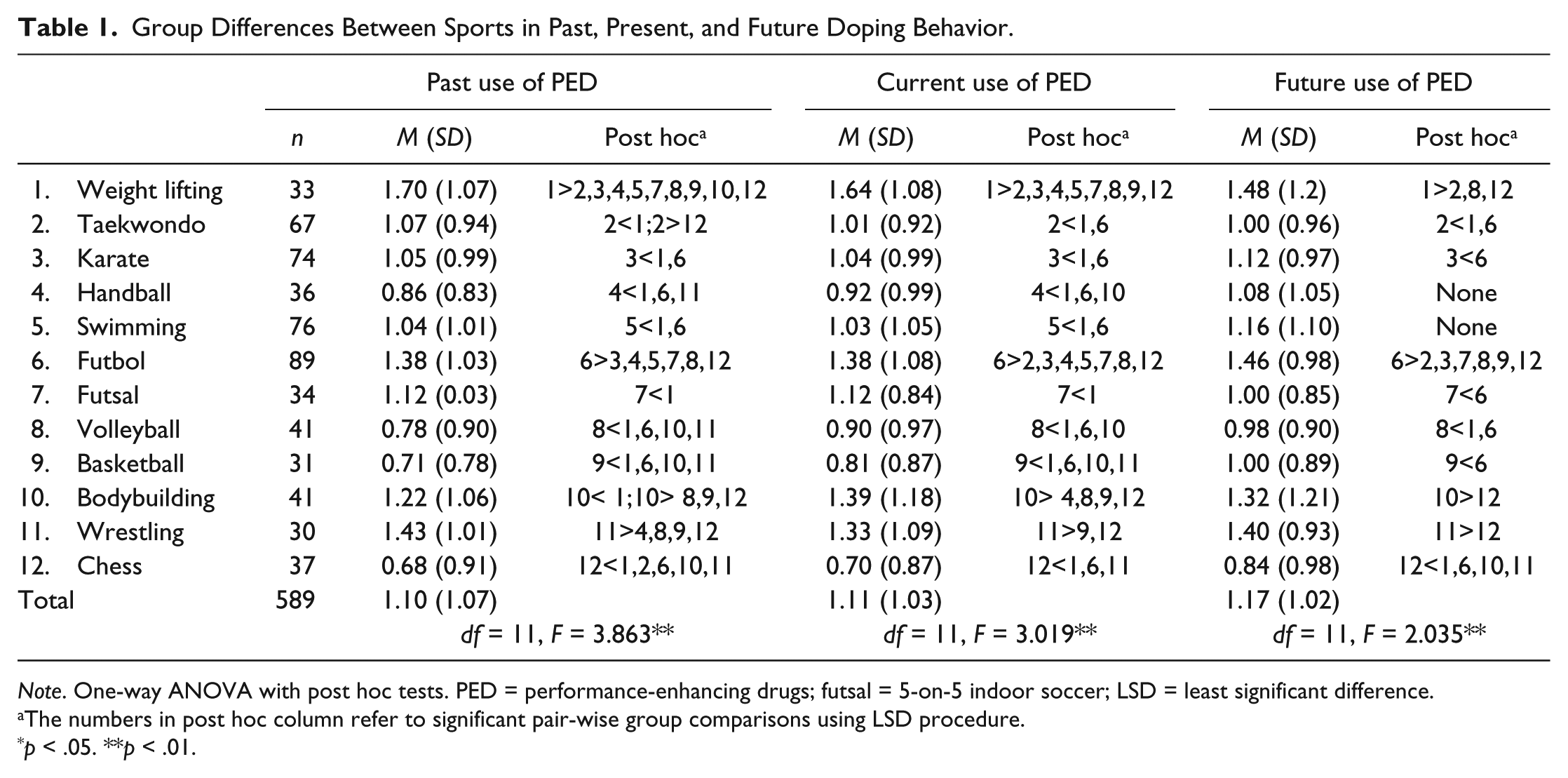
Note. One-way ANOVA with post hoc tests. PED = performance-enhancing drugs; futsal = 5-on-5 indoor soccer; LSD = least significant difference.
The numbers in post hoc column refer to significant pair-wise group comparisons using LSD procedure.
p < .05. **p < .01.
Table 2 reports the zero-order correlations between doping behavior and the subscales that were derived from the tenets of social learning theory. As the table indicates, there is a strong correlation between doping activity (past, current, and anticipated future use) and social learning process components. In detail, the analysis resulted in strongly significant (p < .01) correlations between doping activity and the subscales for Differential Association, Differential Reinforcement, Definitions, and Imitation.
Zero-Order Correlations Between Independent and Dependent Variables (N = 589).
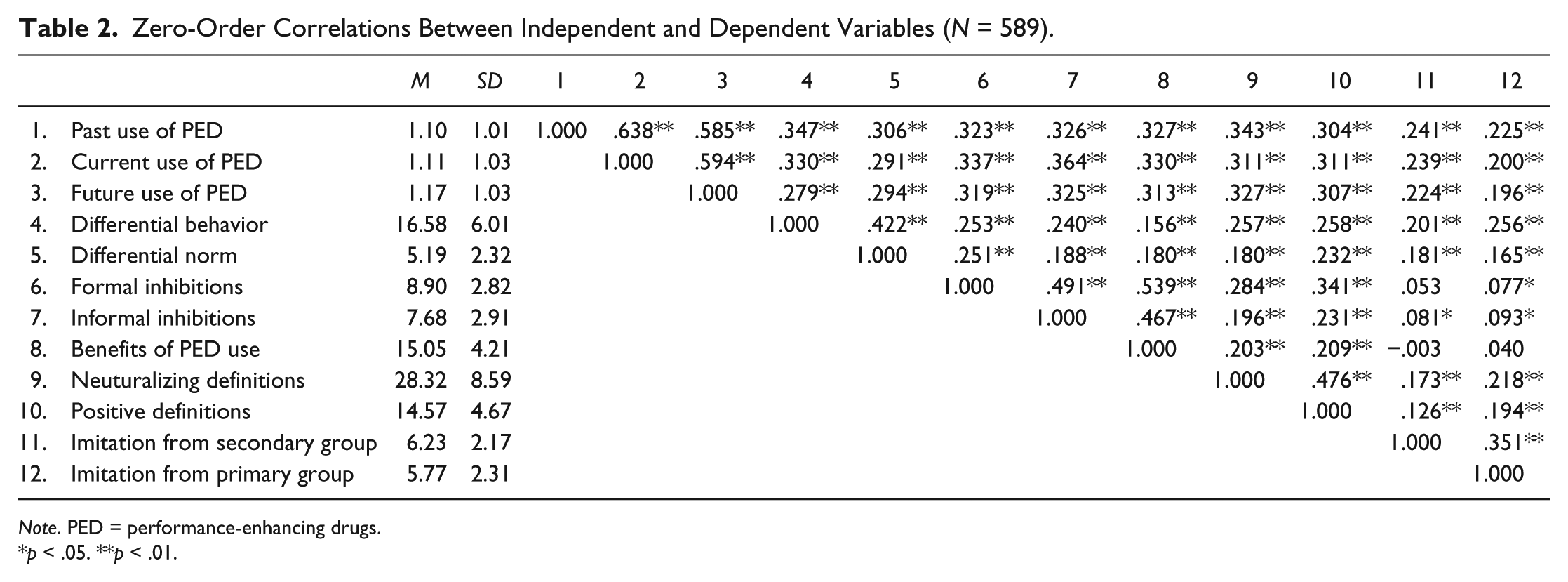
Note. PED = performance-enhancing drugs.
p < .05. **p < .01.
Table 3 presents the direct effects of these social learning scales on the past, current, and future use of PED. The regression model for the past use of PED indicates that social learning components were able to explain 29% of the variance in athletes’ past doping behavior. Moreover, differential association (β = .288), imitation (β = .225), differential reinforcement (β = .320), and definition (β = .239) each have significant direct effects on past doping behavior. Likewise, the four social learning components were also able to explain 28% of the variance in athletes’ present doping behavior and differential association (β = .255), imitation (β = .207), differential reinforcement (β = .359), and definition (β = .220) again have significant direct effects on present doping behavior. Finally, the regression model for future use of PED reveals that these social learning components were able to explain 35% of athletes’ future or intended doping behavior; in fact, differential association (β = .216), imitation (β = .200), differential reinforcement (β = .320), and definition (β = .257) are each significantly and directly related to future doping behavior.
Direct Effects of Social Learning Components on Past, Present, and Future Use of PED.
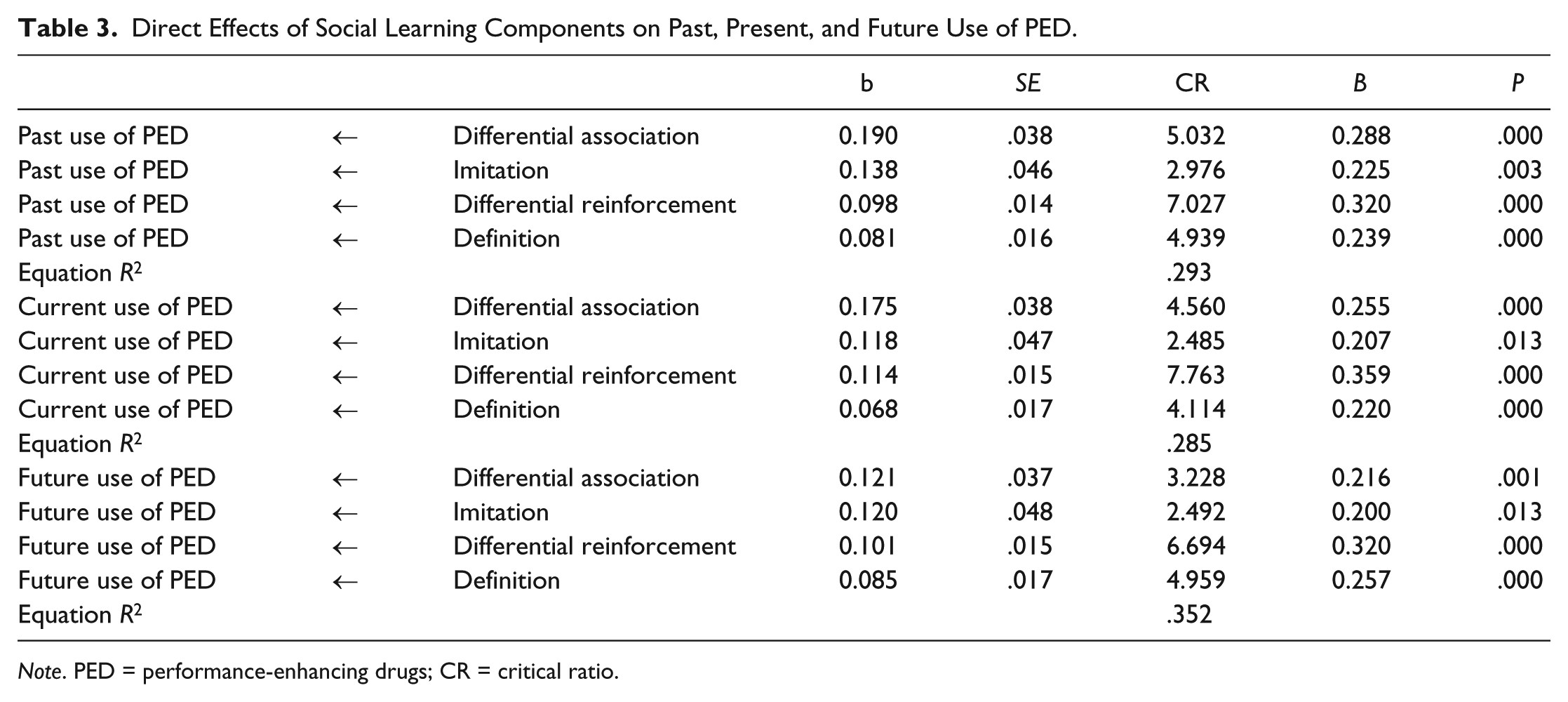
Note. PED = performance-enhancing drugs; CR = critical ratio.
The Mediated Effects of Social Learning Components on Past Use of PED
To investigate the direct and indirect effects of social learning components on doping behavior among professional athletes, we used the multiple least squares analysis with bootstrapping (n = 2,000) in AMOS. As the structural model (see Table 4) shows, past doping behavior was again significantly and directly associated with differential association (β = .488, p = .001), imitation (β = .216, p = .032), differential reinforcement (β = .305, p = .001), and definitions (β = .153, p = .031).
Direct and Indirect Effects of Social Learning Components on Past Use of PED.
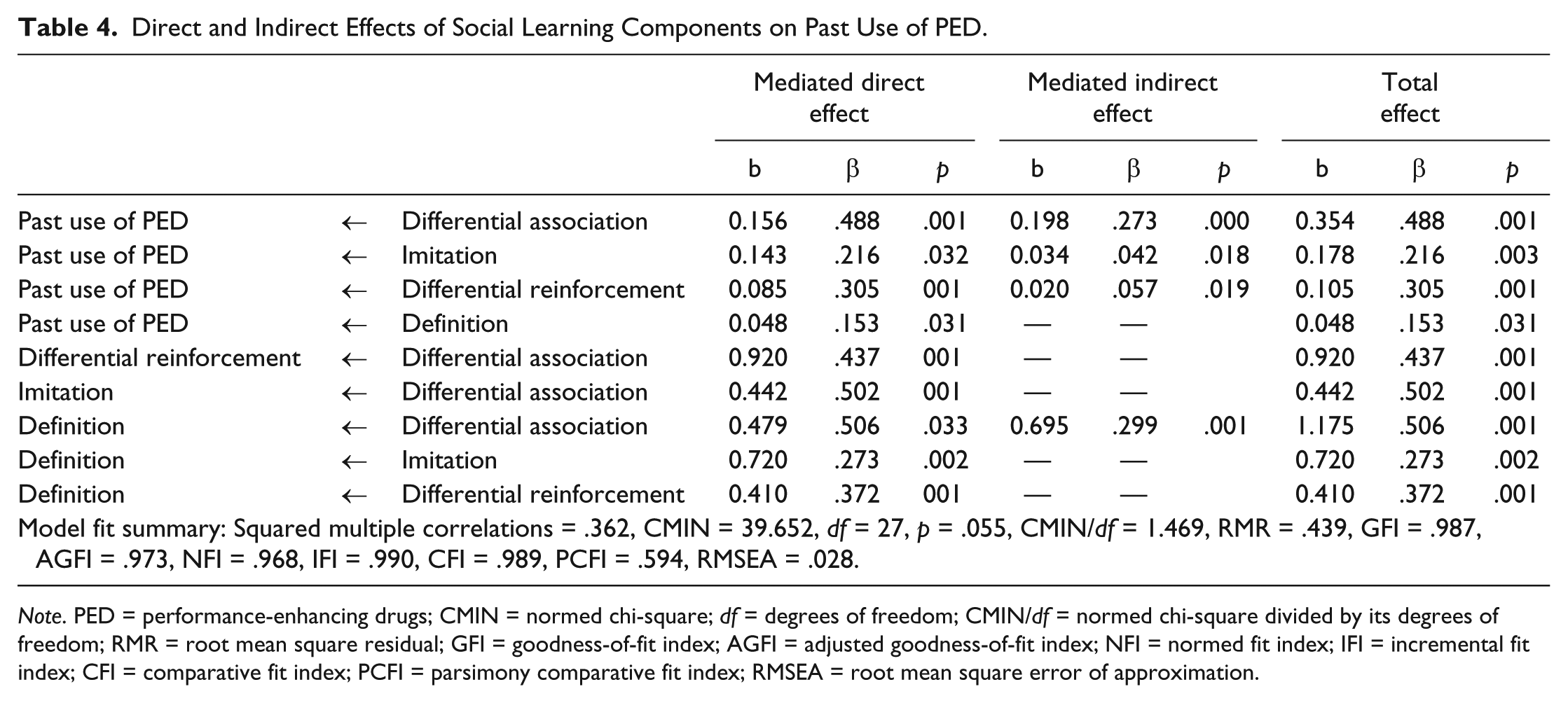
Note. PED = performance-enhancing drugs; CMIN = normed chi-square; df = degrees of freedom; CMIN/df = normed chi-square divided by its degrees of freedom; RMR = root mean square residual; GFI = goodness-of-fit index; AGFI = adjusted goodness-of-fit index; NFI = normed fit index; IFI = incremental fit index; CFI = comparative fit index; PCFI = parsimony comparative fit index; RMSEA = root mean square error of approximation.
In addition, differential association also has direct effects on differential reinforcement (β = .437, p = .001), imitation (β = .502, p = .001), and definitions (β = .506, p = .033) and, from these paths, a mediated indirect effect (partial mediation) on past doping behavior (β = .273, p = .000). Moreover, imitation also has a direct effect on definitions (β = .273, p = .002) and, from this path, a mediated indirect effect (partial mediation) on past use of PED (β = .042, p = .018). Finally, differential reinforcement has a direct effect on definitions (β = .372, p = .001) and, from this path, a mediated indirect effect (partial mediation) on past use of PED (β = .057, p = .019).
Figure 1 shows the structural relationships between the independent and dependent variables. For the fitted AMOS model, the summary statistics, that is, normed chi-square divided by its degrees of freedom (CMIN/df = 1.469), root mean square residual (RMR = .439), goodness-of-fit index (GFI = .987), adjusted goodness-of-fit index (AGFI = .973), normed fit index (NFI = .968), incremental fit index (IFI = .990), comparative fit index (CFI = .989), parsimony comparative fit index (PCFI = .954), and root mean square error of approximation (RMSEA = .028) are better than critical values and represent the goodness of fit for the proposed model. In sum, the structural model shows that past doping behavior is a direct consequence of differential association, differential reinforcement, imitation, and definitions. Thus, exposure to deviant associates who dope themselves, and/or support and reward doping, was associated with an increase in respondents’ past doping behavior. The four social learning components could predict 36% of the variance in past use of PED. Of the social learning components, differential association had the strongest effect on past doping activities (standardized total effect: .408, p = .001) as compared with differential reinforcement (standardized total effect: .305, p = .003), imitation (standardized total effect: .216, p = .001), and definition (standardized total effect: .153, p = .031).
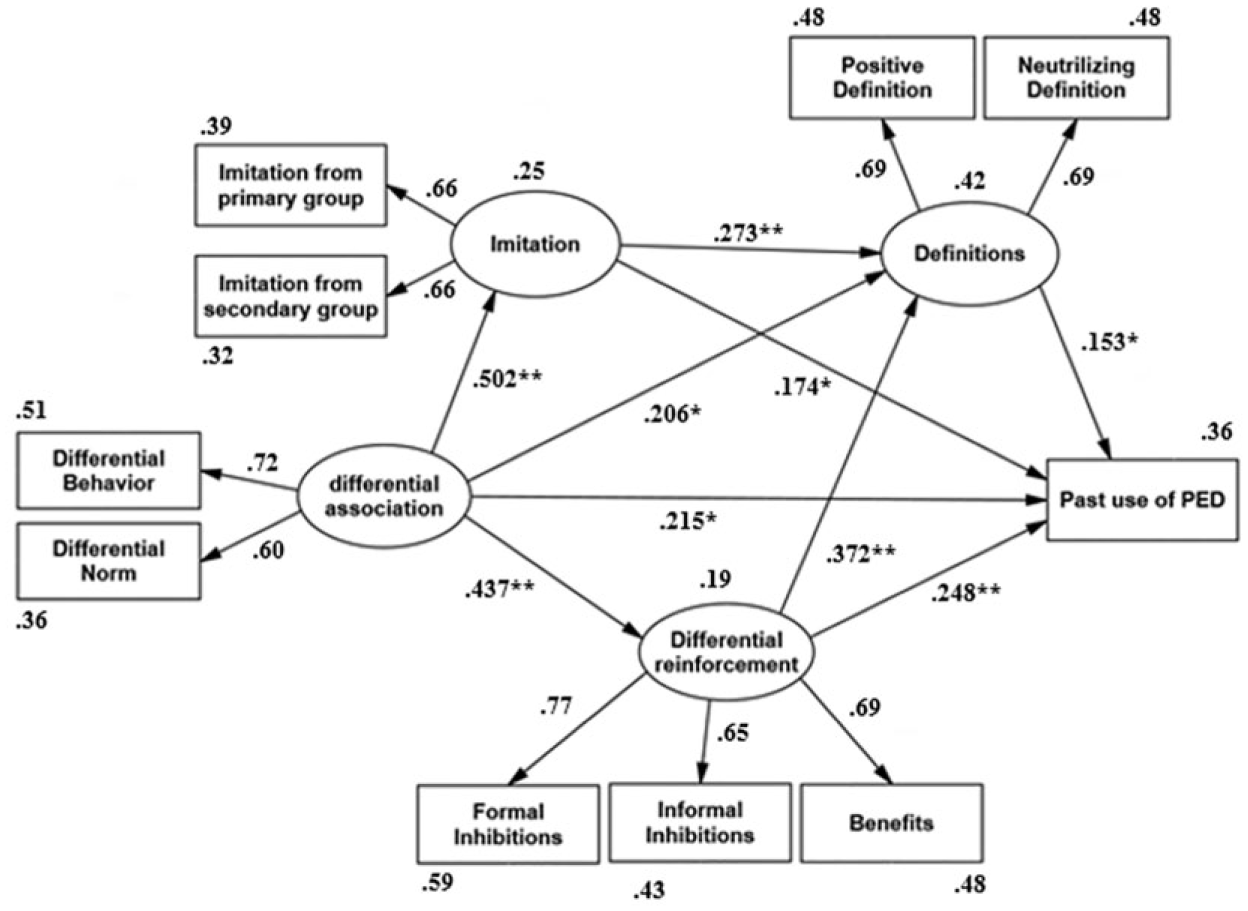
Structural equation model of social learning components on past use of PED.
The Mediated Effects of Social Learning Components on Current Use of PED
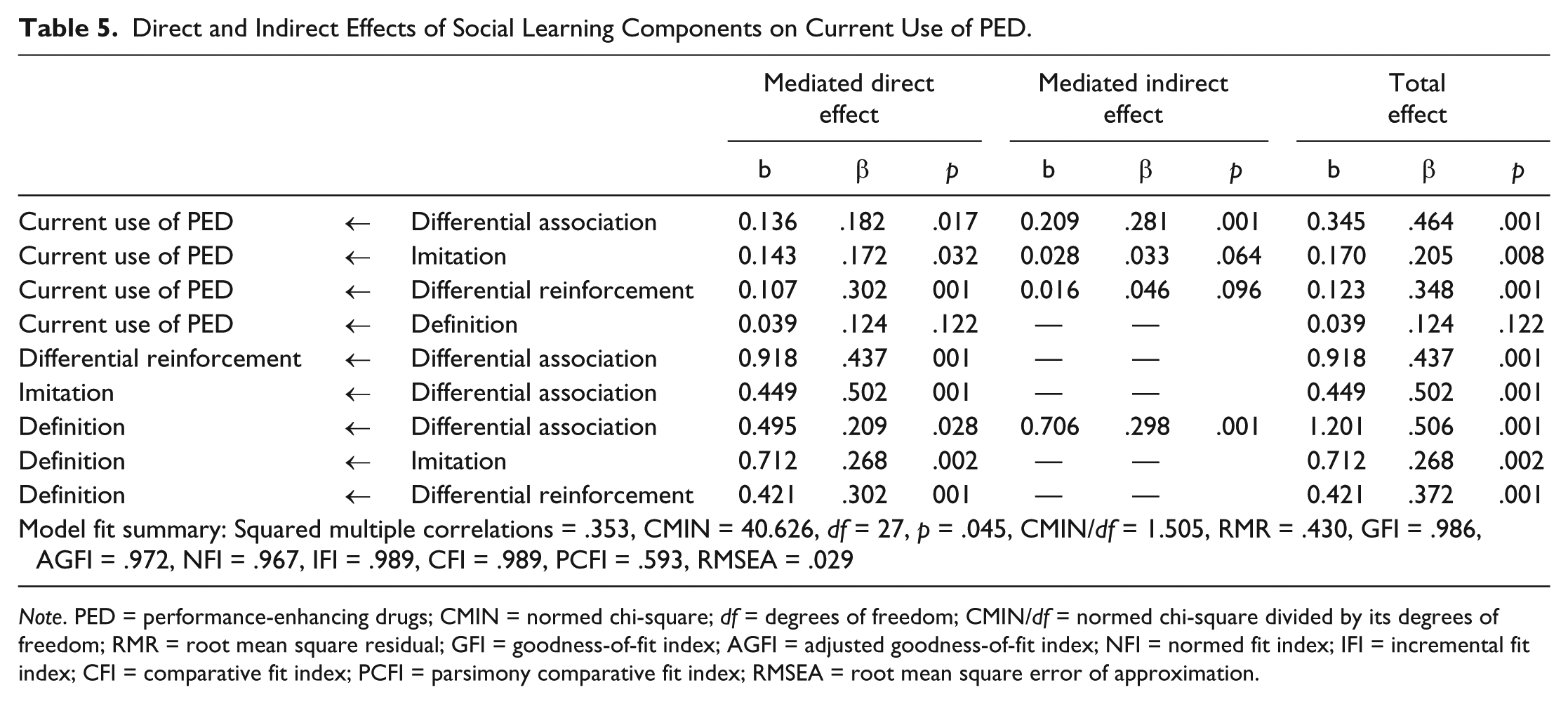
As the structural modeling analysis for current use of PED shows (see Table 5), current use of PED was also significant and directly associated with differential association (β = .182, p = .017), imitation (β = .172, p = .032), and differential reinforcement (β = .302, p = .001); however, the effects of definitions on current use of PED was not significant (β = .124, p = .122).
Direct and Indirect Effects of Social Learning Components on Current Use of PED.
Note. PED = performance-enhancing drugs; CMIN = normed chi-square; df = degrees of freedom; CMIN/df = normed chi-square divided by its degrees of freedom; RMR = root mean square residual; GFI = goodness-of-fit index; AGFI = adjusted goodness-of-fit index; NFI = normed fit index; IFI = incremental fit index; CFI = comparative fit index; PCFI = parsimony comparative fit index; RMSEA = root mean square error of approximation.
Again, differential association also has a direct effect on differential reinforcement (β = .437, p = 001), imitation (β = .502, p = .001), and definitions (β = .209, p = .028) and, from these paths, has a mediated indirect effect (partial mediation) on current use of PED (β = .281, p = .001).
Figure 2 shows the structural relationships between the independent and current use of PED. For the fitted model, the AMOS model summary result demonstrates CMIN/df (1.505), RMR (.430), GFI (.986), AGFI (.971), NFI (.967), IFI (.989), CFI (.989), PCFI (.593), and RMSEA (.029). All of the indices are better than critical values and represent the goodness-of-fit for the proposed model. Generally, the structural model shows that current doping behavior is a direct consequence of differential association, differential reinforcement, and imitation. Thus, exposure to deviant associates who themselves dope and/or support and reward doping is also associated with an increase in respondents’ current use of PED. The four social learning components combined to 35% of variance in current doping behavior. Of the four social learning components, differential association (standardized total effect: .464, p = .001) had the strongest effect on professional athletes’ current use of PED as compared with differential reinforcement (standardized total effect: .348, p = .001) and imitation (standardized total effect: .205, p = .008).
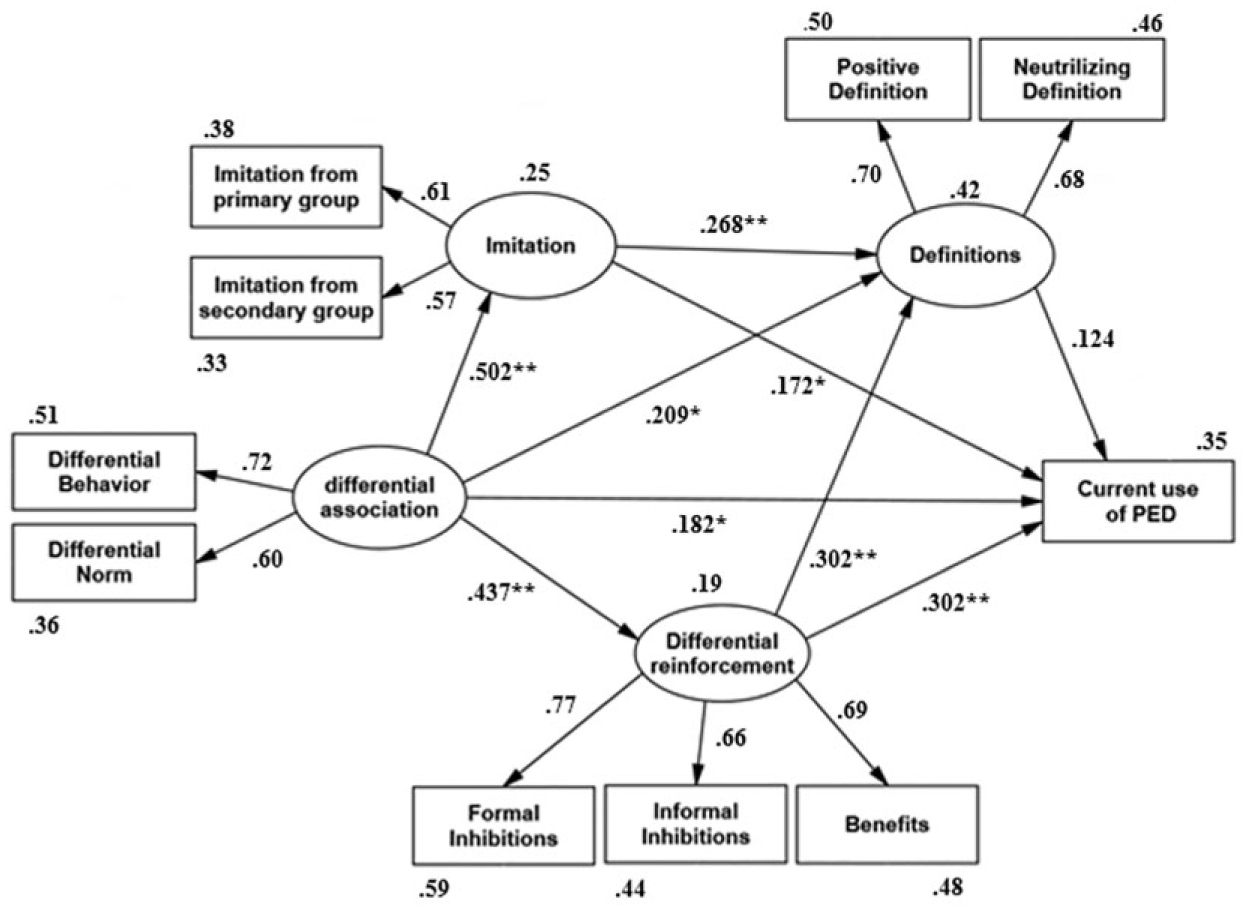
Structural equation model of social learning components on current use of PED.
The Mediated Effects of Social Learning Components on Future Use of PED
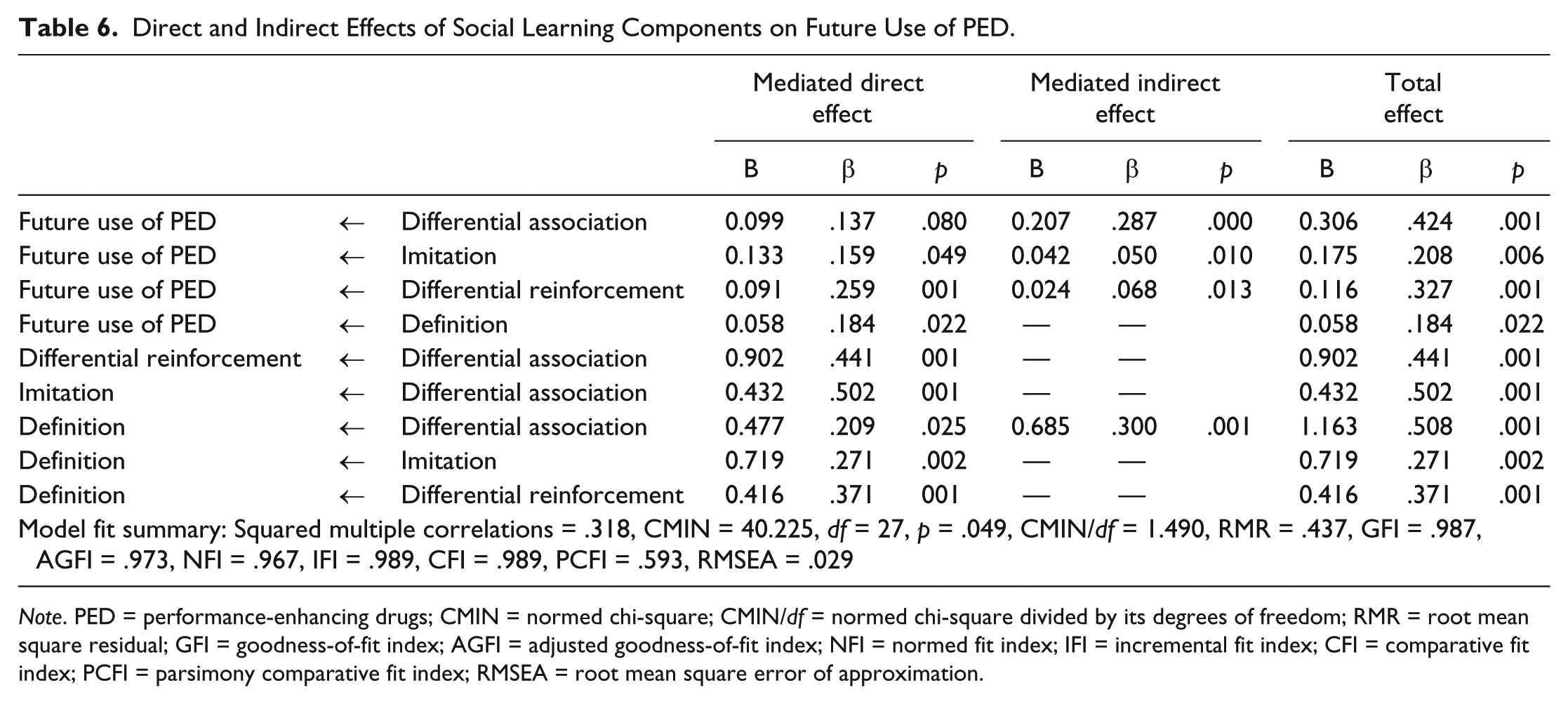
As the structural modeling analysis for the future/intended use of PED shows (see Table 6), the future or intended use of PED was significant and directly associated with imitation (β = .159, p = .049), differential reinforcement (β = .259, p = .001), and definition (β = .184, p = .022); oddly, the effect of differential association on future use of PED was not significant (β = .137, p = .080).
Direct and Indirect Effects of Social Learning Components on Future Use of PED.
Note. PED = performance-enhancing drugs; CMIN = normed chi-square; CMIN/df = normed chi-square divided by its degrees of freedom; RMR = root mean square residual; GFI = goodness-of-fit index; AGFI = adjusted goodness-of-fit index; NFI = normed fit index; IFI = incremental fit index; CFI = comparative fit index; PCFI = parsimony comparative fit index; RMSEA = root mean square error of approximation.
However, differential association does have a direct effect on differential reinforcement (β = .441, p = 001), imitation (β = .502, p = .001), and definitions (β = .209, p = .025) and from these paths has a mediated indirect effect (full mediation) on future use of PED (β = .287, p = .000). Moreover, imitation also has a direct effect on definitions (β = .271, p = .002) and from this path has a mediated indirect effect (partial mediation) on future use of PED (β = .050, p = .010). Finally, differential reinforcement has a direct effect on definitions (β = .371, p = .001) and from this path has a mediated indirect effect (partial mediation) on future use of PED (β = .068, p = .013).
Figure 3 shows the structural relationships between the independent and future/intended use of PED. For the fitted model, the AMOS model summary result demonstrates CMIN/df (1.490), RMR (.437), GFI (.987), AGFI (.973), NFI (.967), IFI (.989), CFI (.989), PCFI (.593), and RMSEA (.029). All of the indices are better than critical values and represent the goodness-of-fit for the proposed model. Generally, the structural model shows that future doping behavior is a direct consequence of differential reinforcement, imitation, and definitions. Thus, exposure to deviant associates who themselves dope and/or support and reward doping leads to an increase in future use of PED. The four social learning components combined to 32% of variance in future doping behavior. Of the four social learning components, differential association (standardized total effect: .424, p = .001) had the strongest total effect on professional athletes’ future use of PED though all of its effects are mediated through the other three social learning components. The total effects of differential reinforcement (standardized total effect: .327, p = .001), imitation (standardized total effect: .208, p = .006), and definition (standardized total effect: .184, p = .001) are smaller but both direct and mediated.
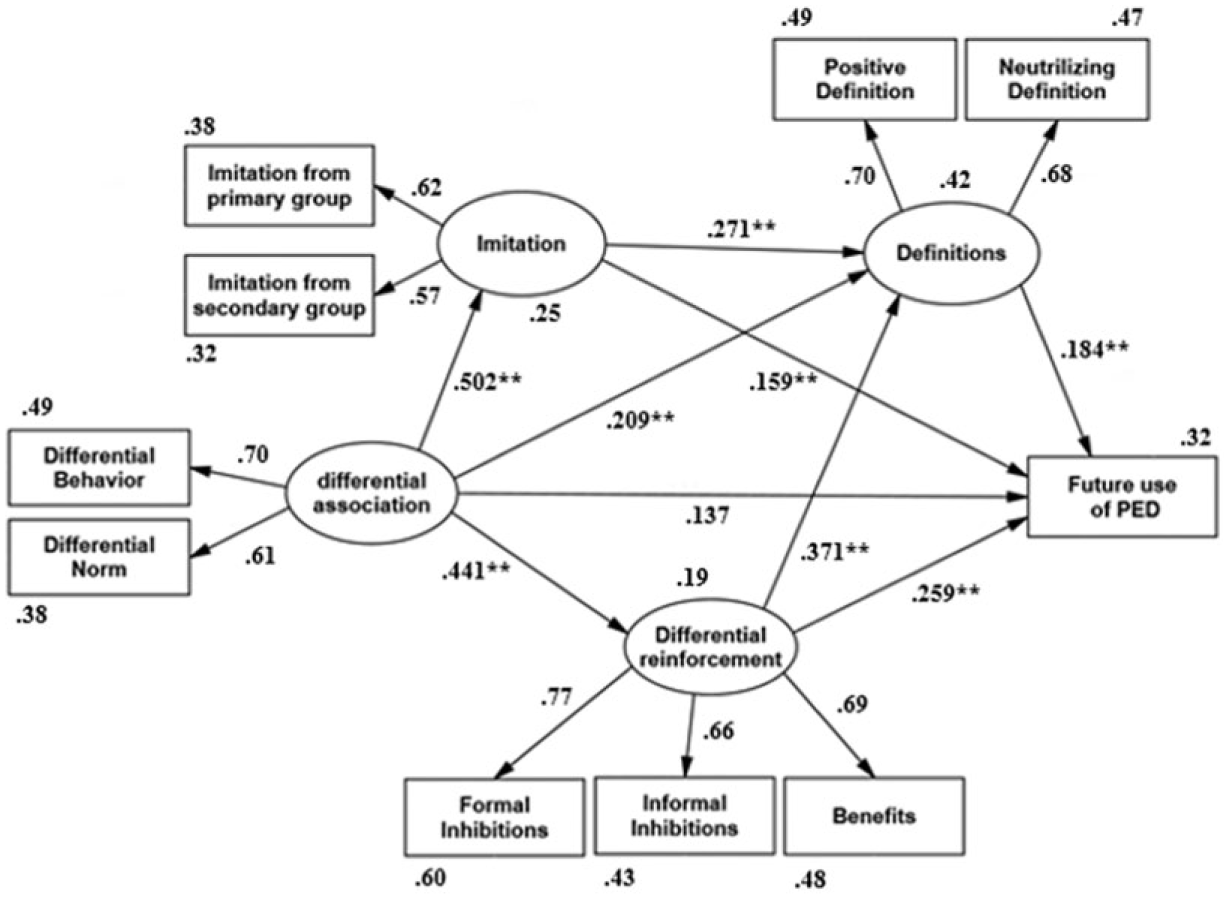
Structural equation model of social learning components on future use of PED.
Conclusion
Although the illicit use of PED by amateur and professional athletes is not a new social problem, the study of this behavior by public health and social science research is relatively nascent; particularly absent from this emerging body of research are efforts to test the efficacy of extant theoretical perspectives on the etiology of doping. The present study rectifies, at least in part, this situation by employing Akers’s social learning theory against self-reported doping behavior of professional athletes from Iran. Akers’s social learning theory states that there are four factors that play an important role in deviant behaviors like doping among athletes: differential association, differential reinforcement, imitation of behavioral patterns, and definitions of what is deviant and what is valued. In other words, social learning theory predicts that deviant behaviors, like doping activity among athletes, is a function of the degree to which an athlete associates with individuals or groups that promote the social viability of doping behavior, a person is exposed to behavioral models that directly or indirectly promote doping behavior, a person experiences positive reinforcement for doping behavior, and a person possesses definitions that are favorable to doping behavior. Using self-report survey data from a sample of professional Iranian athletes, this study tested Akers’s social learning theory against data of the doping behavior (past, present, future use of PED) of these athletes.
According to Akers (1998/2009), deviant behavior such as the use of PED, also known as doping, is a direct consequence of high levels of association with those who engage in and/or encourage deviant behaviors. As this study showed, athletes’ PED usage behavior (past, present, future use of PED) are strongly influenced by their differential associations. In addition to differential associations, the four elements of social learning also influence each of the other social learning components and, in the process, also exert powerful mediated indirect influences (partial mediation) on athletes’ past/present doping activities and full indirect mediation on future use of PED. These direct and indirect social learning effects of differential associations bear out Akers’s theory and coincide with the conclusions drawn by previous research into other forms of deviant behavior (Akers & Cochran, 1985; Akers et al., 1979; Aliverdinia, 2012; Aliverdinia & Heidari, 2011; Cochran et al., 2015; Verrill, 2005).
Differential reinforcement, such as formal and informal sanctions, also directly affects doping behavior (past, present, and future use of PED). In addition, in sport culture, differential reinforcement has a partial mediated effect on past and future doping behavior (there is no mediation effect of differential reinforcement on current use of PED). The analysis conducted in the course of this study also determined that differential reinforcement is the second most powerful predictor of doping behavior (past, present, and future use of PED). This suggests that the extent of formal and informal sanctions directly affect the development of inhibitions, and the lack of sanctions or the presence of positive reinforcement will increase the likelihood of an athlete engaging in doping activity. The risk of being caught can be outweighed by the benefits received, especially if the punishment is not severe; a minimal sanction, or familial or workplace approval of doping behavior, directly affects the athlete’s definitions, minimizing the perception of the doping behavior as deviant and increasing the likelihood that it will be engaged in. The significance of differential reinforcement in the model substantiates previous findings (Akers et al., 1979; Aliverdinia, 2012; Aliverdinia & Heidari, 2011; Lee et al., 2004; Verrill, 2005).
Akers’s theory also claims that behavioral models (i.e., those people that are admired) play a major role in an individual’s attitude toward and engagement in deviant behaviors. The individual experiences vicarious reinforcement as the actions of the behavioral model are reacted to by others or as the model expresses pleasure or satisfaction with his or her own behavior, and thus, he or she is more likely to be emulated by others who may find themselves in a similar situation. As was shown above, imitation of primary and secondary associates has a direct impact on doping behavior on past, current, and future use of PED. Moreover, imitation had a significant partial mediation on past and future use of PED (there is no mediation effect of imitation on current use of PED). Moreover, imitation was the tertiary predictor for doping activity (past, current, and future use of PED). This result was consistent with Akers et al. (1979), Aliverdinia and Heidari (2011), Lee et al. (2004), and Verrill (2005). The significance of definitions in the model substantiates previous findings (Akers et al., 1979; Aliverdinia, 2012; Aliverdinia & Heidari, 2011; Lee et al., 2004; Verrill, 2005).
In sum, the findings of this study showed that Akers’s social learning theory is a suitable framework for describing the mechanisms of doping activities; it explained approximately 36% of the variance in past doping behavior, 35% of the variance in current use of PED, and 32% of the variance in future use of PED, quite a robust model relative what is more typically observed. Importantly, this study is quite novel in a number of ways: It examines the deviant behavior of adults rather than high school or college students; it examines the deviant behavior of professional athletes—a group often in the news for their misconduct but rarely studied by criminologists; and it studies Iranians and thus offers a unique cross-cultural test of Akers’s theory. It is also unique in that it examines the illicit use of PED, a form of deviant behavior rarely studied by criminologists. Relatedly, the study examines PED use (past, current, and future PED use). It also examines the direct and indirect effects of all four of the key theoretical components of Akers’s social learning theory with a structural equation approach, a method of testing Akers’s theory that is quite appropriate but not frequently employed. For each of these reasons, the study contributes to the extant literature.
However, the study is not without its limitations, which futures studies should endeavor to rectify. Two limitations are especially troublesome, though there are also relatively common limitations associated with this kind of research (e.g., limited generalizability, sample size, self-reported data, limited operationalization of key theoretical variables, and limited controls for potential sources of spuriousness, etc.). First, while all four social learning theory components have been operationalized, the operationalization of each is somewhat incomplete. Second, and perhaps most significantly, the data are cross-sectional in design while the theory is inherently processual and requires longitudinal data to be properly tested; this is especially true with regard to modeling the feedback/reciprocal effects of behavior on the social learning process itself.
Footnotes
Declaration of Conflicting Interests
The author(s) declared no potential conflicts of interest with respect to the research, authorship, and/or publication of this article.
Funding
The author(s) received no financial support for the research, authorship, and/or publication of this article.