



Abstract
This study explores the social integration processes older men experience following prison release. Semi-structured in-depth interviews and brief surveys were conducted with 20 men, 50 years of age and older, recently released from prison in a large, Eastern U.S. city. A follow-up interview was conducted with each participant. Conventional content analysis was used to analyze these data. Results show that while men are able to connect with and rely upon some family members and establish basic public benefits, older men’s release experience is nonetheless marked by pervasive disconnection from key desired social relationships and roles. Policies and programs designed to facilitate older men’s social integration are discussed.
In 2009, more than 700,000 offenders were released from U.S. state and federal prisons into the community (West, Sabol, & Greenman, 2010). As criminal sentences have grown longer and repeated spells in prison have become common, aging prisoners represent an increasing share of this population. In 2010, prisoners aged 50 and above composed 16% of those incarcerated in state and federal institutions (Guerino, Harrison, & Sabol, 2011). Fifty is typically designated as the beginning of “old age” among the incarcerated, whose burden of illness and disease are characteristic of the non-incarcerated 10 to 15 years their senior (Human Rights Watch, 2012). Relative growth of this population has also been substantial, increasing by 282% between 1995 and 2010, relative to a 42% growth rate for the general prison population (Carson & Golinelli, 2013). Research has begun to address the challenges posed by incarcerating a growing number of aging prisoners (Aday, 1994, 2003; E. S. Cohen, 2005; Kerbs & Jolley, 2007; Maschi, Viola, & Sun, 2013; Mitka, 2004; Williams & Abraldes, 2007), with the health care costs of older offenders posing a particular point of concern (Holman, 1998; Yates & Gillespie, 2000). In response, policy makers, correctional officials, and advocates have increasingly called for the early release of older offenders, both to ease the financial burden to correctional institutions and protect a vulnerable population unlikely to return to crime (Aday, 2003; Chiu, 2010; Williams & Abraldes, 2007; Yates & Gillespie, 2000). Indeed, former U.S. Attorney General Holder argued for the expanded use of “compassionate [early] release” for older non-violent prisoners (Holder, 2013), which was recently echoed by the U.S. Justice Department’s inspector general (A. Cohen, 2014).
Yet, release from prison is just the first step in the longer process of prisoner reentry, which is composed both of desistance from crime and community reintegration (Visher & Travis, 2003). Although it has been established that older offenders recidivate at a lower rate than younger offenders (Cooper, Durose, & Snyder, 2014; Hoffman & Beck, 1984; Holman, 1998), it remains largely unknown how older offenders fare in the processes of social reintegration more generally (Crawley & Sparks, 2006; Williams, Stern, Mellow, Safer, & Greifinger, 2012). This topic is significant both because of the scope of the problem, with 12% of U.S. prisoners aged 50 and above released each year, and because social integration has important implications for individuals’ long-term health and well-being (Carson & Golinelli, 2013; House, Robbins, & Metzner, 1982; Seeman, 1996). Building on the multidimensional concept of reintegration put forth by Visher and Travis (2003), successful social (re)integration is here defined as encompassing (a) resource factors, such as the attainment of stable housing, benefits, and employment; (b) network factors, such as the (re) establishment of social relationships and roles; and (c) psychosocial factors, such as feelings of “mattering” or being valued within these relationships and roles. In other words, successful reintegration following prison entails securing the material resources, social connections, and psychological grounding necessary for positive social functioning.
Prior studies of prisoner reentry, which generally focus on “average” (i.e., younger) former prisoners, have documented the challenges they face in securing or maintaining necessary resources and valued social roles, including employment, housing, public benefits, and relationships with family (Harding, Wyse, Cooper-Dobson, & Morenoff, 2014; Travis, 2005). There is also evidence that incarceration significantly harms familial bonds by breaking up intact families and diminishing post-incarceration marital prospects and relationships with children (Edin, Nelson, & Paranal, 2004; Lopoo & Western, 2005). Some of these consequences can be long-reaching, as Alexander (2012) suggests that, in the U.S. context, a criminal record essentially serves as a “new Jim Crow,” a racial caste system that excludes a large segment of African American men from essential social institutions.
Older former prisoners’ reentry process is likely distinct in important ways. Older offenders’ ties to family may be frayed following years of criminal involvement and drug abuse, or simply weakened following a lengthy prison sentence. Jobs may be even more challenging to obtain as older men face both the barriers posed by a criminal record as well as those of advanced age. On the contrary, research on criminal careers shows that aging leads to a sharp decline in criminal activity (Blumstein & Cohen, 1987) and increased investment in conventional ties and roles (Shover, 1996). Complicating the picture is whether reentry varies by older offender “type,” 1 and if so, how.
Conceptual Framework
An important component of the reentry experience is that of social integration into the roles and relationships of work, family, and community. Broadly speaking, social integration can be understood as the extent to which an individual is enmeshed in, and feels a sense of belonging with, others in a social system (Anant, 1966; Hooyman & Kiyak, 2008). Such connectivity may be fostered by the assumption of key social roles, the receipt of essential social supports and resources, and/or the formation of social ties. Social integration may encompass both objective dimensions of an individual’s social context, such as number of individual connections or group memberships, and more subjective understandings of these relationships, such as the feeling of being loved and uniquely valued in relationships characterized by mutual obligations (Anant, 1966; Hooyman & Kiyak, 2008; Lindgren, Pass, & Sime, 1990; Vitman, Iecovich, & Alfasi, 2014).
Understanding the social integration processes of older offenders is particularly important given the established relationship between social ties and support and positive physical and mental health outcomes. The positive implications for health of social connectivity include lower overall mortality, improved immune and cardiovascular functioning, and lower rates of depression (Berkman & Syme, 1979; House et al., 1982; Seeman, 1996). Social integration also protects against feelings of loneliness, promotes life satisfaction, and is an important element in successful aging (Rowe & Kahn, 1997; Steinkamp & Kelly, 1987). Given the documented high burden of disease and illness borne by aging former prisoners, social integration may help stave off further mental and physical decline (Aday, 2003; Human Rights Watch, 2012).
Conventional social ties and roles have also been found to encourage desistance from crime (Laub & Sampson, 2001; Lebel & Maruna, 2012; Uggen, Wakefield, & Western, 2005; Visher & Travis, 2003). For instance, Sampson, Laub, and Wimer (2006) suggest that the social control properties present in a strong bond formed with a conventional marital partner may discourage criminal offending through four primary pathways: increasing the cost of crime—as ongoing criminal activity may threaten a valued relationship, protecting ex-offenders from criminal opportunities and influences (e.g., criminal friends, bars), providing structure and supervision (direct processes of social control), and by availing former prisoners of a social identity incompatible with ongoing criminal offending. Employment and military service have likewise been found to suppress recidivism by similarly building former offenders’ attachments to conventional social institutions (Aresti, Eatough, & Brooks-Gordon, 2010; Sampson & Laub, 1993; Uggen, 2000).
Men also return to particular neighborhood contexts that may have important implications for their reintegration processes. Prior research has found that former offenders are more likely to recidivate when they return to their pre-prison neighborhood, or to a neighborhood populated by higher concentrations of ex-offenders (Kirk, 2009, 2012; Stahler et al., 2013). In these cases, recidivism may be facilitated by interaction with criminally engaged friends and neighbors, and/or exposure to environmental “triggers” for substance use that encourage relapse (Carter & Tiffany, 1999; Kirk, 2009, 2012). Another line of research suggests that incarceration itself and the “churning” that results from frequent incarceration and release can erode the informal social control properties present in neighborhoods, leading to fewer sanctions on criminal behaviors and more criminal opportunities (Rose and Clear, 1998). The implications of neighborhood context for reentrants’ reintegration processes more broadly beyond recidivism remain largely unknown (Morenoff & Harding, 2014).
While many questions remain, recent research has begun to shed light on the significance of older age in the reentry process. Western, Braga, Davis, and Sirois (2015) find that, among their sample of prisoners released in Boston, Massachusetts, older offenders, as well as those with histories of mental illness and addiction, were the most materially disadvantaged (insecurely housed and less likely to be employed) and socially disconnected. Although their study did not investigate why this was the case, they hypothesize that older former prisoners’ may have burned bridges with friends and family over their years of criminal involvement, thus cutting off important sources of social and material support.
Prisoner reentry among “lifers” (those incarcerated for 10 or more years) may also prove instructive. For lifers, reentry has been found to be a period of anxiety and difficult adjustment to the outside world, as prisoners slowly acculturate to life outside the prison walls (Clemmer, 1940/1958; Gunnison & Helfgott, 2013; Irwin, 2005). Relationships with women can be emotionally fraught, as minor disagreements provoke anxiety, and men reconcile their idealized expectations of women and relationships with lived realities (Munn, 2011). Yet, lifers may also undergo processes of rehabilitation while incarcerated, which may make successful integration more possible. Irwin (2009) details the stages of lifers’ atonement processes in prison, proceeding from awakening to accepting responsibility, gaining insight, and finally, taking on a socially beneficent orientation. Once in the community, this orientation could encourage former lifers to take on the social roles of “wounded healer” or professional “ex,” what Maruna (2001) calls “generative commitments” that provide purpose and meaning, while also firming resolution to desist.
The present research draws on qualitative interviews and brief surveys with a small sample of male, recently released prisoners aged 50 and above to address the material and social dimensions of older men’s post-prison lives. After discussion of the data and methodology utilized, results are presented regarding interview subjects’ integration into family, employment, and neighborhood social roles and relationships. Results are followed by a summative conclusion, discussion of the study’s limitations, and policy recommendations intended to address some of the challenges identified.
Data and Method
Data Collection
Twenty men aged 50 and older who had been released for a period of 1 year or less to the city of “Easton” 2 were recruited to participate in the study. Two in-depth, semi-structured interviews were conducted with each participant to establish the material and social context of the reentry process. The sample size of 20 was chosen to capture sufficient diversity of experience and perspective among older reentrants, while also allowing for lengthy initial and follow-up interviews with each subject. Qualitative interviews allow for investigation of subjects’ expectations, experiences and beliefs, for instance, in allowing subjects to self-define success, rather than imposing an external definition upon them (Lofland & Lofland, 1995). In addition, brief survey instruments assessing subjects’ physical and behavioral health were administered to interview subjects at the first meeting.
Study procedures were approved by the University of Michigan’s Institutional Review Board. The sample was recruited through flyers hung at halfway houses, non-profit and governmental offices serving disadvantaged and ex-offending populations throughout the city. The primary investigator (PI) also established contacts with workers at many of these organizations who passed along information about the study to those they knew to be eligible. Inclusion criteria consisted of men aged (50+) who had been released from prison within 1 year and who were not residing in a nursing home. A US$50 incentive payment for participation was offered at each interview. At the initial contact, the PI described the primary goals of the study, and participants were screened for inclusion. At the initial in-person meeting, the informed consent was signed and approval to audiotape the interview was secured.
The PI met with subjects in public locations throughout the city, including coffee shops and public library quiet rooms. Interviews ranged between 1.5 and 2.5 hr and covered a diversity of topics, from the community and social context to which offenders returned to their processes of personal and social adjustment following release. Questions addressed a broad array of topics touching on social integration: subjects’ material well-being (Do you feel that you’ve had trouble making ends meet since you were released?), social networks (What family members and friends have you spent most of your time with since you were released? Can you tell me a little about those people?), health (Can you describe any health problems that you have?), and criminal history and engagement (How likely do you think it is that you will return to prison and/or commit another crime? Why do you think this is?). The semi-structured protocol allowed participants to guide the conversation toward topics of particular relevance to them, as well as the opportunity to bring up additional topics. The follow-up interview occurred 2 to 3 months following the initial interview and revisited key aspects of subjects’ reintegration (housing, material well-being, etc.) to assess changes in these domains that had occurred since the prior interview. Interview timing was designed to capture the rapid transitions that tend to occur in the first year following prison release. Analysis drew on both interviews.
Protocols additionally contained short screening tools measuring offenders’ health and well-being. Screening tools included the Patient Health Questionaire-9 (PHQ-9) assessing depressed mood, the Activities of Daily Living (ADL) Screening assessing the subject’s ability to perform ADL, and the Michigan Alcohol Screening Test (MAST) to assess possible alcohol use disorders. Substance use disorders were further identified by subject response to questions such as, “How would you describe your use of drugs and alcohol?” Subjects were given a choice as to whether the screening would be administered orally or on paper. Most subjects chose to complete the screening tool independently and by hand.
To confirm subjects’ age and recent incarceration history, the PI accessed participants’ publicly available criminal records. While possible to confirm that each participant had a criminal history, court records note only sentencing and not release date. While in some cases, a release date could be estimated; this was not possible in all cases. Furthermore, information about returning to prison on parole violation is not included in public records, and several subjects had been returned to prison on violations. Despite this limitation, for the most part, it was possible to confirm that subjects fit the desired age criteria and had recent histories in the criminal justice system.
Participants
Characteristics of the sample are presented in Table 1. Largely aligned with the demographics of those on supervision within the city, 18 of 20 subjects were Black, more than a third had less than a high school education, roughly two third had never married, and slightly fewer had grown children. The average age was 56, with an age range from 50 to 68. The average length of incarceration, skewed by the very long sentences of a few, was 91 months, whereas the median was 50 months. Forty-five percent of the sample had been incarcerated for property or drug crimes, 40% for violent or sex crimes, and 15% for “white collar” crimes. Subjects were classified into categories within an established typology of older offenders (Aday, 2003; Goetting, 1983). Categories included Chronic Recidivists who had engaged in criminal offending throughout their lives, Late Life Offenders whose first criminal offense was late in life, lifers who had been incarcerated for 10 or more years, and 50 in prison, short-term first offenders who turned 50 in prison. In addition, a new category titled Administrative Recidivist was added to the typology to account for subjects whose repeated returns to prison and jail resulted from parole violations rather than new criminal sentences. Of the subjects, 25% were classified as administrative recidivists, 45% as chronic recidivists, 20% as lifers, and 10% as late life offenders.3,4
Demographics, Criminal Histories, Barriers & Resources.
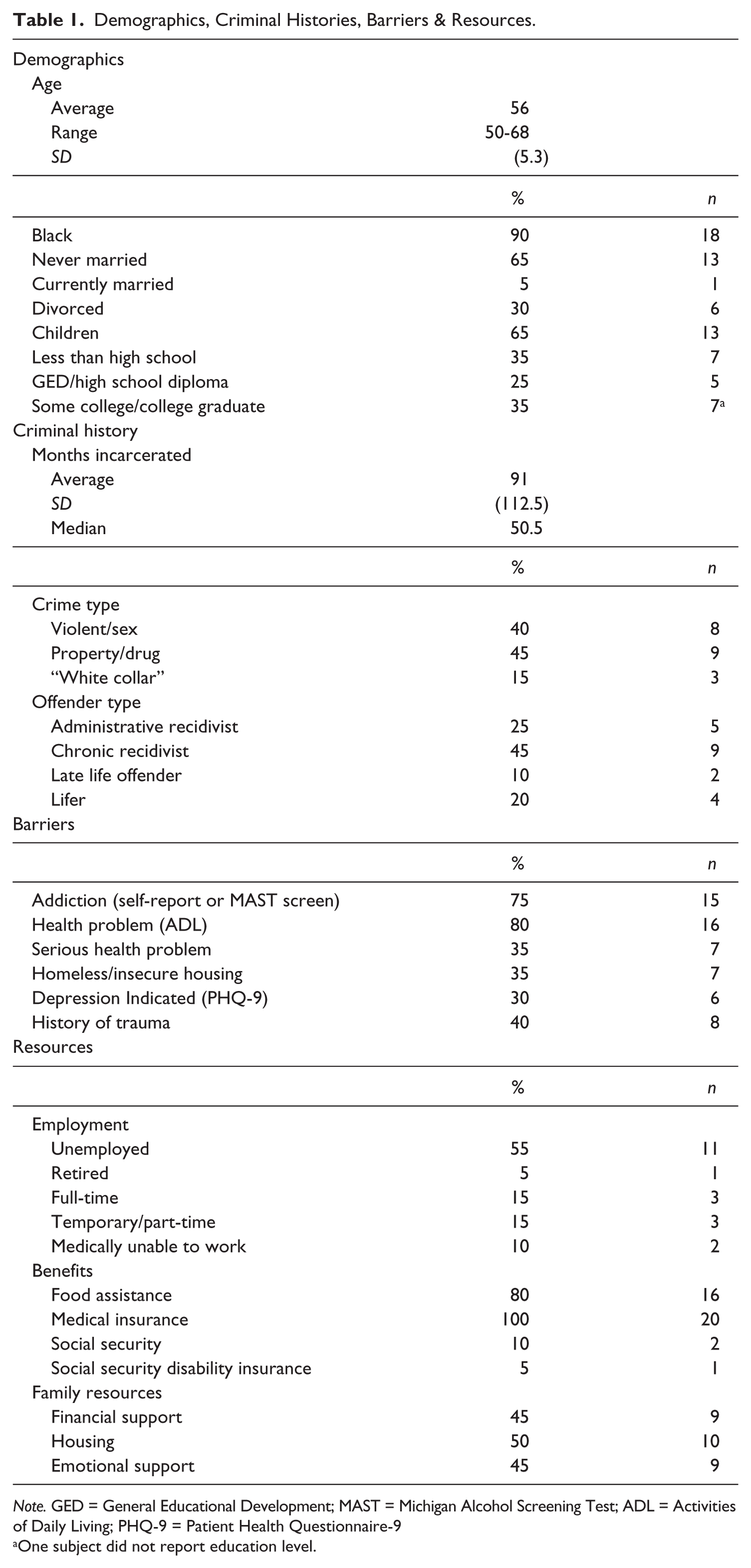
Note. GED = General Educational Development; MAST = Michigan Alcohol Screening Test; ADL = Activities of Daily Living; PHQ-9 = Patient Health Questionnaire-9
One subject did not report education level.
The sample was quite disadvantaged, with a high degree of personal challenges, which are presented in Table 1. Seventy-five percent self-identified as having a substance use disorder; 80% described at least one health problem; 35% named a serious health problem (defined as currently having a life-threatening disease such as cancer, HIV, or Hepatitis C); 30% screened as potentially depressed on the short depression screening tool, the PHQ-9; nearly 40% had experienced trauma (a researcher-defined category encompassing incidences such as physical or sexual abuse as a child or the violent death of a close relative); and more than one third were homeless or housing insecure (a status defined as residing on the street or in a homeless shelter, or temporary residence with friends or family and no plans for where to go next). Furthermore, nearly all participants were struggling financially. Only three were employed full-time (earning between US$1,200 and US$1,600 per month), whereas three were employed in temporary or part-time positions (earning roughly US$800/month). Two subjects received benefits from social security, with one receiving US$1,500/month, another just US$675. One subject received social security disability insurance for HIV and the complications that made him unable to work. Eleven participants were unemployed and subsisted largely on Supplemental Nutrition Assistance Program 5 (SNAP) benefits and handouts from friends or family.
Data Analysis Strategies
The open-ended portion of the interviews was digitally recorded and professionally transcribed verbatim. Completed documents were reviewed by the PI for accuracy. Content analysis was the methodology utilized to analyze the data (Hsieh & Shannon, 2005). ATLAS.ti qualitative analysis software was utilized for data organization and coding. Each transcript was read carefully to identify key themes. First, social disconnection emerged as a central theme across participants’ interviews. Next, interviewee’s thoughts and experiences regarding disconnection and reintegration were identified in the text and a keyword or “code” used to capture this thought or experience. After open coding five interviews, preliminary codes were identified. All remaining transcripts were then coded with the developed code list. Additional codes added as new concepts were encountered. The original transcripts were re-coded with the finalized code list. Finally, text linked with key codes was systematically reviewed and compared both within and across interviews to identify dimensions of participant experience and common patterns of reintegration and disconnection. 6
Findings
Social Integration and Social Disconnection
Although nearly all men left prison voicing a strong desire to become part of conventional society, they faced substantial barriers to achieving the social integration they desired. In fact, one dominant experience the subjects faced was that of disconnection: from key relationships, roles, and neighborhood-based social networks. Although most men connected with family, and were able to draw upon the material and emotional resources these relationships offered, their investment in these ties was ultimately limited by their own feelings of being unable to adequately fill the roles these relationships required. Integral to this assessment was an inability to secure employment. Furthermore, the possibility of playing a generative social role in relationships with children and grandchildren was often limited by previous disinvestment in children’s lives. Finally, in attempting to abstain from substance abuse and criminal behaviors, men often withdrew from their neighborhood-based social networks, some of which had been substantially degraded by processes of gentrification.
Family ties and roles
Upon prison release, subjects were eager to reestablish relationships with their immediate family both for the instrumental resources families could provide and for the emotional support. Family members, including parents, siblings, and romantic partners, were a common source of material support. Forty-five percent of men had received some monetary assistance from their family, whereas half of men resided with family at the time of their interview. Yet, most men’s families were limited in their ability to help given their own financial constraints.
Emotional support was also important for many. Half of the subjects described a close, supportive relationship with at least one family member they felt they could confide in. This was the case for 59-year-old Saul,
7
a heroin addict since age 17 and administrative recidivist who had been back and forth to prison repeatedly over more than two decades on parole violations for a crime he had committed in 1989. He describes how he dealt with the stress of reentry, “I go talk to somebody. I call somebody and they’ll say, ‘Man just keep holding on. Be strong.’ That’s the cousin.” Such emotional support was particularly crucial for those (like Saul) who struggled with sobriety. For others, who knew a return to crime could help solve their financial struggles, such support helped maintain a commitment to desistance. Stanley, 55, a cocaine addict and chronic recidivist, recently released after serving 5 years for transporting stolen property, explains,
. . . Even though these people may have called and asked, ‘come on are you trying to get your hands dirty again,’ the first thing came to my mind is my family. They wouldn’t have no understanding as to why I blew another opportunity to stay home if anything were to happen. That’s another reason why it’s not worth it to me . . . because this is probably the closest we been in a long while.
Such positive change in family relationships was voiced primarily by chronic and administrative recidivists, like Stanley. Lifers, in contrast, described strong connections maintained with their family throughout their imprisonment that simply continued after release. Art, for instance, a 53-year-old lifer who had served 30 years in prison on a deadly multiple assault charge, laughingly described his sister complaining that he was “blowing up her phone” (a term he found perplexing), by calling her every day from prison. It seemed that physical distance over the years had been less detrimental to family relationships than had been the strains and disappointments of ongoing criminal offending and drug abuse the families of chronic and administrative recidivists had endured. Despite this, lifers faced their own challenges, struggling with feelings of anxiety in social situations they were unaccustomed to.
Despite the positive engagement with family that men described, many subjects nonetheless described significant barriers to their full integration into these relationships. This was particularly the case with romantic partners. First, subjects described intense discomfort with relying on romantic partners for financial help, believing that “a grown man” should be independent. Discomfort with financial “dependency” meant that many subjects held off either initiating or formalizing a partnership upon release. Notably, it did not seem to be the partner’s desire for economic support that was the barrier, but rather, men’s own socially shaped expectations for their own role within a romantic partnership. Richard, a long-time heroin addict who had been back and forth to prison on parole violations over a period of 40 years, explains that his financial situation stood in the way of moving in with his girlfriend of 8 years:
I have to come to the table . . . And I ain’t making that kind of money yet.
What do you mean you have to come to the table?
To help her, partners help each other. I mean can’t one person be paying all the bills. So I don’t want that responsibility, like, she’s taking care of me. So that’s why . . . we’re not together full time.
While Richard stayed with his girlfriend 3 days out of the week, he spent the rest of the week sleeping in the dining room of another woman, who was functionally limited and struggled with paranoia. She paid him US$125 a month to run errands for her and reassure her that everything was all right.
For Sly, a man who had turned 50 in prison following a 2-year incarceration on an armed robbery charge, his poverty discouraged him from seeking out a relationship at all:
But see, three things a woman want from a man. And I don’t have them three things.
What are those three things?
Okay, look. Car, cash, and a crib. A woman wants you to have a car. Next she ain’t trying to go in your house if you living with your mother. I don’t have a crib, I don’t have a car, and I damn sure ain’t got no cash. Because I don’t have a job.
Although Sly initially described his financial situation as the reason women rejected him, he went on to explain that he had been pursued by a number of women. When pressed to explain this inconsistency, he stated,
No, I don’t want it because I’m not ready though. I can’t give them what they want . . . If I’m gonna be in a relationship with somebody I’m a have provide the things that make her comfortable and feel warm.
Thus, until he was financially stable, a relationship was not something he was looking for. Instead, Sly cultivated a series of business relationships with older women, who were willing to pay him for sex.
While many subjects described similar wariness or discomfort with financial reliance on romantic partners, they expressed less discomfort with asking for help from their family of origin. Perhaps this was because, with multiple family members to potentially turn to, any given individual would be less likely to be relied on exclusively. However, long-term or extensive support from families of origin, such as permanent housing, was seen as similarly problematic.
While relationships with parents and siblings were often quickly resumed, for most, relationships with children, and by extension grandchildren, were not so easily re-established. Through periods of drug addiction, criminal offending, and multiple incarcerations, most men had appeared in their children’s lives only sporadically. Children, hurt from years of neglect, were then unwilling to welcome their fathers back. As Stanley explains,
Because they say I was never around, you know, I didn’t spend the time a dad should spend with them . . . Kind of drifted out of their lives and they don’t see why it’s necessary for me to put an effort into deal with them now, especially now that they’re grown . . .
In contrast to his siblings, who were willing to accept the mistakes he had made and rebuild a relationship with him, Stanley’s daughters kept him at arm’s length.
Many men’s discussion of their children was characterized by a sense of longing and loss. Such was the case with 57-year-old Ray, a chronic recidivist most recently incarcerated 2 years for a burglary linked with his crack addiction. Years before, Ray and his ex-wife had broken up when his twins were just 1-year old, and he had kept his distance until they turned 13, at which point he had come back into their lives. Later when he was arrested yet again, the children’s mother decided it would be best to cut off contact to protect the children emotionally. Although he longed for a relationship with his children, he had had little contact with them since his release:
I haven’t really talked to them . . . I text my daughter every once in a while. She answers sometimes she doesn’t . . . She’s going through what she’s going through . . . [And] me and my son have . . . no relationship at all. He hasn’t talked to me . . . I haven’t heard his voice . . . [in] oh, around twenty years maybe? . . . I think about him a whole lot though . . . I was even like . . . if I could just get a picture of him, I won’t worry about hearing him no more . . . Eventually I’ll get a picture of him.
For children ambivalent about their relationship with their father, texting seemed to serve as a way to connect superficially while remaining distant, and many men reported corresponding with their children largely through text. Texting let them know that their children were thinking of them and wanted some form of a relationship, albeit a minimal one.
Such disconnection from children and grandchildren was deeply troubling for men who saw these relationships as a way to cultivate meaning in their later lives. Such a finding aligns with Shover’s (1996) work on desisting criminals’ desire for a generative social role in later life. Linked with the desire for a relationship with children was intense regret over the choices they had made in the past in these relationships. As Jacob, a 55-year-old former cocaine addict and chronic recidivist incarcerated on a drug selling charge explains,
I regret not taking advantage of the things I could have took advantage of, the time I wasted I could have raised my daughter. I could have held my daughter when she was a baby. All those things that I missed . . . Just going back to jail, to jail, to jail. You look up and you got twenty-five years gone out of your life. That’s gone. You can’t get it back.
Although regret permeated Jacob’s description of his past, it was in discussion of his relationship to his children that these regrets weighed most heavily.
Whereas chronic and administrative recidivists expressed regret and longing for a relationship with their children, lifers often regretted missing the opportunity to have children at all, incarcerated as they had been for the bulk of their adult lives.
Employment as a social role
While the challenges former prisoners face securing employment has been well documented, the social and emotional significance employment holds has been less discussed. Indeed, men’s intense desire for employment seemed to have as much to do with a longing to become part of the conventional social fabric as it did with financial need. For 52-year-old Edward, a lifer released from 31 years incarcerated for murder, his inability to find work highlighted his status as an outsider:
I don’t feel productive. I don’t feel like I’m a part of society yet . . . But maybe by finding a good job or, naw, It don’t have to be a good job. Any job. And I’ll be able to do something where I can wake up in the morning, go to work, . . . plan my day where I get like it was when I was in prison . . . every day I knew exactly what I had to do. And out here I need to do the same thing. That’s why I say I need to find some type of stability . . . I don’t see nothing stable in my life right now. I just feel like, I’m just here. I’m just . . . another old tree or whatever . . . I’m just another out there in the midst of . . . like, I’m in the way.
Edward struggles to maintain even the sense of stability and belonging he had had when he was incarcerated. For Edward, as for other “lifers,” the opportunity to work was made even more important by the fact that, after such a long period of time spent imprisoned, he struggled to understand how to act appropriately within social relationships. Although he loved and deeply appreciated his family, he nonetheless felt significant stress in interacting with them; in contrast, he knew just what to do on the job.
Many others expressed the same frustration and feeling of rolelessness voiced by Edward. Jerry, an administrative recidivist incarcerated for 1 year on a probation violation, explains,
And basically with her [his fiancé] working and me not working it can humble a person. A man. A man who’s used to working, he’ll get bitter, he’ll get angry, he’ll get disappointed, he’ll get frustrated. He’ll say, “fuck the world. I don’t care.” He might start using drugs, he might start robbing, because he’s less than. He feels less than . . . And she’ll ask me, “What’s wrong?” (pauses; emotionally choked) Everything is wrong. And I just want to be quiet. It’s real, it’s real tight. It can be really . . . frustrating and heartbreaking when you have skills. You have some skills.
For Jerry, as for others, the inability to find work, with the financial resources and associated self-worth employment provided, meant that they struggled to find a sense of purpose; their lives felt “without any meaning,” as Stanley described.
Michael, a 60-year-old administrative recidivist, interpreted rejection by employers as a statement about his worth to society more generally in old age, “You done played out. It seems like that. It’s almost as if they trying to get you to believe this on the inside of yourself. And it’s not so. You feel me?” A job would help reinforce for men that they still had a place in society, a role to play, and in this sense, personal significance. Employment would also make the familial social roles in which men were comfortable, that of independent adult and provider to partner, possible.
While men had numerous health problems, they did not view these problems as a barrier to their employment. This likely reflected the fundamental importance of work to men’s identity. Health problems that could be seen as debilitating were not viewed as such by the men in the sample. Indeed, only one subject received social security disability insurance for HIV and fatigue that plagued him. One other, 61-year-old James, had an application in process to support him while he recovered from a double hip replacement, but planned to obtain a commercial driver’s license and begin truck driving as soon as he had recovered.
Neighborhoods and networks
While neighborhood-based networks are an important component of social embeddedness, providing access to instrumental and expressive support and contributing to feelings of psychological belonging (Rosenbaum, Reynolds, & DeLuca, 2002), most participants remained disconnected from such networks and the supports they could provide in important respects.
One reason for this was proactive decision making. The strategies of social isolation men had cultivated to stay safe while in prison were transposed to the outside world, where running into old friends or “associates” still immersed in addiction and crime posed a temptation some felt they could not resist. Many subjects were careful to spend little time outside at all, knowing that they could encounter old friends immersed in “the life” on any street corner.
To avoid such interactions, Daryl, a chronic recidivist, recently released from 36 months spent incarcerated on a distribution charge, employed a creative strategy. He explained that he wore a large, wooden cross around his neck, not because he was particularly religious, but because it served as a signal to old friends and associates that he would pass on the street that he was on the straight and narrow. “They don’t want to hear about the Lord, especially when they’re using and doing wrong, so they just stay away.”
Not only could old friends be a trigger for a return to drug use, but as 61-year-old James, a lifer released after 17 years in prison on an armed robbery charge, explains, even a chance meeting could draw police attention:
“Man, if you see any of them [old friends], they ask about me . . . tell them I said hi and bye.” And if they stop by the house and I happen to see them in my travels, “How you doing?” That’s it. You can’t even shake hands with these people . . . You don’t know what they got in their pocket . . . what they into. You shake hands with these people and the police stop you, you search him, he got drugs on him. They gonna say that was a transaction.
Such a characterization squares with work by Goffman (2009) and Beckett and Herbert (2010), suggesting that contemporary policing strategies may contribute to the erosion of social networks and community in poor neighborhoods.
Although for most, avoiding old friends and associates was an intentional strategy, for others, neighborhood-based social networks had fallen away as gentrification had rapidly changed the face of the city. Ray explains how neighborhood change had forced him to become increasingly self-reliant:
There were times when I had people that I used to frequent with. [We] used to meet at the library . . . study together. We used to talk about positive things . . . I had a network of people that . . . helped me out when I need some decision making that I couldn’t make on my own . . . [But now] all the people that I basically used to frequent with, they’re gone. And when the neighborhood was developed they would pushed a lot of them wherever they went . . . They’re gone.
Ray had seen his support system disappear alongside the neighborhood he had once known.
Finding a role to play, in families, jobs, and communities, is one important piece of the prisoner-reentry process, another is desistance from crime (Visher & Travis, 2003). And, despite men’s struggle to achieve key markers of successful reentry, they almost universally professed no desire to return to criminal offending. As they had aged, their desires had likewise changed, and their aspirations scaled back. As Stanley explained, “I’m not trying to live lavishly or, you know, not even be overly comfortable. Just, just to make it . . . from month to month.” Moreover, the costs of crime had grown too steep, “I don’t want to take unnecessary chances . . . with what little bit of time I got left.” When pressed to explain why things were different this time, he elaborated, “Time. Time. I can’t afford to give the state any more time.” Other subjects likewise expressed fears about dying in prison or losing their last chance to make something of their lives were they to return to crime. While the desire to return to crime was not entirely absent, as Daryl’s efforts, noted above, to avoid old associates makes clear, for most, criminal offending did not represent the siren song it once had. Thus, despite the ways in which they remained disconnected from supportive, conventional roles and relationships, their commitment to desistance appeared to be strong.
Conclusion
As the incarcerated older population has expanded rapidly in recent years, and with it correctional costs, a growing consensus has begun to advocate for the early release of older prisoners (Aday, 2003; Chiu, 2010; A. Cohen, 2014; Holder, 2013; Williams & Abraldes, 2007; Yates & Gillespie, 2000). Yet, unknown is what prisoner reentry and reintegration entails for an older population that face significant disadvantages both inside as well as outside of the prison walls. To understand older men’s reintegration experience, this article examined the material and social circumstances men returned to, and their thoughts about these central aspects of their new lives. Findings indicate that one dominant experience older men faced following prison was pervasive disconnection from desired social relationships, roles, and networks.
Most men faced substantial material challenges, although family and government benefits provided crucial, if limited, support. The majority of men were living in poverty, with only three employed full-time (earning between US$1,200 and US$1,600/month). More than one third were homeless or insecurely housed, and serious health problems were common. The finding of material hardship upon reentry mirrors that documented by older reentrants returning to Boston (Western et al., 2015), suggesting that severe financial strain, unemployment, and housing insecurity may be common among older reentrants more generally. On the contrary, 80% of the sample received food assistance via the U.S. Federal SNAP Program, and 100% were covered by medical insurance. In addition, men’s family members were a frequent source of material support, particularly in terms of housing assistance, although men’s families often struggled financially as well.
Family relationships with parents and siblings were a key social role and source of emotional support for men exiting prison. All men had at least one family member they felt close to and could confide in, and most had a number of such connections. For chronic and administrative recidivists, relationships were improving, but in some cases remained fragile, as family waited to see whether men followed through on their promises to turn away from drugs and crime. Lifers, however, retained strong family ties, but could feel anxiety in social settings they were unaccustomed to.
Yet, men also remained disengaged or disconnected from roles and relationships in important way. Men struggled with feelings of dependency on their family members and particularly, romantic partners. Their satisfaction with and investment in these valued relationships was often hampered by their own feelings of being unable to adequately fill the roles such relationships required. An inability to secure a job was an important component of this lack of investment, as well as a key factor in men’s feelings of dislocation and social rolelessness. Finally, social roles that men deeply desired, namely, that of father and grandfather, were often closed off to them, reflecting the choices they had made as younger men. While for recidivists, this reflected their failure to be there for their children as they grew up, immersed as they were in lives of substance abuse and crime, lifers, locked within prison walls, had often missed their chance to start families at all.
Men also often remained disconnected from their social networks, whether through a conscious choice or because the network had unraveled and slipped away. Men struggling to stay away from drugs and alcohol often withdrew from their former neighborhood-based social networks, or steered clear of street life to avoid interaction with police. For these men, disconnection from their social networks was a consequence of their desire to desist and stay out of prison. For others, rapid gentrification meant that the neighborhoods they returned to were very different places than those they had left, with friends and neighbors dispersed to other places. In all of these ways, men struggled to achieve the socially connected post-prison lives they desired.
Despite the ways in which men remained disconnected from key relationships, roles, and networks, their commitment to desistance appeared strong. For the older men in this study, commitment to desistance did not seem to hinge upon successful establishment of conventional ties and roles. Rather, men’s desires, their risk calculations, and perceptions of time had changed with age, and prison and crime represented a life stage that had simply passed by, “those days . . . are gone,” as Jacob explained. Failure to find a place for themselves and a role to play outside of prison would seem to have more consequences for health and well-being in old age than it would upon their return to crime. While voicing a strong commitment to desistance is common among those recently released from prison, regardless of the ultimate outcome (Harding, Dobson, Wyse, & Morenoff, 2016), prior research does support the notion that criminal engagement declines with age, and older prisoners are those least likely to return to prison (Cooper et al., 2014).
Limitations
Although this study provides an important first step in understanding the challenges faced by older men returning to society following prison, it is important to identify ways in which the generalizability of the findings may be limited. First, reflecting the incarcerated population of Easton more generally, 90% of the sample was Black. Thus, participants may be more disadvantaged in a number of respects than would a more racially diverse sample. Second, Easton was a city experiencing economic growth, which included substantial opportunities for work in construction and trades that had employed men in the sample in the past, as well as access to charitable and governmental resources. Thus, securing employment and resources may be even more challenging in other locations. Finally, as noted, it was not possible to confirm that participants had been released from prison within a 1-year time frame, leaving open the possibility that some may not have been recent reentrants. If so, this speaks to an even more troubling phenomenon: the possibility that, for some, the struggle to find a place in society, born of crime, imprisonment, and a criminal record, may follow men long into old age.
Policy Implications
If men were to achieve the kind of social reintegration following prison they desired, and have the possibility to meet their personal goals, albeit late in life, what might facilitate this process? First, the possibility of safe, affordable housing for at least a 6-month period (and preferably a year) would allow men the time needed to adjust to their release and search for a job before plunging into financial stress and unwanted dependency on family (Lutze, Rosky, & Hamilton, 2014). Similarly, a supported work program in which men could begin working and reliably make the transition into full-time employment would decrease financial distress, provide structure to men’s lives, and give them hope that their hard work would pay off. 8 An expansion of the federal Senior Community Service Employment Program (SCSEP), which provides part-time community service jobs and training for those above 55, could help to fill this need. Third, the expansion of the Medicaid program provides a substantial opportunity for those residing in states opting into the expansion to secure health care, including substance abuse treatment and mental health services made available under the law’s parity provision. In communities with a high density of returning prisoners, replication of San Francisco’s innovative Transitions Clinic wherein former prisoners receive primary health care as well as reentry case management in a single location provides a promising model (Wang et al., 2010). Fourth, reentry planning that begins in prison is crucial, providing an opportunity to enroll in health care, initiate social security benefits, and identify available community resources (Gunnison & Helfgott, 2013; Irwin, 2009). Fifth, mentorship programs could provide crucial social support outside of men’s former, sometimes problematic, networks and help men navigate neighborhoods, technologies, and social services that were new to them or had changed. If former prisoners themselves were trained and paid to fill this mentorship role, it would not only create job opportunities for the formerly incarcerated but open up the possibility that men might play a generative social role after all, if not with their own children and grandchildren as they wished, then for men much like themselves (see LeBel, Richie, & Maruna, 2015; Maruna, 2001; Maruna & LeBel, 2010, for discussion of how taking on the mentor role may encourage criminal desistance). Facilitating older men’s social embeddedness in these ways would help to ensure that, once released, those who have served their time in prison do not remain permanent outsiders.
Footnotes
Acknowledgements
The author thanks Sandra Danziger and Lydia Li for their mentorship on this project.
Author’s Note
The views expressed in this article are those of the author and do not necessarily reflect the position or policy of the Department of Veterans Affairs or the U.S. government.
Declaration of Conflicting Interests
The author(s) declared no potential conflicts of interest with respect to the research, authorship, and/or publication of this article.
Funding
The author(s) disclosed receipt of the following financial support for the research, authorship, and/or publication of this article: This research was supported in part by an NIA training grant to the Population Studies Center at the University of Michigan (T32 AG000221). This material was also supported with resources and the use of facilities at the Center to Improve Veteran Involvement in Care (CIVIC), VA Portland Health Care System.