



Abstract
The study examines the influence of the sense of meaning in life, or its absence, on the suicide potential of disadvantaged adolescent girls in Israel who reside in boarding school (n = 50) compared with adolescent girls in a rehabilitation project (n = 31), and between them and normative adolescent girls (n = 128). The research findings indicate a negative relation between meaning in life and suicide potential, which exists only among the normative adolescent girls and the disadvantaged adolescent girls residing in the boarding school. This relation does not exist among the disadvantaged adolescent girls in the rehabilitation project. The explanation for this unusual finding is, apparently, the early stage of rehabilitation at which the adolescent girls are found. In conclusion, this study joins previous studies that propose prevention, intervention, and therapy programs based on increasing adolescent (disadvantaged and not disadvantaged) strength factors by finding meaning to their lives.
Disadvantaged Adolescent Girls and Suicide Attempts
In 2012, about 20,000 adolescent girls and young women in Israel were reported as being “disadvantaged” (the Israel National Council for the Child, 2013). Based on the literature review, the characteristics of disadvantaged adolescent girls can be classified based on five main categories: (a) behavioral—acting out, impulsive, anti-social; (b) emotional—low self-image and self-esteem, frustration, disappointment with oneself, problems with personal identity; (c) cognitive—difficulties making decisions, inability to predict the future or plan for it, failure in school and dropping out; (d) social—located in the margins of society, having difficulty conducting a normative social lifestyle; and (e) familial—conflict with the family, a tendency to loiter and run away from home. Often, disadvantage is due to neglect and abandonment, absence of boundaries (or conversely, extreme restrictions), physical violence, and mental or sexual abuse (Grella & Joshi, 2003; Jimerson, Anderson, & Whipple, 2002; Miller, Green, Fettes, & Aarons, 2011; Shechory-Bitton & Kamel, 2014; Whiffen & MacIntosh, 2005).
The combination of any of these characteristics with those of adolescence can place adolescent girls in dangerous situations, and in severe cases lead to prostitution, unwanted pregnancy, drug abuse, delinquent behavior, and suicide attempts (Chung & Steinberg, 2006; D. B. Henry, Tolan, & Gorman-Smith, 2001; Muehlenkamp & Gutierrez, 2004; Patterson, Dishion, & Yoerger, 2000; Thornberry & Krohn, 2000). In a study of disadvantaged adolescent girls, Kahan-Strawczynski, Yurovich, Konstantinov, and Efrati (2005) found a high rate of psychoactive substance use, involvement in crime, and prostitution. The authors also found that between 25% and 31% attempted suicide and approximately 30% were preoccupied with death or suicide.
As a rule, studies that focus on female adolescents at risk indicate distress reflected in social relations with offenders as well as in their personal, moral, and social deterioration. These teenagers are characterized by rebellious, anti-social, and aggressive behavior that is damaging to their environment, and they belong to groups with a criminal subculture that includes drug and alcohol abuse as well as a distorted view of the adult world (Miller et al., 2011; Shechory-Bitton & Kamel, 2014). The present study tests the possible relation between meaning in life and suicide potential among disadvantaged adolescent girls, in a variant rehabilitation programs, to examine whether meaning of life mediates the effects of risk factors on suicidality.
Meaning in Life and Suicide Potential
Meaning in life refers to a sense that one’s life is worth living (Lechet & Lipziger, 2004). Frankl (1984, 2000) maintained that a life that has meaning is one that the individual feels is worth living. Theoreticians following in Frankl’s footsteps (Debate, 1998; Reker & Wong, 1988; Steger, Frazier, Oishi, & Kaler, 2006) considered the search for meaning in life to be a key component, in one’s ability to cope with difficulties and stress. These authors argue that meaning in life is a condition for preserving mental health, coping with crises and difficulties, and maintaining a satisfying lifestyle (Fabry, 1988). According to Frankl (1984, 2000), finding a meaning in life is a universal human goal that creates an identity for individuals and gives them strength to carry on under various circumstances. Frankl cited Nietzsche: “He who has a why to live can bear almost any how” (Frankl, 1978, p. 97).
Moreover, it is important to point out that even studies that focus on salutogenic vision or positive psychology (Galili & Sagi, 2010; Steger & Kashdan, 2013; Steger, Oishi, & Kashdan, 2009) indicate the meaning of life dimension as a strength, which helps human beings to withstand the pressures or diminish pathological behaviors and is important for well-being throughout the human life span.
The opposite occurs when there is no meaning in life. Individuals who regard their lives as meaningless lack the ability to realize worthy goals, or such goals are no longer important to them (Vanhooren, Leijssen, & Dezutter, 2015).
According Frankl, an existential vacuum is characterized by focusing on the present or the past, without being able to look to the future. A sense of pessimism increases the existential vacuum (Fahlman, Mercer, Gaskovski, Eastwood, & Eastwood, 2009), resulting in depression, addiction, licentiousness, and crime.
This relation between the absence of meaning in life and various pathological behaviors has been tested empirically (Aviad-Wilchek & Cohenca, 2011; Brassai, Piko, & Steger, 2012; K. L. Henry et al., 2014; Kiang & Fuligni, 2010; Vignansky & Timor, 2015; and others). Heisel and Flett (2004) found that meaning in life among patients with mental disorders contributes to mental and physical welfare, whereas lack of meaning may result in pathology and suicide. Edwards and Holden (2001) and Aviad-Wilchek, Hasin, and Malka (2012) found a significant negative correlation between meaning in life and suicide potential among women and adolescent girls. It appears, therefore, that loss of meaning and lack of orientation toward the future are motivators of suicide attempts.
As stated above, the present study tests the possible relation between meaning in life and suicide potential among disadvantaged adolescent girls, in a variant rehabilitation programs. Disadvantaged adolescent girls display a deterministic approach devoid of hope toward their chances of success and of changing their situation (Granik, Gibor, Arkin, & Rafaeli, 2004).
To the best of our knowledge, the relation between meaning in life and suicide potential among disadvantaged adolescent girls in different stages of rehabilitation has not been tested, although this dimension might be strength factor, which can help in their rehabilitation (Galili & Sagi, 2010).
Research Aim and Hypotheses
The main goal of the present study is to test whether the negative correlation between meaning in life and suicide potential can also be found among disadvantaged adolescent girls (already at high risk of suicide) and who are found at different stages of rehabilitation (boarding school and rehabilitation framework). Suicide potential includes three dimensions: depression, anxiety, and emotional state (sense of guilt and anger; Aviad-Wilchek et al., 2012).
The study included 51 disadvantaged adolescent girls participating in a special project 1 that focuses on their future, especially their professional future, and places less emphasis on assistance and mental support. This project allows the girls to look beyond their personal situation and plan for their future. We also sampled disadvantaged 31 girls living in a rehabilitation boarding school, whose main orientation was to examine the girls’ past and its implications for the present reality, with less emphasis on their future or on reciprocal help.
The Research Hypotheses
Method
Participants
The study was conducted in Israel. It included 209 adolescent girls: 128 (61.2%) normative girls who served as the control group and 81 (38.8%) disadvantaged ones. The age of the girls ranged between 15 and 18, with a mean of 16.11 years (SD = 1.05), and no significant difference between the groups, t(196) = 1.36, p = .175. All adolescent girls were students in Grades 9 to 12 in various educational frameworks: the normative girls in the national (n = 102, 80%) and the national–religious (n = 26, 20%) frameworks and the disadvantaged girls in a boarding school (n = 30, 37%) or in the rehabilitation project (n = 51, 63%).
Most of the parents of the normative girls were married (n = 103, 81.7%), compared with less than half of the parents of the disadvantaged adolescent girls (n = 37, 47.4%; Z = 5.12, p < .001). Almost all the normative adolescent girls were born in Israel (n = 121, 94.5%), compared with about three quarters of the disadvantaged girls (n = 57, 77.0%; Z = 3.70, p < .001). Most of the adolescent girls, in both groups, were secular (n = 125, 62.2%), some were traditional (n = 42, 20.9%), and the remainder religious (n = 34, 16.9%), with no significant difference in the level of religiosity between the groups (Z = 1.36, p = .174). No significant background differences were found between the girls in boarding school and those in the rehabilitation project, except for degree of religiosity. Most (n = 28, 93%) of the girls in the boarding school were secular, as opposed to only about half (n = 23, 51%) of the girls in the rehabilitation project, where the remainder were traditional (n = 14, 31%) or religious (n = 8, 18%). Six girls did not indicate the degree of their religiosity (Z = 3.71, p < .001).
Tools
Socio-demographic questionnaire
Participants were asked to give information about their age, grade, country of birth, and religiosity. They were also asked to indicate how they usually spend their leisure time.
Purpose in Life Test (PIL)
PIL is a scale of attitudes based on the logotherapy theory. This questionnaire tests the sense of purpose in life, that is, the perception of the world as coherent, understandable, and having meaning. The questionnaire, constructed by Crumbaugh and Maholick (1981), consists of 20 items. It was found to have discriminant validity between psychiatric and normal populations. In adapting PIL to adolescents, two items were deleted, and therefore, the questionnaire used in the present study included 18 items. Each item is a statement, and participants are asked to indicate the extent to which it characterizes them. Responses are provided on a 6-point Likert-type scale, ranging from 1 (associated with a low purpose in life) to 6 (associated with a high purpose in life). The aggregated purpose in life score of each participant was calculated as the mean of her rankings of the 18 items. A higher score indicates a higher sense of purpose in life (M = 4.23, SD = 0.72). The internal reliability of the tool, tested by analysis of the 18 items and Cronbach’s alpha, was high (α = .86). We found good internal consistency for the present sample (α = .86), that is, the higher the total score, the greater the purpose in life.
Index of potential suicide
The questionnaire was designed to differentiate between groups with suicidal behaviors and those without. It is based on Zheng’s (1974) questionnaire, with certain adaptations for the Israeli version, by Bar-Joseph and Tzuriel (1990). The Israeli version included items that discriminate significantly between suicidal and no-suicidal groups. The questionnaire contains 21 items referring to three factors: depression, anxiety, and emotional state (sense of guilt and anger). It is a self-report questionnaire, and participants are asked to answer the questions on a 6-point Likert-type scale ranging from 1 = never to 6 = very often. A high score indicates a high potential for suicide. The Israeli Index for Potential Suicide has good concurrent validity, with significant correlation with the Multi-Attitude Suicide Tendency Scale (Corcoran & Fischer, 1994). Analysis of the internal consistency of the questionnaire yielded a high reliability (α = .85): for the depression factors, α = .82; for the anxiety factors, α = .60; and for the emotional state factors, α = .60. We found good internal consistency for the present sample: α = .86. A higher total score indicates a greater meaning in life. We found good internal consistency for the 21 items included in the present study: α = .84. The following internal consistencies were found for the various scales: Depression, α = .76; Anxiety, α = .68; and Emotional State, α = .54. Given the low internal consistencies that were also found in a previous study (Aviad-Wilchek et al., 2012), we performed a factor analysis that yielded three factors: depression, α = .83; anxiety, α = .72; and emotional state, α = .67. These factors and the total score for suicide potential were used in the present study, a higher score indicating a higher suicide potential.
Procedure and Recruitment
Authorization to administer the questionnaires to students in schools and to disadvantaged adolescent girls in the project and in the boarding school was granted by the Ethics Committee of the Ministry of Education. In all the educational institutions participating in the study, we first applied the institutions managers; we introduced the approval of the Ethics Committee and the Ministry of Education and asked for permission to carry out the research in their institute.
Locating normative adolescent girls
The study was performed in schools located in Jerusalem. The questionnaire was administered by research assistants in the last 30 min of homeroom, and it took approximately 20 min to complete in the class.
Locating disadvantaged adolescent girls living in a boarding school
We applied to a rehabilitation boarding school for disadvantaged adolescent girls in the Jerusalem area. After receiving permission from the principal, research assistants administered the questionnaires in the boarding school in the early evening, during a social activity. Compliance on the part of the girls was about 90%.
Locating disadvantaged adolescent girls participating in the rehabilitation project
After receiving the project manager permission, research assistants administered the questionnaires during a group activity.
In all the groups, the approval of the Ethics Committee was shown to the principals, as requested by the Ethics Committee of the Ministry of Education. Participants were asked to answer the questionnaires honestly, although the questions are very personal. Confidentiality and anonymity were guaranteed. During the course of administering the questionnaires, participants could ask for help if they had difficulty understanding the questions. After the questionnaires were completed, they were collected and placed in an envelope, so that none of the girls could see each other’s answers. The Questionnaires were anonymous.
Findings
Preliminary Findings
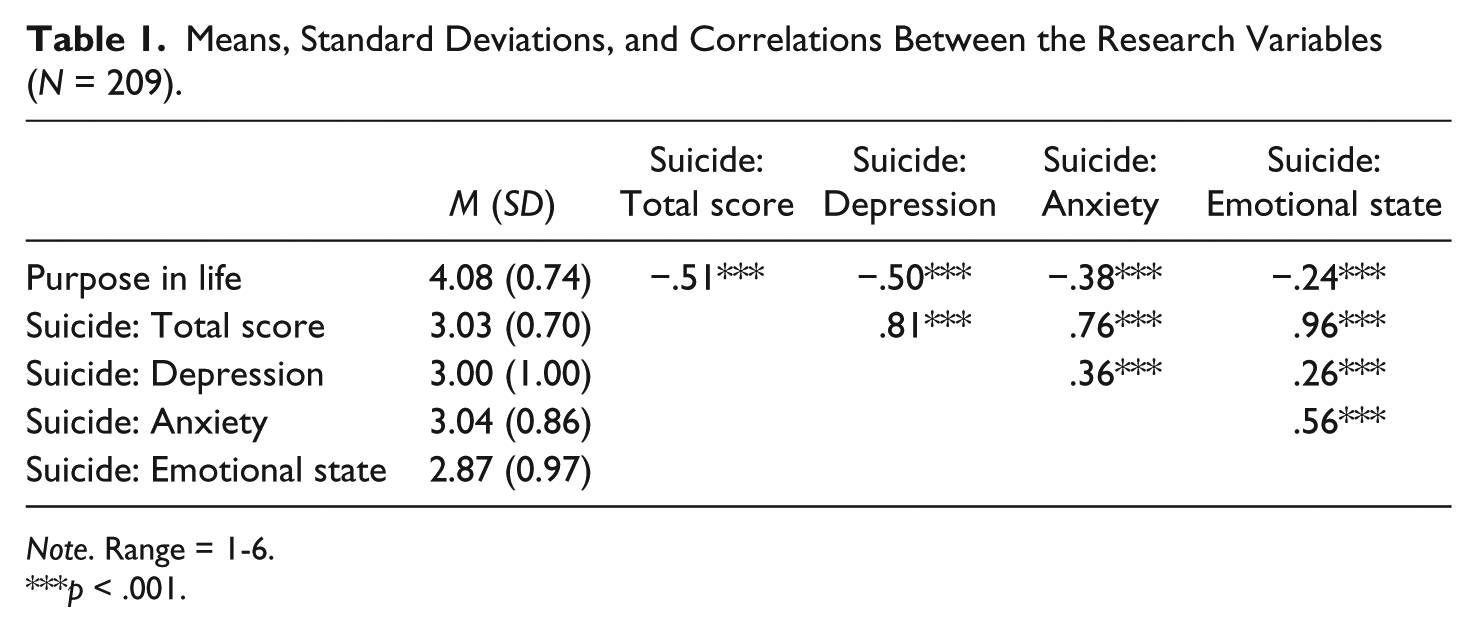
Correlations between the research variables, the age of the adolescent girls, and the degree of their religiosity were tested to identify any confounding variables, and if necessary to control for them when testing the research hypotheses. Pearson correlations showed that the girls’ age was not related significantly to the research variables (r = −.14 to r = .06, p < .05). The extent of their religiosity (secular vs. traditional/religious) was also not significantly related to the research variables (r = −.14 to r = .04, p < .05). The socioeconomic status of the girls’ parents determined, to a great extent, the group to which the girls belonged (normative vs. disadvantaged) and therefore did not serve as a control variable. Because these correlations were not significant, the research variables were tested without controlling for the background variables. Table 1 presents the means, standard deviations, and correlations between the research variables.
Means, Standard Deviations, and Correlations Between the Research Variables (N = 209).
Note. Range = 1-6.
p < .001.
The findings in Table 1 indicate that the mean score of purpose in life in the sample is slightly higher than the middle of the scale, whereas the mean scores of suicide potential are somewhat lower than the middle of the scale. Significant positive correlations were found between the suicide dimensions, and significant negative correlations between the suicide dimensions (separately and all of the together) and purpose in life. Thus, when the suicide potential is higher in the dimensions of depression, anxiety, and emotional state, it is also higher in the other dimensions. Furthermore, the lower the purpose in life, the higher the suicide potential is.
Main Findings
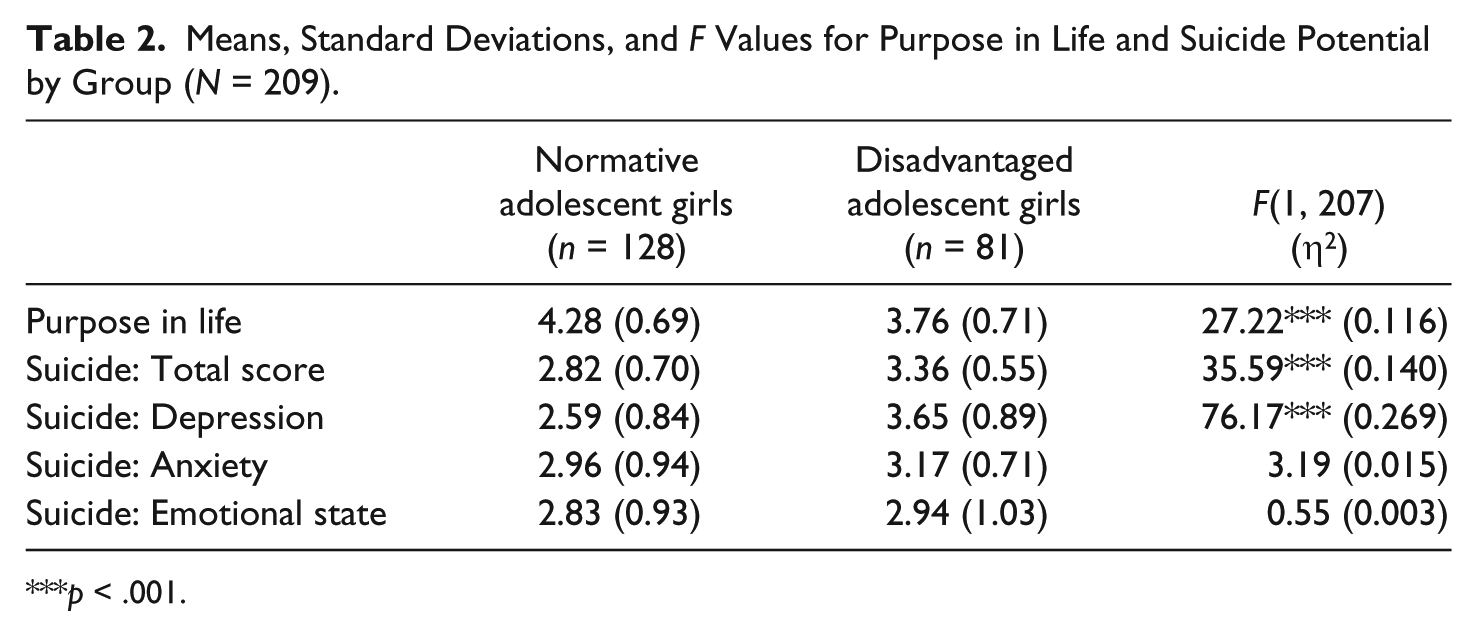
We first tested the hypothesis that the purpose in life of disadvantaged adolescent girls is lower, and that their suicide potential is higher than those of the normative girls. We conducted the first analysis of variance for the total scores of purpose in life and suicide potential, and the second for the three suicide dimensions. The results of these analyses of variance are presented in Table 2.
Means, Standard Deviations, and F Values for Purpose in Life and Suicide Potential by Group (N = 209).
p < .001.
The multivariate analysis of variance for the total scores of purpose in life and suicide was significant, F(2, 206) = 21.16, p < .001, η2 = .170, as was the multivariate analysis of variance for the suicide potential dimensions: F(3, 205) = 26.21, p < .001, η2 = .277. The univariate analyses of variance indicated that the purpose in life of disadvantaged adolescent girls is significantly lower than that of normative girls. The total suicide score and the score in the depression dimension were significantly higher among disadvantaged adolescent girls than among normative ones. For the dimensions of anxiety and emotional state, the differences were not significant.
We also tested the differences between disadvantaged adolescent girls in the boarding school and those in the rehabilitation program. We found a difference in purpose in life, F(2, 206) = 25.20, p < .001, η2 = .197, with the scores of normative adolescent girls (M = 4.28, SD = 0.69) and girls in the rehabilitation project (M = 4.02, SD = 0.59) being significantly higher than the scores of the girls in the boarding school (M = 3.32, SD = 0.70). We found no difference in suicide potential between the disadvantaged adolescent girls in the boarding school and those in the rehabilitation project.
We tested the correlations between purpose in life and suicide potential in each group, as well as the differences in their intensities between the groups, using a Z test for differences between correlations. Table 3 presents these correlations and the differences between them.
Correlations Between Purpose in Life and Suicide Potential by Group, and the Differences Between Them (N = 209).

p < .05. ***p < .001.
The findings shown in Table 3 indicate that the correlations between purpose in life and suicide potential among normative adolescent girls were negative, significant, and moderate-to-high. Most of the correlations among disadvantaged adolescent girls (three out of four) were negative and significant, and were similar to the correlations among normative girls. We found a negative relation between suicide potential and purpose in life in both groups. By contrast, all correlations between purpose in life and suicide potential among disadvantaged girls in the project were not significant. For these girls, in contrast to the others, purpose in life and suicide potential are unrelated concepts.
Comparison of the correlations between the groups indicates that the relation between purpose in life and suicide potential (total score and the dimension of depression) was significantly stronger among normative adolescent girls than among disadvantaged girls in the project. The relation between purpose in life and suicide potential (emotional state dimension) was significantly stronger among normative girls than among disadvantaged girls in the boarding school. In these three cases, the correlations among normative adolescent girls were negative and significant, but they were not significant among the disadvantaged girls. The remaining differences between correlations were not significant.
Discussion
The research aim was to examine the influence of the sense of meaning in life, or its absence, on the suicide potential of disadvantaged adolescent girls by examining three hypotheses: Meaning in life correlates negatively with suicide potential, normative adolescent girls have a greater sense of meaning in life and lower suicide potential than do disadvantaged adolescent girls, and disadvantaged adolescent girls participating in the project have a greater sense of meaning in life and a lower suicide potential than do girls living in a boarding school.
The research confirmed the hypothesis that the purpose in life of disadvantaged adolescent girls is significantly lower than that of normative girls, and that their score in total suicide potential is higher. No differences were found for the dimensions of anxiety and mental state. The results confirmed all remaining hypotheses.
Support for the findings can be found in the harsh background of the disadvantaged adolescent girls, and in their characteristics. These girls are in such a difficult mental and physical state that they experience their lives as lacking the type of meaning for which it is worth living (Chung & Steinberg, 2006; D. B. Henry et al., 2001; Muehlenkamp & Gutierrez, 2004; Patterson et al., 2000; Thornberry & Krohn, 2000). Kekes (1986) expanded on this point, suggesting that there are two possible obstacles to achieving a life with meaning: One is personal, having to do with inner disharmony, and the other is environmental, caused by brutal life circumstances that lead to frustration and indifference. For most of the disadvantaged adolescent girls, both obstacles are present. Consequently, the girls are in an existential vacuum and lack a reason or purpose for existence (Frankl, 1984). Fabry (1988) argued that negative experiences of frustration, pain, sorrow, and despair lead to self-destruction tendencies. Indeed, prominent characteristics of these girls, revealed by various studies, are self-harm and repeated suicide attempts (Muehlenkamp & Gutierrez, 2004).
By contrast, the normative girls who participated in the present study studied in ordinary schools and prepared for matriculation exams, which they perceived as a contribution to their future. The girls also had a clear picture of their immediate future, in the military or in national service. Their future orientation was manifest in their sense of purpose in life, consistent with the view that aspiration for the future is the main factor that confers meaning in life (Frankl, 2000). And because suicide potential is not a prominent characteristic of normative girls, as it is of disadvantaged ones (Chung & Steinberg, 2006; D. B. Henry et al., 2001), they scored lower on this variable than did disadvantaged girls.
Contrary to our hypothesis, however, we found no significant difference in the level of anxiety and in the emotional state between disadvantaged and normative adolescent girls. A possible explanation for this puzzling finding, which requires in-depth investigation in follow-up research, lies in the period in the life of the disadvantaged adolescent girls, who were at various stages of rehabilitation. The goal of rehabilitation is to identify the clients’ hidden strengths, abilities, and efficacies; to devise effective ways for coping with their situation; and to motivate them to work toward success and achievements. Therapy helps improve the clients’ self-image, helps them construct a self-identity, and reduces uncertainty. It is possible that therapy contributed to reducing the girls’ feelings of anxiety and improved their mental state, explaining the absence of significant differences between the studied populations. This assumption requires further investigation in a follow-up study on disadvantaged adolescent girls at various stages of rehabilitation.
The findings confirmed the research hypothesis that a negative correlation exists between the level of meaning in life and suicide potential, including the sub-categories of this potential (depression, anxiety, and emotional state). These findings are in agreement with findings of previous studies (Brassai et al., 2012; Orbach, Mikulincer, Gilboa-Schechtman, & Sirota, 2003; To, Tam, Ngai, & Sung, 2014) and with the salutogenic approach or the positive psychology theory (Galili & Sagi, 2010; Steger & Kashdan, 2013; Steger et al., 2009) that showed clearly that meaning in life and the absence of such meaning are broadly related to happiness, distress, and pathology, and with studies that demonstrated a relation between meaning in life and suicide potential (Aviad- Wilchek, 2015; Edwards & Holden, 2001). According to Lucas (1986), meaning in life protects against pathological behavior, and that the will to bear distress that cannot be corrected is stronger when a person knows “what for.” The present study complements the previous ones, showing that this phenomenon is true not only in adults or in people with social pathologies but also in disadvantaged adolescent girls. The negative relation between meaning in life and suicide potential was found, however, only in disadvantaged adolescent girls who live in a boarding school, and all the correlations between meaning in life and suicide potential (depression, anxiety, and emotional state) in the disadvantaged girls in a rehabilitation project were found to be not significant.
The project in which the disadvantaged adolescent girls participated is intended for girls in situations of difficulty and need, who underwent therapy within the framework of the welfare services or various educational frameworks. The objective of the project is to train the girls for their future and invest less in their past (Golan, Komem, & Kai-Tzadok, 2008).
As noted, according to Frankl (1984), the main component of a “meaning in life” is the prospect for the future. A person, like part of the present research participants, living in an existential vacuum focuses on the present and especially on the past, without looking toward the future. Frankl did not deny the importance of the present but argued that the aspiration for a future is part of meaning in life in the present. According to Frankl (1984), human beings are organisms motivated mainly by their plans for the future. According to this theory, people set goals for themselves and try to coordinate these goals with their lifestyles. It is the agreement between the two that creates a sense that life has meaning (Frankl, 1984). Adolescent girls, who are encouraged to think about the future, acquire a meaning in life, which is stronger than that of disadvantaged adolescent girls living in the boarding school.
The absence of correlation between meaning in life and suicide potential of the girls participating in the rehabilitation project can be explained by one of the research limitations. The adolescent girls who participated in the project were in the first stages of the program, and it is possible that the meaning in life that they were in the process of creating for themselves has not yet taken root or become established, and therefore could not at the time serve as a protective factor against their higher tendency toward risk-taking and suicidal behavior, a tendency typical in most disadvantaged adolescent girls (Muehlenkamp & Gutierrez, 2004). However, there is no empirical evidence for this proposed explanation. We recommend conducting follow-up studies to test the meaning in life and suicide potential of the girls participating in this project at different stages, especially during the advanced stages of the program.
The same explanation may be suggested for the results of the analyses of variance, which compared disadvantaged adolescent girls living in a boarding school with those participating in the rehabilitation project, where no differences were found in the suicide potential of the girls in the two groups. Note, however, that the study’s limitation was the small number of participants because of the problem of locating disadvantaged adolescent girls. A follow-up study with a larger number of participants may arrive at different results.
In conclusion, the present study has important implications in the research field, as well as in the therapy field. It is the first to present empirical test of the relation between meaning in life and suicide potential among disadvantaged adolescent girls, and to show that meaning in life can be used as a salutogenic factor in that population. Its importance is in highlighting the rehabilitative and preventive potential that meaning in life has for these girls with regard to mental health in general and suicide potential in particular.
Footnotes
Acknowledgements
Our thanks to Adi Negasa and Ortal Levi for their help in writing this article.
Declaration of Conflicting Interests
The author(s) declared no potential conflicts of interest with respect to the research, authorship, and/or publication of this article.
Funding
The author(s) received no financial support for the research, authorship, and/or publication of this article.