



Abstract
This article reports on a study of the connection of probation and parole agents’ communication with relationship supportiveness as perceived by both women offenders and agents. For a sample of offenders and their agents, multilevel modeling was used to control for nonindependence of data for women assigned to the same agent. Consistent with communication theory, a conversational approach was positively related to measures of a supportive relationship, and an authoritarian/ conformity pattern of communication was negatively related to a supportive relationship. For low-risk offenders, attention to client-identified problems was positively related to more supportive relationships. For women with high risk for reoffending, the agents viewed themselves as less supportive if they addressed a high proportion of offender-identified needs. Findings suggest the efficacy of training to promote agents’ conversational communication and attention to offender-identified problems. Findings also suggest the need to more fully explore agents’ experience in working with very high-risk offenders.
On December 31, 2014, the U.S. official estimate of the size of the female correctional population, including people who are incarcerated and those supervised in the community, was 1,251,600, and women constituted 18.37% of the 6,814,600 total (Kaeble, Glaze, Tsoutis, & Minton, 2015). In most states, many more offenders are supervised in the community than are incarcerated (Glaze, Bonczar, & Zhang, 2010), so women supervised in the community constitute a sizable group that should be considered in research.
Although some offenders in the community attend programs other than supervision, for many the supervising agent facilitates and encourages involvement in these programs or provides the only intervention (Gill, Hyatt, & Sherman, 2010). There is empirical evidence that in addition to cognitive-behavioral and learning-theory-based intervention techniques (Andrews & Bonta, 2010; Lipsey, Landenberger, & Wilson, 2007), correctional practitioners’ relationships with clients (e.g., warmth, mutual liking, flexibility) promote reductions in recidivism (Dowden & Andrews, 2004). Moreover, low-quality relationships can limit the effectiveness of appropriate techniques of intervention (Skeem, Encandela, & Eno Louden, 2003). Thus, the interactions between the supervising agent and the client are of paramount importance.
Skeem and colleagues (Skeem, Eno Louden, Polaschek, & Camp, 2007; Skeem, Manchak, Vidal, & Hart, 2009; also see Trotter, 1999) have conducted research on the nature and the effects of relationships with individuals who, like probation and parole agents, are expected to both help and exert control over their clients. They found that a supportive supervising agent–client relationship is characterized by caring, trust, fairness, and an absence of toughness, and these relationship features are associated with lower recidivism (Kennealy, Skeem, Manchak, & Eno Louden, 2012, Skeem et al., 2007; Skeem et al., 2009).
Prior research has also highlighted the importance of communication to effective probation and parole supervision. A survey of U.S. probationers revealed that they highly valued communication skills of supervising agents (Cherkos, Ferguson, & Cook, 2008), and research conducted in Canada and Great Britain produced similar findings that probation officers ranked communication as the most important skill for their occupation (Bracken, 2003). Indeed, a meta-analysis revealed that communication styles of supervising agents were associated with lower recidivism across multiple studies (Dowden & Andrews, 2004). Supporting the high value that agents and offenders place on communication, a study of women offenders found that some agent styles of communication had the negative effect of promoting offenders’ efforts to “do what they wanted to do” by breaking the law, whereas other styles promoted self-efficacy to avoid breaking the law (S. W. Smith, Cornacchione, Morash, Kashy, & Cobbina, 2016).
Apart from research that has identified relationships and communication as important elements of the community supervision process, other study has identified a focus on client-identified problems as conducive to a positive relationship (Green et al., 2013; Trotter, 2006). To increase understanding of the correlates of women’s positive interactions with probation and parole agents, the present study examined the degree to which the agents’ communication pattern as conceptualized in a theory developed in the discipline of communication and the agents’ focus on client-identified problems are related to the nature of agents’ relationships with clients.
Theoretical Framework
Relationship Style
Skeem and colleagues built on ideas from research on the working alliance between therapists and patients and exploratory research with probation agents to develop an instrument to measure the nature of the client–offender relationship (Skeem et al., 2003; Skeem et al., 2007). Their research establishes that an agent’s relationship style that is characterized by high levels of supportiveness and low levels of punitiveness promotes positive offender outcomes (Kennealy et al., 2012; Skeem et al., 2007; Skeem et al., 2009). Replications of the initial research team’s findings have confirmed this connection (Green et al., 2013; Taxman & Ainsworth, 2009). Thus, pinpointing agent behaviors associated with supportive relationships would inform the training of agents to work effectively with their clients.
Despite several studies on the dual-role relationship between probation/parole agents and offenders, limited research tests the theory with samples of women, and only small proportions of women were included in the mixed-gender samples. However, because there are studies of agent relationships with offenders who have a combination of substance abuse disorders and other mental illness (Kennealy et al., 2012; Skeem et al., 2009), their findings should be highly applicable to women offenders, who have high prevalence of these co-occurring disorders (Belknap, Lynch, & DeHart, 2016; Fedock, Fries, & Kubiak, 2013; Maxwell & Freeman, 2007; Salina, Lesondak, Razzano, & Weilbaecher, 2007).
Communication Patterns
The family communication patterns approach, developed within the academic discipline of communication, identifies two communication patterns that occur between a person in authority and the individual subject to that authority (Koerner, 2009; Koerner & Fitzpatrick, 2002; Ritchie, 1997; Ritchie & Fitzpatrick, 1990). One type, a conversational pattern, encourages relationships in which all participants are independent, share feelings, and contribute to decision-making processes. In the parent–child context, a conversational orientation promotes the child’s skills in processing information and communication; these skills are helpful in coping with stress and forming positive relationships with people outside the family (Schrodt, Witt, & Messersmith, 2008). In contrast, an authoritarian/conformity approach signifies the power of the person with authority over the other and the compliance of the less powerful individual with the directives of the person with authority (Koerner, 2009; Koerner & Fitzpatrick, 2002; Ritchie & Fitzpatrick, 1990). Although much of the development of this theory is focused on parent–child communication, the attention to a person in authority interacting with the person subject to that authority is relevant to communication in the community supervision setting.
Pertinent to the present research, communication research has linked the manner of communication to the nature of the relationship between the parties, including the levels of control, trust, and intimacy (Burleson, 2009; Courtright, 2007). A comprehensive literature review by Cousin (2011) provides support for the connection between communication and the supportiveness of physician–patient relationships. Cousin concluded that research establishes that verbal and nonverbal dimensions of communication predict patient trust in physicians, which in turn explains patient willingness to share information with the physician and adhere to treatment plans. Although physicians lack authority to require patient actions and to punish, both agents and physicians are similarly expected to assess reasons for illegal behavior or illness and to engage in interventions to prevent or stop negative outcomes. Even when conflict ensues in a relationship, conversationally oriented dyads can strengthen the parties’ relationship as they work through the disagreement, but, in conformity oriented dyads, conflict is discouraged because it undermines authority (Koerner, 2013). Although it is reasonable to expect that Cousin’s (2011) findings about physicians would apply to community supervision interactions, to our knowledge there has been no prior test of the connection of communication to dual-role relationship quality. If conversational communication predicts clients’ perception that the relationship is characterized by caring, fairness, trust, and lack of toughness, and authoritarian/conformity communication predicts the opposite, the communication pattern would be an important target for education and training.
Agent–Client Agreement on Needs Requiring Attention
Several criminal justice scholars have emphasized the effectiveness of the concentration of probation and parole supervision on needs identified by expert-driven assessment tools to detect the risk factors for recidivism (Fielding, Tye, Ogawa, Imam, & Long, 2002; Lowenkamp, Holsinger, & Latessa, 2005; Lowenkamp, Latessa, & Holsinger, 2006). Evaluation researchers have shown that attention to needs identified by assessment tools is related to low levels of recidivism (Singh et al., 2014; Vieira, Skilling, & Peterson-Badali, 2009). Consistent with these findings, a study of women offenders revealed that needs that researchers identified by reading official correctional records were often unmet by parole officers, and unmet need was positively related to recidivism (Schram, Koons-Witt, Williams, & McShane, 2006).
In contrast to reliance on assessment tools or researchers’ reading of official records to indicate the specific offender needs that should be addressed, scholars who focus on women have concluded that meeting the range of needs identified by the offender is of paramount importance. Researchers found that Australian women offenders favored services that were collaborative, holistic, and designed with an understanding of women’s perspectives (Trotter, McIvor, & Sheehan, 2012). The women felt that the more say they had in defining their needs and related goals of correctional interventions, the more helpful the services. A review of the literature similarly found that effective correctional interventions addressed client definitions of problems and took a holistic approach by addressing a wide range of these problems (Trotter, 2006).
According to theory that grew out of research on therapeutic relationships in mental health settings, therapist–client agreement on the goals of the therapy is a component of a working alliance (also called a therapeutic alliance; Bordin, 1979; Hill, Nutt Williams, Heaton, Thompson, & Rhodes, 1996). Supporting this tenet, based on a comprehensive review of community corrections literature, Green et al. (2013) concluded that offenders’ agreement with correctional staff goals promotes reduced substance use and criminal activities, and criminological theory (Bloom, Owen, Covington, & Raeder, 2003; Salisbury, Henning, & Holdford, 2009; Van Voorhis, 2012) points to positive results of interventions that address the range of needs that women offenders view as problematic.
Research Focus and Contribution
Criminal justice and communication theory and research led us to predict a positive relationship between a conversational communication pattern and an agent–client relationship characterized by caring, fairness, and absence of toughness (i.e., a supportive relationship). We expected a negative relationship between authoritarian/conformity-oriented communication and a supportive relationship. We also expected that agent attention to offender-identified needs would predict a supportive relationship.
The present study is unique in its focus on supervising agent–client interactions for women under community supervision. Also unique, it draws on both criminal justice and communication theory and research to provide a more detailed understanding of how particular dimensions of communication are relevant to the type of staff–offender relationship that develops in correctional settings.
Method
Data
Data are from an ongoing longitudinal field study of the nature and result of interactions between women offenders and their probation and parole agents. Shortly after supervision began, demographic information was collected from women offenders and their supervising agents. For women, these data were joined to official police criminal history data on women’s arrests before the study. Approximately 6 months after the start of supervision, quantitative data reflecting both women’s and agents’ perceptions of the style of relationship and the type of communication patterns were collected. At both interviews (i.e., 3 and 6 months from the start of supervision), women reported on whether a variety of criminogenic needs were problematic and whether the agent had discussed each need.
Sample
To sample women offenders, first 77 agents were identified in 16 counties (a mix of suburban and rural areas and the state’s largest cities) within 1 ½ hr drive from the research office in East Lansing, MI. The proportion of agents recruited in each county corresponded to the proportion of women supervised in each county. To increase parolees to almost 25% of the total, parole agents were oversampled in relation to probation agents. In private meetings, 73 of the 77 agents were recruited to take part in the study. Of the four who did not take part, one withdrew, one refused, one was reassigned to supervise men, and one took a medical leave.
To identify eligible women offenders, a principal investigator reviewed the current caseload list with each agent. Criteria for eligibility were a felony conviction, substance involvement, and supervision for approximately 3 months. Agents facilitated recruiting women by (a) giving out project contact cards and flyers so interested women could arrange a time to hear about the study, (b) introducing women to onsite project interviewers, or (c) obtaining women’s permission to share contact information with interviewers who explained the study. Consistent with institutional review board approved protocol, interviewers hired and trained for the project directly recruited participants in private meetings. Not all 846 women identified as eligible for the study took part, because they reported to the office when research staff was not on site and they neither responded to flyers nor gave agents permission to share contact information. A comparison of available data on participants and nonparticipants revealed no statistically significant differences in official records of substance use, violations, arrests, misdemeanor convictions, and felony convictions in a 12-month period. Nonparticipants were slightly but significantly more likely to be in jail or prison, suggesting a small bias toward including women who were not incarcerated at 12 months.
For an analysis that predicted the offenders’ assessment of the relationship style from her assessment of the communication pattern and the agent’s attention to her self-identified needs, data were available for 317 women. The missing data resulted from a change in supervising agent before the second interview (n = 71), the offender’s not completing the second interview (n = 12), or women choosing not to answer questions (n = 2). For the analyses that predicted the agent’s assessment of the relationship supportiveness or that used agent reports of communication pattern as a predictor, data were available for 255 cases. The missing data resulted from the supervising agents’ failure to complete the survey (n = 63), a change in supervising agent before the second interview (n = 71), the offender’s not completing the second interview (n = 12), and one agent not completing the measure for one offender.
We conducted a series of chi-square and independent groups t tests to determine whether the women in the subsamples differed significantly from those who were excluded due to missing data. No differences emerged for either demographic (i.e., age, race, income) or crime-related variables (i.e., criminal history, rearrest at 30 months after the beginning of supervision, and probation vs. parole status) for either subsample.
Characteristics of Supervising Agents and Offenders
Of the 73 participating agents, 36 identified as Black, 32 as White, two as Hispanic, and three did not indicate racial/ethnic identification. Of the 70 agents who reported age, 16 were 21 to 30, 24 were age 31 to 40, and 29 were 41 years of age or older. With regard to gender, 70 agents were female and three were male. The most common degrees were in criminal justice (n = 34), psychology or sociology (14), and social work, counseling, or human services (13). One agent had a high school degree, 52 had a bachelor’s degree, and 20 had graduate degrees.
The average age for women offenders in the subsample of 317 was M = 33.81, SD = 10.48. Most women (84.2%) reported incomes of less than US$10,000 per year. In terms of race, 34.6% identified themselves as Black, 59.6% identified themselves as White, and 7% identified themselves as Hispanic. Of the 317 in the subsample, 24.0% were on parole. On average, women had just under five arrests prior to the conviction (M = 4.85, SD = 3.89). Recidivism data indicated that at 30 months after the beginning of probation/parole supervision, women in the subsample had an average of less than one new arrests (M = .48, SD = .93).
Procedure
Interviewers determined women’s preference for a convenient place to meet, and most interviews occurred in a private room at the probation or parole office, coffee shops, and fast food restaurants. Data from the offenders were entered directly into a computerized quantitative database on a laptop, and data from the agents were collected through an online survey administered at the time of each client’s second interview. The women offenders were compensated with a gift card valued at US$30 for the first and US$50 for the second interview 3 months later, but the supervising agents were not compensated due to department policy.
Measures
Relationship and communication measures
To gather information from each woman offender, the interviewer administered the 30-item Dual-Role Relationship Inventory–Revised (DRI-R), which is a measure of relationship style (Skeem et al., 2007) and the revised 26-item Family Communication Patterns Scale (FCP-R), which is a measure of communication patterns (i.e., conversational or authoritarian/ conformity oriented; Ritchie & Fitzpatrick, 1990; Schrodt et al., 2008). The items were adapted for the present research topic and settings. The online survey for the agents and the in-person interview for the offenders included the same sets of items. For example, on the DRI-R, when offenders reported on their agent’s relationship style items were phrased as “____ cares about me as a person” and when the agents reported on relationship style with each offender, the parallel items were phrased as “I care about ___ as a person.” DRI-R items were rated on a scale from 1 = never to 7 = always. Likewise, two parallel formats were used for the FCP-R depending on the respondent (e.g., “___frequently asks me my opinion when we are talking” and “I frequently ask ___ her opinion when we are talking”). FCP-R items were rated on a scale from 1 = very strongly disagree to 7 = very strongly agree.
The DRI-R is the only validated measure that assesses offender–agent relationship quality in community corrections contexts. The lengthy process of its development and validation has been fully described elsewhere (Manchak, Kennealy, & Skeem, 2014), but we present some highlights. An extensive review of the literature and separate focus groups with probationers and with the agents who supervised them were used to identify core components of agent–offender relationship quality (Skeem et al., 2003; Skeem et al., 2007), and there was an initial high agreement between the sources. Testing of the DRI-R has demonstrated that both summed total and factor scores had theoretically meaningful associations with observed and reported offender and agent behaviors during supervision meetings and with measures of client mental illness symptoms and motivation (Skeem et al., 2007). From the start, research has shown high levels of internal consistency for samples of offenders with and without mental disorders and high correlations between the dimensions of trust, fairness, and toughness (reversed) that justified the use of a composite score (Kennealy et al., 2012; Skeem et al., 2007). The instrument has high predictive validity of responses to supervision, including recidivism, in multiple samples of offenders supervised in the community (Kennealy et al., 2012; Morash, Kashy, Smith, & Cobbina, 2015).
Research also supports the internal consistency and the test-retest reliability of the FCP-R scale (Ritchie & Fitzpatrick, 1990). A meta-analysis (Schrodt et al., 2008) analyzed the findings of 56 studies (N = 19,745) examining the associations between family communication patterns measured with the FCP-R and information-processing, behavioral, and psychosocial outcomes. The authors found that family communication patterns have a meaningful association with a variety of cognitive activities and relational behaviors, as well as individual well-being.
When we considered face validity of the items, we realized that some items in the relationship scale directly asked about communication, 1 and some items in the communication scale directly asked about relationships. 2 To improve the discriminant validity of the relationship style and communication pattern measures, two authors of this article and another PhD researcher examined the items in each of the scales, and based on a consensus, we eliminated the cross-scale items. We refer to the trimmed scales as the reduced DRI-R and the reduced FCP-R.
Twenty items were included in the reduced DRI-R (α = .97 for offenders’ responses and α = .92 for agents’ responses). The toughness items were reverse coded and the items were added into a composite scale with high scores reflecting a more supportive relationship. Examples of items include “___ is enthusiastic and optimistic with me” and “___treats me fairly.” Principal factor analyses using a promax rotation on the 20-item measure indicated that for both offenders and agents, a single factor adequately described the data, and when two factors were extracted, they were very highly correlated (r = .75 for offenders and r = .74 for agents).
For the 14 item reduced conversational subscale (α = .87 for offenders’ responses and α = .80 for agents’ responses), items include “____ and I often talk about things where she/he and I disagree” and “____ encourages me to challenge her/his ideas and beliefs.” As with the DRI-R, factor analyses on the conversational subscale indicated a single factor, but when two factors were extracted, they were highly correlated (r = .70 for offenders and r = .41 for agents).
Examples of the eight items on the reduced authoritarian/conformity subscale (α = .81 for offenders’ responses and α = .81 for agents’ responses) include “My PO thinks it is important to be seen as an authority in charge” and “Sometimes my PO says something like ‘a person under supervision should not argue with the PO or the judge.’” For this subscale, offenders’ and officers’ reports again indicated a single factor and a forced two-factor solution, which resulted in highly correlated factors (r = .53 for offenders, r = .57 for agents).
Proportion of offender-identified problems addressed by the agent
To indicate whether women perceived that the needs they identified were addressed during supervision, at the first and second interview each woman was asked whether the following were problems: thoughts about doing things that are against the law, sometimes called criminal or cognitive thinking; education needs; employment and financial problems; housing safety; avoiding criminal activity and victimization in a high-crime neighborhood; spending time with people who do not break the law and avoiding those who do; controlling temper and aggression; obtaining mental health treatment; avoiding substance use; child custody or contact; an abusive partner or one who promotes lawbreaking; and parenting stress. With the exception of neighborhood crime, these items have been identified as key crime-predicting needs of women in the correctional system (Van Voorhis, 2012; Van Voorhis, Bauman, & Brushett, 2013; Van Voorhis, Wright, Salisbury, & Bauman, 2010). Neighborhood crime was added based on evidence that community context contributes to the prediction of recidivism (Hipp, Petersilia, & Turner, 2010; Kubrin & Stewart, 2006). At both interviews, after women reported on whether they considered each type of need a problem, they were asked whether each was addressed during supervision. The validity of responses was increased by giving women two opportunities to respond to these questions. An indicator of agent attention to offender-identified problem areas was calculated as the proportion of offender-identified problems that were specifically addressed.
Criminal history
Criminal history is indicated by a count of number of arrests before the offense that brought the woman into the study. It was obtained from official police data.
Analytic Strategy
Because agents supervised multiple women in the sample, multilevel modeling (MLM) treating agents as the upper-level sampling unit and offenders as the lower-level unit, and using restricted maximum likelihood, was used to predict both offender-reported and agent-reported relationship supportiveness. Separate models using either offender-reported or agent-reported conversational and authoritarian/conformity communication as predictors were estimated. All models also included offender perception of attention to self-identified needs and criminal history. Research has shown that recidivism risk moderates the effects of probation and parole interventions (Fielding et al., 2002; Lowenkamp et al., 2005; Lowenkamp et al., 2006). Thus by including interactions between key predictors and criminal history, we determined whether criminal history altered the relationships between communication patterns and relationship style, and between discussion of offender-identified problem areas and relationship style. All predictors were grand mean centered prior to analysis. Finally, random effects in the model included a supervising-agent variance and a residual variance. IBM SPSS (version 22) software was used for analyses.
Results
Descriptive and Bivariate Analyses
The means, standard deviations, and correlations for the study variables are presented in Table 1. Of note in the table is that the supervising agents’ and offenders’ perceptions of the supportiveness of their relationship and of the communication patterns were only modestly related. Therefore looking at the results from both people’s perspective provides unique information. Confirming independence of the two communication constructs, the correlations also show that regardless of who reported on the communication pattern, use of conversational communication was relatively independent of use of the authoritarian/conformity communication.
Correlations, Means, and Standard Deviations for the Study Variables.
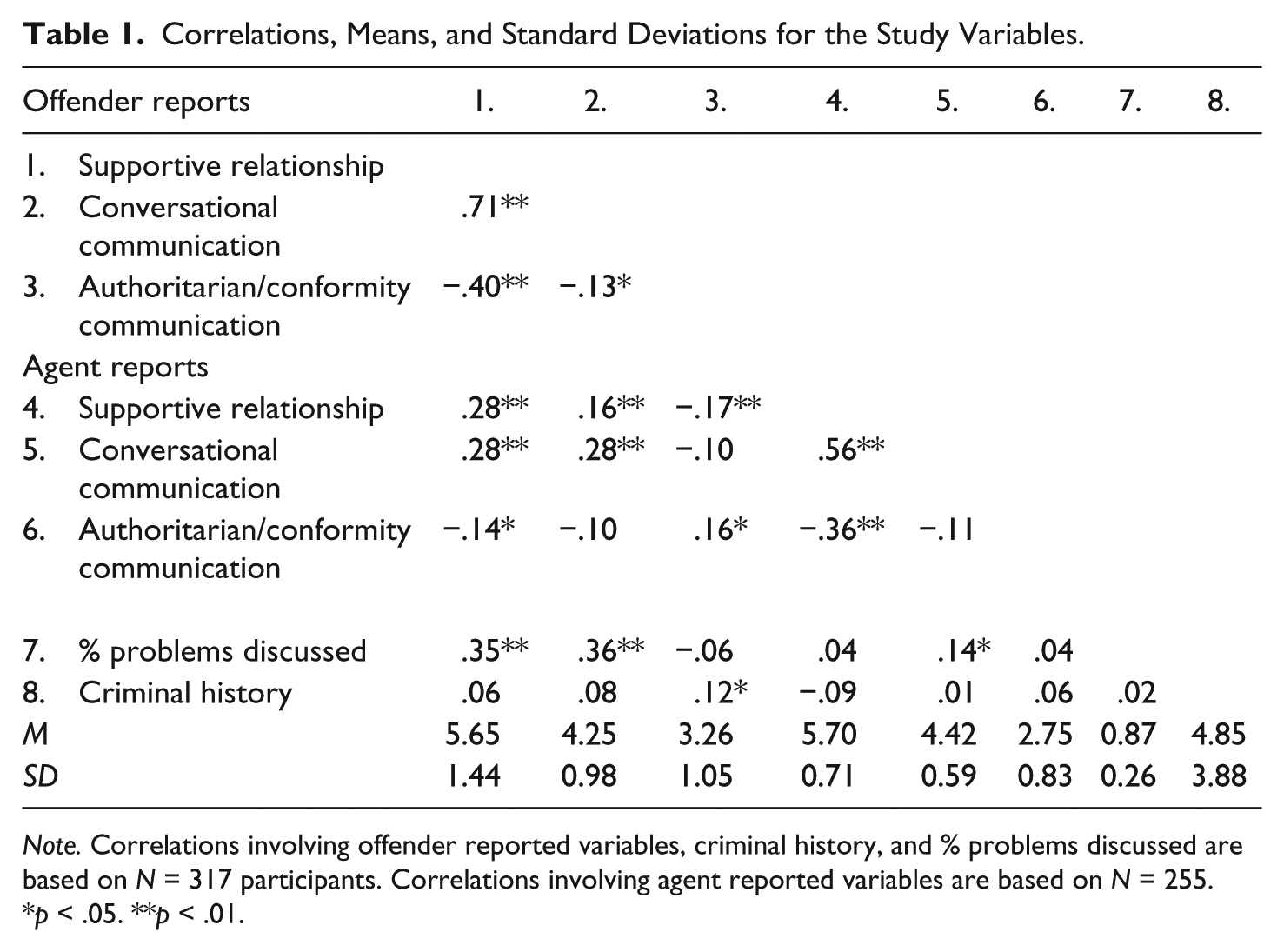
Note. Correlations involving offender reported variables, criminal history, and % problems discussed are based on N = 317 participants. Correlations involving agent reported variables are based on N = 255.
p < .05. **p < .01.
Predictors of Supportive Relationships
Offender perceptions of supportiveness
Table 2 presents results from two models predicting the offender’s reports of relationship supportiveness. Prior to estimating this model, we examined an intercept-only model to ascertain the degree to which women with the same agent reported supportive relationships with that agent. The intraclass correlation (ICC) based on the intercept-only model was ICC = .115, p = .030, indicating a relatively small degree of agreement between offenders regarding the supportiveness of the agent. It may be that agents vary their supportiveness depending on the characteristics of the client, that different clients perceive the same agent differently, or that both of these occur. In the first model reported in Table 2, both supportiveness of the relationship and communication pattern were based on the offender reports, and the pseudo-R2 indicated that approximately 61% of the variance in offender supportive relationship ratings was explained by the predictors in the model, χ2(7) = 290.89, p < .001. The regression coefficients indicate a strong positive correspondence between the offender’s reporting that the agent used conversational communication and the offender’s perception of a supportive relationship. In contrast, there was also a relatively strong negative correspondence between the offender’s report of the agent’s use of authoritarian/conformity communication and the offender’s report of relationship supportiveness. In addition, women who discussed a higher proportion of self-identified problems with their agents also indicated that their relationship was more supportive. Neither criminal history nor interactions between communication patterns and criminal history predicted offender perceptions of a supportive relationship with her agent.
Predicting Offender Reports of Supportive Relationship With Offender and Agent Reports of Communication Patterns, Percent of Problems Discussed, and Criminal History.

Note. CH = criminal history. Analyses in which predictors are offender reports of communication pattern had N = 317 and analyses of agent reports of communication pattern had N = 255.
There was a marginally significant interaction between criminal history and discussion of a higher proportion of problems. Simple slopes analyses examining the effects of discussing problems for low and high levels of criminal history (±1 SD below and above the mean) showed that when criminal history was limited, the coefficient for discussing problems was b = .915, SE = .284, p = .001, but when criminal history was high this coefficient was smaller and not statistically significant, b = .298, SE = .260, p = .254. Thus, when the offender had relatively few arrests prior to the current offense, having an agent who discussed a higher proportion of problems was associated with the offender’s perceiving a more supportive relationship with the agent. However, when the offender had a more serious criminal history, discussing a higher proportion of problems with the agent was unrelated to the offender’s perception of a supportive relationship.
The second model reported in Table 2 uses the agent’s report of conversational or authoritarian/conformity communication to predict the offender’s perceptions of a supportive relationship, and in this case the approximate percent of explained variance using pseudo-R2 was 18.4%, χ2(7) = 50.92, p < .001. Results from this model are similar to those based on the offenders’ reports of communication, such that agent-reported conversational communication was positively associated with offender perceptions of supportiveness, and agent-reported authoritarian/conformity communication was negatively associated with perceptions of supportiveness. However, in this case the interaction between the proportion of problems discussed and criminal history was significant. Simple slopes analyses again showed a strong positive association between discussing problems and offender reports of a supportive relationship when criminal history was limited, b = 2.144, SE = .399, p < .001, but this association was weaker (although still significant) when criminal history was substantial, b = .863, SE = .380, p = .024.
Agent perceptions of supportiveness
Table 3 presents the results predicting the agent’s report of a supportive relationship. The intercept-only model examining the extent to which agents tended to report similar levels of supportive relationships across all of their supervisees resulted in an ICC of .632, p < .001, which is to be expected given that the same person (the agent) was reporting on multiple relationships. When the offender’s report of the agent’s conversational communication pattern was used to predict the agent’s report of relationship supportiveness, the predictors as a set accounted for only 5.4% of the variance, χ2(7) = 16.80, p = .018. In this case, the positive association between the offender’s report of the agent’s conversational communication was only marginally significant, although the negative association between authoritarian/conformity communication and relationship supportiveness was significant. Somewhat surprisingly, agents did not report having more supportive relationships with women with whom they discussed a higher proportion of problems—indeed the coefficient was negative, but not significant. No other significant effects emerged for this combination of agent and offender reports.
Predicting Agent Reports of Supportive Relationship With Offender and Agent Reports of Communication Pattern, Percent of Problems Discussed, and Criminal History.

Note. Analyses had N = 255. PO = probation/parole officer; CH = criminal history.
Finally, the last set of results from Table 3 predicts the agent’s report of supportive relationships from the agent’s report of her or his own conversational and authoritarian/conformity communication. In this case, predictors in the model accounted for 39% of the variance in agent reports of supportiveness, χ2(7) = 97.33, p < .001. These results show the significant positive association between conversational communication and relationship supportiveness, the significant negative association between authoritarian/conformity communication and relationship supportiveness, and the interaction between discussing problems and criminal history. As before, simple slopes analyses were conducted for low and high levels of criminal history. When criminal history was limited, the association between discussing a higher proportion of client-identified problems and agent perceptions of a more supportive relationship was small but positive, b = .144, SE = .137, p = .293. However, for women with more extensive criminal histories, when the agent discussed more problems with the women, the agent reported less supportive relationships with them, b = −.307, SE = .132, p = .021.
Conclusion and Discussion
Across the four models, there was a consistent positive relationship between agent use of conversational communication and both offender and agent perceptions of a supportive relationship style. There also is consistency across the models in the finding that authoritarian/conformity communication is negatively related to perceptions of a supportive relationship style. These findings pertain to the measures of communication and relationship used in the present analysis, for which some items were dropped to improve their discriminate validity. These findings are not affected by the seriousness of offenders’ criminal histories. It appears that conversational communication is congruent with a supportive relationship characterized by caring, trust, and an absence of toughness. Alternatively, authoritarian/conformity communication is predictive of a nonsupportive relationship. Because the measure of communication pattern specifies two dimensions (i.e., conversational and authoritarian/conformity), and these dimensions are more specific than the general references to discussion in the original DRI-R measure, the research provides increased information about the type of communication that is linked to a supportive relationship, and it opens the door to drawing on the research in the field of communication to understand correlates of the dual-role relationship style.
As found in previous research (Bloom et al., 2003; Salisbury et al., 2009; Van Voorhis, 2012), from the offender’s (but not the agent’s) perspective, if the offender feels that a high percentage of her self-identified needs are addressed during her interactions with the agent, she sees the relationship as more supportive. Research on the technique of motivational interviewing, which incorporates respect for clients’ choices, agrees with the notion that offender perceptions that their self-identified needs are being addressed leads to desired outcomes (Walters, Clark, Gingerich, & Meltzer, 2007). However, examination of the interaction effects shows that this last finding does not hold for women with the most serious criminal histories.
Turning to the agent’s view of the relationship, there was no main effect for percentage of needs addressed. Similar to findings based on the offenders’ perspectives, there was an interaction such that for women with the most extensive criminal histories, agents viewed themselves as less supportive and more punitive when they discuss a high proportion of the client-identified problems. More consistent with prior research, for women with less extensive criminal histories, agents who discussed a high proportion of problems viewed themselves as more supportive.
Why do agents and offenders show such opposite patterns in the relationship between offender-identified problems discussed and supportiveness as a function of criminal history? Perhaps women with limited criminal histories have fewer needs and have not experienced repeated or long periods in jail or prison or under correctional supervision. From their perspective, they may appreciate attention to what would typically be a fairly small number of needs they feel they have. However, women with substantial criminal histories are likely to have numerous needs (Van Voorhis et al., 2013; Van Voorhis et al., 2010). Our measure of discussion of needs covered the relatively short period of 6 months. The principles of motivational interviewing emphasize the necessity of prioritizing goals through a shared decision-making process, especially when multiple goals are possible (Miller & Rollnick, 1991). Some practitioners who work with multiproblem clients also view a focus on effective coping to achieve a fairly small number of goals by exercising and building one’s strengths as more effective than focusing on the full range of immediate problems (Sousa, Ribeiro, & Rodriguez, 2006). If the agent responds to multiple problems by reviewing them but not working with the offender to prioritize them and not helping the woman cope with them, neither the client nor the agent may view the relationship as particularly supportive. These findings and prior scholarship suggest that especially for clients with multiple needs, agents should consider working with their clients to prioritize needs and address them in sequence over time (also see Stephenson, Harkins, & Woodhams, 2013). For researchers, further study to explore how agents’ response to multiple problems, clients’ readiness for change, and other possible reasons why offenders with an extensive criminal history respond uniquely to attention to multiple needs would be important, because it would show whether the present findings are replicated. Research on effective methods for prioritizing multiple needs also would be useful.
Limitations
Although the collection of data from both offenders and their supervising agents is a strength of the research, verification of agent communication patterns and supportiveness through observational techniques, including video and audiotaping, would have provided an additional data source. However, as agents do not have an unvarying style or communication pattern, it would be necessary to collect data on every client–agent pair. The cost of observing multiple interviews for a large sample of women across 16 counties was prohibitive. Additionally, observation creates its own threats to validity, as both offenders and their agents may alter their usual behavior due to being observed. Yet, future research might profitably incorporate observations of offender–client interactions in an effort to further validate findings.
Coefficients reflecting the relationship between agent reports of their communication and agent reports of their relationship style with an offender are no doubt inflated because of shared common method variance. There is a similar likelihood of inflation for coefficients reflecting the association of offender reports of both communication and relationship style. We dealt with this problem by testing models that examined agent reports of relationship as a function of offender reports of communication, and other models that examined offender reports of relationship as a function of agent reports of communication. We feel that when there is agreement across models, we can draw the strongest inference that the associations we find between variables are not artifacts, but rather reflect the relationship between two constructs.
Implications
The measures of conversational and authoritarian/conformity communication, and the broader communication literature identify a much broader set of communication practices than are incorporated in the DRI-R. Aside from generating theoretical clarity, conducting research in criminal justice that incorporates communication theory opens the door to tap into a vast literature on effective communication skills and the fact that people can be taught to improve their skills as laid out in the Handbook of Communication and Social Interaction Skills (Greene & Burleson, 2003). Cousin’s (2011) review of research on physician–patient communication found that the effects of specific types of communication on trust differ depending on patient characteristics (e.g., gender, age), thereby suggesting the importance of theory, research, and practice taking into account moderating influences (such as criminal history, which we considered) on the communication–relationship connection in correctional settings. However, our results do suggest that agents will generally build supportive relationships if they use conversational and not conformity communication and attend to needs defined by the women.
In addition to opening the door to benefit from the knowledge base regarding effective communication, the present study complements the widely accepted body of knowledge commonly referred to as the Risk-Needs-Responsivity (RNR) approach to corrections (Bonta et al., 2010). In this empirically supported model, intervention is most effective when it provides high-intensity supervision to fairly high-risk offenders, when it targets the needs that promote recidivism and that can be changed, that use cognitive-behavioral approaches, and that embody responsivity to offenders’ particular characteristics (Andrews & Dowden, 2006; P. Smith, Gendreau, & Goggin, 2005). Our research provides further specification of how reciprocity may be accomplished by using the type of communication and the focus on client-identified needs that promotes supportive relationships.
Footnotes
Declaration of Conflicting Interests
The author(s) declared no potential conflicts of interest with respect to the research, authorship, and/or publication of this article.
Funding
The author(s) disclosed receipt of the following financial support for the research, authorship, and/or publication of this article: This material is based upon work supported by the National Science Foundation under Grant No. 1126162 and by a Strategic Partnership Grant from the Michigan State University Foundation.