



Abstract
Job satisfaction has been linked to many positive outcomes, such as greater work performance, increased organizational commitment, reduced job burnout, decreased absenteeism, and lower turnover intent/turnover. A substantial body of research has examined how work environment variables are linked to job satisfaction among U.S. correctional staff; far less research has examined prison staff in non-Western nations, especially China. Using survey data collected from two prisons in Guangzhou, China, this study investigated the level of job satisfaction among prison staff and how personal characteristics (i.e., gender, tenure, age, and educational level) and work environment variables (i.e., perceived dangerousness of the job, job variety, supervision, instrumental communication, and input into decision making) affect job satisfaction. The findings from ordinary least squares regression equations indicated that the work environment variables explained a greater proportion of the variance in the job satisfaction measure than the personal characteristics. In the full multivariate regression model, gender was the only personal characteristic to have a significant association with job satisfaction, with female staff reporting higher satisfaction. Input into decision making and job variety had significant positive associations, whereas dangerousness had a significant negative relationship with job satisfaction.
The literature supports the claim that job satisfaction (i.e., an affective/emotional response to the overall job) is an important work attitude for correctional staff (Armstrong, Atkin-Plunk, & Wells, 2015; Byrd, Cochran, Silverman, & Blount, 2000; Cranny, Smith, & Stone, 1992; Griffin, 2001; Lambert, Hogan, Paoline, & Baker, 2005). Basically, job satisfaction refers to the degree that an employee likes his or her job (Spector, 1996). Research indicates that job satisfaction is associated with increased life satisfaction, better work performance, greater support for treatment of offenders, higher organizational commitment, lower job burnout, reduced absenteeism, and reduced turnover intent and turnover (Byrd et al., 2000; Culliver, Sigler, & McNeely, 1991; Farkas, 1999; Lambert, Edwards, Camp, & Saylor, 2005; Lambert, Hogan, Paoline, & Baker, 2005; Lew & Guo, 2015; Whitehead & Lindquist, 1986; T. A. Wright, 1993). The importance of job satisfaction has led to a growing number of studies that have explored how different aspects of the work environment are related to the job satisfaction of correctional staff. The research to date supports the contention that a wide array of different aspects of the work environment, such as role stressors (e.g., role conflict and role ambiguity), input into decision making, formalization, integration, job variety, perceptions of equitable treatment, and quality of supervision have been reported to have significant associations with correctional staff job satisfaction (Griffin, 2001; Grossi, Keil, & Vito, 1996; Lambert, 2004; Lambert, Hogan, Paoline, & Clarke, 2005; Lambert, Kim, Keena, & Cheeseman, 2015; Lambert, Paoline, & Hogan, 2006; Stohr, Lovrich, Monke, & Zupan, 1994; Whitehead & Lindquist, 1986; K. N. Wright, Saylor, Gilman, & Camp, 1997). Moreover, many studies have indicated that work environment variables, as a group, tend to have stronger associations with job satisfaction than do personal characteristics, such as age, gender, race, tenure, and educational level (e.g., Garland, McCarty, & Zhao, 2009; Griffin, 2001; Lambert, 2004; Lambert & Paoline, 2008; Misis, Kim, Cheeseman, Hogan, & Lambert, 2013).
The vast majority of studies on correctional staff job satisfaction have focused on staff in Western nations, particularly the United States. Very little has been published in Western journals concerning the correlates of job satisfaction among prison staff in the People’s Republic of China (henceforth, China); thus, this exploratory study was undertaken to fill this void. The purpose of the current study was to explore the degree to which Chinese prison staff are satisfied with their job and the relationship of personal characteristics (i.e., gender, tenure, age, and educational level) and work environment variables (i.e., perceived dangerousness of the job, job variety, supervision, instrumental communication, and input into decision making) with Chinese prison staff job satisfaction.
The current study has both theoretical and practical significance. In theory, this exploratory study examines whether the association between work environment variables and job satisfaction found among U.S. correctional staff is also found among Chinese prison staff. Conducting international research allows scholars to determine whether the effects of variables are universal (i.e., similar across cultures) or contextual (or varying between cultures). In addition, the current study, such as other internationally focused studies, can also help narrow the gaps between nations and build bridges so that information flows more freely (Cao & Cullen, 2001). Jowell (1998) noted that
the importance and utility to social science of rigorous cross-national measures is incontestable. They help to reveal not only intriguing differences between countries and cultures, but also aspects of one’s own country and culture that would be difficult or impossible to detect from domestic data alone. (p. 168)
In terms of practical significance, this study can provide Chinese prison administrators with information concerning the levels and correlates of job satisfaction.
Literature Review
The correlates of correctional staff job satisfaction can be placed into three general groups: personal characteristics, perceptions of job characteristics, and perceptions of organizational characteristics (Lambert, 2004; Lambert & Paoline, 2008). Some studies have reported that personal characteristics, such as age, educational level, gender, and race, may be associated with correctional staff job satisfaction in the United States (Armstrong et al., 2015; Blau, Light, & Chamlin, 1986; Britton, 1997; Cullen, Link, Wolfe, & Frank, 1985; Grossi et al., 1996; Jurik & Winn, 1987; Lambert, Kim, Keena, & Cheeseman, 2015); however, the effects of personal characteristics either disappear or are reduced once work environment variables are included in the analysis (Lambert, 2004; Lambert & Paoline, 2008; Misis et al., 2013). Job characteristics, such as role conflict, role ambiguity, role overload, perceived dangerousness of the job, job variety, job autonomy, and quality of supervision, have frequently been found to be associated with job satisfaction among U.S. correctional staff (Armstrong et al., 2015; Garland et al., 2009; Griffin, 2001; Grossi et al., 1996; Lambert, 2004; Lambert, Hogan, Paoline, & Clarke, 2005; Lambert, Kim, et al., 2015; Lambert & Paoline, 2005; Mahfood, Pollock, & Longmire, 2013; Van Voorhis, Cullen, Link, & Wolfe, 1991). Perceptions of organizational characteristics, such as input into decision making, formalization, integration, and perceptions of equitable treatment have been reported to be linked with higher levels of job satisfaction among U.S. correctional staff (Griffin, 2001; Lambert, 2004; Lambert, Barton, Hogan, & Clarke, 2002; Stohr et al., 1994; Whitehead & Lindquist, 1986; K. N. Wright et al., 1997). In a study of U.S. jail staff, Lambert and Paoline (2008) found that both perceptions of job characteristics and perceptions of organizational characteristics, collectively referred to as work environment variables, individually explained about the same amount of variance of job satisfaction; however, the work environment variables explained far more variance in job satisfaction than the personal characteristics. Likewise, in another study of U.S. correctional staff, Mahfood et al. (2013) reported that the only variables with significant effects in a multivariate analysis were job characteristics; none of the personal characteristics had significant effects.
These studies suggest that work environment variables play a significant role in helping shape the job satisfaction of U.S. correctional staff. It is unclear what relationship, if any, the work environment variables would have with job satisfaction, and whether the work environment variables would play a greater role than personal characteristics among Chinese prison staff. In the next section, we describe features of Chinese institutional corrections and discuss their impacts on staff’s job satisfaction.
Institutional Corrections in China and the Focus of the Current Study
The Importance of Labor
As in other nations, China uses prisons to incarcerate offenders. China has used prisons to confine offenders since antiquity (Jin, 1997). From 1949 to 1983, prisons in China were overseen by the Ministry of Public Security. Most of the prisons during this era were known as Laogai (
This legacy is reflected in the fact that contemporary Chinese prisons tend to emphasize the integration of punishment, treatment, and education, with labor for inmates (Jin, 1997). Labor by inmates is very important in Chinese prisons, with most inmates being required to work 8 hr a day. The purpose of labor is to correct errors in thought and action, as well as to understand the importance of work in life (China.org.cn, 2016; Hill, 2006; Wu, 2003). Chinese corrections also stress the integration of intensive supervision and persuasion of inmates via rational and affective communication. China considers prison as a special school with the functions of political, cultural, and occupational education (Jin, 1997).
Security Levels
According to Shao (2014), there are 680 prisons in China, including 35 female prisons and 31 juvenile prisons (i.e., reformatories). China has no private prisons—all prisons are operated by the government (Wu, 2003). In the United States, prisons are differentiated by different security levels, such as minimum, medium, and maximum. In China, prisons can be classified based on inmates’ sentence length, except prisons holding female or juvenile inmates. Prisons holding inmates with different sentence lengths may have different levels of restriction on inmates but there is no clear security level. Instead, inmates are classified into custody groups at each prison (Hill, 2006; Wu, 2003).
Inmate to Staff Ratio
Most Chinese adult male prisons are designed to hold more than 1,000 inmates, and there are a few Chinese prisons that can hold 5,000 or more inmates (Wu, 2003). In 2014, Chinese prisons incarcerated approximately 1.7 million inmates, including approximately 90,000 female inmates and 10,000 juvenile inmates. China’s incarceration rate is about 120 per 100,000, relative to U.S. incarceration rate of 707 (World Prison Brief, 2015). China has approximately 300,000 prison staff; the United States has approximately 430,000 staff who work in almost 1,700 prison facilities (Shao, 2011; University at Albany, Hindelang Criminal Justice Research Center, 2015). The inmate to staff ratio of 5.7 to 1 in China is only slightly higher than the U.S. ratio of 5.1 to 1, and both are higher than that found in other nations, such as Germany (ratio of 3:1), Japan (ratio of 3.3:1), and England (ratio 4:1; Hu et al., 2015; Wu, 2003). Similar staffing levels in Chinese and U.S. prisons suggest that the demands of dealing with a higher number of inmates may be the same, and, as such, results for job satisfaction and its predictors may be similar between Chinese and U.S. prison staff.
Role of Correction Officers
In most Western correctional systems, staff can be broken into categories by their general positions, such as custody (e.g., uniformed and in charge of security), educational/vocational, treatment (e.g., counselors, case managers, psychological services), support staff (e.g., food service, industry, business office), and management/administrative (e.g., division directors, associate wardens, wardens). There is no such clear division of labor in Chinese prisons, although Chinese prison staff do have specific assigned duties that are often decided on an individual level than by title (Hill, 2006; Wu, 2003). Hill (2006) noted that “in China, there is no distinction between custodial staff and other prison staff” (p. 24). All Chinese prison staff are considered part of the people’s police force and wear uniforms, regardless of job assignments—unlike in U.S. prisons where noncustody staff do not wear security uniforms (although medical staff wear scrubs or other nursing-type uniforms; China.org.cn, 2016; Hill, 2006). Chinese prison staff work within the prison walls/fences and are expected to regularly interact with inmates and engage in a wide array of job duties. For example, in the United States, many prisons employ people with a background in education to be teachers. This is not the case in China, where selected prison staff are expected to provide education to inmates (Wu, 2003).
As found for U.S. correctional staff, Chinese prisons use a military-like hierarchical ranking system for staff. The job duties and expectations of Chinese prison staff are often more complex and multifaceted than those of correctional staff in the United States (Hu et al., 2015). In China, prison staff have multiple roles and are expected to be law enforcers, educators, and factory managers (i.e., overseeing inmate labor; Jin, 1997). Today’s Chinese prison staff are also part of civil service, which require passing the civil service exam and a background check. Compared with many other occupations in China, prison staff have greater job security; however, their pay is lower than many other civil servant occupations (Hu et al., 2015; Wang & Kong, 2006).
Work Environment
Similar to U.S. correctional staff, Chinese prison staff have a more challenging work environment as compared with most other occupations. They deal with inmates, a group held against their will. Also similar to the U.S. prisons, many Chinese inmates are less educated, are generally more antisocial, and have higher rates of mental health and drug problems compared with the general population. In addition, as is found in U.S. prisons, some Chinese inmates can be hostile and even violent toward prison staff. Working in corrections is a unique and often stressful experience (Auerbach, Quick, & Pegg, 2003). As noted by Armstrong and Griffin (2004), “Few other organizations are charged with the central task of supervising and securing an unwilling and potentially violent population” (p. 577). Both U.S. and Chinese prison staff feel at risk at work more frequently than do individuals working in other occupations in the same nation (Finn, 2000; Hu et al., 2015). According to Sun (2015), over the past 10 years, 129 Chinese prison staff died and 1,160 prison staff were injured due to prison violence. From 1999 to 2008, there were 113 U.S. correctional staff workplace fatalities (65% committed by inmates and the remainder were accidents, suicides, or committed by a coworker), along with 254 injuries per 100,000 full-time correctional employees because of workplace violence (i.e., approximately 10,000 injuries; Konda, Tiesman, Reichard, & Hartley, 2013). It appears that working in U.S. and Chinese prisons can carry risks for staff members. The level of job stress and job burnout among U.S. correctional staff is higher than that reported for other occupations, which is likely the result of the dangerous nature of working in institutional corrections (Griffin, Hogan, & Lambert, 2012). Furthermore, Chinese prisons, such as the Western ones, have a paramilitary structure, which can constrain staff. The similarities of the demands faced by Western and Chinese staff suggest that similar predictors of job satisfaction may exist for both.
Conversely, Chinese prison staff tend to work long hours, approximately 12 hr per day compared with most other Chinese civil servants who usually work about 8 hr per day (Hu et al., 2015; Wang & Kong, 2006; Xing, 2014). In the United States, correctional staff tend to work a 40-hr workweek, excluding overtime. As in the United States, Chinese prison staff have three different shifts and need to be ready for any emergency that may arise. U.S. correctional staff tend to have greater legal workplace protections than do Chinese prison staff. Chinese researchers have found that relative to the general population, Chinese prison staff had higher levels of psychological problems in somatization (distress arising from bodily perceptions), obsessive-compulsive disorder, interpersonal sensitivity, depression, anxiety, hostility, phobic anxiety, paranoid ideation, and psychoticism (Guan et al., 2005; Ma, 2007; Wang & Kong, 2006; Zhang, 2007). Overall, the fundamental similarities between U.S. and Chinese prisons seem to be predominant; however, there are a few differences that seem peripherally related to the relationships under investigation.
Hypothesized Effects of Study Variables on Chinese Prison Staff
As noted previously, there are similarities and differences between Chinese and U.S. prisons, as well as differences between the nations’ overall cultures. There is a need for research among Chinese prison staff to examine the degree to which staff are satisfied with their jobs and how personal characteristics and work environment variables were associated with job satisfaction among staff at two Chinese prisons in the city of Guangzhou. Guangzhou, a major trade city near to Hong Kong, is a large city with a population of approximately 14 million (World Population Review, 2015).
The personal characteristics examined in the current study were gender, tenure, age, and educational level. Among U.S. correctional staff, findings on the relationship between the personal characteristics have been mixed (Armstrong et al., 2015; Blau et al., 1986; Britton, 1997; Cheeseman, Kim, Lambert, & Hogan, 2011; Cullen et al., 1985; Jurik & Winn, 1987; Lambert, Hogan, & Barton, 2002; Lambert, Kim, et al., 2015). The work environment variables were divided into the two categories of job characteristics and organizational characteristics. Job characteristics are work environment variables that are applied to a certain type of position or group of positions within an organization. Perceptions of job characteristics refer to how a person views these dimensions of the work environment. Examples of job characteristics are perceived dangerousness of the job, job variety, and supervision, all of which were examined in the current study (Griffin et al., 2012; Lambert, 2004; Lambert, Kim, et al., 2015; Lambert & Paoline, 2008). The perceptions of organizational characteristics examined were instrumental communication and input into decision making. Findings among Western correctional staff support the contention that work environment variables have a stronger relationship with job satisfaction that personal characteristics do (Armstrong et al., 2015; Garland et al., 2009; Griffin, 2001; Lambert, 2004; Lambert & Paoline, 2008; Misis et al., 2013).
Personal characteristics
China, in general as a collective culture, does not stress people’s differences in gender, race, and education; prisons also do not stress these differences. The current study, therefore, hypothesized that personal factors would not have significant impacts on job satisfaction and the work environment variables would have a stronger effect than personal characteristics on Chinese correctional staff job satisfaction.
Perceived dangerousness
Perceived dangerousness of the job refers to feelings of being at risk of injury while at work (Cullen et al., 1985). Staff who feel at risk are probably under greater strain, which detracts from satisfaction with the job. Perceived dangerousness of the job has been found to be negatively related to U.S. correctional staff job satisfaction (Cullen et al., 1985; Dowden & Tellier, 2004; Griffin, 2001, 2007; Hartley, Davila, Marquart, & Mullings, 2013; Lambert, Kim, et al., 2015; Lambert & Paoline, 2008). As noted before, Chinese prison staff face similar risks as their counterparts in the United States. Regardless of culture, fear of victimization is likely to detract from the work experience. As such, perceived dangerousness of the job was hypothesized to have a negative relationship with Chinese staff job satisfaction.
Job variety
Job variety refers to the degree of variation of job tasks (Price & Mueller, 1986). Some jobs involve highly repetitive tasks whereas other jobs require significant variation (Lambert, 2004). Job variety allows for mental stimulation and a chance to grow and learn new things and develop new skills. Job variety should, therefore, result in positive psychological states in which people are more likely to view their jobs in a positive light, resulting in higher job satisfaction. Findings from previous studies support the contention that job variety can increase job satisfaction among U.S. correctional staff (Brief, Munro, & Aldag, 1976; Hogan, Lambert, Jenkins, & Hall, 2009; Lambert, 2004; Lambert & Hogan, 2010; Lambert & Paoline, 2008). Chinese prison staff have multiple roles that increase their job variety. Multiple roles enrich Chinese prison staff’s work experience and strengthen their ability to deal with and help inmates. Thus, this study hypothesized that job variety would have a positive effect on Chinese prison staff job satisfaction.
Supervision
Supervision in this study refers to perceptions of the quality of supervision provided. Quality supervision provides guidance, support, direction, and consideration for staff, which helps develop positive work attitudes (Brough & Williams, 2007; Garland et al., 2009). Conversely, poor supervision can result in frustration and strain, detracting from the job (Lambert, 2004). In the United States, quality supervision has been observed to have a positive association with job satisfaction (Armstrong et al., 2015; Cullen et al., 1985; Garland et al., 2009; Grossi et al., 1996; Hogan et al., 2009; Jurik & Winn, 1987; Lambert, 2004; Lambert, Hogan, Moore, et al., 2009). In contrast to their U.S. counterparts, Chinese prison staff are socialized by a culture (and work under a correctional system) emphasizing hierarchy and authority. Regardless of cultural differences, however, supervisors are a significant job resource for staff, and quality supervision should aid Chinese staff in being more effective and efficient in their duties, which, in turn, should result in a more positive view of the job. As such, perceptions of supervision hypothesized to be positively related to job satisfaction for Chinese prison staff.
Organizational characteristics
Organizational characteristics refer to work environment variables that vary widely across the organization more so than do job characteristics, which may be limited to a specific type of position (Lambert, 2004; Lincoln & Kalleberg, 1990). Examples of forms of organizational characteristics are formalization (the degree of written rules and policies), integration (i.e., the degree to which work groups cooperate rather than compete), legitimacy (i.e., the issue of organizational fairness in employee outcomes, processes, and treatment), instrumental communication (i.e., the degree job-related information provided to staff), and centralization (i.e., degree of worker input allowed in organizational decision making; Griffin et al., 2012; Lambert & Paoline, 2008; Lincoln & Kalleberg, 1990). The two organizational characteristics used in the current study were instrumental communication and input into decision making (i.e., centralization/decentralization). Although there are other organizational characteristics, these two organizational characteristics were selected because they have been found to be predictors of U.S. correctional staff job satisfaction, and there was limited space of the survey to allow for the different dimensions of the workplace to be measured.
Instrumental communication
According to Mueller, Boyer, Price, and Iverson (1994), “instrumental communication is the degree to which information about the job is formally transmitted by the employer to employees” (p. 188). Basically, instrumental communication refers to a person’s perception that he or she has received adequate information to function effectively at work (Lambert, Barton, Hogan, & Clarke, 2002; Lambert & Paoline, 2012). Correctional staff need information to be effective in their jobs. A lack of information can be frustrating and lead to the job being done incorrectly (Lambert, Hogan, & Tucker, 2009). Information sharing allows staff to feel valued, whereas a lack of information can result in them feeling in the dark (Lambert, Hogan, & Allen, 2006). Instrumental communication should result in positive feelings about the job, translating into increased job satisfaction (Lambert, Barton, Hogan, & Clarke, 2002; Lambert, Hogan, Paoline, & Stevenson, 2008). Previous studies indicate that instrumental communication has a significant positive effect on job satisfaction among U.S. correctional staff (Lambert et al., 2008; Lambert & Paoline, 2008). Although there is little published research on the association between instrumental communication and job satisfaction among Chinese prison staff, we believe that functions of instrumental communication in the United States also apply to Chinese prison staff. To be more specific, providing staff in Chinese prisons with salient information regarding their job duties, procedures for carrying out these duties, and measures of their job performance makes their jobs easier and helps them be more likely successful, which, in turn, makes them like their jobs more. Thus, this study hypothesized a positive association between instrumental communication and job satisfaction.
Input into decision making
Input into decision making is concerned with how power is distributed within an organization (Lambert, Paoline, & Hogan, 2006; K. N. Wright et al., 1997). It refers to organizational power sharing and giving staff a voice in the organizational process (Lambert, Minor, Wells, & Hogan, 2015). Providing staff input into decision making sends a message that they are respected workers whose contributions are valued by the organization. In turn, this can result in positive psychological feelings, such as higher levels of job satisfaction (Lambert, Paoline, & Hogan, 2006). Conversely, a lack of input into decision making may signal to staff that their ideas do not matter or that they are merely cogs in the machine, resulting in lower job satisfaction (Lambert, Paoline, & Hogan, 2006). Among U.S. correctional staff, perceptions of having input into decision making has been associated with greater job satisfaction (Hepburn, 1987; Lambert & Paoline, 2008; Lambert, Paoline, & Hogan, 2006; Stohr et al., 1994; Whitehead & Lindquist, 1986). Chinese society tends to be more collective and hierarchical in terms of authority as compared with the United States (Chen, Eberly, Chiang, Farh, & Cheng, 2014; Jiang & Lambert, 2009). In the past, relative to their U.S. counterparts, Chinese prison staff might be less concerned about their input into organizational matters or job duties. However, recent social changes in China and increased educational attainment among Chinese prison staff have increased the likelihood of workers having a voice within their organizations. Although there is a lack of empirical research on the relationship between input into decision making and job satisfaction among Chinese prison staff, we believe input into decision making can send staff a message that they are significant and trusted employees, which can lead them to be more effective in their work. Chinese prison staff who perceive that they have input into decision making were, therefore, hypothesized to be more satisfied with their jobs.
Method
Participants
Data used in this study were collected from two prisons located in Guangzhou. At the time of the survey, the first prison housed approximately 1,500 male inmates and employed 280 staff. The second prison housed approximately 700 female inmates and employed 160 staff. Both prisons were supervised by Guangdong Prison Department. They had similar organizational structure. Each prison had seven offices, one service center, and several districts. The offices include administration, prison management, parole and discipline, budget and accounting, personnel, audit, labor, and production. A district is a subunit of the prison that consists of a certain number of inmates. Inmates within each prison were classified into different levels of supervision (i.e., custody). Levels of supervision included highly intensive/maximum (
The survey instrument was translated into Chinese and then back to English by bilingual scholars. Specifically, the back method of translation was used, wherein survey materials (cover letter and survey) were translated into Chinese, and a second scholar translated the materials back into English to determine whether there were any translation problems. The research study was extensively discussed with the prison human resource department officer and prison staff before it was administered to staff. The instrument was pilot tested among a limited number of prison staff to identify any problems with the survey. After the pilot test and revisions, the survey instrument was administered to all available staff in both prisons, except for top administrations. For both prisons, the staff who worked in different sections of the prison were considered as teams. Teams held daily and weekly meetings. Surveys were conducted during the team meetings. The respondents were informed of the purpose of the study, that participation was voluntary, and that all responses would be anonymous.
For the first prison, which employed 280 staff, 205 completed surveys were returned, which was a response rate of approximately 73%. For this prison, about 67% of respondents were male and 33% had a bachelor’s degree or higher. The typical respondent had worked in his or her current position for 6.5 years and was 45 years old. In terms of rank, 7% were a staff member (i.e., similar to a new/probationary person in a U.S. prison), 47% were a senior staff member (i.e., similar to a nonprobationary person in a U.S. prison), 42% were a principal staff member (i.e., similar to a senior person in a U.S. prison), and the remaining 4% held supervisory or other ranks.
For the second prison, which employed 160 staff, 117 completed surveys were returned, which is a response rate of about 73%. For this prison, 10% were men and 43% had a bachelor’s degree or higher. The typical respondent had worked in his or her current position for 6.6 years and was 45 years old. In terms of rank, 13% were a staff member, 44% were a senior staff, 41% were a principal staff member, and the remaining 3% held supervisory or other ranks.
For the combined data set, the overall response rate was 73%, about 46% were men, and 37% had a bachelor’s degree or higher. The typical respondent had worked 6.6 years in his or her current position and was 44 years old. In terms of these personal characteristics, the only significant difference between the respondents of the first and second prisons was gender (χ2 = 103.58, p ≤ .01). As such, a dichotomous variable representing the prison where the participant worked was included to control for any differences between the two prisons in the multivariate analysis (i.e., so the effects of a variable will be independent of the shared variance of the other variables). About 64% of those who responded were from the first prison, and 34% were from the second prison. This difference is due to the fact that the first prison employed more staff than the second one (i.e., 280 vs. 160). The participants appeared to be representative to the overall staff population of the two prisons based on personal characteristics. Finally, the high number of female participants was partially the result that one prison housed female adult inmates, and as such, this prison employed a higher number of women. In addition, Chinese prisons tend to employ a greater percentage of female staff than U.S. prisons.
Variables
Dependent variable
The dependent variable in this study was job satisfaction, which was measured by three items of the following: (a) Most days I am happy about my job, (b) I find real satisfaction in my job, and (c) I feel satisfied with my job. The items are from Brayfield and Rothe (1951), which have been used in many past studies of U.S. correctional job satisfaction (Lambert, 2004). The response options for the items was a 6-point Likert-type scale of strongly disagree (coded 1), disagree (coded 2), somewhat disagree (coded 3), somewhat agree (coded 4), agree (coded 5), and strongly agree (coded 6). For the first job satisfaction item, 5.3% strongly disagreed, 18.0% disagreed, 18.3% somewhat disagreed, 28.3% agreed, 26.4% agreed, and 3.7% strongly agreed. For the second job satisfaction item, 7.8% strongly disagreed, 16.8% disagreed, 24.5% somewhat disagreed, 28.9% agreed, 20.2% agreed, and 1.9% strongly agreed. For the third job satisfaction item, 6.5% strongly disagreed, 15.5% disagreed, 17.4% somewhat disagreed, 27.6% agreed, 28.6% agreed, and 4.3% strongly agreed. The three job satisfaction items in the current study had a Cronbach’s alpha value of .92, which is similar to the level found in U.S. studies (e.g., Lambert, 2004, reported an alpha value of .90 for job satisfaction variable in his study of U.S. correctional staff). The responses to these items were summed together to form an index measuring satisfaction. In addition, exploratory factor analysis was conducted, and the job satisfaction items loaded on a single factor, indicating unidimensionality and convergent validity.
Independent variables
The three groups of independent variables in the current study were personal, job, and organizational characteristics. The personal characteristics were gender, tenure, age, and educational level. Gender was coded as female = 0 and male = 1. Approximately, 46% of the responding staff indicated that they were men. Tenure was a continuous variable representing the number of years worked in the current position. The median tenure in the current position was 6 years, ranging from 0 to 36 years. Age was a continuous variable measured in years. The median age was 45, and ranged from 24 to 58. Educational level was measured whether the participant had a bachelor’s degree or higher (coded 1) or not (coded 0). About 37% of the responding staff indicated that they had earned a bachelor’s degree or higher. As previously indicated, a dichotomous variable representing the prison where the participant worked was included.
The job characteristic variables were perceived dangerousness of the job, job variety, and supervision. Perceived dangerousness of the job was measured by three items from Cullen et al. (1985). The items were (a) I work at a dangerous job, (b) my job is a lot more dangerous than most jobs in the community, and (c) at my job, there is a real risk of being hurt or injured. The items were answered using a 6-point Likert-type scale of strongly disagree (coded 1) to strongly agree (coded 6). The items for the current study had a Cronbach’s alpha value of .93, and in an exploratory factor analysis, the dangerousness items loaded on a single factor. The alpha level for the current study of .93 is slightly higher than that reported of .78 by Cullen et al. (1985) and .82 by Lambert, Kelley, and Hogan (2013). The responses for the Chinese staff to the three items were summed together to form an index measuring perceived dangerousness of the job.
Three items were used to measure job variety: (a) My job requires that I must constantly learn new things, (b) my job requires that I be very creative, and (c) my job has a lot of variety in it. These items were adapted from Curry, Wakefield, Price, and Mueller (1986). The items were also answered using a 6-point Likert-type scale of strongly disagree to strongly agree. The items had a Cronbach’s alpha value of .85, and in an exploratory factor analysis, the variety items loaded on a single factor. The current alpha value of .85 for Chinese staff is similar to that reported of .76 by Lambert (2004) among U.S. correctional staff and higher than that of .69 reported for hospital employees by Curry et al. The responses by the Chinese staff were added together to form an index for job variety.
Supervision was measured by five items that were based on items from Teas (1981). The items were (a) my supervisor tends to talk down to employees (reverse coded); (b) my supervisor gives me advance notice of changes; (c) my supervisor looks out for my personal welfare; (d) when decisions are made by my supervisor, persons affected are asked for their ideas; and (5) my supervisor is friendly and approachable. The response options for these items were also a 6-point Likert-type scale of strongly disagree to strongly agree. An additive index for supervision was formed by summing the responses by Chinese prison staff for the five items. The Cronbach’s alpha value for the five items was .81 for the Chinese staff, which is similar to that of .78 reported by Lambert (2004) and .85 reported by Griffin et al. (2012) for U.S. correctional staff. All the supervision items loaded on a single factor in an exploratory factor analysis.
The two organizational characteristic variables were instrumental communication and input into decision making. Four items from Curry et al. (1986) were used to measure instrumental communication: How informed are you about the following aspects of your job? (a) What you need to know to do the job correctly, (b) what is most important about the job, (c) how the equipment is used, and (d) rules and regulations. The instrumental communication items were answered using the following scale: not informed at all (coded 1), informed very little (coded 2), informed somewhat (coded 3), informed (coded 4), and very well informed (coded 5). For Chinese staff, the four items had had a Cronbach’s alpha value of .88 and, in an exploratory factor analysis, the variety items loaded on a single factor. The current alpha value of .88 is similar to that of .90 reported by Curry et al. (1986) in their study of hospital employees and of .89 and .85 reported by Lambert and Paoline (2008) and Lambert, Hogan, Barton, and Clarke (2002) in their studies involving U.S. correctional staff. The responses by Chinese participants were added together to form an index for instrumental communication.
Input into decision making was measured by three items adapted from Curry et al. (1986), which had a Cronbach’s alpha value of .93 for Chinese prison staff. This alpha value is slightly higher than .80 reported among hospital employees by Curry et al. (1986) and .87 among U.S. correctional staff by Lambert and Hogan (2009). The three input items were as follows: (a) When there is a problem, management frequently consults with employees on possible solutions; (b) I am frequently asked my input into about organizational issues; and (c) Management around here allows significant employee input into decision making. A 6-point Likert-type scale of strongly disagree to strongly agree was the response option for the items. The responses to the three items were summed together to form an input into decision-making index. The items were entered into exploratory factor analysis, and they loaded on one factor.
Results
The univariate statistics for the study variables are reported in Table 1. There was significant variation in the variables, and statistical tests indicated that the variables were normally distributed. Likewise, the median and mean values for the variables are similar to one another, also suggesting a normal distribution. The skewness and kurtosis values for the index variables (i.e., perceived dangerousness, job variety, supervision, instrumental communication, and input into decision making) ranged from −.57 to .07 and −.89 to .24, respectively. The values are in the generally accepted range (George & Mallery, 2010). For the index variables, the Cronbach’s alpha values were .81 or higher, .70 is viewed as good (Nunnally & Bernstein, 1994). As previously indicated, the items for each of the latent index variable were entered into a factor analysis, and the items loaded on a single factor, indicating unidimensionality of the items and convergent validity (Gorsuch, 1983).
Univariate Statistics.
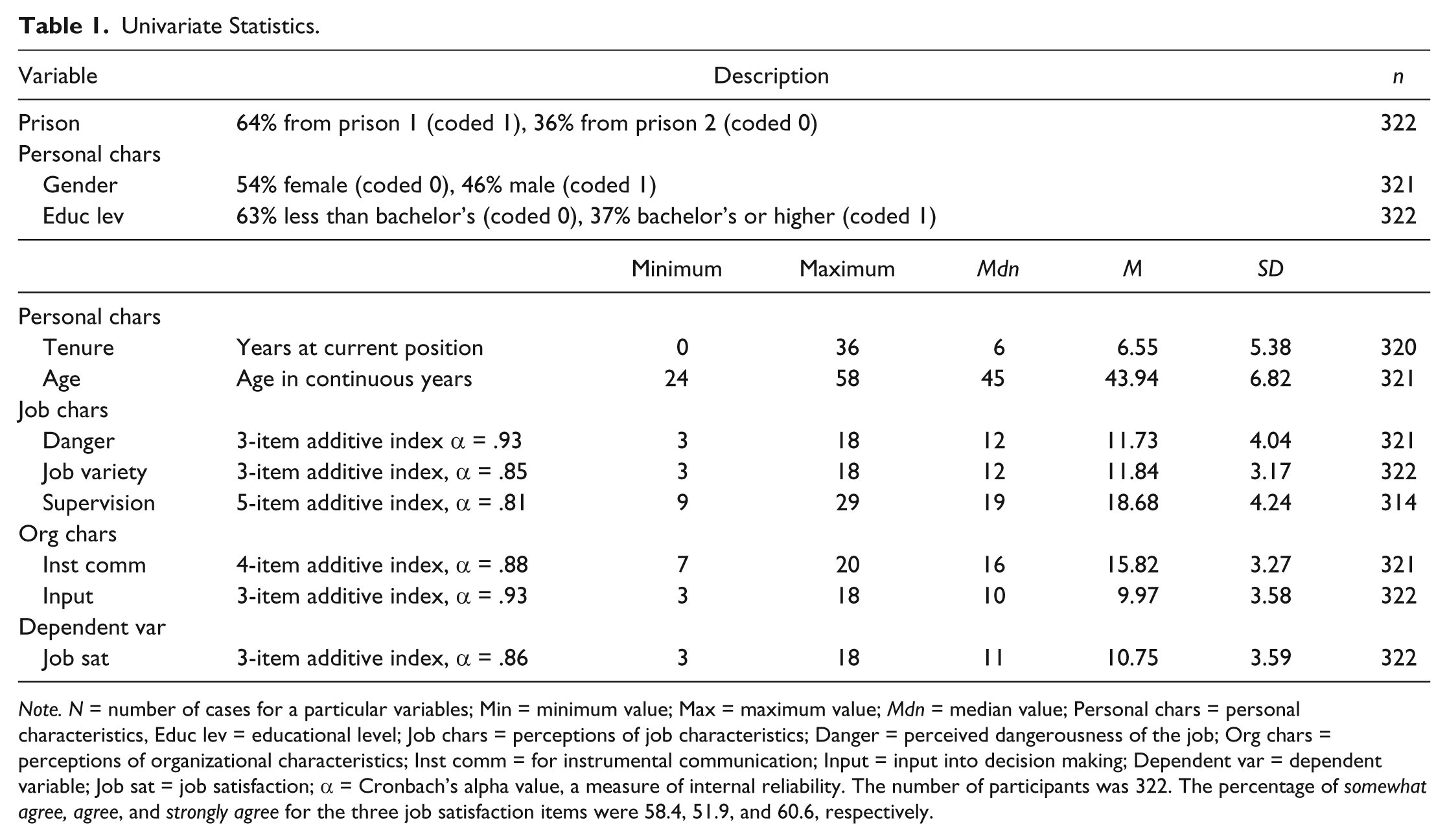
Note. N = number of cases for a particular variables; Min = minimum value; Max = maximum value; Mdn = median value; Personal chars = personal characteristics, Educ lev = educational level; Job chars = perceptions of job characteristics; Danger = perceived dangerousness of the job; Org chars = perceptions of organizational characteristics; Inst comm = for instrumental communication; Input = input into decision making; Dependent var = dependent variable; Job sat = job satisfaction; α = Cronbach’s alpha value, a measure of internal reliability. The number of participants was 322. The percentage of somewhat agree, agree, and strongly agree for the three job satisfaction items were 58.4, 51.9, and 60.6, respectively.
A correlation matrix is presented in Table 2. Gender, perceived dangerousness of the job, job variety, supervision, instrumental communication, and input into decision making all had statistically significant correlations with job satisfaction. Female staff in general had higher satisfaction from the job compared with their male counterparts. Increases in perceived dangerousness were associated with decreases in job satisfaction. Increases in job variety, supervision, instrumental communication, and input into decision making were associated with greater satisfaction from the job. The independent variables of prison, tenure, age, and educational level all had nonsignificant correlations with job satisfaction.
Correlation Matrix.
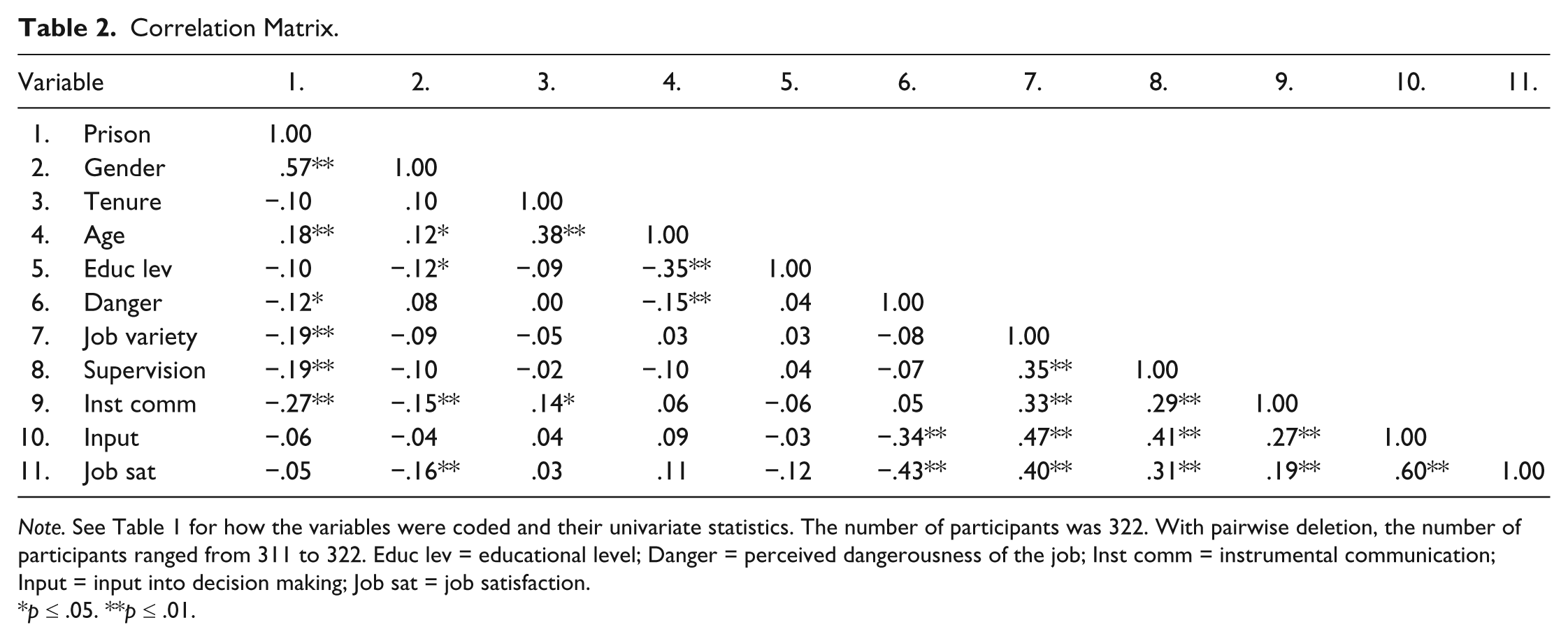
Note. See Table 1 for how the variables were coded and their univariate statistics. The number of participants was 322. With pairwise deletion, the number of participants ranged from 311 to 322. Educ lev = educational level; Danger = perceived dangerousness of the job; Inst comm = instrumental communication; Input = input into decision making; Job sat = job satisfaction.
p ≤ .05. **p ≤ .01.
Four models were estimated using ordinary least squares regression with job satisfaction. 1 In Model 1, the only independent variables entered were the personal characteristics. For Model 2, the independent variables were the job characteristics. For Model 3, the independent variables were organizational characteristics. Model 4 included all the independent variables. The regression results are reported in Table 3.
Regression Results With Job Satisfaction as the Dependent Variable.
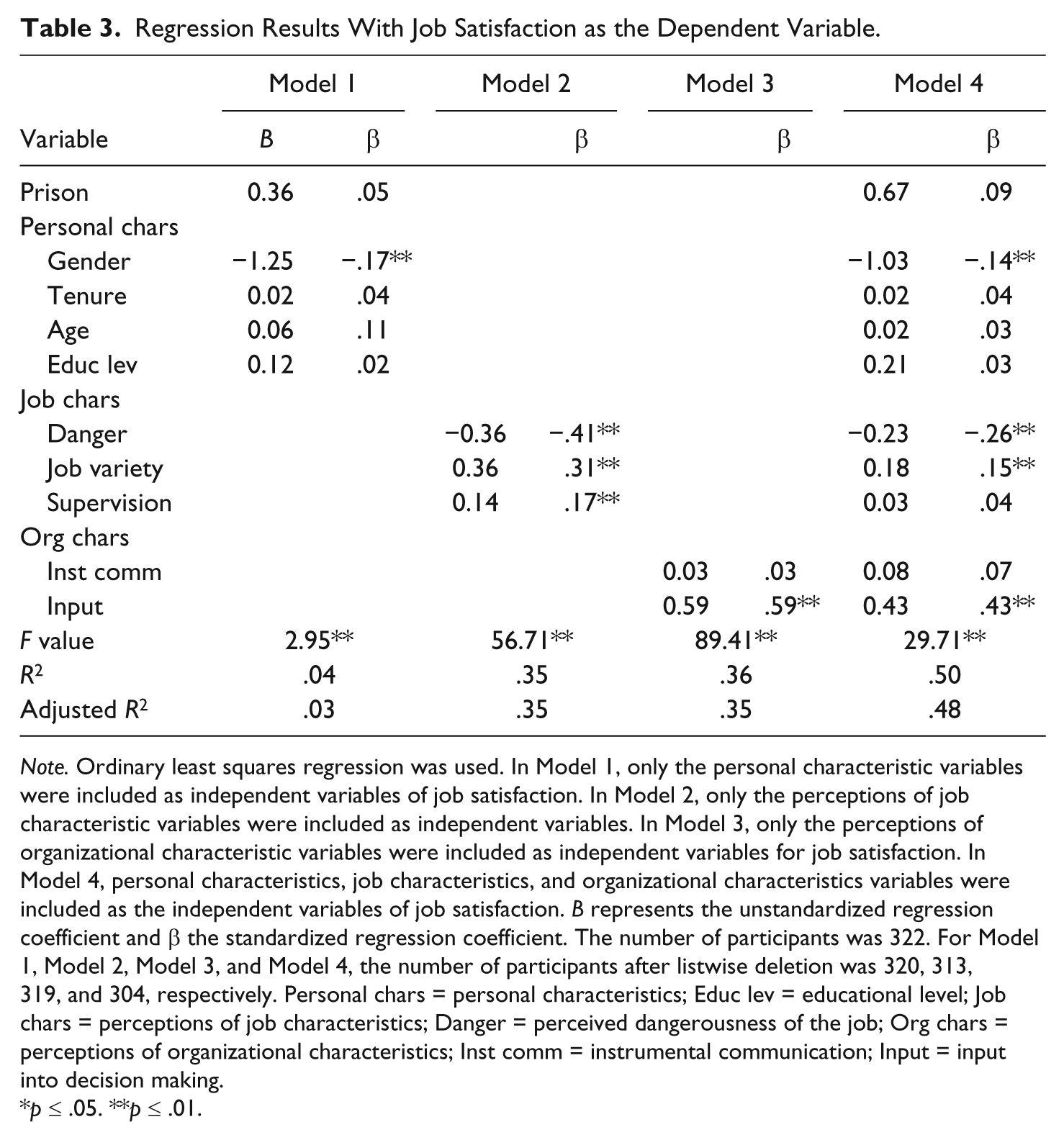
Note. Ordinary least squares regression was used. In Model 1, only the personal characteristic variables were included as independent variables of job satisfaction. In Model 2, only the perceptions of job characteristic variables were included as independent variables. In Model 3, only the perceptions of organizational characteristic variables were included as independent variables for job satisfaction. In Model 4, personal characteristics, job characteristics, and organizational characteristics variables were included as the independent variables of job satisfaction. B represents the unstandardized regression coefficient and β the standardized regression coefficient. The number of participants was 322. For Model 1, Model 2, Model 3, and Model 4, the number of participants after listwise deletion was 320, 313, 319, and 304, respectively. Personal chars = personal characteristics; Educ lev = educational level; Job chars = perceptions of job characteristics; Danger = perceived dangerousness of the job; Org chars = perceptions of organizational characteristics; Inst comm = instrumental communication; Input = input into decision making.
p ≤ .05. **p ≤ .01.
For Model 1, the adjusted R2 value was .03, which means that the personal characteristic variables accounted for only 3% of the observed variance in job satisfaction. Among the personal characteristics, gender was the only variable to have a significant association, with female staff generally reporting higher satisfaction compared with men.
In Model 2, the job characteristic variables accounted for approximately 35% of the variance of job satisfaction. All three independent variables had a significant relationship with the dependent variable. Specifically, increases in perceived dangerousness of the job were associated with decreased satisfaction with the job, whereas job variety and supervision were associated with heightened job satisfaction.
About 35% of the variance of job satisfaction was explained by the two organizational characteristics in Model 3. Input into decision making had a significant positive relationship. Instrumental communication, however, had a nonsignificant correlation.
In Model 4, the independent variables accounted for about 48% of the observed variance of job satisfaction. The only personal characteristic having a significant relationship was gender, with female staff generally reporting higher satisfaction from the job. Among the job characteristics, perceived dangerousness of the job had a significant negative association, and job variety had a significant positive relationship with job satisfaction. Supervision had a nonsignificant association in Model 4. Of the two organizational characteristic variables, only input into decision making had a significant relationship, with increases in this variable being associated with higher job satisfaction. Instrumental communication had a nonsignificant association. Based on the standardized regression coefficients (i.e., the β column in Table 3), input into decision making had the largest effect, which is almost twice that of the other variables, followed by perceived dangerousness of the job, job variety, and then gender. Although not reported in Table 3, a fifth model was estimated using only the job characteristics and organizational characteristics. The R2 for this model was .47, which means that the work environment variables explained more observed variance in the job satisfaction variable than did the personal characteristics.
The problem of multicollinearity was tested for in the regression equations and was found not to be a problem. Multicollinearity is seen as a problem when variance inflation factor (VIF) scores exceed 6 (Tabachnick & Fidell, 1996). For example, in Model 4, the VIF scores ranged from 1.62 to 1.72. In addition, the issues of outliers, influential cases, normality, linearity and homoscedasticity of residuals, and independence of errors in the regression analyses were tested for each of the models. For Model 4, based on the standardized residuals, one case had to be removed because it had a residual greater than ±3. Leverage statistic indicated no nonoutlying influential cases. In addition, based on Cook’s distance statistic, no influential additional outlier cases were observed. The plot of standardized predicted values of job satisfaction against the standardized residuals indicated no problem (i.e., no systematic pattern of variation in the residuals was observed). Finally, the histogram of standardized residuals indicated a normal distribution, as did the normal probability plot of residuals.
Discussion and Conclusion
This exploratory study revealed that 57% of the responding Chinese prison staff were satisfied with their job, which is lower than Chinese community prison staff and Chinese lawyers (Jiang et al., 2016; Lo & Snape, 2005; Lu, Liang, Li, & He, 2014). This level of job satisfaction may be due to the nature of their work. As noted earlier, Chinese prison staff work long hours. As they work with confined inmates, they face higher risks and greater pressure. About 63% of the staff in this study see their job as dangerous, and 62% believe they have a real risk of being hurt or injured. In addition, 65% of the staff perceived their job was a lot more dangerous than most jobs in the community.
Low levels of participation in decision making might have also contributed to the observed lower levels of satisfaction in the current study. The survey results indicate that many staff members felt that they had little input into the prison decision-making process. China’s approach to running organizations, particularly government ones, is different from that commonly found in Western nations, particularly the United States. The paternalistic approach of administration is more common in China than in the United States, and this approach tends not to seek as much input into decision making as other approaches (Chen et al., 2014). As noted by Farh and Cheng (2000), a paternalistic approach is “a style that combines strong discipline and authority with fatherly benevolence” (p. 91). This approach is rooted in the collective culture of China, and is based on Confucianism’s principle of hierarchy to respect those above you and to allow them to make decisions (Chen et al., 2014). The United States is a more individualistic culture where people are expected to have voice in salient matters (Jiang & Lambert, 2009). Nevertheless, as many U.S. prisons have a paramilitary structure, there may be less input into decision making in U.S. prisons than desired. This may explain why a lack of input into decision making is negatively associated with job satisfaction and positively related to job stress among U.S. correctional staff (Lambert, Paoline, & Hogan, 2006; Slate & Vogel, 1997). It is important to note that the current study is unable to test empirically what type of management approach was used at each prison so as to determine why some the surveyed staff were low in their perceptions of the level of input into decision making. This is an area that needs to be explored by future researchers.
As postulated, personal characteristics explained little of the variance of job satisfaction among the surveyed Chinese prison staff. This finding is similar to that found among U.S. correctional staff (Garland et al., 2009; Griffin, 2001; Lambert, 2004; Lambert & Paoline, 2008; Misis et al., 2013) and found among Chinese community correctional staff (Jiang et al., 2016). In terms of the relationships between job characteristics, organizational characteristics, and job satisfaction, there are differences and similarities between U.S. and China prison staff. To be more specific, supervision and instrumental communication had nonsignificant effects on job satisfaction, which indicates differences between U.S. and Chinese prison staff. It is worth noting that supervision and instrumental communication are related to job satisfaction in the bivariate relationship table (Table 2). These relationships, however, become insignificant in the final regression model, once the shared effects of the other independent variables were taken into account (see Model 4 in Table 3). This means, once the shared effects of the workplace variables were taken into account, these variables did not have significant independent effects on work safety concerns. A visual inspection of Model 2, Model 3, and Model 4 in Table 3 reveals that both supervision and instrumental communication may affect job satisfaction via input into decision making. As noted before, input into decision making reflects a prison supervisor’s confidence with employees. To a respondent, it is an indicator of whether he or she was being considered and treated as a significant, competent, and trusted employee. Chinese people in general, and prison staff in particular, highly value personal relationships with their supervisors (quanxi). Findings from the current study suggest that the effects of supervision and instrumental communication on job satisfaction may depend on employer’s trust with employees and the individual relationship between superior and subordinate. This possibility needs to be tested in future. The other three work environmental variables (i.e., perceived dangerousness of the job, job variety, and input into decision making) had significant effects on job satisfaction, which are similar to the findings from studies conducted in the U.S. corrections system.
The majority of multivariate findings are consistent with what has been found with U.S. correctional staff. There are multiple explanations for this occurrence. One possible explanation is that although China and the United States have similarities and differences in politics, economics, law, and general culture, independent variables used in this study are more likely to be indicators of the two nations’ similarities. For example, jobs in corrections in both nations are perceived as more dangerous than most other occupations, and whether in China or the United States, prison staff who feel at greater risk of injury report lower job satisfaction.
Another possible explanation is that an individual’s level of job satisfaction is less affected by political, cultural, and ideological contexts but is more affected by factors within employing organizations. Still another explanation for the similar findings could be related to the location of the selected prisons. As previously indicated, the prisons were in Guangzhou (formerly known as Canton). Guangzhou is a highly populated commercial metropolitan area, well connected as a trading hub, including with Hong Kong and Macau. It may be more influenced by Western ideas than other parts of China, particularly rural areas. Future research should explore whether the effects of work environment variables vary by the location of Chinese prisons. It is clear that more research is needed to test these and other possible explanations.
The only personal characteristic to have a significant association with job satisfaction in the full regression analysis was gender. As previously indicated, women reported greater job satisfaction as compared with their male counterparts. There are several explanations for this finding. One reason could be the specific job duties assigned to female and male staff in the two Chinese prisons. Female staff could be assigned less risky and less dangerous job duties than their male counterparts. In turn, this results in more positive work experiences, which result in higher levels of job satisfaction. A related explanation is that female correctional officers have less confrontational interactions with inmates, which result in less negative psychological strains on the job. Future research should include not only the average daily level of inmate contact but also the characteristics and quality of this contact. Contact with an inmate can be positive or negative. Another explanation may be that the currently surveyed female prison staff are working in an occupational field not previously inclusive of women. While changing, in the past, China was viewed as a patriarchal society (Jiang & Lambert, 2009). Overcoming gender barriers by working in a heretofore male-dominated field could result in greater pride and positive feelings on the part of female staff, which, in turn, could enhance the level of job satisfaction. These are, of course, untested postulations. Future research is needed to determine whether gender continues to have a significant association with job satisfaction among Chinese prison staff, and, if so, whether they are due to gender differences in areas as job duties, gender relations, interpersonal action and communication styles, or sense of achievement.
As with many studies, the current exploratory study had limitations. It was a single study of staff at two prisons located in Guangzhou, China. Although the response rate was similar between the two prisons and the participants appear to be representative of the overall staff for each prison, it is not known why approximately 30% of staff from each prison declined to complete the survey. For example, it is not known whether nonresponse bias played a role. As such, the current findings need to be replicated. Moreover, there are almost 700 correctional facilities in China, and surveying staff at only two prisons is just a small fraction of all Chinese prison staff. Findings from this study may also be situational and contextual, varying across different Chinese prisons. Studies of staff at many other Chinese prisons are needed to determine whether the findings can be replicated or whether they differ across prison facilities. If possible, surveys of a staff at a large number of prisons should be administered so hierarchical linear modeling (HLM) can be conducted. This would allow for the testing of nested effects both at the individual staff level and at the prison level. With only staff from two prisons, it was not possible to conduct this type of analysis given the lack of significant variation between the prisons. In addition, comparative data from prison staff in other nations are needed to determine whether the effects of personal, job, and organizational characteristics are universal or vary across different cultures. Causality of the independent variables cannot be empirically demonstrated because the survey was cross-sectional. Longitudinal studies are needed to demonstrate causal effects of the variables on job satisfaction.
In the current study, the independent variables explained about 50% of the variance observed in the dependent variable job satisfaction. This means that other variables influence the level of job satisfaction among the surveyed prison staff. These other variables need to be identified. We recommend future studies look at how other work environment variables, such as role conflict, role ambiguity, role overload, role underload, formalization, coworker support, and organizational support are associated with job satisfaction among Chinese prison staff. The work environment is complex and has many more dimensions than those explored here. Furthermore, research is needed on how the perceptions of job and organizational characteristics are formed and how they can be improved. Prison administrators need to understand not only what workplace variables effect job satisfaction but also how those variables can be realistically improved. In sum, there is a need for far more research focusing on satisfaction from the job not only among Chinese prison staff but staff working in facilities in other nations. Finally, future research should examine how personal, job, and organizational characteristics are associated with job involvement and organizational commitment among Chinese prison personnel. It is only then that a clear picture will be gained on the variables that effect Chinese staff.
Despite the above limitations, to our best knowledge, this study is the first examination of job satisfaction among Chinese prison staff. This study revealed not only the level of job satisfaction among Chinese prison staff but also the variables that may shape it. Findings from this study have implications for practitioners in corrections, particularly in China. Job satisfaction among Chinese prison staff was low, relative to employees in other occupations. As job satisfaction is very important for work performance, prison administrators in China need to make special efforts to increase their employees’ satisfaction with their job. Bivariate associations indicate that all five job and organizational characteristics in this study are correlates of job satisfaction, suggesting that improvement in these five variables may help increase it. Chinese prison administrators need to pay a special attention to input into decision making, perceived dangerousness of the job and job variety, because they had significant effects after controlling for all other variables in the final regression model. As noted before, the respondents’ participation in decision making was low and input into decision making had the greatest magnitude of effect on job satisfaction, and it was a positive effect. These findings provide clear message to the Chinese prison administrators that they need to increase staff involvement in organizational decision making to increase their satisfaction with job. In addition, the perceived dangerousness of the job was high and negatively related to job satisfaction. Accordingly, employers need to work hard to reduce job risk and the perceived dangerousness of the job so that their employees’ job satisfaction can be increased. In addition, administrators need to explore how job variety can realistically be increased for staff.
In closing, the current exploratory study suggests that job and organizational characteristics have greater effects on job satisfaction for Chinese prison staff than do personal characteristics. In addition, the findings suggest that both job and organizational characteristics have significant associations with prison staff’s satisfaction from the job. The relationship of specific job and organizational characteristics with job satisfaction did, however, vary. It is hoped that the current study will spur more interest and research on the subject of job satisfaction of staff not only in Chinese prisons but also in other nations.
Footnotes
Acknowledgements
The authors thank the reviewers for their comments and suggestions. The authors also thank Janet Lambert for proofreading the article.
Declaration of Conflicting Interests
The author(s) declared no potential conflicts of interest with respect to the research, authorship, and/or publication of this article.
Funding
The author(s) received no financial support for the research, authorship, and/or publication of this article.