




Abstract
The aim of this intervention study was to examine the impact of the Prevention and Relationship Enhancement Program on inmates and their partners with the programming goal to reduce the negative impact of incarceration on families. This study was conducted in a prison facility in the Northeast United States, and data were collected on 40 couples (40 male inmates and 40 female partners) that completed the program. This study used a self-report pre and post survey to collect data on relationship satisfaction, relationship confidence, types of interactions, as well as program satisfaction. Results demonstrated that inmates and their partners improved their positive interactions and relationship confidence. Different trends were found for men and women in marital satisfaction and negative interactions. Both groups reported that the program was beneficial for improving communication; however, listening techniques and setting ground rules during discussions were still issues both groups struggled with at the end of the intervention.
Upon examination of family issues related to incarceration in the United States, the separation of incarcerated men from their families is often detrimental to everyone involved—the person incarcerated, their partners, and the entire family. For offenders, strong family ties can make the difference between successful reentry into society or a return to prison (Arditti, 2005). Male offenders who maintain strong connections to their family during imprisonment have fewer behavior issues while incarcerated and have higher rates of postrelease success than those who do not (Einhorn et al., 2008; Hairston, 2001, 2007; Kazura, 2001; Sampson, Laub, & Wimer, 2006). In general, compared with single inmates, inmates who have a healthy and stable marriage during incarceration experience many benefits, including mental and physical health and increased well-being (Einhorn et al., 2008). However, male offenders historically receive less social support from their families than female inmates (Eddy et al., 2008; Hairston, Rollin, & Jo, 2004; Swanson, Lee, Sansone, & Tatum, 2013). Hairston et al. (2004) reported that when inmates were asked how many visits they received in the last month, 65% of male inmates reported not having a visit from any family member versus 62% of female inmates.
Barriers for Family Visitation
For married offenders, incarceration interrupts important couple dynamics and often results in marital discord (Apel, Blokland, Nieuwbeerta, & van Schellen, 2009). In the United States, inmates are often housed in prisons that are long distances from their homes; 60% are in prison facilities more than 100 miles away from their communities (Mumola, 2000). For low-income families, travel to prison facilities can create financial hardships. Even for those partners and family members able to travel, correctional facilities place a number of limitations (Wildeman & Western, 2010). Prison environment is inhospitable, and security policies and procedures discourage visitors (Arditti, Lambert-Shute, & Joest, 2003). Couples have no privacy, have restricted physical contact, and undergo time constraints. Even telephone calls are limited and expensive. In the United States, inmates are charged exorbitant fees to make telephone calls (Hairston, 2007). Among inmates with partners on the outside, a mere 25% report weekly visits or telephone/mail contact from their partners (Massoglia, Remster, & King, 2011). For various reasons, incarceration puts a financial burden on their families, increasing levels of stress on family systems that are already fragile (Dickie, 2013; Huebner, 2005; Wildeman & Western, 2010). When couples are able to visit or talk on the telephone they report spending a large portion of their time discussing financial and child-rearing decisions which reduces their ability to develop and maintain emotional connections (Kazura, 2001).
Increased Risk of Divorce
Forced separation results in changes for both partners, which often results in decreased compatibility (Apel et al., 2009). From the moment the arrest takes place, the family is separated and a number of immediate risk factors are placed on the relationship. Partners of offenders report increased anger, decreased feelings of affection and attachment toward their partners, and lower marital satisfaction (Einhorn et al., 2008). In addition, partners usually experience economic strain due to the loss of the offender’s income and increased household responsibilities (Massoglia et al., 2011). With the partner on the outside left to make most of the decisions for the family, both partners, male and female, experience role change.
Concurrently, male offenders are going through a number of changes as well. Prison policies have often been criticized as being overly rigid, and many of these policies restrict or limit the maintenance of family ties (Hairston et al., 2004). In addition, the strict routines, lack of privacy, and overall all stressful environment impact inmates’ psychological well-being (Massoglia et al., 2011). Every part of an inmate’s daily routine is dictated and over time inmates have little sense of autonomy or opportunities to make decisions for themselves. The stress of the prison environment creates hypervigilance to men’s safety and trust, both of which results in hyper masculinity, low self-worth, and posttraumatic stress disorder (Haney, 2001). All these experiences and their resulting effects obstruct healthy and stable relationship maintenance (Apel et al., 2009).
These obstacles leave many spouses of incarcerated partners feeling isolated, frustrated, and helpless and leave inmates worried about being replaced in their partner’s lives (Hairston, 2001; Toth & Kazura, 2010). The culminating effect being marital instability and decreases inducements to stay together (Apel et al., 2009). The divorce rate among incarcerated men is 3 times higher than nonincarcerated men (Lopoo & Western, 2005). In addition, longer prison sentences increase the rate exponentially (Siennick, Stewart, & Staff, 2014).
Relationship Education Programs in Prison
Given the increased risk factors placed on married couples because of incarceration, programs and research focused on relationship education and intervention strategies are clearly necessary for successful inmate rehabilitation. Unfortunately, a number of barriers prevent or impede the provision of relationship intervention programs in U.S. prison facilities (Tewksbury & DeMichele, 2005). Correctional officers and community leaders tend to focus rehabilitation effects on inmates’ education, job training, and drug and alcohol counseling. Family intervention programs are often seen as distractions that create more issues than they resolve (Toth & Kazura, 2010). Prison administrators must weigh the benefits of the visits (i.e., improved inmate behavior) and the reality of security issues (i.e., families bringing in contraband) with budget constraints (Fulcher, 2013). From the public point of view, citizens have concerns about state funds being spent on family strengthening rather than correcting the negative behaviors that caused the incarceration (Toth & Kazura, 2010). However, research shows us the need for intervention for both inmates and their families (Kazura, 2001). Otherwise, inmates, upon release, return to a family in crisis. Such crises increase the risk of reoffending and further threaten dissolution of the marital relationship.
Prison programs that aid couples in maintaining healthy relationships have adopted a wide range of formats which have been delivered by a variety of agencies: family support providers, state agencies, and community- and faith-based organizations (Parke & Clarke-Stewart, 2003). Many of these community-based service agencies struggle for funding and often do not last beyond a few years (Toth & Kazura, 2010). In addition, evaluations of relationship programs have been rare, and only recently have empirical data become available to suggest the effectiveness of relationship education classes on this population (Herman-Stahl, Kan, & McKay, 2008). Furthermore, there is even less research on relationship education programs which include both the offender and the partner. To our knowledge, only one other study has examined the impact of relationship intervention on both offenders and their partners, where partners were allowed to participate in the program at the same time (Einhorn et al., 2008).
The three major types of relationship intervention programs off in state run prison facilities—couple counseling, furloughs, and group education classes—each have their own limitations. Couple counseling only serves the small group of individuals who are willing and/or able to make this commitment (i.e., travel to the prison, having limited options on who provides the counseling, taking time away from regular visitation; Herman-Stahl et al., 2008). Couple counseling in prison facilities often lacks funding and is rarely offered. In the United States, furloughs and conjugal visits are another way correctional professionals have attempted to support inmates’ connections to their partners, but furloughs or temporary visits home from the prison are rare and usually occur as a transition step toward the end of an inmate’s sentence (Einhorn et al., 2008). Conjugal visits, also rare, are decreasing all the time. Today only four states (e.g., California, Connecticut, New York, and Washington) provide conjugal visits due to cost and security issues (Herman-Stahl et al., 2008). Although furloughs and conjugal visits allow for more contact between couples under less stressful circumstances, they do nothing to improve the interactions/behaviors of the couple. To make the situation even more challenging, good behavior is often a prerequisite to participate in any of these programs. Inmates who engage in rule violations and receive disciplinary action are often removed from relationship intervention programs, leaving the partner on the outside feeling helpless and frustrated (Toth & Kazura, 2010). This causes continuity problems for program facilitators who have to “make up” that work with that inmate; or more typically, the inmate has to begin the program from the start.
Clearly, there is a need for prison relationship education. The most common forms of relationship education, however, include group sessions with only the inmates. Few programs address the needs of establishing healthy relationships with both the incarcerated member and the partner on the outside (Einhorn et al., 2008). In the United States, two programs are exceptions to this rule.
The Prevention and Relationship Enhancement Program (PREP©) originated in Oklahoma (Einhorn et al., 2008). In 1999, in an effort to reduce the state’s high divorce rate, the state launched the Oklahoma Marriage Initiative, through which PREP© courses were made available free of charge to couples throughout the state, with a particular focus on low-income families (Markman, Stanley, & Blumberg, 2001). With most prisoners and their families falling into the target population, the state decided to extend PREP© to prisoners and their spouses/partners. Nearly 1,000 prisoners and partners in the state’s 17 minimum- and medium-security facilities have participated to date (Einhorn et al., 2008). PREP© subsequently became required for all inmates and their fiancées prior to getting married within the prison. In 2016, due to budget constraints this program was discontinued (Brown, 2016).
The second program to offer both partners relationship intervention during incarceration is the New Hampshire Family Connections Center (FCC), developed through a unique alliance among University of New Hampshire (UNH), Department of Corrections (DOC), and New Hampshire (NH) Child and Family Services. The FCC is an innovative model for providing relationship education and helping maintain parent–child relationships despite incarceration (Toth & Kazura, 2010). The goal of the FCC is to increase protective factors and decrease risk factors associated with incarceration for the inmate and his family with the long-range goal to reduce recidivism and intergenerational criminal behavior. Established in 1998, FCC has successfully designed and implemented a variety of family support programs, which have included partners, parents, and children of inmates (Kazura, 2001).
Current Study
Since its creation in 1998, the FCC has focused on programs that enhance the relationship between inmates and their children. One noticeable limitation was the lack of programming regarding inmates’ romantic partnerships. Therefore, the aim of this intervention study was to provide the PREP© to inmates and their partners while still in prison to help reduce the negative impact of incarceration on families and increase the likelihood of successful reentry into society (Stanley, Markman, Blumberg, & Jenkins, 2006). This exploratory study examined the short-term impact of the PREP© program on relationship satisfaction, confidence, negative interactions, and positive interactions for both inmates and their partners.
Method
Participants
Forty couples (40 male inmates and 40 female partners) completed the PREP© program. Participants’ ages were as follows: 42.3% between the ages of 18 to 35 years, 50.9% between the ages of 36 to 55 years, and 6.8% above 65 years old. Descriptive analyses on ethnicity showed 0.3% as Asian, 7.9% as Black, 9.3% as Hispanic, 70.9% as White, and 11.6% reported as other. All interested inmates could participate in PREP©, whether they were in a relationship or not, but only data from couples who completed the program were examined for the purposes of this study. Relationship lengths averaged 6.29 years (SD = 5.33) and ranged from 1 to 28 years. Participants were excluded from analyses for the following conditions: inmates who participate in PREP© without a partner (n = 17), incomplete data (n = 3), and stopped attending the program (n = 7). The most common reasons for dropping out of the program were scheduling conflicts and travel distance to prison.
Recruitment
Flyers describing the PREP© program and other family programs offered by the FCC were made available to inmates at a NH state prison facility. A program advertisement was posted in the prison’s newsletter, and announcements were made at the NH DOC staff team meetings. Many inmates reported to PREP© staff that they decided to participate because of encouragement from fellow inmates. To participate, DOC mandated that inmates could not have a criminal record for a sex crime against a child under the age of 14 years nor could inmates be under prison disciplinary action due to violations while incarcerated. All remaining inmates were eligible to participate.
Regarding participation of inmates’ partners, partners had to be on the inmates’ approved visitors list and had to agree to comply with the rules for regular institutional visits. In addition, PREP© staff completed home visits with the female partner and conducted a domestic violence screening to ensure that partners felt comfortable participating in the program. Consent forms were developed based on the UNH Institutional Review Board’s human subjects guidelines. Participants were asked to sign the document, which provided full disclosure and attested to the fact that they were agreeing to attend the program and complete the questionnaires voluntarily and that it would not impact inmates’ prison sentences.
Procedure
Staff from a local family resource center partnered with the NH DOC and offered the PREP© in a NH prison facility. PREP© is a research-based approach to teaching couples how to communicate effectively, work as a team to solve problems, and preserve and enhance commitment and friendship (Laurenceau, Stanley, Olmos-Gallo, Baucom, & Markman, 2004; Stanley et al., 2006). Staff from the local family resource center provided a full-time educator to lead PREP© classes at the prison and collected the pre and post survey data.
PREP© curriculum consisted of 14 topics which included topics regarding effective communication, negotiation techniques, forgiveness, hidden relationship issues, relationship expectations, problem-solving, and friendship (Stanley et al., 2006). All staff were certified leaders trained to use the PREP© curriculum. The instructor manual included standardized instructions and lecture materials for each lesson.
The intention was to have each class consisting of five 2-hr sessions held twice a week, for a total of 10 hr of instruction and couples completed PREP© together. At times staff had to adjust class length to meet the participants’ schedules. Therefore, some classes were 2 hr while others were 3 and 4 hr long. Stanley et al. (2006) stated in their manual that the program was created to allow for variation in formats. To offset the cost of traveling long distances to the prison PREP© classes, female partners were provided gas cards and reimbursement for child care expenses.
Between classes, couples completed “homework assignments” to put into practice the communication skills they learned in class. The assignments were carried out through letter writing, phone conservations, visitation, and supervised “video visiting” with their partners. Computers were provided at several community resource centers and at the prison to enable inmates and their partners to view each other in “real time” while they were talking. This was helpful for partners for whom in-person visits in between program sessions was difficult.
Measures
All measures were provided by the PREP© curriculum, and the original items were standardized on a sample of 947 people (Stanley et al., 2006). Factor analyses were conducted on all multi-item measures to determine construct validity using Cronbach’s coefficient alpha. Items were dropped if the alpha was lower than the acceptable .70. The remaining items were totaled to create a composite score.
Relationship satisfaction
Relationship satisfaction was assessed using a one-item indicator from the PREP© survey: How happy are you with your relationship with your partner? This item was rated on a 7-point scale, ranging from 1 (very unhappy) to 7 (perfectly happy; Schumm, Scanlon, Crow, Green, & Buckler, 1983). One-item indicators for relationship satisfaction is standard practice when conditions necessitate short surveys (Bailey, Kerley, & Kibelstis, 2012; Einhorn et al., 2008).
Relationship confidence
The Relationship Confidence Scale (RCS; Stanley, Hoyer, & Trathen, 1994) was selected to measure the confidence each partner had regarding the longevity of his or her relationship. A sample item from this three-item scale is as follows: We have the skills a couple needs to make a relationship last. The Cronbach’s alphas were .72 for males and .81 females. The RCS has shown good reliability and validity in previous samples (e.g., Stanley et al., 2001; Whitton et al., 2007).
Negative interactions
Four items from the Relationship Dynamic Scale were utilized to identify the warning signs of problematic relationships (Stanley & Markman, 1997). Higher scores on this 3-point scale indicated higher risk. Sample items are as follows: I hold back telling my partner what I really think and feel. My partner criticizes or belittles my opinions, feelings, or desires. One item was dropped after a factor analysis was conducted, and the Cronbach’s alphas were .71 males and .77 for females. Variations of this scale have been used in numerous studies (Einhorn et al., 2008; Stanley et al., 2006)
Positive interactions
This five-item scale assessed positive communication traits, which was adapted from the Communication Skills Test (Saiz & Jenkins, 1996). Examples of positive communications items are as follows: When discussing issues, I allow my partner to finish talking before I respond. When discussing issues, I show my partner I am listening by repeating what I heard. The Cronbach’s alphas were .80 for males and .84 for females.
PREP© impact
Participants were asked five additional questions in the posttest to assess knowledge gained from the PREP© program (Stanley et al., 2006). Individuals rated the following items on a scale ranging from 1 (strongly disagree) to 5 (strongly agree). Participants were asked the following questions:
I know about the key risk factors for relationship failure.
I remember the skills for improving communication with my partner that were taught at PREP©.
My Partner and I are using Speaker/Listener techniques introduced at PREP©.
My partner and I are using the “ground rules” introduced at PREP©.
I feel more positive about the important relationships in my life after PREP©.
One additional open-end question was asked during the posttest regarding PREP© program impact. This question asked participants whether there was anything else they would like to say about the PREP© program. A content analysis method was used for this open-ended question (Hsieh & Shannon, 2005). This method involves looking for categories, or themes, among the data and organizing responses in a systematic way (Corbin & Strauss, 2015). Two raters conducted the content analysis. Four questionnaires were selected at random and each rater conducted open coding on each transcript to determine commonalities (Corbin & Strauss, 2015). The two raters then discussed their findings and developed a coding scheme, and both raters coded the remaining questionnaires independently. The raters reviewed their results together and in the few instances when there were disagreements, the raters explained their coding decisions and a final determination was made jointly (Corbin & Strauss, 2015).
Results
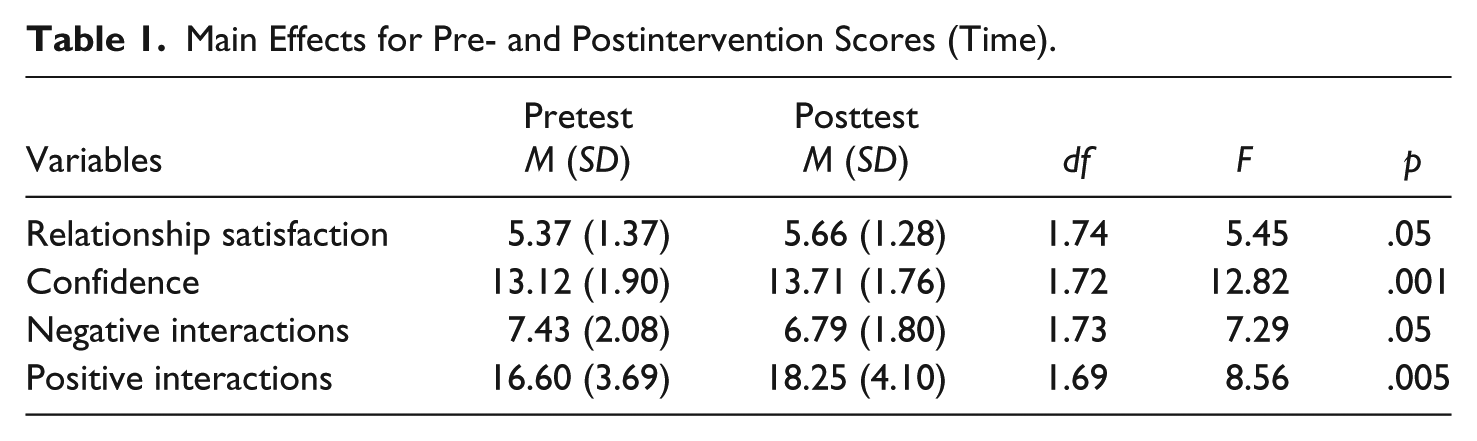
A series of 2 (time) × 2 (gender) analysis of variance was conducted to examine changes from pre- to postintervention among inmates and their partners. Time was treated as a within-subjects factor and gender as a between-subjects factor. The time factor represents the pre- and postintervention scores on each of the measures. Table 1 displays the total group’s means and standard deviations for the pre- and postintervention relationship variables, and Table 2 displays the follow-up pairwise comparisons for men and women run separately.
Main Effects for Pre- and Postintervention Scores (Time).
Inmates’ and Partners’ Means and Standard Deviations for Pre- and Postintervention Relationship Variables.
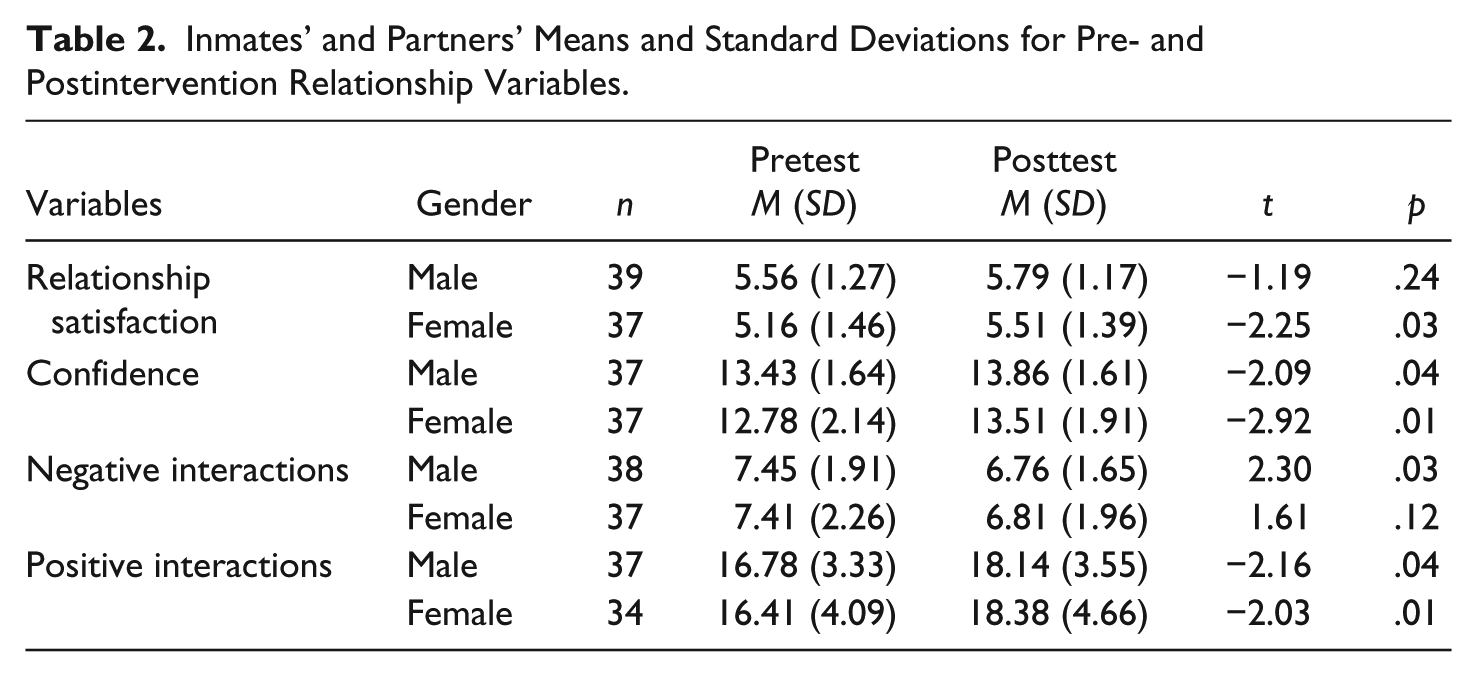
For relationship satisfaction, there was a significant main effect for time, Wilks’s λ = .93, F(1, 74) = 5.45, p < .05 (see Table 1). For men, the follow-up pairwise comparisons for time did not demonstrate a significant difference from pre- to posttest. Women’s mean scores did show a significant increase in relationship satisfaction, t(36) = −2.25, p < .05 (see Table 2). Next, confidence was analyzed and there was a significant main effect for time, Wilks’s λ = .85, F(1, 72) = 8.35, p = .001. For men, the follow-up pairwise comparisons demonstrated a significant increase in confidence from pre- to posttest, t(36) = −2.09, p < .05. Women also had a significant increase, t(36) = −2.92, p < .005. Negative interactions had a significant main effect for time, Wilks’s λ = .91, F(1, 73) = 7.29, p = .05. Men’s scores showed a significant reduction in negative interactions from Time 1 to Time 2, t(37) = 2.30, p < .05. Women did not have a significant difference in their scores. When positive interaction scores were examined, a main effect was found, Wilks’s λ = .89, F(1, 69) = 8.56, p = .005. Both men, t(36) = −2.16, p < .05, and women, t(33) = −2.03, p < .05, had significant increase in positive interactions across time.
PREP© Impact
Descriptive analysis is provided in Figure 1 for the mean differences on the posttest questions that asked couples to answer five questions regarding the impact the PREP© program had on their relationship. Both men (M = 4.49; SD = 0.60) and women (M = 4.46; SD = 0.55) rated high on knowledgeable on key relationship risk factors, feeling more positive about their relationship, and remembering the skills they learned in PREP©. There were two items with lower scores: utilizing listening techniques and establishing ground rules for discussions. These items may be more challenging communication skills to develop and couples may need more time to practice.

Postintervention questions for males and females.
Next, a content analysis of the posttest open-ended question was examined that asked participants whether they wanted to provide any additional information about the program (Hsieh & Shannon, 2005). The results of the content analysis revealed three themes regarding the open-ended question. Note, responses could fit into more than one theme (Hsieh & Shannon, 2005). The first theme was coded as relationship understanding. Nine inmates and six partners provided responses for this category. Inmates tended to respond with greater understanding of relationships in general with statements such as “I understand relationships now” and, “PREP© gave me more understanding,” whereas the female partners’ statements were more specific to their own relationship: “The program helped me to understand him more and how his childhood was” and “I found out a few more things about my partner.”
The second theme was coded as improved conflict resolution. Ten inmates’ and four female partners’ responses were coded for this theme. Statements for this category were consistent for men and women. The majority of comments for this theme addressed increased knowledge for solving conflicts in a more productive manner. One inmate stated, “It gave me guidelines on how to deal with disagreements without them turning nasty.” A female partner stated, “It taught me a healthier way to handle conflict.”
The third and largest theme was coded as improved communication skills (male = 34 and female = 25). Eight inmates’ and four female partners’ responses for this category focused on better listening skills. One female partner stated, “I can listen instead of always being the speaker.” The remaining responses focused on general improved communication skills and new ways to communicate. One inmate stated, “PREP has shown me different techniques and opened my eyes in how to communicate better.” Another commented, “Learning how important true listening is and how a relationship may not survive unless both parties are able to hear each other.” A female partner commented, “This program is helping me to communicate better my needs in a productive way that allows my husband and I to solve issues.”
Discussion
The current study investigated the impact of PREP© when delivered to inmates and their partners. Researchers have stated for years that few U.S. studies have examined the impact of incarceration on romantic relationships and the general lack of empirical evidence of intervention effectiveness (Arditti, 2005; Eddy et al., 2008; Hairston, 2007). This study adds to the growing body of literature demonstrating the importance of such programs. The results suggest that improvement for both inmates and their partners were similar in the areas of positive interactions and relationship confidence, with scores significantly increasing for both groups. However, there were different trends in marital satisfaction and negative interactions. Men’s relationship satisfaction was not significantly different from Time 1 to Time 2. This result may be due to incarcerated men feeling pessimistic due to their incarceration and physical separation from their partner. The second difference was in negative interactions. Although both groups’ scores decreased over time, only the men’s scores were significantly lower. Men’s scores were slightly higher than women’s at Time 1 and combined with the impact of their incarceration they may have had more room for improvement.
The posttest intervention questions revealed that both men and women found the PREP© program useful for learning effective communication skills, increasing positive attitude about their relationship, and learning the key risk factors in relationship failure. However, listening techniques and setting ground rules during discussions were still issues both groups struggled with at Time 2. The posttest open-ended question revealed three themes regarding couples perceptions of the benefits of relationship education in prison. All comments positively supported the need for relationship programs in prison. There were only a few recommendations for improving the program, and those comments focused on a need for more sessions and allowing for more breaks. Overwhelmingly, the comments suggest that the PREP© program enhanced couples’ communication skills and reduced conflict. Some couples provided lengthy descriptions on how beneficial the program was for their relationship. For example, one couple, who had been together for 2½ years and had a 2-year-old daughter together, reported multiple benefits from the program. This couple was unable to schedule regular prison visits because the mother had a criminal record. The FCC requested special permission for the mother to come into the prison and allow the couple to take the PREP© class together. The warden gave permission for the couple to participate in the class. During the class, the couple was able to discuss some of the issues that they have been unsuccessfully trying to resolve via letters. When the program was completed, the couple started family reentry planning with the help of the FCC staff to continue the process of discussing important topics and to facilitate a smoother transition for the entire family when the father is released. The father also began biweekly visits with his daughter whom he had not seen for almost a year.
Limitations and Future Directions
Clearly, more data need to be collected regarding similar programs to tease out the intricacies of relationship training effectiveness on couples with a member experiencing incarceration. The current study had a number of limitations that need to be addressed. The first limitation was the use of self-report surveys for the pre- and posttest assessment. Self-report measures though convenient, easy to administer, and efficient, they also have limitations. Self-reports are susceptible to social desirability especially when the program leaders administered the surveys. For inmates whose behavior was closely monitored and negative behaviors are sanctioned, have increased incentive to participate in such programs and engaged in appropriate behavior to gain privilege. Even though the informed consent stated otherwise, there is always a possibility that inmates feel this pressure to perform. The second limitation was the lack of a control group, which restricted the conclusions that could be drawn from the results. It is unclear whether the positive findings were due to the intervention or simply having more contact with their partners. Unfortunately, prison officials and the University’s Research Review Board would not permit a control group for this population, insisting that all eligible inmates should have access to intervention programs. A third limitation of the methodology was the lack of a follow-up assessment. Future studies would benefit by including an assessment 6 to 12 months after the program concluded to determine whether the positive behavior changes sustained over time.
Conclusions and Recommendations
It is important to remember that consistent empirical evidence suggests that inmates need to maintain healthy family relationships to improve postrelease circumstances (Visher & Travis, 2003). A multisystem intervention approach needs to be developed that coordinates a wide variety of organizations and staff both within and outside of corrections (Eddy et al., 2008). New programs need to take into consideration the realities of these families (i.e., financial issues, distance to prison, criminal records of family members; Hairston et al., 2004). There must be built-in support for travel or programming with partners via the Internet. In addition, like our program, many relationship programs are for a finite amount of time with little or no follow-up. Once intervention programs are concluded, refresher courses and support groups need to be provided for couples to practice these new skills (Hairston et al., 2004). Therefore, policy changes that allow for more funding of family programs and psychosocial intervention efforts in U.S. prisons are needed.
Another recommendation to family educators is to respect the mission of the DOC and recognize that security comes first (Kazura, 2001). Family support programs are important, but these programs cannot be facilitated without the support of security staff. Corrections officers are in charge of getting inmates from their units to the program. Correctional officers may be either implicitly or explicitly resistant to programs providing support to inmates and their families (Toth & Kazura, 2010). With the help of corrections officers, family support programs run more efficiently. Officers often have to take on extra responsibilities when family members visit the prison for special programs and events. Part of the mission of any organization planning similar programs would be to build trust with correctional officers and allow for bidirectional training. For example, FCC administrators achieved officers’ support by going through security training as well as holding meetings for correctional officers to inform them of programming goals and beneficial outcomes (i.e., improved inmate behavior, reduction of recidivism). FCC staff also requested and received feedback on potential challenges that our programs might create for them, and both sides created problem-solving strategies.
It was beyond the scope of this study to determine whether participation in the relationship education contributes to long-term relationship stability; however, the short-term outcomes point in this direction. Evidence-based relationship programs designed specifically for this population is critical for successful reentry into society. The huge cost associated with incarceration and recidivism can be reduced with more reentry programs that address the special needs of inmates’ family systems (Hairston, Rollin, & Jo, 2004; Halford, Markman, Kline, & Stanley, 2003). Studies have found that the majority of prisoners plan to live with a family member or intimate partner upon release (Baer et al., 2006). Naser and Visher (2006) noted that family members and inmates require an array of social and financial support during the transition of release. The entire family experiences hardships during this transition that need to be addressed, such as helping the inmate obtain a job, counseling, transportation, and housing (Bahr, Armstrong, Gibbs, Harris, & Fisher, 2005; Seiter & Kadela, 2003). All these issues start with better communication and healthier relationships.
Footnotes
Declaration of Conflicting Interests
The author(s) declared no potential conflicts of interest with respect to the research, authorship, and/or publication of this article.
Funding
The author(s) received no financial support for the research, authorship, and/or publication of this article.